I Year B.Ed - CORE 3
LEARNING AND TEACHING
Ms R SRIDEVI
Assistant Professor, Pedagogy of Mathematics,
Loyola College of Education
Chennai 34
UNIT IV
Cognitive And Humanistic
Theories Of Learning
Self-actualization ( Maslow)
The questions and allotment of marks
are as described below:
• Type of course : Full course
• Type of Questions : Essay type
• Questions : 10
• To answer : 7
• Marks : Each carries 10 marks
• Total marks : 70 ( 7 x 10 )
• Maximum word : 600 words / 5 sides
for each question
• Time : 3 hrs
Unit IV
Cognitive And Humanistic Theories Of Learning
• Learning – Meaning of learning as defined by
cognitive psychologists
• Insight learning (Kohler)
• Modes of cognitive development (Bruner)
• Stages of intellectual development (Piaget)
• Learning styles (Kolb)
• Self-actualization ( Maslow)
• Theory of a fully functioning person ( Carl
Rogers).
Humanistic Theories Of Learning
4
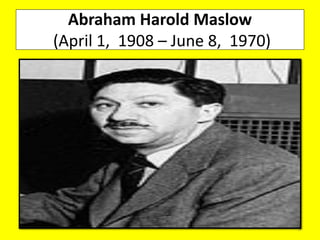
Abraham Harold Maslow
(April 1, 1908 – June 8, 1970)
5
• Born: April 1, 1908 (New York)
• Died: June 8, 1970 (aged 62) , California
• Nationality: American
• Field: Psychology
• Institutions: Cornell University
• Known for: Maslow’s Hierarchy of Needs
6
MASLOW
HIERARCHIAL THEORY OF
MOTIVATION
7
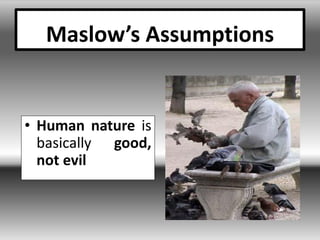
Maslow’s Assumptions
• Human nature is
basically good,
not evil
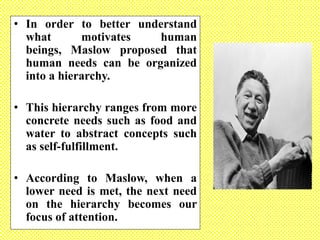
• In order to better understand
what motivates human
beings, Maslow proposed that
human needs can be organized
into a hierarchy.
• This hierarchy ranges from more
concrete needs such as food and
water to abstract concepts such
as self-fulfillment.
• According to Maslow, when a
lower need is met, the next need
on the hierarchy becomes our
focus of attention.
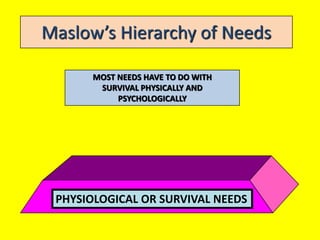
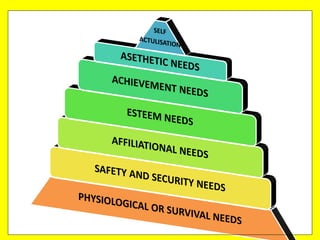
Maslow’s Hierarchy of Needs
PHYSIOLOGICAL OR SURVIVAL NEEDS
MOST NEEDS HAVE TO DO WITH
SURVIVAL PHYSICALLY AND
PSYCHOLOGICALLY
11
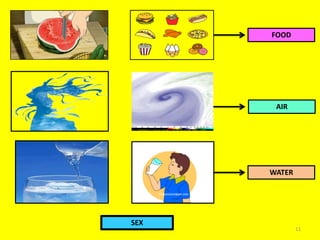
FOOD
AIR
WATER
SEX
12
• According to Maslow, some of these needs involve our efforts
to meet the body’s need for homeostasis; that is, maintaining
consistent levels in different bodily systems (for example,
maintaining a body temperature of 98.6°).
• Maslow considered physiological needs to be the most essential
of our needs. If someone is lacking in more than one need,
they’re likely to try to meet these physiological needs first.
• For example, if someone is extremely hungry, it’s hard to focus
on anything else besides food.
• Another example of a physiological need would be the need for
adequate sleep.
PHYSIOLOGICAL OR SURVIVAL NEEDS
Maslow’s Hierarchy of Needs
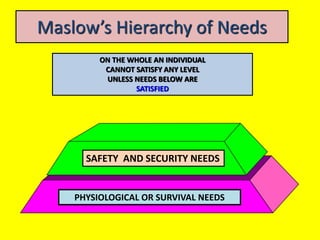
PHYSIOLOGICAL OR SURVIVAL NEEDS
SAFETY AND SECURITY NEEDS
ON THE WHOLE AN INDIVIDUAL
CANNOT SATISFY ANY LEVEL
UNLESS NEEDS BELOW ARE
SATISFIED
Safety and Security Needs
15
• Once people’s physiological requirements are met, the next
need that arises is a safe environment.
• Our safety needs are apparent even early in childhood, as
children have a need for safe and predictable environments
and typically react with fear or anxiety when these are not
met.
• Maslow pointed out that in adults living in developed nations,
safety needs are more apparent in emergency situations (e.g.
war and disasters), but this need can also explain why we
tend to prefer the familiar or why we do things like purchase
insurance and contribute to a savings account.
SAFETY AND SECURITY NEEDS
Maslow’s Hierarchy of Needs
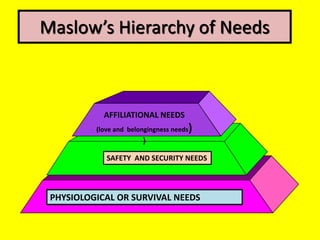
PHYSIOLOGICAL OR SURVIVAL NEEDS
SAFETY AND SECURITY NEEDS
AFFILIATIONAL NEEDS
(love and belongingness needs)
)
17
18
• According to Maslow, the next need in the hierarchy involves
feeling loved and accepted. This need includes both romantic
relationships as well as ties to friends and family members.
• It also includes our need to feel that we belong to a social
group. Importantly, this need encompasses both feeling
loved and feeling love towards others.
• Since Maslow’s time, researchers have continued to explore
how love and belonging needs impact well-being. For example,
having social connections is related to better physical health
and, conversely, feeling isolated (i.e. having unmet belonging
needs) has negative consequences for health and well-being.
AFFILIATIONAL NEEDS
(love and belongingness)
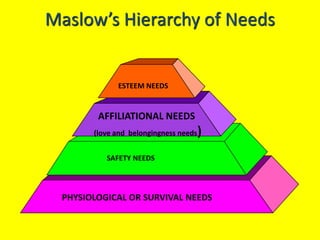
Maslow’s Hierarchy of Needs
PHYSIOLOGICAL OR SURVIVAL NEEDS
SAFETY NEEDS
AFFILIATIONAL NEEDS
(love and belongingness needs)
ESTEEM NEEDS
Esteem Needs
• Respect from
others through:
Awards , Honour
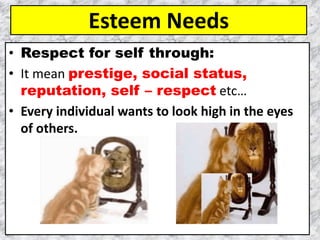
Esteem Needs
• Respect for self through:
• It mean prestige, social status,
reputation, self – respect etc…
• Every individual wants to look high in the eyes
of others.
22
• Our esteem needs involve the desire to feel good about ourselves.
• According to Maslow, esteem needs include two components. The
first involves feeling self-confidence and feeling good about
oneself.
• The second component involves feeling valued by others; that is,
feeling that our achievements and contributions have been
recognized by other people.
• When people’s esteem needs are met, they feel confident and see
their contributions and achievements as valuable and important.
• However, when their esteem needs are not met, they may
experience what psychologist Alfred Adler called “feeling of
inferiority”.
ESTEEM NEEDS
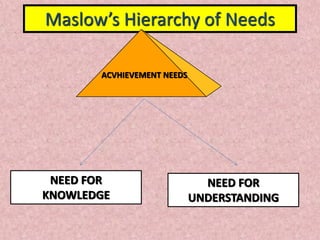
Maslow’s Hierarchy of Needs
ACVHIEVEMENT NEEDS
NEED FOR
KNOWLEDGE
NEED FOR
UNDERSTANDING
24
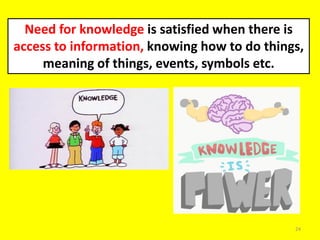
Need for knowledge is satisfied when there is
access to information, knowing how to do things,
meaning of things, events, symbols etc.
25
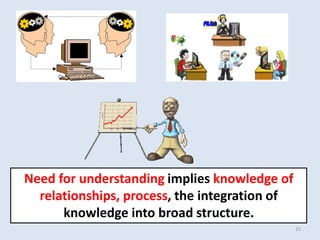
Need for understanding implies knowledge of
relationships, process, the integration of
knowledge into broad structure.
26
Achievement needs depends on individual
talents and the environment.
Eg: Sports, Music, Dance etc
Maslow’s Hierarchy of Needs
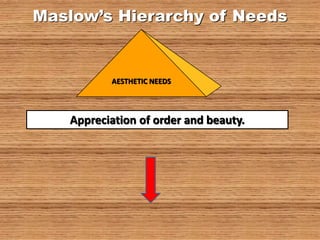
AESTHETIC NEEDS
Appreciation of order and beauty.
28
• Based on Maslow’s beliefs, it is stated in the hierarchy that
humans need beautiful imagery or something new and
aesthetically pleasing to continue up towards Self-
Actualization.
• Humans need to refresh themselves in the presence and
beauty of nature while carefully absorbing and observing
their surroundings to extract the beauty that the world has
to offer.
• This need is a higher level need to relate in a beautiful way
with the environment and leads to the beautiful feeling of
intimacy with nature and everything beautiful.
AESTHETIC NEEDS
29
30
Maslow’s Hierarchy of Needs
SELF-
ACTUALIZATION
NEED
FOR
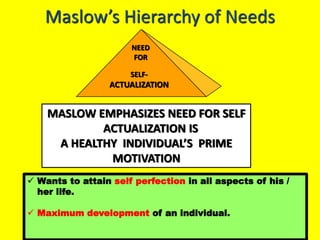
MASLOW EMPHASIZES NEED FOR SELF
ACTUALIZATION IS
A HEALTHY INDIVIDUAL’S PRIME
MOTIVATION
 Wants to attain self perfection in all aspects of his /
her life.
 Maximum development of an individual.
32
33
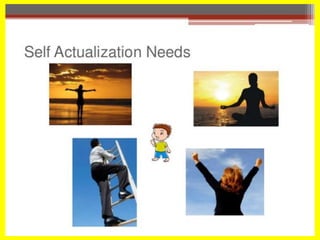
• Self – actualisation refers to feeling fulfilled, or feeling that we
are living up to our potential.
• One unique feature of self-actualization is that it looks
different for everyone.
• For one person, self-actualization might involve helping others;
for another person, it might involve achievements in an artistic
or creative field. Essentially, self-actualization means feeling
that we are doing what we believe we are meant to do.
• According to Maslow, achieving self-actualization is relatively
rara, and his examples of famous self-actualized individuals
include Abraham Lincoln, Albert Einstein and Mother Teresa.
SELF- ACTUALISATION NEEDS
34
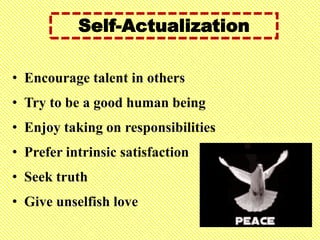
Self-Actualization
• Encourage talent in others
• Try to be a good human being
• Enjoy taking on responsibilities
• Prefer intrinsic satisfaction
• Seek truth
• Give unselfish love
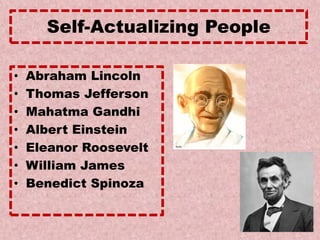
Self-Actualizing People
• Abraham Lincoln
• Thomas Jefferson
• Mahatma Gandhi
• Albert Einstein
• Eleanor Roosevelt
• William James
• Benedict Spinoza
37
38
• Maslow later divided the top of the triangle to add
self-transcendence which is also sometimes
referred to as spiritual needs.
• Spiritual Needs are a little different from other
needs, accessible from many level.
• This need when fulfilled, leads to feelings of
integrity and take things to another level of being.
Self-Transcendence needs
39
How People
Progress Through
the Hierarchy of
Needs
40
• Maslow postulated that there were several
prerequisites to meeting these needs.
• For example, having freedom of speech and freedom
of expression or living in a just and fair society aren’t
specifically mentioned within the hierarchy of needs,
but Maslow believed that having these things makes it
easier for people to achieve their needs.
41
• In addition to these needs, Maslow also believed that
we have a need to learn new information and to better
understand the world around us.
• This is partially because learning more about our
environment helps us meet our other needs; for
example, learning more about the world can help us
feel safer, and developing a better understanding of a
topic one is passionate about can contribute to self-
actualization.
• However, Maslow also believed that this call to
understand the world around us is an innate need as
well.
42
• Although Maslow presented his needs in a hierarchy,
he also acknowledged that meeting each need is not
an all-or-nothing phenomenon.
• Consequently, people don’t need to completely satisfy
one need in order for the next need in the hierarchy to
emerge.
• Maslow suggests that, at any given time, most people
tend to have each of their needs partly met—and that
needs lower on the hierarchy are typically the ones
that people have made the most progress towards.
43
• Additionally, Maslow pointed out that one
behavior might meet two or more needs.
• For example, sharing a meal with someone
meets the physiological need for food, but it
might also meet the need of belonging.
• Similarly, working as a paid caregiver would
provide someone with income (which allows
them to pay for food and shelter), but can also
provide them a sense of social connection and
fulfillment.
44

4. core 3 unit iv maslow

  • 1.
    I Year B.Ed- CORE 3 LEARNING AND TEACHING Ms R SRIDEVI Assistant Professor, Pedagogy of Mathematics, Loyola College of Education Chennai 34 UNIT IV Cognitive And Humanistic Theories Of Learning Self-actualization ( Maslow)
  • 2.
    The questions andallotment of marks are as described below: • Type of course : Full course • Type of Questions : Essay type • Questions : 10 • To answer : 7 • Marks : Each carries 10 marks • Total marks : 70 ( 7 x 10 ) • Maximum word : 600 words / 5 sides for each question • Time : 3 hrs
  • 3.
    Unit IV Cognitive AndHumanistic Theories Of Learning • Learning – Meaning of learning as defined by cognitive psychologists • Insight learning (Kohler) • Modes of cognitive development (Bruner) • Stages of intellectual development (Piaget) • Learning styles (Kolb) • Self-actualization ( Maslow) • Theory of a fully functioning person ( Carl Rogers).
  • 4.
  • 5.
    Abraham Harold Maslow (April1, 1908 – June 8, 1970) 5
  • 6.
    • Born: April1, 1908 (New York) • Died: June 8, 1970 (aged 62) , California • Nationality: American • Field: Psychology • Institutions: Cornell University • Known for: Maslow’s Hierarchy of Needs 6
  • 7.
  • 8.
    Maslow’s Assumptions • Humannature is basically good, not evil
  • 9.
    • In orderto better understand what motivates human beings, Maslow proposed that human needs can be organized into a hierarchy. • This hierarchy ranges from more concrete needs such as food and water to abstract concepts such as self-fulfillment. • According to Maslow, when a lower need is met, the next need on the hierarchy becomes our focus of attention.
  • 10.
    Maslow’s Hierarchy ofNeeds PHYSIOLOGICAL OR SURVIVAL NEEDS MOST NEEDS HAVE TO DO WITH SURVIVAL PHYSICALLY AND PSYCHOLOGICALLY
  • 11.
  • 12.
    12 • According toMaslow, some of these needs involve our efforts to meet the body’s need for homeostasis; that is, maintaining consistent levels in different bodily systems (for example, maintaining a body temperature of 98.6°). • Maslow considered physiological needs to be the most essential of our needs. If someone is lacking in more than one need, they’re likely to try to meet these physiological needs first. • For example, if someone is extremely hungry, it’s hard to focus on anything else besides food. • Another example of a physiological need would be the need for adequate sleep. PHYSIOLOGICAL OR SURVIVAL NEEDS
  • 13.
    Maslow’s Hierarchy ofNeeds PHYSIOLOGICAL OR SURVIVAL NEEDS SAFETY AND SECURITY NEEDS ON THE WHOLE AN INDIVIDUAL CANNOT SATISFY ANY LEVEL UNLESS NEEDS BELOW ARE SATISFIED
  • 14.
  • 15.
    15 • Once people’sphysiological requirements are met, the next need that arises is a safe environment. • Our safety needs are apparent even early in childhood, as children have a need for safe and predictable environments and typically react with fear or anxiety when these are not met. • Maslow pointed out that in adults living in developed nations, safety needs are more apparent in emergency situations (e.g. war and disasters), but this need can also explain why we tend to prefer the familiar or why we do things like purchase insurance and contribute to a savings account. SAFETY AND SECURITY NEEDS
  • 16.
    Maslow’s Hierarchy ofNeeds PHYSIOLOGICAL OR SURVIVAL NEEDS SAFETY AND SECURITY NEEDS AFFILIATIONAL NEEDS (love and belongingness needs) )
  • 17.
  • 18.
    18 • According toMaslow, the next need in the hierarchy involves feeling loved and accepted. This need includes both romantic relationships as well as ties to friends and family members. • It also includes our need to feel that we belong to a social group. Importantly, this need encompasses both feeling loved and feeling love towards others. • Since Maslow’s time, researchers have continued to explore how love and belonging needs impact well-being. For example, having social connections is related to better physical health and, conversely, feeling isolated (i.e. having unmet belonging needs) has negative consequences for health and well-being. AFFILIATIONAL NEEDS (love and belongingness)
  • 19.
    Maslow’s Hierarchy ofNeeds PHYSIOLOGICAL OR SURVIVAL NEEDS SAFETY NEEDS AFFILIATIONAL NEEDS (love and belongingness needs) ESTEEM NEEDS
  • 20.
    Esteem Needs • Respectfrom others through: Awards , Honour
  • 21.
    Esteem Needs • Respectfor self through: • It mean prestige, social status, reputation, self – respect etc… • Every individual wants to look high in the eyes of others.
  • 22.
    22 • Our esteemneeds involve the desire to feel good about ourselves. • According to Maslow, esteem needs include two components. The first involves feeling self-confidence and feeling good about oneself. • The second component involves feeling valued by others; that is, feeling that our achievements and contributions have been recognized by other people. • When people’s esteem needs are met, they feel confident and see their contributions and achievements as valuable and important. • However, when their esteem needs are not met, they may experience what psychologist Alfred Adler called “feeling of inferiority”. ESTEEM NEEDS
  • 23.
    Maslow’s Hierarchy ofNeeds ACVHIEVEMENT NEEDS NEED FOR KNOWLEDGE NEED FOR UNDERSTANDING
  • 24.
    24 Need for knowledgeis satisfied when there is access to information, knowing how to do things, meaning of things, events, symbols etc.
  • 25.
    25 Need for understandingimplies knowledge of relationships, process, the integration of knowledge into broad structure.
  • 26.
    26 Achievement needs dependson individual talents and the environment. Eg: Sports, Music, Dance etc
  • 27.
    Maslow’s Hierarchy ofNeeds AESTHETIC NEEDS Appreciation of order and beauty.
  • 28.
    28 • Based onMaslow’s beliefs, it is stated in the hierarchy that humans need beautiful imagery or something new and aesthetically pleasing to continue up towards Self- Actualization. • Humans need to refresh themselves in the presence and beauty of nature while carefully absorbing and observing their surroundings to extract the beauty that the world has to offer. • This need is a higher level need to relate in a beautiful way with the environment and leads to the beautiful feeling of intimacy with nature and everything beautiful. AESTHETIC NEEDS
  • 29.
  • 30.
  • 31.
    Maslow’s Hierarchy ofNeeds SELF- ACTUALIZATION NEED FOR MASLOW EMPHASIZES NEED FOR SELF ACTUALIZATION IS A HEALTHY INDIVIDUAL’S PRIME MOTIVATION  Wants to attain self perfection in all aspects of his / her life.  Maximum development of an individual.
  • 32.
  • 33.
    33 • Self –actualisation refers to feeling fulfilled, or feeling that we are living up to our potential. • One unique feature of self-actualization is that it looks different for everyone. • For one person, self-actualization might involve helping others; for another person, it might involve achievements in an artistic or creative field. Essentially, self-actualization means feeling that we are doing what we believe we are meant to do. • According to Maslow, achieving self-actualization is relatively rara, and his examples of famous self-actualized individuals include Abraham Lincoln, Albert Einstein and Mother Teresa. SELF- ACTUALISATION NEEDS
  • 34.
  • 35.
    Self-Actualization • Encourage talentin others • Try to be a good human being • Enjoy taking on responsibilities • Prefer intrinsic satisfaction • Seek truth • Give unselfish love
  • 36.
    Self-Actualizing People • AbrahamLincoln • Thomas Jefferson • Mahatma Gandhi • Albert Einstein • Eleanor Roosevelt • William James • Benedict Spinoza
  • 37.
  • 38.
    38 • Maslow laterdivided the top of the triangle to add self-transcendence which is also sometimes referred to as spiritual needs. • Spiritual Needs are a little different from other needs, accessible from many level. • This need when fulfilled, leads to feelings of integrity and take things to another level of being. Self-Transcendence needs
  • 39.
  • 40.
    40 • Maslow postulatedthat there were several prerequisites to meeting these needs. • For example, having freedom of speech and freedom of expression or living in a just and fair society aren’t specifically mentioned within the hierarchy of needs, but Maslow believed that having these things makes it easier for people to achieve their needs.
  • 41.
    41 • In additionto these needs, Maslow also believed that we have a need to learn new information and to better understand the world around us. • This is partially because learning more about our environment helps us meet our other needs; for example, learning more about the world can help us feel safer, and developing a better understanding of a topic one is passionate about can contribute to self- actualization. • However, Maslow also believed that this call to understand the world around us is an innate need as well.
  • 42.
    42 • Although Maslowpresented his needs in a hierarchy, he also acknowledged that meeting each need is not an all-or-nothing phenomenon. • Consequently, people don’t need to completely satisfy one need in order for the next need in the hierarchy to emerge. • Maslow suggests that, at any given time, most people tend to have each of their needs partly met—and that needs lower on the hierarchy are typically the ones that people have made the most progress towards.
  • 43.
    43 • Additionally, Maslowpointed out that one behavior might meet two or more needs. • For example, sharing a meal with someone meets the physiological need for food, but it might also meet the need of belonging. • Similarly, working as a paid caregiver would provide someone with income (which allows them to pay for food and shelter), but can also provide them a sense of social connection and fulfillment.
  • 44.