Abraham Maslow
The Hierarchy of Needs
Linda Zimmerman
Professor
of Student Development
Oakton Community College
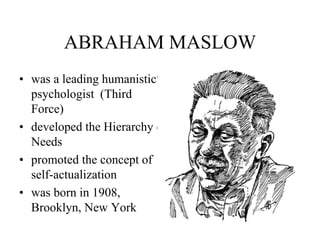
ABRAHAM MASLOW
• was a leading humanistic
psychologist (Third
Force)
• developed the Hierarchy of
Needs
• promoted the concept of
self-actualization
• was born in 1908,
Brooklyn, New York
Maslow’s Early Life
• was the eldest of seven
siblings
• was a poor student as an
adolescent
• was pressured by dad to
become an attorney
• took one law class, dropped
out of college for one year
• entered U of WI one year
later to study scientific
psychology
Maslow’s Professional Life
• studied dominance in monkeys
• received Ph.D. in experimental
psychology in 1934
• was on the Brooklyn College
faculty, 1937-1951
• was on the Brandeis U faculty,
1952-1969
• became a fellow of Laughlin
Foundation in CA
• died in 1970, age 62
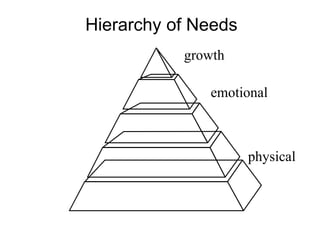
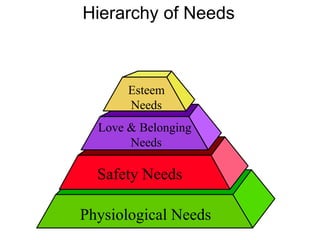
Hierarchy of Needs
growth
emotional
physical
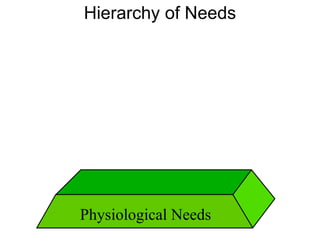
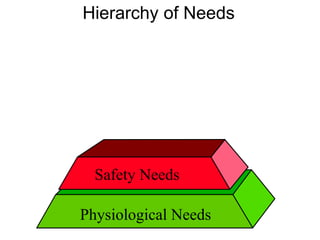
Hierarchy of Needs
Physiological Needs
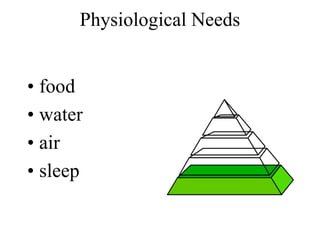
Physiological Needs
• food
• water
• air
• sleep
Food: A Most Powerful Need
• South American
Rugby team
crashed in 1970
• Food was the most
pressing problem.
• They ate human
flesh for survival.
• Even the strongest
taboo was broken
to fill the basic
need for food.
Food: A Most Powerful Need
• Ik tribe in Uganda forced
to give up hunting and
live on unfertile land
• long standing social
mores dissolve - people
became psychopathic
• “ngag”, word for food,
also becomes word for
good
• parents steal food from
children, children from
other children
Physiological Needs
Hierarchy of Needs
Safety Needs
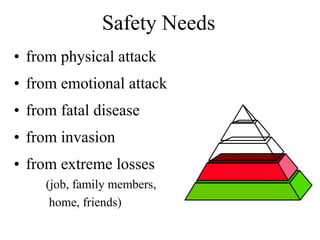
Safety Needs
• from physical attack
• from emotional attack
• from fatal disease
• from invasion
• from extreme losses
(job, family members,
home, friends)
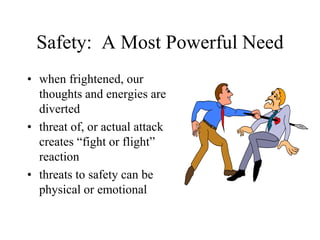
Safety: A Most Powerful Need
• when frightened, our
thoughts and energies are
diverted
• threat of, or actual attack
creates “fight or flight”
reaction
• threats to safety can be
physical or emotional
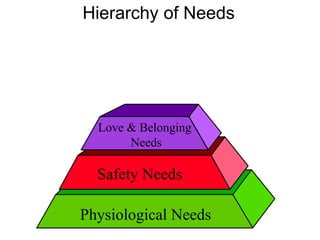
Physiological Needs
Love & Belonging
Needs
Safety Needs
Hierarchy of Needs
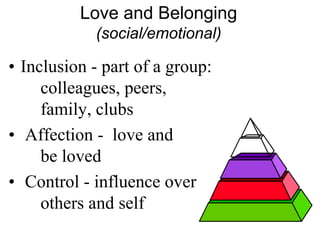
Love and Belonging
(social/emotional)
• Inclusion - part of a group:
colleagues, peers,
family, clubs
• Affection - love and
be loved
• Control - influence over
others and self
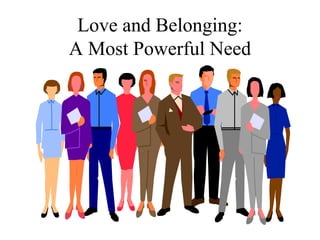
Love and Belonging:
A Most Powerful Need
Esteem
Needs
Love & Belonging
Needs
Physiological Needs
Safety Needs
Hierarchy of Needs
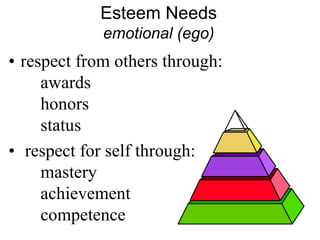
Esteem Needs
emotional (ego)
• respect from others through:
awards
honors
status
• respect for self through:
mastery
achievement
competence
Esteem from Self and Others:
A Most Powerful Need
Congratulations
Love & Belonging
Needs
Physiological Needs
Safety Needs
Esteem
Needs
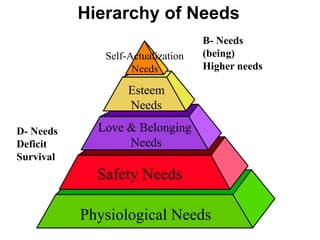
Self-Actualization
Needs
Hierarchy of Needs
D- Needs
Deficit
Survival
B- Needs
(being)
Higher needs
Some Self-Actualizing People from
History
• Abraham Lincoln
• Thomas Jefferson
• Mahatma Gandhi
• Albert Einstein
• Eleanor Roosevelt
• William James
• Benedict Spinoza
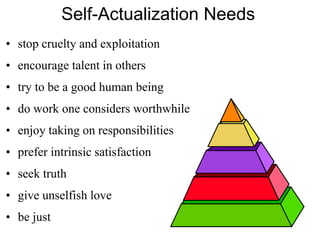
Self-Actualization Needs
• stop cruelty and exploitation
• encourage talent in others
• try to be a good human being
• do work one considers worthwhile
• enjoy taking on responsibilities
• prefer intrinsic satisfaction
• seek truth
• give unselfish love
• be just
B-Needs of the Self-Actualized
• Truth
• Goodness
• Beauty
• Unity
• Aliveness
• Uniqueness
• Perfection and
Necessity
• Completion
• Justice and order
• Simplicity
• Richness
• Effortlessness
• Playfulness
• Self-sufficiency
• Meaningfulness
Qualities of the Self-Actualized
• An non-hostile sense of humor
• Intimate personal relationships
• Acceptance of self and others
• Spontaneity and simplicity
• Freshness of appreciation
• More peak experiences
• Democratic values
• Independence

Abraham maslow need theory

  • 1.
    Abraham Maslow The Hierarchyof Needs Linda Zimmerman Professor of Student Development Oakton Community College
  • 2.
    ABRAHAM MASLOW • wasa leading humanistic psychologist (Third Force) • developed the Hierarchy of Needs • promoted the concept of self-actualization • was born in 1908, Brooklyn, New York
  • 3.
    Maslow’s Early Life •was the eldest of seven siblings • was a poor student as an adolescent • was pressured by dad to become an attorney • took one law class, dropped out of college for one year • entered U of WI one year later to study scientific psychology
  • 4.
    Maslow’s Professional Life •studied dominance in monkeys • received Ph.D. in experimental psychology in 1934 • was on the Brooklyn College faculty, 1937-1951 • was on the Brandeis U faculty, 1952-1969 • became a fellow of Laughlin Foundation in CA • died in 1970, age 62
  • 5.
  • 6.
  • 7.
    Physiological Needs • food •water • air • sleep
  • 8.
    Food: A MostPowerful Need • South American Rugby team crashed in 1970 • Food was the most pressing problem. • They ate human flesh for survival. • Even the strongest taboo was broken to fill the basic need for food.
  • 9.
    Food: A MostPowerful Need • Ik tribe in Uganda forced to give up hunting and live on unfertile land • long standing social mores dissolve - people became psychopathic • “ngag”, word for food, also becomes word for good • parents steal food from children, children from other children
  • 10.
  • 11.
    Safety Needs • fromphysical attack • from emotional attack • from fatal disease • from invasion • from extreme losses (job, family members, home, friends)
  • 12.
    Safety: A MostPowerful Need • when frightened, our thoughts and energies are diverted • threat of, or actual attack creates “fight or flight” reaction • threats to safety can be physical or emotional
  • 13.
    Physiological Needs Love &Belonging Needs Safety Needs Hierarchy of Needs
  • 14.
    Love and Belonging (social/emotional) •Inclusion - part of a group: colleagues, peers, family, clubs • Affection - love and be loved • Control - influence over others and self
  • 15.
    Love and Belonging: AMost Powerful Need
  • 16.
    Esteem Needs Love & Belonging Needs PhysiologicalNeeds Safety Needs Hierarchy of Needs
  • 17.
    Esteem Needs emotional (ego) •respect from others through: awards honors status • respect for self through: mastery achievement competence
  • 18.
    Esteem from Selfand Others: A Most Powerful Need Congratulations
  • 19.
    Love & Belonging Needs PhysiologicalNeeds Safety Needs Esteem Needs Self-Actualization Needs Hierarchy of Needs D- Needs Deficit Survival B- Needs (being) Higher needs
  • 20.
    Some Self-Actualizing Peoplefrom History • Abraham Lincoln • Thomas Jefferson • Mahatma Gandhi • Albert Einstein • Eleanor Roosevelt • William James • Benedict Spinoza
  • 21.
    Self-Actualization Needs • stopcruelty and exploitation • encourage talent in others • try to be a good human being • do work one considers worthwhile • enjoy taking on responsibilities • prefer intrinsic satisfaction • seek truth • give unselfish love • be just
  • 22.
    B-Needs of theSelf-Actualized • Truth • Goodness • Beauty • Unity • Aliveness • Uniqueness • Perfection and Necessity • Completion • Justice and order • Simplicity • Richness • Effortlessness • Playfulness • Self-sufficiency • Meaningfulness
  • 23.
    Qualities of theSelf-Actualized • An non-hostile sense of humor • Intimate personal relationships • Acceptance of self and others • Spontaneity and simplicity • Freshness of appreciation • More peak experiences • Democratic values • Independence