THEORIST OF HUMANISM
 Researcher
 Abraham Maslow
 Humanism
 Contribution
 Hierarchy of needs
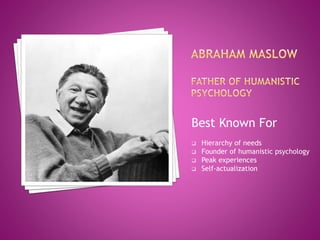
Best Known For
 Hierarchy of needs
 Founder of humanistic psychology
 Peak experiences
 Self-actualization
 Abraham Maslow was born on April 1, 1908, New
York
 Maslow earned all three of his degrees in
psychology
 American psychologist who developed
a hierarchy of needs to explain human
motivation
 Maslow was a psychology professor at Brandeis
University, Brooklyn College, New School for
Social Research, and Columbia University.
 He stressed the importance of focusing on the
positive qualities in people, as opposed to
treating them as a "bag of symptoms“
 He died in 1970
 CONTRIBUTIONS
 Humanistic psychology
 Peak and plateau experiences
 B-values
 Hierarchy of Needs
 Self-actualization
 Metamotivation
 Methodology
 Transpersonal psychology
 Positive psychology
 Psychology of science
 Maslow's hammer
 Emphasizes on the study of whole person.
 Humanism is a philosophy of imagination.
 Humanism is a philosophy for people who
think for themselves. They challenge and
explore.
 Humanism is a philosophy for creating and
determining ones destiny.
 Humanism focuses on human behavior
through the eyes of observer and also
through the eyes of person doing the
behavior.
 Humanism is the study of philosophy and
psychology that focuses on human values and
concerns.
 Each individual is unique and people’s
thought processes may be different from one
another.
 Abraham Maslow emphasized on choice,
creativity, values, self realization, all distinct
human qualities.
CONFLICTS BETWEEN CONCEPTS OF FRUED AND
MASLOW
 Freud’s views of human nature is negative
 While Maslow Valued goodness and potential
 Frued concentrated on mentally ill, and
Maslow was interested in healthy human
psychology.
 After psychoanalysis, behaviorism was also
on the rise.
 Neither school fully acknowledged qualities
of human potential.
 His field Humanism is also called Third Force
in psychology after psychoanalysis and
behaviorism.
 Being a humanist, he argued about the right
to chose how to behave.
 Everyone has the inner resources necessary
for growth and self healing.
 The goal of humanism is to remove barriers
to the client’s use of inner resources.
THEORY
People have a number of basic needs that must
be met before people move up the hierarchy
to pursue more social, emotional, and self-
actualizing needs.
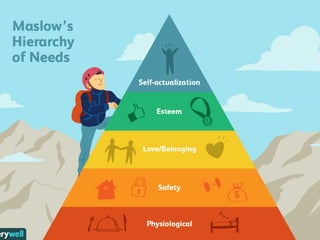
 Proposed that human beings have certain
needs in common and that these needs must
be met in a certain order.
 Needs range from most basic psychological
need for survival to higher level self
actualization and transcendence needs.
 Each layer must be fulfilled before moving
up the pyramid to higher needs.
 PHSIOLOGICAL NEEDS
Breathing, food, water, air, excretion.
 SAFETY
Security of body, employement, health, property.
 LOVE/ BELONGINGS
Friendship, family, love
 ESTEEM
respect of others, self esteem, confidence,
achievement
 SELF ACTUALIZATION
Morality, creativity , spontaneity, problem solving,
acceptance of facts.
 The first four levels are considered
“deficiency needs.” If we are lacking in any
of these levels, we can become distracted,
anxious, or depressed. If all of those needs
are met, we are free to explore our “growth
needs” or our uniquely human need to grow
as an individual.
 Self-actualization
It is actually considered quite rare, which
means that peak experiences can be equally
elusive. Not all people reach the peak of
Maslow's pyramid.
 It is a desire to “become everything that one
is capable of becoming.”
 We can examine the sum of our efforts and
decide what really gives us a sense of
fulfillment.
 At this level, it’s possible to realize one’s life
purpose
 Maslow experimented on dominance
of monkeys:
“some needs take precedence over others.”
 Eg: if you are hungry and thirsty, you will
tend to take care of your thirst first,
because you can live without food for few
days but can not live without water for
couple of days.
 If you are very thirsty and someone put a
choke hold on you, you can’t breath, than
the need of breath is more important than
thirst.
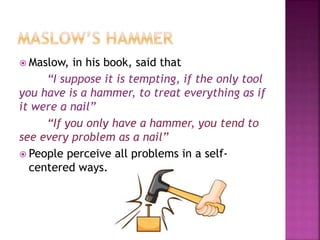
 Maslow, in his book, said that
“I suppose it is tempting, if the only tool
you have is a hammer, to treat everything as if
it were a nail”
“If you only have a hammer, you tend to
see every problem as a nail”
 People perceive all problems in a self-
centered ways.
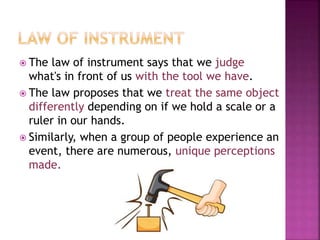
 The law of instrument says that we judge
what's in front of us with the tool we have.
 The law proposes that we treat the same object
differently depending on if we hold a scale or a
ruler in our hands.
 Similarly, when a group of people experience an
event, there are numerous, unique perceptions
made.
Abraham maslow
Abraham maslow

Abraham maslow

  • 1.
  • 2.
     Researcher  AbrahamMaslow  Humanism  Contribution  Hierarchy of needs
  • 3.
    Best Known For Hierarchy of needs  Founder of humanistic psychology  Peak experiences  Self-actualization
  • 4.
     Abraham Maslowwas born on April 1, 1908, New York  Maslow earned all three of his degrees in psychology  American psychologist who developed a hierarchy of needs to explain human motivation  Maslow was a psychology professor at Brandeis University, Brooklyn College, New School for Social Research, and Columbia University.  He stressed the importance of focusing on the positive qualities in people, as opposed to treating them as a "bag of symptoms“  He died in 1970
  • 5.
     CONTRIBUTIONS  Humanisticpsychology  Peak and plateau experiences  B-values  Hierarchy of Needs  Self-actualization  Metamotivation  Methodology  Transpersonal psychology  Positive psychology  Psychology of science  Maslow's hammer
  • 6.
     Emphasizes onthe study of whole person.  Humanism is a philosophy of imagination.  Humanism is a philosophy for people who think for themselves. They challenge and explore.  Humanism is a philosophy for creating and determining ones destiny.  Humanism focuses on human behavior through the eyes of observer and also through the eyes of person doing the behavior.
  • 7.
     Humanism isthe study of philosophy and psychology that focuses on human values and concerns.  Each individual is unique and people’s thought processes may be different from one another.  Abraham Maslow emphasized on choice, creativity, values, self realization, all distinct human qualities.
  • 8.
    CONFLICTS BETWEEN CONCEPTSOF FRUED AND MASLOW  Freud’s views of human nature is negative  While Maslow Valued goodness and potential  Frued concentrated on mentally ill, and Maslow was interested in healthy human psychology.
  • 9.
     After psychoanalysis,behaviorism was also on the rise.  Neither school fully acknowledged qualities of human potential.  His field Humanism is also called Third Force in psychology after psychoanalysis and behaviorism.
  • 10.
     Being ahumanist, he argued about the right to chose how to behave.  Everyone has the inner resources necessary for growth and self healing.  The goal of humanism is to remove barriers to the client’s use of inner resources.
  • 11.
    THEORY People have anumber of basic needs that must be met before people move up the hierarchy to pursue more social, emotional, and self- actualizing needs.
  • 13.
     Proposed thathuman beings have certain needs in common and that these needs must be met in a certain order.  Needs range from most basic psychological need for survival to higher level self actualization and transcendence needs.  Each layer must be fulfilled before moving up the pyramid to higher needs.
  • 14.
     PHSIOLOGICAL NEEDS Breathing,food, water, air, excretion.  SAFETY Security of body, employement, health, property.  LOVE/ BELONGINGS Friendship, family, love  ESTEEM respect of others, self esteem, confidence, achievement  SELF ACTUALIZATION Morality, creativity , spontaneity, problem solving, acceptance of facts.
  • 15.
     The firstfour levels are considered “deficiency needs.” If we are lacking in any of these levels, we can become distracted, anxious, or depressed. If all of those needs are met, we are free to explore our “growth needs” or our uniquely human need to grow as an individual.
  • 17.
     Self-actualization It isactually considered quite rare, which means that peak experiences can be equally elusive. Not all people reach the peak of Maslow's pyramid.  It is a desire to “become everything that one is capable of becoming.”  We can examine the sum of our efforts and decide what really gives us a sense of fulfillment.  At this level, it’s possible to realize one’s life purpose
  • 18.
     Maslow experimentedon dominance of monkeys: “some needs take precedence over others.”  Eg: if you are hungry and thirsty, you will tend to take care of your thirst first, because you can live without food for few days but can not live without water for couple of days.  If you are very thirsty and someone put a choke hold on you, you can’t breath, than the need of breath is more important than thirst.
  • 19.
     Maslow, inhis book, said that “I suppose it is tempting, if the only tool you have is a hammer, to treat everything as if it were a nail” “If you only have a hammer, you tend to see every problem as a nail”  People perceive all problems in a self- centered ways.
  • 20.
     The lawof instrument says that we judge what's in front of us with the tool we have.  The law proposes that we treat the same object differently depending on if we hold a scale or a ruler in our hands.  Similarly, when a group of people experience an event, there are numerous, unique perceptions made.