“Literary Criticism Edition”
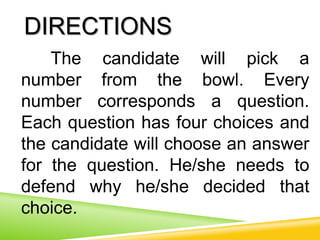
DIRECTIONS
The candidate will pick a
number from the bowl. Every
number corresponds a question.
Each question has four choices and
the candidate will choose an answer
for the question. He/she needs to
defend why he/she decided that
choice.
JUDGES
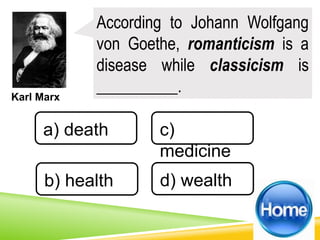
Karl Marx
According to Johann Wolfgang
von Goethe, romanticism is a
disease while classicism is
__________.
a) death
b) health d) wealth
c)
medicine
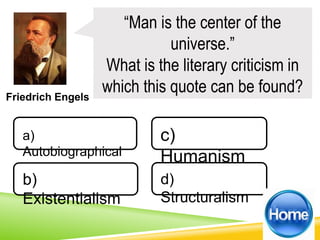
Friedrich Engels
“Man is the center of the
universe.”
What is the literary criticism in
which this quote can be found?
a)
Autobiographical
b)
Existentialism
d)
Structuralism
c)
Humanism
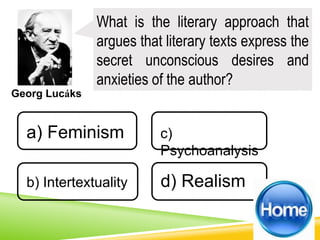
Georg Lucáks
What is the literary approach that
argues that literary texts express the
secret unconscious desires and
anxieties of the author?
a) Feminism
b) Intertextuality d) Realism
c)
Psychoanalysis
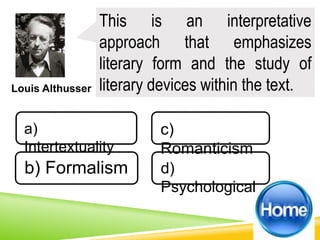
Louis Althusser
This is an interpretative
approach that emphasizes
literary form and the study of
literary devices within the text.
a)
Intertextuality
b) Formalism d)
Psychological
c)
Romanticism
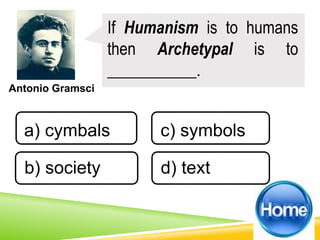
Antonio Gramsci
If Humanism is to humans
then Archetypal is to
___________.
a) cymbals
b) society d) text
c) symbols
Jesper Silva
BSEd III-A,
English
Hi… I am CAPTAIN
BARBELL. I usually
help people in distress.
I give solutions to your
problems. I am so
happy that I am here
today at the Sunshine
City of Laoag! Let’s
meet my first client.
Hello…My name
is Nicholas, “NICK” in
short. Captain Barbell,
I have a problem
about learning this
literary approach
called “MARXISM”.
Can you help me with
this?
Sure! Did you
hear it? Nick needs our
help. So let us try to
help him! Come on.
Let’s do it.
Marxist literary criticism is the
belief that literature reflects class
struggle and materialism. It looks
at how literature functions in
relation to other aspects of the
superstructure, particularly other
articulations of ideology.
General Description
General Description
Like feminist critics, it investigates
how literature can work as a force for
social change, or as a reaffirmation of
existing conditions.
Like New Historicism, it
examines how history influences
literature; the difference is that
Marxism focuses on the lower
classes.
General Description
captainbarbell@gmail.com *******************************
Captain
Barbell
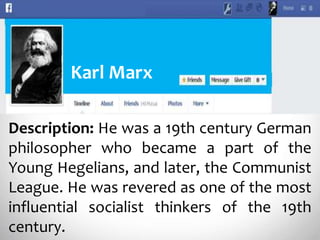
Description: He was a 19th century German
philosopher who became a part of the
Young Hegelians, and later, the Communist
League. He was revered as one of the most
influential socialist thinkers of the 19th
century.
Karl Marx
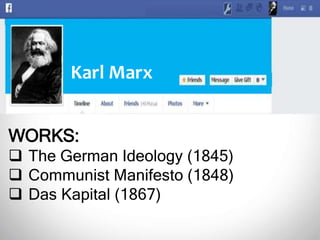
WORKS:
 The German Ideology (1845)
 Communist Manifesto (1848)
 Das Kapital (1867)
Karl Marx
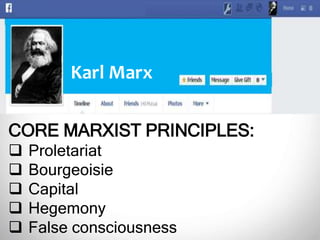
CORE MARXIST PRINCIPLES:
 Proletariat
 Bourgeoisie
 Capital
 Hegemony
 False consciousness
Karl Marx
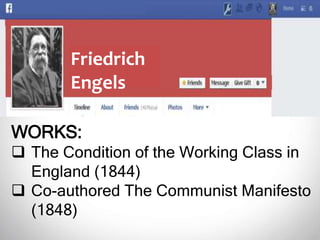
Friedrich
Engels
Description: He shared Marx’s socialist
beliefs and provided support financially
as well as intellectually while Marx
developed his theories.
Friedrich
Engels
WORKS:
 The Condition of the Working Class in
England (1844)
 Co-authored The Communist Manifesto
(1848)
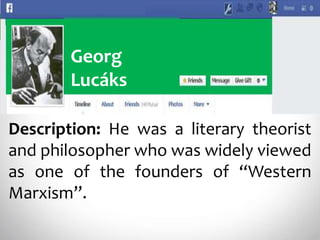
Georg
Lucáks
Description: He was a literary theorist
and philosopher who was widely viewed
as one of the founders of “Western
Marxism”.
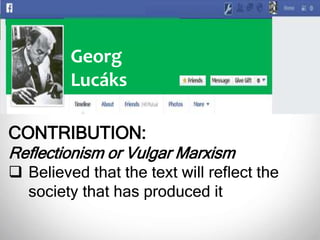
Georg
Lucáks
CONTRIBUTION:
Reflectionism or Vulgar Marxism
 Believed that the text will reflect the
society that has produced it
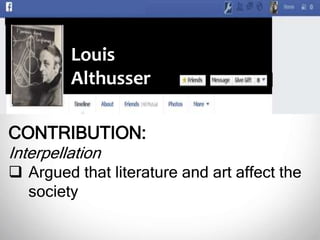
Louis
Althusser
Description: He was commonly referred
to as a structural Marxist.
Louis
Althusser
CONTRIBUTION:
Interpellation
 Argued that literature and art affect the
society
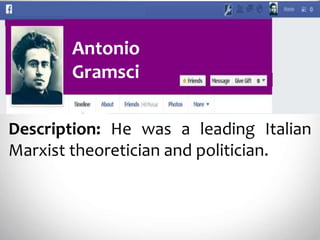
Antonio
Gramsci
Description: He was a leading Italian
Marxist theoretician and politician.
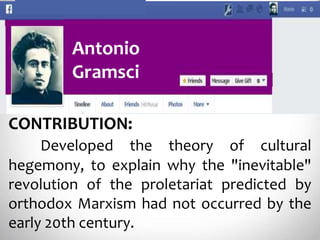
Antonio
Gramsci
CONTRIBUTION:
Developed the theory of cultural
hegemony, to explain why the "inevitable"
revolution of the proletariat predicted by
orthodox Marxism had not occurred by the
early 20th century.
Trivia Corner
Did you know that…?
The principles of Marxism were
not designed to serve as a theory
about how to interpret texts. Instead,
they were meant to be a set of social,
economic, and political ideas that
would, according to their followers,
change the world.
General Precepts
Marxist literary criticism
promotes the idea that
literature should be a tool in
the revolutionary struggle.
General Precepts
It attempts to clarify the
relationship of literary work
to social reality.
General Precepts
It judges literature by how it
represents the main
struggles for power going on
that time, how it may
influence those struggles
General Precepts
It should follow rules laid
down by literary tradition.
Marxist Literary Criticism
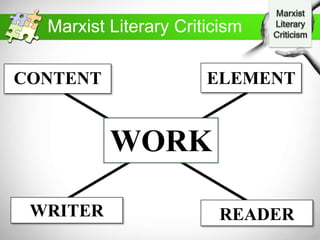
CONTENT ELEMENT
WRITER READER
WORK
Marxist Literary Criticism
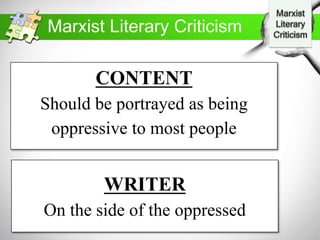
CONTENT
Should be portrayed as being
oppressive to most people
WRITER
On the side of the oppressed
Marxist Literary Criticism
ELEMENT
Follows the rules laid down by
literary tradition
READER
Enlightened about the relationship of the
powerful few to the powerless many
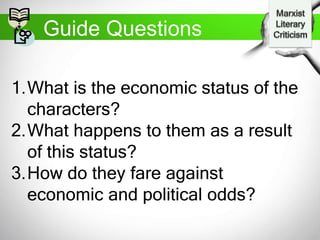
Guide Questions
1.What is the economic status of the
characters?
2.What happens to them as a result
of this status?
3.How do they fare against
economic and political odds?
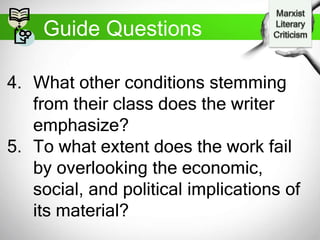
Guide Questions
4. What other conditions stemming
from their class does the writer
emphasize?
5. To what extent does the work fail
by overlooking the economic,
social, and political implications of
its material?
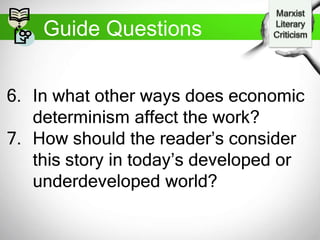
Guide Questions
6. In what other ways does economic
determinism affect the work?
7. How should the reader’s consider
this story in today’s developed or
underdeveloped world?
Task 1. If Your Eyes Can See
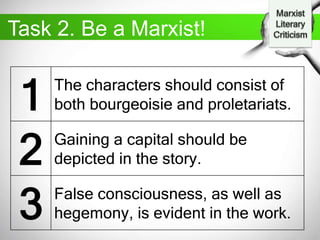
Task 2. Be a Marxist!
1 The characters should consist of
both bourgeoisie and proletariats.
2 Gaining a capital should be
depicted in the story.
3 False consciousness, as well as
hegemony, is evident in the work.
Task 2. Be a Marxist!
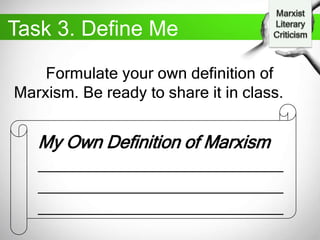
Task 3. Define Me
Formulate your own definition of
Marxism. Be ready to share it in class.
My Own Definition of Marxism
_________________________
_________________________
_________________________
Wow! We just helped
‘Nick’ on his problem.
Well, I enjoyed my
stay here at Laoag
City. I enjoyed being
with you ‘Nick’ and
our friends. Until next
time!
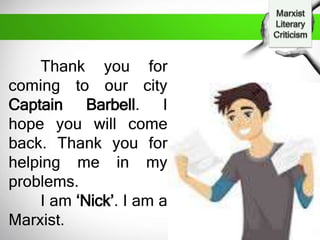
Thank you for
coming to our city
Captain Barbell. I
hope you will come
back. Thank you for
helping me in my
problems.
I am ‘Nick’. I am a
Marxist.

Marxist Literary Criticism