Marxist   Criticism Critical   Theory
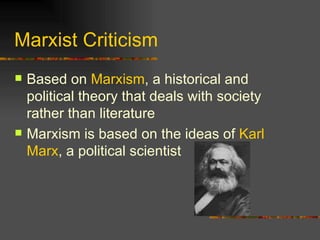
Marxist Criticism Based on  Marxism , a historical and political theory that deals with society rather than literature Marxism is based on the ideas of  Karl Marx , a political scientist
Principles of Marxism Focus on matters such as culture, class, race and power Marx believed that history is created and change occurs because of the struggles between social and economic classes
Principles of Marxism The current struggle in modern history, is the struggle between the rich (owner) called the “bourgeoisies” and the poor (worker) called the “proletariat”
Marxism and Literature The Marxist critic finds a reflection of the same conflicts in literature (whether intended by the author or not) Marxist critics suggest that the struggle is inherent in our society so it is also reflected in our literature
Marxist Critical Analysis How do I apply  Marxist Criticism?
Questions to ask: 1. How are the conflicts in the work connected to the struggle between  the haves and the have nots owners and workers rich and poor
Questions to ask: 2. How does the work suggest that life in a  Bourgeois society is empty? The pursuit of wealth and power is meaningless Money does not buy happiness
Questions to ask: 3. What are the values of each social class in the work? Look at the characters that have a high social status – What do they appear to believe about the value of life, money, work, family, love? Now look at the characters that have a low social status and ask the same questions.
What you don’t want to hear: You must  memorize  these 3 questions and be prepared to reproduce them on a test You must also be able to  apply  these questions to other texts that we study in class and new sight passages
Prepared for your viewing pleasure by: Liana Cote-Montminy

Marxist Criticism

  • 1.
    Marxist Criticism Critical Theory
  • 2.
    Marxist Criticism Basedon Marxism , a historical and political theory that deals with society rather than literature Marxism is based on the ideas of Karl Marx , a political scientist
  • 3.
    Principles of MarxismFocus on matters such as culture, class, race and power Marx believed that history is created and change occurs because of the struggles between social and economic classes
  • 4.
    Principles of MarxismThe current struggle in modern history, is the struggle between the rich (owner) called the “bourgeoisies” and the poor (worker) called the “proletariat”
  • 5.
    Marxism and LiteratureThe Marxist critic finds a reflection of the same conflicts in literature (whether intended by the author or not) Marxist critics suggest that the struggle is inherent in our society so it is also reflected in our literature
  • 6.
    Marxist Critical AnalysisHow do I apply Marxist Criticism?
  • 7.
    Questions to ask:1. How are the conflicts in the work connected to the struggle between the haves and the have nots owners and workers rich and poor
  • 8.
    Questions to ask:2. How does the work suggest that life in a Bourgeois society is empty? The pursuit of wealth and power is meaningless Money does not buy happiness
  • 9.
    Questions to ask:3. What are the values of each social class in the work? Look at the characters that have a high social status – What do they appear to believe about the value of life, money, work, family, love? Now look at the characters that have a low social status and ask the same questions.
  • 10.
    What you don’twant to hear: You must memorize these 3 questions and be prepared to reproduce them on a test You must also be able to apply these questions to other texts that we study in class and new sight passages
  • 11.
    Prepared for yourviewing pleasure by: Liana Cote-Montminy