
FEMINISM
SIOBE CHUAREPORTED BY:
FAMOUS FEMINISTS
Abigail Adams
(1744-1888)
Wife of John Adams, who
was the second President of
the United States.
Remembered for the many
letters she wrote to her
husband while he stayed in
Philadelphia, Pennsylvania,
during the Continental
Congresses. One of which
says “Remember the ladies”
in the laws drawn up in the
newly independent country.
Gloria Steinem
(1934)
Writer and editor.
During the 1960s
she appeared as a
leader in the women's
movement in the
United States.
In 1970 cofounded
Ms., which grew to be
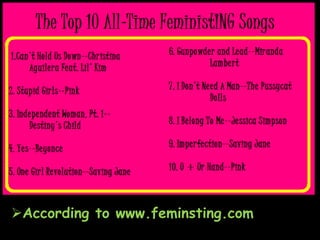
According to www.feminsting.com
What is FMINISM?
•The actual definition of a feminist
(according to the American Heritage
Dictionary) is someone, male or
female, who believes in social, political and
economic equality between the sexes.
•The Merriam-Webster Dictionary defines
feminism as "the theory of the
political, economic, and social equality of
the sexes and organized activity on behalf
of women's rights and interests.“
•By general definition, feminism is a
philosophy in which women and their
contributions are valued.
•Feminism can also be described as a
movement. A revolution that includes
women and men who wish the world to be
equal without boundaries.
cbcbcbcbcbcbcbcbcb
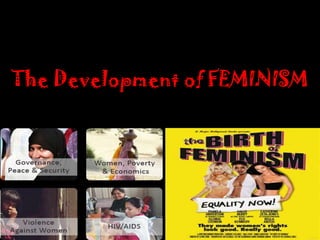
The Development of FEMINISM
•The term was
developed in France
(feminisme) in the
mid-1800s.
•It didn't become
popular until the
1960s. Previously,
these women's groups
had used the term
"women's liberationist"
to define themselves,
but as it began to lose
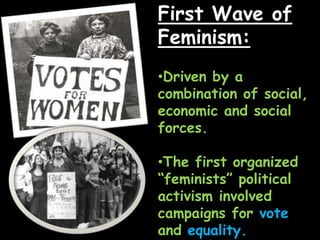
First Wave of
Feminism:
•Driven by a
combination of social,
economic and social
forces.
•The first organized
“feminists” political
activism involved
campaigns for vote
and equality.
•Feminism was driven by middle-aged,
unattractive women who had most to
lose from a changing sexual landscape.
•These threatened women believed that
the personal had to become political.
•Yet, when women obtained their vote,
they did not used it differently for their
husband, when women did vote
significantly different, it was to vote in
fascist dictatorship all over Europe.
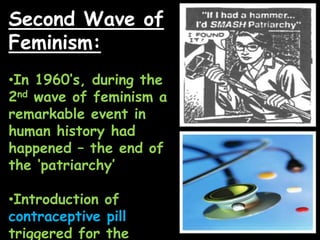
Second Wave of
Feminism:
•In 1960‟s, during the
2nd wave of feminism a
remarkable event in
human history had
happened – the end of
the „patriarchy‟
•Introduction of
contraceptive pill
triggered for the
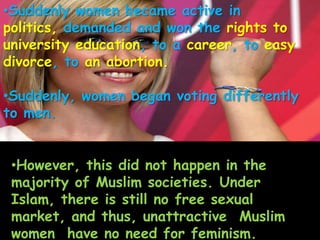
•Suddenly women became active in
politics, demanded and won the rights to
university education, to a career, to easy
divorce, to an abortion.
•Suddenly, women began voting differently
to men.
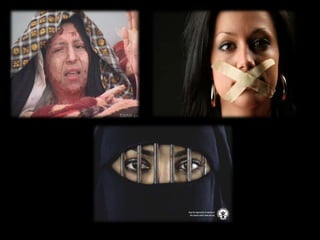
•However, this did not happen in the
majority of Muslim societies. Under
Islam, there is still no free sexual
market, and thus, unattractive Muslim
women have no need for feminism.
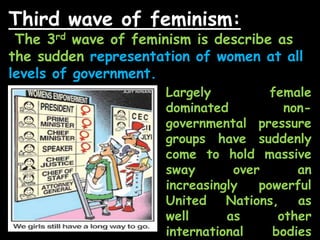
Third wave of feminism:
The 3rd wave of feminism is describe as
the sudden representation of women at all
levels of government.
Largely female
dominated non-
governmental pressure
groups have suddenly
come to hold massive
sway over an
increasingly powerful
United Nations, as
well as other
international bodies
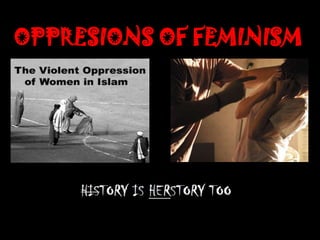
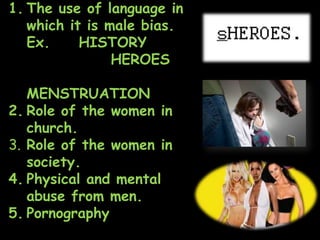
OPPRESIONS OF FEMINISM
1. The use of language in
which it is male bias.
Ex. HISTORY
HEROES
MENSTRUATION
2. Role of the women in
church.
3. Role of the women in
society.
4. Physical and mental
abuse from men.
5. Pornography
CLASSIFICATIONS OF FEMINIST RESPONSES
They argue that
the basic pattern
of society is
generally
acceptable but the
changes are needed
so that women are
not put at a
disadvantage by
their sex.
They want equal
opportunity to
REFORM FEMINISM
They also
proposed an
improved and
expanded day-care
facilities and
improved parental
eave, that will more
readily allow women
to combine paid
employment and
motherhood.
They are also
INTEGRATIVE FMINISM
Their goal is to break through those
mental barriers as well as the political,
economic, and cultural barriers that keep
all human beings from becoming fully
human.
They are also arguing for a fundamental
transformation not only to our political and
economic lives but our social, cultural, and
personal lives as well.
RADICAL FEMINISM
According to Alison Jagger, Radical
Feminism argues for the following:
Lesbianism – the sexual separation
from men, the sexual bonding with
women, and the end of the biological
family.
Development of a woman – centered
culture to replace the male-centered
culture; and
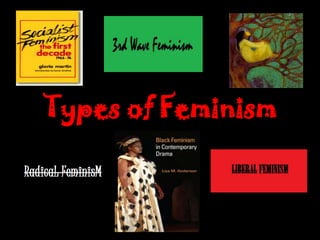
Types of Feminism
Liberal Feminism
Characterized by an individualistic
emphasis on equality.
Society itself does not need a major
overhaul, but rather laws need to be
changed and opportunities have to be
opened up to allow women to become
equals in society.
Socialist Feminism
Sometimes known as the Marxist
Feminism.
Different than liberal feminism in that
it emphasizes that true equality will not
be achieved without major overhauls
within society-- particularly economic
overhaul.
Socialist feminists argue that there are
fundamental inequalities built in to a
Radical Feminism
Similar to socialist feminism in that it
emphasizes the need for dramatic social
change in order to achieve genuine
equality for women.
Radical feminists believe that society is
extremely patriarchal, and until
patriarchy is transformed on all levels,
the system will remain unjust.
A minority of radical feminists are
separatist feminists, who believe that
men and women need to maintain separate
institutions and relationships.
Third Wave Feminism
Popular among younger women, many of
whom are children of feminists from the
1970s (who are referred to as Second
Wave Feminists).
Similar to liberal feminism, Third Wave
feminism is very individualistic.
Focused more on personal empowerment
as a starting place for social change.
Ecofeminism
Draws from and links together both the
women's movement and the environmental
movement.
Ecofeminism draws parallels between
the domination and exploitation of both
women and nature.
Black Feminism
Posits that sexism and racism are
inextricably linked, and that sexism will
never be overcome while the system is
still so fundamentally racist.
The movement grew out of the
discontent of African Americans women
during the Women's Liberation Movement
in the 1970s, who felt their particular
needs as minority women were not being
addressed.
END OF REPORT

Feminism

  • 2.
  • 3.
    FAMOUS FEMINISTS Abigail Adams (1744-1888) Wifeof John Adams, who was the second President of the United States. Remembered for the many letters she wrote to her husband while he stayed in Philadelphia, Pennsylvania, during the Continental Congresses. One of which says “Remember the ladies” in the laws drawn up in the newly independent country.
  • 4.
    Gloria Steinem (1934) Writer andeditor. During the 1960s she appeared as a leader in the women's movement in the United States. In 1970 cofounded Ms., which grew to be
  • 5.
  • 6.
    What is FMINISM? •Theactual definition of a feminist (according to the American Heritage Dictionary) is someone, male or female, who believes in social, political and economic equality between the sexes. •The Merriam-Webster Dictionary defines feminism as "the theory of the political, economic, and social equality of the sexes and organized activity on behalf of women's rights and interests.“
  • 7.
    •By general definition,feminism is a philosophy in which women and their contributions are valued. •Feminism can also be described as a movement. A revolution that includes women and men who wish the world to be equal without boundaries. cbcbcbcbcbcbcbcbcb
  • 9.
  • 10.
    •The term was developedin France (feminisme) in the mid-1800s. •It didn't become popular until the 1960s. Previously, these women's groups had used the term "women's liberationist" to define themselves, but as it began to lose
  • 11.
    First Wave of Feminism: •Drivenby a combination of social, economic and social forces. •The first organized “feminists” political activism involved campaigns for vote and equality.
  • 12.
    •Feminism was drivenby middle-aged, unattractive women who had most to lose from a changing sexual landscape. •These threatened women believed that the personal had to become political. •Yet, when women obtained their vote, they did not used it differently for their husband, when women did vote significantly different, it was to vote in fascist dictatorship all over Europe.
  • 13.
    Second Wave of Feminism: •In1960‟s, during the 2nd wave of feminism a remarkable event in human history had happened – the end of the „patriarchy‟ •Introduction of contraceptive pill triggered for the
  • 14.
    •Suddenly women becameactive in politics, demanded and won the rights to university education, to a career, to easy divorce, to an abortion. •Suddenly, women began voting differently to men. •However, this did not happen in the majority of Muslim societies. Under Islam, there is still no free sexual market, and thus, unattractive Muslim women have no need for feminism.
  • 16.
    Third wave offeminism: The 3rd wave of feminism is describe as the sudden representation of women at all levels of government. Largely female dominated non- governmental pressure groups have suddenly come to hold massive sway over an increasingly powerful United Nations, as well as other international bodies
  • 17.
  • 18.
    1. The useof language in which it is male bias. Ex. HISTORY HEROES MENSTRUATION 2. Role of the women in church. 3. Role of the women in society. 4. Physical and mental abuse from men. 5. Pornography
  • 20.
  • 21.
    They argue that thebasic pattern of society is generally acceptable but the changes are needed so that women are not put at a disadvantage by their sex. They want equal opportunity to REFORM FEMINISM They also proposed an improved and expanded day-care facilities and improved parental eave, that will more readily allow women to combine paid employment and motherhood. They are also
  • 22.
    INTEGRATIVE FMINISM Their goalis to break through those mental barriers as well as the political, economic, and cultural barriers that keep all human beings from becoming fully human. They are also arguing for a fundamental transformation not only to our political and economic lives but our social, cultural, and personal lives as well.
  • 23.
    RADICAL FEMINISM According toAlison Jagger, Radical Feminism argues for the following: Lesbianism – the sexual separation from men, the sexual bonding with women, and the end of the biological family. Development of a woman – centered culture to replace the male-centered culture; and
  • 24.
  • 25.
    Liberal Feminism Characterized byan individualistic emphasis on equality. Society itself does not need a major overhaul, but rather laws need to be changed and opportunities have to be opened up to allow women to become equals in society.
  • 26.
    Socialist Feminism Sometimes knownas the Marxist Feminism. Different than liberal feminism in that it emphasizes that true equality will not be achieved without major overhauls within society-- particularly economic overhaul. Socialist feminists argue that there are fundamental inequalities built in to a
  • 27.
    Radical Feminism Similar tosocialist feminism in that it emphasizes the need for dramatic social change in order to achieve genuine equality for women. Radical feminists believe that society is extremely patriarchal, and until patriarchy is transformed on all levels, the system will remain unjust. A minority of radical feminists are separatist feminists, who believe that men and women need to maintain separate institutions and relationships.
  • 28.
    Third Wave Feminism Popularamong younger women, many of whom are children of feminists from the 1970s (who are referred to as Second Wave Feminists). Similar to liberal feminism, Third Wave feminism is very individualistic. Focused more on personal empowerment as a starting place for social change.
  • 29.
    Ecofeminism Draws from andlinks together both the women's movement and the environmental movement. Ecofeminism draws parallels between the domination and exploitation of both women and nature.
  • 30.
    Black Feminism Posits thatsexism and racism are inextricably linked, and that sexism will never be overcome while the system is still so fundamentally racist. The movement grew out of the discontent of African Americans women during the Women's Liberation Movement in the 1970s, who felt their particular needs as minority women were not being addressed.
  • 31.