READER RESPONSEREADER RESPONSE
CRITICISMCRITICISM
AssumptionsAssumptions
1.1. You canYou can’t know for sure what an author’t know for sure what an author
intended, and the text itself is meaninglessintended, and the text itself is meaningless
without a reader: the reader’s response is whatwithout a reader: the reader’s response is what
counts.counts.
2.2. Readers actively create (rather than discover)Readers actively create (rather than discover)
meaning in texts, guided by certain goals andmeaning in texts, guided by certain goals and
rules that may be personal or shared withrules that may be personal or shared with
other members of a community.other members of a community.
3.3. Responding to a text is a process. DescriptionResponding to a text is a process. Description
of that process are valuable because yourof that process are valuable because your
response may enrich another readerresponse may enrich another reader’s’s
response.response.
PracticesPractices
1.1. Read the text slowly, describing theRead the text slowly, describing the
response of an ideal reader – whatresponse of an ideal reader – what
is anticipated, what is experienced.is anticipated, what is experienced.
2.2. Or, move through the text describingOr, move through the text describing
your own personal response.your own personal response.
3.3. Focus on details and ask how theFocus on details and ask how the
readerreader’s response – your own’s response – your own
response – would change if a detailresponse – would change if a detail
were changed.were changed.
DEFINITIONDEFINITION
Reader Response Criticism encompassesReader Response Criticism encompasses
various approaches to literature thatvarious approaches to literature that exploreexplore
and seek to explain the diversity (andand seek to explain the diversity (and
often divergence) of readers' responsesoften divergence) of readers' responses
to literary worksto literary works..
Louise Rosenblatt:Louise Rosenblatt: "A poem is what the"A poem is what the
reader lives through under the guidancereader lives through under the guidance
of the text and experiences as relevant toof the text and experiences as relevant to
the text."the text."
"The idea that a"The idea that a poempoem presupposes apresupposes a
readerreader actively involved with aactively involved with a texttext isis
particularly shocking to those seeking toparticularly shocking to those seeking to
emphasize the objectivity of theiremphasize the objectivity of their
interpretations."interpretations."
 Formalists spoke of "the poem itself," theFormalists spoke of "the poem itself," the
"concrete work of art," the "real poem." They had"concrete work of art," the "real poem." They had
no interest in what a work of literature makes ano interest in what a work of literature makes a
reader "live through."reader "live through."
 William K. Wimsatt and Monroe C. BeardsleyWilliam K. Wimsatt and Monroe C. Beardsley
(1954) used the term(1954) used the term affective fallacyaffective fallacy to defineto define
as erroneous the very idea that a readeras erroneous the very idea that a reader’s’s
response is relevant to the meaning of a literaryresponse is relevant to the meaning of a literary
work.work.
 Stanley Fish, in "Literature in the Reader:Stanley Fish, in "Literature in the Reader:
Affective Stylistics" (1970), argued that anyAffective Stylistics" (1970), argued that any
school of criticism that sees a literary work as anschool of criticism that sees a literary work as an
object, claiming to describe what it is and neverobject, claiming to describe what it is and never
what it does, misconstrues the very essence ofwhat it does, misconstrues the very essence of
literature and reading.literature and reading. Literature exists andLiterature exists and
signifies when it is readsignifies when it is read, Fish suggests, and its, Fish suggests, and its
force is an affective one.force is an affective one.
 Wolfgang Iser argues thatWolfgang Iser argues that textstexts
contain gaps (or blanks) thatcontain gaps (or blanks) that
powerfully affect the reader,powerfully affect the reader,
who must explain them,who must explain them,
connect what they separate,connect what they separate,
and create in his or her mindand create in his or her mind
aspects of a work that arenaspects of a work that aren’t’t inin
the text but are incited by thethe text but are incited by the
texttext..
With the redefinition ofWith the redefinition of
literature as something thatliterature as something that
only exists meaningfully in theonly exists meaningfully in the
mind of the reader, and withmind of the reader, and with
the redefinition of the literarythe redefinition of the literary
work as a catalyst of mentalwork as a catalyst of mental
events, comes a redefinition ofevents, comes a redefinition of
the reader.the reader.
 No longer is the reader theNo longer is the reader the
passive recipient of those ideaspassive recipient of those ideas
that an author has planted in athat an author has planted in a
text.text.
""The reader isThe reader is activeactive":":
Rosenblatt.Rosenblatt.
Fish: "Fish: "Reading is . . . somethingReading is . . . something
youyou do.do.""
Iser:Iser: the reader as an activethe reader as an active
maker of meaningmaker of meaning..
 Other reader-response criticsOther reader-response critics
define the reader differently.define the reader differently.
Wayne Booth uses the phraseWayne Booth uses the phrase thethe
implied readerimplied reader to mean the readerto mean the reader
"created by the work.""created by the work."
Iser:Iser: the implied readerthe implied reader andand thethe
educated readereducated reader..
Since the mid-1970s, RRC has evolved into aSince the mid-1970s, RRC has evolved into a
variety of new forms.variety of new forms.
 Subjectivists like David Bleich, Norman Holland,Subjectivists like David Bleich, Norman Holland,
and Robert Crosman have viewed theand Robert Crosman have viewed the readerreader’s’s
response not as one "guided" by the text butresponse not as one "guided" by the text but
rather as one motivated by deep-seated,rather as one motivated by deep-seated,
personal, psychological needs.personal, psychological needs.
Holland:Holland: when we read, we find our ownwhen we read, we find our own
"identity theme" in the text by using "the"identity theme" in the text by using "the
literary work to symbolize and finallyliterary work to symbolize and finally
replicate ourselves. We work out through thereplicate ourselves. We work out through the
text our own characteristic patterns oftext our own characteristic patterns of
desire."desire."
 Even Fish has moved away from RRC as he hadEven Fish has moved away from RRC as he had
initially helped define it, focusing on "interpretiveinitially helped define it, focusing on "interpretive
strategies" held in common by "interpretivestrategies" held in common by "interpretive
communities"—such as the one comprised bycommunities"—such as the one comprised by
American college students reading a novel as aAmerican college students reading a novel as a
class assignment.class assignment.
Fish’s shift in focus is in many ways typical ofFish’s shift in focus is in many ways typical of
changes that have taken place within the field ofchanges that have taken place within the field of
RRC—a field that, because of those changes, isRRC—a field that, because of those changes, is
increasingly being referred to asincreasingly being referred to as reader-reader-
oriented criticismoriented criticism..
 Many contemporary critics view themselves asMany contemporary critics view themselves as
reader-oriented critics and as practitioners ofreader-oriented critics and as practitioners of
some other critical approach as well.some other critical approach as well.
 Certain feminist and gender critics with anCertain feminist and gender critics with an
interest in reader response have asked whetherinterest in reader response have asked whether
there is such a thing as "reading like a woman."there is such a thing as "reading like a woman."
 Reading-oriented new historicists have looked atReading-oriented new historicists have looked at
the way in which racism affects and is affectedthe way in which racism affects and is affected
by reading and, more generally, at the way inby reading and, more generally, at the way in
which politics can affect reading practices andwhich politics can affect reading practices and
outcomes.outcomes.
 Gay and lesbian critics, have argued thatGay and lesbian critics, have argued that
sexualities have been similarly constructedsexualities have been similarly constructed
within and by social discourses and that therewithin and by social discourses and that there
may even be a homosexual way of reading.may even be a homosexual way of reading.
Nearly every reader suppliesNearly every reader supplies
personal meanings andpersonal meanings and
observations, making eachobservations, making each
readerreader’s experience with a’s experience with a
work unique and distinctivework unique and distinctive
from every other reader’sfrom every other reader’s
experience with the sameexperience with the same
work.work.
Romeo and JulietRomeo and Juliet
 A 14 year old reader vs. her fatherA 14 year old reader vs. her father
 She is almost certain to identify closely with theShe is almost certain to identify closely with the
Juliet and willJuliet and will “read” Lord Capulet as“read” Lord Capulet as
overbearing and rigid.overbearing and rigid.
 Her father, on the other hand, may be drawn toHer father, on the other hand, may be drawn to
the poignant passage where Capulet talks with athe poignant passage where Capulet talks with a
prospective suitor, urging that he wait whileprospective suitor, urging that he wait while
Juliet has the time to enjoy her youth.Juliet has the time to enjoy her youth.
 To Capulet, Juliet isTo Capulet, Juliet is “the hopeful lady of my“the hopeful lady of my
earth”. The young woman may interpret thisearth”. The young woman may interpret this
another sign of Capulet’ possessiveness, heranother sign of Capulet’ possessiveness, her
father may see it as a sign of love and evenfather may see it as a sign of love and even
generosity.generosity.
 So, whose interpretation is correct?So, whose interpretation is correct?
 The differing interpretations produced byThe differing interpretations produced by
different readers can be seen as simplydifferent readers can be seen as simply
the effect of the different personalitiesthe effect of the different personalities
(and personal histories) involved in(and personal histories) involved in
constructing meaning from the sameconstructing meaning from the same
series of clues.series of clues.
 Not only does the readerNot only does the reader “create” the work“create” the work
of literature, in large part, but the literatureof literature, in large part, but the literature
itself may work on the reader as he/sheitself may work on the reader as he/she
reads, altering the reader’s experience,reads, altering the reader’s experience,
and thus the reader’s interpretation.and thus the reader’s interpretation.
 Reader response theoristsReader response theorists
believe in the importance ofbelieve in the importance of
recursive readingrecursive reading (reading and(reading and
rereading with the idea that norereading with the idea that no
interpretation is carved in stone).interpretation is carved in stone).
A second or third interaction withA second or third interaction with
the text may well produce a newthe text may well produce a new
interpretation.interpretation.
Reader-Response:Reader-Response:
Various PositionsVarious Positions
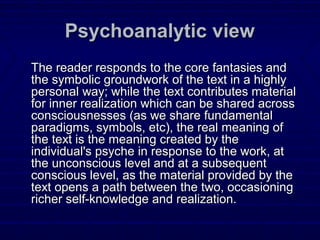
Psychoanalytic viewPsychoanalytic view
The reader responds to the core fantasies andThe reader responds to the core fantasies and
the symbolic groundwork of the text in a highlythe symbolic groundwork of the text in a highly
personal way; while the text contributes materialpersonal way; while the text contributes material
for inner realization which can be shared acrossfor inner realization which can be shared across
consciousnesses (as we share fundamentalconsciousnesses (as we share fundamental
paradigms, symbols, etc), the real meaning ofparadigms, symbols, etc), the real meaning of
the text is the meaning created by thethe text is the meaning created by the
individual's psyche in response to the work, atindividual's psyche in response to the work, at
the unconscious level and at a subsequentthe unconscious level and at a subsequent
conscious level, as the material provided by theconscious level, as the material provided by the
text opens a path between the two, occasioningtext opens a path between the two, occasioning
richer self-knowledge and realization.richer self-knowledge and realization.
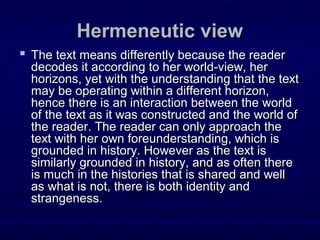
Hermeneutic viewHermeneutic view
 The text means differently because the readerThe text means differently because the reader
decodes it according to her world-view, herdecodes it according to her world-view, her
horizons, yet with the understanding that the texthorizons, yet with the understanding that the text
may be operating within a different horizon,may be operating within a different horizon,
hence there is an interaction between the worldhence there is an interaction between the world
of the text as it was constructed and the world ofof the text as it was constructed and the world of
the reader. The reader can only approach thethe reader. The reader can only approach the
text with her own foreunderstanding, which istext with her own foreunderstanding, which is
grounded in history. However as the text isgrounded in history. However as the text is
similarly grounded in history, and as often theresimilarly grounded in history, and as often there
is much in the histories that is shared and wellis much in the histories that is shared and well
as what is not, there is both identity andas what is not, there is both identity and
strangeness.strangeness.
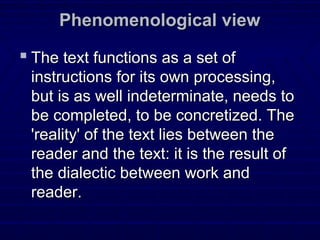
Phenomenological viewPhenomenological view
 The text functions as a set ofThe text functions as a set of
instructions for its own processing,instructions for its own processing,
but is as well indeterminate, needs tobut is as well indeterminate, needs to
be completed, to be concretized. Thebe completed, to be concretized. The
'reality' of the text lies between the'reality' of the text lies between the
reader and the text: it is the result ofreader and the text: it is the result of
the dialectic between work andthe dialectic between work and
reader.reader.
Structuralist viewStructuralist view
 Decoding the text requires various levels ofDecoding the text requires various levels of
competence -- competence in how texts work, incompetence -- competence in how texts work, in
the genre and tradition of the text, etc, as thethe genre and tradition of the text, etc, as the
work is constructed according to sets ofwork is constructed according to sets of
conventions which have their basis in anconventions which have their basis in an
objective, socially shared reality. The 'meaning'objective, socially shared reality. The 'meaning'
then depends largely on the competence of thethen depends largely on the competence of the
reader in responding to the structures andreader in responding to the structures and
practices of the text and which operate implicitlypractices of the text and which operate implicitly
(i.e. they affect us without our knowing it); the(i.e. they affect us without our knowing it); the
competent reader can make these explicit.competent reader can make these explicit.
Political or ideological viewPolitical or ideological view
 Texts include statements, assumptions,Texts include statements, assumptions,
attitudes, which are intrinsically ideological, i.e.attitudes, which are intrinsically ideological, i.e.
express attitudes towards and beliefs aboutexpress attitudes towards and beliefs about
certain sets of social and political realities,certain sets of social and political realities,
relations, values and powers. As a text isrelations, values and powers. As a text is
produced in a certain social and material milieuproduced in a certain social and material milieu
it cannot not have embedded ideologicalit cannot not have embedded ideological
assumptions. The reader herself will haveassumptions. The reader herself will have
ideological convictions and understandings asideological convictions and understandings as
well, often unrecognized, as is the nature ofwell, often unrecognized, as is the nature of
ideology, which understandings will conditionideology, which understandings will condition
and direct the reading and the application of theand direct the reading and the application of the
reading.reading.
Post-structuralist view(s)Post-structuralist view(s)
 Meaning is indeterminate, is not 'in' the text butMeaning is indeterminate, is not 'in' the text but
in the play of language and the nuances ofin the play of language and the nuances of
conventions in which the reader is immersed:conventions in which the reader is immersed:
hence the reader constructs a text as shehence the reader constructs a text as she
participates in this play, driven by the instabilitiesparticipates in this play, driven by the instabilities
and meaning potentials of the semantic andand meaning potentials of the semantic and
rhetorical aspects of the text. Stanley Fish's viewrhetorical aspects of the text. Stanley Fish's view
here is that the reader belongs to an interpretivehere is that the reader belongs to an interpretive
community which will have taught the reader tocommunity which will have taught the reader to
see a certain set of forms, topics and so forth;see a certain set of forms, topics and so forth;
his is one view which refers to the world ofhis is one view which refers to the world of
discourse of the reader as being the determiningdiscourse of the reader as being the determining
factor.factor.
 Tony Bennett, from a more marxistTony Bennett, from a more marxist
position, sees readers as belonging toposition, sees readers as belonging to
'reading formations'. In various sorts of'reading formations'. In various sorts of
post-structuralist reading the readingpost-structuralist reading the reading
process may involve the reader'sprocess may involve the reader's
countering and/or re-interpreting prevailingcountering and/or re-interpreting prevailing
views, depending on various things,views, depending on various things,
including: the force of the direction of theincluding: the force of the direction of the
text to the reader; the potentialtext to the reader; the potential
reconceptualization, freeing-up ofreconceptualization, freeing-up of
meaning the text can effect; the opennessmeaning the text can effect; the openness
to the play of language and meaning ofto the play of language and meaning of
the reader.the reader.
 The text may 'deconstruct itself', i.e. theThe text may 'deconstruct itself', i.e. the
reader may experience or see that thereader may experience or see that the
language of the text implicitly undermineslanguage of the text implicitly undermines
its own assumptions -- the real agent hereits own assumptions -- the real agent here
as in all post-structuralist positions beingas in all post-structuralist positions being
the reader, open to polysemy (multiplethe reader, open to polysemy (multiple
meanings and the sliding and interplay ofmeanings and the sliding and interplay of
signs) -- in her 'own' (socially shared)signs) -- in her 'own' (socially shared)
world of discourse, in a world discursivelyworld of discourse, in a world discursively
and socially constructed.and socially constructed.

Reader response

  • 1.
  • 2.
    AssumptionsAssumptions 1.1. You canYoucan’t know for sure what an author’t know for sure what an author intended, and the text itself is meaninglessintended, and the text itself is meaningless without a reader: the reader’s response is whatwithout a reader: the reader’s response is what counts.counts. 2.2. Readers actively create (rather than discover)Readers actively create (rather than discover) meaning in texts, guided by certain goals andmeaning in texts, guided by certain goals and rules that may be personal or shared withrules that may be personal or shared with other members of a community.other members of a community. 3.3. Responding to a text is a process. DescriptionResponding to a text is a process. Description of that process are valuable because yourof that process are valuable because your response may enrich another readerresponse may enrich another reader’s’s response.response.
  • 3.
    PracticesPractices 1.1. Read thetext slowly, describing theRead the text slowly, describing the response of an ideal reader – whatresponse of an ideal reader – what is anticipated, what is experienced.is anticipated, what is experienced. 2.2. Or, move through the text describingOr, move through the text describing your own personal response.your own personal response. 3.3. Focus on details and ask how theFocus on details and ask how the readerreader’s response – your own’s response – your own response – would change if a detailresponse – would change if a detail were changed.were changed.
  • 4.
    DEFINITIONDEFINITION Reader Response CriticismencompassesReader Response Criticism encompasses various approaches to literature thatvarious approaches to literature that exploreexplore and seek to explain the diversity (andand seek to explain the diversity (and often divergence) of readers' responsesoften divergence) of readers' responses to literary worksto literary works.. Louise Rosenblatt:Louise Rosenblatt: "A poem is what the"A poem is what the reader lives through under the guidancereader lives through under the guidance of the text and experiences as relevant toof the text and experiences as relevant to the text."the text." "The idea that a"The idea that a poempoem presupposes apresupposes a readerreader actively involved with aactively involved with a texttext isis particularly shocking to those seeking toparticularly shocking to those seeking to emphasize the objectivity of theiremphasize the objectivity of their interpretations."interpretations."
  • 5.
     Formalists spokeof "the poem itself," theFormalists spoke of "the poem itself," the "concrete work of art," the "real poem." They had"concrete work of art," the "real poem." They had no interest in what a work of literature makes ano interest in what a work of literature makes a reader "live through."reader "live through."  William K. Wimsatt and Monroe C. BeardsleyWilliam K. Wimsatt and Monroe C. Beardsley (1954) used the term(1954) used the term affective fallacyaffective fallacy to defineto define as erroneous the very idea that a readeras erroneous the very idea that a reader’s’s response is relevant to the meaning of a literaryresponse is relevant to the meaning of a literary work.work.  Stanley Fish, in "Literature in the Reader:Stanley Fish, in "Literature in the Reader: Affective Stylistics" (1970), argued that anyAffective Stylistics" (1970), argued that any school of criticism that sees a literary work as anschool of criticism that sees a literary work as an object, claiming to describe what it is and neverobject, claiming to describe what it is and never what it does, misconstrues the very essence ofwhat it does, misconstrues the very essence of literature and reading.literature and reading. Literature exists andLiterature exists and signifies when it is readsignifies when it is read, Fish suggests, and its, Fish suggests, and its force is an affective one.force is an affective one.
  • 6.
     Wolfgang Iserargues thatWolfgang Iser argues that textstexts contain gaps (or blanks) thatcontain gaps (or blanks) that powerfully affect the reader,powerfully affect the reader, who must explain them,who must explain them, connect what they separate,connect what they separate, and create in his or her mindand create in his or her mind aspects of a work that arenaspects of a work that aren’t’t inin the text but are incited by thethe text but are incited by the texttext..
  • 7.
    With the redefinitionofWith the redefinition of literature as something thatliterature as something that only exists meaningfully in theonly exists meaningfully in the mind of the reader, and withmind of the reader, and with the redefinition of the literarythe redefinition of the literary work as a catalyst of mentalwork as a catalyst of mental events, comes a redefinition ofevents, comes a redefinition of the reader.the reader.
  • 8.
     No longeris the reader theNo longer is the reader the passive recipient of those ideaspassive recipient of those ideas that an author has planted in athat an author has planted in a text.text. ""The reader isThe reader is activeactive":": Rosenblatt.Rosenblatt. Fish: "Fish: "Reading is . . . somethingReading is . . . something youyou do.do."" Iser:Iser: the reader as an activethe reader as an active maker of meaningmaker of meaning..
  • 9.
     Other reader-responsecriticsOther reader-response critics define the reader differently.define the reader differently. Wayne Booth uses the phraseWayne Booth uses the phrase thethe implied readerimplied reader to mean the readerto mean the reader "created by the work.""created by the work." Iser:Iser: the implied readerthe implied reader andand thethe educated readereducated reader..
  • 10.
    Since the mid-1970s,RRC has evolved into aSince the mid-1970s, RRC has evolved into a variety of new forms.variety of new forms.  Subjectivists like David Bleich, Norman Holland,Subjectivists like David Bleich, Norman Holland, and Robert Crosman have viewed theand Robert Crosman have viewed the readerreader’s’s response not as one "guided" by the text butresponse not as one "guided" by the text but rather as one motivated by deep-seated,rather as one motivated by deep-seated, personal, psychological needs.personal, psychological needs. Holland:Holland: when we read, we find our ownwhen we read, we find our own "identity theme" in the text by using "the"identity theme" in the text by using "the literary work to symbolize and finallyliterary work to symbolize and finally replicate ourselves. We work out through thereplicate ourselves. We work out through the text our own characteristic patterns oftext our own characteristic patterns of desire."desire."
  • 11.
     Even Fishhas moved away from RRC as he hadEven Fish has moved away from RRC as he had initially helped define it, focusing on "interpretiveinitially helped define it, focusing on "interpretive strategies" held in common by "interpretivestrategies" held in common by "interpretive communities"—such as the one comprised bycommunities"—such as the one comprised by American college students reading a novel as aAmerican college students reading a novel as a class assignment.class assignment. Fish’s shift in focus is in many ways typical ofFish’s shift in focus is in many ways typical of changes that have taken place within the field ofchanges that have taken place within the field of RRC—a field that, because of those changes, isRRC—a field that, because of those changes, is increasingly being referred to asincreasingly being referred to as reader-reader- oriented criticismoriented criticism..
  • 12.
     Many contemporarycritics view themselves asMany contemporary critics view themselves as reader-oriented critics and as practitioners ofreader-oriented critics and as practitioners of some other critical approach as well.some other critical approach as well.  Certain feminist and gender critics with anCertain feminist and gender critics with an interest in reader response have asked whetherinterest in reader response have asked whether there is such a thing as "reading like a woman."there is such a thing as "reading like a woman."  Reading-oriented new historicists have looked atReading-oriented new historicists have looked at the way in which racism affects and is affectedthe way in which racism affects and is affected by reading and, more generally, at the way inby reading and, more generally, at the way in which politics can affect reading practices andwhich politics can affect reading practices and outcomes.outcomes.  Gay and lesbian critics, have argued thatGay and lesbian critics, have argued that sexualities have been similarly constructedsexualities have been similarly constructed within and by social discourses and that therewithin and by social discourses and that there may even be a homosexual way of reading.may even be a homosexual way of reading.
  • 13.
    Nearly every readersuppliesNearly every reader supplies personal meanings andpersonal meanings and observations, making eachobservations, making each readerreader’s experience with a’s experience with a work unique and distinctivework unique and distinctive from every other reader’sfrom every other reader’s experience with the sameexperience with the same work.work.
  • 14.
    Romeo and JulietRomeoand Juliet  A 14 year old reader vs. her fatherA 14 year old reader vs. her father  She is almost certain to identify closely with theShe is almost certain to identify closely with the Juliet and willJuliet and will “read” Lord Capulet as“read” Lord Capulet as overbearing and rigid.overbearing and rigid.  Her father, on the other hand, may be drawn toHer father, on the other hand, may be drawn to the poignant passage where Capulet talks with athe poignant passage where Capulet talks with a prospective suitor, urging that he wait whileprospective suitor, urging that he wait while Juliet has the time to enjoy her youth.Juliet has the time to enjoy her youth.  To Capulet, Juliet isTo Capulet, Juliet is “the hopeful lady of my“the hopeful lady of my earth”. The young woman may interpret thisearth”. The young woman may interpret this another sign of Capulet’ possessiveness, heranother sign of Capulet’ possessiveness, her father may see it as a sign of love and evenfather may see it as a sign of love and even generosity.generosity.  So, whose interpretation is correct?So, whose interpretation is correct?
  • 15.
     The differinginterpretations produced byThe differing interpretations produced by different readers can be seen as simplydifferent readers can be seen as simply the effect of the different personalitiesthe effect of the different personalities (and personal histories) involved in(and personal histories) involved in constructing meaning from the sameconstructing meaning from the same series of clues.series of clues.  Not only does the readerNot only does the reader “create” the work“create” the work of literature, in large part, but the literatureof literature, in large part, but the literature itself may work on the reader as he/sheitself may work on the reader as he/she reads, altering the reader’s experience,reads, altering the reader’s experience, and thus the reader’s interpretation.and thus the reader’s interpretation.
  • 16.
     Reader responsetheoristsReader response theorists believe in the importance ofbelieve in the importance of recursive readingrecursive reading (reading and(reading and rereading with the idea that norereading with the idea that no interpretation is carved in stone).interpretation is carved in stone). A second or third interaction withA second or third interaction with the text may well produce a newthe text may well produce a new interpretation.interpretation.
  • 17.
  • 18.
    Psychoanalytic viewPsychoanalytic view Thereader responds to the core fantasies andThe reader responds to the core fantasies and the symbolic groundwork of the text in a highlythe symbolic groundwork of the text in a highly personal way; while the text contributes materialpersonal way; while the text contributes material for inner realization which can be shared acrossfor inner realization which can be shared across consciousnesses (as we share fundamentalconsciousnesses (as we share fundamental paradigms, symbols, etc), the real meaning ofparadigms, symbols, etc), the real meaning of the text is the meaning created by thethe text is the meaning created by the individual's psyche in response to the work, atindividual's psyche in response to the work, at the unconscious level and at a subsequentthe unconscious level and at a subsequent conscious level, as the material provided by theconscious level, as the material provided by the text opens a path between the two, occasioningtext opens a path between the two, occasioning richer self-knowledge and realization.richer self-knowledge and realization.
  • 19.
    Hermeneutic viewHermeneutic view The text means differently because the readerThe text means differently because the reader decodes it according to her world-view, herdecodes it according to her world-view, her horizons, yet with the understanding that the texthorizons, yet with the understanding that the text may be operating within a different horizon,may be operating within a different horizon, hence there is an interaction between the worldhence there is an interaction between the world of the text as it was constructed and the world ofof the text as it was constructed and the world of the reader. The reader can only approach thethe reader. The reader can only approach the text with her own foreunderstanding, which istext with her own foreunderstanding, which is grounded in history. However as the text isgrounded in history. However as the text is similarly grounded in history, and as often theresimilarly grounded in history, and as often there is much in the histories that is shared and wellis much in the histories that is shared and well as what is not, there is both identity andas what is not, there is both identity and strangeness.strangeness.
  • 20.
    Phenomenological viewPhenomenological view The text functions as a set ofThe text functions as a set of instructions for its own processing,instructions for its own processing, but is as well indeterminate, needs tobut is as well indeterminate, needs to be completed, to be concretized. Thebe completed, to be concretized. The 'reality' of the text lies between the'reality' of the text lies between the reader and the text: it is the result ofreader and the text: it is the result of the dialectic between work andthe dialectic between work and reader.reader.
  • 21.
    Structuralist viewStructuralist view Decoding the text requires various levels ofDecoding the text requires various levels of competence -- competence in how texts work, incompetence -- competence in how texts work, in the genre and tradition of the text, etc, as thethe genre and tradition of the text, etc, as the work is constructed according to sets ofwork is constructed according to sets of conventions which have their basis in anconventions which have their basis in an objective, socially shared reality. The 'meaning'objective, socially shared reality. The 'meaning' then depends largely on the competence of thethen depends largely on the competence of the reader in responding to the structures andreader in responding to the structures and practices of the text and which operate implicitlypractices of the text and which operate implicitly (i.e. they affect us without our knowing it); the(i.e. they affect us without our knowing it); the competent reader can make these explicit.competent reader can make these explicit.
  • 22.
    Political or ideologicalviewPolitical or ideological view  Texts include statements, assumptions,Texts include statements, assumptions, attitudes, which are intrinsically ideological, i.e.attitudes, which are intrinsically ideological, i.e. express attitudes towards and beliefs aboutexpress attitudes towards and beliefs about certain sets of social and political realities,certain sets of social and political realities, relations, values and powers. As a text isrelations, values and powers. As a text is produced in a certain social and material milieuproduced in a certain social and material milieu it cannot not have embedded ideologicalit cannot not have embedded ideological assumptions. The reader herself will haveassumptions. The reader herself will have ideological convictions and understandings asideological convictions and understandings as well, often unrecognized, as is the nature ofwell, often unrecognized, as is the nature of ideology, which understandings will conditionideology, which understandings will condition and direct the reading and the application of theand direct the reading and the application of the reading.reading.
  • 23.
    Post-structuralist view(s)Post-structuralist view(s) Meaning is indeterminate, is not 'in' the text butMeaning is indeterminate, is not 'in' the text but in the play of language and the nuances ofin the play of language and the nuances of conventions in which the reader is immersed:conventions in which the reader is immersed: hence the reader constructs a text as shehence the reader constructs a text as she participates in this play, driven by the instabilitiesparticipates in this play, driven by the instabilities and meaning potentials of the semantic andand meaning potentials of the semantic and rhetorical aspects of the text. Stanley Fish's viewrhetorical aspects of the text. Stanley Fish's view here is that the reader belongs to an interpretivehere is that the reader belongs to an interpretive community which will have taught the reader tocommunity which will have taught the reader to see a certain set of forms, topics and so forth;see a certain set of forms, topics and so forth; his is one view which refers to the world ofhis is one view which refers to the world of discourse of the reader as being the determiningdiscourse of the reader as being the determining factor.factor.
  • 24.
     Tony Bennett,from a more marxistTony Bennett, from a more marxist position, sees readers as belonging toposition, sees readers as belonging to 'reading formations'. In various sorts of'reading formations'. In various sorts of post-structuralist reading the readingpost-structuralist reading the reading process may involve the reader'sprocess may involve the reader's countering and/or re-interpreting prevailingcountering and/or re-interpreting prevailing views, depending on various things,views, depending on various things, including: the force of the direction of theincluding: the force of the direction of the text to the reader; the potentialtext to the reader; the potential reconceptualization, freeing-up ofreconceptualization, freeing-up of meaning the text can effect; the opennessmeaning the text can effect; the openness to the play of language and meaning ofto the play of language and meaning of the reader.the reader.
  • 25.
     The textmay 'deconstruct itself', i.e. theThe text may 'deconstruct itself', i.e. the reader may experience or see that thereader may experience or see that the language of the text implicitly undermineslanguage of the text implicitly undermines its own assumptions -- the real agent hereits own assumptions -- the real agent here as in all post-structuralist positions beingas in all post-structuralist positions being the reader, open to polysemy (multiplethe reader, open to polysemy (multiple meanings and the sliding and interplay ofmeanings and the sliding and interplay of signs) -- in her 'own' (socially shared)signs) -- in her 'own' (socially shared) world of discourse, in a world discursivelyworld of discourse, in a world discursively and socially constructed.and socially constructed.