Mitochondriome-Exome Wide Associations (MEWAs):
sviluppo di un sistema bioinformatico per studi di associazione fra
l'intero esoma nucleare e il DNA mitocondriale
in fenotipi fisiologici e patologici

Maria Angela Diroma
Università degli Studi di Bari - Dipartimento di Bioscienze, Biotecnologie e Biofarmaceutica
Mitochondriome-Exome Wide Associations
(MEWAs)

MToolBox
...the importance of being a mitochondrion
ü  cellular power plants
ü  signaling through mitochondrial
reactive oxygen species
ü  regulation of the membrane potential
ü  control of the cell cycle and cell
growth
ü  motility
ü  cellular differentiation
ü  apoptosis-programmed cell death
ü  storage of calcium ions and calcium
signaling
ü  synthesis of aminoacids, haem,
nucleotides and lipids
…the double face of mtDNA mutations

‘Classical’ mtDNA diseases:
• 
• 
• 
• 

LHON (Leber Hereditary
Optic Neuropathy)
MERFF (Myoclonic Epilepsy
with Ragged Red Fibers)
MELAS (Mitochondrial
encephalomyopathy)
KSS (Kearns–Sayre
syndrome)

Other disorders:
• 
• 
• 
• 
• 
• 

Parkinson’s disease
Alzheimer’s disease
Type 2 Diabetes
Deafness
Multiple Sclerosis
Cancer …

Human evolution and
phylogeny
Haplogroup: group of mtDNA
haplotypes derived by descent from
the same ancestral mtDNA molecule as
revealed by the sharing of a
distinguishing mutational motif
Torroni et al. 2006, Harvesting the fruit of the human
mtDNA tree. TRENDS in Genetics, 22(6)

RSRS: Reconstructed Sapiens Reference Sequence
Behar et al. 2012, A “Copernican” reassessment of the human
mitochondrial DNA tree from its root. Am. J of Human Genetics 90,
675-684
HmtDB
Human mitochondrial DataBase

Since 2005 HmtDB supports
population genetics and biomedical
research
Currently it includes 14144 and 1612
complete human mitochondrial
sequences from healthy and patients,
respectively
ü  The Query function allows the user to
retrieve data from the database

!

example of a genome card

ü  The downloading function allows to
download
o  multialignments of the entire
healthy and pathologic as well as
of the continent specific datasets
o  variability data obtained by
applying SiteVar and MitVarProt
software
ü  The application of the classify
procedure allows the prediction of
the haplogroup on the basis of the
classification available through
Phylotree (build R15).
o  comparison of a query genome
with the reference sequence RSRS,
based on the application of the
MUSCLE software
o  a genome card of the submitted
genome is generated and
displayed
mt-classifier

ü  Haplogroup prediction of the genome
(either complete or incomplete) based on
Phylotree Build 15
ü  Functional annotation of each variant site
by comparing the query genome with the
related hg_MARGe (haplogroup Major
Allele Reference Genome) sequence
ü  Identification of private mutations of the
genome

Santorsola et al. 2013, The mitochondrial Major Allele Reference
Genome (MARGe): a tool to isolate functionally relevant
mutations in human mitochondrial sequences. Under review
NumtS: Nuclear mitochondrial Sequence

190 Human NumtS
41 validated by PCR

766 NumtS
(585 assembled NumtS)
Similarity: 63-100%

ü  NumtS and their mitochondrial counterparts
evolve at different rates
ü  NumtS insertion is an ongoing process

outgroups for population genetics

NumtS tracks useful for studies
concerning
ü  human structural variation
ü  diversity
ü  disease
Integration of information from both
mitochondrial and nuclear genomes may
favour
ü  molecular evolution studies
ü  clinical studies

Mitochondriome-Exome Wide Associations
(MEWAs)

Whole Exome Sequencing (WES)
•  high depth of coverage with relatively few reads
•  cost-effective
•  faster

ü  overlapping of nuclear probes
onto NumtS
ü  stoichiometric ratios between
nuclear and mitochondrial
molecules
Association among
•  mitochondrial variants
•  nuclear exome variants
•  phenotype data
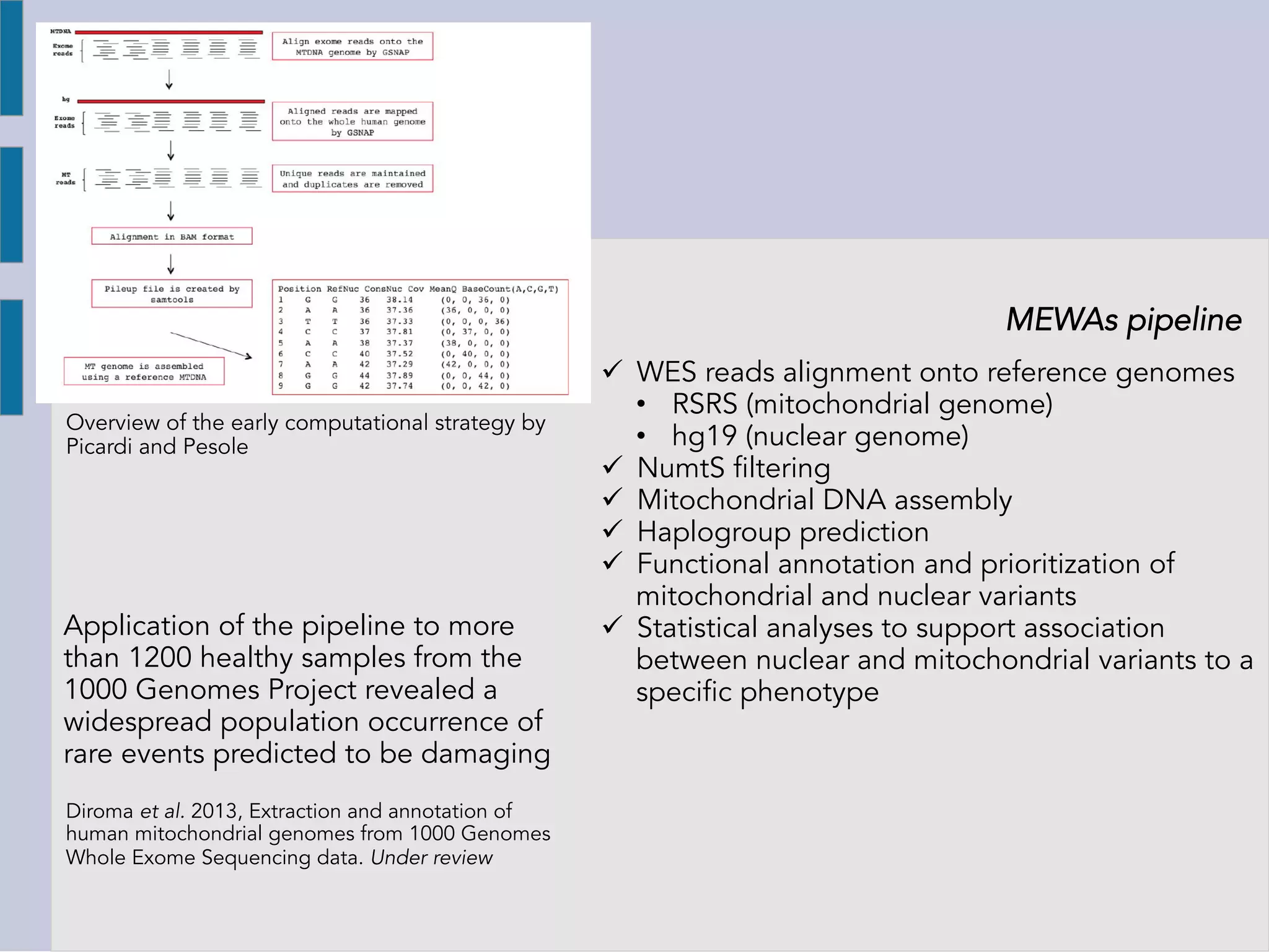
MEWAs pipeline
Overview of the early computational strategy by
Picardi and Pesole

Application of the pipeline to more
than 1200 healthy samples from the
1000 Genomes Project revealed a
widespread population occurrence of
rare events predicted to be damaging
Diroma et al. 2013, Extraction and annotation of
human mitochondrial genomes from 1000 Genomes
Whole Exome Sequencing data. Under review

ü  WES reads alignment onto reference genomes
•  RSRS (mitochondrial genome)
•  hg19 (nuclear genome)
ü  NumtS filtering
ü  Mitochondrial DNA assembly
ü  Haplogroup prediction
ü  Functional annotation and prioritization of
mitochondrial and nuclear variants
ü  Statistical analyses to support association
between nuclear and mitochondrial variants to a
specific phenotype
Acknowledgments
Prof. Marcella Attimonelli, University of Bari
Prof. Graziano Pesole, IBBE / University of Bari
Prof. Maria Svelto, University of Bari
Prof. Marni Falk, CHOP / University of Pennsylvania
Prof. Giorgio Pietro Maggi, INFN / Politecnico of Bari
Prof. Stefano Maria Pagnotta, University of Sannio
Ernesto Picardi, IBBE / University of Bari
Giuseppe Gasparre, University of Bologna
Giacinto Donvito, INFN
Domenico Simone, IBBE / University of Milano
Mariangela Santorsola, University of Sannio
Claudia Calabrese, University of Bologna
Cristiano Guttà, University of Bari
Francesco Maria Calabrese, University of Napoli
Dario Leonardo Balacco, University of Nottingham
Thanks for your attention

Maria A. Diroma – MEWAs: sviluppo di un sistema bioinformatico per studi di associazione fra l’intero esoma nucleare e il DNA mitocondriale in fenotipi fisiologici o patologici.

  • 1.
    Mitochondriome-Exome Wide Associations(MEWAs): sviluppo di un sistema bioinformatico per studi di associazione fra l'intero esoma nucleare e il DNA mitocondriale in fenotipi fisiologici e patologici Maria Angela Diroma Università degli Studi di Bari - Dipartimento di Bioscienze, Biotecnologie e Biofarmaceutica
  • 2.
  • 3.
    ...the importance ofbeing a mitochondrion ü  cellular power plants ü  signaling through mitochondrial reactive oxygen species ü  regulation of the membrane potential ü  control of the cell cycle and cell growth ü  motility ü  cellular differentiation ü  apoptosis-programmed cell death ü  storage of calcium ions and calcium signaling ü  synthesis of aminoacids, haem, nucleotides and lipids
  • 4.
    …the double faceof mtDNA mutations ‘Classical’ mtDNA diseases: •  •  •  •  LHON (Leber Hereditary Optic Neuropathy) MERFF (Myoclonic Epilepsy with Ragged Red Fibers) MELAS (Mitochondrial encephalomyopathy) KSS (Kearns–Sayre syndrome) Other disorders: •  •  •  •  •  •  Parkinson’s disease Alzheimer’s disease Type 2 Diabetes Deafness Multiple Sclerosis Cancer … Human evolution and phylogeny
  • 5.
    Haplogroup: group ofmtDNA haplotypes derived by descent from the same ancestral mtDNA molecule as revealed by the sharing of a distinguishing mutational motif Torroni et al. 2006, Harvesting the fruit of the human mtDNA tree. TRENDS in Genetics, 22(6) RSRS: Reconstructed Sapiens Reference Sequence Behar et al. 2012, A “Copernican” reassessment of the human mitochondrial DNA tree from its root. Am. J of Human Genetics 90, 675-684
  • 6.
    HmtDB Human mitochondrial DataBase Since2005 HmtDB supports population genetics and biomedical research Currently it includes 14144 and 1612 complete human mitochondrial sequences from healthy and patients, respectively
  • 7.
    ü  The Queryfunction allows the user to retrieve data from the database ! example of a genome card ü  The downloading function allows to download o  multialignments of the entire healthy and pathologic as well as of the continent specific datasets o  variability data obtained by applying SiteVar and MitVarProt software ü  The application of the classify procedure allows the prediction of the haplogroup on the basis of the classification available through Phylotree (build R15). o  comparison of a query genome with the reference sequence RSRS, based on the application of the MUSCLE software o  a genome card of the submitted genome is generated and displayed
  • 8.
    mt-classifier ü  Haplogroup predictionof the genome (either complete or incomplete) based on Phylotree Build 15 ü  Functional annotation of each variant site by comparing the query genome with the related hg_MARGe (haplogroup Major Allele Reference Genome) sequence ü  Identification of private mutations of the genome Santorsola et al. 2013, The mitochondrial Major Allele Reference Genome (MARGe): a tool to isolate functionally relevant mutations in human mitochondrial sequences. Under review
  • 9.
    NumtS: Nuclear mitochondrialSequence 190 Human NumtS 41 validated by PCR 766 NumtS (585 assembled NumtS) Similarity: 63-100% ü  NumtS and their mitochondrial counterparts evolve at different rates ü  NumtS insertion is an ongoing process outgroups for population genetics NumtS tracks useful for studies concerning ü  human structural variation ü  diversity ü  disease
  • 10.
    Integration of informationfrom both mitochondrial and nuclear genomes may favour ü  molecular evolution studies ü  clinical studies Mitochondriome-Exome Wide Associations (MEWAs) Whole Exome Sequencing (WES) •  high depth of coverage with relatively few reads •  cost-effective •  faster ü  overlapping of nuclear probes onto NumtS ü  stoichiometric ratios between nuclear and mitochondrial molecules Association among •  mitochondrial variants •  nuclear exome variants •  phenotype data
  • 11.
    MEWAs pipeline Overview ofthe early computational strategy by Picardi and Pesole Application of the pipeline to more than 1200 healthy samples from the 1000 Genomes Project revealed a widespread population occurrence of rare events predicted to be damaging Diroma et al. 2013, Extraction and annotation of human mitochondrial genomes from 1000 Genomes Whole Exome Sequencing data. Under review ü  WES reads alignment onto reference genomes •  RSRS (mitochondrial genome) •  hg19 (nuclear genome) ü  NumtS filtering ü  Mitochondrial DNA assembly ü  Haplogroup prediction ü  Functional annotation and prioritization of mitochondrial and nuclear variants ü  Statistical analyses to support association between nuclear and mitochondrial variants to a specific phenotype
  • 12.
    Acknowledgments Prof. Marcella Attimonelli,University of Bari Prof. Graziano Pesole, IBBE / University of Bari Prof. Maria Svelto, University of Bari Prof. Marni Falk, CHOP / University of Pennsylvania Prof. Giorgio Pietro Maggi, INFN / Politecnico of Bari Prof. Stefano Maria Pagnotta, University of Sannio Ernesto Picardi, IBBE / University of Bari Giuseppe Gasparre, University of Bologna Giacinto Donvito, INFN Domenico Simone, IBBE / University of Milano Mariangela Santorsola, University of Sannio Claudia Calabrese, University of Bologna Cristiano Guttà, University of Bari Francesco Maria Calabrese, University of Napoli Dario Leonardo Balacco, University of Nottingham
  • 13.
    Thanks for yourattention