1
A Novel Platform For Cancer Therapy
Using Extracellular Vesicles
In The Name Of GOD
2Extracellular Vesicles
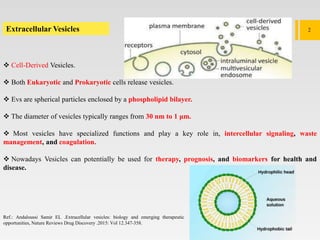
 Cell-Derived Vesicles.
 Both Eukaryotic and Prokaryotic cells release vesicles.
 Evs are spherical particles enclosed by a phospholipid bilayer.
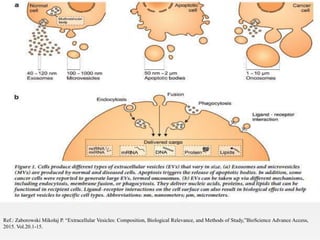
 The diameter of vesicles typically ranges from 30 nm to 1 μm.
 Most vesicles have specialized functions and play a key role in, intercellular signaling, waste
management, and coagulation.
 Nowadays Vesicles can potentially be used for therapy, prognosis, and biomarkers for health and
disease.
Ref.: Andaloussi Samir EL .Extracellular vesicles: biology and emerging therapeutic
opportunities, Nature Reviews Drug Discovery .2015: Vol 12.347-358.
3
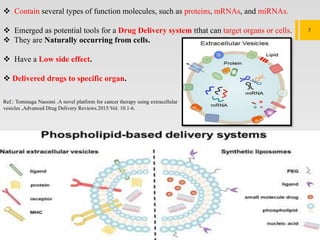
 Contain several types of function molecules, such as proteins, mRNAs, and miRNAs.
 Emerged as potential tools for a Drug Delivery system tthat can target organs or cells.
 They are Naturally occurring from cells.
 Have a Low side effect.
 Delivered drugs to specific organ.
Ref.: Tominaga Naoomi .A novel platform for cancer therapy using extracellular
vesicles ,Advanced Drug Delivery Reviews.2015:Vol. 10.1-6.
4
These vesicles diameter between 20 and 50 nm and density of 1.020 to 1.025 g/ml (Wolf,
1967).
 One decade later, fetal calf serum was also shown to contain “numerous microvesicles”
ranging in diameter from 30 to 60 nm (Dalton, 1975).
 The term “Exosomes” was introduced when vesicles were isolated from conditioned culture
medium of sheep reticulocytes. (John stone , 1987).
Cont..
Ref.: Pol Edwin vander .“Classification, Functions, and Clinical Relevance of Extracellular Vesicles” The American Society for Pharmacology
and Experimental Therapeuics . 2012: Vol. 64, No. 3 pg no. 676–705.
Different types of Evs
Microvesicles
Apoptotic bodies
Exosome
5
Ref.: Tominaga Naoomi .A novel platform for cancer therapy using extracellular vesicles ,Advanced Drug Delivery Reviews.2015:Vol. 10.1-6.
6Microvesicles (MVs)
 MVs are structures surrounded by a phospholipid bilayer. ( 100–1,000 nm in diameter )
Their size range overlaps that of bacteria.
 They are formed by regulated release by budding/ blebbing of the plasma membrane.
 They have been characterized as products of Platelets, Red blood cells and Endothelial
cells.
 Isolation and analytical methods include Differential Centrifugation , Flow Cytometry
(FC) and Capture-based assays.
Ref.: Zaborowski Mikołaj P. “Extracellular Vesicles: Composition, Biological Relevance, and Methods of Study,”BioScience Advance Access, 2015. Vol.20.1-
15.
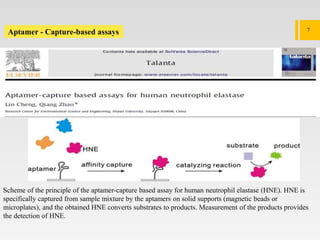
Aptamer - Capture-based assays
Scheme of the principle of the aptamer-capture based assay for human neutrophil elastase (HNE). HNE is
specifically captured from sample mixture by the aptamers on solid supports (magnetic beads or
microplates), and the obtained HNE converts substrates to products. Measurement of the products provides
the detection of HNE.
7
 First described by Trams in 1983.
 They are vesicles surrounded by a phospholipid bilayer (approximately 50–150 nm in
diameter), their size range roughly overlaps that of the viruses.
 They are released by exocytosis of multivesicular bodies.
 Exosomes have been predominantly characterized in the case of immune cells (dendritic
cells, T cell, B cells, macrophages) and tumors.
Exosome 8
Ref.: Zaborowski Mikołaj P. “Extracellular Vesicles: Composition, Biological Relevance, and Methods of Study,”BioScience Advance Access,
2015. Vol.20.1-15.
9
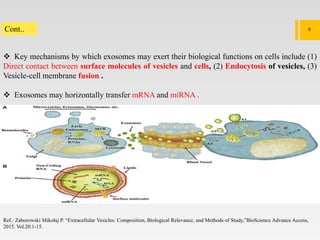
 Key mechanisms by which exosomes may exert their biological functions on cells include (1)
Direct contact between surface molecules of vesicles and cells, (2) Endocytosis of vesicles, (3)
Vesicle-cell membrane fusion .
 Exosomes may horizontally transfer mRNA and miRNA .
Cont..
Ref.: Zaborowski Mikołaj P. “Extracellular Vesicles: Composition, Biological Relevance, and Methods of Study,”BioScience Advance Access,
2015. Vol.20.1-15.
10
Ref.: Zaborowski Mikołaj P. “Extracellular Vesicles: Composition, Biological Relevance, and Methods of Study,”BioScience Advance Access,
2015. Vol.20.1-15.
11Characteristics of Different Types of EVs
Ref.: Vader Pieter .“Extracellular vesicles: emerging targets for cancer therapy”, Trends in Molecular Medicine.2014:Vol. 20. 385-393.
12Exosome
Ref.: Zaborowski Mikołaj P. “Extracellular Vesicles: Composition, Biological Relevance, and Methods of Study,”BioScience Advance Access,
2015. Vol.20.1-15.
13Composition
Exosomes are composed of a wide range of contents including:
 Proteins ( integrins, selectins, Rab proteins, tetraspanins like CD9, CD81, CD63 etc).
 Lipids (e.g, steroids, sphingolipids, glycerophospholipids)
 Nucleic acids (mRNA, miRNA, sRNA, DNA)
 Growth receptors
 Soluble factors
Ref.: Zaborowski Mikołaj P. “Extracellular Vesicles: Composition, Biological Relevance, and Methods of Study,”BioScience Advance Access,
2015. Vol.20.1-15.
14
Ref.: Gupta Archana .“Exosome as a Mediators of Neuroinflamation,” Journal Of Neuroinflamation,2014.Vol.15.11-68
15Function
 Different biological functions both in normal and pathophysiological conditions.
 Elimination of un-necessary proteins & molecules from cell and blood coagulation.
 Exchange of materials between cells, intercellular communication.
 Propagation of pathogens, immune responses (inhibitory and regulatory).
Ref.: Zaborowski Mikołaj P. “Extracellular Vesicles: Composition, Biological Relevance, and Methods of Study,”BioScience Advance Access,
2015. Vol.20.1-15.
16Biogenesis and Release of Exosome
Released by :
B‐cells,
dendritic cells (DCs)
T‐cells,
epithelial cells
platelets
present in physiological fluids :
serum
urine
breast milk
cerebrospinal fluid
saliva
Ref.: Zaborowski Mikołaj P. “Extracellular Vesicles: Composition, Biological Relevance, and Methods of Study,”BioScience Advance Access,
2015. Vol.20.1-15.
17
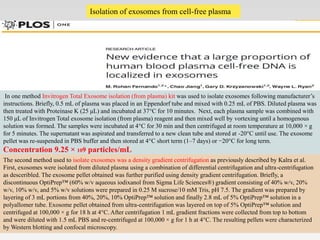
Isolation of exosomes from cell-free plasma
In one method Invitrogen Total Exosome isolation (from plasma) kit was used to isolate exosomes following manufacturer’s
instructions. Briefly, 0.5 mL of plasma was placed in an Eppendorf tube and mixed with 0.25 mL of PBS. Diluted plasma was
then treated with Proteinase K (25 μL) and incubated at 37°C for 10 minutes. Next, each plasma sample was combined with
150 μL of Invitrogen Total exosome isolation (from plasma) reagent and then mixed well by vortexing until a homogenous
solution was formed. The samples were incubated at 4°C for 30 min and then centrifuged at room temperature at 10,000 × g
for 5 minutes. The supernatant was aspirated and transferred to a new clean tube and stored at -20°C until use. The exosome
pellet was re-suspended in PBS buffer and then stored at 4°C short term (1–7 days) or −20°C for long term.
Concentration 9.25 × 10⁹ particles/mL
The second method used to isolate exosomes was a density gradient centrifugation as previously described by Kalra et al.
First, exosomes were isolated from diluted plasma using a combination of differential centrifugation and ultra-centrifugation
as desceribled. The exosome pellet obtained was further purified using density gradient centrifugation. Briefly, a
discontinuous OptiPrep™ (60% w/v aqueous iodixanol from Sigma Life Sciences®) gradient consisting of 40% w/v, 20%
w/v, 10% w/v, and 5% w/v solutions were prepared in 0.25 M sucrose/10 mM Tris, pH 7.5. The gradient was prepared by
layering of 3 mL portions from 40%, 20%, 10% OptiPrep™ solution and finally 2.8 mL of 5% OptiPrep™ solution in a
polyallomer tube. Exosome pellet obtained from ultra-centrifugation was layered on top of 5% OptiPrep™ solution and
centrifuged at 100,000 × g for 18 h at 4°C. After centrifugation 1 mL gradient fractions were collected from top to bottom
and were diluted with 1.5 mL PBS and re-centrifuged at 100,000 × g for 1 h at 4°C. The resulting pellets were characterized
by Western blotting and confocal microscopy.
18
19
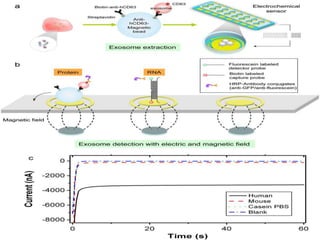
Schematic illustration of aptamer-based exosome detection, (A) The device is composed of an Au electrode array patterned
on a glass surface, along with a PDMS layer, which defines the flow chamber. Aptamers specific for CD63 were immobilized
onto the Au electrodes prior to use. (B and C) MB-labeled probing strands hybridize with the aptamers anchored on the
surface and emit an electrochemical signal (blue curve in Fig. C). Exosomes interact with DNA duplexes via CD63 proteins,
displacing the antisense strand and causing electrochemical signal to decrease (C). The change in redox signal is proportional
to the concentration of exosomes in solution.
20
Surface immobilization of CD63 aptamers Prior to modification of the electrodes, CD63 aptamer
stock solution (100 lM) was reduced in 10 mM TCEP for 1 h to cleave the disulfide bonds. The
stock solution was then diluted in HEPES buffer to 1 lM, followed by overnight incubation on the
Au electrode surface in the dark. The surface was then rinsed without copious amount of DI
water and then went through passivation in 1 mM MCH for 15 min to prevent non-specific
absorption of the aptamer strands.
Cont..

Exosome

  • 1.
    1 A Novel PlatformFor Cancer Therapy Using Extracellular Vesicles In The Name Of GOD
  • 2.
    2Extracellular Vesicles  Cell-DerivedVesicles.  Both Eukaryotic and Prokaryotic cells release vesicles.  Evs are spherical particles enclosed by a phospholipid bilayer.  The diameter of vesicles typically ranges from 30 nm to 1 μm.  Most vesicles have specialized functions and play a key role in, intercellular signaling, waste management, and coagulation.  Nowadays Vesicles can potentially be used for therapy, prognosis, and biomarkers for health and disease. Ref.: Andaloussi Samir EL .Extracellular vesicles: biology and emerging therapeutic opportunities, Nature Reviews Drug Discovery .2015: Vol 12.347-358.
  • 3.
    3  Contain severaltypes of function molecules, such as proteins, mRNAs, and miRNAs.  Emerged as potential tools for a Drug Delivery system tthat can target organs or cells.  They are Naturally occurring from cells.  Have a Low side effect.  Delivered drugs to specific organ. Ref.: Tominaga Naoomi .A novel platform for cancer therapy using extracellular vesicles ,Advanced Drug Delivery Reviews.2015:Vol. 10.1-6.
  • 4.
    4 These vesicles diameterbetween 20 and 50 nm and density of 1.020 to 1.025 g/ml (Wolf, 1967).  One decade later, fetal calf serum was also shown to contain “numerous microvesicles” ranging in diameter from 30 to 60 nm (Dalton, 1975).  The term “Exosomes” was introduced when vesicles were isolated from conditioned culture medium of sheep reticulocytes. (John stone , 1987). Cont.. Ref.: Pol Edwin vander .“Classification, Functions, and Clinical Relevance of Extracellular Vesicles” The American Society for Pharmacology and Experimental Therapeuics . 2012: Vol. 64, No. 3 pg no. 676–705.
  • 5.
    Different types ofEvs Microvesicles Apoptotic bodies Exosome 5 Ref.: Tominaga Naoomi .A novel platform for cancer therapy using extracellular vesicles ,Advanced Drug Delivery Reviews.2015:Vol. 10.1-6.
  • 6.
    6Microvesicles (MVs)  MVsare structures surrounded by a phospholipid bilayer. ( 100–1,000 nm in diameter ) Their size range overlaps that of bacteria.  They are formed by regulated release by budding/ blebbing of the plasma membrane.  They have been characterized as products of Platelets, Red blood cells and Endothelial cells.  Isolation and analytical methods include Differential Centrifugation , Flow Cytometry (FC) and Capture-based assays. Ref.: Zaborowski Mikołaj P. “Extracellular Vesicles: Composition, Biological Relevance, and Methods of Study,”BioScience Advance Access, 2015. Vol.20.1- 15.
  • 7.
    Aptamer - Capture-basedassays Scheme of the principle of the aptamer-capture based assay for human neutrophil elastase (HNE). HNE is specifically captured from sample mixture by the aptamers on solid supports (magnetic beads or microplates), and the obtained HNE converts substrates to products. Measurement of the products provides the detection of HNE. 7
  • 8.
     First describedby Trams in 1983.  They are vesicles surrounded by a phospholipid bilayer (approximately 50–150 nm in diameter), their size range roughly overlaps that of the viruses.  They are released by exocytosis of multivesicular bodies.  Exosomes have been predominantly characterized in the case of immune cells (dendritic cells, T cell, B cells, macrophages) and tumors. Exosome 8 Ref.: Zaborowski Mikołaj P. “Extracellular Vesicles: Composition, Biological Relevance, and Methods of Study,”BioScience Advance Access, 2015. Vol.20.1-15.
  • 9.
    9  Key mechanismsby which exosomes may exert their biological functions on cells include (1) Direct contact between surface molecules of vesicles and cells, (2) Endocytosis of vesicles, (3) Vesicle-cell membrane fusion .  Exosomes may horizontally transfer mRNA and miRNA . Cont.. Ref.: Zaborowski Mikołaj P. “Extracellular Vesicles: Composition, Biological Relevance, and Methods of Study,”BioScience Advance Access, 2015. Vol.20.1-15.
  • 10.
    10 Ref.: Zaborowski MikołajP. “Extracellular Vesicles: Composition, Biological Relevance, and Methods of Study,”BioScience Advance Access, 2015. Vol.20.1-15.
  • 11.
    11Characteristics of DifferentTypes of EVs Ref.: Vader Pieter .“Extracellular vesicles: emerging targets for cancer therapy”, Trends in Molecular Medicine.2014:Vol. 20. 385-393.
  • 12.
    12Exosome Ref.: Zaborowski MikołajP. “Extracellular Vesicles: Composition, Biological Relevance, and Methods of Study,”BioScience Advance Access, 2015. Vol.20.1-15.
  • 13.
    13Composition Exosomes are composedof a wide range of contents including:  Proteins ( integrins, selectins, Rab proteins, tetraspanins like CD9, CD81, CD63 etc).  Lipids (e.g, steroids, sphingolipids, glycerophospholipids)  Nucleic acids (mRNA, miRNA, sRNA, DNA)  Growth receptors  Soluble factors Ref.: Zaborowski Mikołaj P. “Extracellular Vesicles: Composition, Biological Relevance, and Methods of Study,”BioScience Advance Access, 2015. Vol.20.1-15.
  • 14.
    14 Ref.: Gupta Archana.“Exosome as a Mediators of Neuroinflamation,” Journal Of Neuroinflamation,2014.Vol.15.11-68
  • 15.
    15Function  Different biologicalfunctions both in normal and pathophysiological conditions.  Elimination of un-necessary proteins & molecules from cell and blood coagulation.  Exchange of materials between cells, intercellular communication.  Propagation of pathogens, immune responses (inhibitory and regulatory). Ref.: Zaborowski Mikołaj P. “Extracellular Vesicles: Composition, Biological Relevance, and Methods of Study,”BioScience Advance Access, 2015. Vol.20.1-15.
  • 16.
    16Biogenesis and Releaseof Exosome Released by : B‐cells, dendritic cells (DCs) T‐cells, epithelial cells platelets present in physiological fluids : serum urine breast milk cerebrospinal fluid saliva Ref.: Zaborowski Mikołaj P. “Extracellular Vesicles: Composition, Biological Relevance, and Methods of Study,”BioScience Advance Access, 2015. Vol.20.1-15.
  • 17.
    17 Isolation of exosomesfrom cell-free plasma In one method Invitrogen Total Exosome isolation (from plasma) kit was used to isolate exosomes following manufacturer’s instructions. Briefly, 0.5 mL of plasma was placed in an Eppendorf tube and mixed with 0.25 mL of PBS. Diluted plasma was then treated with Proteinase K (25 μL) and incubated at 37°C for 10 minutes. Next, each plasma sample was combined with 150 μL of Invitrogen Total exosome isolation (from plasma) reagent and then mixed well by vortexing until a homogenous solution was formed. The samples were incubated at 4°C for 30 min and then centrifuged at room temperature at 10,000 × g for 5 minutes. The supernatant was aspirated and transferred to a new clean tube and stored at -20°C until use. The exosome pellet was re-suspended in PBS buffer and then stored at 4°C short term (1–7 days) or −20°C for long term. Concentration 9.25 × 10⁹ particles/mL The second method used to isolate exosomes was a density gradient centrifugation as previously described by Kalra et al. First, exosomes were isolated from diluted plasma using a combination of differential centrifugation and ultra-centrifugation as desceribled. The exosome pellet obtained was further purified using density gradient centrifugation. Briefly, a discontinuous OptiPrep™ (60% w/v aqueous iodixanol from Sigma Life Sciences®) gradient consisting of 40% w/v, 20% w/v, 10% w/v, and 5% w/v solutions were prepared in 0.25 M sucrose/10 mM Tris, pH 7.5. The gradient was prepared by layering of 3 mL portions from 40%, 20%, 10% OptiPrep™ solution and finally 2.8 mL of 5% OptiPrep™ solution in a polyallomer tube. Exosome pellet obtained from ultra-centrifugation was layered on top of 5% OptiPrep™ solution and centrifuged at 100,000 × g for 18 h at 4°C. After centrifugation 1 mL gradient fractions were collected from top to bottom and were diluted with 1.5 mL PBS and re-centrifuged at 100,000 × g for 1 h at 4°C. The resulting pellets were characterized by Western blotting and confocal microscopy.
  • 18.
  • 19.
    19 Schematic illustration ofaptamer-based exosome detection, (A) The device is composed of an Au electrode array patterned on a glass surface, along with a PDMS layer, which defines the flow chamber. Aptamers specific for CD63 were immobilized onto the Au electrodes prior to use. (B and C) MB-labeled probing strands hybridize with the aptamers anchored on the surface and emit an electrochemical signal (blue curve in Fig. C). Exosomes interact with DNA duplexes via CD63 proteins, displacing the antisense strand and causing electrochemical signal to decrease (C). The change in redox signal is proportional to the concentration of exosomes in solution.
  • 20.
    20 Surface immobilization ofCD63 aptamers Prior to modification of the electrodes, CD63 aptamer stock solution (100 lM) was reduced in 10 mM TCEP for 1 h to cleave the disulfide bonds. The stock solution was then diluted in HEPES buffer to 1 lM, followed by overnight incubation on the Au electrode surface in the dark. The surface was then rinsed without copious amount of DI water and then went through passivation in 1 mM MCH for 15 min to prevent non-specific absorption of the aptamer strands. Cont..