Identification of Gene Expression Modules in Colorectal Cancer September 08, 2009 Manikhandan A V Mudaliar MSc Thesis Supervisors: Dr. Daniel Crowther and Dr. Keith Vass
Outline Introduction Aims and Objectives Review of Literature  Methods Results Conclusions Summary
Introduction Colorectal Cancer is the second leading cause of cancer death Gene expression profiling using microarrays is one of the effective methods to infer molecular mechanisms The main purpose: To identify gene expression modules that conclusively exist in colorectal cancer The outcome: Emphatically identified functional gene expression modules and mapped with other studies
Aims and Objectives To identify gene expression modules that are common to many colorectal cancer microarray datasets using three different methods  To find biological relevance of the modules using BiNGO, NetAffix and KEGG pathway online tools Mapping with other studies:  Predict probability of tumour relapse in colorectal cancer patients Predict probability of survival in breast cancer patients
Review of Literature Ruan  et al.  1  successfully identified co-expression modules enriched with cancer related Gene Ontology categories from colon cancer microarray data Staub  et al.  2   successfully classified various cancer patient populations using the genes present in WIPF1 co-expression module
Methods and Materials Data Collection from public databases Analytical methods Normalisation Multi-cluster comparison using Eigen Decomposition Correlation Similarity Pooled Co-expression Network – Clustering by Eigen Decomposition Correlation Similarity Pooled Co-expression Network – Clustering by Cytoscape – MCODE plug-in Analysis of the modules using BiNGO ,NetAffix and KEGG Pathway online tools Kaplan-Meier Survival Analysis
Results and Discussion The nodes (probe sets) are shown as red circles and the edges are shown as blue lines. The modules are named after their MCODE cluster ranks The number of nodes present in the modules 1 to 4 is 40, 32, 24 and 17 respectively Visualisation of gene expression modules in Cytoscape
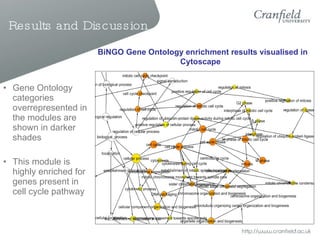
Results and Discussion Gene Ontology categories overrepresented in the modules are shown in darker shades This module is highly enriched for genes present in cell cycle pathway  BiNGO Gene Ontology enrichment results visualised in Cytoscape
Results and Discussion Kaplan-Meier Survival Analysis Plot showing probability of tumour relapse over time: predictability using  MCODE cluster No.8 (RAS signalling pathway) as classifier  on Wang  et al. 3  Colorectal Cancer dataset  No of samples = 74 Class  Samples  Relapse  Cluster 1  42  15  Cluster 2  32  16  p-value = 0.3817  Red curve = Cluster 1 (under expressed) Blue curve = Cluster 2 (over expressed)
Result and Discussion No of samples = 235 Class  Samples  Death Class=0  47  9  Class=1  94  29  Class=2  94  17  p-value = 0.0168  Blue curve = Class 1 (over expressed) Black curve = Class 2 (under expressed) Kaplan-Meier Survival Analysis Plot showing probability of survival over time: predictability using  MCODE cluster No.1 (Focal adhesion pathway) as classifier  on  GSE 3494 Breast Cancer dataset
Conclusions Emphatically identified gene expression modules that regularly occur in colorectal cancer Conclusively found functional significance of the modules Mapped with other studies to show their biological relevance Suggestions for future work
Summary The main purpose Three different methods Results  Conclusions
References 1.  Ruan, X. G., Wang, J. L. and Li, J. G. (2006), "A network partition algorithm for mining gene functional modules of colon cancer from DNA microarray data",  Genomics, proteomics & bioinformatics / Beijing Genomics Institute, vol. 4, no. 4, pp. 245-252  Staub, E., Groene, J., Heinze, M., Mennerich, D., Roepcke, S., Klaman, I., Hinzmann, B., Castanos-Velez, E., Pilarsky, C., Mann, B., Brummendorf, T., Weber, B., Buhr, H. J. and Rosenthal, A. (2009), "An expression module of WIPF1-coexpressed genes identifies patients with favourable prognosis in three tumour types",  Journal of Molecular Medicine (Berlin, Germany), vol. 87, no. 6, pp. 633-644.  Wang, Y., Jatkoe, T., Zhang, Y., Mutch, M. G., Talantov, D., Jiang, J., McLeod, H. L. and Atkins, D. (2004), "Gene expression profiles and molecular markers to predict recurrence of Dukes' B colon cancer",  Journal of clinical oncology : official journal of the American Society of Clinical Oncology, vol. 22, no. 9, pp. 1564-1571.
Acknowledgements Thanks to Translational Medicine Research Collaboration (TMRC), Dundee Thanks to Scottish Bioinformatics Forum Thank you

Msc Thesis - Presentation

  • 1.
    Identification of GeneExpression Modules in Colorectal Cancer September 08, 2009 Manikhandan A V Mudaliar MSc Thesis Supervisors: Dr. Daniel Crowther and Dr. Keith Vass
  • 2.
    Outline Introduction Aimsand Objectives Review of Literature Methods Results Conclusions Summary
  • 3.
    Introduction Colorectal Canceris the second leading cause of cancer death Gene expression profiling using microarrays is one of the effective methods to infer molecular mechanisms The main purpose: To identify gene expression modules that conclusively exist in colorectal cancer The outcome: Emphatically identified functional gene expression modules and mapped with other studies
  • 4.
    Aims and ObjectivesTo identify gene expression modules that are common to many colorectal cancer microarray datasets using three different methods To find biological relevance of the modules using BiNGO, NetAffix and KEGG pathway online tools Mapping with other studies: Predict probability of tumour relapse in colorectal cancer patients Predict probability of survival in breast cancer patients
  • 5.
    Review of LiteratureRuan et al. 1 successfully identified co-expression modules enriched with cancer related Gene Ontology categories from colon cancer microarray data Staub et al. 2 successfully classified various cancer patient populations using the genes present in WIPF1 co-expression module
  • 6.
    Methods and MaterialsData Collection from public databases Analytical methods Normalisation Multi-cluster comparison using Eigen Decomposition Correlation Similarity Pooled Co-expression Network – Clustering by Eigen Decomposition Correlation Similarity Pooled Co-expression Network – Clustering by Cytoscape – MCODE plug-in Analysis of the modules using BiNGO ,NetAffix and KEGG Pathway online tools Kaplan-Meier Survival Analysis
  • 7.
    Results and DiscussionThe nodes (probe sets) are shown as red circles and the edges are shown as blue lines. The modules are named after their MCODE cluster ranks The number of nodes present in the modules 1 to 4 is 40, 32, 24 and 17 respectively Visualisation of gene expression modules in Cytoscape
  • 8.
    Results and DiscussionGene Ontology categories overrepresented in the modules are shown in darker shades This module is highly enriched for genes present in cell cycle pathway BiNGO Gene Ontology enrichment results visualised in Cytoscape
  • 9.
    Results and DiscussionKaplan-Meier Survival Analysis Plot showing probability of tumour relapse over time: predictability using MCODE cluster No.8 (RAS signalling pathway) as classifier on Wang et al. 3 Colorectal Cancer dataset No of samples = 74 Class Samples Relapse Cluster 1 42 15 Cluster 2 32 16 p-value = 0.3817 Red curve = Cluster 1 (under expressed) Blue curve = Cluster 2 (over expressed)
  • 10.
    Result and DiscussionNo of samples = 235 Class Samples Death Class=0 47 9 Class=1 94 29 Class=2 94 17 p-value = 0.0168 Blue curve = Class 1 (over expressed) Black curve = Class 2 (under expressed) Kaplan-Meier Survival Analysis Plot showing probability of survival over time: predictability using MCODE cluster No.1 (Focal adhesion pathway) as classifier on GSE 3494 Breast Cancer dataset
  • 11.
    Conclusions Emphatically identifiedgene expression modules that regularly occur in colorectal cancer Conclusively found functional significance of the modules Mapped with other studies to show their biological relevance Suggestions for future work
  • 12.
    Summary The mainpurpose Three different methods Results Conclusions
  • 13.
    References 1. Ruan, X. G., Wang, J. L. and Li, J. G. (2006), "A network partition algorithm for mining gene functional modules of colon cancer from DNA microarray data", Genomics, proteomics & bioinformatics / Beijing Genomics Institute, vol. 4, no. 4, pp. 245-252 Staub, E., Groene, J., Heinze, M., Mennerich, D., Roepcke, S., Klaman, I., Hinzmann, B., Castanos-Velez, E., Pilarsky, C., Mann, B., Brummendorf, T., Weber, B., Buhr, H. J. and Rosenthal, A. (2009), "An expression module of WIPF1-coexpressed genes identifies patients with favourable prognosis in three tumour types", Journal of Molecular Medicine (Berlin, Germany), vol. 87, no. 6, pp. 633-644. Wang, Y., Jatkoe, T., Zhang, Y., Mutch, M. G., Talantov, D., Jiang, J., McLeod, H. L. and Atkins, D. (2004), "Gene expression profiles and molecular markers to predict recurrence of Dukes' B colon cancer", Journal of clinical oncology : official journal of the American Society of Clinical Oncology, vol. 22, no. 9, pp. 1564-1571.
  • 14.
    Acknowledgements Thanks toTranslational Medicine Research Collaboration (TMRC), Dundee Thanks to Scottish Bioinformatics Forum Thank you

Editor's Notes

  • #4 In the UK more than 16,000 people died of colorectal cancer in 2007. More than 200,000 people died of colorectal cancer in the whole of Europe. Better understanding of the molecular mechanisms and signalling pathways of initiation and progression of colorectal cancer would facilitate discovery of new prognostic markers and therapeutic targets. Genome-wide gene expression profiling analysis using microarray technology is one of the most effective approaches to understand these key molecular events. The main purpose of the study was to identify consensus gene expression modules that were common to many microarray datasets together with their biological relevance. The results of this study show that I have identified gene expression modules with distinct biological role that occur regularly across many datasets To prove my findings conclusively , I successfully mapped them with other studies.
  • #11 The genes from module 1 identified as associated with Focal adhesion pathway, separated the GSE 3494 breast cancer dataset which has 235 samples into three classes on the basis of expression levels, i.e., over expression (class 1) has 94 samples, and under expression (class 2) has 94 samples and unclassified (at p–value < 0.05) 47 samples. The plot shows the class 1 which is the overexpressed class has 29 deaths and the underexpressed class has 17 deaths. The blue curve shows the probability of survival for class 1 which is low and the black curve for probability of survival which is higher at p-value =0.0168.
  • #12 The findings can be applied in other diseases areas Combine with differential expression between normal tissues and CRC tissues