Name : Vihari Rajaguru
Group : NO 32
3rd year 2nd semester (2015)
 The German physicist, Wilhelm Conrad Röntgen
was the first person to systematically produce and
detect electromagnetic radiation in a wavelength
range today known as x-rays or Röntgen rays.
 His discovery of x-rays was a great revolution in
the fields of physics and medicine and electrified
the general public. It also earned him the Rumford
Medal of the Royal Society of London in 1896 and
the first Nobel Prize in Physics in 1901. He is also
known for his discoveries in mechanics, heat, and
electricity.
 Röntgen was married to
Anna Bertha Ludwig
(m. 1872, d. 1919) and
had one child, Josephine
Bertha Ludwig.
Adopted at age 6, in 1887,
she was the daughter of
Anna's brother.
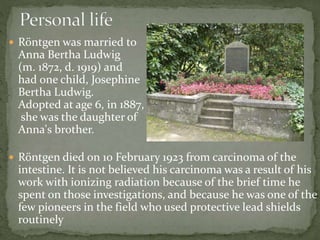
 Röntgen died on 10 February 1923 from carcinoma of the
intestine. It is not believed his carcinoma was a result of his
work with ionizing radiation because of the brief time he
spent on those investigations, and because he was one of the
few pioneers in the field who used protective lead shields
routinely
 He was the only child of a merchant and cloth
manufacturer. Röntgen was brought up in
Netherlands after he and his family moved to
Apeldoorn in 1848. Here he first received his early
education at the Institute of Martinus Herman van
Doorn, a boarding school and in 1861 attended the
Utrecht Technical School.
 Unfortunately in 1863 he was expelled unfairly
from his school after being accused of a prank
another student had committed. Even though
Röntgen did not seem to be especially gifted in his
schoolwork, he was good at building mechanical
objects, a talent that enabled him to build many of
his own experimental devices in his later life.
 Having inherited two Million Reichsmarks after
his father's death. Röntgen did not take patents
out on his discoveries, and donated the money for
his Nobel prize to the University of Würzburg.
 With the inflation
following World War I,
Röntgen fell into
bankruptcy later in life,
spending his final years
at his country home
at Munich. In keeping
with his will, all his
personal and scientific
correspondence was
destroyed upon his death.
 He then entered the University of Utrecht in 1865 to
study physics without having the necessary credentials
required for a regular student.
 In 1869, he earned a Ph.D. in mechanical engineering
from the University of Zurich. Here he attended
lectures by the noted physicist Rudolf Julius
Emmanuel Clausius and also worked in the laboratory
of Kundt.
 As soon as he completed his graduation he was
appointed assistant to Kundt and went with him to
Würzburg in the same year, and three years later to
Strasbourg
 In 1874 he was appointed as a lecturer at Strasbourg University
and in 1875 served as a professor in the Academy of
Agriculture at Hohenheim in Württemberg.
 In 1876 he returned to Strasbourg as Professor of Physics.
Three years later he accepted the invitation to the Chair of
Physics in the University of Giessen. In 1888, he obtained the
same position at the University of Würzburg, and in 1900 at
the University of Munich.
 Even though he accepted an appointment at Columbia
University in New York City but due to the occurrence of
World War I, Röntgen changed his plans and remained in
Munich for the rest of his career.
 In 1901 Röntgen was awarded the very first Nobel Prize in Physics.
The award was officially "in recognition of the extraordinary services
he has rendered by the discovery of the remarkable rays
subsequently named after him". Röntgen donated the monetary
reward from his Nobel Prize to his university. Like Pierre Curie,
Röntgen refused to take out patents related to his discovery, as he
wanted mankind as a whole to benefit from practical applications of
the same (personal statement).
 Rumford Medal (1896)
 Matteucci Medal (1896)
 Elliott Cresson Medal (1897)
 Nobel Prize for Physics (1901)
 In November 2004 IUPAC named element number 111 Roentigenium
(Rg) in his honour. IUPAP adopted the name in November 2011.
 In 1907 he became a foreign member of the Royal Netherlands
Academy of Arts and Sciences
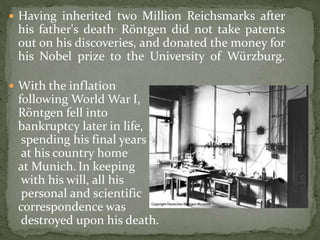
 The Röntgen Memorial Site gives an insight into the
particle physics of the late 19th century. It shows an
experimental set-up of cathodic rays beside the
apparatus of the discovery. An experiment of
penetrating solid materials by X rays is shown in the
historic laboratory of Röntgen. A separate room shows
various X-ray tubes, a medical X-ray machine
of Seimens and Halske from 1912 and several original
documents.
Wilhelm röntgen
Wilhelm röntgen

Wilhelm röntgen

  • 1.
    Name : VihariRajaguru Group : NO 32 3rd year 2nd semester (2015)
  • 2.
     The Germanphysicist, Wilhelm Conrad Röntgen was the first person to systematically produce and detect electromagnetic radiation in a wavelength range today known as x-rays or Röntgen rays.  His discovery of x-rays was a great revolution in the fields of physics and medicine and electrified the general public. It also earned him the Rumford Medal of the Royal Society of London in 1896 and the first Nobel Prize in Physics in 1901. He is also known for his discoveries in mechanics, heat, and electricity.
  • 3.
     Röntgen wasmarried to Anna Bertha Ludwig (m. 1872, d. 1919) and had one child, Josephine Bertha Ludwig. Adopted at age 6, in 1887, she was the daughter of Anna's brother.  Röntgen died on 10 February 1923 from carcinoma of the intestine. It is not believed his carcinoma was a result of his work with ionizing radiation because of the brief time he spent on those investigations, and because he was one of the few pioneers in the field who used protective lead shields routinely
  • 4.
     He wasthe only child of a merchant and cloth manufacturer. Röntgen was brought up in Netherlands after he and his family moved to Apeldoorn in 1848. Here he first received his early education at the Institute of Martinus Herman van Doorn, a boarding school and in 1861 attended the Utrecht Technical School.  Unfortunately in 1863 he was expelled unfairly from his school after being accused of a prank another student had committed. Even though Röntgen did not seem to be especially gifted in his schoolwork, he was good at building mechanical objects, a talent that enabled him to build many of his own experimental devices in his later life.
  • 5.
     Having inheritedtwo Million Reichsmarks after his father's death. Röntgen did not take patents out on his discoveries, and donated the money for his Nobel prize to the University of Würzburg.  With the inflation following World War I, Röntgen fell into bankruptcy later in life, spending his final years at his country home at Munich. In keeping with his will, all his personal and scientific correspondence was destroyed upon his death.
  • 7.
     He thenentered the University of Utrecht in 1865 to study physics without having the necessary credentials required for a regular student.  In 1869, he earned a Ph.D. in mechanical engineering from the University of Zurich. Here he attended lectures by the noted physicist Rudolf Julius Emmanuel Clausius and also worked in the laboratory of Kundt.  As soon as he completed his graduation he was appointed assistant to Kundt and went with him to Würzburg in the same year, and three years later to Strasbourg
  • 9.
     In 1874he was appointed as a lecturer at Strasbourg University and in 1875 served as a professor in the Academy of Agriculture at Hohenheim in Württemberg.  In 1876 he returned to Strasbourg as Professor of Physics. Three years later he accepted the invitation to the Chair of Physics in the University of Giessen. In 1888, he obtained the same position at the University of Würzburg, and in 1900 at the University of Munich.  Even though he accepted an appointment at Columbia University in New York City but due to the occurrence of World War I, Röntgen changed his plans and remained in Munich for the rest of his career.
  • 10.
     In 1901Röntgen was awarded the very first Nobel Prize in Physics. The award was officially "in recognition of the extraordinary services he has rendered by the discovery of the remarkable rays subsequently named after him". Röntgen donated the monetary reward from his Nobel Prize to his university. Like Pierre Curie, Röntgen refused to take out patents related to his discovery, as he wanted mankind as a whole to benefit from practical applications of the same (personal statement).  Rumford Medal (1896)  Matteucci Medal (1896)  Elliott Cresson Medal (1897)  Nobel Prize for Physics (1901)  In November 2004 IUPAC named element number 111 Roentigenium (Rg) in his honour. IUPAP adopted the name in November 2011.  In 1907 he became a foreign member of the Royal Netherlands Academy of Arts and Sciences
  • 11.
     The RöntgenMemorial Site gives an insight into the particle physics of the late 19th century. It shows an experimental set-up of cathodic rays beside the apparatus of the discovery. An experiment of penetrating solid materials by X rays is shown in the historic laboratory of Röntgen. A separate room shows various X-ray tubes, a medical X-ray machine of Seimens and Halske from 1912 and several original documents.