Relapsing Fever
Definition
• Relapsing fever: An acute, infectious, bacterial (spirochete)
disease characterized by alternating febrile periods and non
febrile periods.
• It is also known as recurrent fever or tick fever.
Types of Relapsing Fever
• There are 2 types of relapsing fever:
o Louse-borne relapsing fever
o Tick born relapsing fever
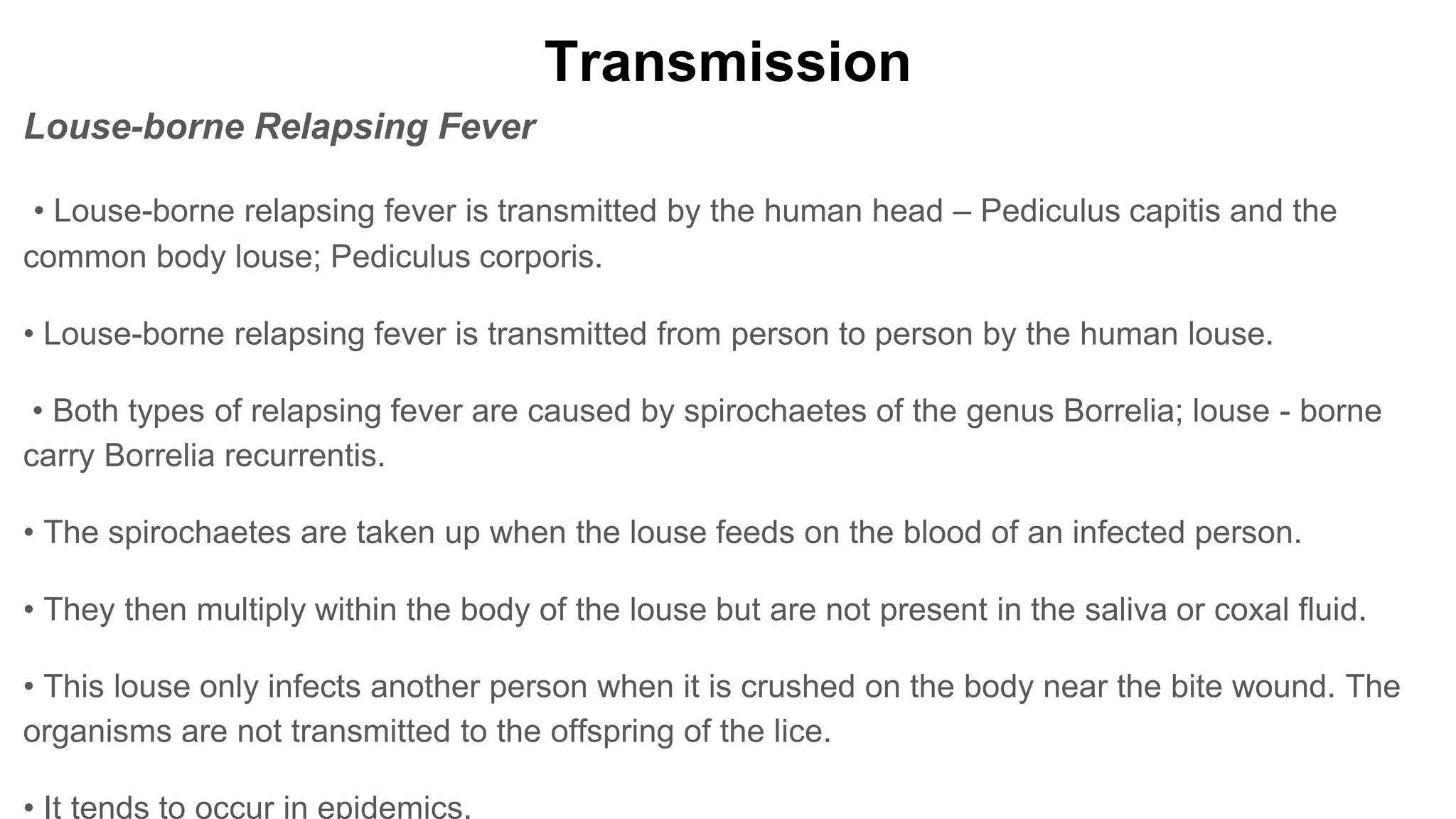
Transmission
Louse-borne Relapsing Fever
• Louse-borne relapsing fever is transmitted by the human head – Pediculus capitis and the
common body louse; Pediculus corporis.
• Louse-borne relapsing fever is transmitted from person to person by the human louse.
• Both types of relapsing fever are caused by spirochaetes of the genus Borrelia; louse - borne
carry Borrelia recurrentis.
• The spirochaetes are taken up when the louse feeds on the blood of an infected person.
• They then multiply within the body of the louse but are not present in the saliva or coxal fluid.
• This louse only infects another person when it is crushed on the body near the bite wound. The
organisms are not transmitted to the offspring of the lice.
• It tends to occur in epidemics.
Tick Born Relapsing Fever
• Tick born relapsing fever is transmitted by soft ticks called Ornithodorus moubata
• Tick-borne relapsing fever is transmitted when the tick sucks blood from an infected person and the
spirochaetes are taken up and multiply in the body of the tick
• Ticks carry Borrelia duttoni
• The spirochetes pass into the ovary of the tick and the offspring of an infected tick are automatically
infected without themselves having sucked infectious blood i.e. transovarian or vertical transmission
• Ticks remain infectious for the rest of its life
• In this way, a house once inhabited by infectious ticks can remain dangerous for many years if no
intervention
• Within one week after sucking infected blood spirochaetes appear in the tick's salivary glands and in
the coxal fluid ready to be transmitted to a new host
cont...
The organisms can either be injected directly when the tick feeds on
the host, or they invade the body through intact mucous membrane.
(e.g., in laboratory infections: Duttoni, the discoverer of the disease
died from it)
• In humans, the spirochaetes can cross the placenta from mother to
foetus
• This may result in abortion, stillbirth, premature delivery or congenital
infection in the newborn
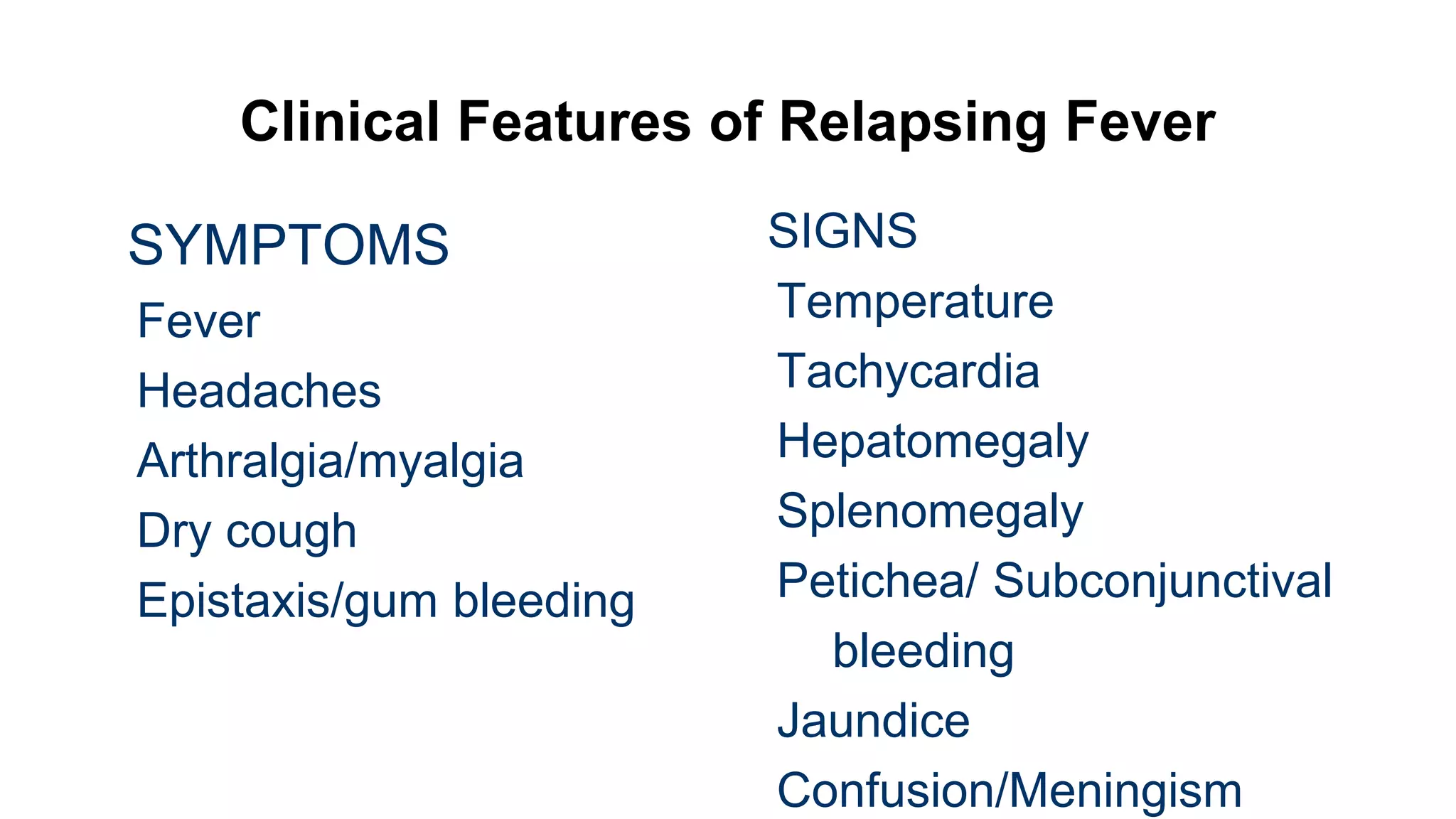
Clinical Features of Relapsing Fever
SYMPTOMS
Fever
Headaches
Arthralgia/myalgia
Dry cough
Epistaxis/gum bleeding
SIGNS
Temperature
Tachycardia
Hepatomegaly
Splenomegaly
Petichea/ Subconjunctival
bleeding
Jaundice
Confusion/Meningism
Complications
● Congestive heart failure
● Jaundice
● Bleeding diathesis
● Jarish- Herxheimer reaction:
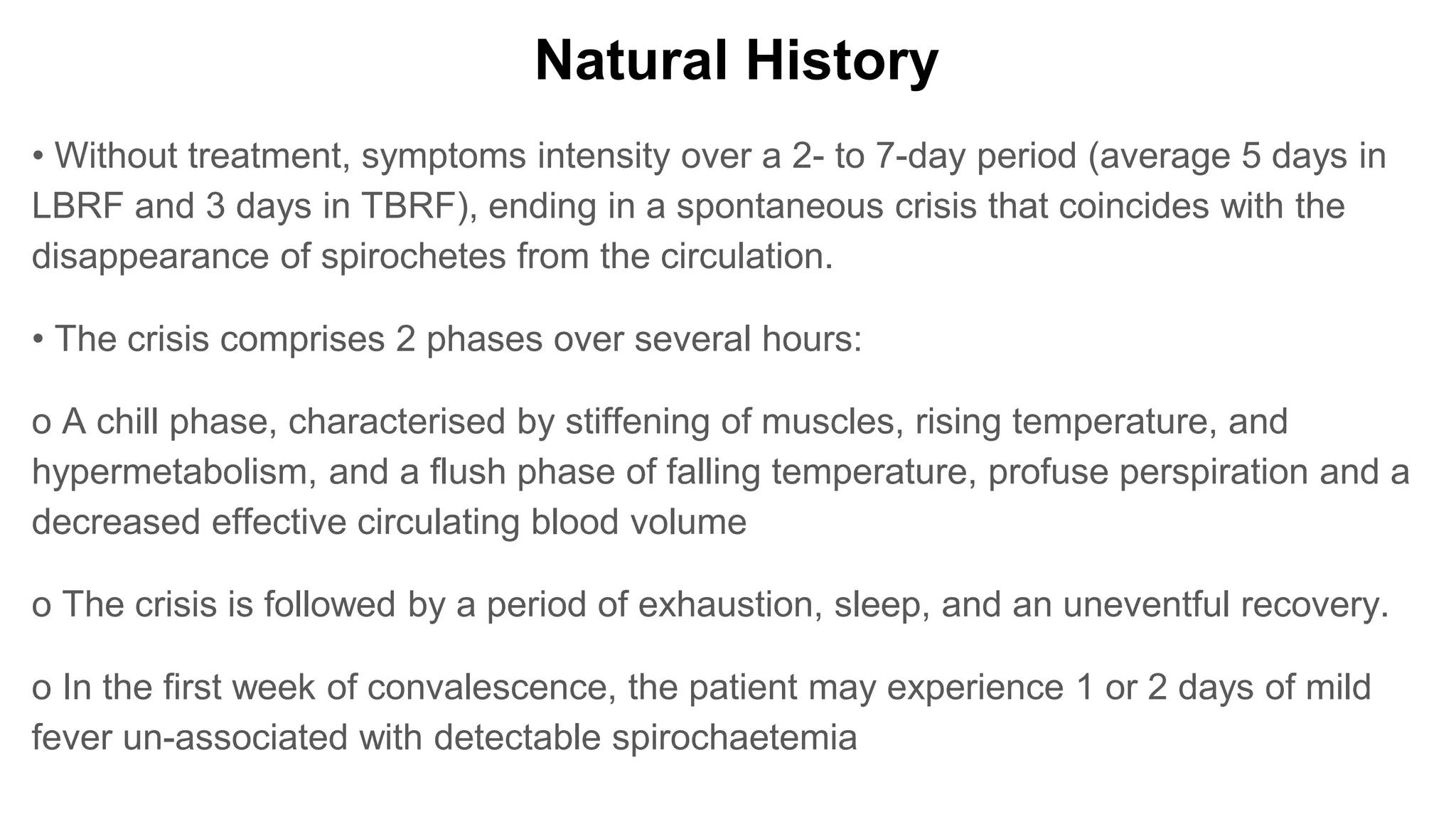
Natural History
• Without treatment, symptoms intensity over a 2- to 7-day period (average 5 days in
LBRF and 3 days in TBRF), ending in a spontaneous crisis that coincides with the
disappearance of spirochetes from the circulation.
• The crisis comprises 2 phases over several hours:
o A chill phase, characterised by stiffening of muscles, rising temperature, and
hypermetabolism, and a flush phase of falling temperature, profuse perspiration and a
decreased effective circulating blood volume
o The crisis is followed by a period of exhaustion, sleep, and an uneventful recovery.
o In the first week of convalescence, the patient may experience 1 or 2 days of mild
fever un-associated with detectable spirochaetemia
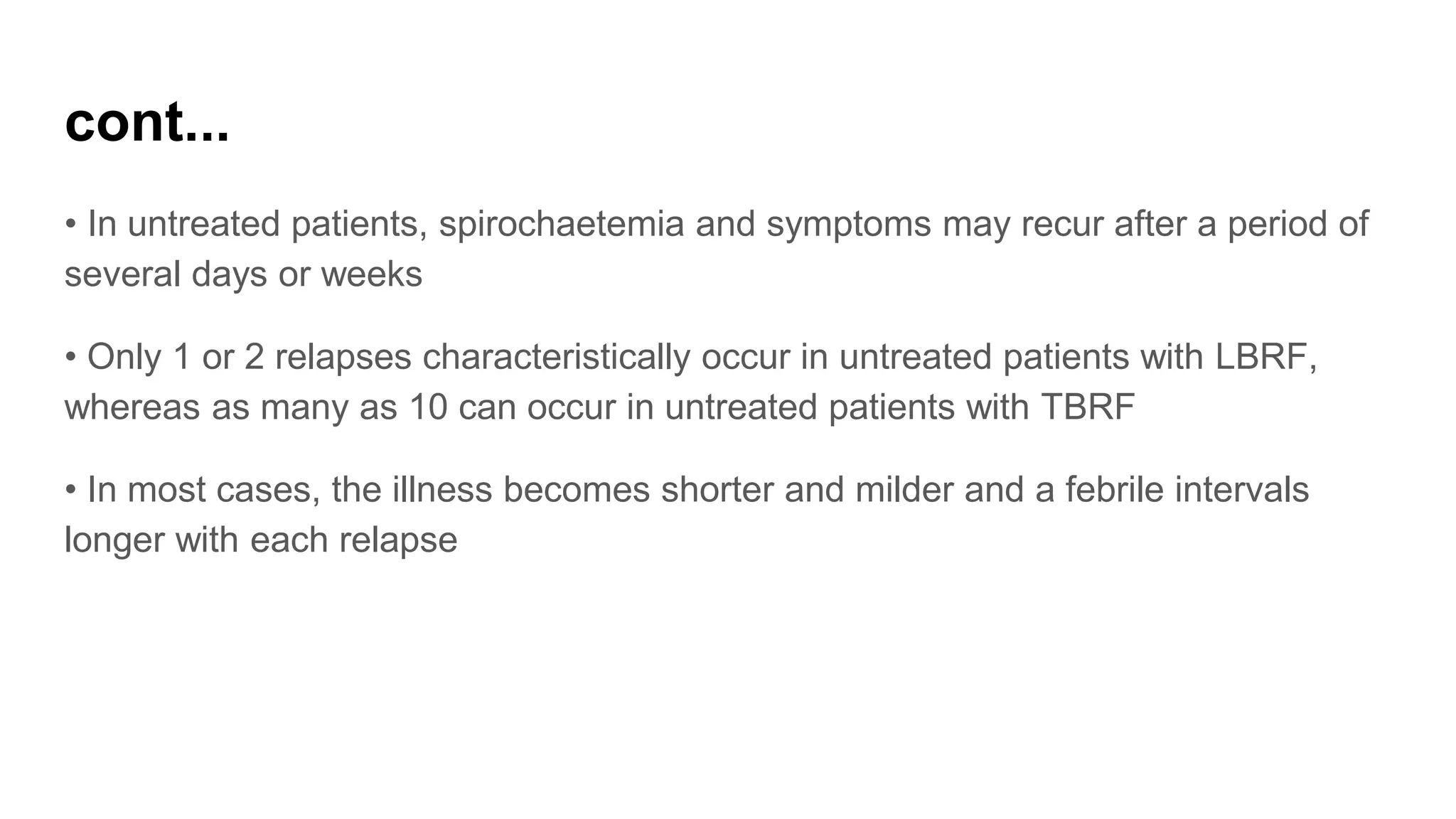
cont...
• In untreated patients, spirochaetemia and symptoms may recur after a period of
several days or weeks
• Only 1 or 2 relapses characteristically occur in untreated patients with LBRF,
whereas as many as 10 can occur in untreated patients with TBRF
• In most cases, the illness becomes shorter and milder and a febrile intervals
longer with each relapse
Differential Diagnosis of Relapsing Fever
• Malaria
• Typhoid fever
• Tuberculosis
• Leptospirosis
• Viral haemorrhagic fever
• Acute HIV seroconversion
• Influenza
Management of Relapsing Fever
Diagnosis
• The clinical picture may be so similar to malaria that only a blood smear can
differentiate the two.
• Microscopic examination of a thick blood smear stained with Leishman or Giemsa, as
is done for malaria, is useful in diagnosis.
• Malaria as a differential diagnosis can also be excluded at the same time.
• Differentiation between the two types of relapsing fever is not possible by
microscopy.
Treatment
• The organisms causing relapsing fever are very sensitive to antibiotics.
• LBRF is usually treated with single dose therapy while TBRF is treated with a 7-
day course of antibiotics.
• Since due to limited resources of differentiating the two organisms a 7-day
course of antibiotics should be given for both.
• Pregnant women and young children 8 years old should be treated with penicillin
or erythromycin, given the potential adverse effects of tetracycline in these
populations.
Drug and Dosage
Erythromycin 500mg. 6 hourly
Tetracycline 500mg. 6 hourly
Doxycycline 100mg. BD. 12 hourly
Chloramphenicol 500mg. 6 hourly
Procaine penicillin G 600, 000 iv per day
Jarisch-Herxheimer Reaction
• Some deaths occur after starting treatment as a result of a severe Jarisch-Herxheimer reaction.
• The antibiotic suddenly kills a large number of spirochaetes which release ‘toxins’ into the
circulation causing the patient to collapse.
• This reaction is characterised by rapid breathing, chills and a fall in blood pressure.
• Patients must be nursed flat, given adequate fluids and be confined to bed for at least 24 hours.
• This reaction tends to be more pronounced with the use of rapidly acting or large doses of
antibiotics.
• To prevent the Jarisch-Herxheimer reaction one may use prednisolone 10-20 mg 8- hourly for 3
days then start treatment for LBRF or TBRF after 24 hours (but use steroids carefully)
Prevention and control of Relapsing Fever
• The best way to control the disease is to improve housing conditions especially filling of
the cracks in the walls.
• The use of corrugated-iron sheets for roofing would eliminate this problem but not
everyone can afford them.
• It is hoped, however, that as the standards of living improve, more people will be able to
afford better housing and the disease will be eliminated.
• Insecticides can be used to kill ticks.
• Gammexane (Gammatox plus) is recommended.
• One kilogram of gammexane is enough to make 40 litres of solution which can then be
sprayed or applied on the floor and walls and in cracks.
cont...
• Control of tick fever can also be achieved by reducing exposure to the infection.
• People who sleep on the floor have the greatest risk of infection.
• The use of beds should therefore be encouraged.
• Mass treatment of patients is not useful as the important reservoir is the tick;
once infected, a tick is able to produce offspring which are also infectious.
Never kills your inborn TALENT!

Relapsing fever notes

  • 2.
  • 3.
    Definition • Relapsing fever:An acute, infectious, bacterial (spirochete) disease characterized by alternating febrile periods and non febrile periods. • It is also known as recurrent fever or tick fever.
  • 4.
    Types of RelapsingFever • There are 2 types of relapsing fever: o Louse-borne relapsing fever o Tick born relapsing fever
  • 5.
    Transmission Louse-borne Relapsing Fever •Louse-borne relapsing fever is transmitted by the human head – Pediculus capitis and the common body louse; Pediculus corporis. • Louse-borne relapsing fever is transmitted from person to person by the human louse. • Both types of relapsing fever are caused by spirochaetes of the genus Borrelia; louse - borne carry Borrelia recurrentis. • The spirochaetes are taken up when the louse feeds on the blood of an infected person. • They then multiply within the body of the louse but are not present in the saliva or coxal fluid. • This louse only infects another person when it is crushed on the body near the bite wound. The organisms are not transmitted to the offspring of the lice. • It tends to occur in epidemics.
  • 6.
    Tick Born RelapsingFever • Tick born relapsing fever is transmitted by soft ticks called Ornithodorus moubata • Tick-borne relapsing fever is transmitted when the tick sucks blood from an infected person and the spirochaetes are taken up and multiply in the body of the tick • Ticks carry Borrelia duttoni • The spirochetes pass into the ovary of the tick and the offspring of an infected tick are automatically infected without themselves having sucked infectious blood i.e. transovarian or vertical transmission • Ticks remain infectious for the rest of its life • In this way, a house once inhabited by infectious ticks can remain dangerous for many years if no intervention • Within one week after sucking infected blood spirochaetes appear in the tick's salivary glands and in the coxal fluid ready to be transmitted to a new host
  • 7.
    cont... The organisms caneither be injected directly when the tick feeds on the host, or they invade the body through intact mucous membrane. (e.g., in laboratory infections: Duttoni, the discoverer of the disease died from it) • In humans, the spirochaetes can cross the placenta from mother to foetus • This may result in abortion, stillbirth, premature delivery or congenital infection in the newborn
  • 8.
    Clinical Features ofRelapsing Fever SYMPTOMS Fever Headaches Arthralgia/myalgia Dry cough Epistaxis/gum bleeding SIGNS Temperature Tachycardia Hepatomegaly Splenomegaly Petichea/ Subconjunctival bleeding Jaundice Confusion/Meningism
  • 9.
    Complications ● Congestive heartfailure ● Jaundice ● Bleeding diathesis ● Jarish- Herxheimer reaction:
  • 10.
    Natural History • Withouttreatment, symptoms intensity over a 2- to 7-day period (average 5 days in LBRF and 3 days in TBRF), ending in a spontaneous crisis that coincides with the disappearance of spirochetes from the circulation. • The crisis comprises 2 phases over several hours: o A chill phase, characterised by stiffening of muscles, rising temperature, and hypermetabolism, and a flush phase of falling temperature, profuse perspiration and a decreased effective circulating blood volume o The crisis is followed by a period of exhaustion, sleep, and an uneventful recovery. o In the first week of convalescence, the patient may experience 1 or 2 days of mild fever un-associated with detectable spirochaetemia
  • 11.
    cont... • In untreatedpatients, spirochaetemia and symptoms may recur after a period of several days or weeks • Only 1 or 2 relapses characteristically occur in untreated patients with LBRF, whereas as many as 10 can occur in untreated patients with TBRF • In most cases, the illness becomes shorter and milder and a febrile intervals longer with each relapse
  • 12.
    Differential Diagnosis ofRelapsing Fever • Malaria • Typhoid fever • Tuberculosis • Leptospirosis • Viral haemorrhagic fever • Acute HIV seroconversion • Influenza
  • 13.
    Management of RelapsingFever Diagnosis • The clinical picture may be so similar to malaria that only a blood smear can differentiate the two. • Microscopic examination of a thick blood smear stained with Leishman or Giemsa, as is done for malaria, is useful in diagnosis. • Malaria as a differential diagnosis can also be excluded at the same time. • Differentiation between the two types of relapsing fever is not possible by microscopy.
  • 14.
    Treatment • The organismscausing relapsing fever are very sensitive to antibiotics. • LBRF is usually treated with single dose therapy while TBRF is treated with a 7- day course of antibiotics. • Since due to limited resources of differentiating the two organisms a 7-day course of antibiotics should be given for both. • Pregnant women and young children 8 years old should be treated with penicillin or erythromycin, given the potential adverse effects of tetracycline in these populations.
  • 15.
    Drug and Dosage Erythromycin500mg. 6 hourly Tetracycline 500mg. 6 hourly Doxycycline 100mg. BD. 12 hourly Chloramphenicol 500mg. 6 hourly Procaine penicillin G 600, 000 iv per day
  • 16.
    Jarisch-Herxheimer Reaction • Somedeaths occur after starting treatment as a result of a severe Jarisch-Herxheimer reaction. • The antibiotic suddenly kills a large number of spirochaetes which release ‘toxins’ into the circulation causing the patient to collapse. • This reaction is characterised by rapid breathing, chills and a fall in blood pressure. • Patients must be nursed flat, given adequate fluids and be confined to bed for at least 24 hours. • This reaction tends to be more pronounced with the use of rapidly acting or large doses of antibiotics. • To prevent the Jarisch-Herxheimer reaction one may use prednisolone 10-20 mg 8- hourly for 3 days then start treatment for LBRF or TBRF after 24 hours (but use steroids carefully)
  • 17.
    Prevention and controlof Relapsing Fever • The best way to control the disease is to improve housing conditions especially filling of the cracks in the walls. • The use of corrugated-iron sheets for roofing would eliminate this problem but not everyone can afford them. • It is hoped, however, that as the standards of living improve, more people will be able to afford better housing and the disease will be eliminated. • Insecticides can be used to kill ticks. • Gammexane (Gammatox plus) is recommended. • One kilogram of gammexane is enough to make 40 litres of solution which can then be sprayed or applied on the floor and walls and in cracks.
  • 18.
    cont... • Control oftick fever can also be achieved by reducing exposure to the infection. • People who sleep on the floor have the greatest risk of infection. • The use of beds should therefore be encouraged. • Mass treatment of patients is not useful as the important reservoir is the tick; once infected, a tick is able to produce offspring which are also infectious.
  • 19.
    Never kills yourinborn TALENT!