Engineering | Architecture | Design-Build | Surveying | Planning | GeoSpatial Solutions
February 18, 2014
GEOSPATIAL SOLUTIONS
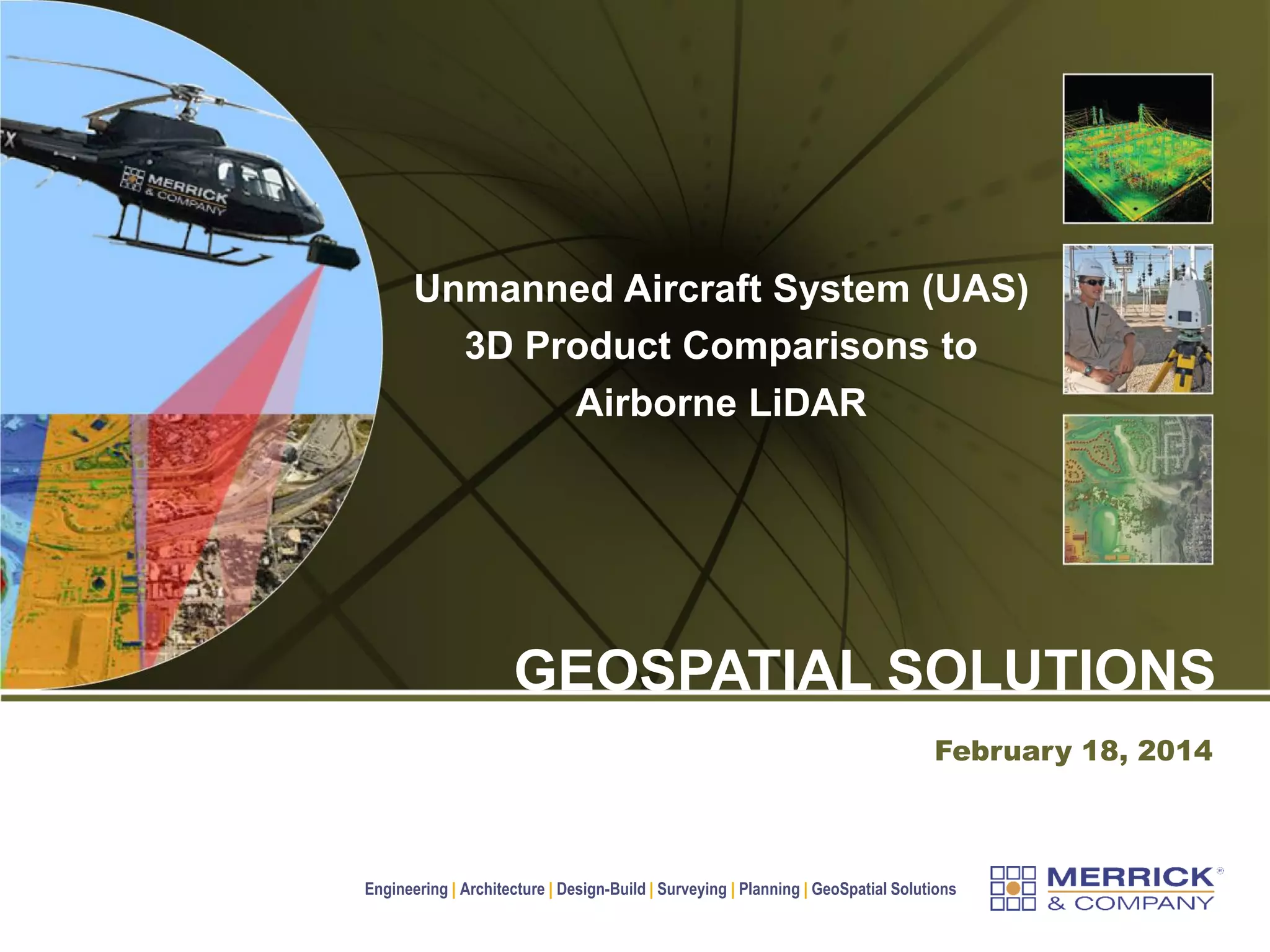
Unmanned Aircraft System (UAS)
3D Product Comparisons to
Airborne LiDAR
Copyright © 2013 Merrick & Company - All rights reserved.
PREXXXX 2
Matt Bethel, GISP
Director of Technology for Merrick & Company
 UAS processing vs. direct georeferencing
 Overview of UAS workflow
 Influences on UAS accuracy
 Discuss and compare 3D UAS imaging products to LiDAR
Presentation Agenda
Copyright © 2013 Merrick & Company - All rights reserved.
PREXXXX 4
Not the purpose of this presentation
 Comparing different UAV
systems and their components
 Rigorous comparison of UAS
processing software fucntionality
 UAS vs. LiDAR costs
 UAS vs. traditional digital aerial
photography quality
 UAS procedures, best practices,
FAA regulations, etc.
 UAS vs. LiDAR collection
efficiencies
 UAS sensors other than RGB
cameras
Copyright © 2013 Merrick & Company - All rights reserved.
PREXXXX 5
UAS vs. Direct Georeferencing
 GPS seeds the processing
 No post processing GPS (no base station required)
 No rigorous IMU processing
 Photo identifiable points are still required
 Exterior orientation is calculated with little to no GPS/IMU information
 Camera model is automatically refined throughout the process
 Interior is adjusted, typically per image
 This allows for the use of non-metric cameras
 Movement towards more streamlined / black box process
 Less human time, more computer time (until processes are improved)
1. Relative 3D model is built using computer vision processes
2. Adjusted to ground with control using traditional AT procedures
3. Strengthened and densified using new photogrammetric processes
Copyright © 2013 Merrick & Company - All rights reserved.
PREXXXX 6
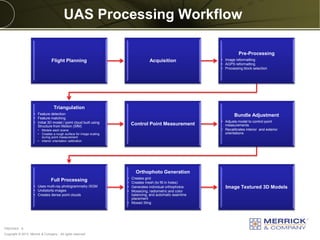
UAS Processing Workflow
Flight Planning Acquisition
Pre-Processing
• Image reformatting
• AGPS reformatting
• Processing block selection
Triangulation
• Feature detection
• Feature matching
• Initial 3D model / point cloud built using
Structure from Motion (SfM)
• Models each scene
• Creates a rough surface for image scaling
during point measurement
• Interior orientation calibration
Control Point Measurement
Bundle Adjustment
• Adjusts model to control point
measurements
• Recalibrates interior and exterior
orientations
Full Processing
• Uses multi-ray photogrammetry /SGM
• Undistorts images
• Creates dense point clouds
Orthophoto Generation
• Creates grid
• Creates mesh (to fill in holes)
• Generates individual orthophotos
• Mosaicing, radiometric and color
balancing, and automatic seamline
placement
• Mosaic tiling
Image Textured 3D Models
Copyright © 2013 Merrick & Company - All rights reserved.
PREXXXX 7
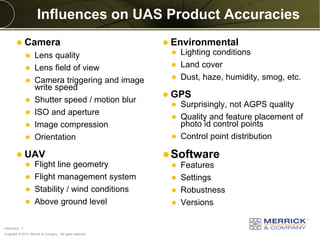
Influences on UAS Product Accuracies
 Camera
 Lens quality
 Lens field of view
 Camera triggering and image
write speed
 Shutter speed / motion blur
 ISO and aperture
 Image compression
 Orientation
 UAV
 Flight line geometry
 Flight management system
 Stability / wind conditions
 Above ground level
 Environmental
 Lighting conditions
 Land cover
 Dust, haze, humidity, smog, etc.
 GPS
 Surprisingly, not AGPS quality
 Quality and feature placement of
photo id control points
 Control point distribution
Software
 Features
 Settings
 Robustness
 Versions
Copyright © 2013 Merrick & Company - All rights reserved.
PREXXXX 8
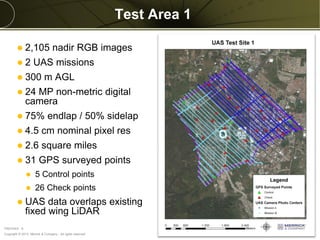
Test Area 1
 2,105 nadir RGB images
 2 UAS missions
 300 m AGL
 24 MP non-metric digital
camera
 75% endlap / 50% sidelap
 4.5 cm nominal pixel res
 2.6 square miles
 31 GPS surveyed points
 5 Control points
 26 Check points
 UAS data overlaps existing
fixed wing LiDAR
Copyright © 2013 Merrick & Company - All rights reserved.
PREXXXX 9
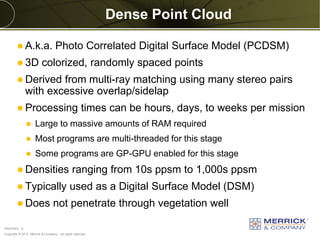
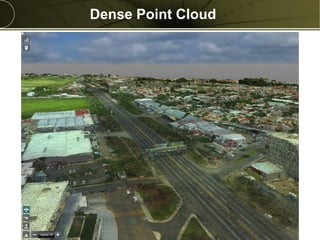
Dense Point Cloud
 A.k.a. Photo Correlated Digital Surface Model (PCDSM)
 3D colorized, randomly spaced points
 Derived from multi-ray matching using many stereo pairs
with excessive overlap/sidelap
 Processing times can be hours, days, to weeks per mission
 Large to massive amounts of RAM required
 Most programs are multi-threaded for this stage
 Some programs are GP-GPU enabled for this stage
 Densities ranging from 10s ppsm to 1,000s ppsm
 Typically used as a Digital Surface Model (DSM)
 Does not penetrate through vegetation well
Copyright © 2013 Merrick & Company - All rights reserved.
PREXXXX 10
Dense Point Cloud
Copyright © 2013 Merrick & Company - All rights reserved.
PREXXXX 11
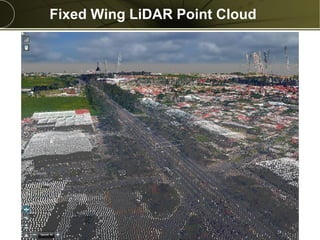
Fixed Wing LiDAR Point Cloud
Copyright © 2013 Merrick & Company - All rights reserved.
PREXXXX 12
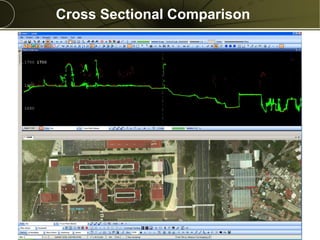
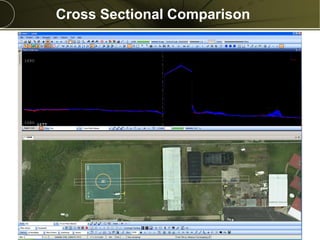
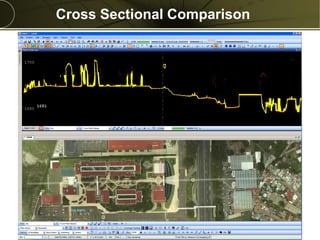
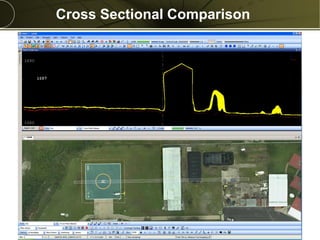
Cross Sectional Comparison
Copyright © 2013 Merrick & Company - All rights reserved.
PREXXXX 13
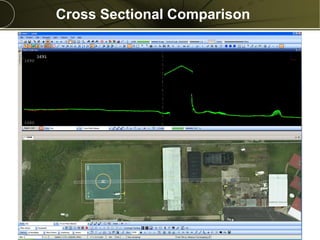
Cross Sectional Comparison
Copyright © 2013 Merrick & Company - All rights reserved.
PREXXXX 14
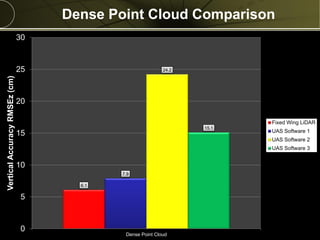
Dense Point Cloud Comparison
6.1
7.9
24.2
15.1
0
5
10
15
20
25
30
Dense Point Cloud
VerticalAccuracyRMSEz(cm)
Fixed Wing LiDAR
UAS Software 1
UAS Software 2
UAS Software 3
Copyright © 2013 Merrick & Company - All rights reserved.
PREXXXX 15
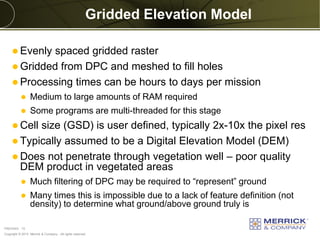
Gridded Elevation Model
 Evenly spaced gridded raster
 Gridded from DPC and meshed to fill holes
 Processing times can be hours to days per mission
 Medium to large amounts of RAM required
 Some programs are multi-threaded for this stage
 Cell size (GSD) is user defined, typically 2x-10x the pixel res
 Typically assumed to be a Digital Elevation Model (DEM)
 Does not penetrate through vegetation well – poor quality
DEM product in vegetated areas
 Much filtering of DPC may be required to “represent” ground
 Many times this is impossible due to a lack of feature definition (not
density) to determine what ground/above ground truly is
Copyright © 2013 Merrick & Company - All rights reserved.
PREXXXX 16
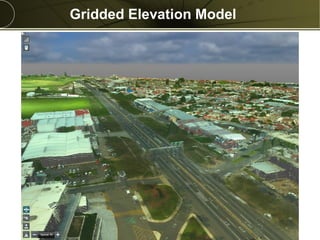
Gridded Elevation Model
Copyright © 2013 Merrick & Company - All rights reserved.
PREXXXX 17
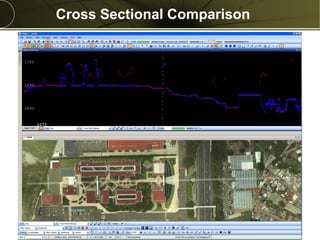
Cross Sectional Comparison
Copyright © 2013 Merrick & Company - All rights reserved.
PREXXXX 18
Cross Sectional Comparison
Copyright © 2013 Merrick & Company - All rights reserved.
PREXXXX 19
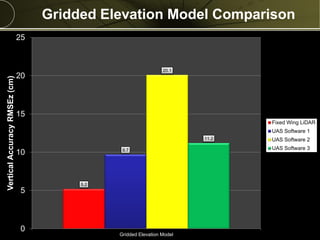
Gridded Elevation Model Comparison
5.2
9.7
20.1
11.2
0
5
10
15
20
25
Gridded Elevation Model
VerticalAccuracyRMSEz(cm)
Fixed Wing LiDAR
UAS Software 1
UAS Software 2
UAS Software 3
Copyright © 2013 Merrick & Company - All rights reserved.
PREXXXX 20
Image Textured 3D Model
 Multi-directional Triangulated Irregular Network (TIN)
 Created from three dimensionally modeling all visible portions of
ground and above ground features
 Ray tracing 3D feature positions compared to each image’s focal plane
looking for the most perpendicular
 Processing times can be hours, days, to weeks per mission – very
dependent on software package
 Medium to massive RAM required (successful /unsuccessful memory
management varies dramatically across software packages)
 Most programs are multi-threaded for this stage
 Some programs are GP-GPU enabled for this stage
 Native format are image textured TINs but when converted to colorized
point clouds preserving all voxels, densities can range from 1,000s
ppsm to 10,000s ppsm
 Typically used for city models
 Does not penetrate through vegetation well but can sometimes get
around and under trees
Copyright © 2013 Merrick & Company - All rights reserved.
PREXXXX 21
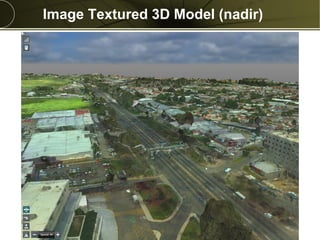
Image Textured 3D Model (nadir)
Copyright © 2013 Merrick & Company - All rights reserved.
PREXXXX 22
Cross Sectional Comparison
Copyright © 2013 Merrick & Company - All rights reserved.
PREXXXX 23
Cross Sectional Comparison
Copyright © 2013 Merrick & Company - All rights reserved.
PREXXXX 24
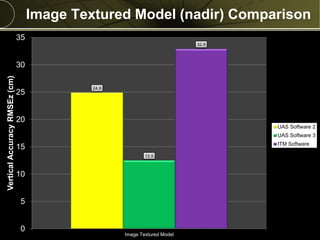
Image Textured Model (nadir) Comparison
24.9
12.5
32.9
0
5
10
15
20
25
30
35
Image Textured Model
VerticalAccuracyRMSEz(cm)
UAS Software 2
UAS Software 3
ITM Software
Copyright © 2013 Merrick & Company - All rights reserved.
PREXXXX 25
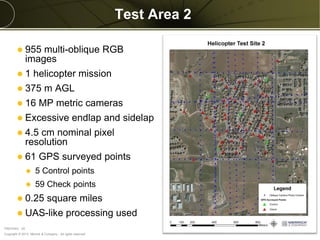
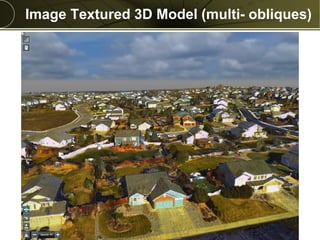
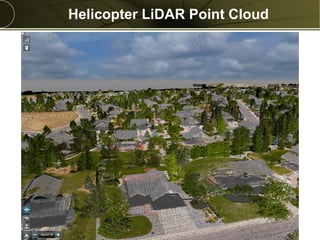
Test Area 2
 955 multi-oblique RGB
images
 1 helicopter mission
 375 m AGL
 16 MP metric cameras
 Excessive endlap and sidelap
 4.5 cm nominal pixel
resolution
 61 GPS surveyed points
 5 Control points
 59 Check points
 0.25 square miles
 UAS-like processing used
Copyright © 2013 Merrick & Company - All rights reserved.
PREXXXX 26
Image Textured 3D Model (multi- obliques)
Copyright © 2013 Merrick & Company - All rights reserved.
PREXXXX 27
Helicopter LiDAR Point Cloud
Copyright © 2013 Merrick & Company - All rights reserved.
PREXXXX 28
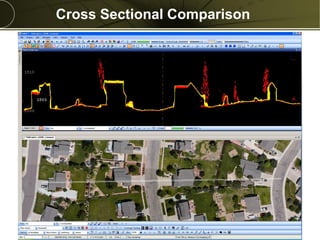
Cross Sectional Comparison
Copyright © 2013 Merrick & Company - All rights reserved.
PREXXXX 29
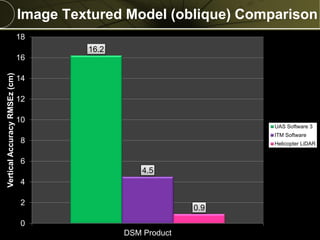
Image Textured Model (oblique) Comparison
16.2
4.5
0.9
0
2
4
6
8
10
12
14
16
18
DSM Product
VerticalAccuracyRMSEz(cm)
UAS Software 3
ITM Software
Helicopter LiDAR
Copyright © 2013 Merrick & Company - All rights reserved.
PREXXXX 30
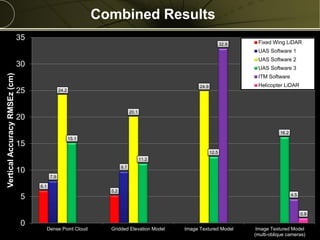
Combined Results
6.1
5.2
7.9
9.7
24.2
20.1
24.9
15.1
11.2
12.5
16.2
32.9
4.5
0.9
0
5
10
15
20
25
30
35
Dense Point Cloud Gridded Elevation Model Image Textured Model Image Textured Model
(multi-oblique cameras)
VerticalAccuracyRMSEz(cm)
Fixed Wing LiDAR
UAS Software 1
UAS Software 2
UAS Software 3
ITM Software
Helicopter LiDAR
Copyright © 2013 Merrick & Company - All rights reserved.
PREXXXX 31
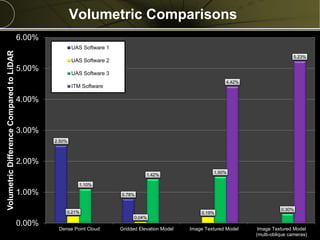
Volumetric Comparisons
2.50%
0.78%
0.21%
0.04%
0.19%
1.10%
1.42%
1.50%
0.30%
4.42%
5.23%
0.00%
1.00%
2.00%
3.00%
4.00%
5.00%
6.00%
Dense Point Cloud Gridded Elevation Model Image Textured Model Image Textured Model
(multi-oblique cameras)
VolumetricDifferenceComparedtoLiDAR
UAS Software 1
UAS Software 2
UAS Software 3
ITM Software
Copyright © 2013 Merrick & Company - All rights reserved.
PREXXXX 32
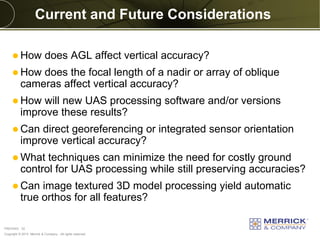
Current and Future Considerations
 How does AGL affect vertical accuracy?
 How does the focal length of a nadir or array of oblique
cameras affect vertical accuracy?
 How will new UAS processing software and/or versions
improve these results?
 Can direct georeferencing or integrated sensor orientation
improve vertical accuracy?
 What techniques can minimize the need for costly ground
control for UAS processing while still preserving accuracies?
 Can image textured 3D model processing yield automatic
true orthos for all features?
Copyright © 2013 Merrick & Company - All rights reserved.
PREXXXX 33
Contact Info
Matt Bethel
Director of Technology
Merrick & Company
www.merrick.com
matt.bethel@merrick.com
(303) 353-3662
ILMF booth #68

Unmanned Aircraft System (UAS) 3D Product Comparisons to Airborne LiDAR

  • 1.
    Engineering | Architecture| Design-Build | Surveying | Planning | GeoSpatial Solutions February 18, 2014 GEOSPATIAL SOLUTIONS Unmanned Aircraft System (UAS) 3D Product Comparisons to Airborne LiDAR
  • 2.
    Copyright © 2013Merrick & Company - All rights reserved. PREXXXX 2 Matt Bethel, GISP Director of Technology for Merrick & Company
  • 3.
     UAS processingvs. direct georeferencing  Overview of UAS workflow  Influences on UAS accuracy  Discuss and compare 3D UAS imaging products to LiDAR Presentation Agenda
  • 4.
    Copyright © 2013Merrick & Company - All rights reserved. PREXXXX 4 Not the purpose of this presentation  Comparing different UAV systems and their components  Rigorous comparison of UAS processing software fucntionality  UAS vs. LiDAR costs  UAS vs. traditional digital aerial photography quality  UAS procedures, best practices, FAA regulations, etc.  UAS vs. LiDAR collection efficiencies  UAS sensors other than RGB cameras
  • 5.
    Copyright © 2013Merrick & Company - All rights reserved. PREXXXX 5 UAS vs. Direct Georeferencing  GPS seeds the processing  No post processing GPS (no base station required)  No rigorous IMU processing  Photo identifiable points are still required  Exterior orientation is calculated with little to no GPS/IMU information  Camera model is automatically refined throughout the process  Interior is adjusted, typically per image  This allows for the use of non-metric cameras  Movement towards more streamlined / black box process  Less human time, more computer time (until processes are improved) 1. Relative 3D model is built using computer vision processes 2. Adjusted to ground with control using traditional AT procedures 3. Strengthened and densified using new photogrammetric processes
  • 6.
    Copyright © 2013Merrick & Company - All rights reserved. PREXXXX 6 UAS Processing Workflow Flight Planning Acquisition Pre-Processing • Image reformatting • AGPS reformatting • Processing block selection Triangulation • Feature detection • Feature matching • Initial 3D model / point cloud built using Structure from Motion (SfM) • Models each scene • Creates a rough surface for image scaling during point measurement • Interior orientation calibration Control Point Measurement Bundle Adjustment • Adjusts model to control point measurements • Recalibrates interior and exterior orientations Full Processing • Uses multi-ray photogrammetry /SGM • Undistorts images • Creates dense point clouds Orthophoto Generation • Creates grid • Creates mesh (to fill in holes) • Generates individual orthophotos • Mosaicing, radiometric and color balancing, and automatic seamline placement • Mosaic tiling Image Textured 3D Models
  • 7.
    Copyright © 2013Merrick & Company - All rights reserved. PREXXXX 7 Influences on UAS Product Accuracies  Camera  Lens quality  Lens field of view  Camera triggering and image write speed  Shutter speed / motion blur  ISO and aperture  Image compression  Orientation  UAV  Flight line geometry  Flight management system  Stability / wind conditions  Above ground level  Environmental  Lighting conditions  Land cover  Dust, haze, humidity, smog, etc.  GPS  Surprisingly, not AGPS quality  Quality and feature placement of photo id control points  Control point distribution Software  Features  Settings  Robustness  Versions
  • 8.
    Copyright © 2013Merrick & Company - All rights reserved. PREXXXX 8 Test Area 1  2,105 nadir RGB images  2 UAS missions  300 m AGL  24 MP non-metric digital camera  75% endlap / 50% sidelap  4.5 cm nominal pixel res  2.6 square miles  31 GPS surveyed points  5 Control points  26 Check points  UAS data overlaps existing fixed wing LiDAR
  • 9.
    Copyright © 2013Merrick & Company - All rights reserved. PREXXXX 9 Dense Point Cloud  A.k.a. Photo Correlated Digital Surface Model (PCDSM)  3D colorized, randomly spaced points  Derived from multi-ray matching using many stereo pairs with excessive overlap/sidelap  Processing times can be hours, days, to weeks per mission  Large to massive amounts of RAM required  Most programs are multi-threaded for this stage  Some programs are GP-GPU enabled for this stage  Densities ranging from 10s ppsm to 1,000s ppsm  Typically used as a Digital Surface Model (DSM)  Does not penetrate through vegetation well
  • 10.
    Copyright © 2013Merrick & Company - All rights reserved. PREXXXX 10 Dense Point Cloud
  • 11.
    Copyright © 2013Merrick & Company - All rights reserved. PREXXXX 11 Fixed Wing LiDAR Point Cloud
  • 12.
    Copyright © 2013Merrick & Company - All rights reserved. PREXXXX 12 Cross Sectional Comparison
  • 13.
    Copyright © 2013Merrick & Company - All rights reserved. PREXXXX 13 Cross Sectional Comparison
  • 14.
    Copyright © 2013Merrick & Company - All rights reserved. PREXXXX 14 Dense Point Cloud Comparison 6.1 7.9 24.2 15.1 0 5 10 15 20 25 30 Dense Point Cloud VerticalAccuracyRMSEz(cm) Fixed Wing LiDAR UAS Software 1 UAS Software 2 UAS Software 3
  • 15.
    Copyright © 2013Merrick & Company - All rights reserved. PREXXXX 15 Gridded Elevation Model  Evenly spaced gridded raster  Gridded from DPC and meshed to fill holes  Processing times can be hours to days per mission  Medium to large amounts of RAM required  Some programs are multi-threaded for this stage  Cell size (GSD) is user defined, typically 2x-10x the pixel res  Typically assumed to be a Digital Elevation Model (DEM)  Does not penetrate through vegetation well – poor quality DEM product in vegetated areas  Much filtering of DPC may be required to “represent” ground  Many times this is impossible due to a lack of feature definition (not density) to determine what ground/above ground truly is
  • 16.
    Copyright © 2013Merrick & Company - All rights reserved. PREXXXX 16 Gridded Elevation Model
  • 17.
    Copyright © 2013Merrick & Company - All rights reserved. PREXXXX 17 Cross Sectional Comparison
  • 18.
    Copyright © 2013Merrick & Company - All rights reserved. PREXXXX 18 Cross Sectional Comparison
  • 19.
    Copyright © 2013Merrick & Company - All rights reserved. PREXXXX 19 Gridded Elevation Model Comparison 5.2 9.7 20.1 11.2 0 5 10 15 20 25 Gridded Elevation Model VerticalAccuracyRMSEz(cm) Fixed Wing LiDAR UAS Software 1 UAS Software 2 UAS Software 3
  • 20.
    Copyright © 2013Merrick & Company - All rights reserved. PREXXXX 20 Image Textured 3D Model  Multi-directional Triangulated Irregular Network (TIN)  Created from three dimensionally modeling all visible portions of ground and above ground features  Ray tracing 3D feature positions compared to each image’s focal plane looking for the most perpendicular  Processing times can be hours, days, to weeks per mission – very dependent on software package  Medium to massive RAM required (successful /unsuccessful memory management varies dramatically across software packages)  Most programs are multi-threaded for this stage  Some programs are GP-GPU enabled for this stage  Native format are image textured TINs but when converted to colorized point clouds preserving all voxels, densities can range from 1,000s ppsm to 10,000s ppsm  Typically used for city models  Does not penetrate through vegetation well but can sometimes get around and under trees
  • 21.
    Copyright © 2013Merrick & Company - All rights reserved. PREXXXX 21 Image Textured 3D Model (nadir)
  • 22.
    Copyright © 2013Merrick & Company - All rights reserved. PREXXXX 22 Cross Sectional Comparison
  • 23.
    Copyright © 2013Merrick & Company - All rights reserved. PREXXXX 23 Cross Sectional Comparison
  • 24.
    Copyright © 2013Merrick & Company - All rights reserved. PREXXXX 24 Image Textured Model (nadir) Comparison 24.9 12.5 32.9 0 5 10 15 20 25 30 35 Image Textured Model VerticalAccuracyRMSEz(cm) UAS Software 2 UAS Software 3 ITM Software
  • 25.
    Copyright © 2013Merrick & Company - All rights reserved. PREXXXX 25 Test Area 2  955 multi-oblique RGB images  1 helicopter mission  375 m AGL  16 MP metric cameras  Excessive endlap and sidelap  4.5 cm nominal pixel resolution  61 GPS surveyed points  5 Control points  59 Check points  0.25 square miles  UAS-like processing used
  • 26.
    Copyright © 2013Merrick & Company - All rights reserved. PREXXXX 26 Image Textured 3D Model (multi- obliques)
  • 27.
    Copyright © 2013Merrick & Company - All rights reserved. PREXXXX 27 Helicopter LiDAR Point Cloud
  • 28.
    Copyright © 2013Merrick & Company - All rights reserved. PREXXXX 28 Cross Sectional Comparison
  • 29.
    Copyright © 2013Merrick & Company - All rights reserved. PREXXXX 29 Image Textured Model (oblique) Comparison 16.2 4.5 0.9 0 2 4 6 8 10 12 14 16 18 DSM Product VerticalAccuracyRMSEz(cm) UAS Software 3 ITM Software Helicopter LiDAR
  • 30.
    Copyright © 2013Merrick & Company - All rights reserved. PREXXXX 30 Combined Results 6.1 5.2 7.9 9.7 24.2 20.1 24.9 15.1 11.2 12.5 16.2 32.9 4.5 0.9 0 5 10 15 20 25 30 35 Dense Point Cloud Gridded Elevation Model Image Textured Model Image Textured Model (multi-oblique cameras) VerticalAccuracyRMSEz(cm) Fixed Wing LiDAR UAS Software 1 UAS Software 2 UAS Software 3 ITM Software Helicopter LiDAR
  • 31.
    Copyright © 2013Merrick & Company - All rights reserved. PREXXXX 31 Volumetric Comparisons 2.50% 0.78% 0.21% 0.04% 0.19% 1.10% 1.42% 1.50% 0.30% 4.42% 5.23% 0.00% 1.00% 2.00% 3.00% 4.00% 5.00% 6.00% Dense Point Cloud Gridded Elevation Model Image Textured Model Image Textured Model (multi-oblique cameras) VolumetricDifferenceComparedtoLiDAR UAS Software 1 UAS Software 2 UAS Software 3 ITM Software
  • 32.
    Copyright © 2013Merrick & Company - All rights reserved. PREXXXX 32 Current and Future Considerations  How does AGL affect vertical accuracy?  How does the focal length of a nadir or array of oblique cameras affect vertical accuracy?  How will new UAS processing software and/or versions improve these results?  Can direct georeferencing or integrated sensor orientation improve vertical accuracy?  What techniques can minimize the need for costly ground control for UAS processing while still preserving accuracies?  Can image textured 3D model processing yield automatic true orthos for all features?
  • 33.
    Copyright © 2013Merrick & Company - All rights reserved. PREXXXX 33 Contact Info Matt Bethel Director of Technology Merrick & Company www.merrick.com matt.bethel@merrick.com (303) 353-3662 ILMF booth #68