Evolving EO/IR Commercial UAS Landscape: User
Needs and DefenseTrends
For TTC’s Next-Generation ISR Symposium for Military and Government
Arlington,VA. December 15-16, 2016
Ron Stearns,
Director, Business Development, Robotics and Unmanned Systems
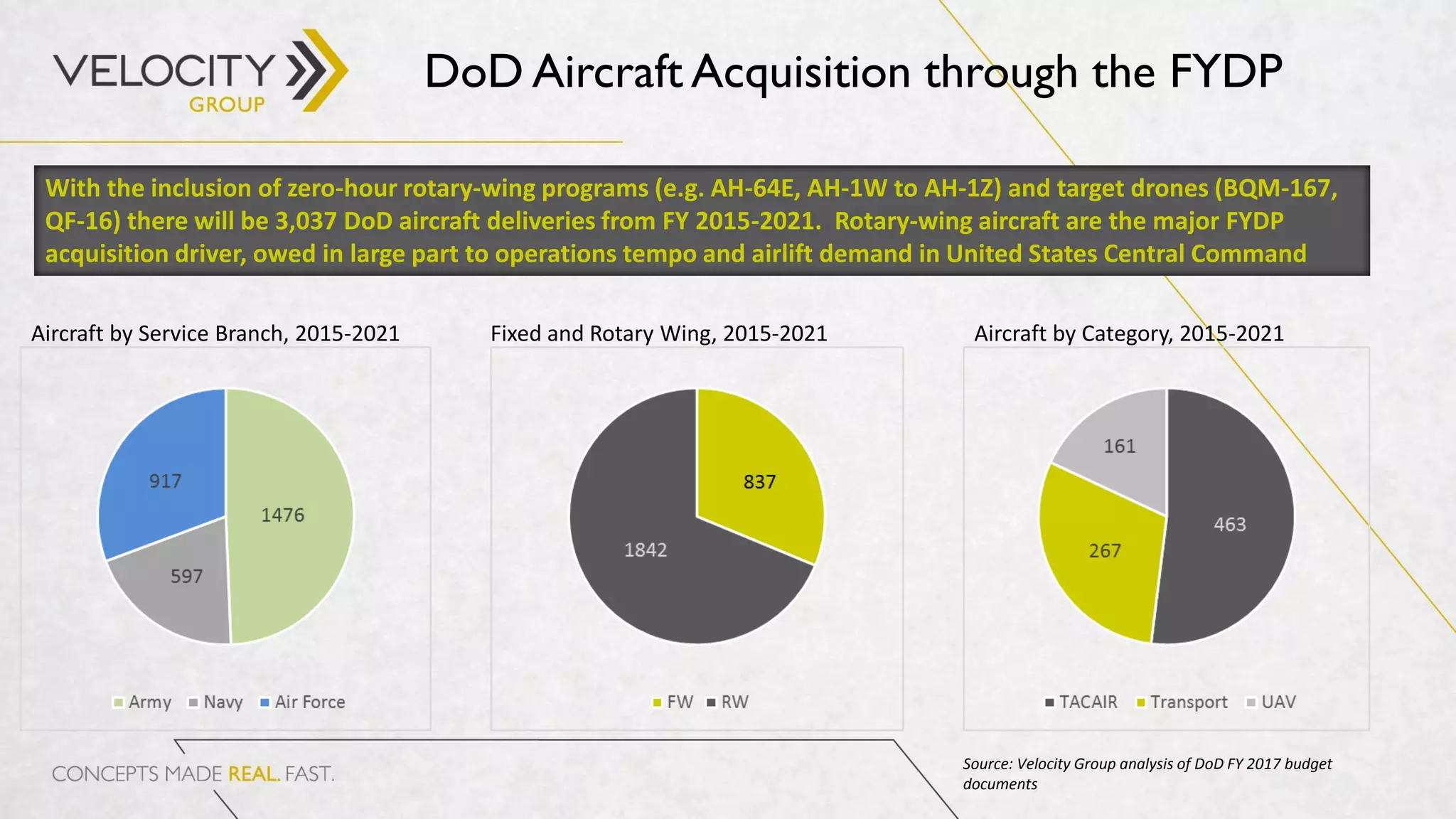
DoD Aircraft Acquisition through the FYDP
Aircraft by Service Branch, 2015-2021 Fixed and Rotary Wing, 2015-2021 Aircraft by Category, 2015-2021
Source: Velocity Group analysis of DoD FY 2017 budget
documents
With the inclusion of zero-hour rotary-wing programs (e.g. AH-64E, AH-1W to AH-1Z) and target drones (BQM-167,
QF-16) there will be 3,037 DoD aircraft deliveries from FY 2015-2021. Rotary-wing aircraft are the major FYDP
acquisition driver, owed in large part to operations tempo and airlift demand in United States Central Command
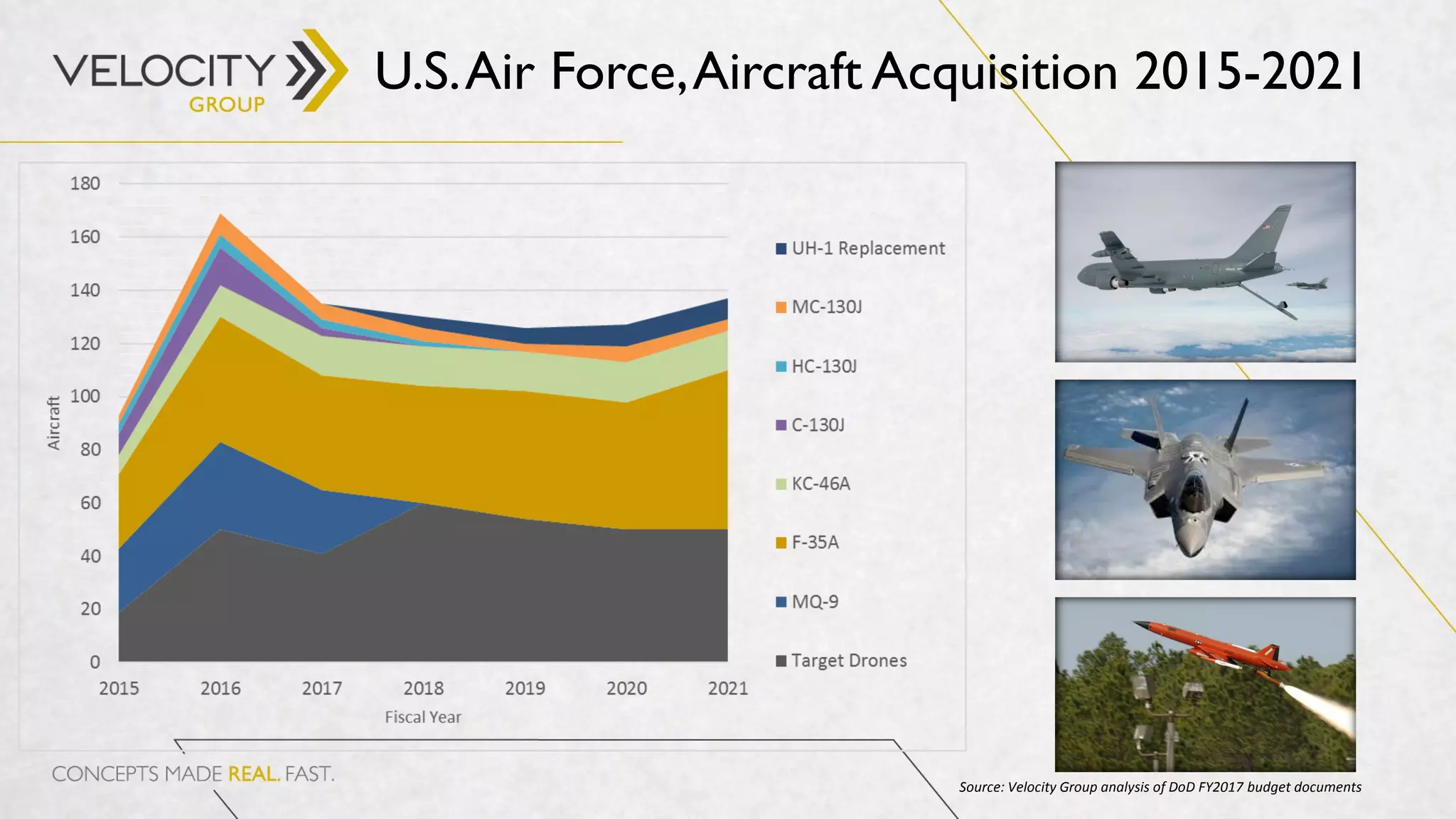
U.S.Air Force,Aircraft Acquisition 2015-2021
Source: Velocity Group analysis of DoD FY2017 budget documents
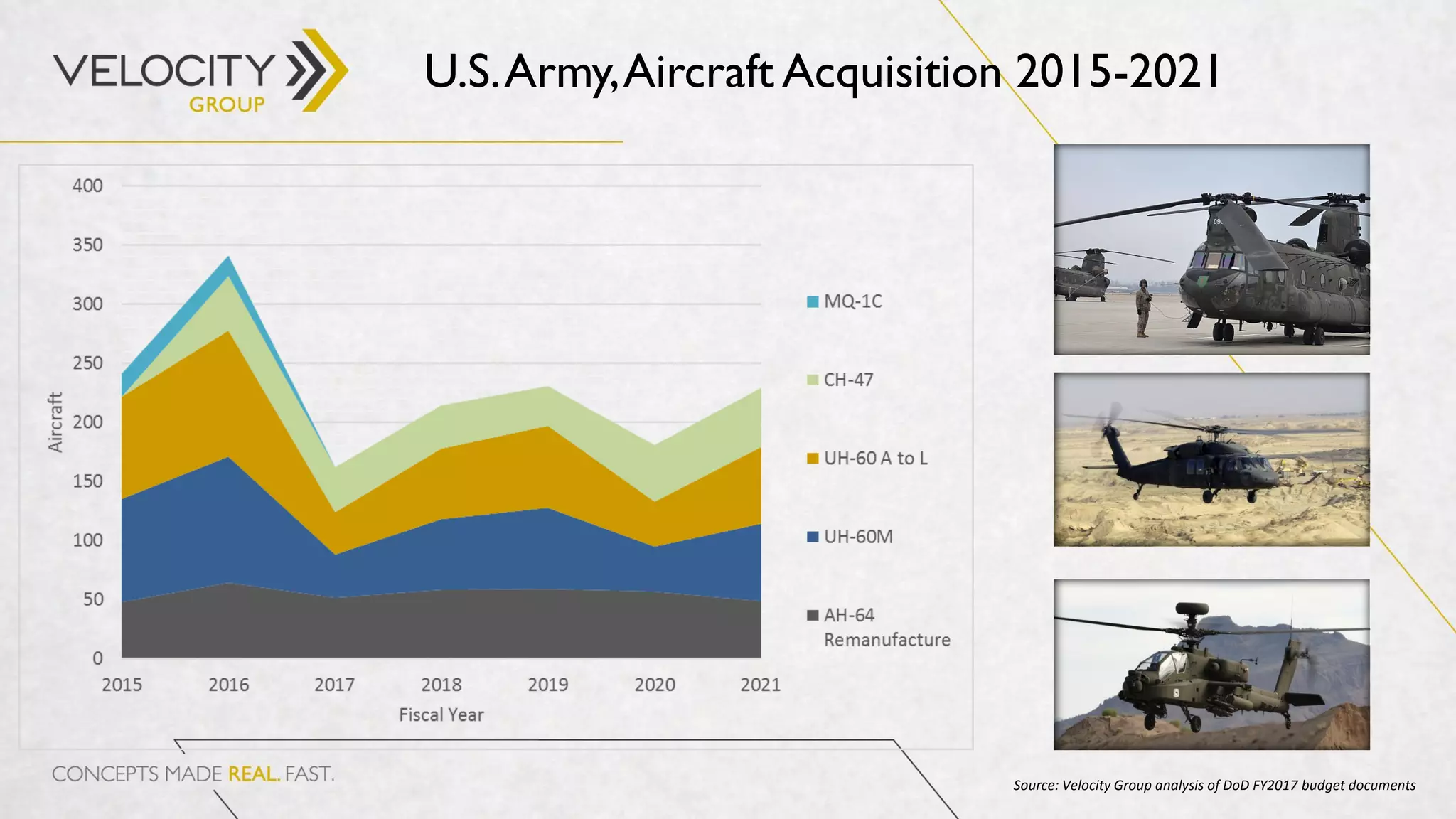
U.S.Army,Aircraft Acquisition 2015-2021
Source: Velocity Group analysis of DoD FY2017 budget documents
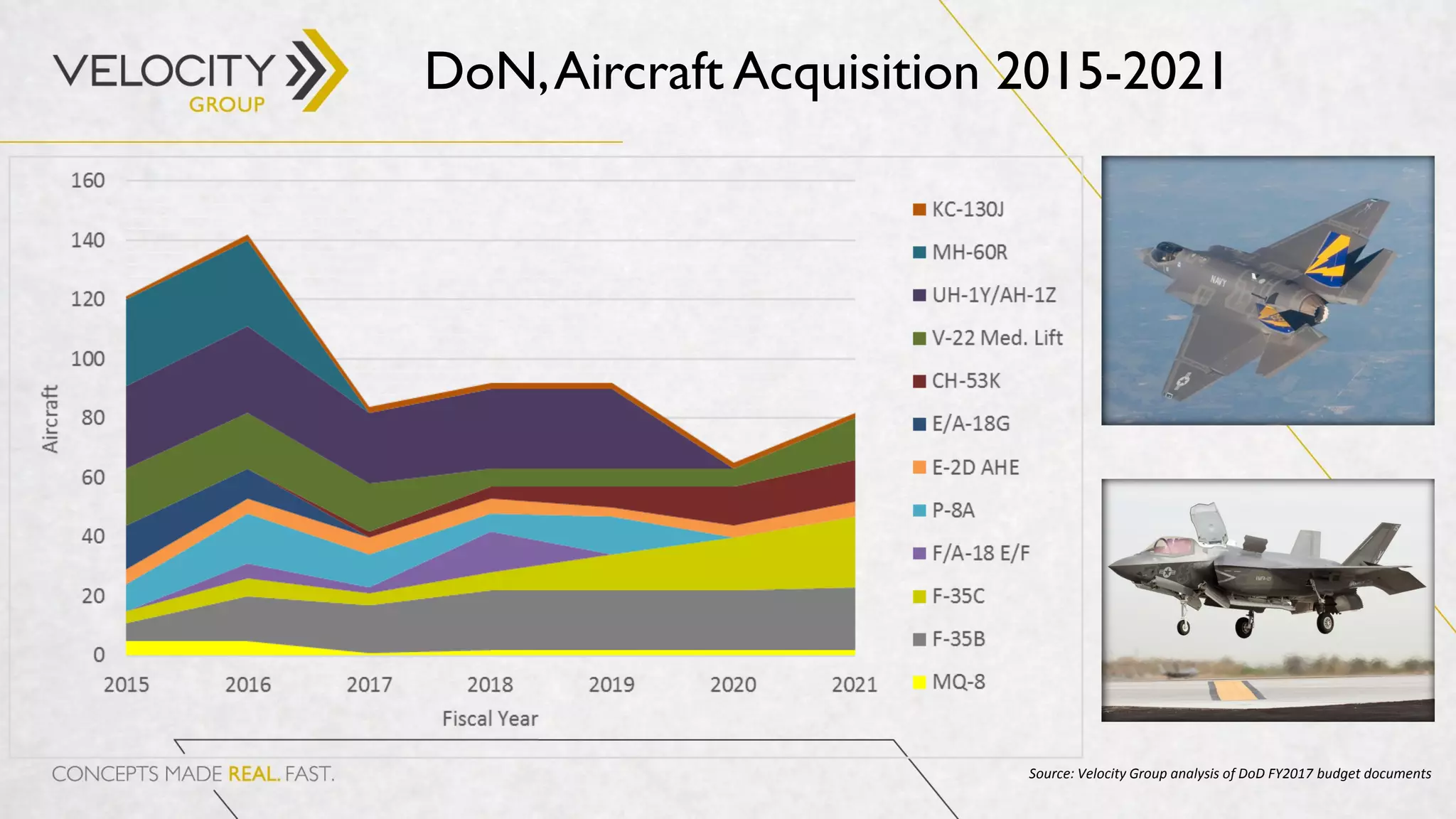
DoN,Aircraft Acquisition 2015-2021
Source: Velocity Group analysis of DoD FY2017 budget documents
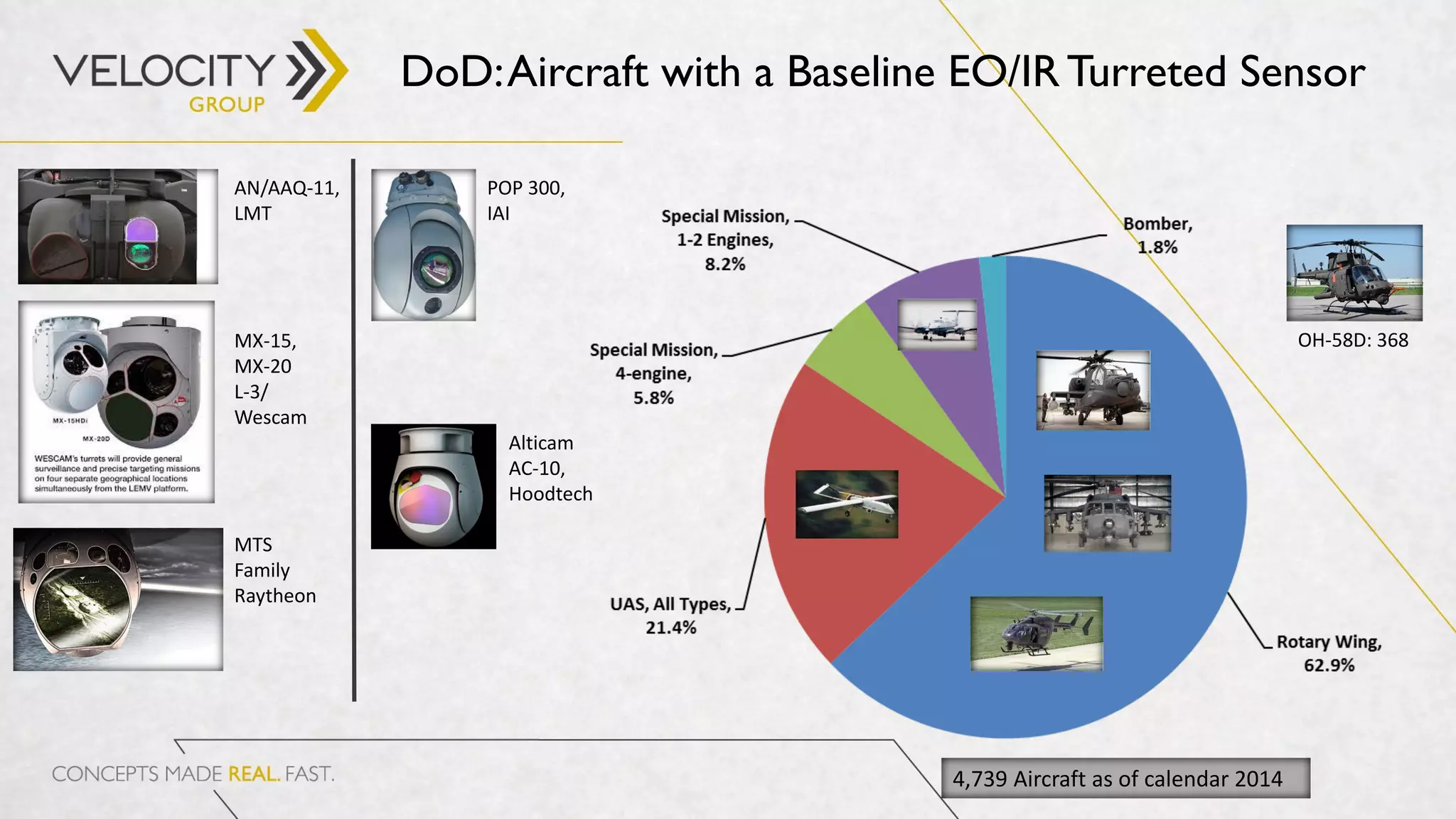
DoD:Aircraft with a Baseline EO/IR Turreted Sensor
OH-58D: 368
AN/AAQ-11,
LMT
MX-15,
MX-20
L-3/
Wescam
MTS
Family
Raytheon
4,739 Aircraft as of calendar 2014
POP 300,
IAI
Alticam
AC-10,
Hoodtech
Unmanned Aerial Systems: Commercial Proving
Grounds, Airspace Access and Safety-Case
Development
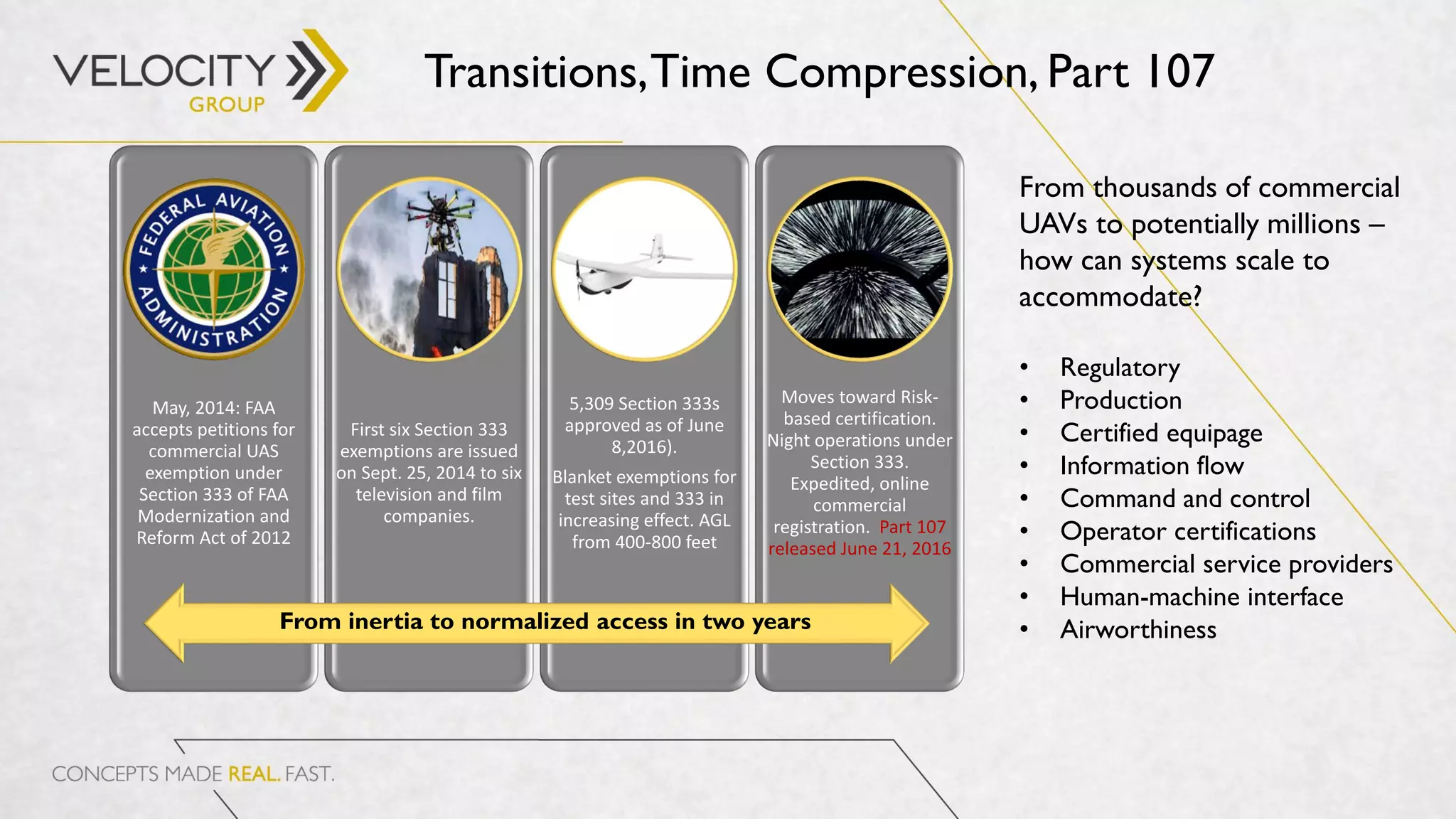
Transitions,Time Compression, Part 107
May, 2014: FAA
accepts petitions for
commercial UAS
exemption under
Section 333 of FAA
Modernization and
Reform Act of 2012
First six Section 333
exemptions are issued
on Sept. 25, 2014 to six
television and film
companies.
5,309 Section 333s
approved as of June
8,2016).
Blanket exemptions for
test sites and 333 in
increasing effect. AGL
from 400-800 feet
Moves toward Risk-
based certification.
Night operations under
Section 333.
Expedited, online
commercial
registration. Part 107
released June 21, 2016
From inertia to normalized access in two years
From thousands of commercial
UAVs to potentially millions –
how can systems scale to
accommodate?
• Regulatory
• Production
• Certified equipage
• Information flow
• Command and control
• Operator certifications
• Commercial service providers
• Human-machine interface
• Airworthiness
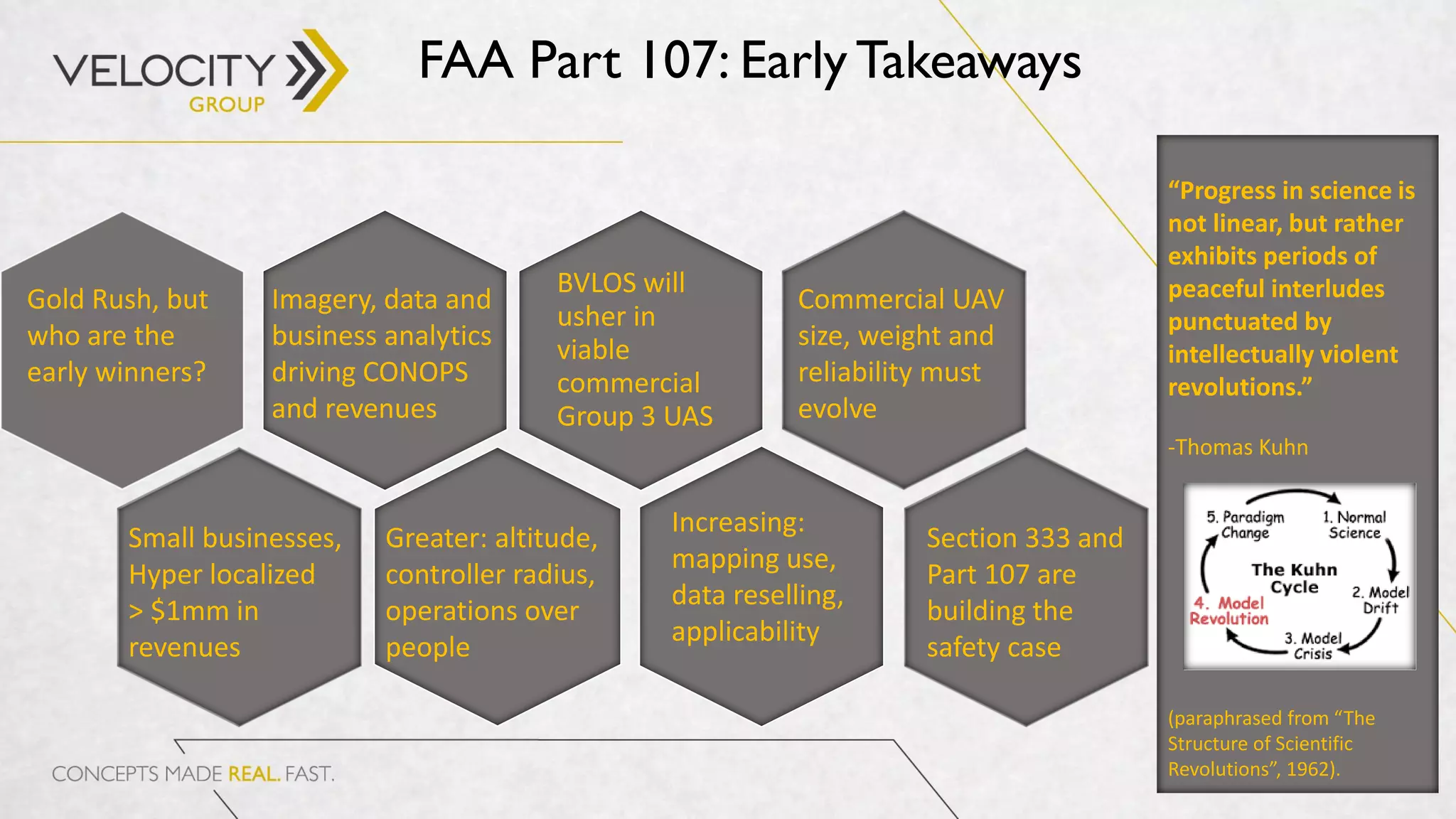
FAA Part 107: Early Takeaways
BVLOS will
usher in
viable
commercial
Group 3 UAS
“Progress in science is
not linear, but rather
exhibits periods of
peaceful interludes
punctuated by
intellectually violent
revolutions.”
-Thomas Kuhn
(paraphrased from “The
Structure of Scientific
Revolutions”, 1962).
Gold Rush, but
who are the
early winners?
Imagery, data and
business analytics
driving CONOPS
and revenues
Commercial UAV
size, weight and
reliability must
evolve
Small businesses,
Hyper localized
> $1mm in
revenues
Greater: altitude,
controller radius,
operations over
people
Increasing:
mapping use,
data reselling,
applicability
Section 333 and
Part 107 are
building the
safety case
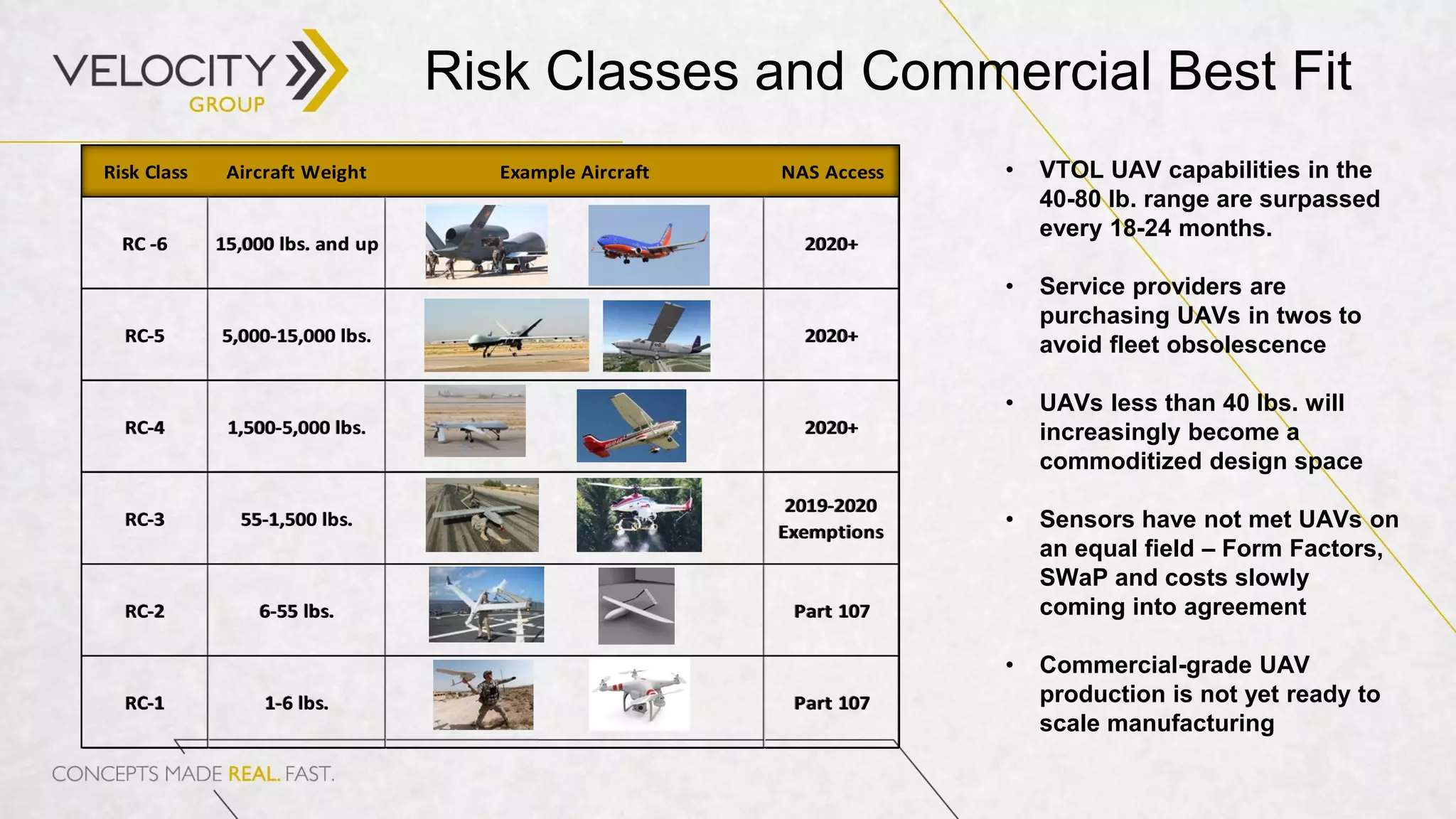
Risk Classes and Commercial Best Fit
• VTOL UAV capabilities in the
40-80 lb. range are surpassed
every 18-24 months.
• Service providers are
purchasing UAVs in twos to
avoid fleet obsolescence
• UAVs less than 40 lbs. will
increasingly become a
commoditized design space
• Sensors have not met UAVs on
an equal field – Form Factors,
SWaP and costs slowly
coming into agreement
• Commercial-grade UAV
production is not yet ready to
scale manufacturing
Risk Class Aircraft Weight Example Aircraft NAS Access
RC -6 15,000 lbs. and up 2020+
RC-5 5,000-15,000 lbs. 2020+
RC-4 1,500-5,000 lbs. 2020+
RC-3 55-1,500 lbs.
2019-2020
Exemptions
RC-2 6-55 lbs. Part 107
RC-1 1-6 lbs. Part 107
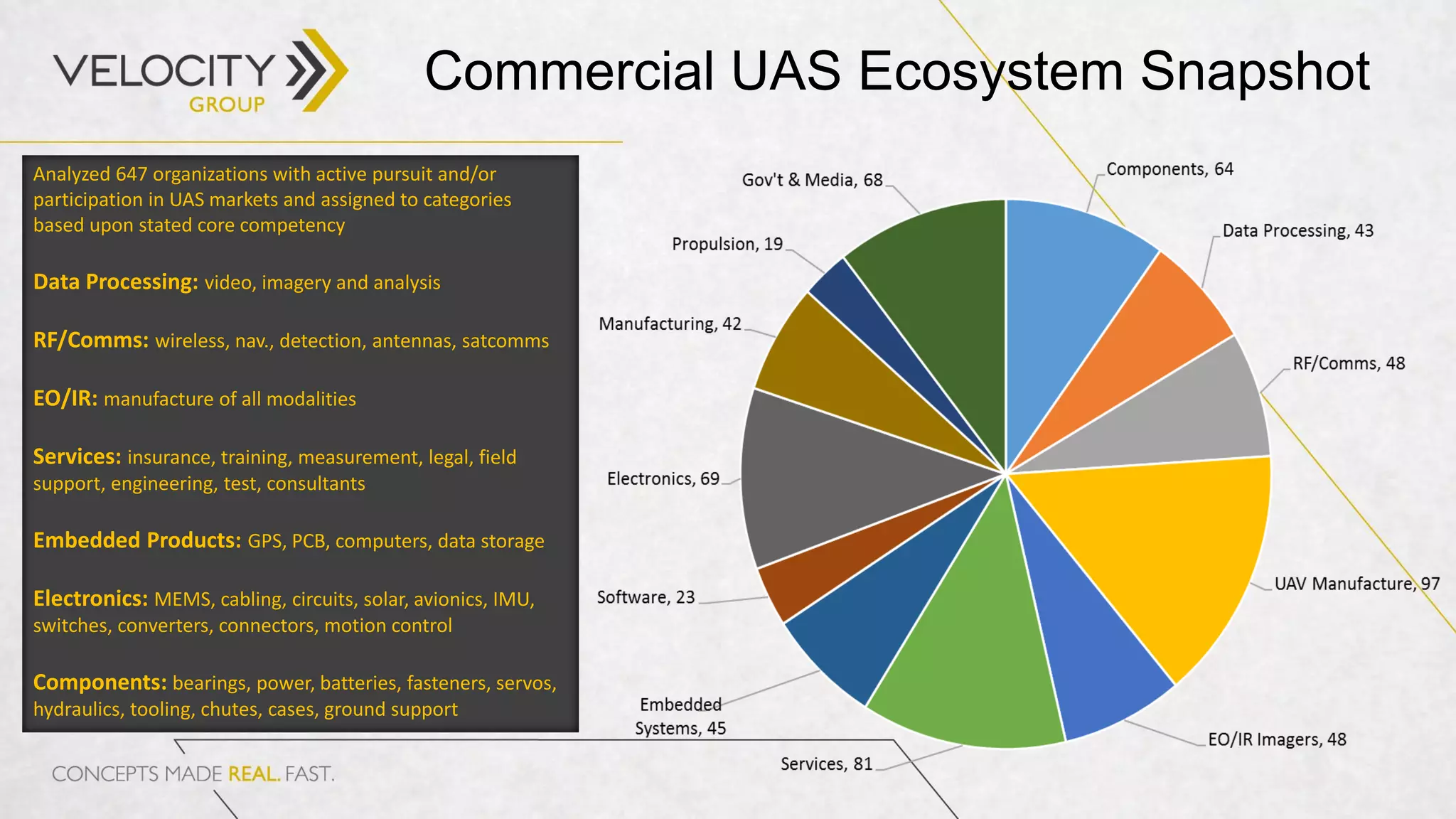
Commercial UAS Ecosystem Snapshot
Analyzed 647 organizations with active pursuit and/or
participation in UAS markets and assigned to categories
based upon stated core competency
Data Processing: video, imagery and analysis
RF/Comms: wireless, nav., detection, antennas, satcomms
EO/IR: manufacture of all modalities
Services: insurance, training, measurement, legal, field
support, engineering, test, consultants
Embedded Products: GPS, PCB, computers, data storage
Electronics: MEMS, cabling, circuits, solar, avionics, IMU,
switches, converters, connectors, motion control
Components: bearings, power, batteries, fasteners, servos,
hydraulics, tooling, chutes, cases, ground support
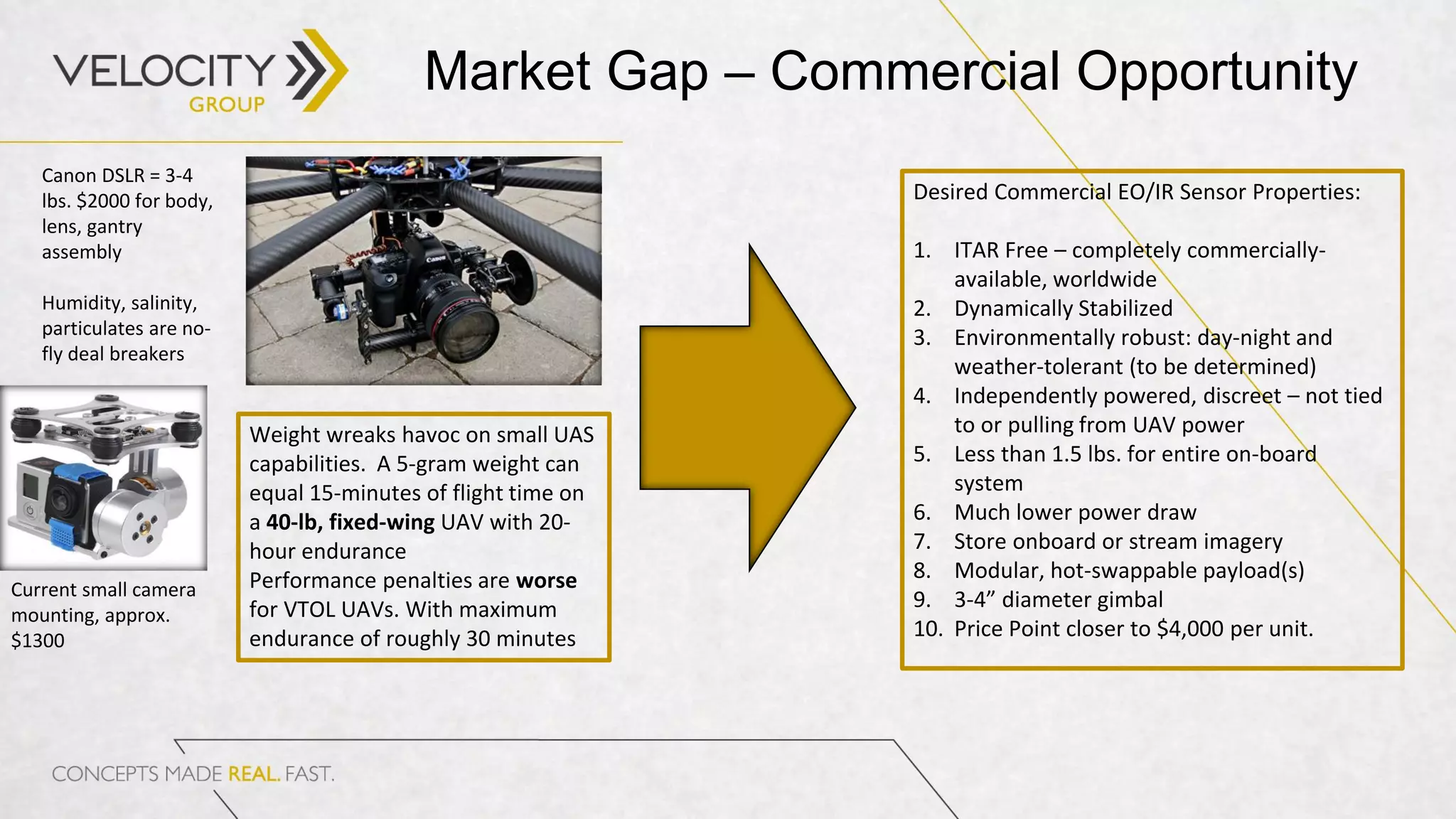
Market Gap – Commercial Opportunity
Canon DSLR = 3-4
lbs. $2000 for body,
lens, gantry
assembly
Humidity, salinity,
particulates are no-
fly deal breakers
Current small camera
mounting, approx.
$1300
Weight wreaks havoc on small UAS
capabilities. A 5-gram weight can
equal 15-minutes of flight time on
a 40-lb, fixed-wing UAV with 20-
hour endurance
Performance penalties are worse
for VTOL UAVs. With maximum
endurance of roughly 30 minutes
Desired Commercial EO/IR Sensor Properties:
1. ITAR Free – completely commercially-
available, worldwide
2. Dynamically Stabilized
3. Environmentally robust: day-night and
weather-tolerant (to be determined)
4. Independently powered, discreet – not tied
to or pulling from UAV power
5. Less than 1.5 lbs. for entire on-board
system
6. Much lower power draw
7. Store onboard or stream imagery
8. Modular, hot-swappable payload(s)
9. 3-4” diameter gimbal
10. Price Point closer to $4,000 per unit.
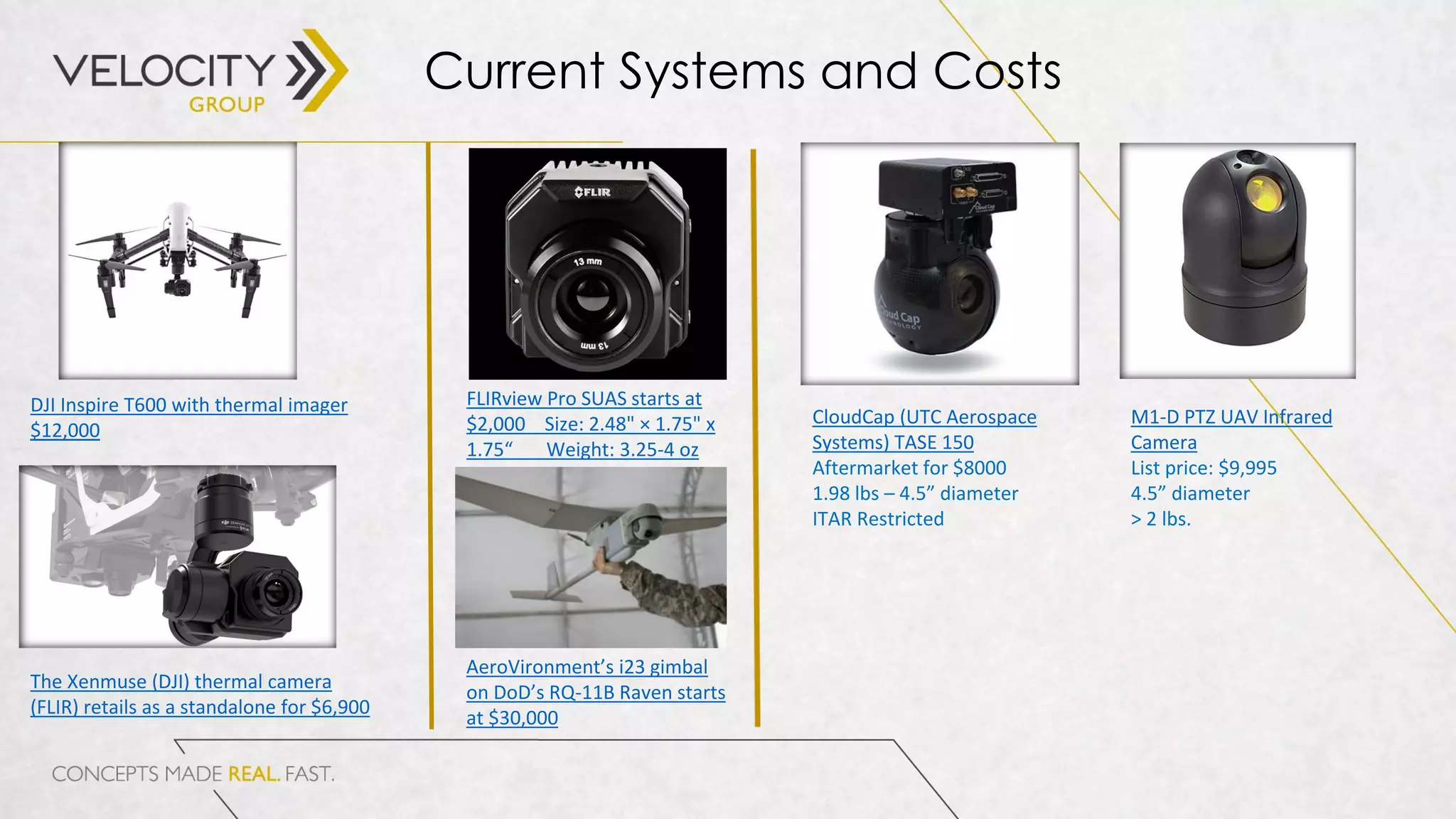
Current Systems and Costs
DJI Inspire T600 with thermal imager
$12,000
The Xenmuse (DJI) thermal camera
(FLIR) retails as a standalone for $6,900
FLIRview Pro SUAS starts at
$2,000 Size: 2.48" × 1.75" x
1.75“ Weight: 3.25-4 oz
AeroVironment’s i23 gimbal
on DoD’s RQ-11B Raven starts
at $30,000
CloudCap (UTC Aerospace
Systems) TASE 150
Aftermarket for $8000
1.98 lbs – 4.5” diameter
ITAR Restricted
M1-D PTZ UAV Infrared
Camera
List price: $9,995
4.5” diameter
> 2 lbs.
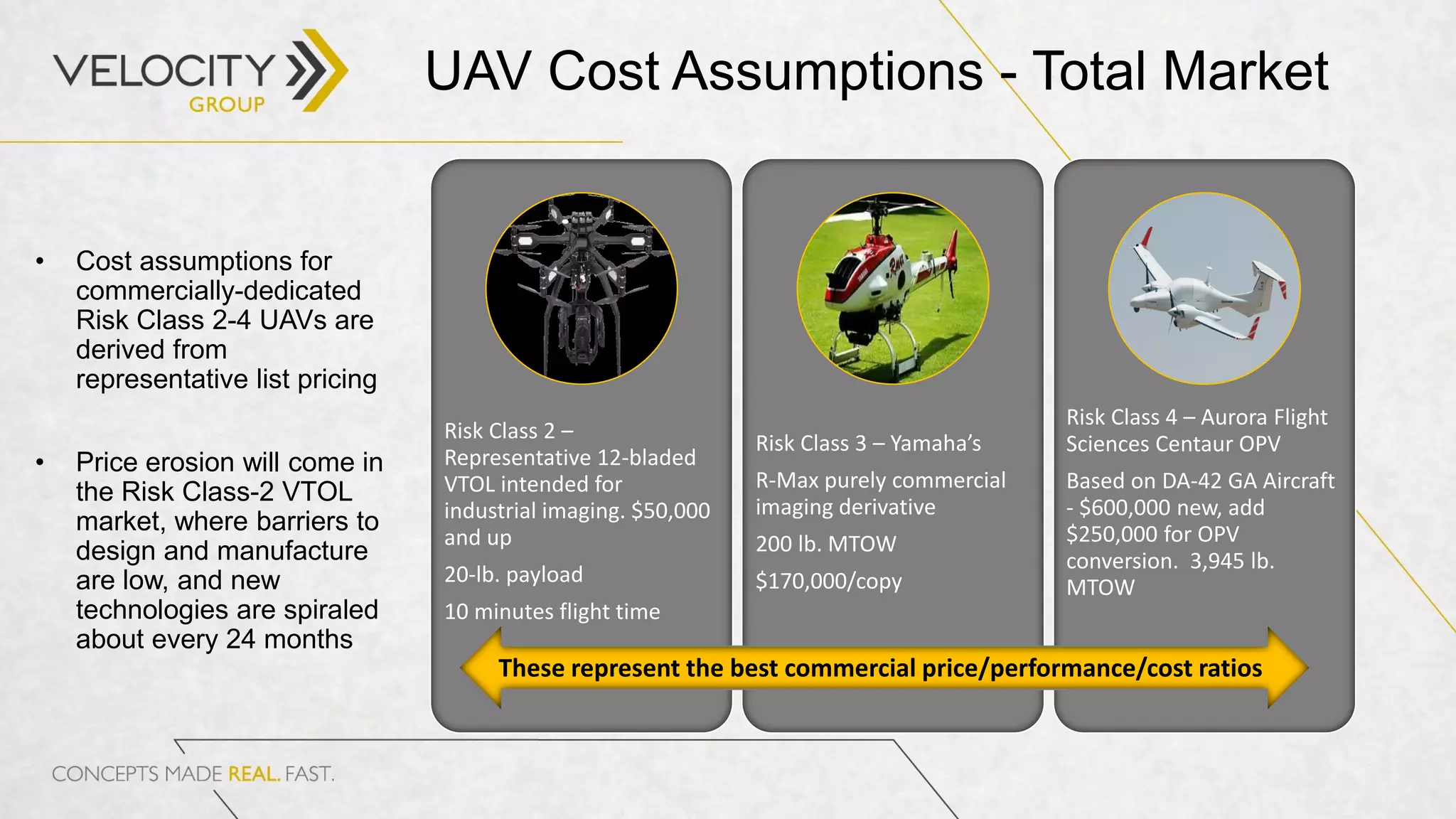
UAV Cost Assumptions - Total Market
• Cost assumptions for
commercially-dedicated
Risk Class 2-4 UAVs are
derived from
representative list pricing
• Price erosion will come in
the Risk Class-2 VTOL
market, where barriers to
design and manufacture
are low, and new
technologies are spiraled
about every 24 months
Risk Class 2 –
Representative 12-bladed
VTOL intended for
industrial imaging. $50,000
and up
20-lb. payload
10 minutes flight time
Risk Class 3 – Yamaha’s
R-Max purely commercial
imaging derivative
200 lb. MTOW
$170,000/copy
Risk Class 4 – Aurora Flight
Sciences Centaur OPV
Based on DA-42 GA Aircraft
- $600,000 new, add
$250,000 for OPV
conversion. 3,945 lb.
MTOW
These represent the best commercial price/performance/cost ratios
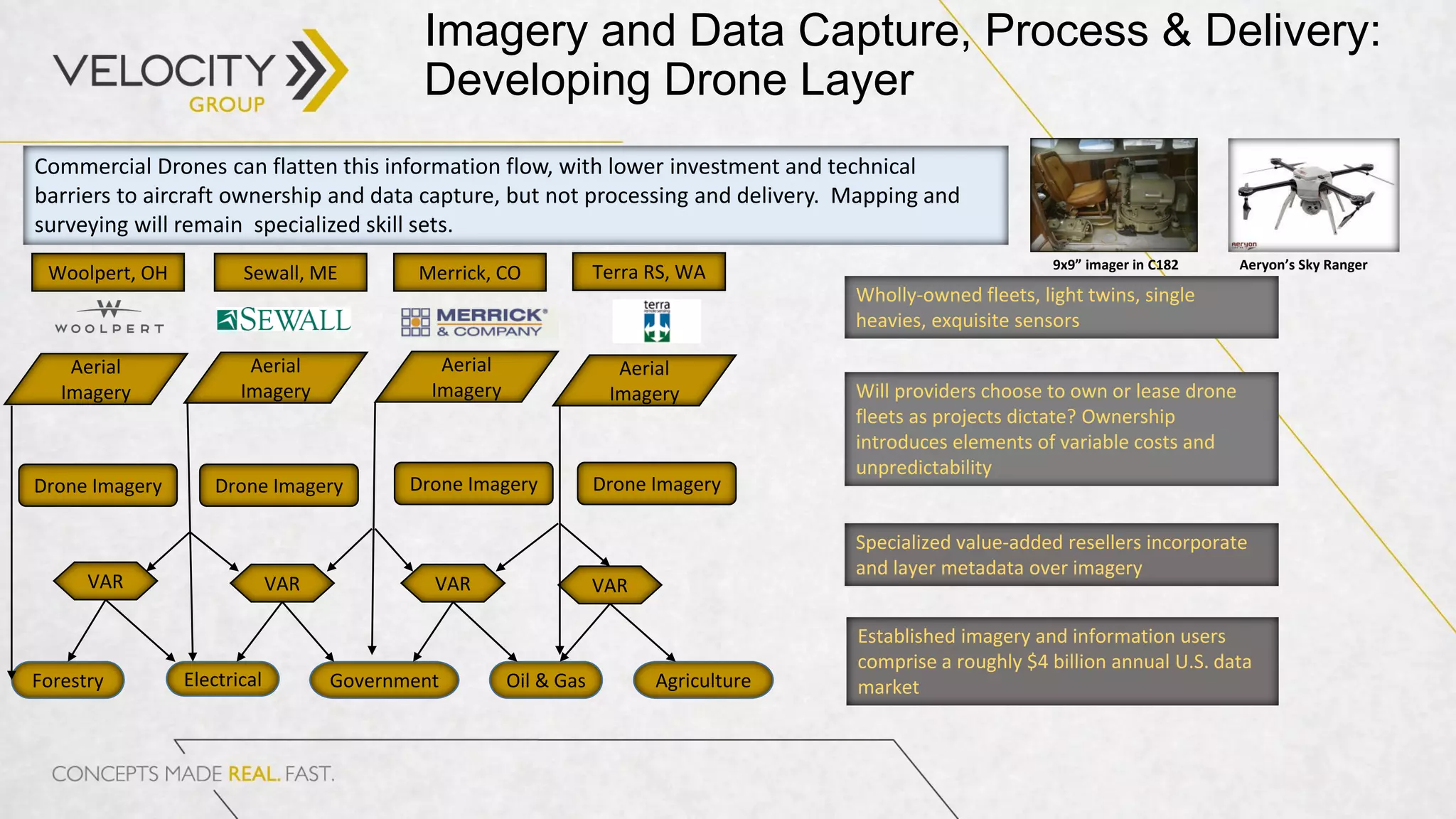
Imagery and Data Capture, Process & Delivery:
Developing Drone Layer
Electrical Government Oil & Gas AgricultureForestry
VAR VAR VAR VAR
Woolpert, OH Sewall, ME Merrick, CO Terra RS, WA
Aerial
Imagery
Aerial
Imagery
Aerial
Imagery
Aerial
Imagery
Drone Imagery Drone Imagery Drone Imagery Drone Imagery
Wholly-owned fleets, light twins, single
heavies, exquisite sensors
Will providers choose to own or lease drone
fleets as projects dictate? Ownership
introduces elements of variable costs and
unpredictability
Specialized value-added resellers incorporate
and layer metadata over imagery
Established imagery and information users
comprise a roughly $4 billion annual U.S. data
market
9x9” imager in C182 Aeryon’s Sky Ranger
Commercial Drones can flatten this information flow, with lower investment and technical
barriers to aircraft ownership and data capture, but not processing and delivery. Mapping and
surveying will remain specialized skill sets.
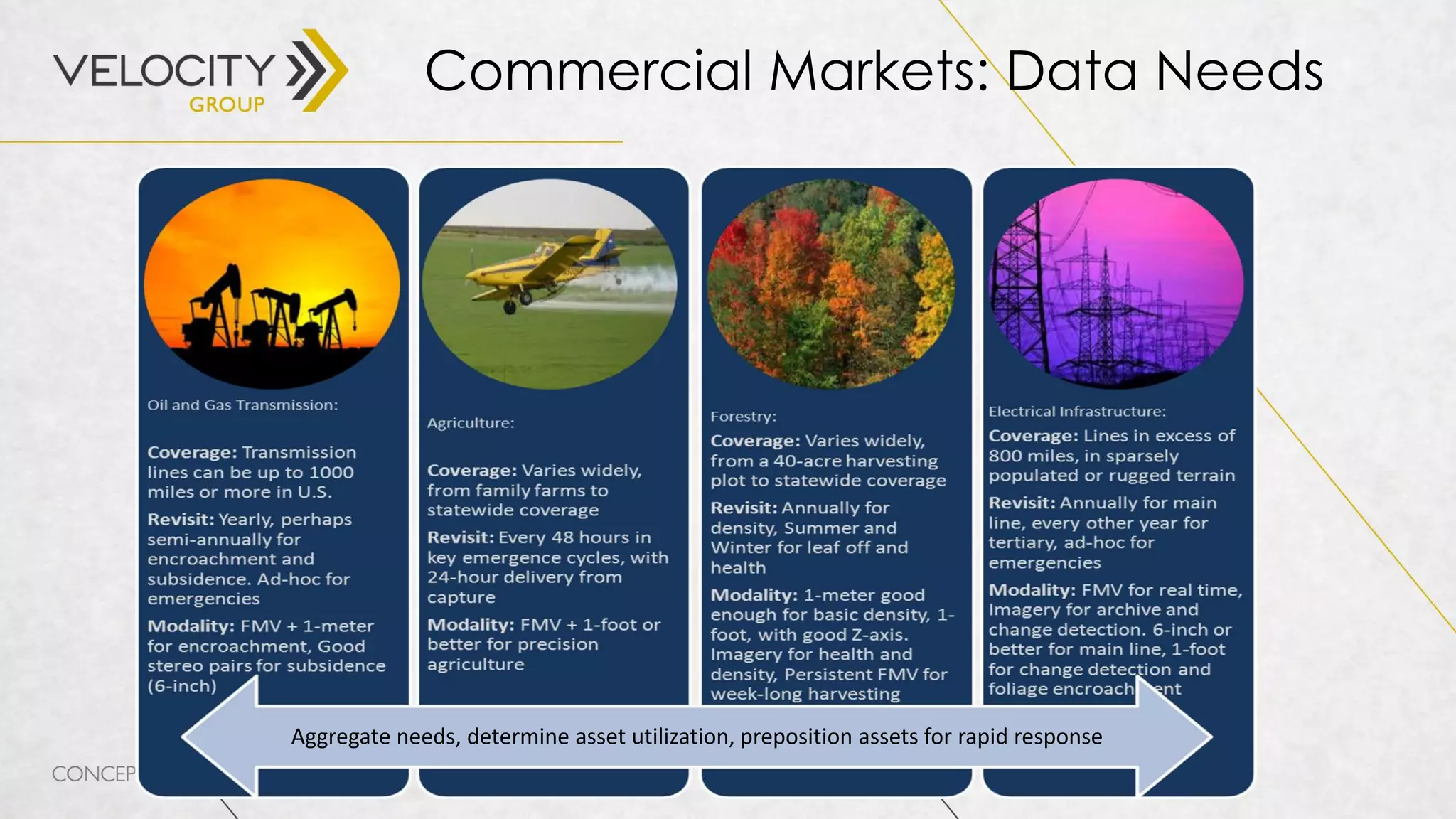
Commercial Markets: Data Needs
Aggregate needs, determine asset utilization, preposition assets for rapid response
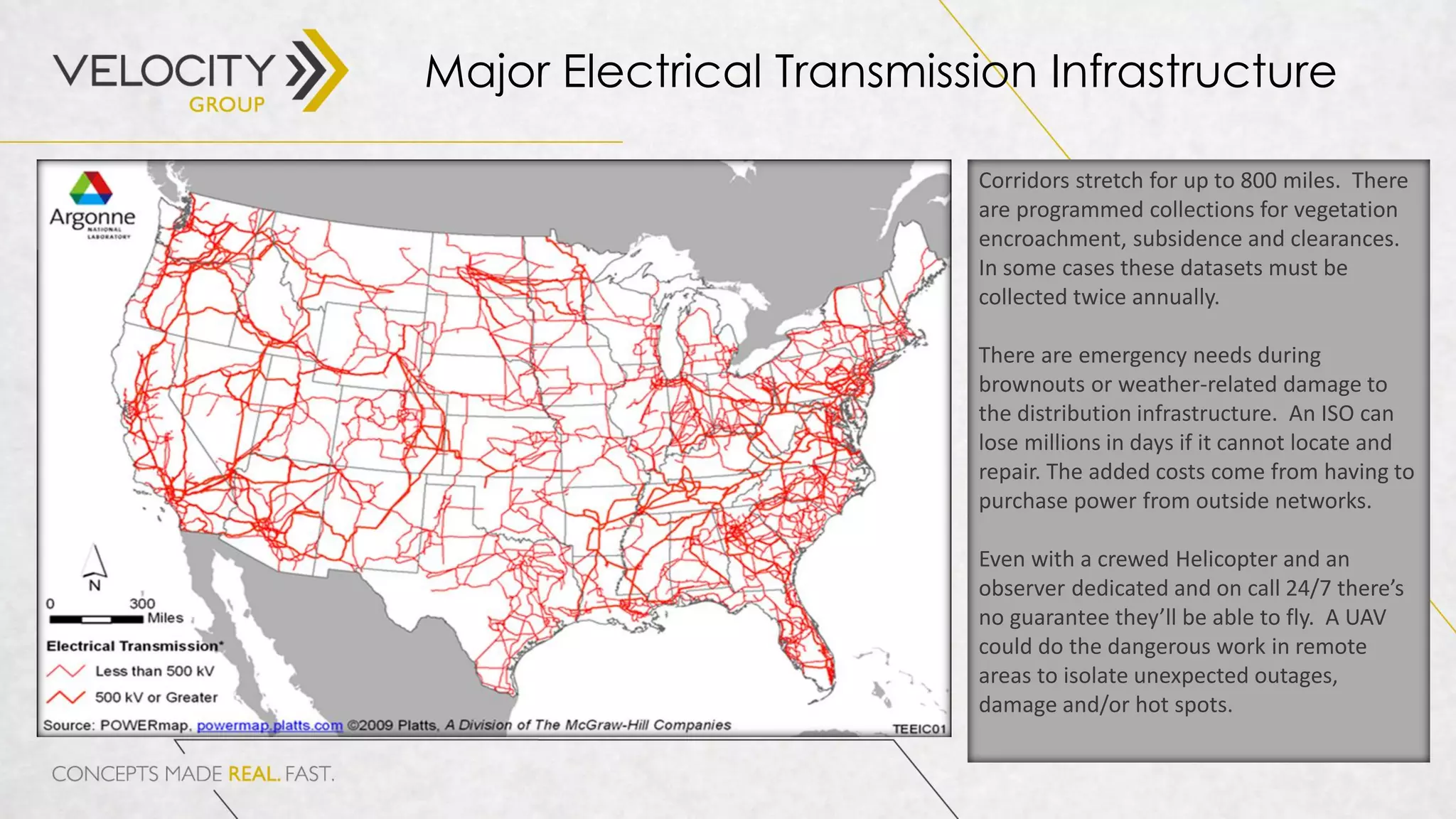
Major Electrical Transmission Infrastructure
Corridors stretch for up to 800 miles. There
are programmed collections for vegetation
encroachment, subsidence and clearances.
In some cases these datasets must be
collected twice annually.
There are emergency needs during
brownouts or weather-related damage to
the distribution infrastructure. An ISO can
lose millions in days if it cannot locate and
repair. The added costs come from having to
purchase power from outside networks.
Even with a crewed Helicopter and an
observer dedicated and on call 24/7 there’s
no guarantee they’ll be able to fly. A UAV
could do the dangerous work in remote
areas to isolate unexpected outages,
damage and/or hot spots.
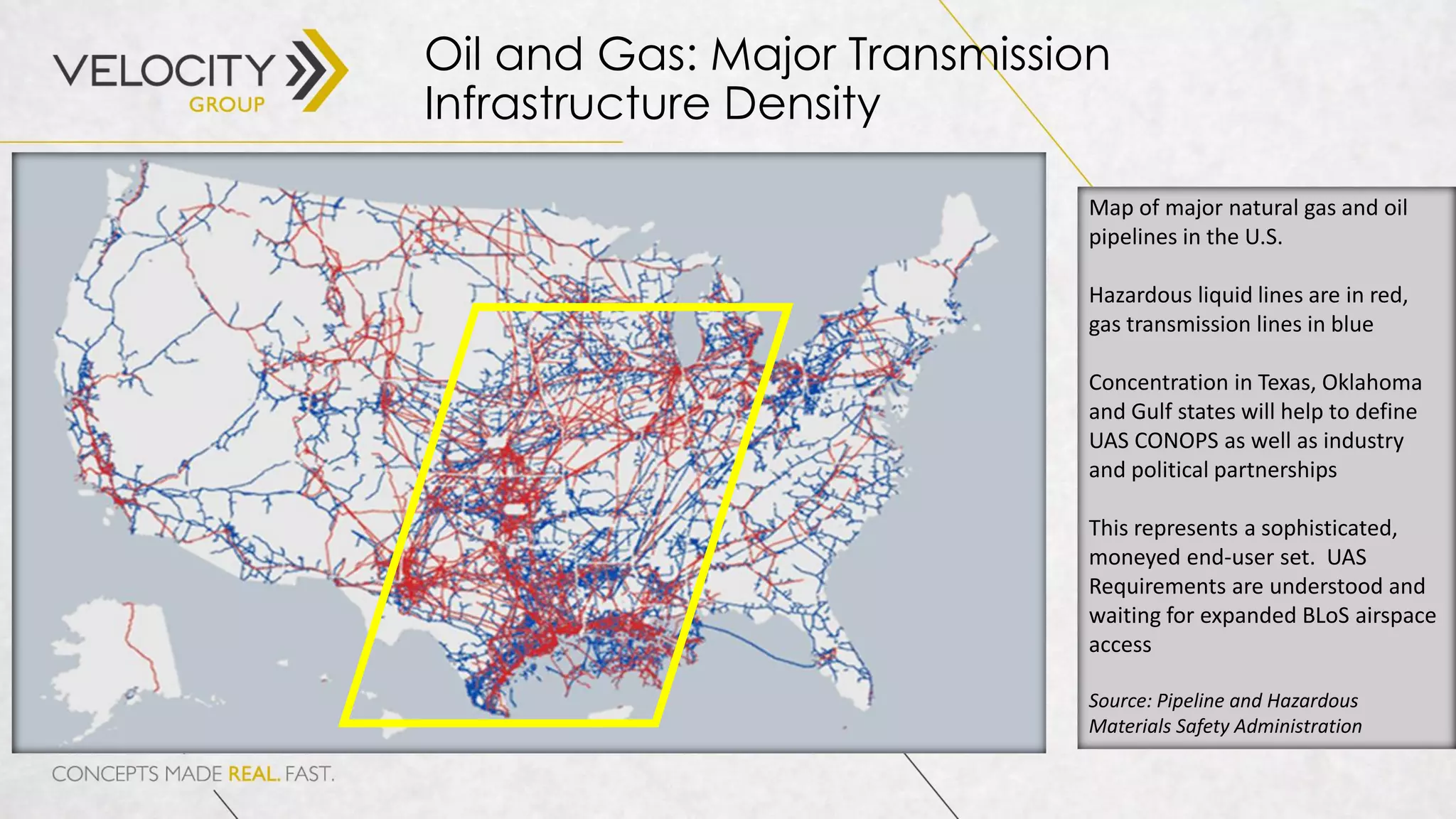
Oil and Gas: Major Transmission
Infrastructure Density
Map of major natural gas and oil
pipelines in the U.S.
Hazardous liquid lines are in red,
gas transmission lines in blue
Concentration in Texas, Oklahoma
and Gulf states will help to define
UAS CONOPS as well as industry
and political partnerships
This represents a sophisticated,
moneyed end-user set. UAS
Requirements are understood and
waiting for expanded BLoS airspace
access
Source: Pipeline and Hazardous
Materials Safety Administration
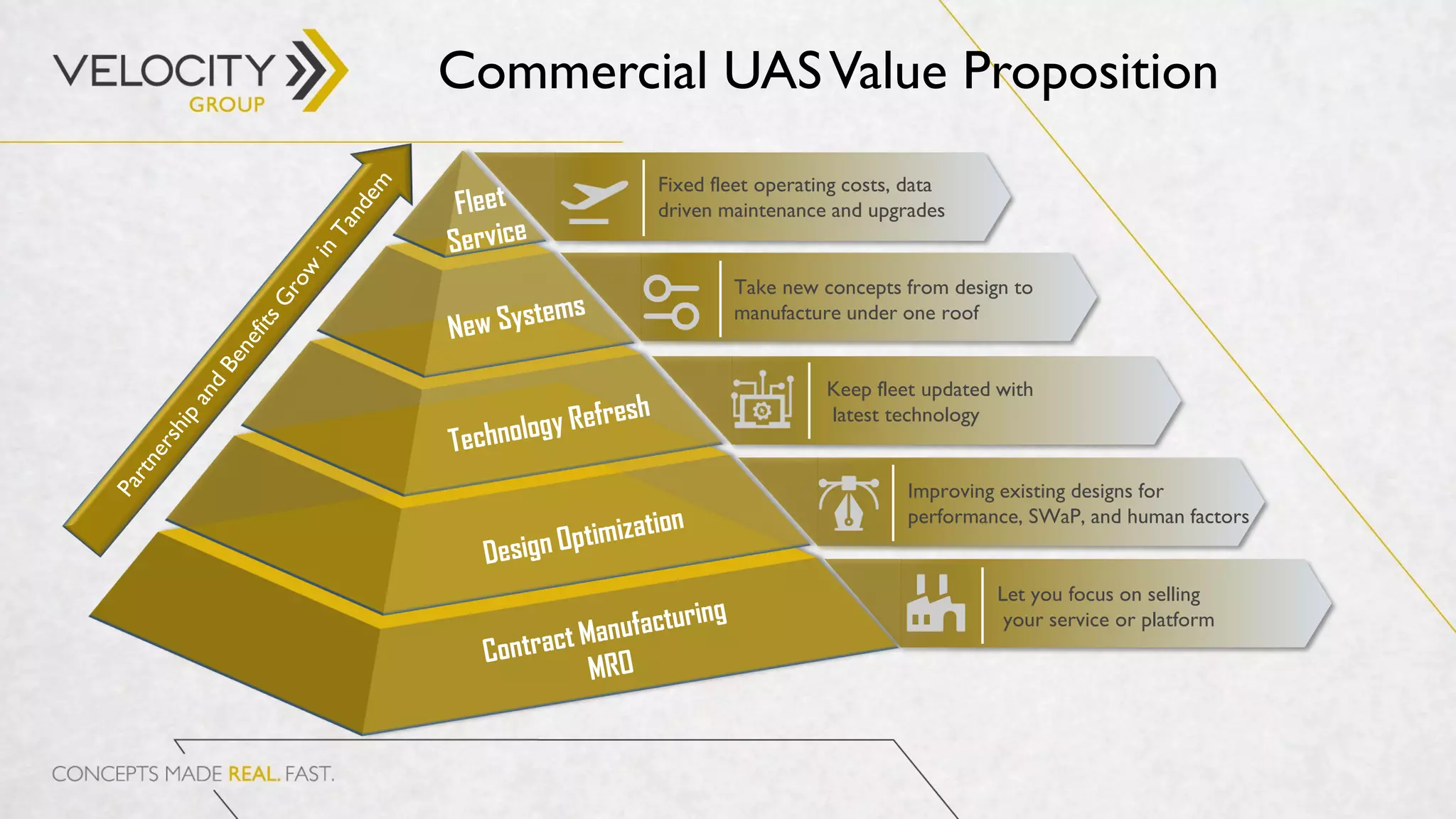
Commercial UASValue Proposition
Fixed fleet operating costs, data
driven maintenance and upgrades
Improving existing designs for
performance, SWaP, and human factors
Take new concepts from design to
manufacture under one roof
Keep fleet updated with
latest technology
Let you focus on selling
your service or platform
The Velocity Group is at the leading edge of onshore product development and
rapid time-to-market. We are assembling a world-class portfolio of design and
manufacturing organizations that put customer focus at the heart of everything
we do.
Our mission:
We help our clients accelerate time from idea to profit by providing single-source
accountability for and management of the entire range of resources needed to
bring concepts to profitable, market-ready products, to scale up for manufacturing
and to produce and sustain them efficiently and cost-effectively.
www.velocityfast.com info@velocityfast.com ron.stearns@velocityfast.com
About Us

2016 Next Gen ISR Velocity Group Presentation

  • 1.
    Evolving EO/IR CommercialUAS Landscape: User Needs and DefenseTrends For TTC’s Next-Generation ISR Symposium for Military and Government Arlington,VA. December 15-16, 2016 Ron Stearns, Director, Business Development, Robotics and Unmanned Systems
  • 2.
    DoD Aircraft Acquisitionthrough the FYDP Aircraft by Service Branch, 2015-2021 Fixed and Rotary Wing, 2015-2021 Aircraft by Category, 2015-2021 Source: Velocity Group analysis of DoD FY 2017 budget documents With the inclusion of zero-hour rotary-wing programs (e.g. AH-64E, AH-1W to AH-1Z) and target drones (BQM-167, QF-16) there will be 3,037 DoD aircraft deliveries from FY 2015-2021. Rotary-wing aircraft are the major FYDP acquisition driver, owed in large part to operations tempo and airlift demand in United States Central Command
  • 3.
    U.S.Air Force,Aircraft Acquisition2015-2021 Source: Velocity Group analysis of DoD FY2017 budget documents
  • 4.
    U.S.Army,Aircraft Acquisition 2015-2021 Source:Velocity Group analysis of DoD FY2017 budget documents
  • 5.
    DoN,Aircraft Acquisition 2015-2021 Source:Velocity Group analysis of DoD FY2017 budget documents
  • 6.
    DoD:Aircraft with aBaseline EO/IR Turreted Sensor OH-58D: 368 AN/AAQ-11, LMT MX-15, MX-20 L-3/ Wescam MTS Family Raytheon 4,739 Aircraft as of calendar 2014 POP 300, IAI Alticam AC-10, Hoodtech
  • 7.
    Unmanned Aerial Systems:Commercial Proving Grounds, Airspace Access and Safety-Case Development
  • 8.
    Transitions,Time Compression, Part107 May, 2014: FAA accepts petitions for commercial UAS exemption under Section 333 of FAA Modernization and Reform Act of 2012 First six Section 333 exemptions are issued on Sept. 25, 2014 to six television and film companies. 5,309 Section 333s approved as of June 8,2016). Blanket exemptions for test sites and 333 in increasing effect. AGL from 400-800 feet Moves toward Risk- based certification. Night operations under Section 333. Expedited, online commercial registration. Part 107 released June 21, 2016 From inertia to normalized access in two years From thousands of commercial UAVs to potentially millions – how can systems scale to accommodate? • Regulatory • Production • Certified equipage • Information flow • Command and control • Operator certifications • Commercial service providers • Human-machine interface • Airworthiness
  • 9.
    FAA Part 107:Early Takeaways BVLOS will usher in viable commercial Group 3 UAS “Progress in science is not linear, but rather exhibits periods of peaceful interludes punctuated by intellectually violent revolutions.” -Thomas Kuhn (paraphrased from “The Structure of Scientific Revolutions”, 1962). Gold Rush, but who are the early winners? Imagery, data and business analytics driving CONOPS and revenues Commercial UAV size, weight and reliability must evolve Small businesses, Hyper localized > $1mm in revenues Greater: altitude, controller radius, operations over people Increasing: mapping use, data reselling, applicability Section 333 and Part 107 are building the safety case
  • 10.
    Risk Classes andCommercial Best Fit • VTOL UAV capabilities in the 40-80 lb. range are surpassed every 18-24 months. • Service providers are purchasing UAVs in twos to avoid fleet obsolescence • UAVs less than 40 lbs. will increasingly become a commoditized design space • Sensors have not met UAVs on an equal field – Form Factors, SWaP and costs slowly coming into agreement • Commercial-grade UAV production is not yet ready to scale manufacturing Risk Class Aircraft Weight Example Aircraft NAS Access RC -6 15,000 lbs. and up 2020+ RC-5 5,000-15,000 lbs. 2020+ RC-4 1,500-5,000 lbs. 2020+ RC-3 55-1,500 lbs. 2019-2020 Exemptions RC-2 6-55 lbs. Part 107 RC-1 1-6 lbs. Part 107
  • 11.
    Commercial UAS EcosystemSnapshot Analyzed 647 organizations with active pursuit and/or participation in UAS markets and assigned to categories based upon stated core competency Data Processing: video, imagery and analysis RF/Comms: wireless, nav., detection, antennas, satcomms EO/IR: manufacture of all modalities Services: insurance, training, measurement, legal, field support, engineering, test, consultants Embedded Products: GPS, PCB, computers, data storage Electronics: MEMS, cabling, circuits, solar, avionics, IMU, switches, converters, connectors, motion control Components: bearings, power, batteries, fasteners, servos, hydraulics, tooling, chutes, cases, ground support
  • 12.
    Market Gap –Commercial Opportunity Canon DSLR = 3-4 lbs. $2000 for body, lens, gantry assembly Humidity, salinity, particulates are no- fly deal breakers Current small camera mounting, approx. $1300 Weight wreaks havoc on small UAS capabilities. A 5-gram weight can equal 15-minutes of flight time on a 40-lb, fixed-wing UAV with 20- hour endurance Performance penalties are worse for VTOL UAVs. With maximum endurance of roughly 30 minutes Desired Commercial EO/IR Sensor Properties: 1. ITAR Free – completely commercially- available, worldwide 2. Dynamically Stabilized 3. Environmentally robust: day-night and weather-tolerant (to be determined) 4. Independently powered, discreet – not tied to or pulling from UAV power 5. Less than 1.5 lbs. for entire on-board system 6. Much lower power draw 7. Store onboard or stream imagery 8. Modular, hot-swappable payload(s) 9. 3-4” diameter gimbal 10. Price Point closer to $4,000 per unit.
  • 13.
    Current Systems andCosts DJI Inspire T600 with thermal imager $12,000 The Xenmuse (DJI) thermal camera (FLIR) retails as a standalone for $6,900 FLIRview Pro SUAS starts at $2,000 Size: 2.48" × 1.75" x 1.75“ Weight: 3.25-4 oz AeroVironment’s i23 gimbal on DoD’s RQ-11B Raven starts at $30,000 CloudCap (UTC Aerospace Systems) TASE 150 Aftermarket for $8000 1.98 lbs – 4.5” diameter ITAR Restricted M1-D PTZ UAV Infrared Camera List price: $9,995 4.5” diameter > 2 lbs.
  • 14.
    UAV Cost Assumptions- Total Market • Cost assumptions for commercially-dedicated Risk Class 2-4 UAVs are derived from representative list pricing • Price erosion will come in the Risk Class-2 VTOL market, where barriers to design and manufacture are low, and new technologies are spiraled about every 24 months Risk Class 2 – Representative 12-bladed VTOL intended for industrial imaging. $50,000 and up 20-lb. payload 10 minutes flight time Risk Class 3 – Yamaha’s R-Max purely commercial imaging derivative 200 lb. MTOW $170,000/copy Risk Class 4 – Aurora Flight Sciences Centaur OPV Based on DA-42 GA Aircraft - $600,000 new, add $250,000 for OPV conversion. 3,945 lb. MTOW These represent the best commercial price/performance/cost ratios
  • 15.
    Imagery and DataCapture, Process & Delivery: Developing Drone Layer Electrical Government Oil & Gas AgricultureForestry VAR VAR VAR VAR Woolpert, OH Sewall, ME Merrick, CO Terra RS, WA Aerial Imagery Aerial Imagery Aerial Imagery Aerial Imagery Drone Imagery Drone Imagery Drone Imagery Drone Imagery Wholly-owned fleets, light twins, single heavies, exquisite sensors Will providers choose to own or lease drone fleets as projects dictate? Ownership introduces elements of variable costs and unpredictability Specialized value-added resellers incorporate and layer metadata over imagery Established imagery and information users comprise a roughly $4 billion annual U.S. data market 9x9” imager in C182 Aeryon’s Sky Ranger Commercial Drones can flatten this information flow, with lower investment and technical barriers to aircraft ownership and data capture, but not processing and delivery. Mapping and surveying will remain specialized skill sets.
  • 16.
    Commercial Markets: DataNeeds Aggregate needs, determine asset utilization, preposition assets for rapid response
  • 17.
    Major Electrical TransmissionInfrastructure Corridors stretch for up to 800 miles. There are programmed collections for vegetation encroachment, subsidence and clearances. In some cases these datasets must be collected twice annually. There are emergency needs during brownouts or weather-related damage to the distribution infrastructure. An ISO can lose millions in days if it cannot locate and repair. The added costs come from having to purchase power from outside networks. Even with a crewed Helicopter and an observer dedicated and on call 24/7 there’s no guarantee they’ll be able to fly. A UAV could do the dangerous work in remote areas to isolate unexpected outages, damage and/or hot spots.
  • 18.
    Oil and Gas:Major Transmission Infrastructure Density Map of major natural gas and oil pipelines in the U.S. Hazardous liquid lines are in red, gas transmission lines in blue Concentration in Texas, Oklahoma and Gulf states will help to define UAS CONOPS as well as industry and political partnerships This represents a sophisticated, moneyed end-user set. UAS Requirements are understood and waiting for expanded BLoS airspace access Source: Pipeline and Hazardous Materials Safety Administration
  • 19.
    Commercial UASValue Proposition Fixedfleet operating costs, data driven maintenance and upgrades Improving existing designs for performance, SWaP, and human factors Take new concepts from design to manufacture under one roof Keep fleet updated with latest technology Let you focus on selling your service or platform
  • 20.
    The Velocity Groupis at the leading edge of onshore product development and rapid time-to-market. We are assembling a world-class portfolio of design and manufacturing organizations that put customer focus at the heart of everything we do. Our mission: We help our clients accelerate time from idea to profit by providing single-source accountability for and management of the entire range of resources needed to bring concepts to profitable, market-ready products, to scale up for manufacturing and to produce and sustain them efficiently and cost-effectively. www.velocityfast.com info@velocityfast.com ron.stearns@velocityfast.com About Us