1
www.merrick.com
© Copyright 2017 Merrick & Company
Some fundamental steps can keep a technology on the right track to ensure
WWT won’t be the death of the innovation:
ƒƒ Collect representative water samples during each stage of the technology
scale up. Have a lab with expertise in characterizing waste water provide
appropriate analyses of the samples.
ƒƒ Identify where a plant will be located as early as possible. Each county,
municipality, or authority having jurisdiction over water discharge permits
has different requirements. If the location is uncertain, consider evaluating
the cost at multiple sites that are probable locations for the project.
ƒƒ Engage a waste water treatment vendor early and often. Provide them with
the characterization of the waste water samples along the development path
and water discharge requirements identified. These vendors provide vital
input to the true cost and needs of the process.
ƒƒ Ensure the vendor understands the objectives of the unique process; writing
a clear performance specification is key to successful communication. If a
vendor is willing to provide a proposal for a treatment unit without reviewing
water characterizations or established parameters at the point of discharge,
think twice about using their solution. Those proposals may contain vastly
oversized and/or unnecessary treatment steps that may or may not work for
this unique process.
ƒƒ Engage an EPC firm as early as possible as well. They have expertise in
the integration of WWT system to the overall process. They can perform a
plant water balance early on, then look for places to integrate and recycle
water. They will also ensure sufficient plot space is allocated for wastewater
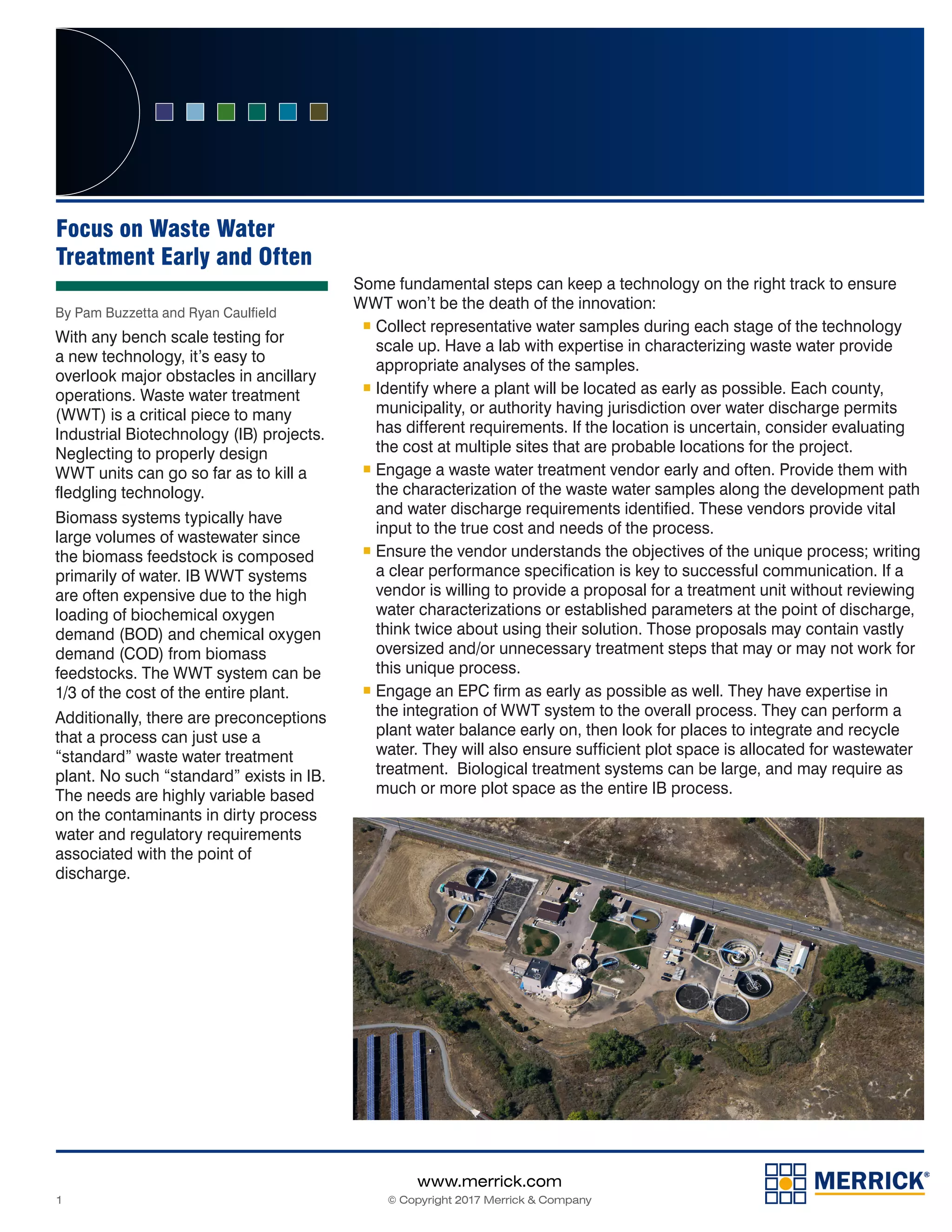
treatment. Biological treatment systems can be large, and may require as
much or more plot space as the entire IB process.
By Pam Buzzetta and Ryan Caulfield
With any bench scale testing for
a new technology, it’s easy to
overlook major obstacles in ancillary
operations. Waste water treatment
(WWT) is a critical piece to many
Industrial Biotechnology (IB) projects.
Neglecting to properly design
WWT units can go so far as to kill a
fledgling technology.
Biomass systems typically have
large volumes of wastewater since
the biomass feedstock is composed
primarily of water. IB WWT systems
are often expensive due to the high
loading of biochemical oxygen
demand (BOD) and chemical oxygen
demand (COD) from biomass
feedstocks. The WWT system can be
1/3 of the cost of the entire plant.
Additionally, there are preconceptions
that a process can just use a
“standard” waste water treatment
plant. No such “standard” exists in IB.
The needs are highly variable based
on the contaminants in dirty process
water and regulatory requirements
associated with the point of
discharge.
Focus on Waste Water
Treatment Early and Often

Waste watertreatment Merrick

  • 1.
    1 www.merrick.com © Copyright 2017Merrick & Company Some fundamental steps can keep a technology on the right track to ensure WWT won’t be the death of the innovation: ƒƒ Collect representative water samples during each stage of the technology scale up. Have a lab with expertise in characterizing waste water provide appropriate analyses of the samples. ƒƒ Identify where a plant will be located as early as possible. Each county, municipality, or authority having jurisdiction over water discharge permits has different requirements. If the location is uncertain, consider evaluating the cost at multiple sites that are probable locations for the project. ƒƒ Engage a waste water treatment vendor early and often. Provide them with the characterization of the waste water samples along the development path and water discharge requirements identified. These vendors provide vital input to the true cost and needs of the process. ƒƒ Ensure the vendor understands the objectives of the unique process; writing a clear performance specification is key to successful communication. If a vendor is willing to provide a proposal for a treatment unit without reviewing water characterizations or established parameters at the point of discharge, think twice about using their solution. Those proposals may contain vastly oversized and/or unnecessary treatment steps that may or may not work for this unique process. ƒƒ Engage an EPC firm as early as possible as well. They have expertise in the integration of WWT system to the overall process. They can perform a plant water balance early on, then look for places to integrate and recycle water. They will also ensure sufficient plot space is allocated for wastewater treatment. Biological treatment systems can be large, and may require as much or more plot space as the entire IB process. By Pam Buzzetta and Ryan Caulfield With any bench scale testing for a new technology, it’s easy to overlook major obstacles in ancillary operations. Waste water treatment (WWT) is a critical piece to many Industrial Biotechnology (IB) projects. Neglecting to properly design WWT units can go so far as to kill a fledgling technology. Biomass systems typically have large volumes of wastewater since the biomass feedstock is composed primarily of water. IB WWT systems are often expensive due to the high loading of biochemical oxygen demand (BOD) and chemical oxygen demand (COD) from biomass feedstocks. The WWT system can be 1/3 of the cost of the entire plant. Additionally, there are preconceptions that a process can just use a “standard” waste water treatment plant. No such “standard” exists in IB. The needs are highly variable based on the contaminants in dirty process water and regulatory requirements associated with the point of discharge. Focus on Waste Water Treatment Early and Often