What is
Photogrammetry?
http://www.merriam-webster.com/dictionary/photogrammetry
From the good folks at Merriam-Webster:
pho·to·gram·me·try
DEFINITION:
the science of making reliable measure-
ments by the use of photographs and
especially aerial photographs
(as in surveying)
ORIGINS:
International Scientific Vocabulary
“photogram” photograph
(from phot- + -gram) + -metry
DATES BACK TO: 1875
There’s a lot more to
the story...
Since the day Wilbur
and Orville Wright
turned a bicycle into
a flying machine, pho-
togrammetry and
the airplane were
destined for one
another.
An industry is born:
AERIAL PHOTOGRAMMETRY
As it turns out, the world was never flat. However, an easy way to get up in
the air to cover the earth with an accurate map was almost non-existent. Sure,
there were hot air-balloons and kites, but that was hardly a recipe for a
controlled environment. Other mapping means were not functional as the second
industrial revolution spurned
skylines that made perspec-
tive mapping accuracy a near
impossibility.
It only took five years after
the Wright Brothers’ first
flight for Italian Captain
Cesare Tardivo to use the
airplane to take the first
aerial photos for mapping
purposes. By 1914 the first
mounted camera made its way
onto an airplane. In short,
it took less than fifteen
years for an industry to get
off the ground (literally).
The technology went from
earth to sky, but didn’t stop
there...
In 1924 Fairchild created the first aerial mosaic of Manhattan
Island. Fairchild used over 100 aerial photos to stitch together
the most detailed map the world had seen to that point.
Source: NYC.gov
October 4, 1957, 7:28 PM is a day that stuck like glue
for those who were old enough at the time to remember it.
The world changed forever when the USSR launched Sputnik,
the world’s first satellite, into orbit. It was just 2
years later in 1959 when Explorer VI, an American satel-
lite, took the first picture of the earth. Like many ad-
vancements in technology from that era, the meteoric rise
of satellite technology during the cold war was a byprod-
uct of the struggle for supremacy between the USSR and
the USA. In fact there are currently (2014) 2,271 satellites in orbit around the
Earth.
In April of 2005 Google added satellite imagery to its broadening map viewing
platform, signifying a shift in accessibility of satellite mapping. To date over
1 billion people around the world have downloaded Google Earth. Commercially,
stereo satellite imagery provides a great resource for orthoimagery creation on
a global scale.
...and how has it evolved?
Sputnik
(Image source: NASA)
From sky to space:
SATELLITE IMAGERY
UAS, or drones, as they are commonly known, are the latest advancement in
the photogrammetric process. As alluded to above, balloons and kites
were sometimes used for aerial imagery, but they had some obvious
shortcomings. In 1937 the first competition was held for
a new kind of hobby: remote control aircraft. These remote
control aircraft were merely toys at their outset, but
they’re actually the predecessor to today’s drones. Although the term “drone”
can attract negative attention as a tool of espionage and war, they are also
broadening the possibilities of mapping firms around
the world. Today drone capabilities are being inte-
grated to increase the speed, efficiency and cost ef-
fectiveness of data collection and mapping.
For a deeper look at drones, and their integration
into society, please check out our other infographics
across multiple social media platforms.
Massive Expansion in Image Acquisition:
UNMANNED AERIAL SYSTEMS(UAS)
Drone derived imagery
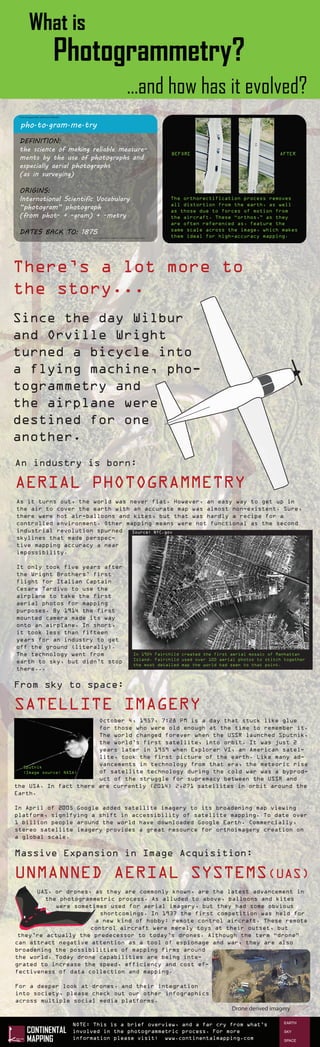
The orthorectification process removes
all distortion from the earth, as well
as those due to forces of motion from
the aircraft. These “orthos,” as they
are often referenced as, feature the
same scale across the image, which makes
them ideal for high-accuracy mapping.
NOTE: This is a brief overview, and a far cry from what’s
involved in the photogrammetric process. For more
information please visit: www.continentalmapping.com
BEFORE AFTER

Photogrammetry

  • 1.
    What is Photogrammetry? http://www.merriam-webster.com/dictionary/photogrammetry From thegood folks at Merriam-Webster: pho·to·gram·me·try DEFINITION: the science of making reliable measure- ments by the use of photographs and especially aerial photographs (as in surveying) ORIGINS: International Scientific Vocabulary “photogram” photograph (from phot- + -gram) + -metry DATES BACK TO: 1875 There’s a lot more to the story... Since the day Wilbur and Orville Wright turned a bicycle into a flying machine, pho- togrammetry and the airplane were destined for one another. An industry is born: AERIAL PHOTOGRAMMETRY As it turns out, the world was never flat. However, an easy way to get up in the air to cover the earth with an accurate map was almost non-existent. Sure, there were hot air-balloons and kites, but that was hardly a recipe for a controlled environment. Other mapping means were not functional as the second industrial revolution spurned skylines that made perspec- tive mapping accuracy a near impossibility. It only took five years after the Wright Brothers’ first flight for Italian Captain Cesare Tardivo to use the airplane to take the first aerial photos for mapping purposes. By 1914 the first mounted camera made its way onto an airplane. In short, it took less than fifteen years for an industry to get off the ground (literally). The technology went from earth to sky, but didn’t stop there... In 1924 Fairchild created the first aerial mosaic of Manhattan Island. Fairchild used over 100 aerial photos to stitch together the most detailed map the world had seen to that point. Source: NYC.gov October 4, 1957, 7:28 PM is a day that stuck like glue for those who were old enough at the time to remember it. The world changed forever when the USSR launched Sputnik, the world’s first satellite, into orbit. It was just 2 years later in 1959 when Explorer VI, an American satel- lite, took the first picture of the earth. Like many ad- vancements in technology from that era, the meteoric rise of satellite technology during the cold war was a byprod- uct of the struggle for supremacy between the USSR and the USA. In fact there are currently (2014) 2,271 satellites in orbit around the Earth. In April of 2005 Google added satellite imagery to its broadening map viewing platform, signifying a shift in accessibility of satellite mapping. To date over 1 billion people around the world have downloaded Google Earth. Commercially, stereo satellite imagery provides a great resource for orthoimagery creation on a global scale. ...and how has it evolved? Sputnik (Image source: NASA) From sky to space: SATELLITE IMAGERY UAS, or drones, as they are commonly known, are the latest advancement in the photogrammetric process. As alluded to above, balloons and kites were sometimes used for aerial imagery, but they had some obvious shortcomings. In 1937 the first competition was held for a new kind of hobby: remote control aircraft. These remote control aircraft were merely toys at their outset, but they’re actually the predecessor to today’s drones. Although the term “drone” can attract negative attention as a tool of espionage and war, they are also broadening the possibilities of mapping firms around the world. Today drone capabilities are being inte- grated to increase the speed, efficiency and cost ef- fectiveness of data collection and mapping. For a deeper look at drones, and their integration into society, please check out our other infographics across multiple social media platforms. Massive Expansion in Image Acquisition: UNMANNED AERIAL SYSTEMS(UAS) Drone derived imagery The orthorectification process removes all distortion from the earth, as well as those due to forces of motion from the aircraft. These “orthos,” as they are often referenced as, feature the same scale across the image, which makes them ideal for high-accuracy mapping. NOTE: This is a brief overview, and a far cry from what’s involved in the photogrammetric process. For more information please visit: www.continentalmapping.com BEFORE AFTER