Welcome!
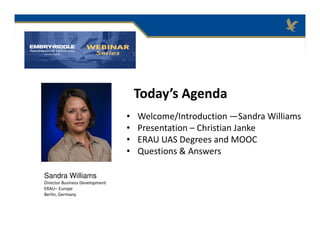
Today’s Agenda
• Welcome/Introduction —Sandra Williams
• Presentation – Christian Janke
• ERAU UAS Degrees and MOOC
• Questions & Answers
Sandra Williams
Director Business Development
ERAU– Europe
Berlin, Germany
A few session pointers
1. We will answer questions at the conclusion of the presentation.
Post questions via the Chat Box at any time. We will answer as

many as we can
2. Slides are available for download at any time

3. The recording link will be emailed to you
4. We have provided additional links we encourage you to open
and save during the presentation. They will open in new
window
WEBINAR
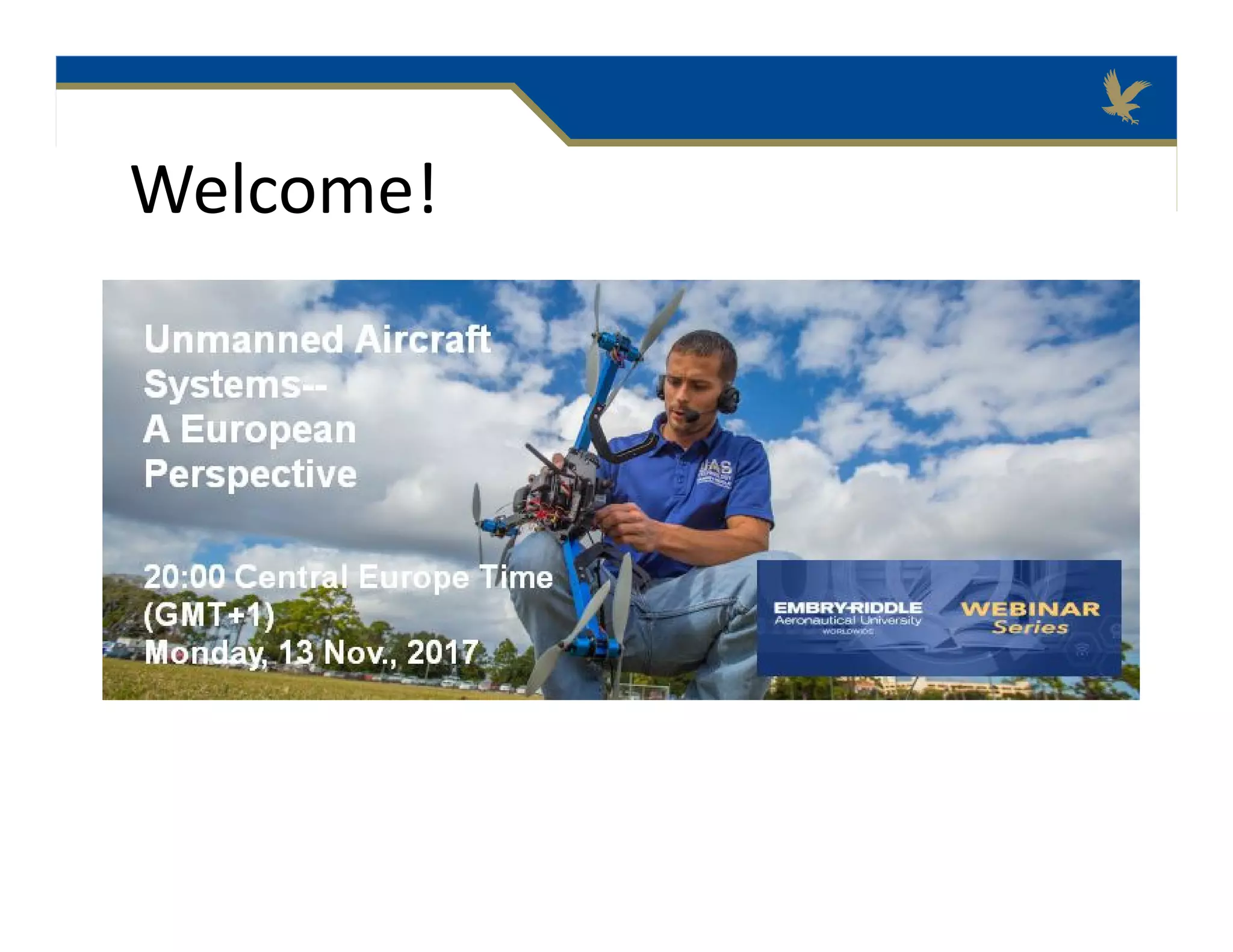
November 13th 2017
Developments in Unmanned Aircraft Systems (UAS) in
Commercial and Public Operations:
A European Perspective
Presenter:
Christian Janke
Assistant Professor, College of Aeronautics
Embry Riddle Aeronautical University
Associate Program Chair Bachelor of Science in Unmanned
Systems Applications
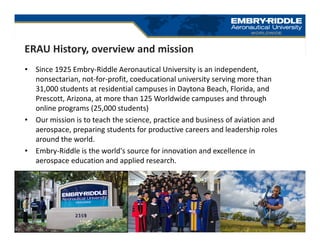
• Since 1925 Embry-Riddle Aeronautical University is an independent,
nonsectarian, not-for-profit, coeducational university serving more than
31,000 students at residential campuses in Daytona Beach, Florida, and
Prescott, Arizona, at more than 125 Worldwide campuses and through
online programs (25,000 students)
• Our mission is to teach the science, practice and business of aviation and
aerospace, preparing students for productive careers and leadership roles
around the world.
• Embry-Riddle is the world's source for innovation and excellence in
aerospace education and applied research.
ERAU History, overview and mission
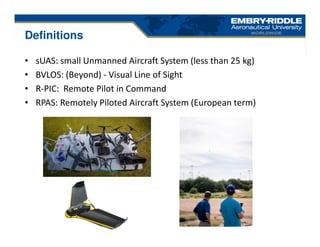
Definitions
• sUAS: small Unmanned Aircraft System (less than 25 kg)
• BVLOS: (Beyond) - Visual Line of Sight
• R-PIC: Remote Pilot in Command
• RPAS: Remotely Piloted Aircraft System (European term)
1. Introduction
2. European market and regulations
3. Cyber Security
4. Counter-UAS
5. Outlook
Agenda
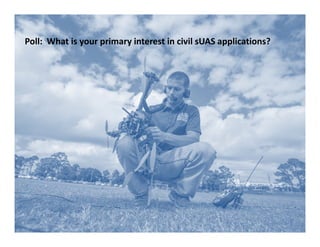
Poll: What is your primary interest in civil sUAS applications?
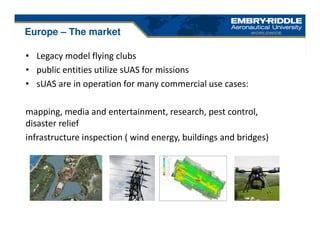
• Legacy model flying clubs
• public entities utilize sUAS for missions
• sUAS are in operation for many commercial use cases:
mapping, media and entertainment, research, pest control,
disaster relief
infrastructure inspection ( wind energy, buildings and bridges)
Europe – The market
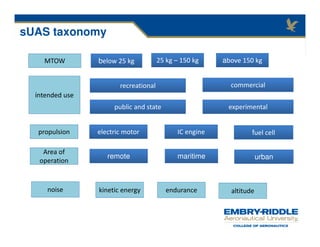
sUAS taxonomy
below 25 kg 25 kg – 150 kg
recreational commercial
public and state experimental
electric motor IC engine fuel cell
MTOW
intended use
propulsion
above 150 kg
noise kinetic energy endurance altitude
Area of
operation
Area of
operation
remote maritime urban
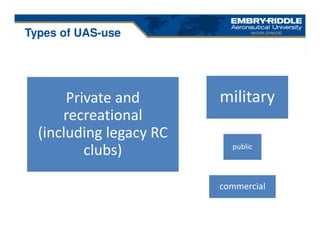
commercial
public
militaryPrivate and
recreational
(including legacy RC
clubs)
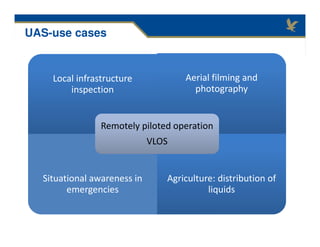
Types of UAS-use
Local infrastructure
inspection
Local infrastructure
inspection
Aerial filming and
photography
Aerial filming and
photography
Situational awareness in
emergencies
Situational awareness in
emergencies
Agriculture: distribution of
liquids
Agriculture: distribution of
liquids
Remotely piloted operation
VLOS
Remotely piloted operation
VLOS
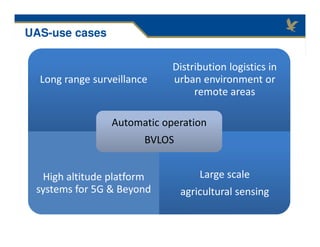
UAS-use cases
Long range surveillanceLong range surveillance
Distribution logistics in
urban environment or
remote areas
Distribution logistics in
urban environment or
remote areas
High altitude platform
systems for 5G & Beyond
High altitude platform
systems for 5G & Beyond
Large scale
agricultural sensing
Large scale
agricultural sensing
Automatic operation
BVLOS
Automatic operation
BVLOS
UAS-use cases
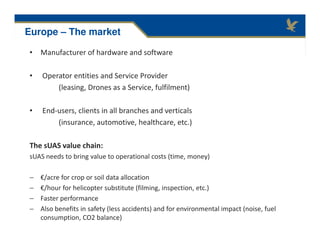
• Manufacturer of hardware and software
• Operator entities and Service Provider
(leasing, Drones as a Service, fulfilment)
• End-users, clients in all branches and verticals
(insurance, automotive, healthcare, etc.)
The sUAS value chain:
sUAS needs to bring value to operational costs (time, money)
− €/acre for crop or soil data allocation
− €/hour for helicopter substitute (filming, inspection, etc.)
− Faster performance
− Also benefits in safety (less accidents) and for environmental impact (noise, fuel
consumption, CO2 balance)
Europe – The market
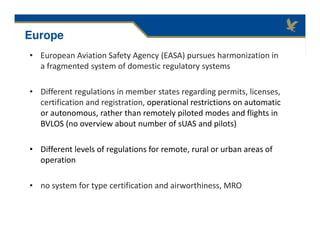
• European Aviation Safety Agency (EASA) pursues harmonization in
a fragmented system of domestic regulatory systems
• Different regulations in member states regarding permits, licenses,
certification and registration, operational restrictions on automatic
or autonomous, rather than remotely piloted modes and flights in
BVLOS (no overview about number of sUAS and pilots)
• Different levels of regulations for remote, rural or urban areas of
operation
• no system for type certification and airworthiness, MRO
Europe
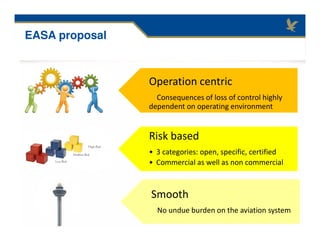
Operation centric
Consequences of loss of control highly
dependent on operating environment
Risk based
• 3 categories: open, specific, certified
• Commercial as well as non commercial
Smooth
No undue burden on the aviation system
EASA proposal
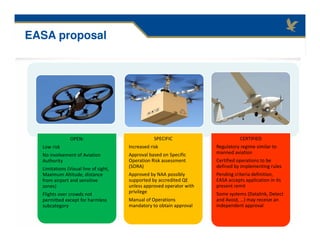
OPEN:
Low risk
No involvement of Aviation
Authority
Limitations (Visual line of sight,
Maximum Altitude, distance
from airport and sensitive
zones)
Flights over crowds not
permitted except for harmless
subcategory
SPECIFIC
Increased risk
Approval based on Specific
Operation Risk assessment
(SORA)
Approved by NAA possibly
supported by accredited QE
unless approved operator with
privilege
Manual of Operations
mandatory to obtain approval
CERTIFIED
Regulatory regime similar to
manned aviation
Certified operations to be
defined by implementing rules
Pending criteria definition,
EASA accepts application in its
present remit
Some systems (Datalink, Detect
and Avoid, …) may receive an
independent approval
EASA proposal
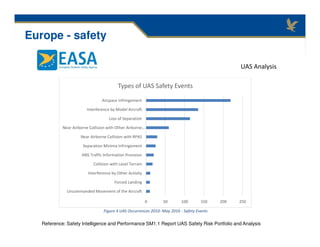
UAS Analysis
Figure 4 UAS Occurrences 2010- May 2016 - Safety Events
0 50 100 150 200 250
Uncommanded Movement of the Aircraft
Forced Landing
Interference by Other Activity
Collision with Level Terrain
ANS Traffic Information Provision
Separation Minima Infringement
Near Airborne Collision with RPAS
Near Airborne Collision with Other Airborne…
Loss of Separation
Interference by Model Aircraft
Airspace Infringement
Types of UAS Safety Events
Europe - safety
Reference: Safety Intelligence and Performance SM1.1 Report UAS Safety Risk Portfolio and Analysis
Europe
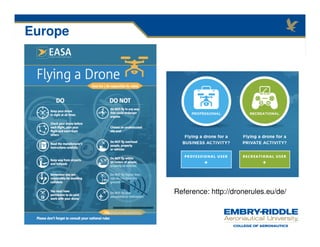
Reference: http://dronerules.eu/de/
• Numerous studies from commercial and academic resources predict
exponential growth in the market
• Macro data and reports about world-wide market size, shares and usage
of commercial drones are more educated guesses and extrapolations
• Regulation is the biggest showstopper for high-profit use cases
• Growing startup scene hardware, software and services
• Market consolidation and increasing global M&A
• Corporates spin-offs
The market
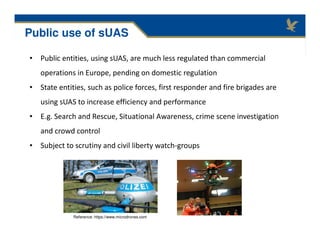
• Public entities, using sUAS, are much less regulated than commercial
operations in Europe, pending on domestic regulation
• State entities, such as police forces, first responder and fire brigades are
using sUAS to increase efficiency and performance
• E.g. Search and Rescue, Situational Awareness, crime scene investigation
and crowd control
• Subject to scrutiny and civil liberty watch-groups
Public use of sUAS
Reference: https://www.microdrones.com
Outlook - Europe
• Importance sUAS coordination in uncontrolled airspace will increase, e.g.
geofencing and separation of airspace participants
• U-Space and UTM (UAS Airspace Traffic Management)
• New technologies to address and mitigate the hazards of mid-air collisions and
ground impact
• sUAS will be a growing factor in many industries
• Awareness building and education is the key!
• Cyber Security and sUAS
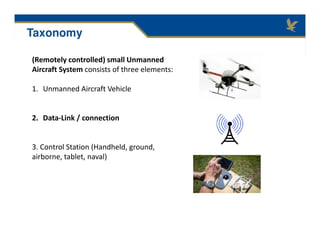
(Remotely controlled) small Unmanned
Aircraft System consists of three elements:
1. Unmanned Aircraft Vehicle
2. Data-Link / connection
3. Control Station (Handheld, ground,
airborne, tablet, naval)
Taxonomy
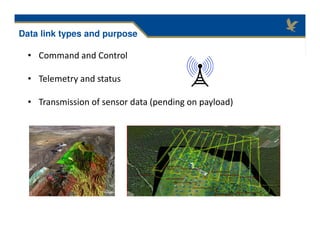
• Command and Control
• Telemetry and status
• Transmission of sensor data (pending on payload)
Data link types and purpose
• Jamming of Command and Control link
• Spoofing of GPS
• Hi-jacking of the UAV
• Espionage with payload data
• Intentional Electromagnetic Interference (IEMI)
• infrastructure radiation and interference
• Congestion and saturation
Threats and hazards
• Protection and encryption of data links
• Hardening of Components
• Autonomy and Artificial Intelligence
Countermeasures
• Counter UAS
• The truth:
sUAS can be misused in various forms and ways
• Possible detection
• optical and acoustical sensors, radar, frequency scanning,
• laser barriers, awareness and security personnel
• Possible countermeasures:
• Signal- Jamming, spoofing, kinetic interception
• interceptor UAV, laser, disruption of electronic operations
• passive infrastructure
Protection
• Many providers and services are already on the market
• Different Technology Readiness Levels
• Startups and legacy corporates
Counter UAS solutions must provide:
• Civil dimensions in terms of power consumption, emission rate in
the EM spectrum, weight, mobility and price
• Sensor-Fusion
• Compliance with data protection legislation (image acquisition)
• Quality and functionality must be tested (low false-negative and
false positive rate)
Counter UAS status
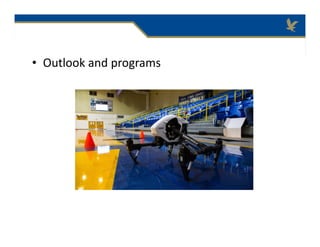
• Outlook and programs
• Online academic education is contextual, interactive, portable,
ubiquitous, informal
• Mobility - Geolocation is learning location
• Bring Your Own Device
• Makes access to education easier and flexible
• Non-technical skills, such as project management assignments
within a group over several time zones, nationalities and
cultures
• Why study analog for a digital working environment ?
Embry Riddle success:
Growing student enrollments per academic year
Very high employment rate with above average salaries
Strong alumni network and high student satisfaction
Worldwide Campus
• Master of Science in Unmanned Systems (MSUS)
• Bachelor of Science in Unmanned Systems Applications (BSUSA)
• Focus: application, development, and management of unmanned systems,
policies, regulations, and related technology to meet the dynamic needs and
challenges of industry
• Goal: Produce graduates qualified to enter or advance position in workforce
(application, development, management, policy-making, and support)
Increasing career opportunities with above average salaries
International market expansion
Industry outreach and survey for degree optimization
Embry Riddle sUAS programs
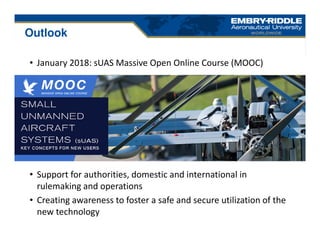
• January 2018: sUAS Massive Open Online Course (MOOC)
• Support for authorities, domestic and international in
rulemaking and operations
• Creating awareness to foster a safe and secure utilization of the
new technology
Outlook
Thank you! Questions?
Christian Janke, MSA & Dipl. Pol.
Assistant Professor, College of Aeronautics
Embry-Riddle Aeronautical University-
Worldwide
jankec@erau.edu
https://worldwide.erau.edu/
https://europe.erau.edu/
Thank You!
This concludes today’s webinar
Watch for a follow up email that
contains a link to the
session recording and slide download

Erau webinar UAS-a european perspective

  • 1.
  • 2.
    Today’s Agenda • Welcome/Introduction—Sandra Williams • Presentation – Christian Janke • ERAU UAS Degrees and MOOC • Questions & Answers Sandra Williams Director Business Development ERAU– Europe Berlin, Germany
  • 3.
    A few sessionpointers 1. We will answer questions at the conclusion of the presentation. Post questions via the Chat Box at any time. We will answer as many as we can 2. Slides are available for download at any time 3. The recording link will be emailed to you 4. We have provided additional links we encourage you to open and save during the presentation. They will open in new window
  • 4.
    WEBINAR November 13th 2017 Developmentsin Unmanned Aircraft Systems (UAS) in Commercial and Public Operations: A European Perspective
  • 5.
    Presenter: Christian Janke Assistant Professor,College of Aeronautics Embry Riddle Aeronautical University Associate Program Chair Bachelor of Science in Unmanned Systems Applications
  • 6.
    • Since 1925Embry-Riddle Aeronautical University is an independent, nonsectarian, not-for-profit, coeducational university serving more than 31,000 students at residential campuses in Daytona Beach, Florida, and Prescott, Arizona, at more than 125 Worldwide campuses and through online programs (25,000 students) • Our mission is to teach the science, practice and business of aviation and aerospace, preparing students for productive careers and leadership roles around the world. • Embry-Riddle is the world's source for innovation and excellence in aerospace education and applied research. ERAU History, overview and mission
  • 7.
    Definitions • sUAS: smallUnmanned Aircraft System (less than 25 kg) • BVLOS: (Beyond) - Visual Line of Sight • R-PIC: Remote Pilot in Command • RPAS: Remotely Piloted Aircraft System (European term)
  • 8.
    1. Introduction 2. Europeanmarket and regulations 3. Cyber Security 4. Counter-UAS 5. Outlook Agenda
  • 9.
    Poll: What isyour primary interest in civil sUAS applications?
  • 10.
    • Legacy modelflying clubs • public entities utilize sUAS for missions • sUAS are in operation for many commercial use cases: mapping, media and entertainment, research, pest control, disaster relief infrastructure inspection ( wind energy, buildings and bridges) Europe – The market
  • 11.
    sUAS taxonomy below 25kg 25 kg – 150 kg recreational commercial public and state experimental electric motor IC engine fuel cell MTOW intended use propulsion above 150 kg noise kinetic energy endurance altitude Area of operation Area of operation remote maritime urban
  • 12.
  • 13.
    Local infrastructure inspection Local infrastructure inspection Aerialfilming and photography Aerial filming and photography Situational awareness in emergencies Situational awareness in emergencies Agriculture: distribution of liquids Agriculture: distribution of liquids Remotely piloted operation VLOS Remotely piloted operation VLOS UAS-use cases
  • 14.
    Long range surveillanceLongrange surveillance Distribution logistics in urban environment or remote areas Distribution logistics in urban environment or remote areas High altitude platform systems for 5G & Beyond High altitude platform systems for 5G & Beyond Large scale agricultural sensing Large scale agricultural sensing Automatic operation BVLOS Automatic operation BVLOS UAS-use cases
  • 15.
    • Manufacturer ofhardware and software • Operator entities and Service Provider (leasing, Drones as a Service, fulfilment) • End-users, clients in all branches and verticals (insurance, automotive, healthcare, etc.) The sUAS value chain: sUAS needs to bring value to operational costs (time, money) − €/acre for crop or soil data allocation − €/hour for helicopter substitute (filming, inspection, etc.) − Faster performance − Also benefits in safety (less accidents) and for environmental impact (noise, fuel consumption, CO2 balance) Europe – The market
  • 16.
    • European AviationSafety Agency (EASA) pursues harmonization in a fragmented system of domestic regulatory systems • Different regulations in member states regarding permits, licenses, certification and registration, operational restrictions on automatic or autonomous, rather than remotely piloted modes and flights in BVLOS (no overview about number of sUAS and pilots) • Different levels of regulations for remote, rural or urban areas of operation • no system for type certification and airworthiness, MRO Europe
  • 17.
    Operation centric Consequences ofloss of control highly dependent on operating environment Risk based • 3 categories: open, specific, certified • Commercial as well as non commercial Smooth No undue burden on the aviation system EASA proposal
  • 18.
    OPEN: Low risk No involvementof Aviation Authority Limitations (Visual line of sight, Maximum Altitude, distance from airport and sensitive zones) Flights over crowds not permitted except for harmless subcategory SPECIFIC Increased risk Approval based on Specific Operation Risk assessment (SORA) Approved by NAA possibly supported by accredited QE unless approved operator with privilege Manual of Operations mandatory to obtain approval CERTIFIED Regulatory regime similar to manned aviation Certified operations to be defined by implementing rules Pending criteria definition, EASA accepts application in its present remit Some systems (Datalink, Detect and Avoid, …) may receive an independent approval EASA proposal
  • 19.
    UAS Analysis Figure 4UAS Occurrences 2010- May 2016 - Safety Events 0 50 100 150 200 250 Uncommanded Movement of the Aircraft Forced Landing Interference by Other Activity Collision with Level Terrain ANS Traffic Information Provision Separation Minima Infringement Near Airborne Collision with RPAS Near Airborne Collision with Other Airborne… Loss of Separation Interference by Model Aircraft Airspace Infringement Types of UAS Safety Events Europe - safety Reference: Safety Intelligence and Performance SM1.1 Report UAS Safety Risk Portfolio and Analysis
  • 20.
  • 21.
    • Numerous studiesfrom commercial and academic resources predict exponential growth in the market • Macro data and reports about world-wide market size, shares and usage of commercial drones are more educated guesses and extrapolations • Regulation is the biggest showstopper for high-profit use cases • Growing startup scene hardware, software and services • Market consolidation and increasing global M&A • Corporates spin-offs The market
  • 22.
    • Public entities,using sUAS, are much less regulated than commercial operations in Europe, pending on domestic regulation • State entities, such as police forces, first responder and fire brigades are using sUAS to increase efficiency and performance • E.g. Search and Rescue, Situational Awareness, crime scene investigation and crowd control • Subject to scrutiny and civil liberty watch-groups Public use of sUAS Reference: https://www.microdrones.com
  • 23.
    Outlook - Europe •Importance sUAS coordination in uncontrolled airspace will increase, e.g. geofencing and separation of airspace participants • U-Space and UTM (UAS Airspace Traffic Management) • New technologies to address and mitigate the hazards of mid-air collisions and ground impact • sUAS will be a growing factor in many industries • Awareness building and education is the key!
  • 24.
  • 25.
    (Remotely controlled) smallUnmanned Aircraft System consists of three elements: 1. Unmanned Aircraft Vehicle 2. Data-Link / connection 3. Control Station (Handheld, ground, airborne, tablet, naval) Taxonomy
  • 26.
    • Command andControl • Telemetry and status • Transmission of sensor data (pending on payload) Data link types and purpose
  • 27.
    • Jamming ofCommand and Control link • Spoofing of GPS • Hi-jacking of the UAV • Espionage with payload data • Intentional Electromagnetic Interference (IEMI) • infrastructure radiation and interference • Congestion and saturation Threats and hazards
  • 28.
    • Protection andencryption of data links • Hardening of Components • Autonomy and Artificial Intelligence Countermeasures
  • 29.
  • 30.
    • The truth: sUAScan be misused in various forms and ways
  • 31.
    • Possible detection •optical and acoustical sensors, radar, frequency scanning, • laser barriers, awareness and security personnel • Possible countermeasures: • Signal- Jamming, spoofing, kinetic interception • interceptor UAV, laser, disruption of electronic operations • passive infrastructure Protection
  • 32.
    • Many providersand services are already on the market • Different Technology Readiness Levels • Startups and legacy corporates Counter UAS solutions must provide: • Civil dimensions in terms of power consumption, emission rate in the EM spectrum, weight, mobility and price • Sensor-Fusion • Compliance with data protection legislation (image acquisition) • Quality and functionality must be tested (low false-negative and false positive rate) Counter UAS status
  • 33.
  • 34.
    • Online academiceducation is contextual, interactive, portable, ubiquitous, informal • Mobility - Geolocation is learning location • Bring Your Own Device • Makes access to education easier and flexible • Non-technical skills, such as project management assignments within a group over several time zones, nationalities and cultures • Why study analog for a digital working environment ? Embry Riddle success: Growing student enrollments per academic year Very high employment rate with above average salaries Strong alumni network and high student satisfaction Worldwide Campus
  • 35.
    • Master ofScience in Unmanned Systems (MSUS) • Bachelor of Science in Unmanned Systems Applications (BSUSA) • Focus: application, development, and management of unmanned systems, policies, regulations, and related technology to meet the dynamic needs and challenges of industry • Goal: Produce graduates qualified to enter or advance position in workforce (application, development, management, policy-making, and support) Increasing career opportunities with above average salaries International market expansion Industry outreach and survey for degree optimization Embry Riddle sUAS programs
  • 36.
    • January 2018:sUAS Massive Open Online Course (MOOC) • Support for authorities, domestic and international in rulemaking and operations • Creating awareness to foster a safe and secure utilization of the new technology Outlook
  • 37.
    Thank you! Questions? ChristianJanke, MSA & Dipl. Pol. Assistant Professor, College of Aeronautics Embry-Riddle Aeronautical University- Worldwide jankec@erau.edu https://worldwide.erau.edu/ https://europe.erau.edu/
  • 38.
    Thank You! This concludestoday’s webinar Watch for a follow up email that contains a link to the session recording and slide download