Mapping UK Sea Space
Mapping UK Sea Space


           John Pepper
           J h P
       Principal Consultant
   John Pepper Consultancy Ltd


         BCS Symposium 11th June 2010
A Few Facts…
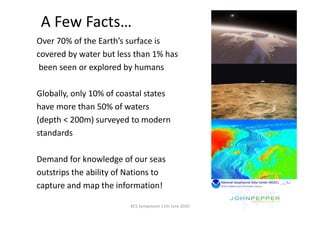
Over 70% of the Earth’s surface is 
covered by water but less than 1% has
 been seen or explored by humans 

Globally, only 10% of coastal states 
have more than 50% of waters 
(depth < 200m) surveyed to modern 
standards

Demand for knowledge of our seas 
outstrips the ability of Nations to 
capture and map the information!

                         BCS Symposium 11th June 2010
Historic perspective
     Historic perspective
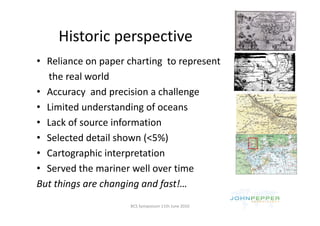
• Reliance on paper charting to represent
  Reliance on paper charting  to represent
  the real world
• Accuracy  and precision a challenge
• Limited understanding of oceans
• Lack of source information
• Selected detail shown (<5%)
  Selected detail shown (<5%)
• Cartographic interpretation 
• Served the mariner well over time
But things are changing and fast!… 
                     BCS Symposium 11th June 2010
Why do we need a map?
  y                p
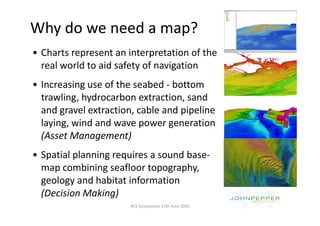
• Charts represent an interpretation of the 
  real world to aid safety of navigation
     l    ld      d f       f
• Increasing use of the seabed ‐ bottom
  Increasing use of the seabed  bottom 
  trawling, hydrocarbon extraction, sand 
  and gravel extraction, cable and pipeline 
  and gravel extraction, cable and pipeline
  laying, wind and wave power generation 
  (Asset Management)
  (Asset Management)
• Spatial planning requires a sound base‐
  map combining seafloor topography, 
            bi i      fl            h
  geology and habitat information 
  (Decision Making)
  (D i i M ki )
                       BCS Symposium 11th June 2010
THE CHALLENGE – SOURCE FROM PRODUCT
THE CHALLENGE SOURCE FROM PRODUCT


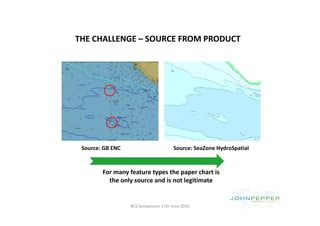
 Source: GB ENC                       Source: SeaZone HydroSpatial


        For many feature types the paper chart is 
          the only source and is not legitimate


                  BCS Symposium 11th June 2010
Areas to be mapped
              pp
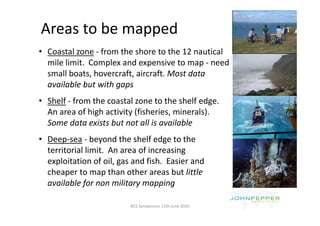
• Coastal zone ‐ from the shore to the 12 nautical 
  mile limit.  Complex and expensive to map ‐ need 
  mile limit Complex and expensive to map need
  small boats, hovercraft, aircraft. Most data 
  available but with gaps
  available but with gaps
• Shelf ‐ from the coastal zone to the shelf edge. 
  An area of high activity (fisheries, minerals). 
  An area of high activity (fisheries minerals)
  Some data exists but not all is available
• Deep sea ‐ beyond the shelf edge to the
  Deep‐sea beyond the shelf edge to the 
  territorial limit.  An area of increasing 
  exploitation of oil, gas and fish.  Easier and 
    p                  ,g
  cheaper to map than other areas but little 
  available for non military mapping

                          BCS Symposium 11th June 2010
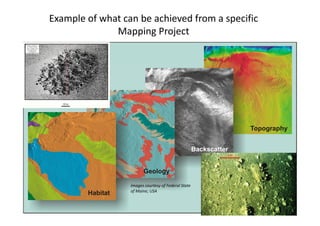
Example of what can be achieved from a specific 
              Mapping Project
                  pp g     j


                  Images courtesy of Federal State 
                  of Maine; USA
                   f M i USA
Technological Developments
              g           p
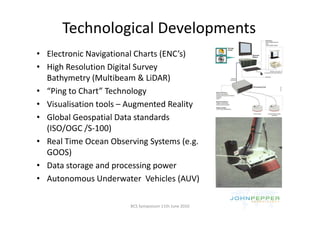
• Electronic Navigational Charts (ENC’s)
• High Resolution Digital Survey 
  Bathymetry (Multibeam & LiDAR)
• “Ping to Chart” Technology
• Visualisation tools – Augmented Reality
• Global Geospatial Data standards 
  (ISO/OGC /S‐100)
• R l Ti
  Real Time Ocean Observing Systems (e.g. 
             O      Ob     i S         (
  GOOS)
• Data storage and processing power
  Data storage and processing power
• Autonomous Underwater  Vehicles (AUV)

                        BCS Symposium 11th June 2010
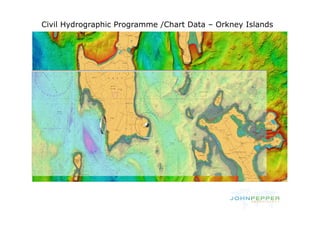
Civil Hydrographic Programme /Chart Data – Orkney Islands
Legislative Drivers 
           Legislative Drivers
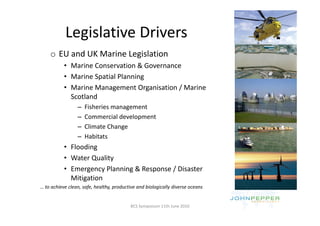
    o EU and UK Marine Legislation
           • Marine Conservation & Governance
           • Marine Spatial Planning
           • Marine Management Organisation / Marine
             Marine Management Organisation / Marine 
             Scotland
                 –   Fisheries management
                 –   Commercial development 
                 –   Climate Change
                 –   Habitats
                       ab tats
           • Flooding
           • Water Quality
           • Emergency Planning & Response / Disaster 
             Mitigation
… to achieve clean, safe, healthy, productive and biologically diverse oceans


                                          BCS Symposium 11th June 2010
Governance Drivers 
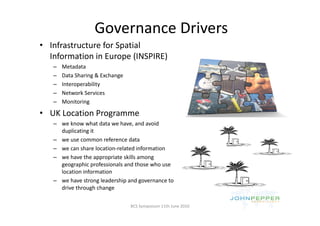
• Infrastructure for Spatial 
  Information in Europe (INSPIRE)
   –   Metadata
   –   Data Sharing & Exchange
   –   Interoperability
   –   Network Services
   –   Monitoring

• UK Location Programme
  UK Location Programme
   – we know what data we have, and avoid 
     duplicating it
   – we use common reference data
                        f       d t
   – we can share location‐related information
   – we have the appropriate skills among 
     geographic professionals and those who use 
     geographic professionals and those who use
     location information 
   – we have strong leadership and governance to 
                 g      g
     drive through change

                                 BCS Symposium 11th June 2010
Recent developments in mapping & 
 R       d l           i       i &
 visualising the marine environment
 visualising the marine environment

          Coastal Mapping and Analysis
                            p       y
            Land‐Sea Interoperability
            Digital Terrain Modelling
              Deep Ocean Mapping
              Deep Ocean Mapping
                 Land‐Sea DEM’s
Smart Processes – Data Capture to Output Delivery


                   BCS Symposium 11th June 2010
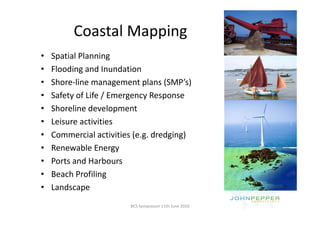
Coastal Mapping
         Coastal Mapping
•   Spatial Planning
•   Flooding and Inundation
•   Shore‐line management plans (SMP’s)
•   Safety of Life / Emergency Response
•   Shoreline development
•   Leisure activities
•   Commercial activities (e.g. dredging)
                           ( g      g g)
•   Renewable Energy
•   Ports and Harbours
•   Beach Profiling
•   Landscape
                        BCS Symposium 11th June 2010
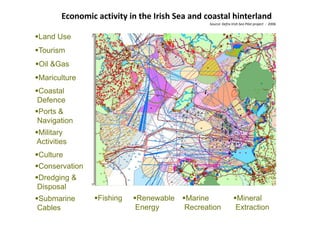
Economic activity in the Irish Sea and coastal hinterland
                                                Source: Defra Irish Sea Pilot project  ‐ 2006 


Land Use
Tourism
Oil &G
    &Gas
Mariculture
Coastal
Defence
Ports &
Navigation
Military
Activities
A i ii
Culture
Conservation
C       ti
Dredging &
   p
Disposal
Submarine        Fishing   Renewable     Marine                  Mineral
Cables                     Energy        Recreation              Extraction
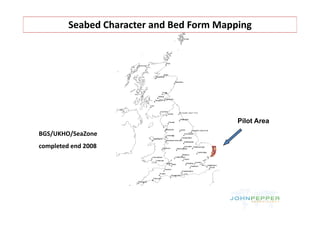
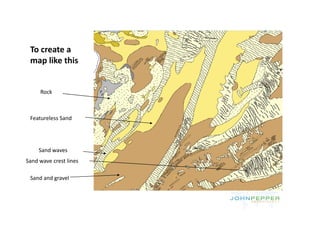
Seabed Character and Bed Form Mapping


                                           Pilot Area
BGS/UKHO/SeaZone
completed end 2008
To create a 
 map like this
 map like this


     Rock


 Featureless Sand


     Sand waves
Sand wave crest lines

 Sand and gravel
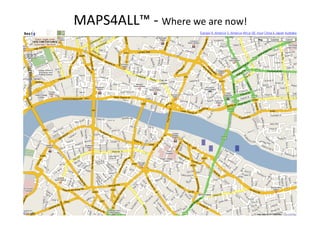
MAPS4ALL™ ‐ Where we are now!
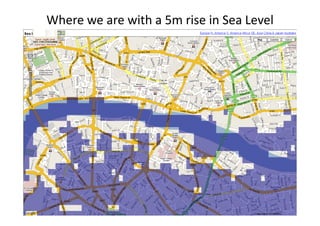
Where we are with a 5m rise in Sea Level
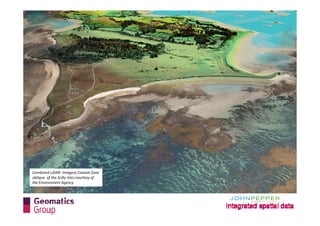
Combined LiDAR ‐Imagery Coastal Zone 
oblique  of the Scilly Isles‐courtesy of 
the Environment Agency
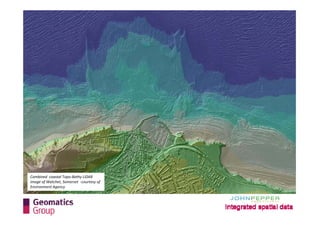
Combined  coastal Topo‐Bathy LiDAR
image of Watchet, Somerset  ‐courtesy of 
Environment Agency
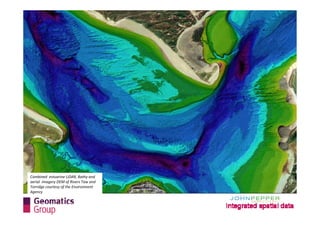
Combined  estuarine LiDAR, Bathy and 
aerial  imagery DEM of Rivers Taw and 
Torridge courtesy of the Environment 
Agency
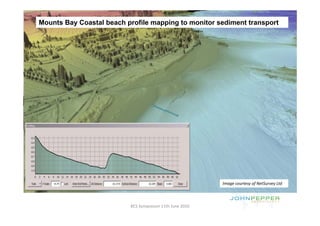
Mounts Bay Coastal beach profile mapping to monitor sediment transport


                                                         Image courtesy of NetSurvey Ltd


                          BCS Symposium 11th June 2010
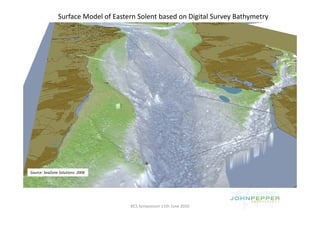
Surface Model of Eastern Solent based on Digital Survey Bathymetry


Source: SeaZone Solutions: 2006


                                     BCS Symposium 11th June 2010
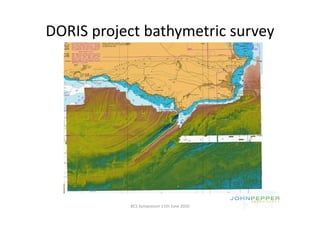
DORIS project bathymetric survey 
DORIS project bathymetric survey


            BCS Symposium 11th June 2010
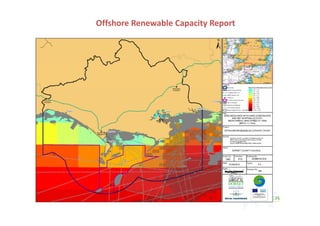
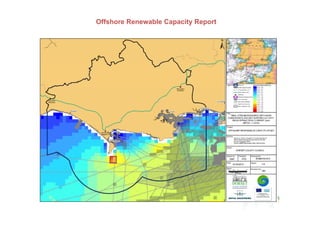
Offshore Renewable Capacity Report
Offshore Renewable Capacity Report
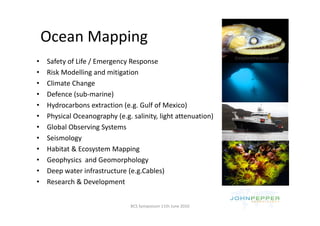
Ocean Mapping
    Ocean Mapping
•   Safety of Life / Emergency Response
    Safety of Life / Emergency Response
•   Risk Modelling and mitigation
•   Climate Change
•   Defence (sub‐marine)
•   Hydrocarbons extraction (e.g. Gulf of Mexico)
•   Physical Oceanography (e.g. salinity, light attenuation) 
•   Global Observing Systems
•   Seismology
•   Habitat & Ecosystem Mapping
•   Geophysics  and Geomorphology
•   Deep water infrastructure (e.g.Cables)
•   Research & Development


                                BCS Symposium 11th June 2010
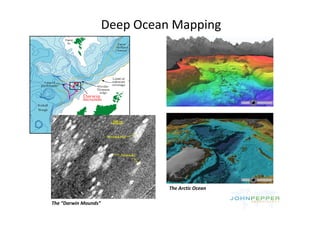
Deep Ocean Mapping


                                The Arctic Ocean

The “Darwin Mounds”
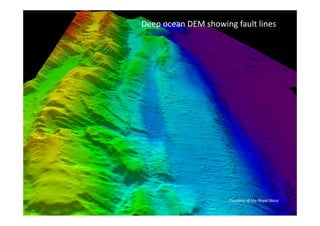
Deep ocean DEM showing fault lines


                      Courtesy of the Royal Navy
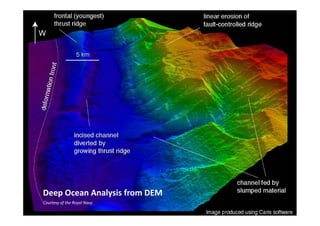
Channel and ridge
                             Channel and ridge


Deep Ocean Analysis from DEM
D    O     A l i f       DEM
Courtesy of the Royal Navy
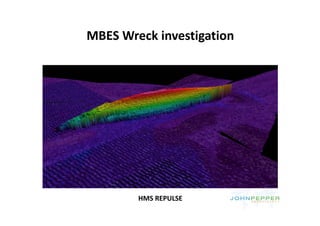
MBES Wreck investigation
MBES Wreck investigation


        HMS REPULSE
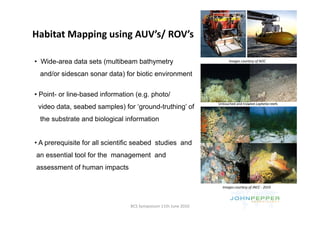
Habitat Mapping using AUV s/ ROV s
Habitat Mapping using AUV’s/ ROV’s

• Wide area data sets (multibeam bathymetry
  Wide-area                                                           Images courtesy of NOC
                                                                      Images courtesy of NOC


 and/or sidescan sonar data) for biotic environment


• Point- or line-based information (e.g. photo/
                                                                Untouched and trawled Lophelia‐reefs
 video data, seabed samples) for ‘ground-truthing’ of
 the substrate and biological information


• A prerequisite for all scientific seabed studies and
an essential tool for the management and
assessment of human impacts

                                                                  Images courtesy of JNCC ‐ 2010


                                 BCS Symposium 11th June 2010
Software requirements for bringing land and 
             sea data together
             sea data together
• Hydro data is +ve down, Topo data is +ve up
   – Software needs to be able to handle this
       f         d     b bl       h dl hi
• Land and Sea data is often referenced to different 
  coordinate systems
  coordinate systems
   –   Vertical = MSL for Land, LAT for Sea
   –   DEM’s therefore need to be shifted (VORF, VDATUM, ASCII)
                                            (                 )
   –   Or stored in reference to the Ellipsoid
   –   Lat & Long versus OSGB36
• Sea to Shore models need to be created to resolve data 
  gaps in the surf zone
• DEM’s need to be combined
   – For seamless examination and analysis
   – To derive continuous vector features e g contours
     To derive continuous vector features e.g. contours
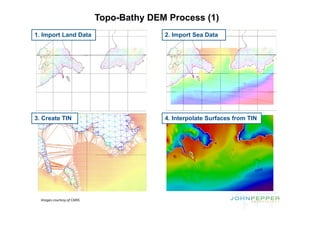
Topo-Bathy DEM Process (1)
1.
1 Import Land Data                         2.
                                           2 Import Sea Data


3. Create TIN                              4. Interpolate Surfaces from TIN


  Images courtesy of CARIS
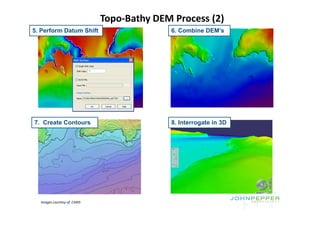
Topo‐Bathy DEM Process (2)
5. Perform Datum Shift                      6. Combine DEM’s


7. Create Contours                          8. Interrogate in 3D


  Images courtesy of  CARIS
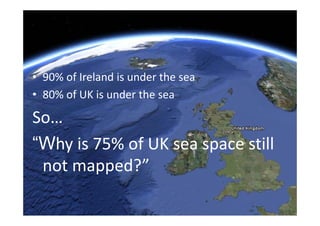
• 90% of Ireland is under the sea
• 80% of UK is under the sea

So… 
“Wh i 75% f UK                ill
“Why is 75% of UK sea space still 
 not mapped?
 not mapped?”
                   BCS Symposium 11th June 2010
Thank You


Any Questions
 www.johnpepperconsultancy.com


     BCS Symposium 11th June 2010

Mapping UK Sea Space