Oregon

   Marine Spatial Planning

    Overview and Update

     Paul Klarin, Marine Program Coordinator
Department of Land Conservation and Development
                    May 2012
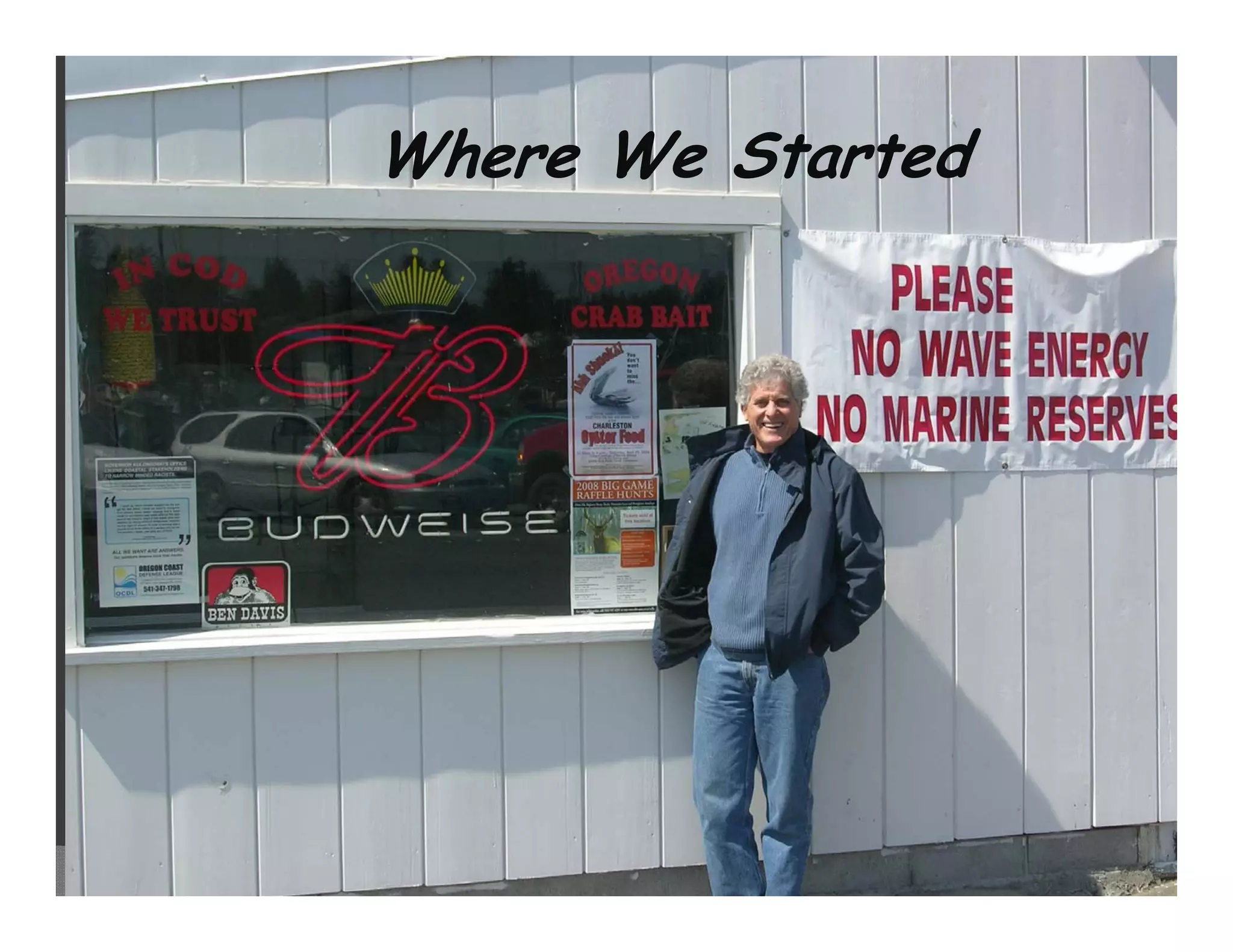
Where We Started
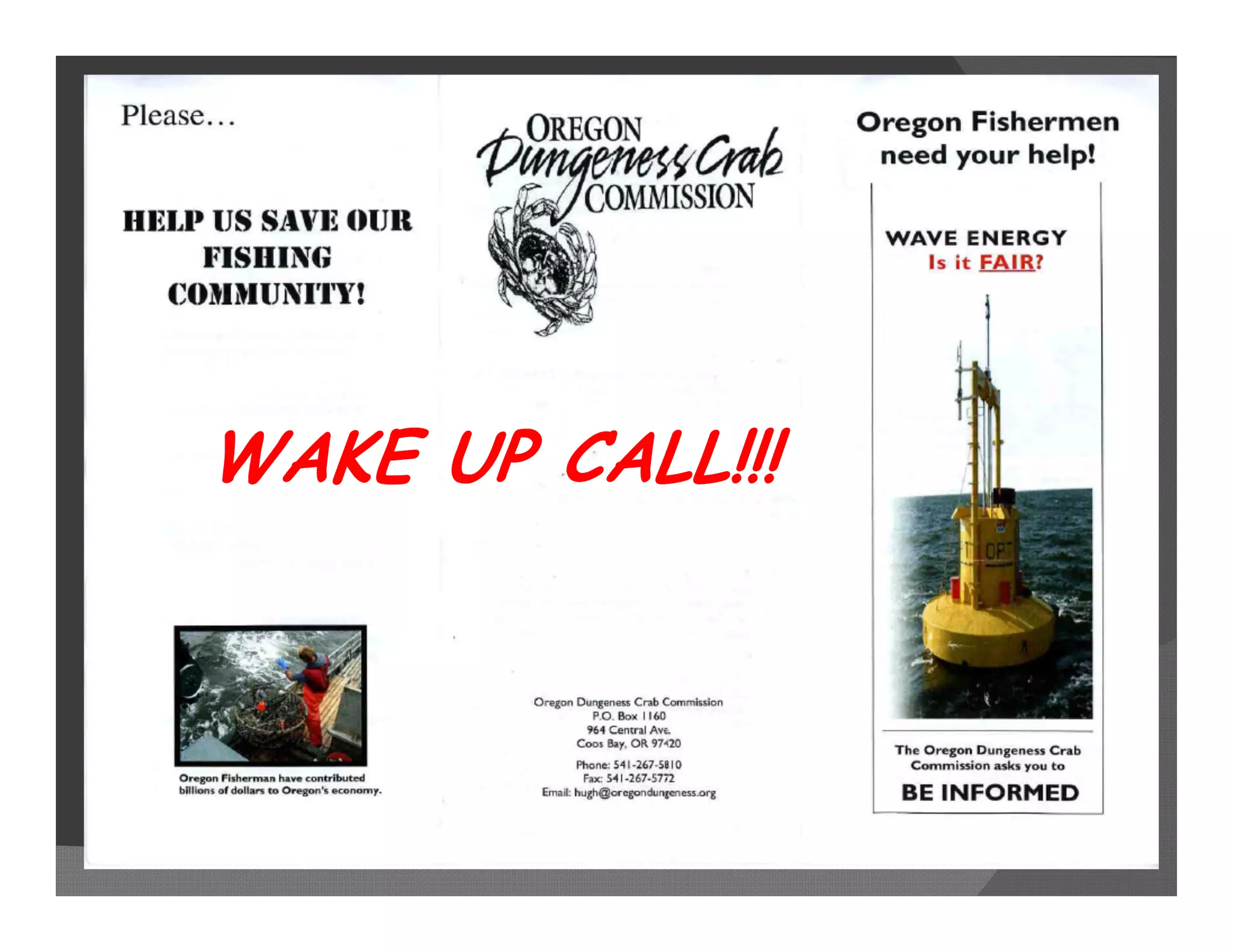
WAKE UP CALL!!!
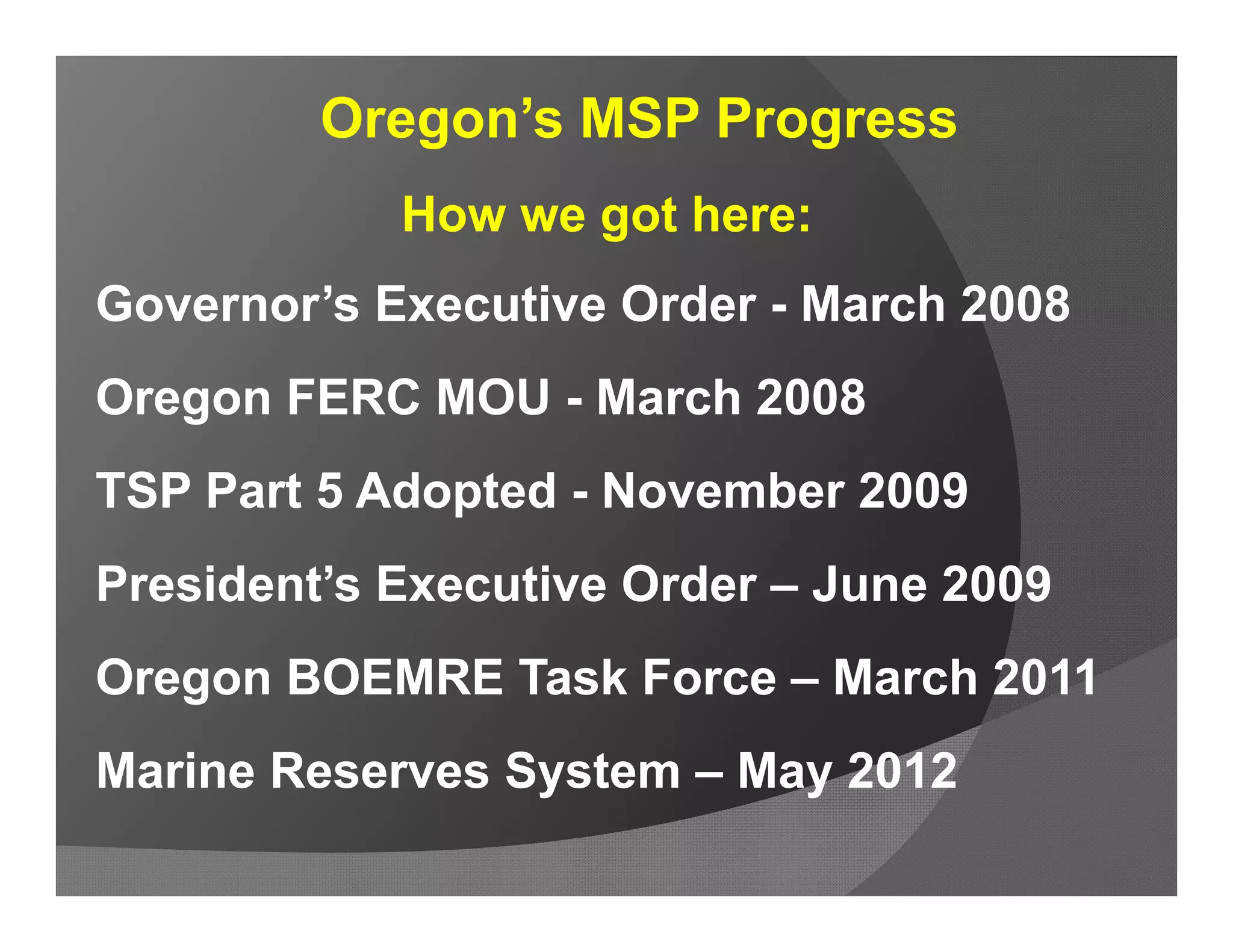
Oregon’s MSP Progress
            How we got here:
Governor’s Executive Order - March 2008
Oregon FERC MOU - March 2008
TSP Part 5 Adopted - November 2009
President’s Executive Order – June 2009
Oregon BOEMRE Task Force – March 2011
Marine Reserves System – May 2012
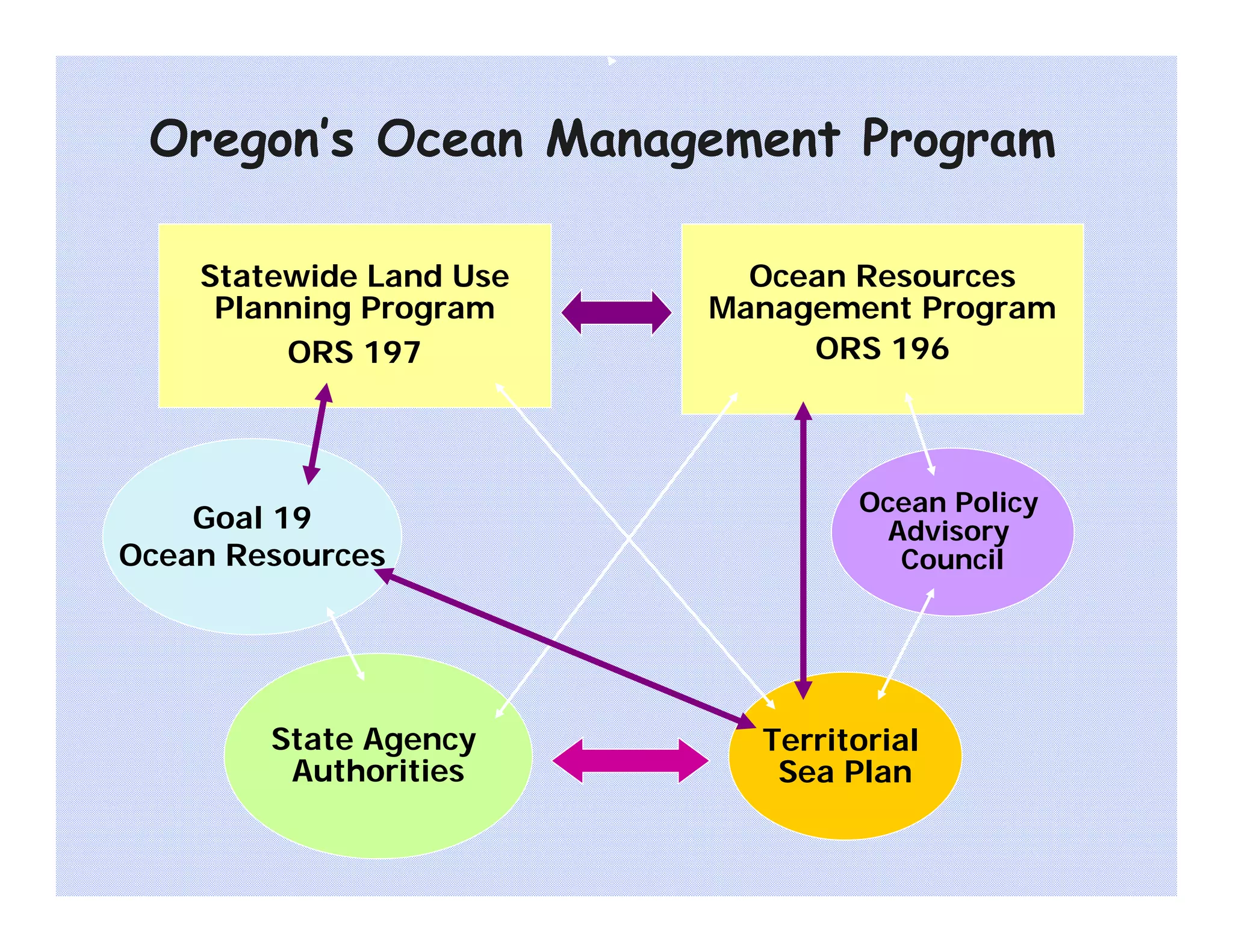
Oregon’s Ocean Management Program

    Statewide Land Use     Ocean Resources
     Planning Program    Management Program
         ORS 197              ORS 196


                                 Ocean Policy
    Goal 19                       Advisory
Ocean Resources                    Council


        State Agency       Territorial
         Authorities        Sea Plan
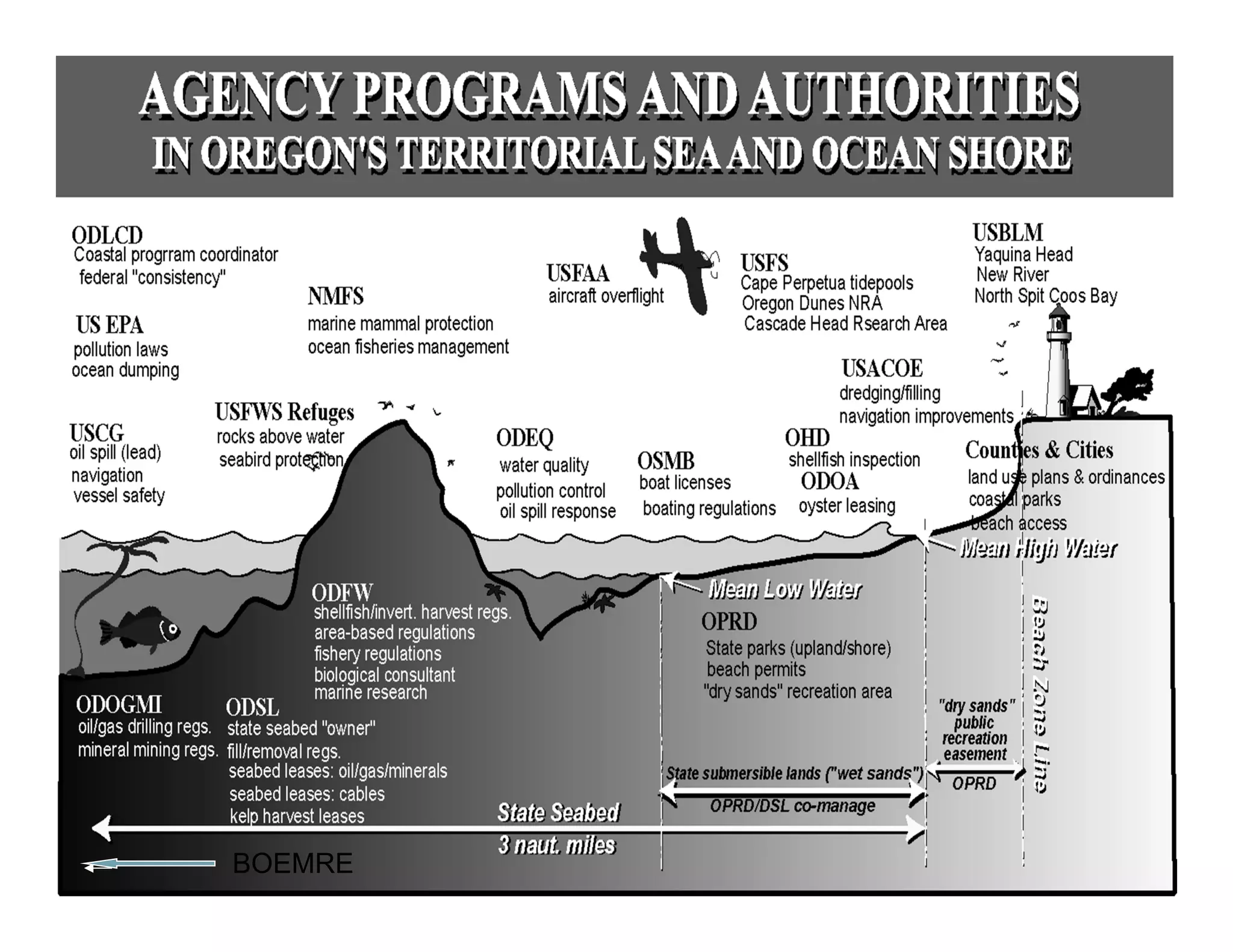
FERC – Wave Energy


BOEMRE
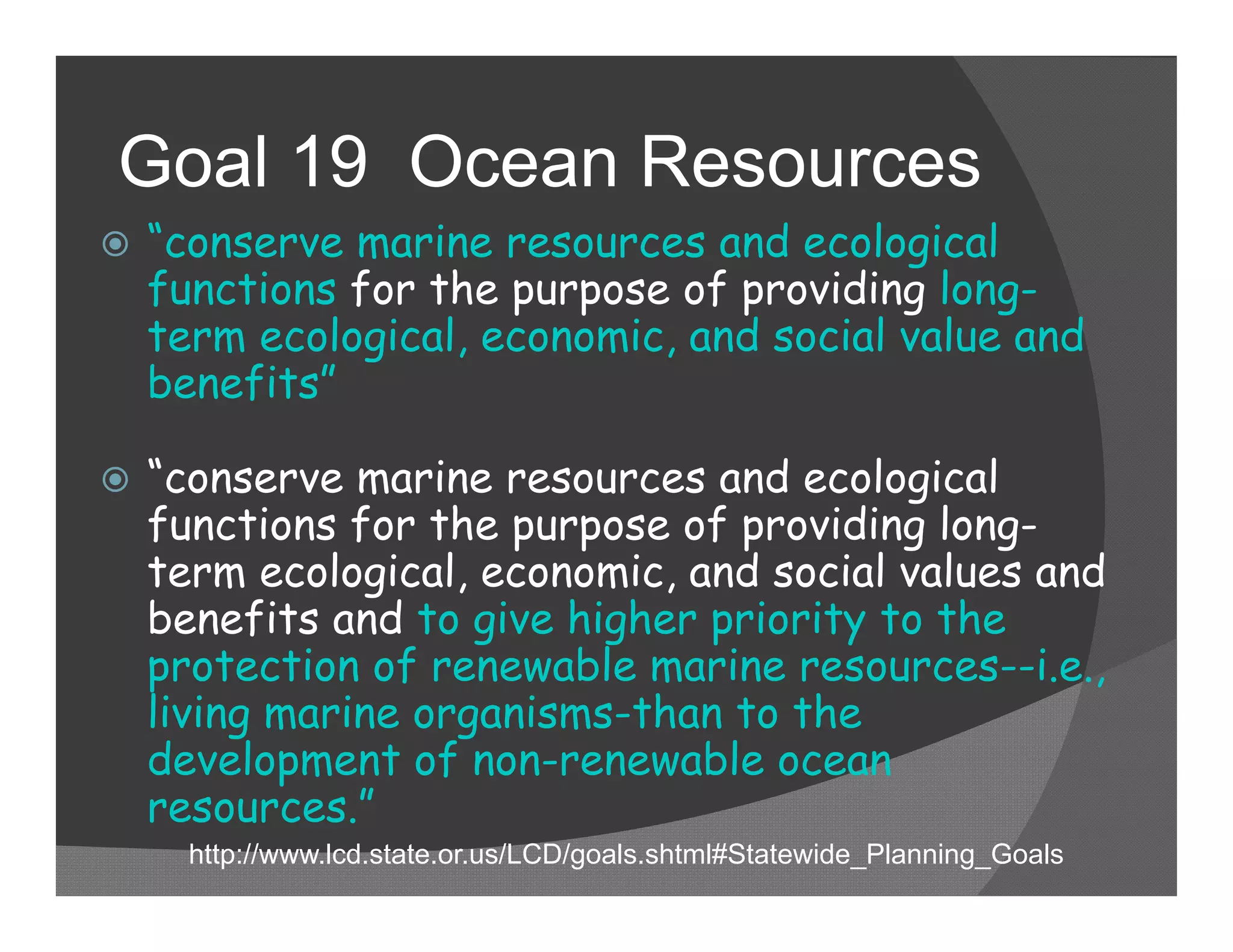
Goal 19 Ocean Resources
   “conserve marine resources and ecological
    functions for the purpose of providing long-
    term ecological, economic, and social value and
    benefits”

   “conserve marine resources and ecological
    functions for the purpose of providing long-
    term ecological, economic, and social values and
    benefits and to give higher priority to the
    protection of renewable marine resources--i.e.,
    living marine organisms-than to the
    development of non-renewable ocean
    resources.”
      http://www.lcd.state.or.us/LCD/goals.shtml#Statewide_Planning_Goals
Goal 19 Ocean Resources
Requires:
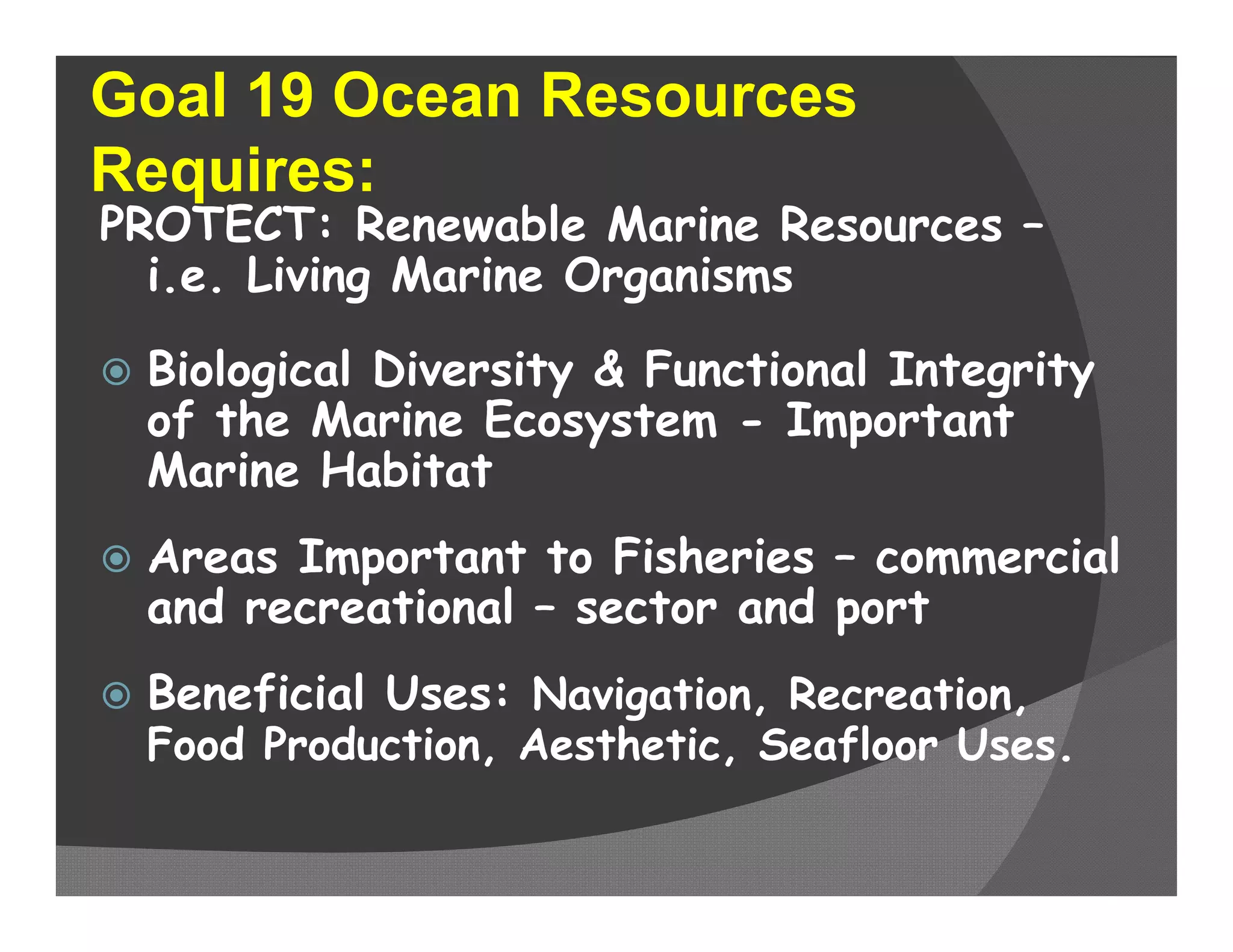
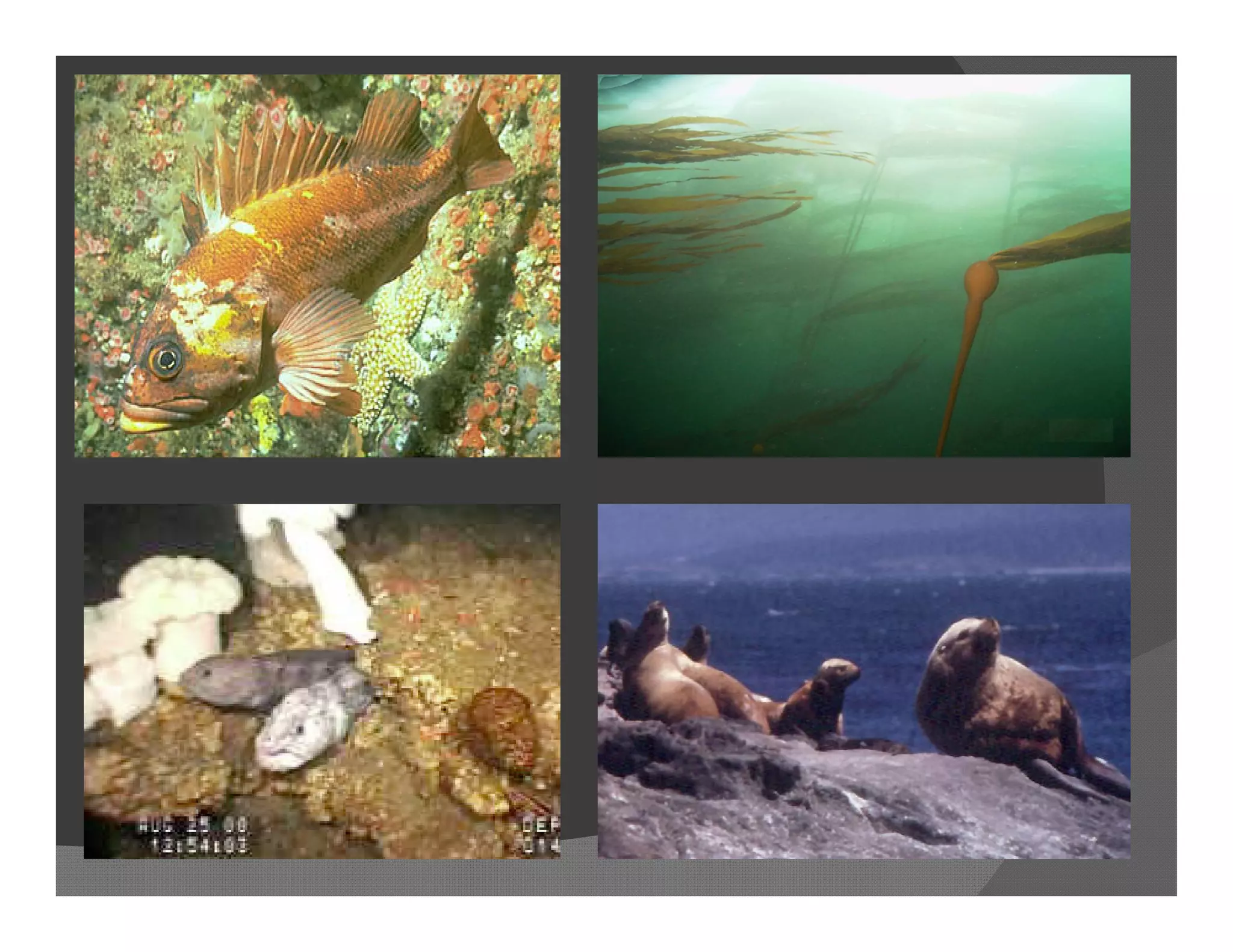
PROTECT: Renewable Marine Resources –
  i.e. Living Marine Organisms

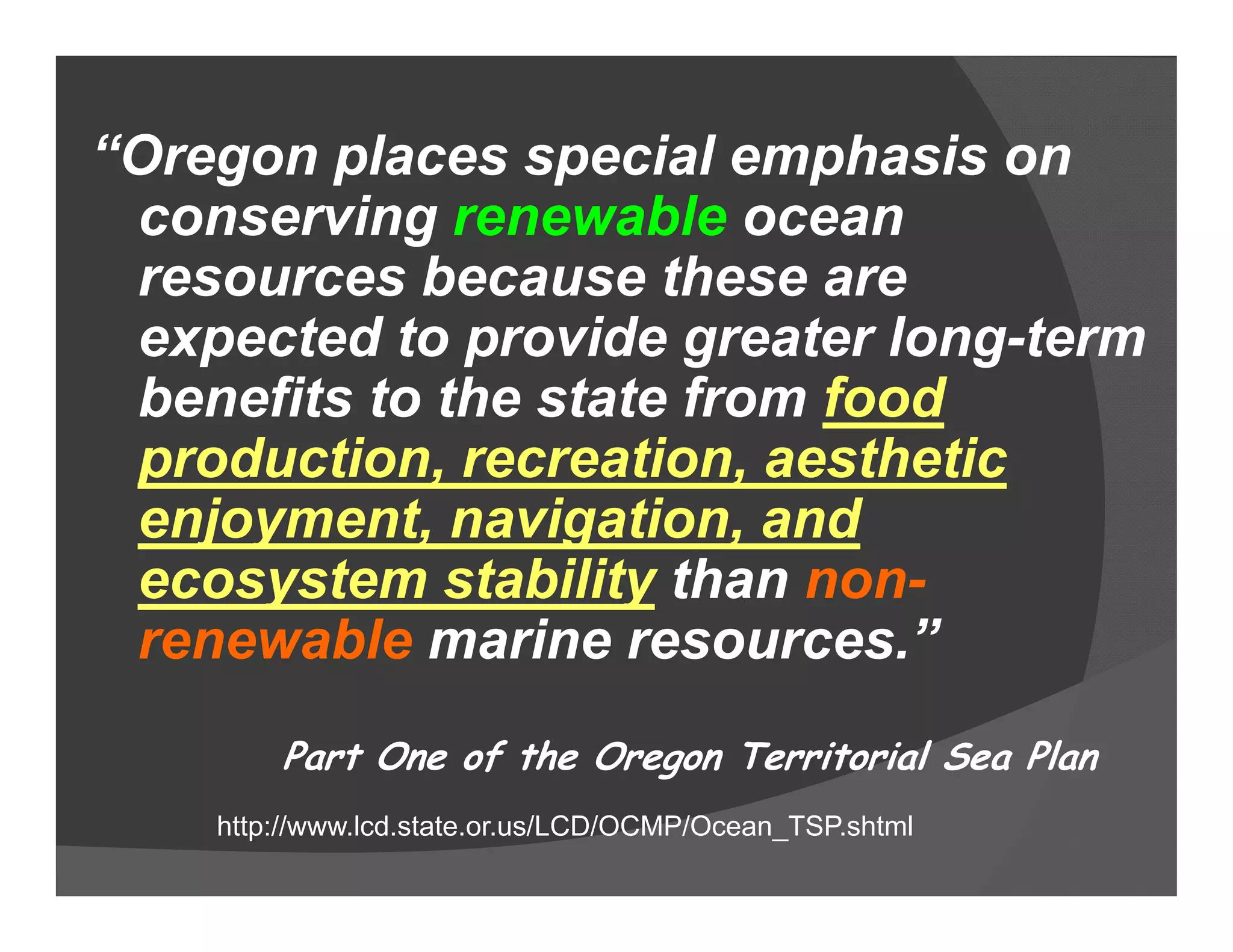
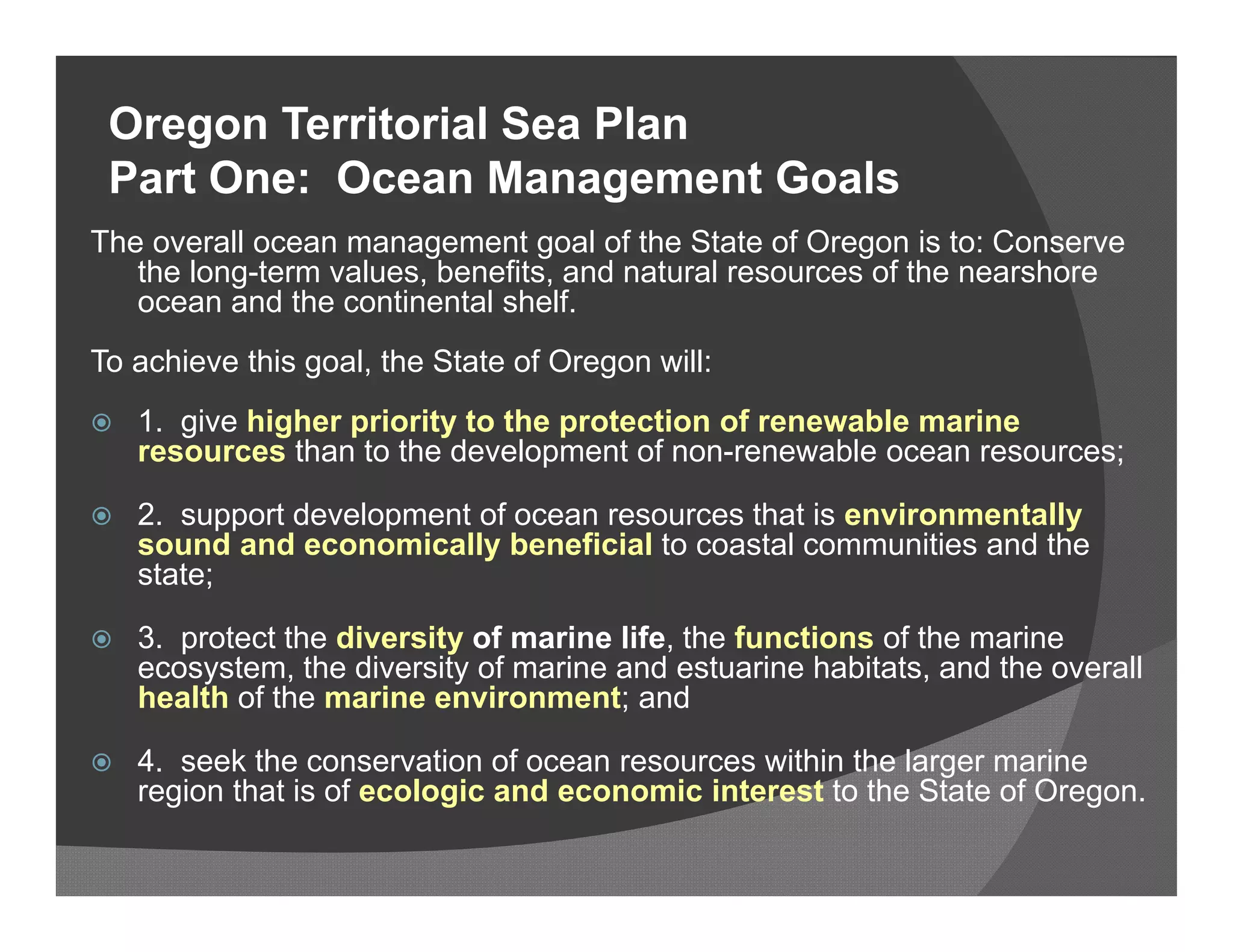
   Biological Diversity & Functional Integrity
    of the Marine Ecosystem - Important
    Marine Habitat
   Areas Important to Fisheries – commercial
    and recreational – sector and port
   Beneficial Uses: Navigation, Recreation,
    Food Production, Aesthetic, Seafloor Uses.
“Oregon places special emphasis on
 conserving renewable ocean
 resources because these are
 expected to provide greater long-term
 benefits to the state from food
 production, recreation, aesthetic
 enjoyment, navigation, and
 ecosystem stability than non-
 renewable marine resources.”
        Part One of the Oregon Territorial Sea Plan
    http://www.lcd.state.or.us/LCD/OCMP/Ocean_TSP.shtml
Oregon Territorial Sea Plan
 Part One: Ocean Management Goals
The overall ocean management goal of the State of Oregon is to: Conserve
   the long-term values, benefits, and natural resources of the nearshore
   ocean and the continental shelf.
To achieve this goal, the State of Oregon will:
   1. give higher priority to the protection of renewable marine
    resources than to the development of non-renewable ocean resources;

   2. support development of ocean resources that is environmentally
    sound and economically beneficial to coastal communities and the
    state;

   3. protect the diversity of marine life, the functions of the marine
    ecosystem, the diversity of marine and estuarine habitats, and the overall
    health of the marine environment; and

   4. seek the conservation of ocean resources within the larger marine
    region that is of ecologic and economic interest to the State of Oregon.
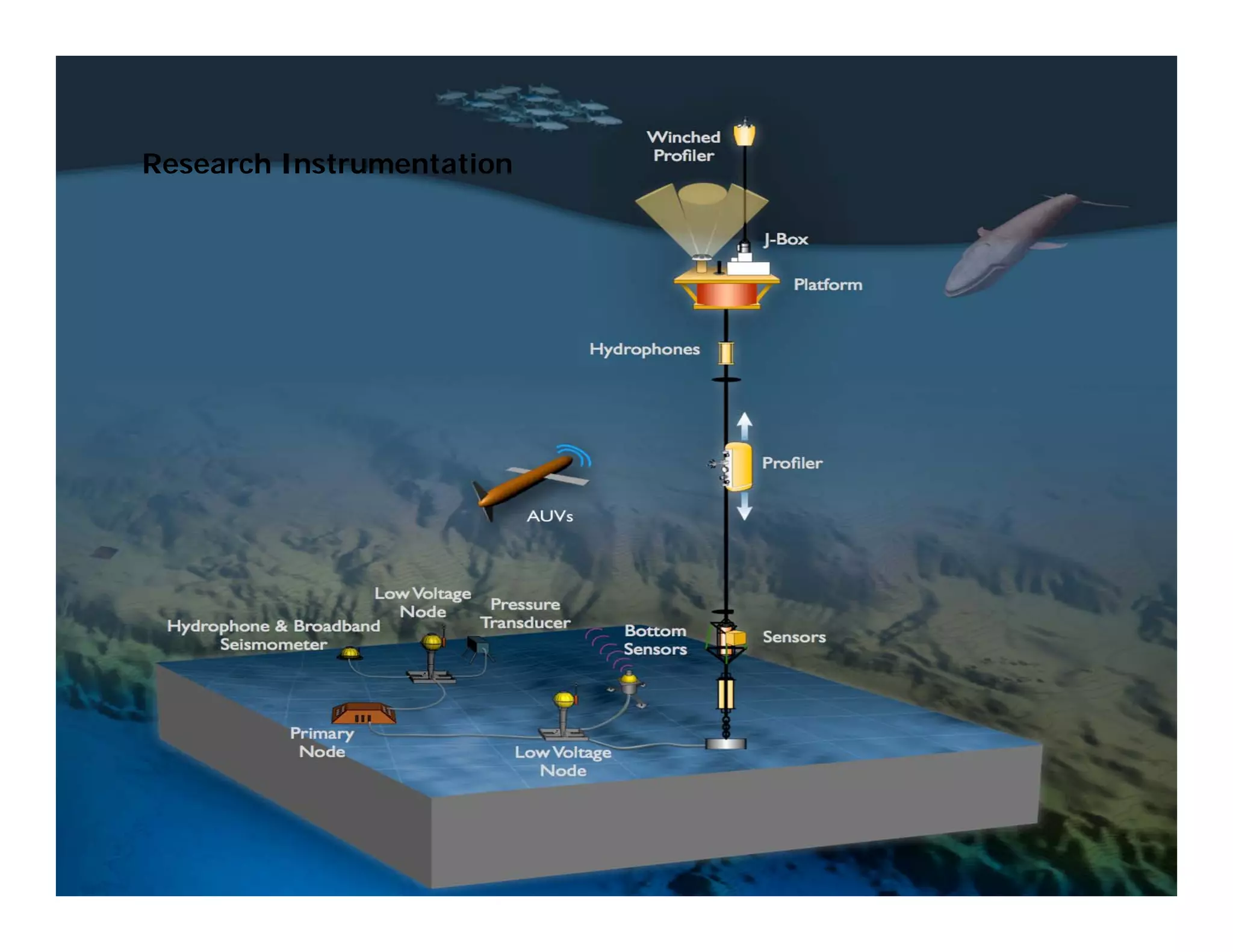
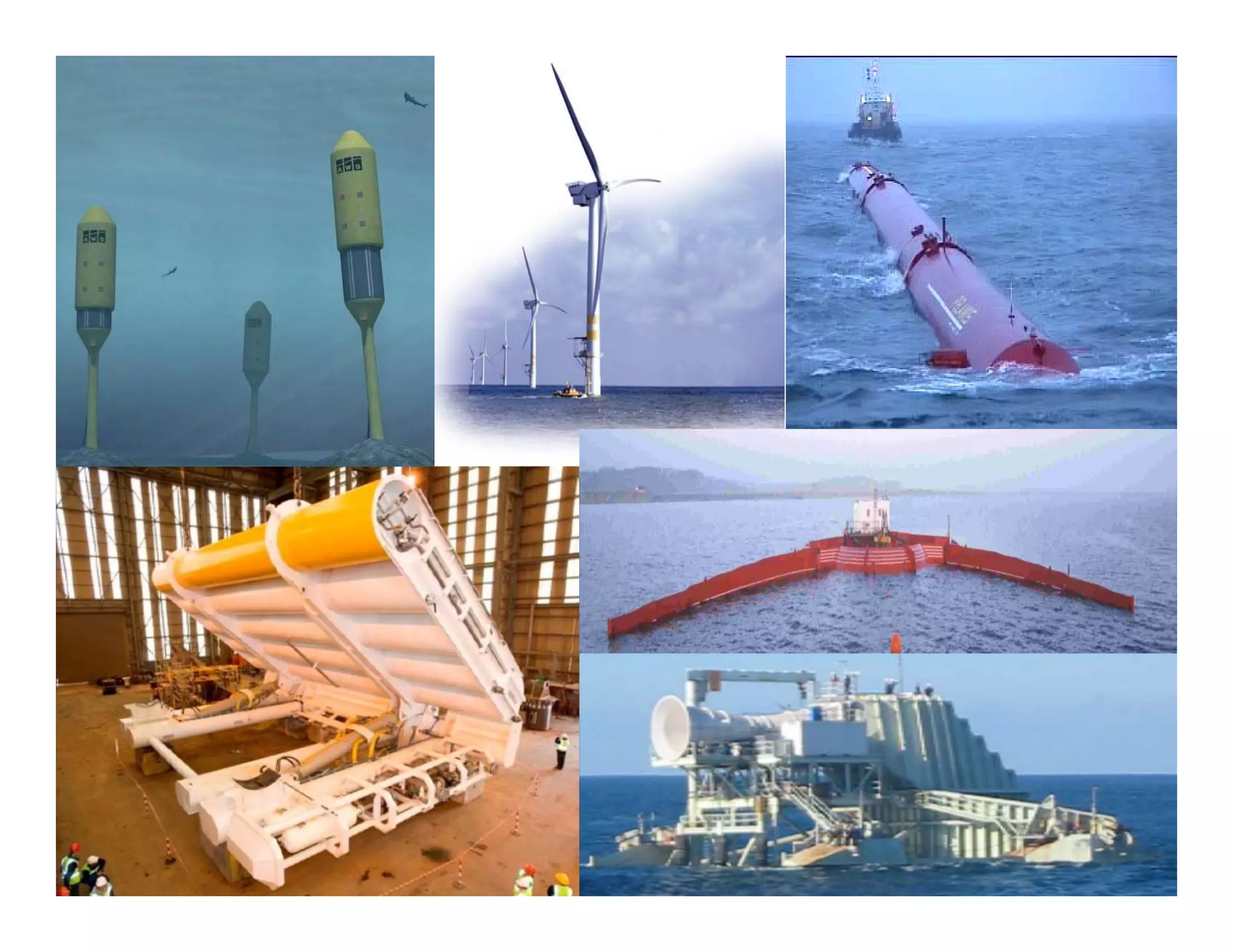
Research Instrumentation
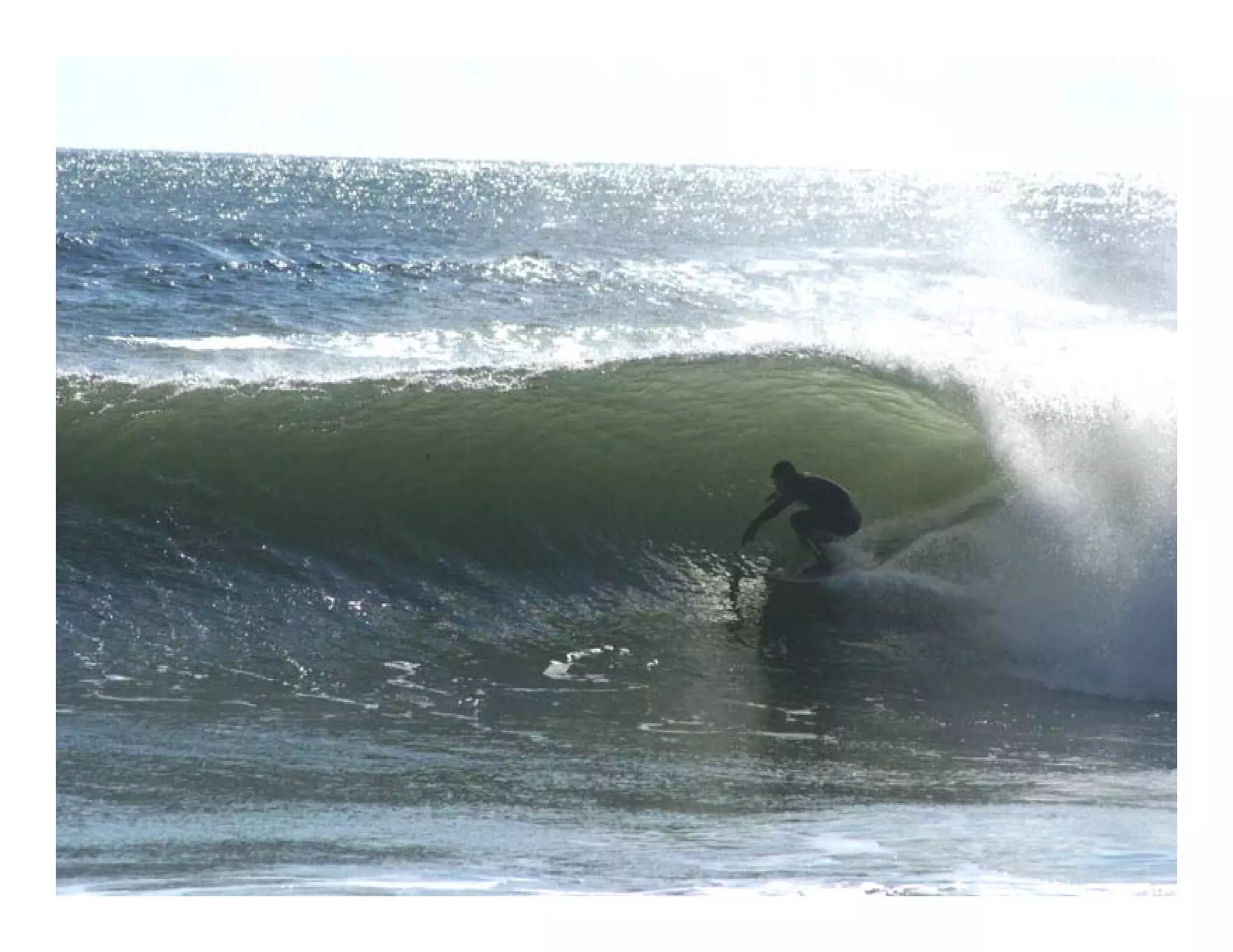
Recreation
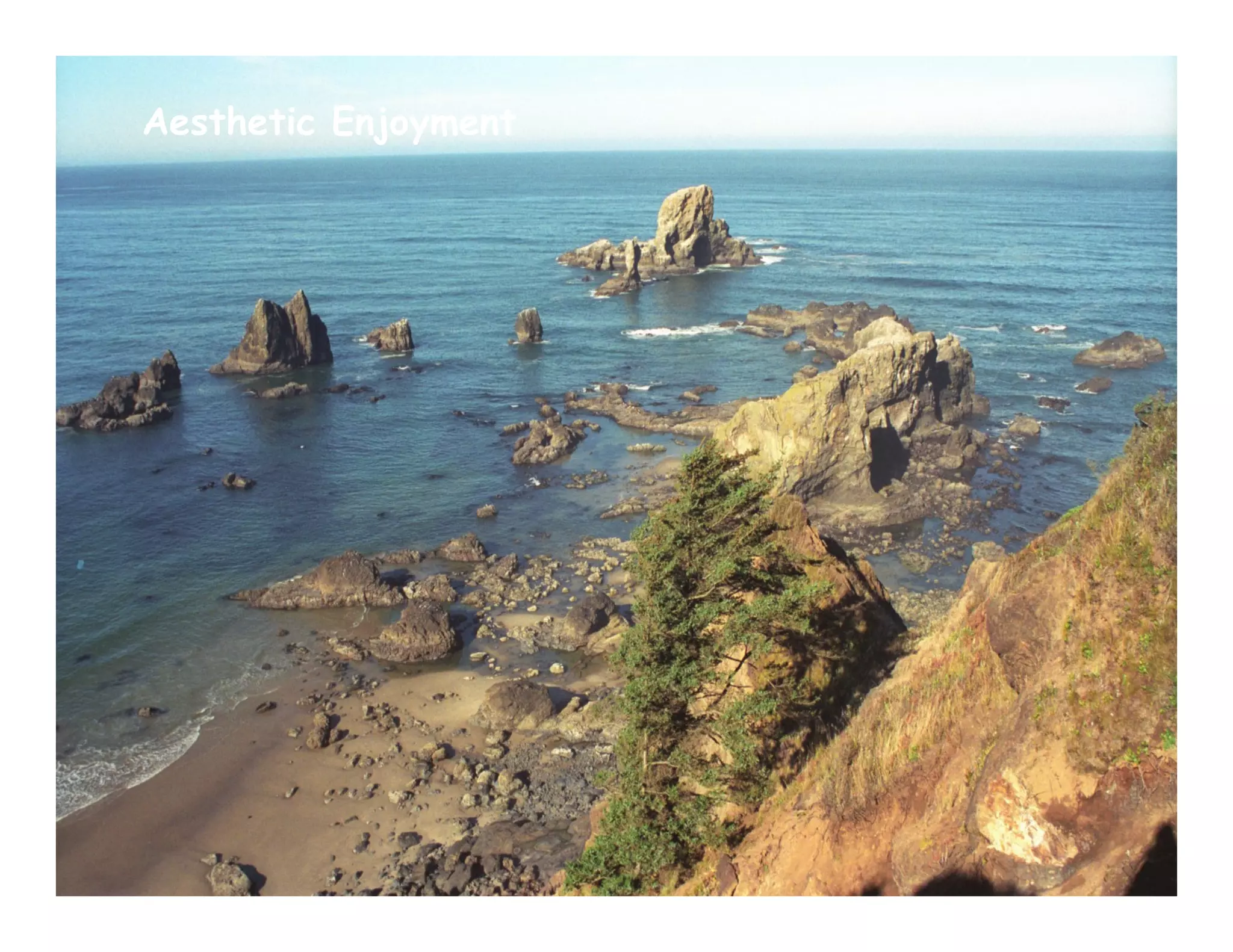
Aesthetic Enjoyment
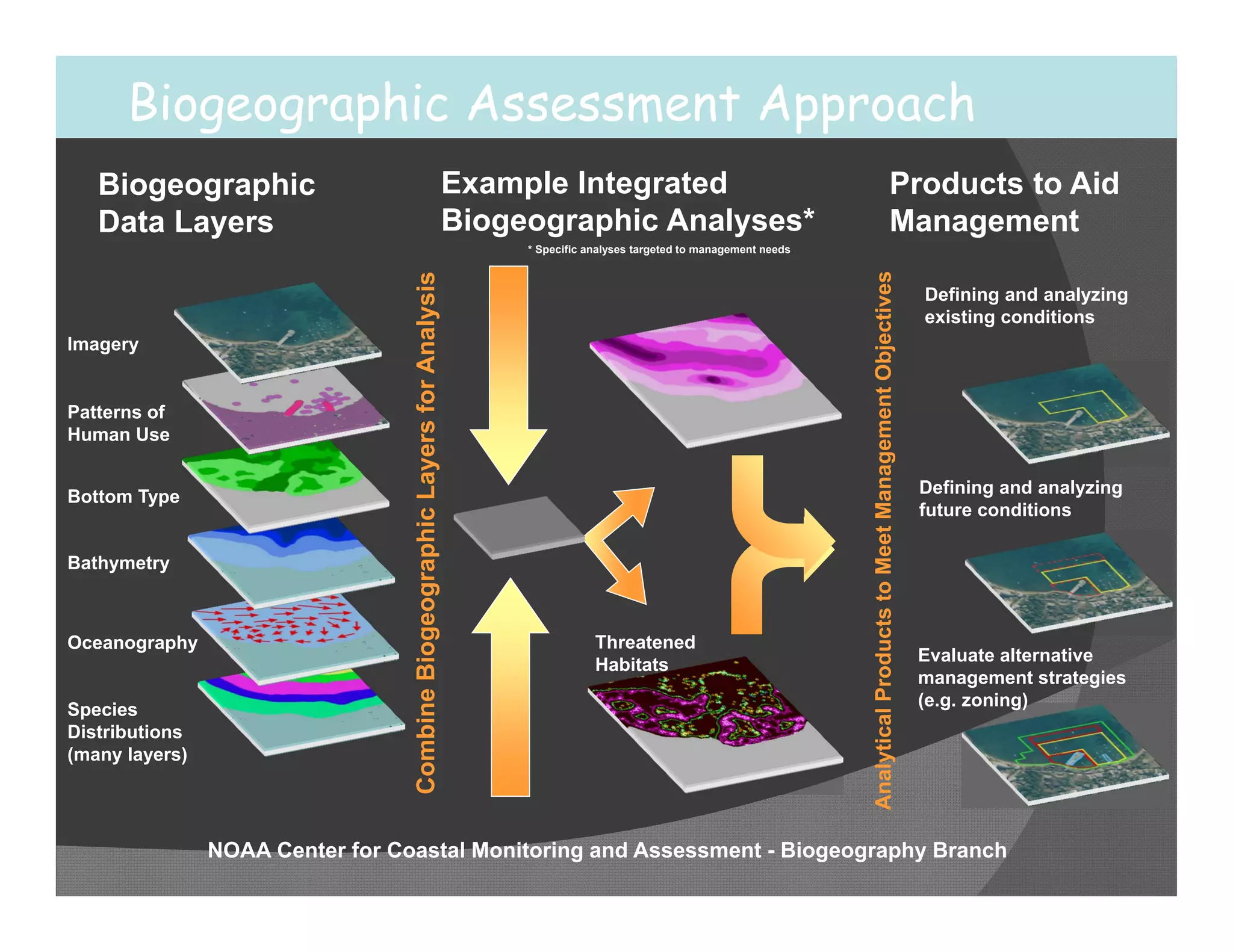
Biogeographic Assessment Approach
  Biogeographic Assessment Approach
   Biogeographic                                                              Example Integrated                                                                        Products to Aid
   Data Layers                                                                Biogeographic Analyses*                                                                   Management
                                                                                   * Specific analyses targeted to management needs


                                                                                                                                      Analytical Products to Meet Management Objectives
                                  Combine Biogeographic Layers for Analysis
                                                                                                                                                                                          Defining and analyzing
                                                                                                                                                                                          existing conditions
Imagery


Patterns of
Human Use


Bottom Type                                                                                                                                                                               Defining and analyzing
                                                                                                                                                                                          future conditions

Bathymetry


Oceanography                                                                                   Threatened
                                                                                                                                                                                          Evaluate alternative
                                                                                               Habitats
                                                                                                                                                                                          management strategies
                                                                                                                                                                                          (e.g. zoning)
Species
Distributions
(many layers)


                NOAA Center for Coastal Monitoring and Assessment - Biogeography Branch
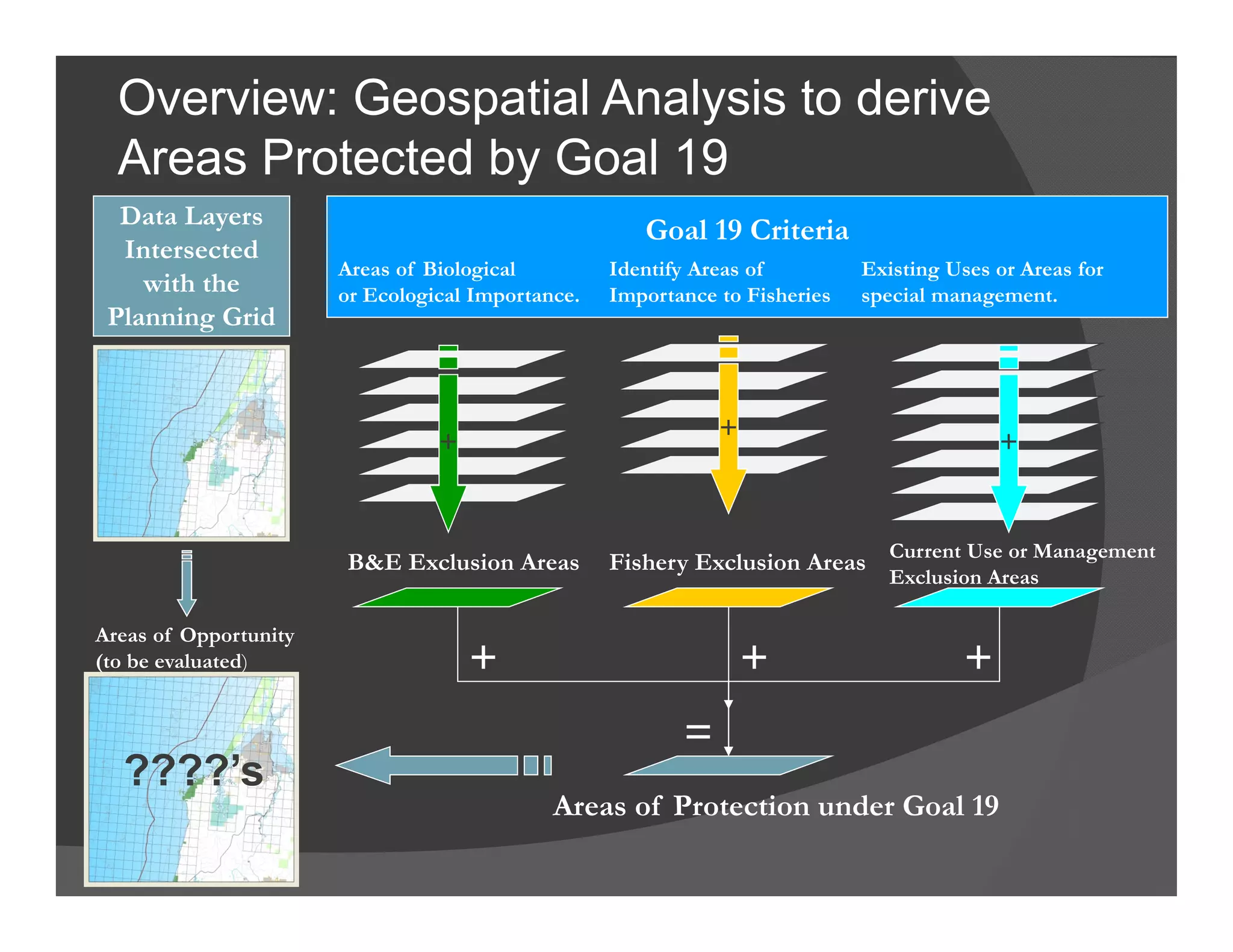
Overview: Geospatial Analysis to derive
  Areas Protected by Goal 19
  Data Layers
                                                      Goal 19 Criteria
  Intersected
                       Areas of Biological         Identify Areas of         Existing Uses or Areas for
    with the           or Ecological Importance.   Importance to Fisheries   special management.
 Planning Grid


                                                             +
                                +


                                                                                           +
                       B&E Exclusion Areas         Fishery Exclusion Areas Current Use or Management
                                                                                Exclusion Areas

Areas of Opportunity
(to be evaluated)                   +                           +                       +
                                                          =
  ????’s
                                             Areas of Protection under Goal 19
MarineMap – Coming up Next!


  Http://Oregon.MarineMap.org


Acknowledgements: Oregon Dept. of Fish and Wildlife, Oregon Dept. of Land
Conservation and Development, Ecotrust, Oregon Wave Energy Trust
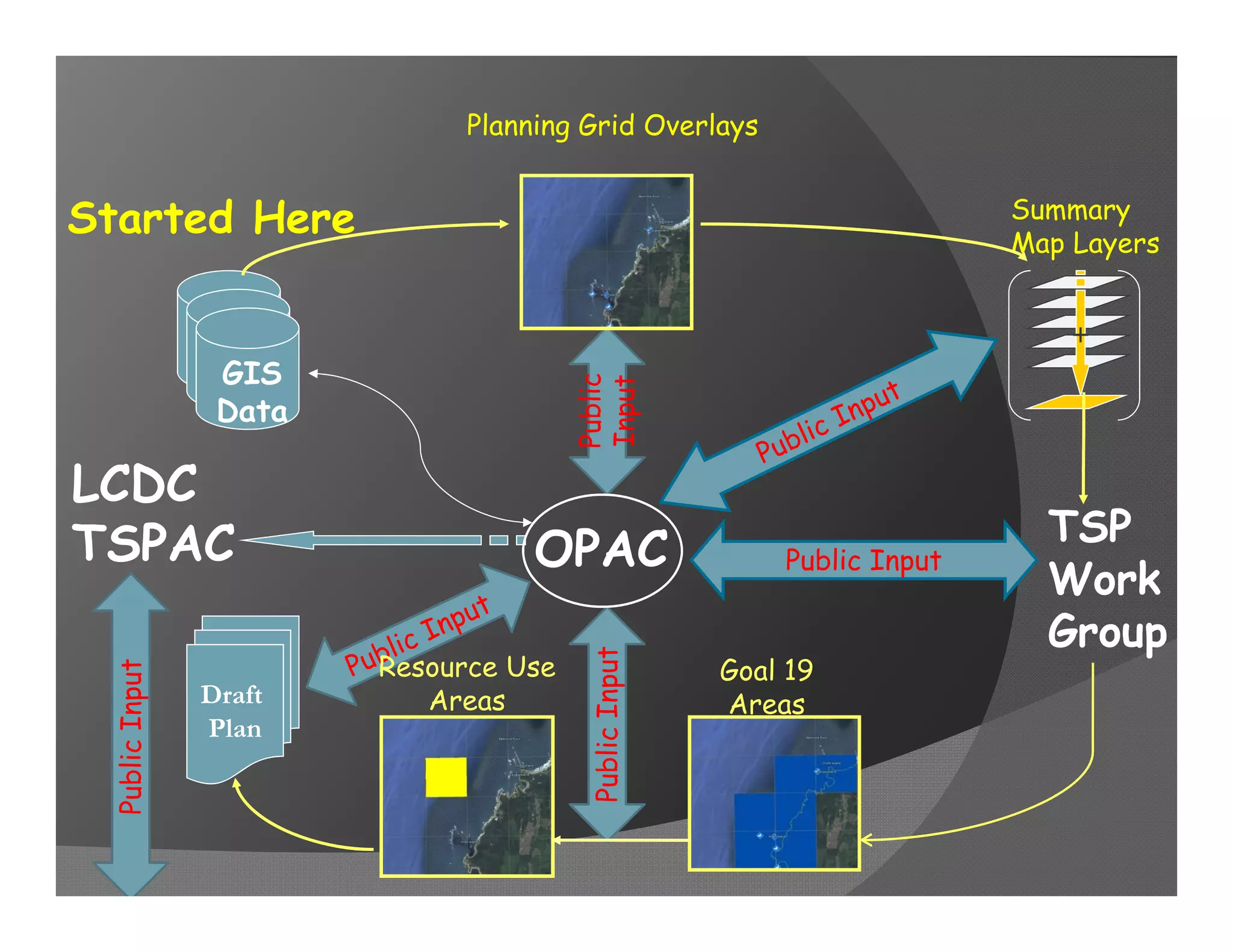
Planning Grid Overlays


Started Here                                                              Summary
                                                                          Map Layers


                                                                             +
                 GIS


                                       Public
                                       Input
                 Data

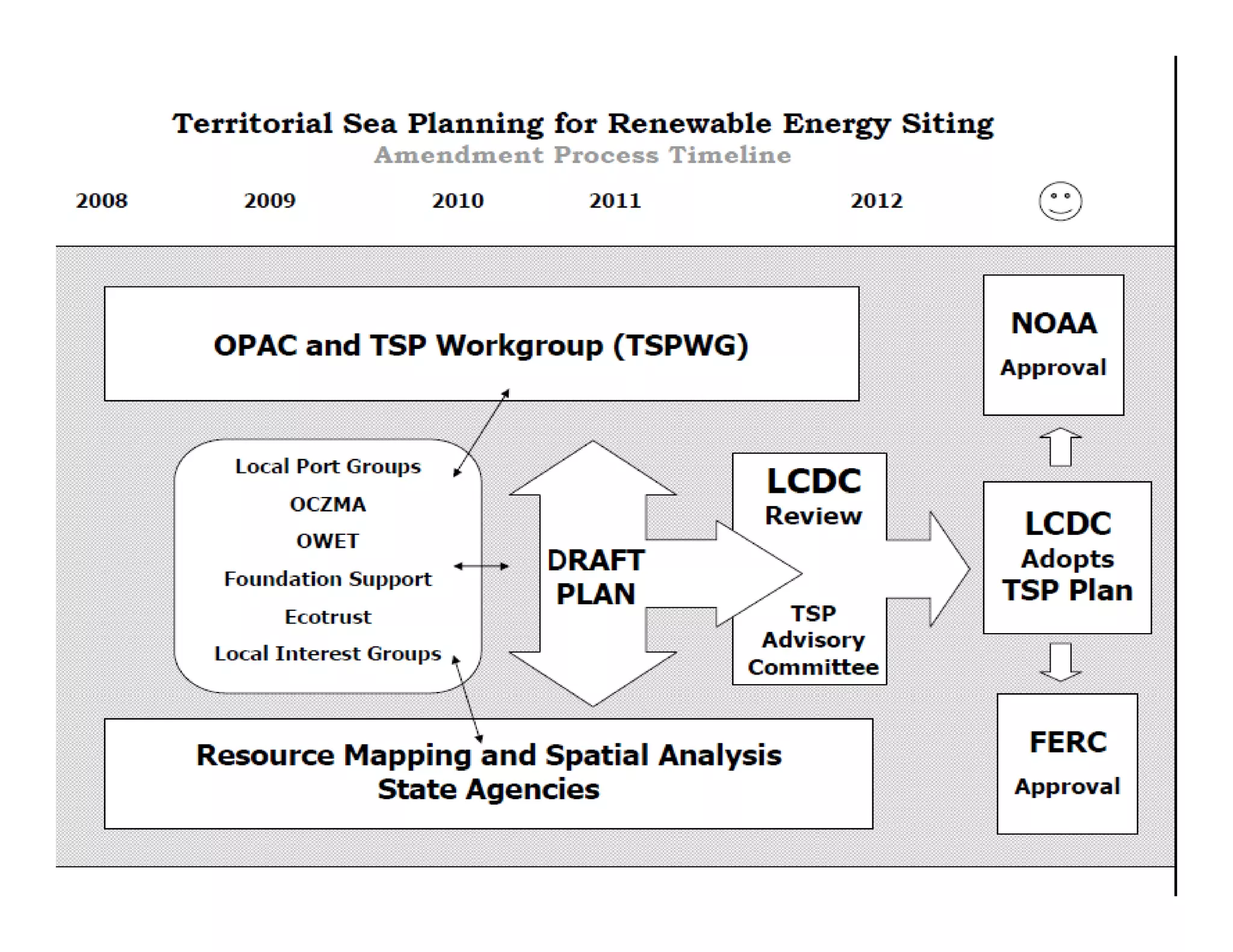
LCDC
TSPAC                                                                       TSP
                                  OPAC                     Public Input
                                                                            Work
                                                                            Group
                        Resource Use
                                        Public Input

                                                       Goal 19
 Public Input


                Draft      Areas                       Areas
                Plan
Outline:
   Draft Plan
     Framework – Area Definition
     Area composition (Draft)
 Marine Recreation Conservation Area
 Visual Assessment Analysis Framework
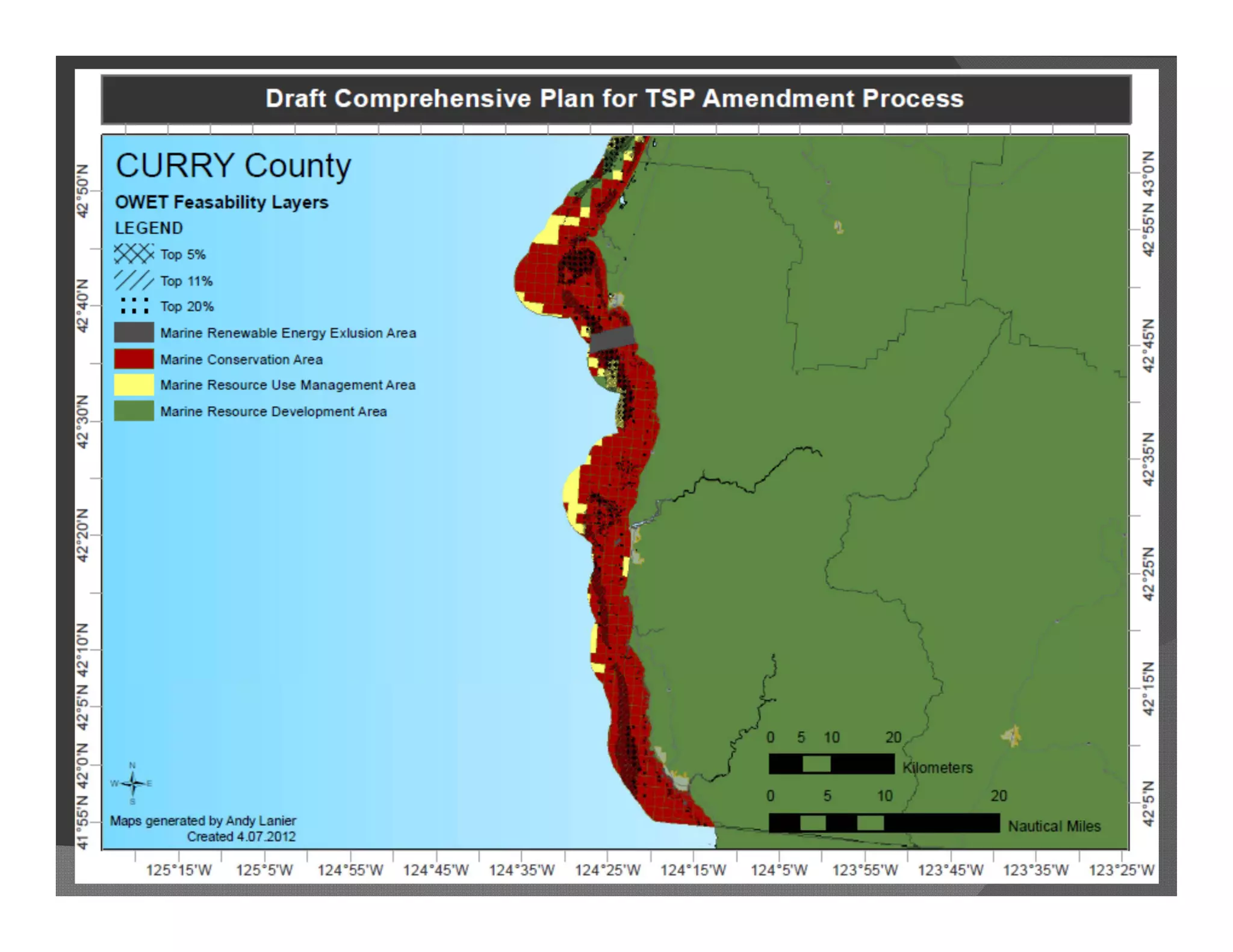
 Overlay OWET Feasibility Map
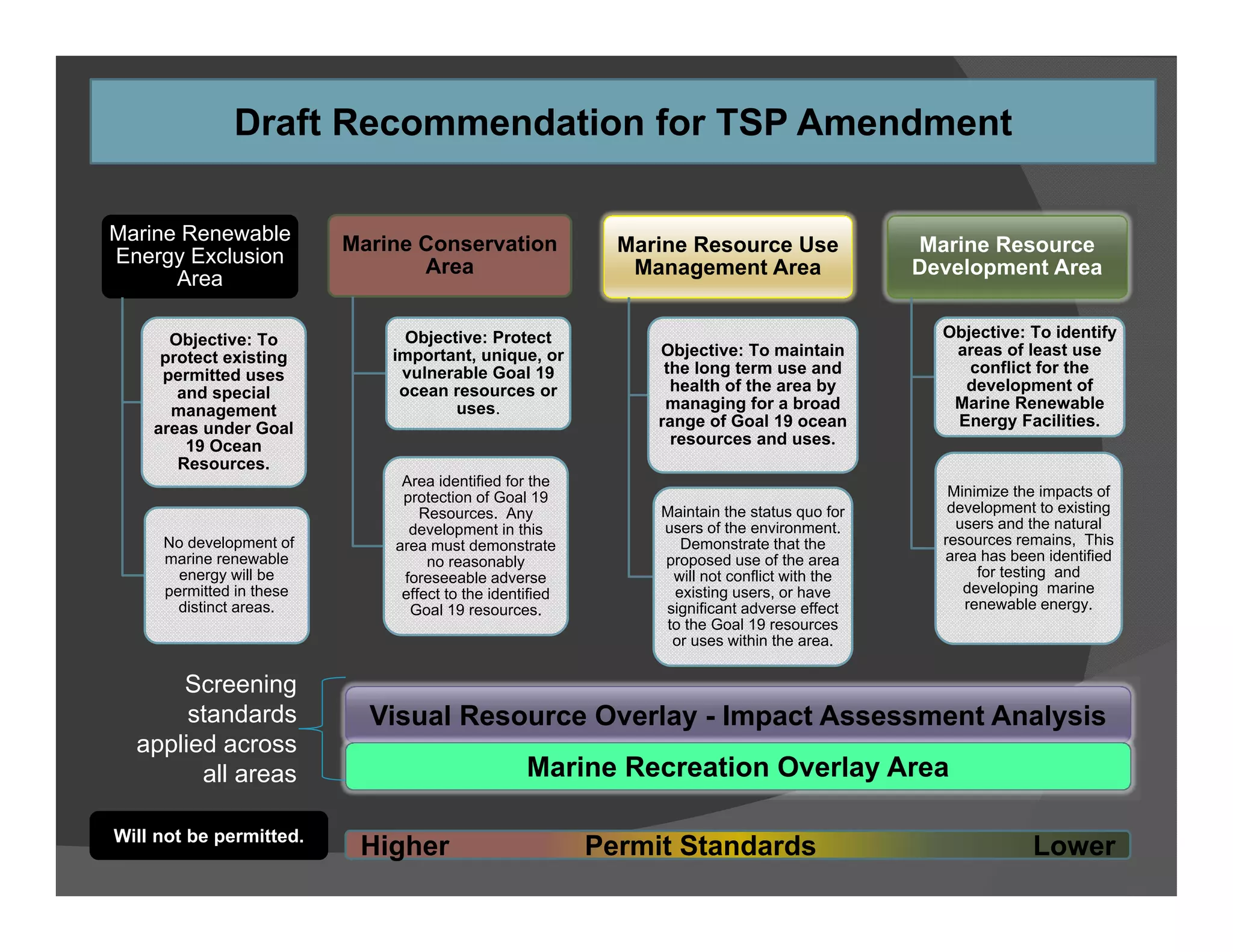
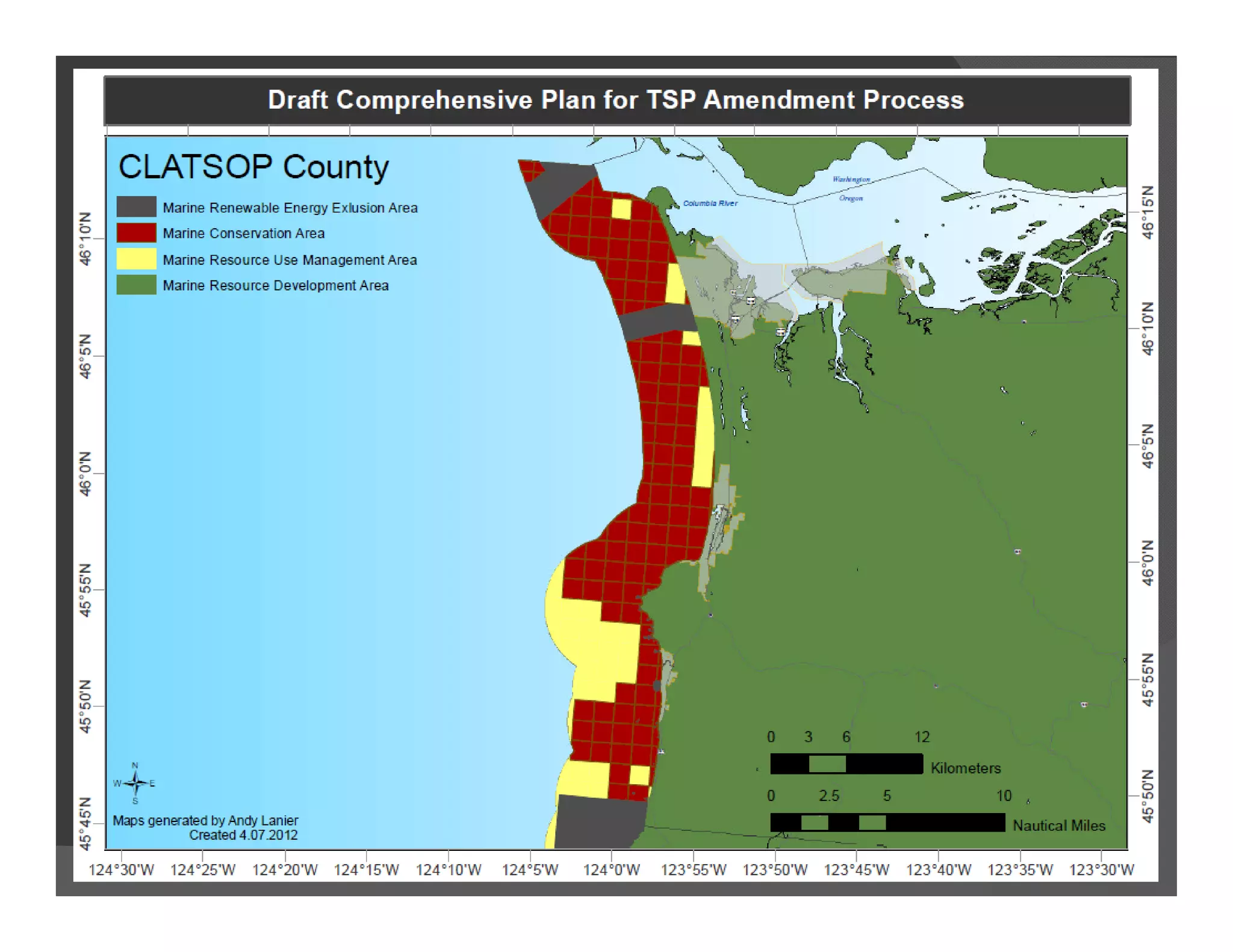
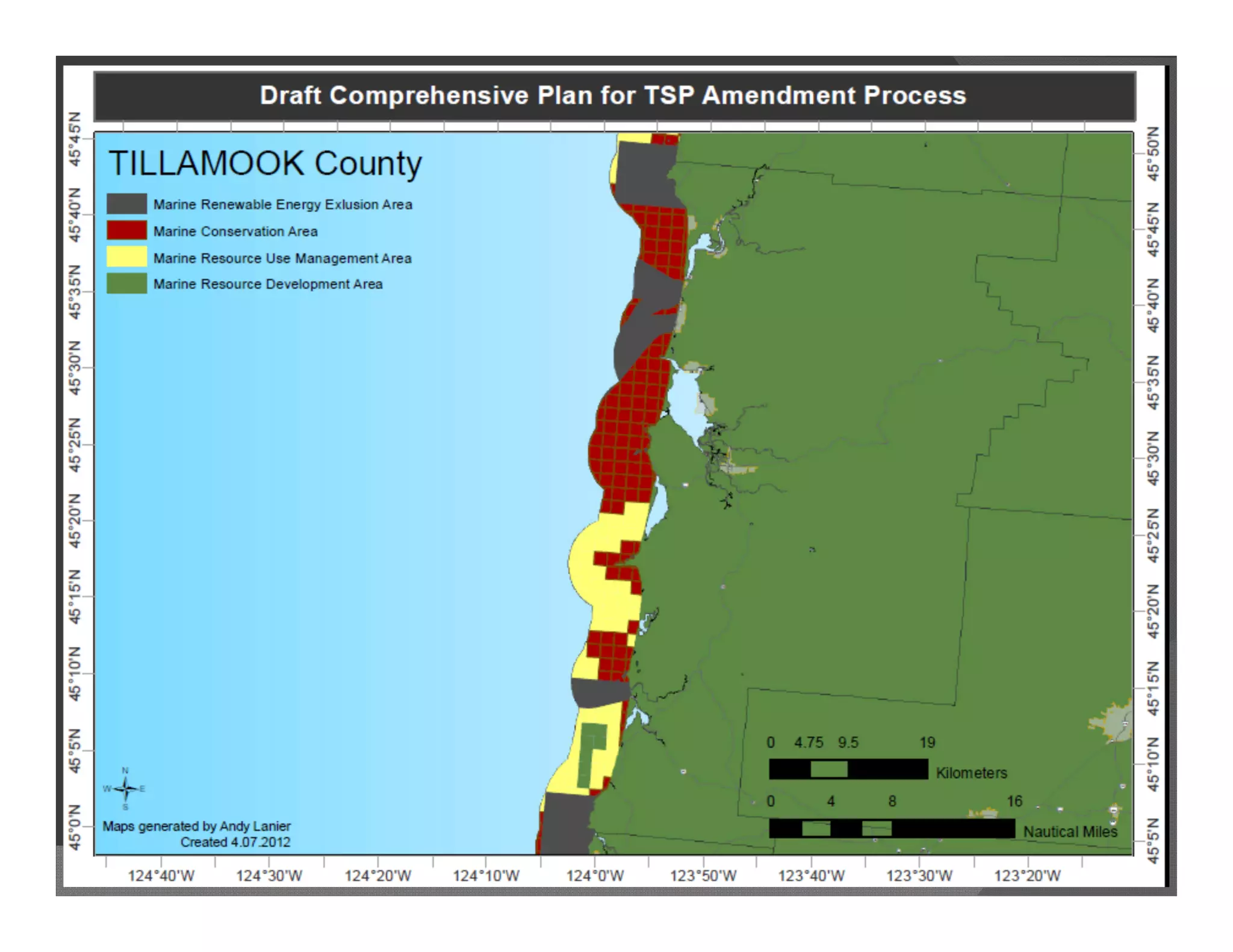
Draft Recommendation for TSP Amendment

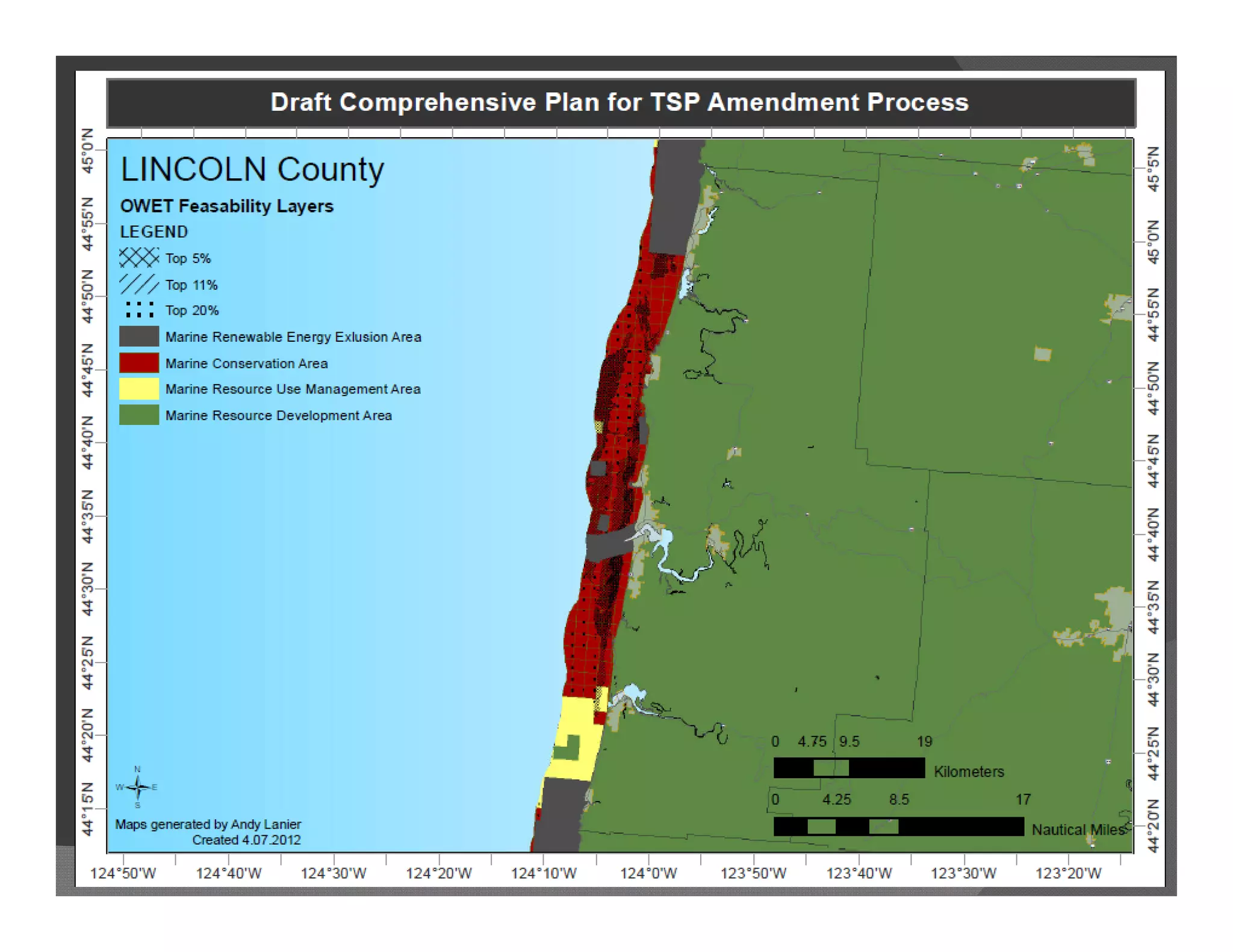
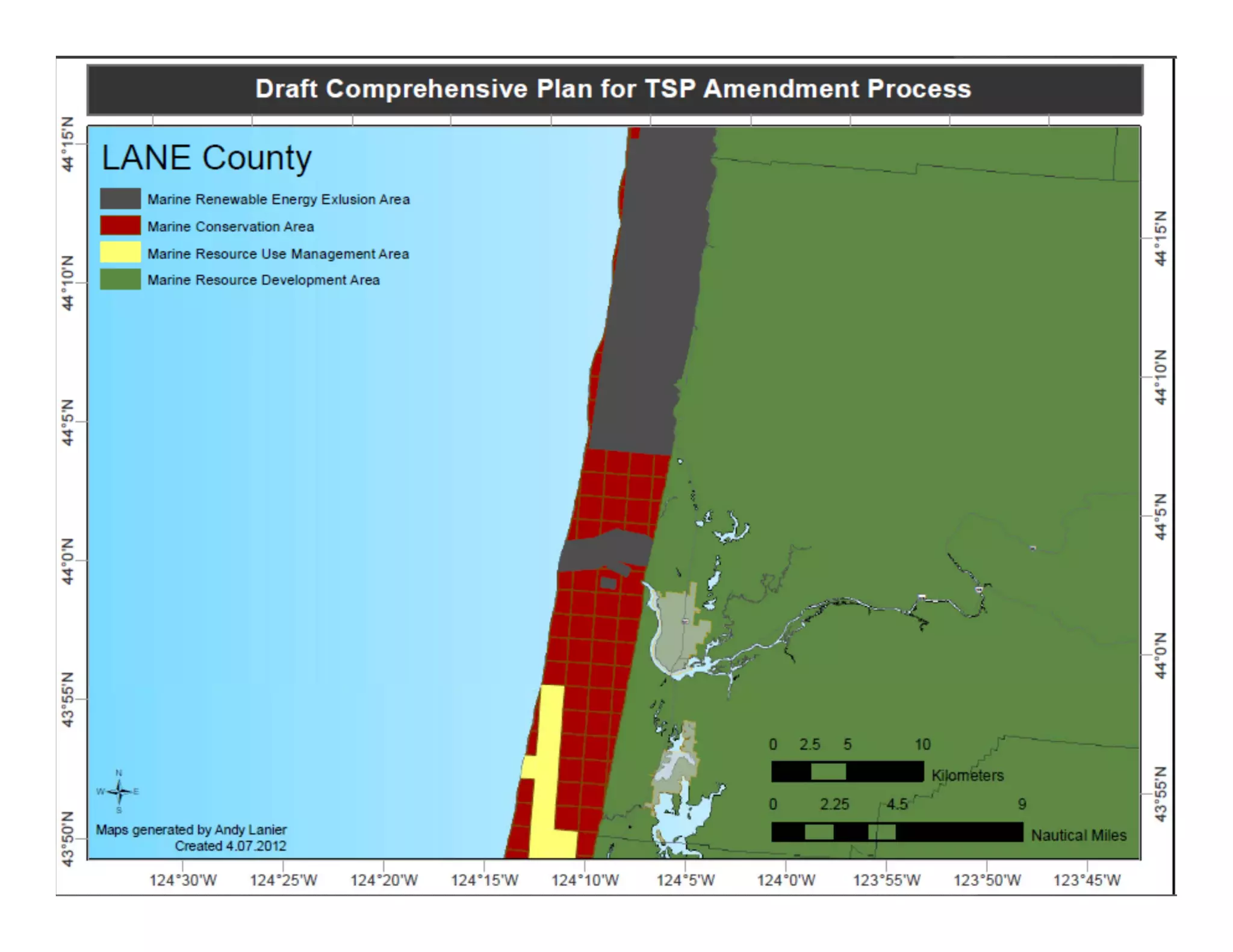
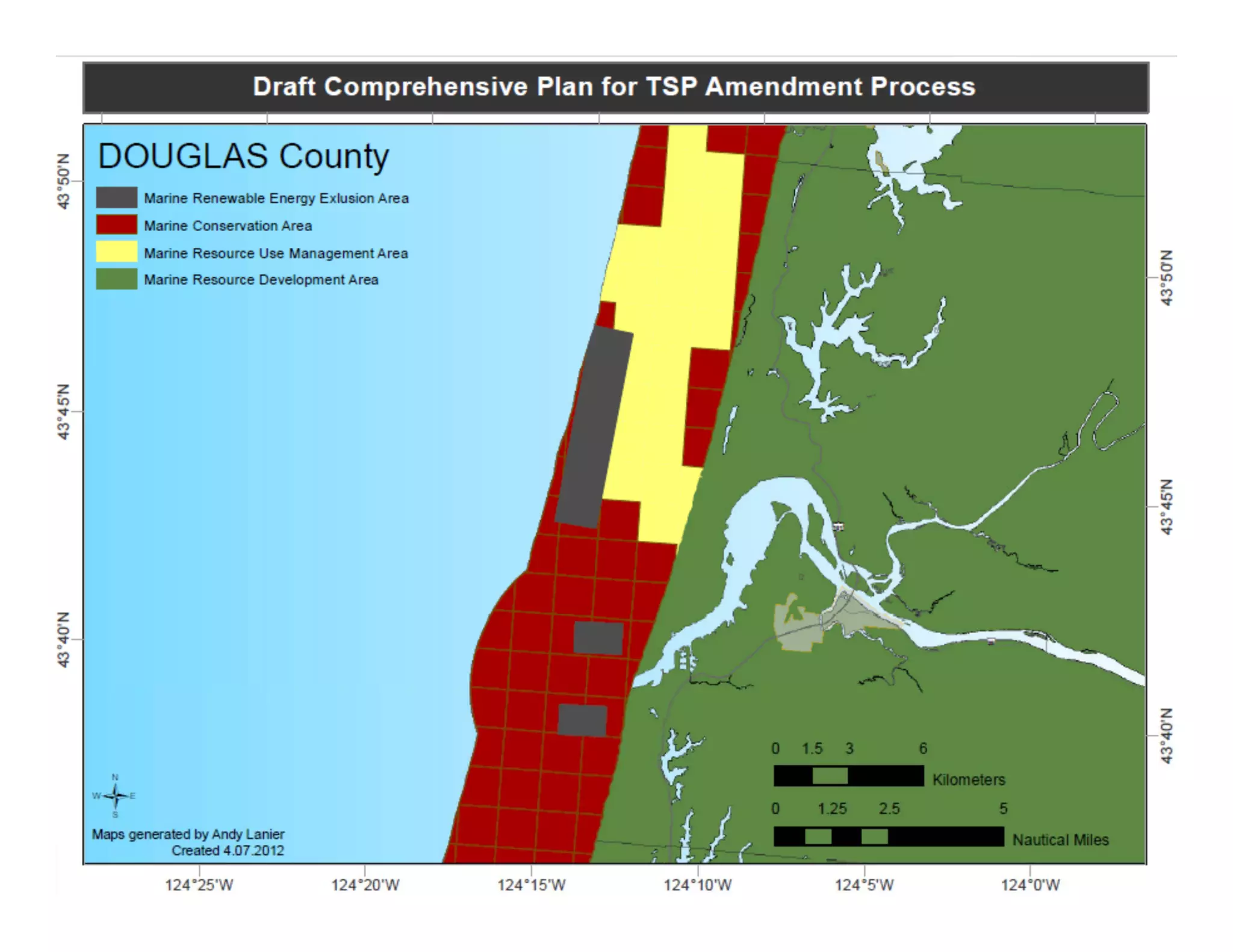
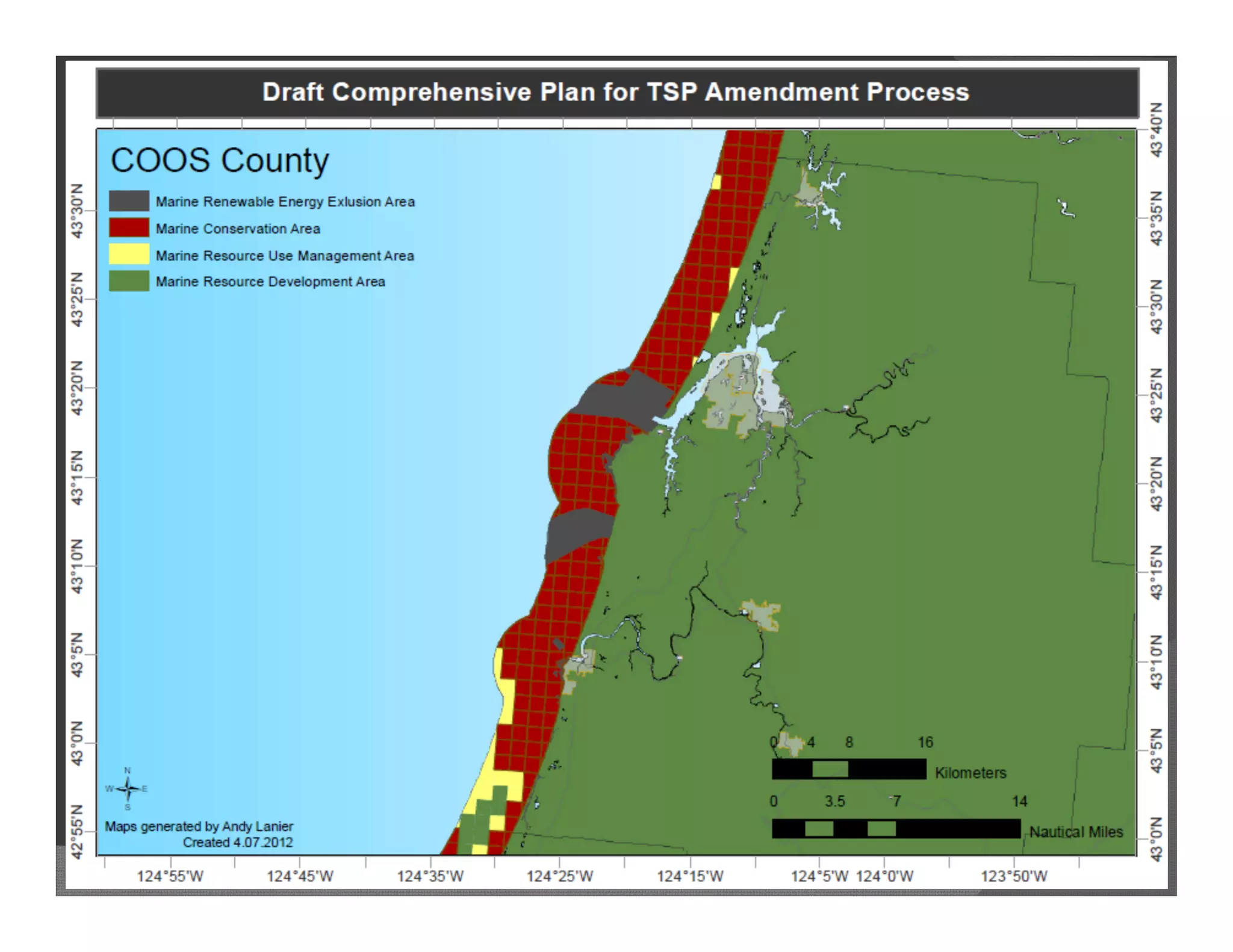
Marine Renewable          Marine Conservation               Marine Resource Use              Marine Resource
Energy Exclusion                 Area                        Management Area                 Development Area
      Area

      Objective: To             Objective: Protect                                             Objective: To identify
     protect existing         important, unique, or            Objective: To maintain           areas of least use
     permitted uses            vulnerable Goal 19               the long term use and             conflict for the
       and special             ocean resources or                health of the area by           development of
      management                      uses.                     managing for a broad            Marine Renewable
    areas under Goal                                           range of Goal 19 ocean           Energy Facilities.
        19 Ocean                                                 resources and uses.
       Resources.
                               Area identified for the
                               protection of Goal 19                                            Minimize the impacts of
                                  Resources. Any               Maintain the status quo for      development to existing
                                development in this            users of the environment.         users and the natural
     No development of        area must demonstrate              Demonstrate that the          resources remains, This
     marine renewable              no reasonably               proposed use of the area        area has been identified
       energy will be          foreseeable adverse              will not conflict with the          for testing and
     permitted in these        effect to the identified         existing users, or have           developing marine
       distinct areas.          Goal 19 resources.             significant adverse effect         renewable energy.
                                                               to the Goal 19 resources
                                                                or uses within the area.

      Screening
       standards            Visual Resource Overlay - Impact Assessment Analysis
  applied across
        all areas                                 Marine Recreation Overlay Area

Will not be permitted.
                           Higher                         Permit Standards                                 Lower
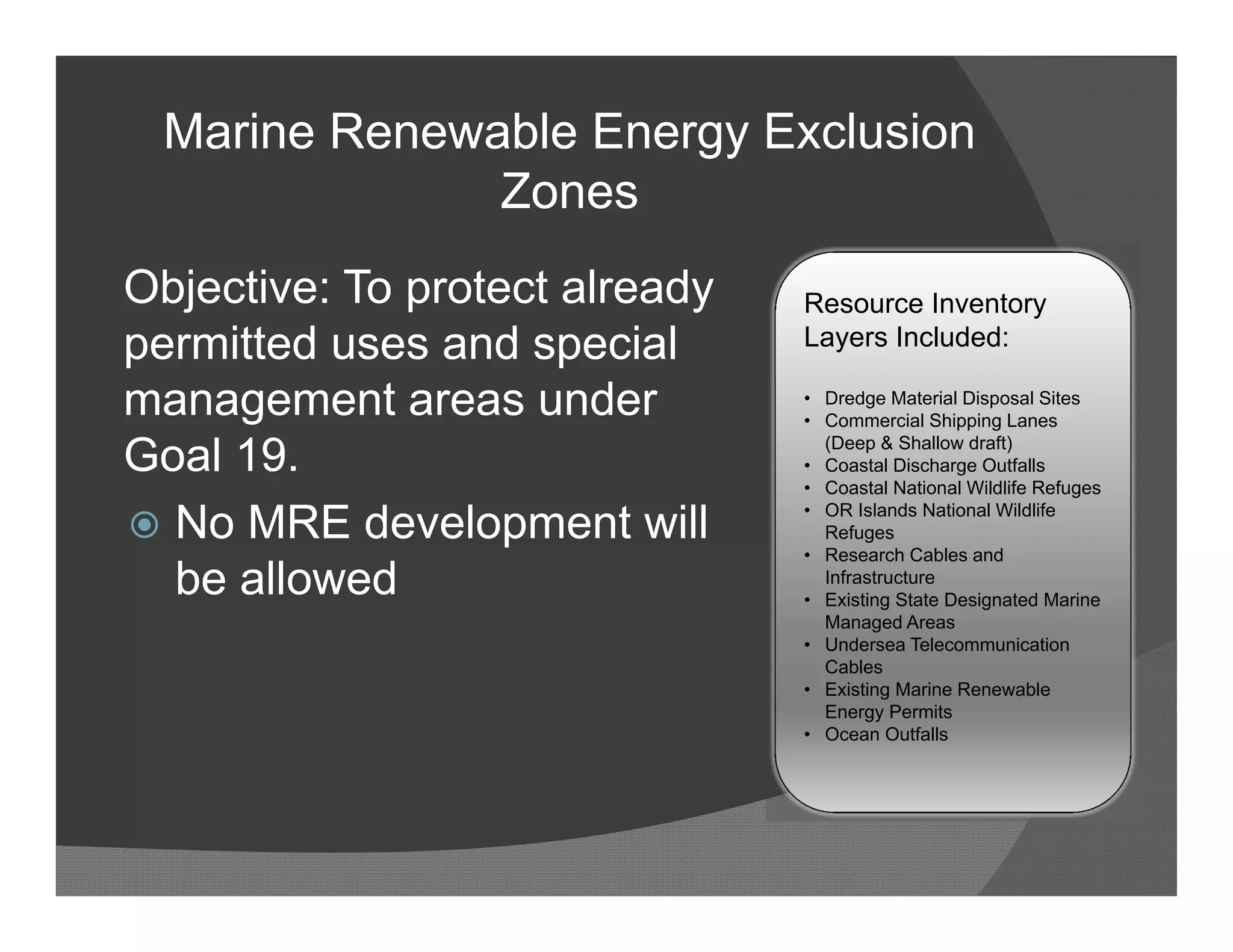
Marine Renewable Energy Exclusion
              Zones
Objective: To protect already   Resource Inventory
permitted uses and special      Layers Included:

management areas under          • Dredge Material Disposal Sites
                                • Commercial Shipping Lanes

Goal 19.                          (Deep & Shallow draft)
                                • Coastal Discharge Outfalls
                                • Coastal National Wildlife Refuges

 No MRE development will
                                • OR Islands National Wildlife
                                  Refuges
                                • Research Cables and
  be allowed                      Infrastructure
                                • Existing State Designated Marine
                                  Managed Areas
                                • Undersea Telecommunication
                                  Cables
                                • Existing Marine Renewable
                                  Energy Permits
                                • Ocean Outfalls
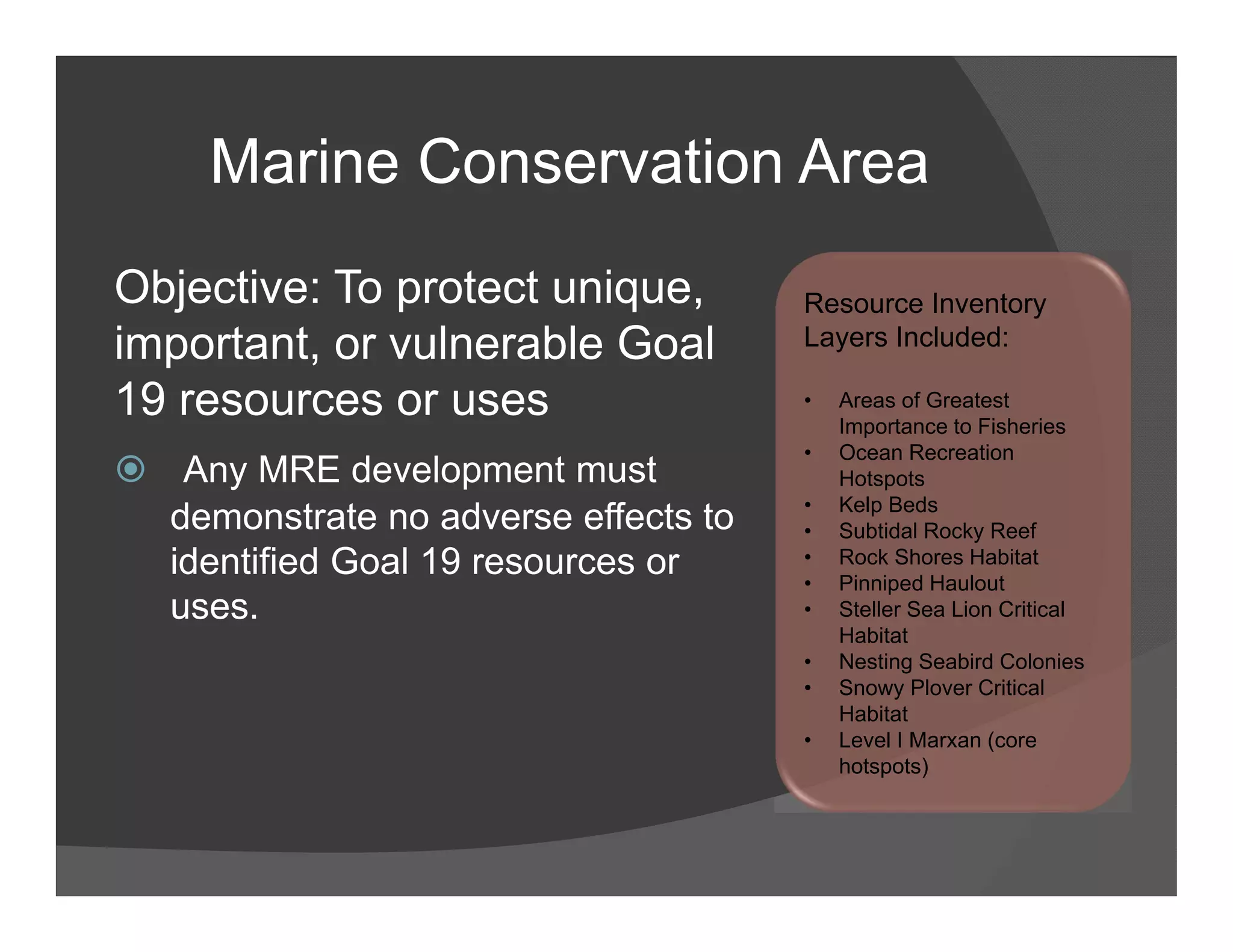
Marine Conservation Area
Objective: To protect unique,         Resource Inventory
important, or vulnerable Goal         Layers Included:

19 resources or uses                  •   Areas of Greatest
                                          Importance to Fisheries
                                      •   Ocean Recreation
 Any MRE development must                Hotspots
                                      •   Kelp Beds
  demonstrate no adverse effects to   •   Subtidal Rocky Reef
  identified Goal 19 resources or     •
                                      •
                                          Rock Shores Habitat
                                          Pinniped Haulout
  uses.                               •   Steller Sea Lion Critical
                                          Habitat
                                      •   Nesting Seabird Colonies
                                      •   Snowy Plover Critical
                                          Habitat
                                      •   Level I Marxan (core
                                          hotspots)
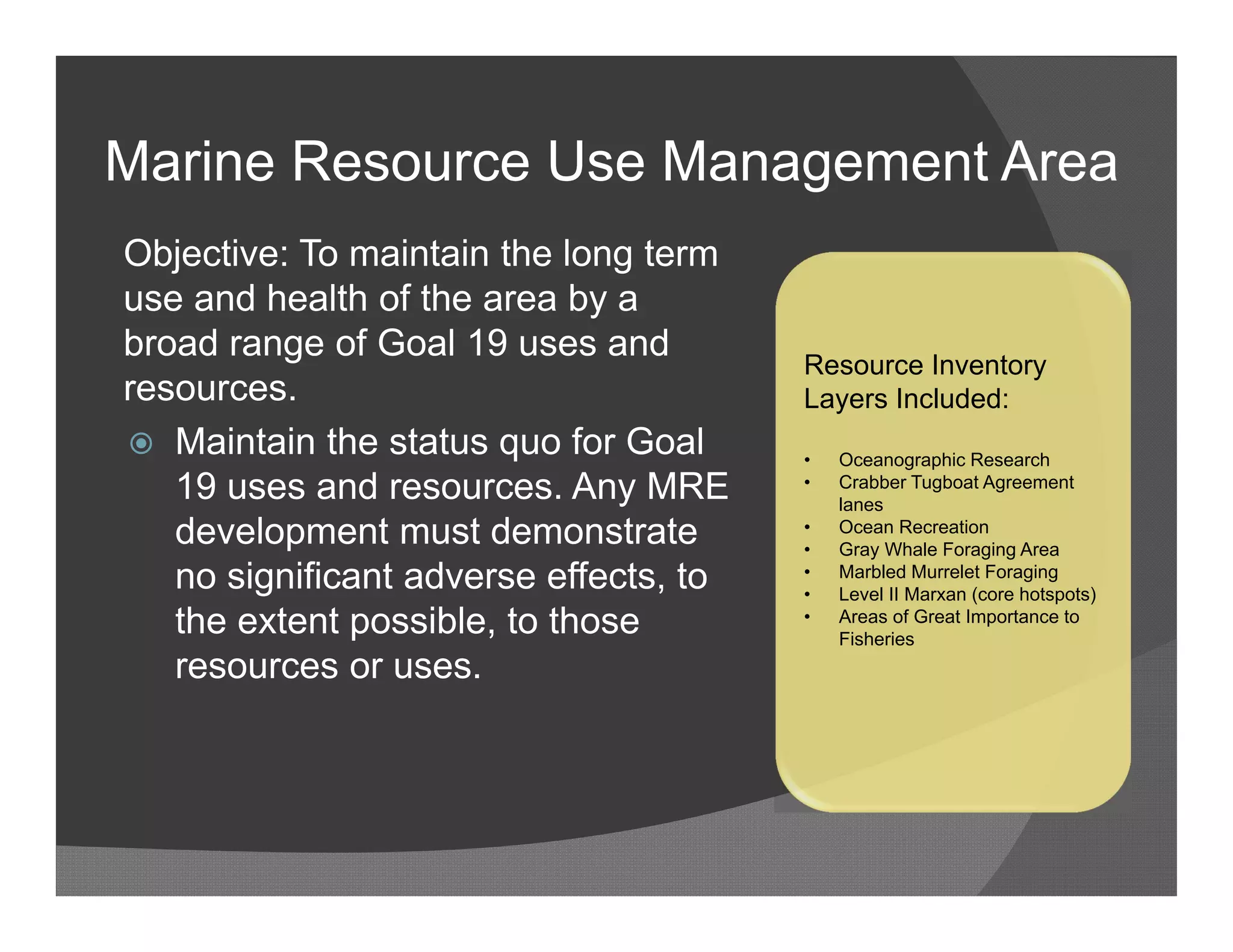
Marine Resource Use Management Area
Objective: To maintain the long term
use and health of the area by a
broad range of Goal 19 uses and
                                        Resource Inventory
resources.                              Layers Included:
 Maintain the status quo for Goal      •   Oceanographic Research
   19 uses and resources. Any MRE       •   Crabber Tugboat Agreement
                                            lanes
   development must demonstrate         •
                                        •
                                            Ocean Recreation
                                            Gray Whale Foraging Area
   no significant adverse effects, to   •
                                        •
                                            Marbled Murrelet Foraging
                                            Level II Marxan (core hotspots)
   the extent possible, to those        •   Areas of Great Importance to
                                            Fisheries
   resources or uses.
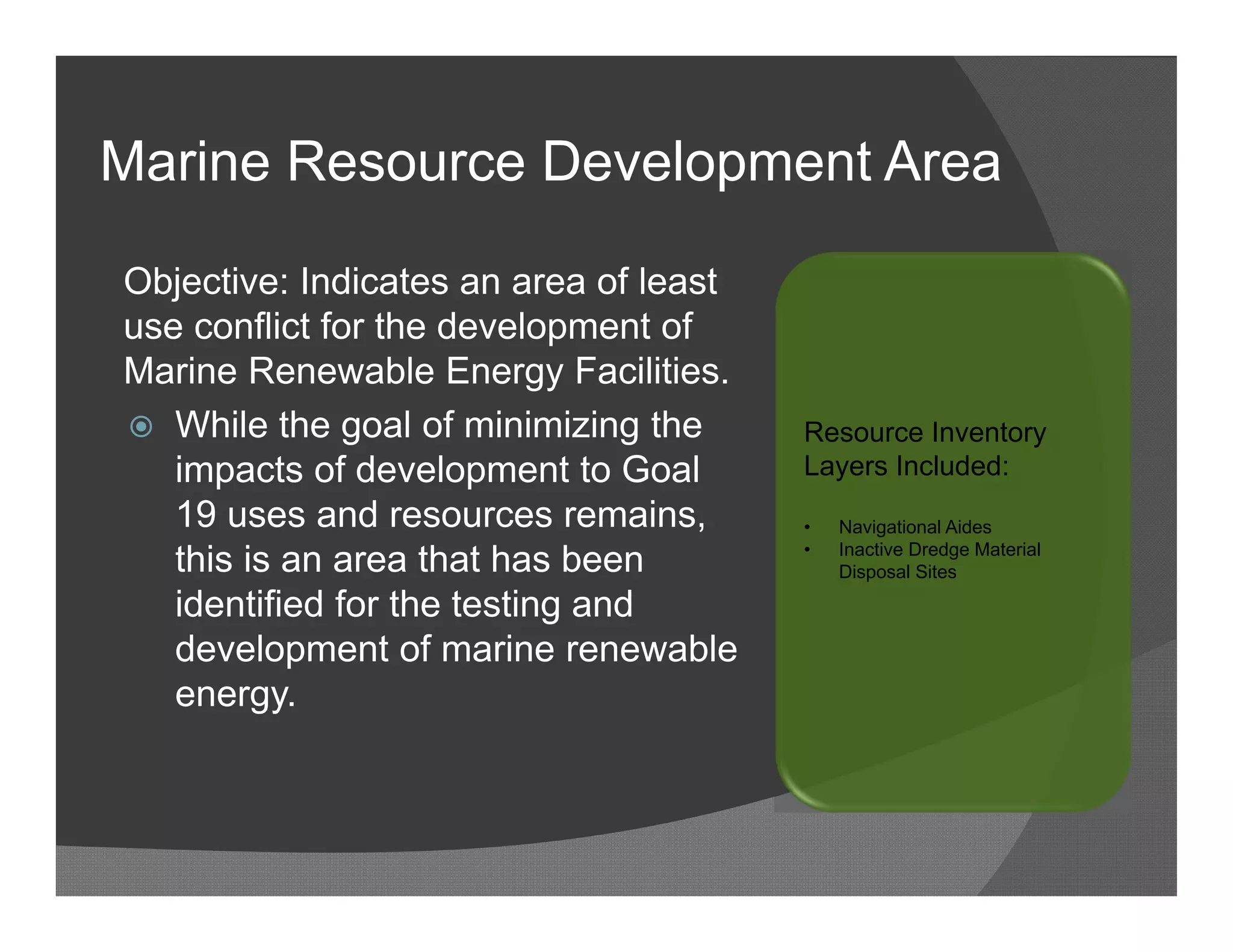
Marine Resource Development Area

Objective: Indicates an area of least
use conflict for the development of
Marine Renewable Energy Facilities.
 While the goal of minimizing the      Resource Inventory
   impacts of development to Goal       Layers Included:
   19 uses and resources remains,       •   Navigational Aides

   this is an area that has been        •   Inactive Dredge Material
                                            Disposal Sites

   identified for the testing and
   development of marine renewable
   energy.
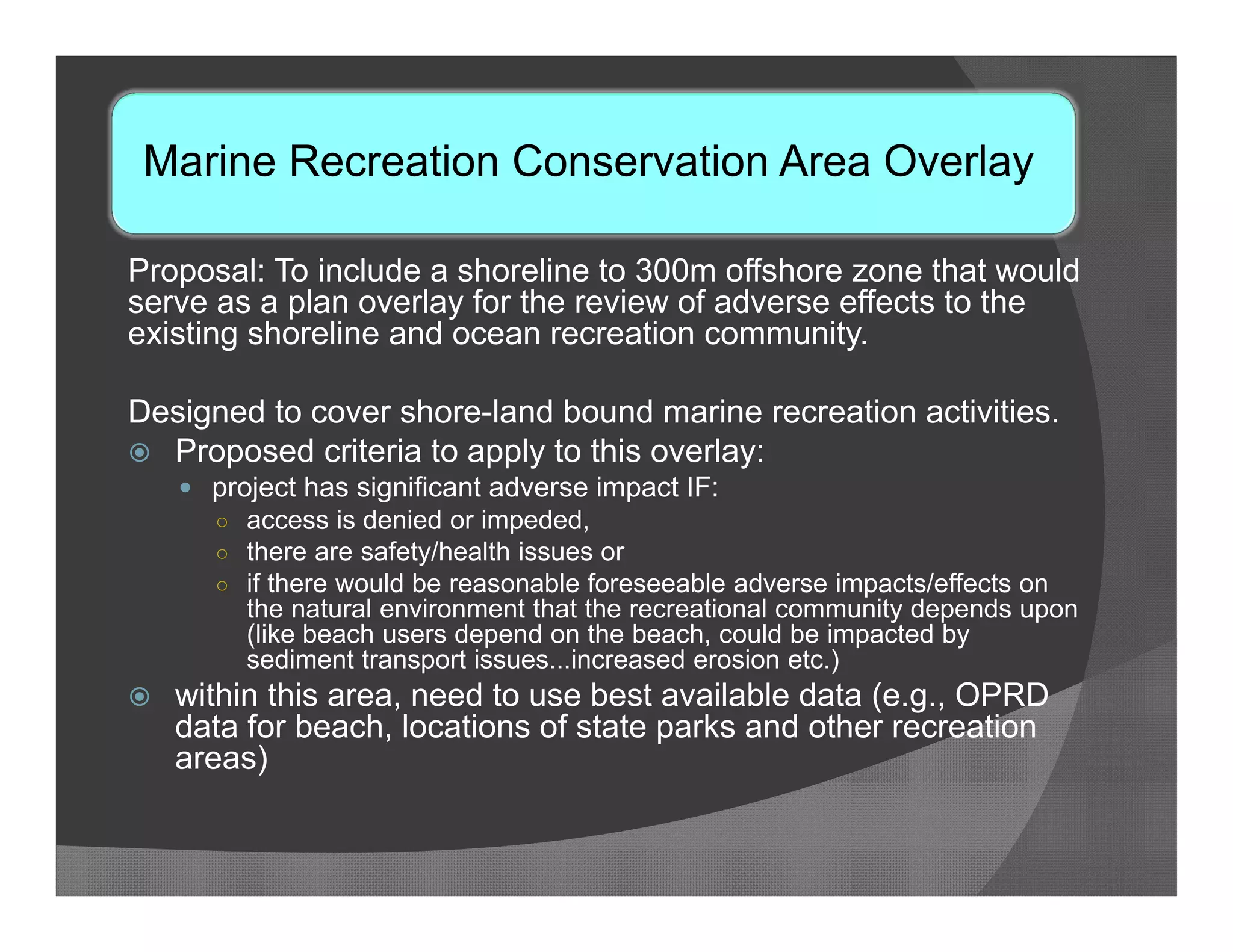
Marine Recreation Conservation Area Overlay

Proposal: To include a shoreline to 300m offshore zone that would
serve as a plan overlay for the review of adverse effects to the
existing shoreline and ocean recreation community.

Designed to cover shore-land bound marine recreation activities.
 Proposed criteria to apply to this overlay:
     project has significant adverse impact IF:
      ○ access is denied or impeded,
      ○ there are safety/health issues or
      ○ if there would be reasonable foreseeable adverse impacts/effects on
         the natural environment that the recreational community depends upon
         (like beach users depend on the beach, could be impacted by
         sediment transport issues...increased erosion etc.)
   within this area, need to use best available data (e.g., OPRD
    data for beach, locations of state parks and other recreation
    areas)
Visual Impact Assessment Analysis Overlay


The visual impact assessment framework by OPRD
will serve as a model framework for the evaluation of
impacts.

   In the planning phase of work, all view shed sites
    included in the inventory will be given a class rating

   That rating will be used in the regulatory phase to
    evaluate impacts to any viewpoint in the inventory.
The Planning Phase:
   Determine scenic quality
     • Measure of visual appeal based on key
        factors: Seascape, vegetation, color,
        adjacent scenery, scarcity, and cultural
        modification.

   Determine sensitivity
     • Measure of public concern for scenic
        quality: type of users, amount of use,
        public interest, adjacent land use, special
        areas, and other factors.
     • Park users are considered to have high
        user sensitivity.

   Determine distance zone
     • Seascapes divided into distanced zones
        based on relative visibility from
        observation points.

   Determine visual resource classes
     • Combination of scenic quality, sensitivity
        and distance zone
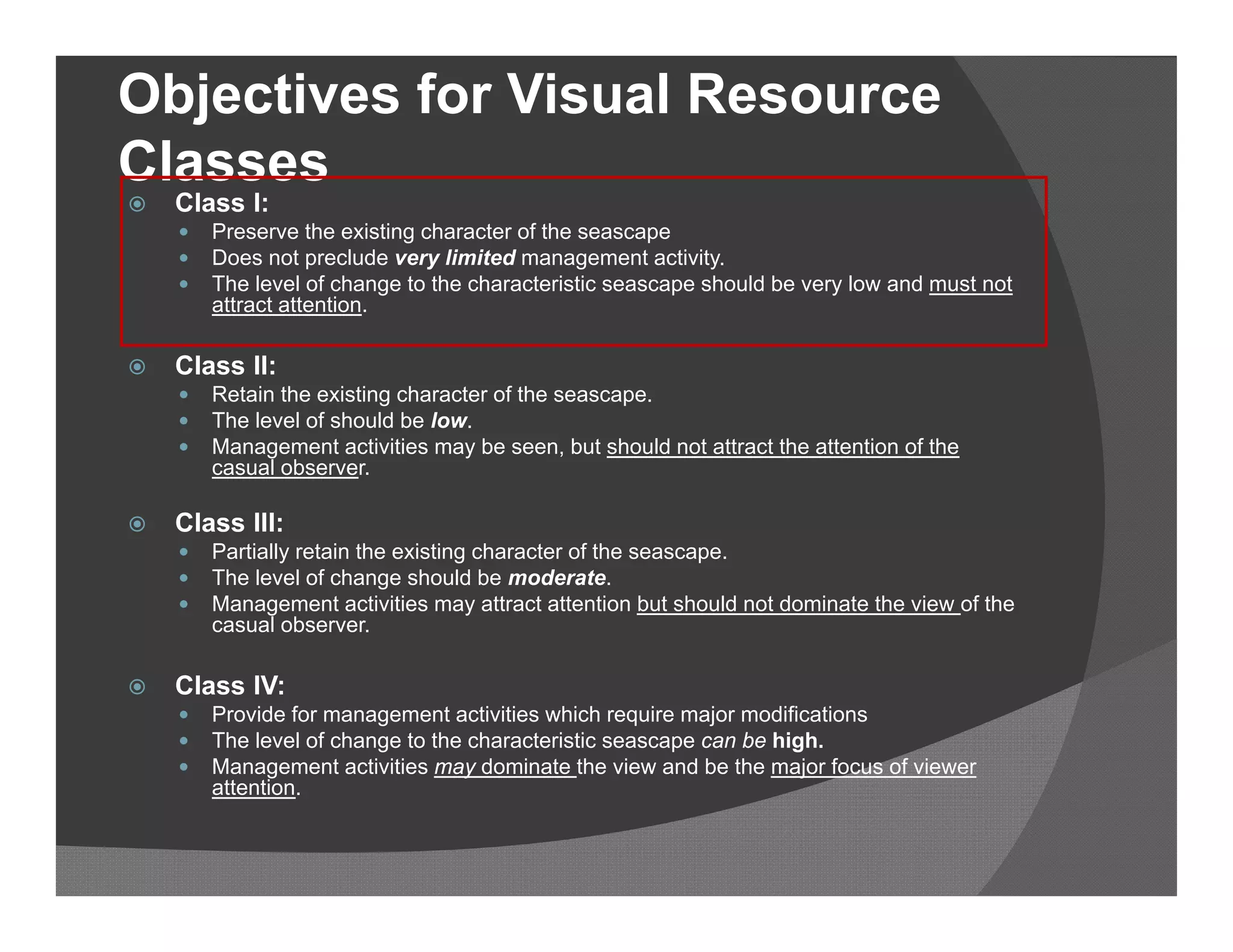
Objectives for Visual Resource
Classes
   Class I:
       Preserve the existing character of the seascape
       Does not preclude very limited management activity.
       The level of change to the characteristic seascape should be very low and must not
        attract attention.

   Class II:
       Retain the existing character of the seascape.
       The level of should be low.
       Management activities may be seen, but should not attract the attention of the
        casual observer.

   Class III:
       Partially retain the existing character of the seascape.
       The level of change should be moderate.
       Management activities may attract attention but should not dominate the view of the
        casual observer.

   Class IV:
       Provide for management activities which require major modifications
       The level of change to the characteristic seascape can be high.
       Management activities may dominate the view and be the major focus of viewer
        attention.
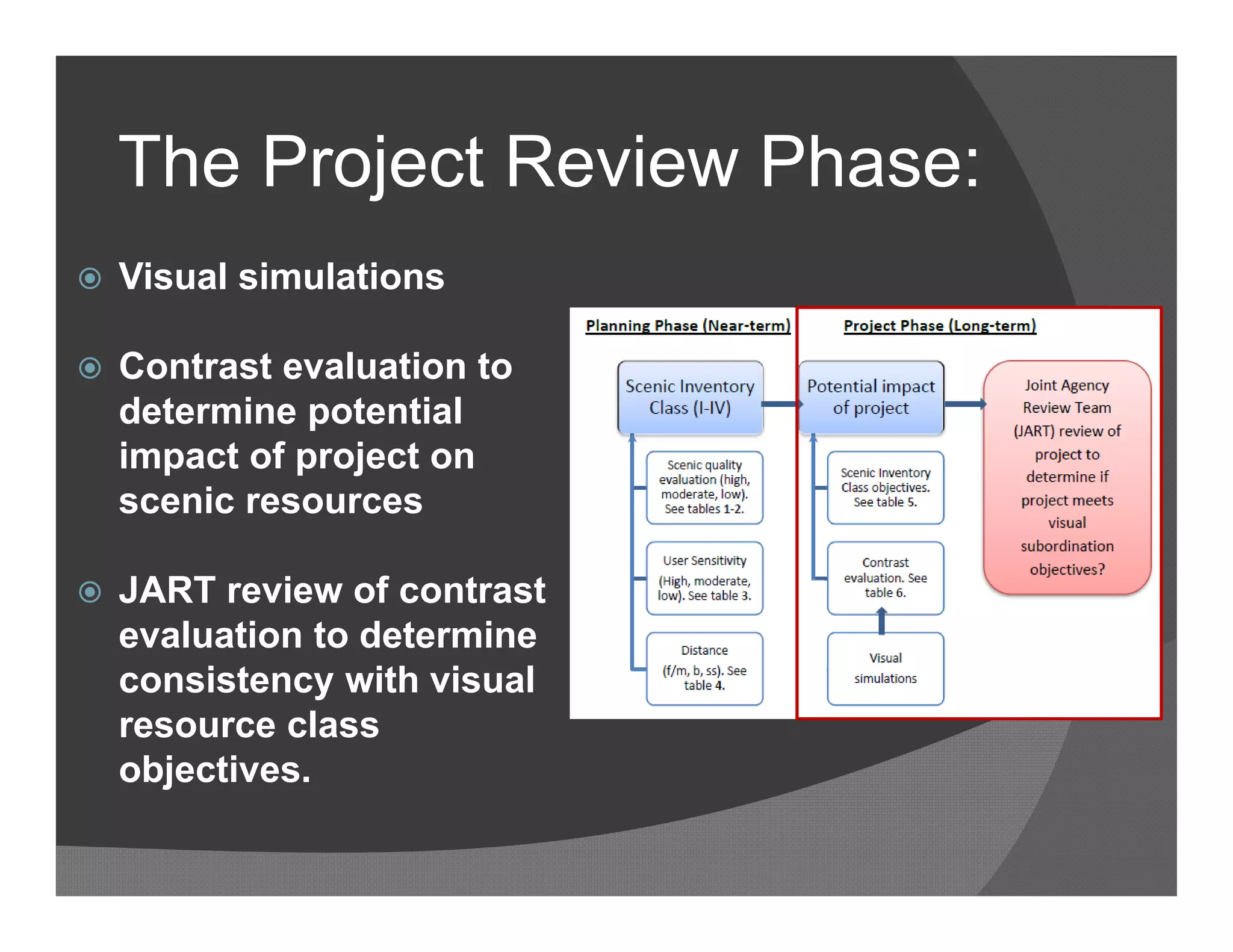
The Project Review Phase:
   Visual simulations

   Contrast evaluation to
    determine potential
    impact of project on
    scenic resources

   JART review of contrast
    evaluation to determine
    consistency with visual
    resource class
    objectives.
To Be Continued…

Oregon Marine Spatial Planning Overview and Update Paul Klarin

  • 1.
    Oregon Marine Spatial Planning Overview and Update Paul Klarin, Marine Program Coordinator Department of Land Conservation and Development May 2012
  • 2.
  • 3.
  • 4.
    Oregon’s MSP Progress How we got here: Governor’s Executive Order - March 2008 Oregon FERC MOU - March 2008 TSP Part 5 Adopted - November 2009 President’s Executive Order – June 2009 Oregon BOEMRE Task Force – March 2011 Marine Reserves System – May 2012
  • 5.
    Oregon’s Ocean ManagementProgram Statewide Land Use Ocean Resources Planning Program Management Program ORS 197 ORS 196 Ocean Policy Goal 19 Advisory Ocean Resources Council State Agency Territorial Authorities Sea Plan
  • 7.
    FERC – WaveEnergy BOEMRE
  • 8.
    Goal 19 OceanResources  “conserve marine resources and ecological functions for the purpose of providing long- term ecological, economic, and social value and benefits”  “conserve marine resources and ecological functions for the purpose of providing long- term ecological, economic, and social values and benefits and to give higher priority to the protection of renewable marine resources--i.e., living marine organisms-than to the development of non-renewable ocean resources.” http://www.lcd.state.or.us/LCD/goals.shtml#Statewide_Planning_Goals
  • 9.
    Goal 19 OceanResources Requires: PROTECT: Renewable Marine Resources – i.e. Living Marine Organisms  Biological Diversity & Functional Integrity of the Marine Ecosystem - Important Marine Habitat  Areas Important to Fisheries – commercial and recreational – sector and port  Beneficial Uses: Navigation, Recreation, Food Production, Aesthetic, Seafloor Uses.
  • 10.
    “Oregon places specialemphasis on conserving renewable ocean resources because these are expected to provide greater long-term benefits to the state from food production, recreation, aesthetic enjoyment, navigation, and ecosystem stability than non- renewable marine resources.” Part One of the Oregon Territorial Sea Plan http://www.lcd.state.or.us/LCD/OCMP/Ocean_TSP.shtml
  • 11.
    Oregon Territorial SeaPlan Part One: Ocean Management Goals The overall ocean management goal of the State of Oregon is to: Conserve the long-term values, benefits, and natural resources of the nearshore ocean and the continental shelf. To achieve this goal, the State of Oregon will:  1. give higher priority to the protection of renewable marine resources than to the development of non-renewable ocean resources;  2. support development of ocean resources that is environmentally sound and economically beneficial to coastal communities and the state;  3. protect the diversity of marine life, the functions of the marine ecosystem, the diversity of marine and estuarine habitats, and the overall health of the marine environment; and  4. seek the conservation of ocean resources within the larger marine region that is of ecologic and economic interest to the State of Oregon.
  • 15.
  • 17.
  • 18.
  • 21.
    Biogeographic Assessment Approach Biogeographic Assessment Approach Biogeographic Example Integrated Products to Aid Data Layers Biogeographic Analyses* Management * Specific analyses targeted to management needs Analytical Products to Meet Management Objectives Combine Biogeographic Layers for Analysis Defining and analyzing existing conditions Imagery Patterns of Human Use Bottom Type Defining and analyzing future conditions Bathymetry Oceanography Threatened Evaluate alternative Habitats management strategies (e.g. zoning) Species Distributions (many layers) NOAA Center for Coastal Monitoring and Assessment - Biogeography Branch
  • 22.
    Overview: Geospatial Analysisto derive Areas Protected by Goal 19 Data Layers Goal 19 Criteria Intersected Areas of Biological Identify Areas of Existing Uses or Areas for with the or Ecological Importance. Importance to Fisheries special management. Planning Grid + + + B&E Exclusion Areas Fishery Exclusion Areas Current Use or Management Exclusion Areas Areas of Opportunity (to be evaluated) + + + = ????’s Areas of Protection under Goal 19
  • 23.
    MarineMap – Comingup Next! Http://Oregon.MarineMap.org Acknowledgements: Oregon Dept. of Fish and Wildlife, Oregon Dept. of Land Conservation and Development, Ecotrust, Oregon Wave Energy Trust
  • 24.
    Planning Grid Overlays StartedHere Summary Map Layers + GIS Public Input Data LCDC TSPAC TSP OPAC Public Input Work Group Resource Use Public Input Goal 19 Public Input Draft Areas Areas Plan
  • 25.
    Outline:  Draft Plan  Framework – Area Definition  Area composition (Draft)  Marine Recreation Conservation Area  Visual Assessment Analysis Framework  Overlay OWET Feasibility Map
  • 26.
    Draft Recommendation forTSP Amendment Marine Renewable Marine Conservation Marine Resource Use Marine Resource Energy Exclusion Area Management Area Development Area Area Objective: To Objective: Protect Objective: To identify protect existing important, unique, or Objective: To maintain areas of least use permitted uses vulnerable Goal 19 the long term use and conflict for the and special ocean resources or health of the area by development of management uses. managing for a broad Marine Renewable areas under Goal range of Goal 19 ocean Energy Facilities. 19 Ocean resources and uses. Resources. Area identified for the protection of Goal 19 Minimize the impacts of Resources. Any Maintain the status quo for development to existing development in this users of the environment. users and the natural No development of area must demonstrate Demonstrate that the resources remains, This marine renewable no reasonably proposed use of the area area has been identified energy will be foreseeable adverse will not conflict with the for testing and permitted in these effect to the identified existing users, or have developing marine distinct areas. Goal 19 resources. significant adverse effect renewable energy. to the Goal 19 resources or uses within the area. Screening standards Visual Resource Overlay - Impact Assessment Analysis applied across all areas Marine Recreation Overlay Area Will not be permitted. Higher Permit Standards Lower
  • 27.
    Marine Renewable EnergyExclusion Zones Objective: To protect already Resource Inventory permitted uses and special Layers Included: management areas under • Dredge Material Disposal Sites • Commercial Shipping Lanes Goal 19. (Deep & Shallow draft) • Coastal Discharge Outfalls • Coastal National Wildlife Refuges  No MRE development will • OR Islands National Wildlife Refuges • Research Cables and be allowed Infrastructure • Existing State Designated Marine Managed Areas • Undersea Telecommunication Cables • Existing Marine Renewable Energy Permits • Ocean Outfalls
  • 28.
    Marine Conservation Area Objective:To protect unique, Resource Inventory important, or vulnerable Goal Layers Included: 19 resources or uses • Areas of Greatest Importance to Fisheries • Ocean Recreation  Any MRE development must Hotspots • Kelp Beds demonstrate no adverse effects to • Subtidal Rocky Reef identified Goal 19 resources or • • Rock Shores Habitat Pinniped Haulout uses. • Steller Sea Lion Critical Habitat • Nesting Seabird Colonies • Snowy Plover Critical Habitat • Level I Marxan (core hotspots)
  • 29.
    Marine Resource UseManagement Area Objective: To maintain the long term use and health of the area by a broad range of Goal 19 uses and Resource Inventory resources. Layers Included:  Maintain the status quo for Goal • Oceanographic Research 19 uses and resources. Any MRE • Crabber Tugboat Agreement lanes development must demonstrate • • Ocean Recreation Gray Whale Foraging Area no significant adverse effects, to • • Marbled Murrelet Foraging Level II Marxan (core hotspots) the extent possible, to those • Areas of Great Importance to Fisheries resources or uses.
  • 30.
    Marine Resource DevelopmentArea Objective: Indicates an area of least use conflict for the development of Marine Renewable Energy Facilities.  While the goal of minimizing the Resource Inventory impacts of development to Goal Layers Included: 19 uses and resources remains, • Navigational Aides this is an area that has been • Inactive Dredge Material Disposal Sites identified for the testing and development of marine renewable energy.
  • 31.
    Marine Recreation ConservationArea Overlay Proposal: To include a shoreline to 300m offshore zone that would serve as a plan overlay for the review of adverse effects to the existing shoreline and ocean recreation community. Designed to cover shore-land bound marine recreation activities.  Proposed criteria to apply to this overlay:  project has significant adverse impact IF: ○ access is denied or impeded, ○ there are safety/health issues or ○ if there would be reasonable foreseeable adverse impacts/effects on the natural environment that the recreational community depends upon (like beach users depend on the beach, could be impacted by sediment transport issues...increased erosion etc.)  within this area, need to use best available data (e.g., OPRD data for beach, locations of state parks and other recreation areas)
  • 32.
    Visual Impact AssessmentAnalysis Overlay The visual impact assessment framework by OPRD will serve as a model framework for the evaluation of impacts.  In the planning phase of work, all view shed sites included in the inventory will be given a class rating  That rating will be used in the regulatory phase to evaluate impacts to any viewpoint in the inventory.
  • 33.
    The Planning Phase:  Determine scenic quality • Measure of visual appeal based on key factors: Seascape, vegetation, color, adjacent scenery, scarcity, and cultural modification.  Determine sensitivity • Measure of public concern for scenic quality: type of users, amount of use, public interest, adjacent land use, special areas, and other factors. • Park users are considered to have high user sensitivity.  Determine distance zone • Seascapes divided into distanced zones based on relative visibility from observation points.  Determine visual resource classes • Combination of scenic quality, sensitivity and distance zone
  • 34.
    Objectives for VisualResource Classes  Class I:  Preserve the existing character of the seascape  Does not preclude very limited management activity.  The level of change to the characteristic seascape should be very low and must not attract attention.  Class II:  Retain the existing character of the seascape.  The level of should be low.  Management activities may be seen, but should not attract the attention of the casual observer.  Class III:  Partially retain the existing character of the seascape.  The level of change should be moderate.  Management activities may attract attention but should not dominate the view of the casual observer.  Class IV:  Provide for management activities which require major modifications  The level of change to the characteristic seascape can be high.  Management activities may dominate the view and be the major focus of viewer attention.
  • 35.
    The Project ReviewPhase:  Visual simulations  Contrast evaluation to determine potential impact of project on scenic resources  JART review of contrast evaluation to determine consistency with visual resource class objectives.
  • 43.