Complete GIS for Maritime Users
Technology disrupters such as mobile, cloud, and new data technology are allowing people
to look at how they manage and use data in a whole new light. Now is the time to adopt
geographic information system (GIS) technology for your hydrographic organization.


A Modern Hydrographic Workflow
ArcGIS® for Maritime helps hydrographic offices create,
analyze, and produce more with their data.

• Establish a Marine Spatial Data Infrastructure—
  Help drive economic growth and collaboration by
  sharing more accurate administrative, biologic, and
  physical data with other organizations. For example
  share tools and data models necessary to analyze the
  transition zone between land and sea.
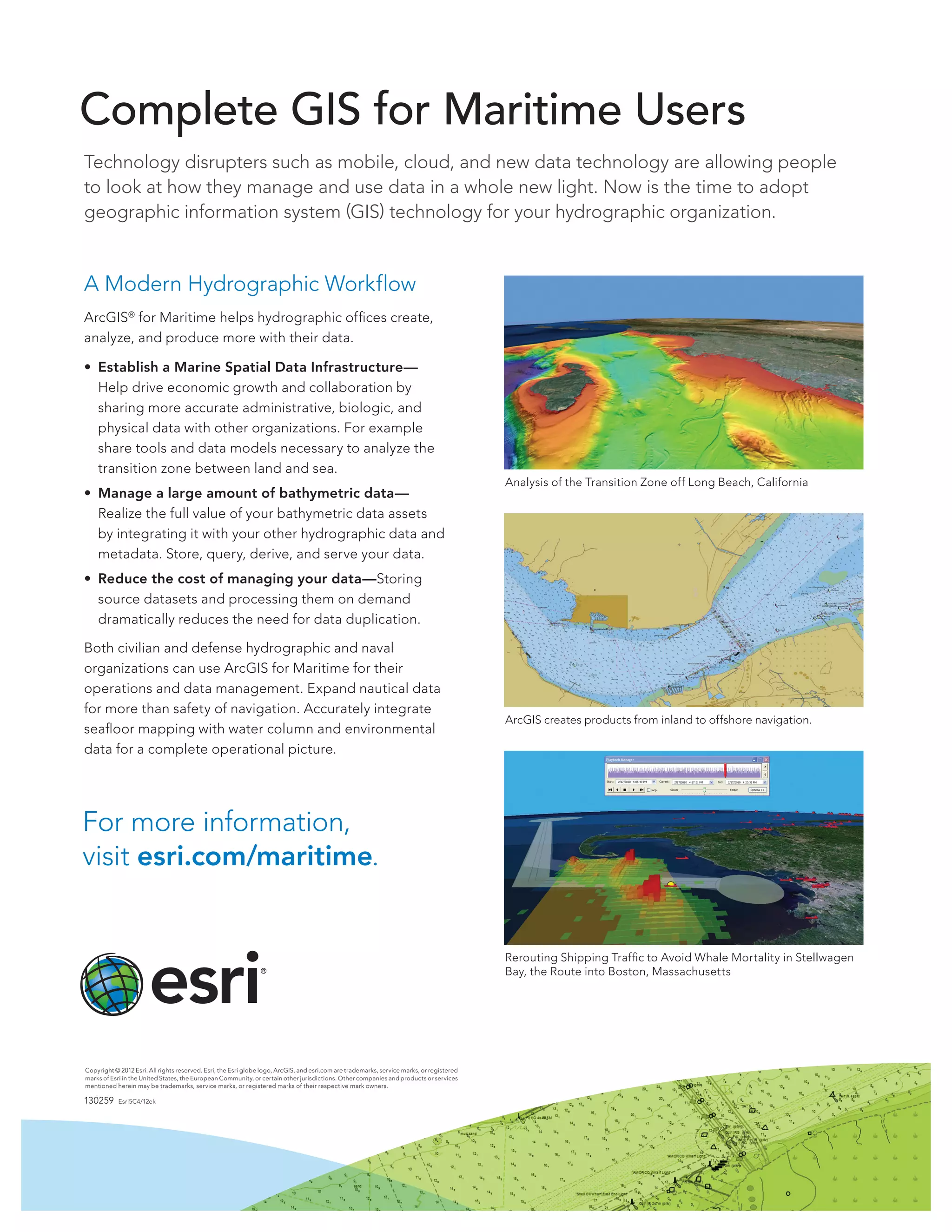
                                                                                                                                           Analysis of the Transition Zone off Long Beach, California
• Manage a large amount of bathymetric data—
  Realize the full value of your bathymetric data assets
  by integrating it with your other hydrographic data and
  metadata. Store, query, derive, and serve your data.
• Reduce the cost of managing your data—Storing
  source datasets and processing them on demand
  dramatically reduces the need for data duplication.

Both civilian and defense hydrographic and naval
organizations can use ArcGIS for Maritime for their
operations and data management. Expand nautical data
for more than safety of navigation. Accurately integrate
                                                                                                                                           ArcGIS creates products from inland to offshore navigation.
seafloor mapping with water column and environmental
data for a complete operational picture.


For more information,
visit esri.com/maritime.


                                                                                                                                           Rerouting Shipping Traffic to Avoid Whale Mortality in Stellwagen
                                                                                                                                           Bay, the Route into Boston, Massachusetts


Copyright © 2012 Esri. All rights reserved. Esri, the Esri globe logo, ArcGIS, and esri.com are trademarks, service marks, or registered
marks of Esri in the United States, the European Community, or certain other jurisdictions. Other companies and products or services
mentioned herein may be trademarks, service marks, or registered marks of their respective mark owners.

130259      Esri5C4/12ek

GIS for Maritime Users

  • 1.
    Complete GIS forMaritime Users Technology disrupters such as mobile, cloud, and new data technology are allowing people to look at how they manage and use data in a whole new light. Now is the time to adopt geographic information system (GIS) technology for your hydrographic organization. A Modern Hydrographic Workflow ArcGIS® for Maritime helps hydrographic offices create, analyze, and produce more with their data. • Establish a Marine Spatial Data Infrastructure— Help drive economic growth and collaboration by sharing more accurate administrative, biologic, and physical data with other organizations. For example share tools and data models necessary to analyze the transition zone between land and sea. Analysis of the Transition Zone off Long Beach, California • Manage a large amount of bathymetric data— Realize the full value of your bathymetric data assets by integrating it with your other hydrographic data and metadata. Store, query, derive, and serve your data. • Reduce the cost of managing your data—Storing source datasets and processing them on demand dramatically reduces the need for data duplication. Both civilian and defense hydrographic and naval organizations can use ArcGIS for Maritime for their operations and data management. Expand nautical data for more than safety of navigation. Accurately integrate ArcGIS creates products from inland to offshore navigation. seafloor mapping with water column and environmental data for a complete operational picture. For more information, visit esri.com/maritime. Rerouting Shipping Traffic to Avoid Whale Mortality in Stellwagen Bay, the Route into Boston, Massachusetts Copyright © 2012 Esri. All rights reserved. Esri, the Esri globe logo, ArcGIS, and esri.com are trademarks, service marks, or registered marks of Esri in the United States, the European Community, or certain other jurisdictions. Other companies and products or services mentioned herein may be trademarks, service marks, or registered marks of their respective mark owners. 130259 Esri5C4/12ek