TODAY,
TOMORROW
AND
BEYOND . . .
1963 – 2013 CELEBRATING 50 YEARS OF THE BRITISH CARTOGRAPHIC SOCIETY
Cartography and Geospatial Intelligence:
Actionable Knowledge for Human Security
R. Maxwell Baber, Ph.D., FBCart.S
Director of Academic Programs
US Geospatial Intelligence Foundation
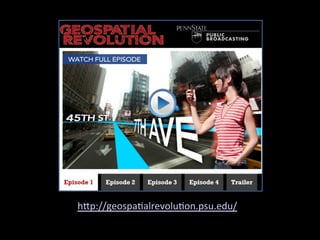
h"p://geospa+alrevolu+on.psu.edu/	


USGIF Strategic Partners
www.GEOINT2013.com
TRAJECTORYmagazine.com
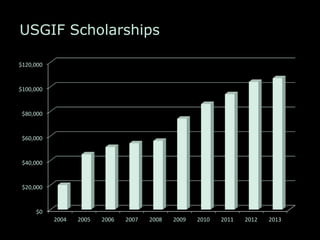
USGIF Scholarships
$0	
  
$20,000	
  
$40,000	
  
$60,000	
  
$80,000	
  
$100,000	
  
$120,000	
  
2004	
   2005	
   2006	
   2007	
   2008	
   2009	
   2010	
   2011	
   2012	
   2013	
  
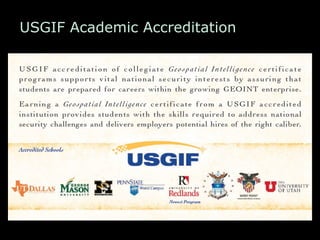
USGIF Academic Accreditation
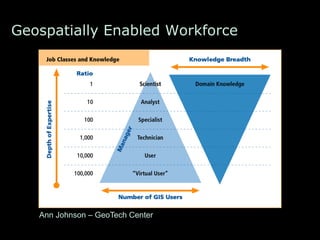
Geospatially Enabled Workforce
Ann Johnson – GeoTech Center
Geospatial Intelligence
TODAY,
TOMORROW
AND
BEYOND . . .
1963 – 2013 CELEBRATING 50 YEARS OF THE BRITISH CARTOGRAPHIC SOCIETY
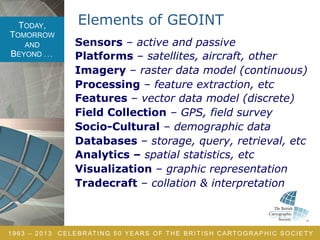
Elements of GEOINT
Sensors – active and passive
Platforms – satellites, aircraft, other
Imagery – raster data model (continuous)
Processing – feature extraction, etc
Features – vector data model (discrete)
Field Collection – GPS, field survey
Socio-Cultural – demographic data
Databases – storage, query, retrieval, etc
Analytics – spatial statistics, etc
Visualization – graphic representation
Tradecraft – collation & interpretation
TODAY,
TOMORROW
AND
BEYOND . . .
1963 – 2013 CELEBRATING 50 YEARS OF THE BRITISH CARTOGRAPHIC SOCIETY
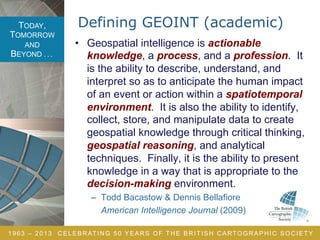
Defining GEOINT (academic)
•  Geospatial intelligence is actionable
knowledge, a process, and a profession. It
is the ability to describe, understand, and
interpret so as to anticipate the human impact
of an event or action within a spatiotemporal
environment. It is also the ability to identify,
collect, store, and manipulate data to create
geospatial knowledge through critical thinking,
geospatial reasoning, and analytical
techniques. Finally, it is the ability to present
knowledge in a way that is appropriate to the
decision-making environment.
–  Todd Bacastow & Dennis Bellafiore
American Intelligence Journal (2009)
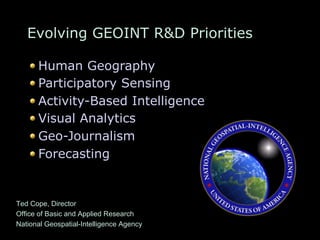
Evolving GEOINT R&D Priorities
" Human Geography
" Participatory Sensing
" Activity-Based Intelligence
" Visual Analytics
" Geo-Journalism
" Forecasting
Ted Cope, Director
Office of Basic and Applied Research
National Geospatial-Intelligence Agency
TODAY,
TOMORROW
AND
BEYOND . . .
1963 – 2013 CELEBRATING 50 YEARS OF THE BRITISH CARTOGRAPHIC SOCIETY
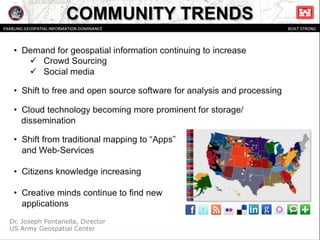
Dr. Joseph Fontanella, Director
US Army Geospatial Center
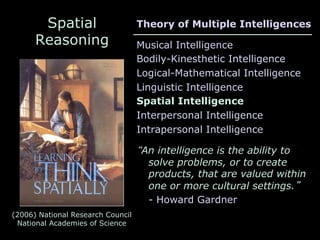
Spatial Reasoning
Spatial
Reasoning
Theory of Multiple Intelligences
Musical Intelligence
Bodily-Kinesthetic Intelligence
Logical-Mathematical Intelligence
Linguistic Intelligence
Spatial Intelligence
Interpersonal Intelligence
Intrapersonal Intelligence
“An intelligence is the ability to
solve problems, or to create
products, that are valued within
one or more cultural settings.”
- Howard Gardner
(2006) National Research Council
National Academies of Science
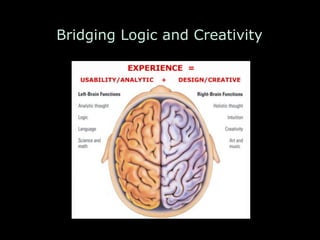
Bridging Logic and Creativity
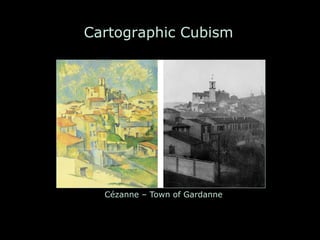
Cartographic Cubism
Cézanne – Town of Gardanne
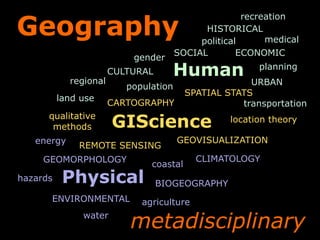
recreation
energy
water
regional
agriculture
coastal
hazards
location theoryqualitative
methods
medical
gender
planning
land use
population
transportation
political
ECONOMIC
SPATIAL STATS
ENVIRONMENTAL
HISTORICAL
CARTOGRAPHY
URBAN
CLIMATOLOGY
GEOVISUALIZATION
BIOGEOGRAPHY
GEOMORPHOLOGY
REMOTE SENSING
CULTURAL
SOCIAL
Human
Physical
GIScience
Geography
metadisciplinary
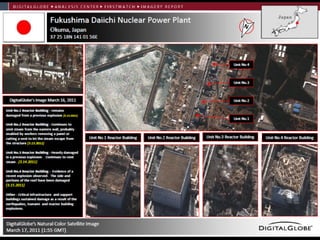
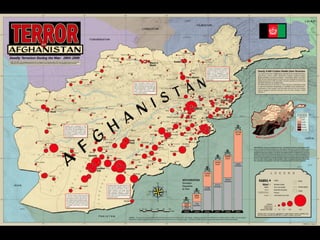
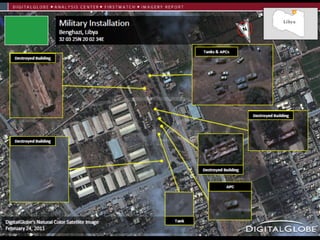
Broad Mission of GEOINT
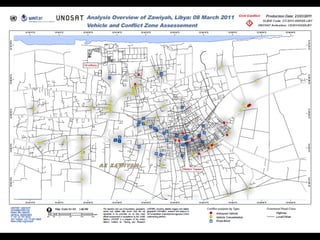
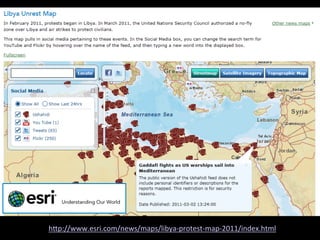
Conflict – Crisis – Disaster
h"p://www.esri.com/news/maps/libya-­‐protest-­‐map-­‐2011/index.html	
  
TODAY,
TOMORROW
AND
BEYOND . . .
1963 – 2013 CELEBRATING 50 YEARS OF THE BRITISH CARTOGRAPHIC SOCIETY
Max Baber, Director of Academic Programs
max.baber@usgif.org
Cartography and Geospatial Intelligence:
Actionable Knowledge for Human Security

Cartography and Geospatial Intelligence (GEOINT): Actionable Knowledge for Human Security - by Max Baber