


Scavenging System
By Muhammad Tayyeb
Lecturer Anesthesiology
BKMC Mardan.
Purpose of
Scavenging
Legal requirement
• Control of substance, hazardous to
health (COSHH).
• Only local environment is protected
• The pollutant gases are vented
uncharged to atmosphere
• Most are potent green house gases
Possible
Health Hazard
• Some studies have Identified weak
association with exposure to trace amount
of waste anesthetic vapours such as
• Spontaneous abortion.
• Male anesthetists were more likely to
become a father of a daughter than son.
• Hematological malignancies
• Other studies have not replicated these
data
Sources of
pollution by
anesthetic
gases and
vapours
• Incomplete scavenging of gases from
• APL Valve
• Ventilator
• Leaks from equipment’s
• Poorly fitting face mask
• T Piece
• Uncuffed trachea
• O rings
• Soda lime canister
• Cryosurgery unit
• Cardiopulmonary bypass circuit
• APL Valve
• Discharge of anesthetic gases from ventilators/vaporizer
• Failure to turn off fresh gas flow/vaporizer at the end
of anesthesia
• Spilling during filling of vaporizer
CONT.
• Gas exhaled by patient after
anesthesia
• OR/OT
• Corridors
• Recovery room
Maximum
Permitted
Exposure
levels
Expressed as an 8 hours time weighted
average
Different country suggest different data
Values are below the level at which any
significant adverse effects occurred to animal
No evidence or data available to suggest
human health will be adversely affected
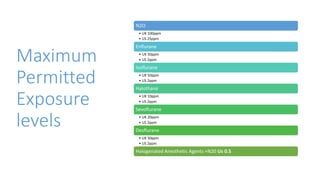
Maximum
Permitted
Exposure
levels
N2O
• UK 100ppm
• US 25ppm
Enflurane
• UK 50ppm
• US 2ppm
Isoflurane
• UK 50ppm
• US 2ppm
Halothane
• UK 10ppm
• US 2ppm
Sevoflurane
• UK 20ppm
• US 2ppm
Desflurane
• UK 50ppm
• US 2ppm
Halogenated Anesthetic Agents +N20 Us 0.5
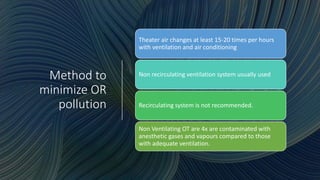
Method to
minimize OR
pollution
Theater air changes at least 15-20 times per hours
with ventilation and air conditioning
Non recirculating ventilation system usually used
Recirculating system is not recommended.
Non Ventilating OT are 4x are contaminated with
anesthetic gases and vapours compared to those
with adequate ventilation.
Cont.
• Use of circle breathing systems
• These low and ultra low flow breathing systems recycle
exhaled anesthetic vapours (rebreathing system).
• There is a mean to absorb exhaled Co2 (soda lime).
• Low fresh gas flow reduces the amount of inhalational
agents used.
• Alternative anesthetic methods to avoid inhalational
anesthetic agents
• Regional anesthesia
• TIVA
CONT.
• Avoid spillage of volatile anesthetic agents
when filling vaporizers
• In some country vaporizers are filled with only in
a portable fume cupboard
• Agents' specific connector reduces spillages
• Scavenging
• Collect waste anesthetic gases from the
breathing system and discarding them safely.
• Should not affect ventilation/oxygenation of
the patients
• Should not affect dynamics of the breathing
system
CONT.
• Quality Control Procedure
• Sampling to assess waste anesthetic vapor concentration in the air for N2O and
halogenated agents done.
• In UK yearly
• In US quarterly
• Location
• Wherever anesthesia is administered
• Includes
• Leak test of equipment's
• Sampling air in the operation theater personal breathing zone.
• Planned preventive militance programs
• General ventilation system and scavenging equipment should be tested at
least yearly
• Involve anesthetic equipment's gas scavenging gas supply flowmeter and
ventilation system
Classification of
Scavenging
system
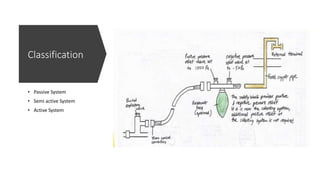
Classification
• Passive System
• Semi active System
• Active System
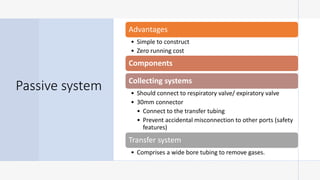
Passive system
Advantages
• Simple to construct
• Zero running cost
Components
Collecting systems
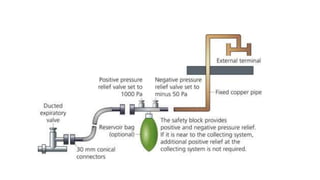
• Should connect to respiratory valve/ expiratory valve
• 30mm connector
• Connect to the transfer tubing
• Prevent accidental misconnection to other ports (safety
features)
Transfer system
• Comprises a wide bore tubing to remove gases.
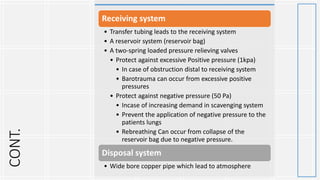
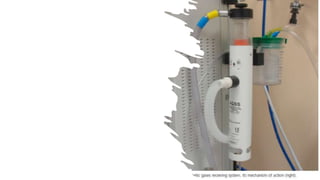
CONT. Receiving system
• Transfer tubing leads to the receiving system
• A reservoir system (reservoir bag)
• A two-spring loaded pressure relieving valves
• Protect against excessive Positive pressure (1kpa)
• In case of obstruction distal to receiving system
• Barotrauma can occur from excessive positive
pressures
• Protect against negative pressure (50 Pa)
• Incase of increasing demand in scavenging system
• Prevent the application of negative pressure to the
patients lungs
• Rebreathing Can occur from collapse of the
reservoir bag due to negative pressure.
Disposal system
• Wide bore copper pipe which lead to atmosphere
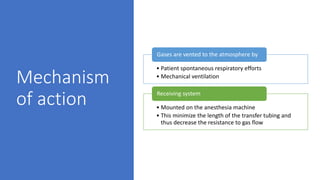
Mechanism
of action
• Patient spontaneous respiratory efforts
• Mechanical ventilation
Gases are vented to the atmosphere by
• Mounted on the anesthesia machine
• This minimize the length of the transfer tubing and
thus decrease the resistance to gas flow
Receiving system
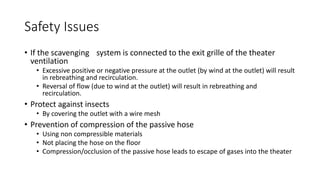
Safety Issues
• If the scavenging system is connected to the exit grille of the theater
ventilation
• Excessive positive or negative pressure at the outlet (by wind at the outlet) will result
in rebreathing and recirculation.
• Reversal of flow (due to wind at the outlet) will result in rebreathing and
recirculation.
• Protect against insects
• By covering the outlet with a wire mesh
• Prevention of compression of the passive hose
• Using non compressible materials
• Not placing the hose on the floor
• Compression/occlusion of the passive hose leads to escape of gases into the theater
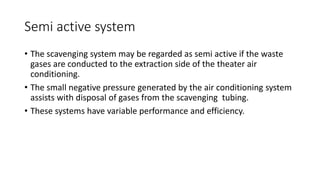
Semi active system
• The scavenging system may be regarded as semi active if the waste
gases are conducted to the extraction side of the theater air
conditioning.
• The small negative pressure generated by the air conditioning system
assists with disposal of gases from the scavenging tubing.
• These systems have variable performance and efficiency.
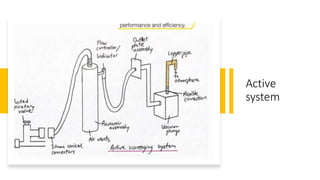
Active
system
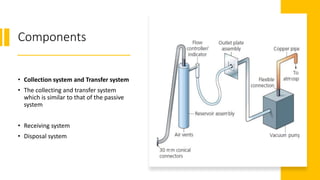
Components
• Collection system and Transfer system
• The collecting and transfer system
which is similar to that of the passive
system
• Receiving system
• Disposal system
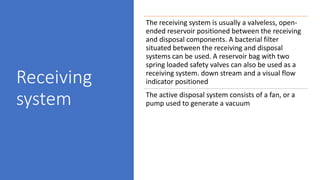
Receiving
system
The receiving system is usually a valveless, open-
ended reservoir positioned between the receiving
and disposal components. A bacterial filter
situated between the receiving and disposal
systems can be used. A reservoir bag with two
spring loaded safety valves can also be used as a
receiving system. down stream and a visual flow
indicator positioned
The active disposal system consists of a fan, or a
pump used to generate a vacuum
Mechanism
of action
1. The vacuum drives the gases through the system. Active
scavenging systems are able to deal with a wide range of
expiratory flow rates (30–130 L/min).
2. A motorized fan, a pump or a Venturi system is used to
generate the vacuum or negative pressure that is transmitted
through the pipes.
3. The receiving system is capable of coping with changes in gas
flow rates. Increased demands (or excessive negative pressure)
allow ambient air to be entrained so maintaining the pressure.
The opposite occurs during excessive positive pressure. As a
result, a uniform gas flow is passed to the disposal system
Problems in practice and
safety features
1. The reservoir is designed to prevent
excessive negative or positive pressures
being applied to the patient. Excessive
negative pressure leads to the collapse of
the reservoir bag of the breathing system
and the risk of rebreathing. Excessive
positive pressure increases the risk of
barotrauma should there be an obstruction
beyond the receiving system.
2. An independent vacuum pump should
be used for scavenging purposes.
References
• Al sheikh B et al. essential of anesthetic
equipment's 4th edition
• Alan R atikenhead et al.
• Stephen Boumphery
• Simon Bricker
• Daniel Aston et al.
• Mendonca C et al.
Thank you

scavenging system

  • 1.
    Scavenging System By MuhammadTayyeb Lecturer Anesthesiology BKMC Mardan.
  • 3.
    Purpose of Scavenging Legal requirement •Control of substance, hazardous to health (COSHH). • Only local environment is protected • The pollutant gases are vented uncharged to atmosphere • Most are potent green house gases
  • 4.
    Possible Health Hazard • Somestudies have Identified weak association with exposure to trace amount of waste anesthetic vapours such as • Spontaneous abortion. • Male anesthetists were more likely to become a father of a daughter than son. • Hematological malignancies • Other studies have not replicated these data
  • 5.
    Sources of pollution by anesthetic gasesand vapours • Incomplete scavenging of gases from • APL Valve • Ventilator • Leaks from equipment’s • Poorly fitting face mask • T Piece • Uncuffed trachea • O rings • Soda lime canister • Cryosurgery unit • Cardiopulmonary bypass circuit • APL Valve • Discharge of anesthetic gases from ventilators/vaporizer • Failure to turn off fresh gas flow/vaporizer at the end of anesthesia • Spilling during filling of vaporizer
  • 6.
    CONT. • Gas exhaledby patient after anesthesia • OR/OT • Corridors • Recovery room
  • 7.
    Maximum Permitted Exposure levels Expressed as an8 hours time weighted average Different country suggest different data Values are below the level at which any significant adverse effects occurred to animal No evidence or data available to suggest human health will be adversely affected
  • 8.
    Maximum Permitted Exposure levels N2O • UK 100ppm •US 25ppm Enflurane • UK 50ppm • US 2ppm Isoflurane • UK 50ppm • US 2ppm Halothane • UK 10ppm • US 2ppm Sevoflurane • UK 20ppm • US 2ppm Desflurane • UK 50ppm • US 2ppm Halogenated Anesthetic Agents +N20 Us 0.5
  • 9.
    Method to minimize OR pollution Theaterair changes at least 15-20 times per hours with ventilation and air conditioning Non recirculating ventilation system usually used Recirculating system is not recommended. Non Ventilating OT are 4x are contaminated with anesthetic gases and vapours compared to those with adequate ventilation.
  • 10.
    Cont. • Use ofcircle breathing systems • These low and ultra low flow breathing systems recycle exhaled anesthetic vapours (rebreathing system). • There is a mean to absorb exhaled Co2 (soda lime). • Low fresh gas flow reduces the amount of inhalational agents used. • Alternative anesthetic methods to avoid inhalational anesthetic agents • Regional anesthesia • TIVA
  • 11.
    CONT. • Avoid spillageof volatile anesthetic agents when filling vaporizers • In some country vaporizers are filled with only in a portable fume cupboard • Agents' specific connector reduces spillages • Scavenging • Collect waste anesthetic gases from the breathing system and discarding them safely. • Should not affect ventilation/oxygenation of the patients • Should not affect dynamics of the breathing system
  • 12.
    CONT. • Quality ControlProcedure • Sampling to assess waste anesthetic vapor concentration in the air for N2O and halogenated agents done. • In UK yearly • In US quarterly • Location • Wherever anesthesia is administered • Includes • Leak test of equipment's • Sampling air in the operation theater personal breathing zone. • Planned preventive militance programs • General ventilation system and scavenging equipment should be tested at least yearly • Involve anesthetic equipment's gas scavenging gas supply flowmeter and ventilation system
  • 13.
  • 14.
    Classification • Passive System •Semi active System • Active System
  • 15.
    Passive system Advantages • Simpleto construct • Zero running cost Components Collecting systems • Should connect to respiratory valve/ expiratory valve • 30mm connector • Connect to the transfer tubing • Prevent accidental misconnection to other ports (safety features) Transfer system • Comprises a wide bore tubing to remove gases.
  • 16.
    CONT. Receiving system •Transfer tubing leads to the receiving system • A reservoir system (reservoir bag) • A two-spring loaded pressure relieving valves • Protect against excessive Positive pressure (1kpa) • In case of obstruction distal to receiving system • Barotrauma can occur from excessive positive pressures • Protect against negative pressure (50 Pa) • Incase of increasing demand in scavenging system • Prevent the application of negative pressure to the patients lungs • Rebreathing Can occur from collapse of the reservoir bag due to negative pressure. Disposal system • Wide bore copper pipe which lead to atmosphere
  • 17.
    Mechanism of action • Patientspontaneous respiratory efforts • Mechanical ventilation Gases are vented to the atmosphere by • Mounted on the anesthesia machine • This minimize the length of the transfer tubing and thus decrease the resistance to gas flow Receiving system
  • 19.
    Safety Issues • Ifthe scavenging system is connected to the exit grille of the theater ventilation • Excessive positive or negative pressure at the outlet (by wind at the outlet) will result in rebreathing and recirculation. • Reversal of flow (due to wind at the outlet) will result in rebreathing and recirculation. • Protect against insects • By covering the outlet with a wire mesh • Prevention of compression of the passive hose • Using non compressible materials • Not placing the hose on the floor • Compression/occlusion of the passive hose leads to escape of gases into the theater
  • 21.
    Semi active system •The scavenging system may be regarded as semi active if the waste gases are conducted to the extraction side of the theater air conditioning. • The small negative pressure generated by the air conditioning system assists with disposal of gases from the scavenging tubing. • These systems have variable performance and efficiency.
  • 22.
  • 23.
    Components • Collection systemand Transfer system • The collecting and transfer system which is similar to that of the passive system • Receiving system • Disposal system
  • 24.
    Receiving system The receiving systemis usually a valveless, open- ended reservoir positioned between the receiving and disposal components. A bacterial filter situated between the receiving and disposal systems can be used. A reservoir bag with two spring loaded safety valves can also be used as a receiving system. down stream and a visual flow indicator positioned The active disposal system consists of a fan, or a pump used to generate a vacuum
  • 25.
    Mechanism of action 1. Thevacuum drives the gases through the system. Active scavenging systems are able to deal with a wide range of expiratory flow rates (30–130 L/min). 2. A motorized fan, a pump or a Venturi system is used to generate the vacuum or negative pressure that is transmitted through the pipes. 3. The receiving system is capable of coping with changes in gas flow rates. Increased demands (or excessive negative pressure) allow ambient air to be entrained so maintaining the pressure. The opposite occurs during excessive positive pressure. As a result, a uniform gas flow is passed to the disposal system
  • 26.
    Problems in practiceand safety features 1. The reservoir is designed to prevent excessive negative or positive pressures being applied to the patient. Excessive negative pressure leads to the collapse of the reservoir bag of the breathing system and the risk of rebreathing. Excessive positive pressure increases the risk of barotrauma should there be an obstruction beyond the receiving system. 2. An independent vacuum pump should be used for scavenging purposes.
  • 28.
    References • Al sheikhB et al. essential of anesthetic equipment's 4th edition • Alan R atikenhead et al. • Stephen Boumphery • Simon Bricker • Daniel Aston et al. • Mendonca C et al.
  • 29.