
ZIKRULLAH
ASPIRATION
 Is the misdirection of oropharyngeal or gastric
contents into larynx and lower respiratory tract.
GASTRIC SECRETION
1500 ml/day
Oxyntic glands (oxyntic cells) secrete HCl
Pyloric glands (chief cells) secrete
pepsinogen
Basal rate (empty stomach): 10% of
maximal rate
Diurnal variation:
• Lowest in morning
• Highest in evening
LOWER ESOPHAGEAL SPHINCTER
 LES is characterized anatomically and manometrically
as a 3 cm zone of specialized muscle that maintains
tonic activity
 End expiratory pressure in sphincter 8-20 mmHg
above end expiratory gastric pressure
 Chronic contraction in circular muscle fiber
 Wrapping of esophagus by crus of diaphragm at hiatus
 Length of esophagus exposed to intra abdominal
pressure
 A valve like effect of obliquity of esophago-gastric
angle
 A plug like action of mucosal folds at the esophago-
gastric junction
LOWER ESOPHAGEAL SPHINCTER
How does it occur
 Aspiration can occur when there is problem, with the
process that co-ordinates swallowing and breathing.
 CNS disorders ( stroke, multiple sclerosis etc ).
 Seizures
 Following head trauma
 Drug overdose
 Surgery ( esophageal, upper abdominal, laproscopic
etc.)
 Laughing or inhaling with food or fluid in mouth.
 Any defect in some part of throat or vocal cord
anatomy.
 Severity of injury depends on presence of particulate
matter, volume and pH of aspirate.
 Traditionally patients with gastric volume >0.4 ml/kg
(25 ml in adult) and with pH<2.5 are at risk of
aspiration pneumonitis.
PATHOPHYSIOLOGY
 Aspiration of gastric contents leads to intense
parenchymal inflammatory reaction.
 There is biphasic pattern of lung injury in aspiration.
 First phase : peaks at 1-2 hrs after aspiration .Direct
caustic effect of the low pH on alveolar capillary
lining cells.
 Second phase : peaks at 4-6 hours.
 Associated with infiltration of neutrophil into alveoli
and lung interstitium with histological picture of acute
inflammation.
TYPES OF INJURY
 ASPIRATION PNEUMONITIS
 described by CURTIS LESTER MENDELSON in
1946,also known as MENDELSON SYNDROME.
 it is non infectious chemical injury of lungs from
aspiration of contents.
 increased acidity (pH <2.5) & increased volume
(>25ml or 0.4ml/kg) increases the risk.
 food particles independent of pH can also cause
chemical injury.
ASPIRATION PNEUMONIA
 It is a parenchymal inflammatory reaction to an infectious
agent (mostly gr –ve) caused by aspiration of oropharyngeal
secretions characterised by an infilterate on chest
radiograph.
SIGNS AND SYMPTOMS
 Gastric contents in oropharynx.
 Wheezing
 Coughing
 Shortness of breath
 Cyanosis
 Tachypnea
 Tachycardia
 Bronchospasm
Radiological findings:-
 Diffuse , patchy pulmonary infiltrates.
 Irregular,mottled densities.
 Fluffiness White-out lung.
RISK FACTORS
 Physiological
 Pathological
 Pharmacological
Physiological Factors-
1.Pregnancy
 Pregnant patients are particularly at risk for aspiration of gastric
contents for a variety of reasons including-
a) Mechanical factors
gravid uterus-increases intra abdominal & intra gastric pressure.
b)Hormonal factors
increased gastrin level- increases gastric vol. & acidity.
increased progesterone- decreases LES tone.
decreased motilin level- decreases GI sphincter tone & delay
gastric emptying.
c) Iatrogenic factors-
sedative & narcotic administration during labour
prolong gastric emptying & also may depress
protective airway reflexes.
moreover, lithotomy position increases the intra-
gastric pressure.
2.Elderly patients
 decreased gastric motility
3.Pediatric patients
 increased gastric vol. & acidity
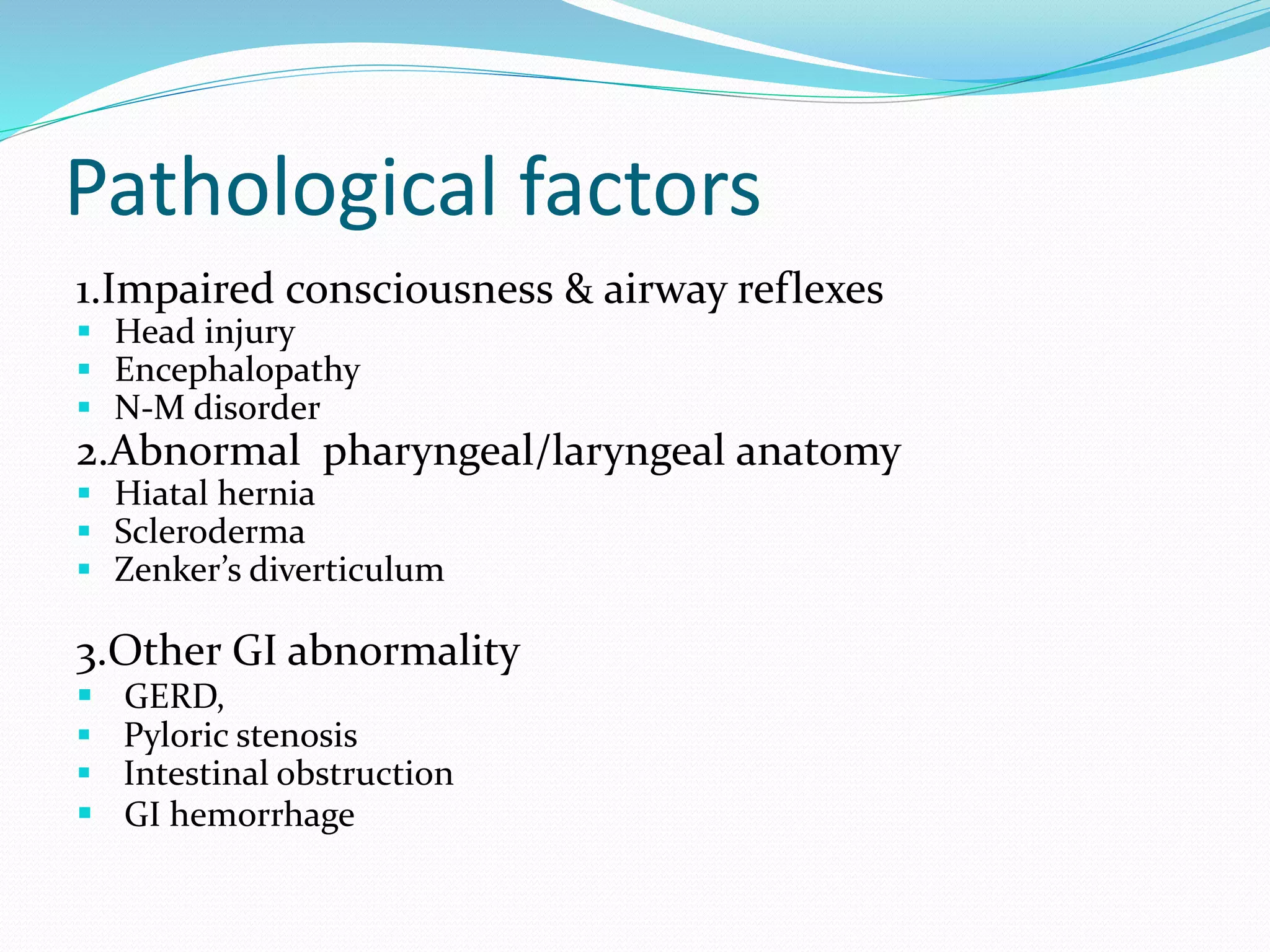
Pathological factors
1.Impaired consciousness & airway reflexes
 Head injury
 Encephalopathy
 N-M disorder
2.Abnormal pharyngeal/laryngeal anatomy
 Hiatal hernia
 Scleroderma
 Zenker’s diverticulum
3.Other GI abnormality
 GERD,
 Pyloric stenosis
 Intestinal obstruction
 GI hemorrhage
4.Motor dysfunction
 Collagen vascular disease
 Myaesthenia gravis
 Muscular dystrophy
 Transient pharyngeal weakness in newborns &
infants
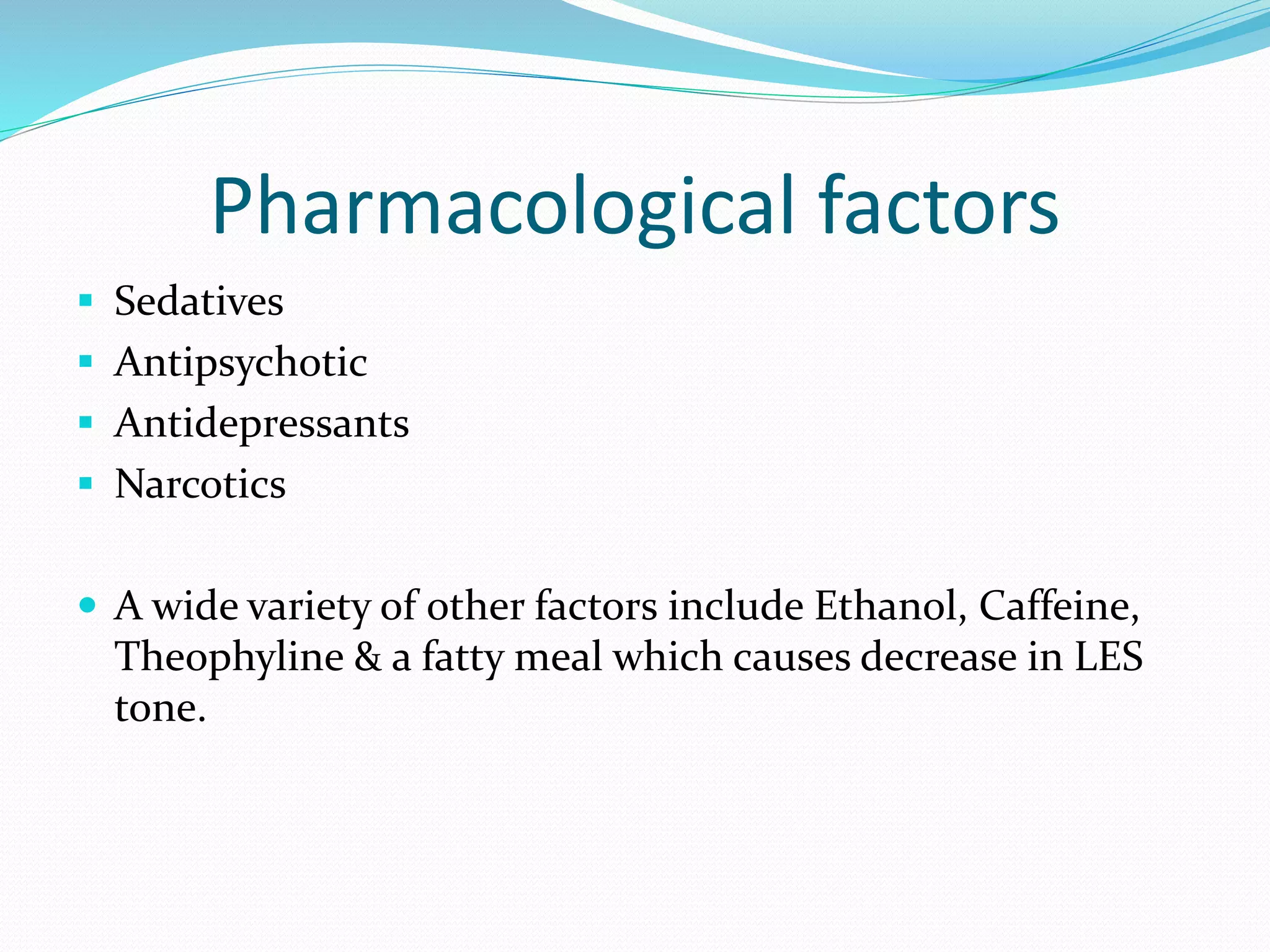
Pharmacological factors
 Sedatives
 Antipsychotic
 Antidepressants
 Narcotics
 A wide variety of other factors include Ethanol, Caffeine,
Theophyline & a fatty meal which causes decrease in LES
tone.
 The effect of Succinylcholine on LES tone is
complex.
Succinylcholine has been shown to lncrease the
intragastric pressure & also to increase LES tone,
thereby preventing the trans-sphincteric gradient
Miscellaneous factors
1.Difficult intubation/Multiple intubation attempts
2.Nasogastric feeding
3.Positive pressure ventilation via face mask in periop
period which increases stimulus for vomiting
PREVENTION OF ASPIRATION
Avoidance of oral fluids
AGE SOLID
FOOD
LIQUID
FOOD
0 – 6 MONTHS 4 HRS 2 HRS
6 – 36 MONTHS 6 HRS 3 HRS
> 36 MONTHS 8 HRS 3 HRS
 Prolonged fasting >8hrs before elective surgery should be
avoided because it may land up the patient in high risk
criteria due to dehydration ,anxiety ,unpleasant
hunger/thirst & increased gastric secretion
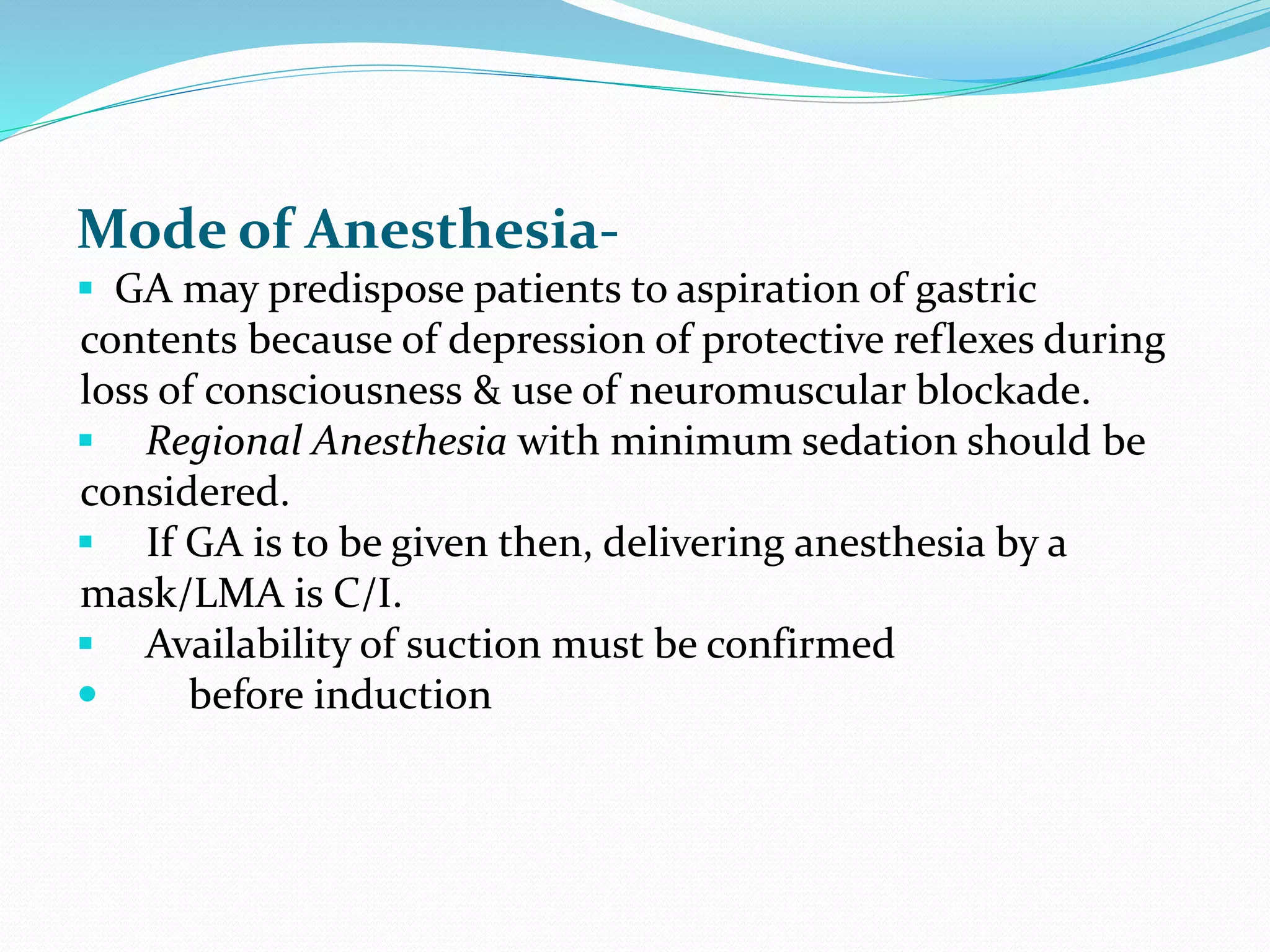
Mode of Anesthesia-
 GA may predispose patients to aspiration of gastric
contents because of depression of protective reflexes during
loss of consciousness & use of neuromuscular blockade.
 Regional Anesthesia with minimum sedation should be
considered.
 If GA is to be given then, delivering anesthesia by a
mask/LMA is C/I.
 Availability of suction must be confirmed
 before induction
 Awake intubation :- orally or nasally.
 Use of high volume – low pressure cuffed endotracheal
tubes.
 Nasogastric suction through Ryles tube to decompress
the stomach.
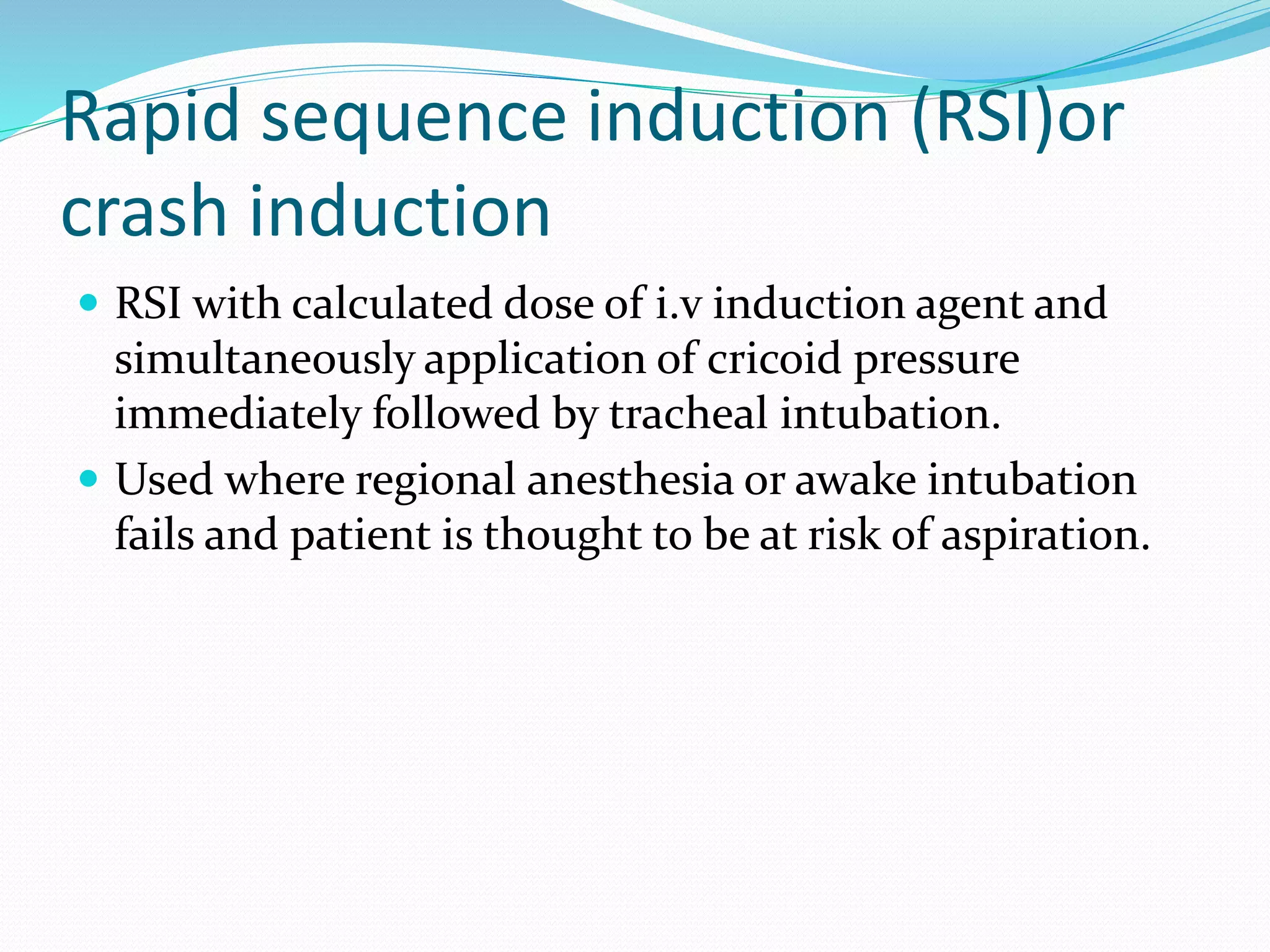
Rapid sequence induction (RSI)or
crash induction
 RSI with calculated dose of i.v induction agent and
simultaneously application of cricoid pressure
immediately followed by tracheal intubation.
 Used where regional anesthesia or awake intubation
fails and patient is thought to be at risk of aspiration.
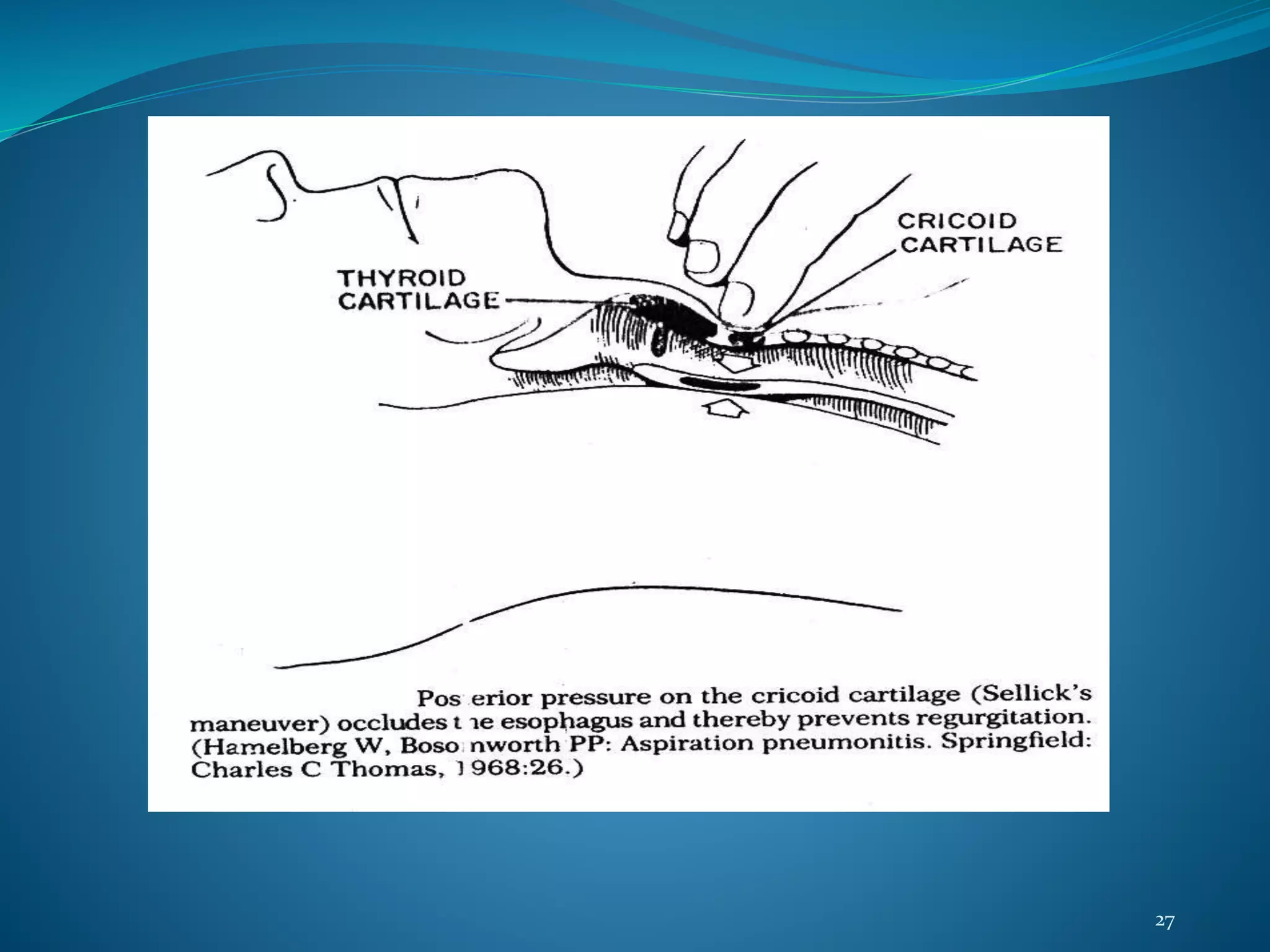
Sellicks maneuver
 An assistant exerts firm pressure on cricoid cartilage as
soon as patient loses consciousness.
 Esophageal lumen is completely collapsed at 100cm of
H2o(intragastric pressure genetrated from
fasciculation of succinylcholine is usually<50 cm of
H2o.
27
 If intubation is difficult, cricoid pressure is maintained
and patient is ventilated with o2 until another
intubation is attempted.
 If intubation is unsuccessful, spontaneous respiration
is allowed to return and awake intubation is done.
 Extubation is accomplished when pharyngeal reflexes
are once again active with a large tipped suction device
at hand and the patient in the lateral decubitus
position.
 Stomach should be decompressed with a large bore
nasogastric tube before extubation.
CHEMOPROPHYLAXIS
1. Anta acids ( Non –particulate):
 Neutralize gastric acidity but increase the gastric
volume.
 Immediately effective and useful in emergency
situation when patient has eaten.
 15-30ml of 0.3M sdium citrate should be given within
60 min of anesthetic induction and may be repeated
intra-operatively.
 Should be avoided in non obstetric patients with H/O
GERD and receiving narcotics pre-operatively.
 Efficacy may be improved by turning the patient to
promote mixing.
 Major concerns : -Increased gastric volume
-Inadequate mixing with gastric
contents
-Possible nausea and vomiting.
 ) Prokinetic Agent (METOCLOPROMIDE)
 (Dopamine Antagonist)
shortens gastric emptying time.
increases LES tone.
have anti-emetic action.
Does NOT affect gastric pH.
o Metoclopromide , 10 – 20 mg IV over 3 -5 min is
administered 15 – 30 min prior to induction.
 -More rapid IV administration may produce
abdominal cramping.
 NOT given to patients with a suspected/known
mechanical obstruction to gastric emptying.
 C) H 2 Receptor Blockers –
 ( RANITIDINE, CIMITIDINE, FAMOTIDINE,
 NIZATIDINE )
 decrease gastric acid secretion & inhibit
 further acid production.
 decrease gastric pH & vol.
 NO EFFECT on gastric contents present already in
stomach.
o should be given at least 60 – 90 min prior to induction
for maximal effect.
 Combination of METOCLOPRAMIDE and RANITIDINE
is very effective in reducing gastric acidity & volume
D) Proton Pump Inhibitors –
( OMEPRAZOLE, ESMOPRAZOLE,
LANSOPRAZOLE,
PANTOPRAZOLE, RABEPRAZOLE )
 Exact role is not clear
 increases gastric fluid pH.
 decreases gastric fluid volume.
o Pantoprazole , 40 mg IV ,given 1 hr before
induction
E) Selective 5-HT Receptor Antagonist-
( ONDANSETRON )
 markedly decreases incidence of PONV.
 NO known effect on gastric pH or volume.
F) Anti-Cholinergic Drugs-
(GLYCOPYRROLATE )
 in large doses it decreases gastric secretion, but, LES
tone is also reduced.
 Overall Anticholinergic drugs do NOT reliably reduce
the risk of aspiration.
TREATEMENT
Despite all precautions and prevention aspiration may still
occur.
Success of treatment depends on prompt recognition of
aspiration & immediate vigorous measures taken.
1.Positioning-
Put patient in Trendelenberg’s position with head to the
side to prevent further aspiration.
37
Position of trachea with changes
in position in unconscious patient
2.Airway Management
Clear the airway as soon as possible.
3.Improve Oxygenation
By supplementing 100% oxygen.
4.Pulmonary Lavage
 Via bronchoscopy can be performed to loosen
impacted particulate matter/ secretions obstructing
the airway.
DISAVANTAGE- it may increase pulmonary damage
due to spread of aspirate.
5.Mechanical ventilatory support
 CPAP / PEEP.
6. Corticosteroids
7. Antibiotics
8. Adequate hydration should be maintained.
Aspiration prophylaxis in full stomach

Aspiration prophylaxis in full stomach

  • 1.
  • 2.
    ASPIRATION  Is themisdirection of oropharyngeal or gastric contents into larynx and lower respiratory tract.
  • 3.
    GASTRIC SECRETION 1500 ml/day Oxynticglands (oxyntic cells) secrete HCl Pyloric glands (chief cells) secrete pepsinogen Basal rate (empty stomach): 10% of maximal rate Diurnal variation: • Lowest in morning • Highest in evening
  • 4.
    LOWER ESOPHAGEAL SPHINCTER LES is characterized anatomically and manometrically as a 3 cm zone of specialized muscle that maintains tonic activity  End expiratory pressure in sphincter 8-20 mmHg above end expiratory gastric pressure  Chronic contraction in circular muscle fiber  Wrapping of esophagus by crus of diaphragm at hiatus  Length of esophagus exposed to intra abdominal pressure  A valve like effect of obliquity of esophago-gastric angle  A plug like action of mucosal folds at the esophago- gastric junction
  • 5.
  • 6.
    How does itoccur  Aspiration can occur when there is problem, with the process that co-ordinates swallowing and breathing.  CNS disorders ( stroke, multiple sclerosis etc ).  Seizures  Following head trauma  Drug overdose
  • 7.
     Surgery (esophageal, upper abdominal, laproscopic etc.)  Laughing or inhaling with food or fluid in mouth.  Any defect in some part of throat or vocal cord anatomy.
  • 8.
     Severity ofinjury depends on presence of particulate matter, volume and pH of aspirate.  Traditionally patients with gastric volume >0.4 ml/kg (25 ml in adult) and with pH<2.5 are at risk of aspiration pneumonitis.
  • 9.
    PATHOPHYSIOLOGY  Aspiration ofgastric contents leads to intense parenchymal inflammatory reaction.  There is biphasic pattern of lung injury in aspiration.  First phase : peaks at 1-2 hrs after aspiration .Direct caustic effect of the low pH on alveolar capillary lining cells.
  • 10.
     Second phase: peaks at 4-6 hours.  Associated with infiltration of neutrophil into alveoli and lung interstitium with histological picture of acute inflammation.
  • 11.
    TYPES OF INJURY ASPIRATION PNEUMONITIS  described by CURTIS LESTER MENDELSON in 1946,also known as MENDELSON SYNDROME.  it is non infectious chemical injury of lungs from aspiration of contents.  increased acidity (pH <2.5) & increased volume (>25ml or 0.4ml/kg) increases the risk.  food particles independent of pH can also cause chemical injury.
  • 12.
    ASPIRATION PNEUMONIA  Itis a parenchymal inflammatory reaction to an infectious agent (mostly gr –ve) caused by aspiration of oropharyngeal secretions characterised by an infilterate on chest radiograph.
  • 13.
    SIGNS AND SYMPTOMS Gastric contents in oropharynx.  Wheezing  Coughing  Shortness of breath  Cyanosis  Tachypnea  Tachycardia  Bronchospasm
  • 14.
    Radiological findings:-  Diffuse, patchy pulmonary infiltrates.  Irregular,mottled densities.  Fluffiness White-out lung.
  • 15.
    RISK FACTORS  Physiological Pathological  Pharmacological Physiological Factors- 1.Pregnancy  Pregnant patients are particularly at risk for aspiration of gastric contents for a variety of reasons including- a) Mechanical factors gravid uterus-increases intra abdominal & intra gastric pressure. b)Hormonal factors increased gastrin level- increases gastric vol. & acidity. increased progesterone- decreases LES tone. decreased motilin level- decreases GI sphincter tone & delay gastric emptying.
  • 16.
    c) Iatrogenic factors- sedative& narcotic administration during labour prolong gastric emptying & also may depress protective airway reflexes. moreover, lithotomy position increases the intra- gastric pressure. 2.Elderly patients  decreased gastric motility 3.Pediatric patients  increased gastric vol. & acidity
  • 17.
    Pathological factors 1.Impaired consciousness& airway reflexes  Head injury  Encephalopathy  N-M disorder 2.Abnormal pharyngeal/laryngeal anatomy  Hiatal hernia  Scleroderma  Zenker’s diverticulum 3.Other GI abnormality  GERD,  Pyloric stenosis  Intestinal obstruction  GI hemorrhage
  • 18.
    4.Motor dysfunction  Collagenvascular disease  Myaesthenia gravis  Muscular dystrophy  Transient pharyngeal weakness in newborns & infants
  • 19.
    Pharmacological factors  Sedatives Antipsychotic  Antidepressants  Narcotics  A wide variety of other factors include Ethanol, Caffeine, Theophyline & a fatty meal which causes decrease in LES tone.
  • 20.
     The effectof Succinylcholine on LES tone is complex. Succinylcholine has been shown to lncrease the intragastric pressure & also to increase LES tone, thereby preventing the trans-sphincteric gradient
  • 21.
    Miscellaneous factors 1.Difficult intubation/Multipleintubation attempts 2.Nasogastric feeding 3.Positive pressure ventilation via face mask in periop period which increases stimulus for vomiting
  • 22.
    PREVENTION OF ASPIRATION Avoidanceof oral fluids AGE SOLID FOOD LIQUID FOOD 0 – 6 MONTHS 4 HRS 2 HRS 6 – 36 MONTHS 6 HRS 3 HRS > 36 MONTHS 8 HRS 3 HRS  Prolonged fasting >8hrs before elective surgery should be avoided because it may land up the patient in high risk criteria due to dehydration ,anxiety ,unpleasant hunger/thirst & increased gastric secretion
  • 23.
    Mode of Anesthesia- GA may predispose patients to aspiration of gastric contents because of depression of protective reflexes during loss of consciousness & use of neuromuscular blockade.  Regional Anesthesia with minimum sedation should be considered.  If GA is to be given then, delivering anesthesia by a mask/LMA is C/I.  Availability of suction must be confirmed  before induction
  • 24.
     Awake intubation:- orally or nasally.  Use of high volume – low pressure cuffed endotracheal tubes.  Nasogastric suction through Ryles tube to decompress the stomach.
  • 25.
    Rapid sequence induction(RSI)or crash induction  RSI with calculated dose of i.v induction agent and simultaneously application of cricoid pressure immediately followed by tracheal intubation.  Used where regional anesthesia or awake intubation fails and patient is thought to be at risk of aspiration.
  • 26.
    Sellicks maneuver  Anassistant exerts firm pressure on cricoid cartilage as soon as patient loses consciousness.  Esophageal lumen is completely collapsed at 100cm of H2o(intragastric pressure genetrated from fasciculation of succinylcholine is usually<50 cm of H2o.
  • 27.
  • 28.
     If intubationis difficult, cricoid pressure is maintained and patient is ventilated with o2 until another intubation is attempted.  If intubation is unsuccessful, spontaneous respiration is allowed to return and awake intubation is done.
  • 29.
     Extubation isaccomplished when pharyngeal reflexes are once again active with a large tipped suction device at hand and the patient in the lateral decubitus position.  Stomach should be decompressed with a large bore nasogastric tube before extubation.
  • 30.
    CHEMOPROPHYLAXIS 1. Anta acids( Non –particulate):  Neutralize gastric acidity but increase the gastric volume.  Immediately effective and useful in emergency situation when patient has eaten.  15-30ml of 0.3M sdium citrate should be given within 60 min of anesthetic induction and may be repeated intra-operatively.
  • 31.
     Should beavoided in non obstetric patients with H/O GERD and receiving narcotics pre-operatively.  Efficacy may be improved by turning the patient to promote mixing.  Major concerns : -Increased gastric volume -Inadequate mixing with gastric contents -Possible nausea and vomiting.
  • 32.
     ) ProkineticAgent (METOCLOPROMIDE)  (Dopamine Antagonist) shortens gastric emptying time. increases LES tone. have anti-emetic action. Does NOT affect gastric pH. o Metoclopromide , 10 – 20 mg IV over 3 -5 min is administered 15 – 30 min prior to induction.  -More rapid IV administration may produce abdominal cramping.  NOT given to patients with a suspected/known mechanical obstruction to gastric emptying.
  • 33.
     C) H2 Receptor Blockers –  ( RANITIDINE, CIMITIDINE, FAMOTIDINE,  NIZATIDINE )  decrease gastric acid secretion & inhibit  further acid production.  decrease gastric pH & vol.  NO EFFECT on gastric contents present already in stomach. o should be given at least 60 – 90 min prior to induction for maximal effect.  Combination of METOCLOPRAMIDE and RANITIDINE is very effective in reducing gastric acidity & volume
  • 34.
    D) Proton PumpInhibitors – ( OMEPRAZOLE, ESMOPRAZOLE, LANSOPRAZOLE, PANTOPRAZOLE, RABEPRAZOLE )  Exact role is not clear  increases gastric fluid pH.  decreases gastric fluid volume. o Pantoprazole , 40 mg IV ,given 1 hr before induction
  • 35.
    E) Selective 5-HTReceptor Antagonist- ( ONDANSETRON )  markedly decreases incidence of PONV.  NO known effect on gastric pH or volume. F) Anti-Cholinergic Drugs- (GLYCOPYRROLATE )  in large doses it decreases gastric secretion, but, LES tone is also reduced.  Overall Anticholinergic drugs do NOT reliably reduce the risk of aspiration.
  • 36.
    TREATEMENT Despite all precautionsand prevention aspiration may still occur. Success of treatment depends on prompt recognition of aspiration & immediate vigorous measures taken. 1.Positioning- Put patient in Trendelenberg’s position with head to the side to prevent further aspiration.
  • 37.
    37 Position of tracheawith changes in position in unconscious patient
  • 38.
    2.Airway Management Clear theairway as soon as possible. 3.Improve Oxygenation By supplementing 100% oxygen. 4.Pulmonary Lavage  Via bronchoscopy can be performed to loosen impacted particulate matter/ secretions obstructing the airway. DISAVANTAGE- it may increase pulmonary damage due to spread of aspirate.
  • 39.
    5.Mechanical ventilatory support CPAP / PEEP. 6. Corticosteroids 7. Antibiotics 8. Adequate hydration should be maintained.