Continuity and
Differentiability of a
function
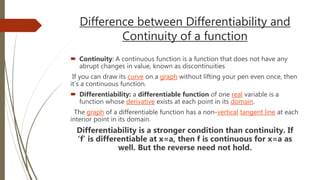
Difference between Differentiability and
Continuity of a function
 Continuity: A continuous function is a function that does not have any
abrupt changes in value, known as discontinuities
If you can draw its curve on a graph without lifting your pen even once, then
it’s a continuous function.
 Differentiability: a differentiable function of one real variable is a
function whose derivative exists at each point in its domain.
The graph of a differentiable function has a non-vertical tangent line at each
interior point in its domain.
Differentiability is a stronger condition than continuity. If
‘f’ is differentiable at x=a, then f is continuous for x=a as
well. But the reverse need not hold.
Various meaning of Differential
coefficient of a function
 Differential coefficient is simply another term for the
derivative of a function.
 The instantaneous change of one quantity relative to another;
df(x)/dx.
 A coefficient is usually a constant quantity, but the differential
coefficient of f is a constant function only if f is a linear
function.
 The derivative function gives the derivative of a function at
each point in the domain of the original function for which
the derivative is defined.
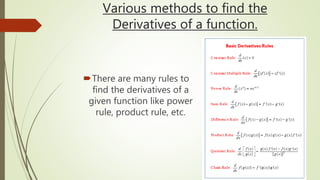
Various methods to find the
Derivatives of a function.
There are many rules to
find the derivatives of a
given function like power
rule, product rule, etc.
Rolle’s Theorem
 Rolle’s theorem states that if a
function f is continuous on the
closed interval [a, b] and
differentiable on the open
interval (a, b) such that f(a)
= f(b), then f′(x) = 0 for
some x with a ≤ x ≤ b.
 Geometrical Meaning: If a
continuous curve passes through
the same y-value (such as the x-
axis) twice and has a unique
tangent line (derivative) at every
point of the interval, then
somewhere between the
endpoints it has a tangent
parallel to the x-axis.
Mean Value Theorem
 Suppose f(x) is a function that
satisfies both of the following.
* f(x) is continuous on the
closed interval [a,b][a,b].
* f(x) is differentiable on the
open interval (a,b)(a,b).
Then there is a number ’c’ such
that a < c < b and
f′(c)=f(b)−f(a)b−af′(c)=f(b)−f(a)b−
aOr, f(b)−f(a)=f′(c)(b−a)
What the Mean Value Theorem tells us
is that these two slopes must be equal
or in other words the secant line
connecting AA and BB and the tangent
line at x=cx=c must be parallel. We can
see this in the following sketch.
Application of Derivatives in
Real Life
 To calculate the profit and loss in business using graphs.
 To check the temperature variation.
 To determine the speed or distance covered such as miles
per hour, kilometer per hour etc.
 Derivatives are used to derive many equations in Physics.
 In the study of Seismology like to find the range of
magnitudes of the earthquake.
Application of
Derivatives
Increasing and decreasing function
 The derivative of a function may be used to determine whether the function is increasing
or decreasing on any intervals in its domain.
 If f′(x) > 0 at each point in an interval I, then the function is said to be increasing on I.
 If f′(x) < 0 at each point in an interval I, then the function is said to be decreasing on I.
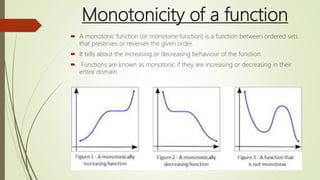
Monotonicity of a function
 A monotonic function (or monotone function) is a function between ordered sets
that preserves or reverses the given order.
 It tells about the increasing or decreasing behaviour of the function.
 Functions are known as monotonic if they are increasing or decreasing in their
entire domain.
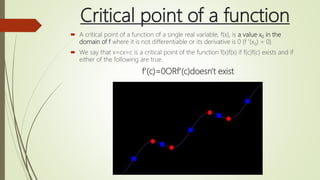
Critical point of a function
 A critical point of a function of a single real variable, f(x), is a value x0 in the
domain of f where it is not differentiable or its derivative is 0 (f ′(x0) = 0).
 We say that x=cx=c is a critical point of the function f(x)f(x) if f(c)f(c) exists and if
either of the following are true.
f′(c)=0ORf′(c)doesn't exist
Tangent and normal with
point of inflexion
 Consider a function y=f(x), which is continuous at a point x0. The
function f(x) can have a finite or infinite derivative f′(x0) at this point. If,
when passing through x0, the function changes the direction of convexity,
i.e. there exists a number n>0 such that the function is convex upward on
one of the intervals (x0−n ,x0) or (x0, x0+n), and is convex downward on
the other, then x0 is called a point of inflection of the function y=f(x).
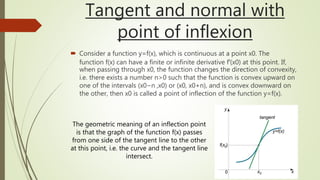
The geometric meaning of an inflection point
is that the graph of the function f(x) passes
from one side of the tangent line to the other
at this point, i.e. the curve and the tangent line
intersect.
Maxima and Minima
the maxima and minima of a function, known
collectively as extrema, are the largest and smallest
value of the function, either within a given range, or on
the entire domain.
Its applications exist in economics, business, and
engineering. Many can be solved using the methods
of differential calculus described above. For example,
in any manufacturing business it is usually possible to
express profit as a function of the number of units
sold.
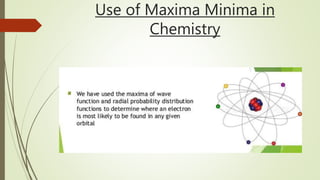
Use of Maxima Minima in
Chemistry
Thank
You!

Golden Rule PPT

  • 1.
  • 2.
    Difference between Differentiabilityand Continuity of a function  Continuity: A continuous function is a function that does not have any abrupt changes in value, known as discontinuities If you can draw its curve on a graph without lifting your pen even once, then it’s a continuous function.  Differentiability: a differentiable function of one real variable is a function whose derivative exists at each point in its domain. The graph of a differentiable function has a non-vertical tangent line at each interior point in its domain. Differentiability is a stronger condition than continuity. If ‘f’ is differentiable at x=a, then f is continuous for x=a as well. But the reverse need not hold.
  • 3.
    Various meaning ofDifferential coefficient of a function  Differential coefficient is simply another term for the derivative of a function.  The instantaneous change of one quantity relative to another; df(x)/dx.  A coefficient is usually a constant quantity, but the differential coefficient of f is a constant function only if f is a linear function.  The derivative function gives the derivative of a function at each point in the domain of the original function for which the derivative is defined.
  • 4.
    Various methods tofind the Derivatives of a function. There are many rules to find the derivatives of a given function like power rule, product rule, etc.
  • 5.
    Rolle’s Theorem  Rolle’stheorem states that if a function f is continuous on the closed interval [a, b] and differentiable on the open interval (a, b) such that f(a) = f(b), then f′(x) = 0 for some x with a ≤ x ≤ b.  Geometrical Meaning: If a continuous curve passes through the same y-value (such as the x- axis) twice and has a unique tangent line (derivative) at every point of the interval, then somewhere between the endpoints it has a tangent parallel to the x-axis.
  • 6.
    Mean Value Theorem Suppose f(x) is a function that satisfies both of the following. * f(x) is continuous on the closed interval [a,b][a,b]. * f(x) is differentiable on the open interval (a,b)(a,b). Then there is a number ’c’ such that a < c < b and f′(c)=f(b)−f(a)b−af′(c)=f(b)−f(a)b− aOr, f(b)−f(a)=f′(c)(b−a) What the Mean Value Theorem tells us is that these two slopes must be equal or in other words the secant line connecting AA and BB and the tangent line at x=cx=c must be parallel. We can see this in the following sketch.
  • 7.
    Application of Derivativesin Real Life  To calculate the profit and loss in business using graphs.  To check the temperature variation.  To determine the speed or distance covered such as miles per hour, kilometer per hour etc.  Derivatives are used to derive many equations in Physics.  In the study of Seismology like to find the range of magnitudes of the earthquake.
  • 8.
  • 9.
    Increasing and decreasingfunction  The derivative of a function may be used to determine whether the function is increasing or decreasing on any intervals in its domain.  If f′(x) > 0 at each point in an interval I, then the function is said to be increasing on I.  If f′(x) < 0 at each point in an interval I, then the function is said to be decreasing on I.
  • 10.
    Monotonicity of afunction  A monotonic function (or monotone function) is a function between ordered sets that preserves or reverses the given order.  It tells about the increasing or decreasing behaviour of the function.  Functions are known as monotonic if they are increasing or decreasing in their entire domain.
  • 11.
    Critical point ofa function  A critical point of a function of a single real variable, f(x), is a value x0 in the domain of f where it is not differentiable or its derivative is 0 (f ′(x0) = 0).  We say that x=cx=c is a critical point of the function f(x)f(x) if f(c)f(c) exists and if either of the following are true. f′(c)=0ORf′(c)doesn't exist
  • 12.
    Tangent and normalwith point of inflexion  Consider a function y=f(x), which is continuous at a point x0. The function f(x) can have a finite or infinite derivative f′(x0) at this point. If, when passing through x0, the function changes the direction of convexity, i.e. there exists a number n>0 such that the function is convex upward on one of the intervals (x0−n ,x0) or (x0, x0+n), and is convex downward on the other, then x0 is called a point of inflection of the function y=f(x). The geometric meaning of an inflection point is that the graph of the function f(x) passes from one side of the tangent line to the other at this point, i.e. the curve and the tangent line intersect.
  • 13.
    Maxima and Minima themaxima and minima of a function, known collectively as extrema, are the largest and smallest value of the function, either within a given range, or on the entire domain. Its applications exist in economics, business, and engineering. Many can be solved using the methods of differential calculus described above. For example, in any manufacturing business it is usually possible to express profit as a function of the number of units sold.
  • 14.
    Use of MaximaMinima in Chemistry
  • 15.