Section 5.1
   Increasing and Decreasing Functions
Objectives
Upon completion of this lesson, you should be
 able to:

  • find where functions are increasing or
    decreasing
Increasing/Decreasing
               Functions
So far, we have only been able to determine if a
function is increasing or decreasing by plotting
points to graph the function.

Now that we know how to find the derivative of a
function, we will learn how the derivative can be
used to determine the intervals where a function is
increasing or decreasing.
Increasing/Decreasing
               Functions
Remember, the derivative of a function represents
the slope of the tangent line at a particular point on
the graph.
So, if the derivative is positive on an open interval
(a, b), then the slope of the tangent line is positive,
which means the function is increasing on the
interval (a, b).
So, if the derivative is negative on an open interval
(a, b), then the slope of the tangent line is negative,
which means the function is decreasing on the
interval (a, b).
Increasing/Decreasing
                Functions
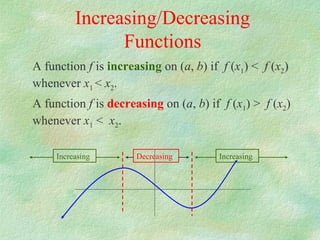
A function f is increasing on (a, b) if f (x1) < f (x2)
whenever x1 < x2.
A function f is decreasing on (a, b) if f (x1) > f (x2)
whenever x1 < x2.

     Increasing       Decreasing        Increasing
Increasing/Decreasing/Constant
           Functions
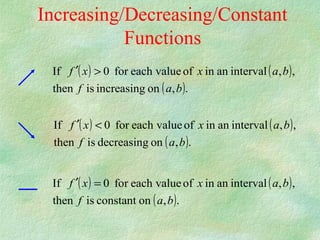
 If f ′( x ) > 0 for each value of x in an interval ( a, b ) ,
 then f is increasing on ( a, b ).


 If f ′( x ) < 0 for each value of x in an interval ( a, b ) ,
 then f is decreasing on ( a, b ).


 If f ′( x ) = 0 for each value of x in an interval ( a, b ) ,
 then f is constant on ( a, b ).
Example
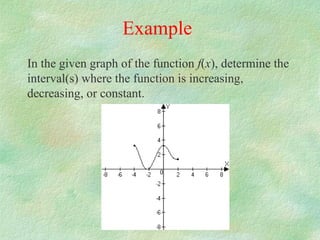
In the given graph of the function f(x), determine the
interval(s) where the function is increasing,
decreasing, or constant.
Example
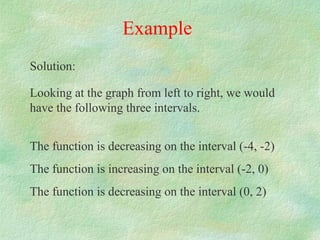
Solution:

Looking at the graph from left to right, we would
have the following three intervals.


The function is decreasing on the interval (-4, -2)
The function is increasing on the interval (-2, 0)
The function is decreasing on the interval (0, 2)
Critical Numbers
In order to find the intervals where a function is
increasing, decreasing, or constant without first
graph the function, we must find what are called
critical numbers.

The critical numbers are those contained in the
domain of f(x) and which make the first derivative
equal to zero or undefined.
Critical Points of f
A critical point of a function f is a point in the
domain of f where
         f ′( x) = 0 or f ′( x) does not exist.
    (horizontal tangent lines, vertical tangent lines
    and sharp corners)
Increasing/Decreasing
                   Functions
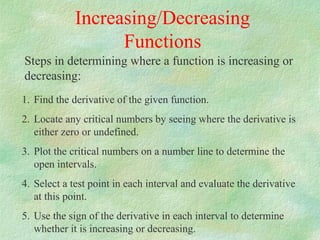
Steps in determining where a function is increasing or
decreasing:
1. Find the derivative of the given function.
2. Locate any critical numbers by seeing where the derivative is
   either zero or undefined.
3. Plot the critical numbers on a number line to determine the
   open intervals.
4. Select a test point in each interval and evaluate the derivative
   at this point.
5. Use the sign of the derivative in each interval to determine
   whether it is increasing or decreasing.
Example
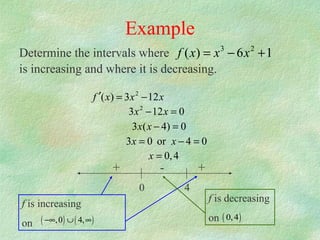
Determine the intervals where f ( x) = x 3 − 6 x 2 + 1
is increasing and where it is decreasing.

                      f ′( x) = 3x 2 − 12 x
                                 3x 2 − 12 x = 0
                                  3 x ( x − 4) = 0
                                3x = 0 or x − 4 = 0
                                        x = 0, 4
                           +           -         +
                                 0           4
                                                      f is decreasing
f is increasing
                                                      on ( 0, 4 )
on ( −∞, 0 ) ∪ ( 4, ∞ )

MS2 Max and Min Points

  • 1.
    Section 5.1 Increasing and Decreasing Functions
  • 2.
    Objectives Upon completion ofthis lesson, you should be able to: • find where functions are increasing or decreasing
  • 3.
    Increasing/Decreasing Functions So far, we have only been able to determine if a function is increasing or decreasing by plotting points to graph the function. Now that we know how to find the derivative of a function, we will learn how the derivative can be used to determine the intervals where a function is increasing or decreasing.
  • 4.
    Increasing/Decreasing Functions Remember, the derivative of a function represents the slope of the tangent line at a particular point on the graph. So, if the derivative is positive on an open interval (a, b), then the slope of the tangent line is positive, which means the function is increasing on the interval (a, b). So, if the derivative is negative on an open interval (a, b), then the slope of the tangent line is negative, which means the function is decreasing on the interval (a, b).
  • 5.
    Increasing/Decreasing Functions A function f is increasing on (a, b) if f (x1) < f (x2) whenever x1 < x2. A function f is decreasing on (a, b) if f (x1) > f (x2) whenever x1 < x2. Increasing Decreasing Increasing
  • 6.
    Increasing/Decreasing/Constant Functions If f ′( x ) > 0 for each value of x in an interval ( a, b ) , then f is increasing on ( a, b ). If f ′( x ) < 0 for each value of x in an interval ( a, b ) , then f is decreasing on ( a, b ). If f ′( x ) = 0 for each value of x in an interval ( a, b ) , then f is constant on ( a, b ).
  • 7.
    Example In the givengraph of the function f(x), determine the interval(s) where the function is increasing, decreasing, or constant.
  • 8.
    Example Solution: Looking at thegraph from left to right, we would have the following three intervals. The function is decreasing on the interval (-4, -2) The function is increasing on the interval (-2, 0) The function is decreasing on the interval (0, 2)
  • 9.
    Critical Numbers In orderto find the intervals where a function is increasing, decreasing, or constant without first graph the function, we must find what are called critical numbers. The critical numbers are those contained in the domain of f(x) and which make the first derivative equal to zero or undefined.
  • 10.
    Critical Points off A critical point of a function f is a point in the domain of f where f ′( x) = 0 or f ′( x) does not exist. (horizontal tangent lines, vertical tangent lines and sharp corners)
  • 11.
    Increasing/Decreasing Functions Steps in determining where a function is increasing or decreasing: 1. Find the derivative of the given function. 2. Locate any critical numbers by seeing where the derivative is either zero or undefined. 3. Plot the critical numbers on a number line to determine the open intervals. 4. Select a test point in each interval and evaluate the derivative at this point. 5. Use the sign of the derivative in each interval to determine whether it is increasing or decreasing.
  • 12.
    Example Determine the intervalswhere f ( x) = x 3 − 6 x 2 + 1 is increasing and where it is decreasing. f ′( x) = 3x 2 − 12 x 3x 2 − 12 x = 0 3 x ( x − 4) = 0 3x = 0 or x − 4 = 0 x = 0, 4 + - + 0 4 f is decreasing f is increasing on ( 0, 4 ) on ( −∞, 0 ) ∪ ( 4, ∞ )