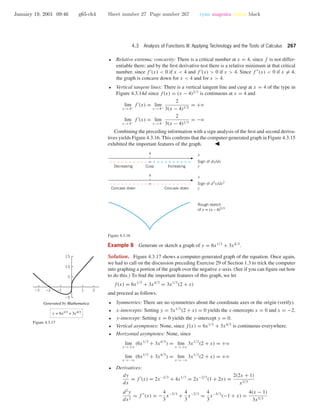
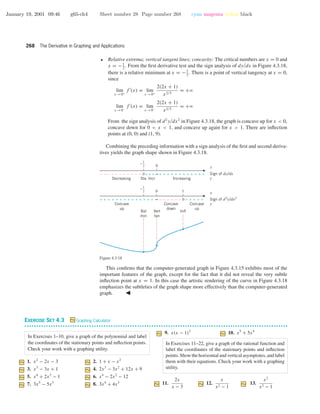
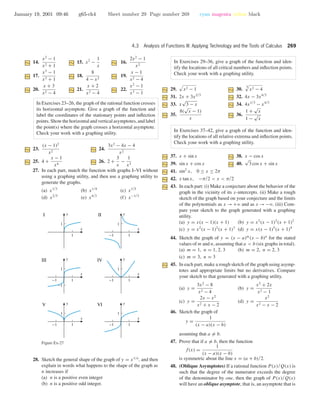
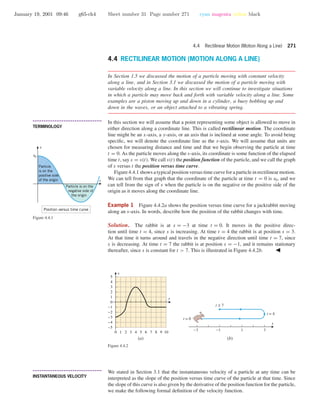
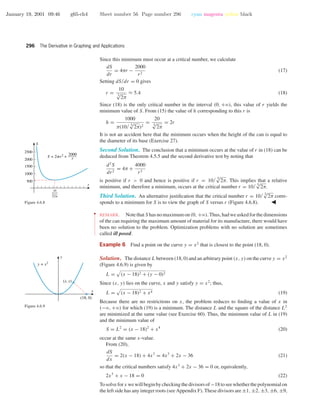
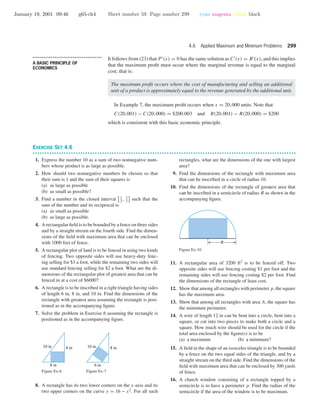
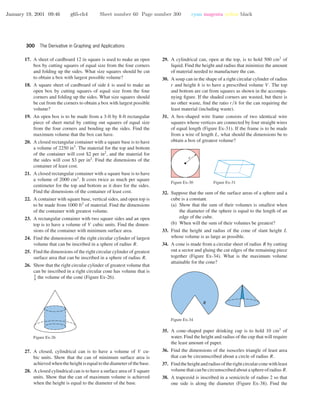
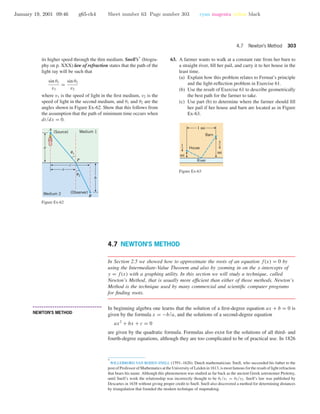
January 19, 2001 09:46 g65-ch4 Sheet number 1 Page number 241 cyan magenta yellow black
THE DERIVATIVE
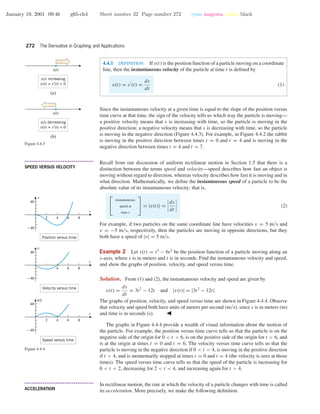
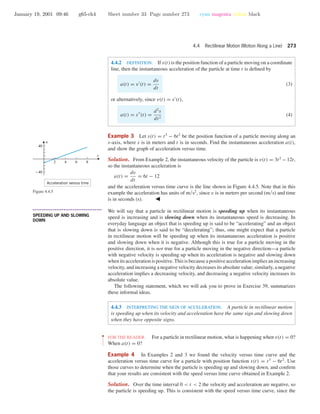
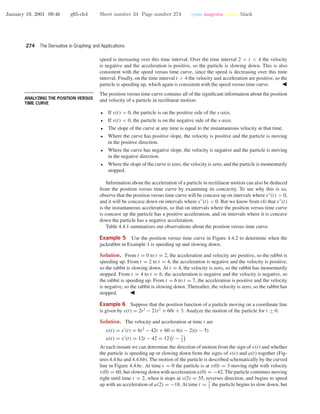
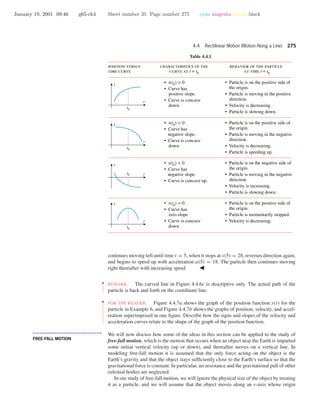
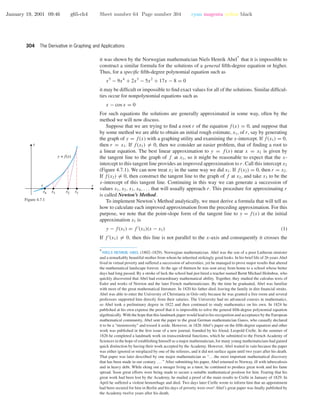
IN GRAPHING AND
APPLICATIONS
n this chapter we will study various applications
of the derivative. For example, we will use methods of
calculus to analyze functions and their graphs. In the pro-
cess, we will show how calculus and graphing utilities,
working together, can provide most of the important in-
formation about the behavior of functions. Another im-
portant application of the derivative will be in the solution
of optimization problems. For example, if time is the main
consideration in a problem, we might be interested in find-
ing the quickest way to perform a task, and if cost is the
main consideration, we might be interested in finding the
leastexpensivewaytoperformatask.Mathematically,op-
timization problems can be reduced to finding the largest
or smallest value of a function on some interval, and de-
termining where the largest or smallest value occurs. Us-
ing the derivative, we will develop the mathematical tools
necessary for solving such problems. We will also use the
derivative to study the motion of a particle moving along
a line, and we will show how the derivative can help us to
approximate solutions of equations.
January 19, 2001 09:46 g65-ch4 Sheet number 2 Page number 242 cyan magenta yellow black
242 The Derivative in Graphing and Applications
4.1 ANALYSIS OF FUNCTIONS I: INCREASE, DECREASE,
AND CONCAVITY
Although graphing utilities are useful for determining the general shape of a graph,
many problems require more precision than graphing utilities are capable of produc-
ing. The purpose of this section is to develop mathematical tools that can be used to
determine the exact shape of a graph and the precise locations of its key features.
• • • • • • • • • • • • • • • • • • • • • • • • • • • • • • • • • • • • • •
INCREASING AND DECREASING
FUNCTIONS
Suppose that a function f is differentiable at x0 and that f (x0) > 0. Since the slope of the
graph of f at the point P(x0, f(x0)) is positive, we would expect that a point Q(x, f(x))
on the graph of f that is just to the left of P would be lower than P, and we would expect
that Q would be higher than P if Q is just to the right of P. Analytically, to see why this
is the case, recall that
f (x0) = lim
x →x0
f(x) − f(x0)
x − x0
(Definition 3.2.1 with x1 replaced by x). Since 0 < f (x0), it follows that
0 <
f(x) − f(x0)
x − x0
for values of x very close to (but not equal to) x0. However, for the difference quotient
f(x) − f(x0)
x − x0
to be positive, its numerator f(x) − f(x0) and its denominator x − x0 must have the same
sign. Therefore, for values of x very close to x0, we must have
f(x) − f(x0) < 0 when x − x0 < 0
and
0 < f(x) − f(x0) when 0 < x − x0
Equivalently, f(x) < f(x0) for values of x just to the left of x0, and f(x0) < f(x) for
values of x just to the right of x0. These inequalities confirm our expectation about the
relative positions of P and Q. Similarly, if f (x0) < 0, then f(x) > f(x0) for values of x
just to the left of x0, and f(x0) > f(x) for values of x just to the right of x0. Geometrically,
this means that our point Q would be higher than P if Q is just to the left of P, and that Q
would be lower than P if Q is just to the right of P .
Our next goal is to relate the sign of the derivative of a function f and the relative positions
of points on the graph of f over an entire interval. The terms increasing, decreasing, and
constant are used to describe the behavior of a function over an interval as we travel left to
right along its graph. For example, the function graphed in Figure 4.1.1 can be described
as increasing on the interval (−ϱ, 0], decreasing on the interval [0, 2], increasing again on
the interval [2, 4], and constant on the interval [4, +ϱ).
xIncreasing Decreasing Increasing Constant
0 2 4
Figure 4.1.1
January 19, 2001 09:46 g65-ch4 Sheet number 3 Page number 243 cyan magenta yellow black
4.1 Analysis of Functions I: Increase, Decrease, and Concavity 243
The following definition, which is illustrated in Figure 4.1.2, expresses these intuitive
ideas precisely.
4.1.1 DEFINITION. Let f be defined on an interval, and let x1 and x2 denote numbers
in that interval.
(a) f is increasing on the interval if f(x1) < f(x2) whenever x1 < x2.
(b) f is decreasing on the interval if f(x1) > f(x2) whenever x1 < x2.
(c) f is constant on the interval if f(x1) = f(x2) for all x1 and x2.
Increasing Decreasing
f(x1)
f(x2) f(x1)
f(x2)
f(x2)f(x1)
f(x1) > f(x2) if x1 < x2f(x1) < f(x2) if x1 < x2 f(x1) = f(x2) for all x1 and x2
Constant
(a) (b) (c)
x1 x2x1 x2x1 x2
Figure 4.1.2
Figure 4.1.3 suggests that a differentiable function f is increasing on any interval where
its graph has positive slope, is decreasing on any interval where its graph has negative slope,
and is constant on any interval where its graph has zero slope. This intuitive observation
suggests the following important theorem that will be proved in Section 4.8.
Graph has
zero slope.
Graph has
negative slope.
Graph has
positive slope.
x x x
y y y
Figure 4.1.3
4.1.2 THEOREM. Let f be a function that is continuous on a closed interval [a, b]
and differentiable on the open interval (a, b).
(a) If f (x) > 0 for every value of x in (a, b), then f is increasing on [a, b].
(b) If f (x) < 0 for every value of x in (a, b), then f is decreasing on [a, b].
(c) If f (x) = 0 for every value of x in (a, b), then f is constant on [a, b].
January 19, 2001 09:46 g65-ch4 Sheet number 4 Page number 244 cyan magenta yellow black
244 The Derivative in Graphing and Applications
••
•
•
•
•
•
•
•
•
•
•
•
•
•
•
•
•
•
•
•
•
•
•
•
•
•
•
•
•
•
•
•
•
REMARK. Observe that in Theorem 4.1.2 it is only necessary to examine the derivative of
f on the open interval (a, b) to determine whether f is increasing, decreasing, or constant
on the closed interval [a, b]. Moreover, although this theorem was stated for a closed interval
[a, b], it is applicable to any interval I on which f is continuous and inside of which f is
differentiable. For example, if f is continuous on [a, +ϱ) and f (x) > 0 for each x in the
interval (a, +ϱ), then f is increasing on [a, +ϱ); and if f (x) < 0 on (−ϱ, +ϱ), then f is
decreasing on (−ϱ, +ϱ) [the continuity on (−ϱ, +ϱ) follows from the differentiability].
Example 1 Find the intervals on which the following functions are increasing and the
intervals on which they are decreasing.
(a) f(x) = x2
− 4x + 3 (b) f(x) = x3
Solution (a). The graph of f in Figure 4.1.4 suggests that f is decreasing for x ≤ 2 and
increasing for x ≥ 2. To confirm this, we differentiate f to obtain
f (x) = 2x − 4 = 2(x − 2)
It follows that
f (x) < 0 if −ϱ < x < 2
f (x) > 0 if 2 < x < +ϱ
Since f is continuous at x = 2, it follows from Theorem 4.1.2 and the subsequent remark
that
f is decreasing on (−ϱ, 2]
f is increasing on [2, +ϱ)
These conclusions are consistent with the graph of f in Figure 4.1.4.
-1 52
-1
7
f(x) = x2
– 4x + 3
x
y
Figure 4.1.4
-3 3
-4
4
f(x) = x3
x
y
Figure 4.1.5
Solution (b). The graph of f in Figure 4.1.5 suggests that f is increasing over the entire
x-axis. To confirm this, we differentiate f to obtain f (x) = 3x2
. Thus,
f (x) > 0 if −ϱ < x < 0
f (x) > 0 if 0 < x < +ϱ
Since f is continuous at x = 0,
f is increasing on (−ϱ, 0]
f is increasing on [0, +ϱ)
Hence f is increasing over the entire interval (−ϱ, +ϱ), which is consistent with the graph
in Figure 4.1.5 (see Exercise 47).
Example 2
(a) Use the graph of f(x) = 3x4
+ 4x3
− 12x2
+ 2 in Figure 4.1.6 to make a conjecture
about the intervals on which f is increasing or decreasing.
(b) Use Theorem 4.1.2 to determine whether your conjecture is correct.-3 3
-30
20
x
y
f(x) = 3x4
+ 4x3
– 12x2
+ 2
Figure 4.1.6
Solution (a). The graph suggests that f is decreasing if x ≤ −2, increasing if −2 ≤ x ≤ 0,
decreasing if 0 ≤ x ≤ 1, and increasing if x ≥ 1.
Solution (b). Differentiating f we obtain
f (x) = 12x3
+ 12x2
− 24x = 12x(x2
+ x − 2) = 12x(x + 2)(x − 1)
The sign analysis of f in Table 4.1.1 can be obtained using the method of test values
discussed in Appendix A. The conclusions in that table confirm the conjecture in part (a).
January 19, 2001 09:46 g65-ch4 Sheet number 5 Page number 245 cyan magenta yellow black
4.1 Analysis of Functions I: Increase, Decrease, and Concavity 245
Table 4.1.1
interval (12x)(x + 2)(x – 1) conclusion
f is decreasing on (–∞, –2]
f is increasing on [–2, 0]
f is decreasing on [0, 1]
f is increasing on [1, +∞)
(–)
(–)
(+)
(+)
(–)
(+)
(+)
(+)
(–)
(–)
(–)
(+)
f ′(x)
–
+
–
+
x < –2
1 < x
0 < x < 1
–2 < x < 0
• • • • • • • • • • • • • • • • • • • • • • • • • • • • • • • • • • • • • •
CONCAVITY
Although the sign of the derivative of f reveals where the graph of f is increasing or
decreasing, it does not reveal the direction of curvature. For example, on both sides of the
point in Figure 4.1.7 the graph is increasing, but on the left side it has an upward curvature
(“holds water”) and on the right side it has a downward curvature (“spills water”). On
intervals where the graph of f has upward curvature we say that f is concave up, and on
intervals where the graph has downward curvature we say that f is concave down.
Concave
up
“holds
water”
Concave
down
“spills
water”
Figure 4.1.7
For differentiable functions, the direction of curvature can be characterized in terms of
the tangent lines in two ways: As suggested by Figure 4.1.8, the graph of a function f
has upward curvature on intervals where the graph lies above its tangent lines, and it has
downward curvature on intervals where it lies below its tangent lines. Alternatively, the
graph has upward curvature on intervals where the tangent lines have increasing slopes and
downward curvature on intervals where they have decreasing slopes. We will use this latter
characterization as our formal definition.
4.1.3 DEFINITION. If f is differentiable on an open interval I, then f is said to be
concave up on I if f is increasing on I, and f is said to be concave down on I if f is
decreasing on I.
To apply this definition we need some way to determine the intervals on which f is
increasing or decreasing. One way to do this is to apply Theorem 4.1.2 (and the remark
that follows it) to the function f . It follows from that theorem and remark that f will be
increasing where its derivative f is positive and will be decreasing where its derivative f
is negative. This is the idea behind the following theorem.
4.1.4 THEOREM. Let f be twice differentiable on an open interval I.
(a) If f (x) > 0 on I, then f is concave up on I.
(b) If f (x) < 0 on I, then f is concave down on I.
x
y
Concave
down
(spills water)
x
y
Concave
up
(holds water)
Figure 4.1.8
Example 3 Find open intervals on which the following functions are concave up and
open intervals on which they are concave down.
(a) f(x) = x2
− 4x + 3 (b) f(x) = x3
(c) f(x) = x3
− 3x2
+ 1
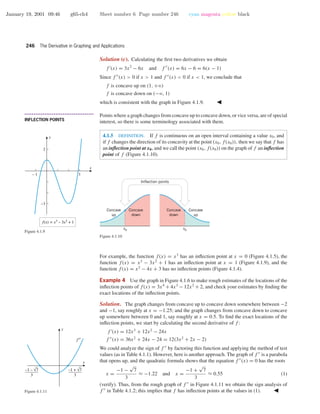
Solution (a). Calculating the first two derivatives we obtain
f (x) = 2x − 4 and f (x) = 2
Since f (x) > 0 for all x, the function f is concave up on (−ϱ, +ϱ). This is consistent
with Figure 4.1.4.
Solution (b). Calculating the first two derivatives we obtain
f (x) = 3x2
and f (x) = 6x
Since f (x) < 0 if x < 0 and f (x) > 0 if x > 0, the function f is concave down on
(−ϱ, 0) and concave up on (0, +ϱ). This is consistent with Figure 4.1.5.
January 19, 2001 09:46 g65-ch4 Sheet number 6 Page number 246 cyan magenta yellow black
246 The Derivative in Graphing and Applications
Solution (c). Calculating the first two derivatives we obtain
f (x) = 3x2
− 6x and f (x) = 6x − 6 = 6(x − 1)
Since f (x) > 0 if x > 1 and f (x) < 0 if x < 1, we conclude that
f is concave up on (1, +ϱ)
f is concave down on (−ϱ, 1)
which is consistent with the graph in Figure 4.1.9.
– 1 3
–3
2
x
y
f(x) = x3
– 3x2
+ 1
Figure 4.1.9
• • • • • • • • • • • • • • • • • • • • • • • • • • • • • • • • • • • • • •
INFLECTION POINTS
Points where a graph changes from concave up to concave down, or vice versa, are of special
interest, so there is some terminology associated with them.
4.1.5 DEFINITION. If f is continuous on an open interval containing a value x0, and
if f changes the direction of its concavity at the point (x0, f(x0)), then we say that f has
an inflection point at x0, and we call the point (x0, f(x0)) on the graph of f an inflection
point of f (Figure 4.1.10).
x0
Concave
down
Concave
up
x0
Concave
up
Concave
down
Inflection points
Figure 4.1.10
For example, the function f(x) = x3
has an inflection point at x = 0 (Figure 4.1.5), the
function f(x) = x3
− 3x2
+ 1 has an inflection point at x = 1 (Figure 4.1.9), and the
function f(x) = x2
− 4x + 3 has no inflection points (Figure 4.1.4).
x
y
3
–1 – √7
3
–1 + √7
f ′′
Figure 4.1.11
Example 4 Use the graph in Figure 4.1.6 to make rough estimates of the locations of the
inflection points of f(x) = 3x4
+ 4x3
− 12x2
+ 2, and check your estimates by finding the
exact locations of the inflection points.
Solution. The graph changes from concave up to concave down somewhere between −2
and −1, say roughly at x = −1.25; and the graph changes from concave down to concave
up somewhere between 0 and 1, say roughly at x = 0.5. To find the exact locations of the
inflection points, we start by calculating the second derivative of f :
f (x) = 12x3
+ 12x2
− 24x
f (x) = 36x2
+ 24x − 24 = 12(3x2
+ 2x − 2)
We could analyze the sign of f by factoring this function and applying the method of test
values (as in Table 4.1.1). However, here is another approach. The graph of f is a parabola
that opens up, and the quadratic formula shows that the equation f (x) = 0 has the roots
x =
−1 −
√
7
3
≈ −1.22 and x =
−1 +
√
7
3
≈ 0.55 (1)
(verify). Thus, from the rough graph of f in Figure 4.1.11 we obtain the sign analysis of
f in Table 4.1.2; this implies that f has inflection points at the values in (1).
January 19, 2001 09:46 g65-ch4 Sheet number 7 Page number 247 cyan magenta yellow black
4.1 Analysis of Functions I: Increase, Decrease, and Concavity 247
Table 4.1.2
interval conclusionsign of f′′
3
–1 – √7
x < f is concave up
f is concave down
f is concave up
+
–
+
3
–1 + √7
3
–1 – √7
< x <
3
–1 + √7
< x
1 2 3 4 5 6
-1
1
x
y
f(x) = sin x, 0 ≤ x ≤ o
Figure 4.1.12
Example 5 Find the inflection points of f(x) = sin x on [0, 2π], and confirm that your
results are consistent with the graph of the function.
Solution. Calculating the first two derivatives of f we obtain
f (x) = cos x, f (x) = − sin x
Thus, f (x) < 0 if 0 < x < π, and f (x) > 0 if π < x < 2π, which implies that the
graph is concave down for 0 < x < π and concave up for π < x < 2π. Thus, there is an
inflection point at x = π ≈ 3.14 (Figure 4.1.12).
••
•
•
•
•
•
•
•
•
•
•
•
•
FOR THE READER. If you have a CAS, devise a method for using it to find exact values
for the inflection points of a function f , and use your method to find the inflection points
of f(x) = x/(x2
+ 1). Verify that your results are consistent with the graph of f .
Intheprecedingexamplestheinflectionpointsoff occurredwheref (x) = 0.However,
inflection points do not always occur where f (x) = 0. Here is a specific example.
Example 6 Find the inflection points, if any, of f(x) = x4
.
Solution. Calculating the first two derivatives of f we obtain
f (x) = 4x3
, f (x) = 12x2
Here f (x) > 0 for x < 0 and for x > 0, which implies that f is concave up for x < 0
and for x > 0 (In fact, f is concave up on (−ϱ, +ϱ.). Thus, there are no inflection points;
and in particular, there is no inflection point at x = 0, even though f (0) = 0 (Figure
4.1.13).
-2 2
4
f(x) = x4
x
y
Figure 4.1.13
••
•
•
•
•
•
•
FOR THE READER. An inflection point may occur at a point of nondifferentiability. Verify
that this is the case for x1/3
at x = 0.
• • • • • • • • • • • • • • • • • • • • • • • • • • • • • • • • • • • • • •
INFLECTION POINTS IN
APPLICATIONS
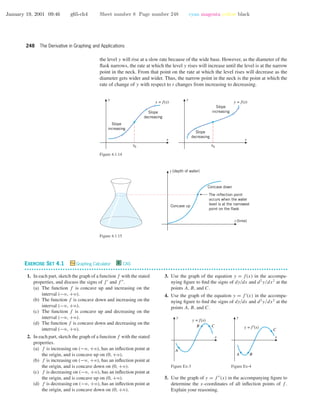
Up to now we have viewed the inflection points of a curve y = f(x) as those points where the
curve changes the direction of its concavity. However, inflection points also mark the points
on the curve where the slopes of the tangent lines change from increasing to decreasing, or
vice versa (Figure 4.1.14); stated another way:
Inflection points mark the places on the curve y = f(x) where the rate of change of y
with respect to x changes from increasing to decreasing, or vice versa.
Note that we are dealing with a rather subtle concept here—a change of a rate of change.
However, the following physical example should help to clarify the idea: Suppose that water
is added to the flask in Figure 4.1.15 in such a way that the volume increases at a constant
rate, and let us examine the rate at which the water level y rises with the time t. Initially,
January 19, 2001 09:46 g65-ch4 Sheet number 8 Page number 248 cyan magenta yellow black
248 The Derivative in Graphing and Applications
the level y will rise at a slow rate because of the wide base. However, as the diameter of the
flask narrows, the rate at which the level y rises will increase until the level is at the narrow
point in the neck. From that point on the rate at which the level rises will decrease as the
diameter gets wider and wider. Thus, the narrow point in the neck is the point at which the
rate of change of y with respect to t changes from increasing to decreasing.
x
y
y = f(x)
Slope
decreasing
Slope
increasing
x
y
y = f(x)
Slope
increasing
Slope
decreasing
x0 x0
Figure 4.1.14
t (time)
y (depth of water)
Concave down
Concave up
The inflection point
occurs when the water
level is at the narrowest
point on the flask
Figure 4.1.15
EXERCISE SET 4.1 Graphing Calculator C CAS
• • • • • • • • • • • • • • • • • • • • • • • • • • • • • • • • • • • • • • • • • • • • • • • • • • • • • • • • • • • • • • • • • • • • • • • • • • • • • • • • • • • • • • • • • • • • • • • • • • • • • • • • • • • • • •
1. In each part, sketch the graph of a function f with the stated
properties, and discuss the signs of f and f .
(a) The function f is concave up and increasing on the
interval (−ϱ, +ϱ).
(b) The function f is concave down and increasing on the
interval (−ϱ, +ϱ).
(c) The function f is concave up and decreasing on the
interval (−ϱ, +ϱ).
(d) The function f is concave down and decreasing on the
interval (−ϱ, +ϱ).
2. In each part, sketch the graph of a function f with the stated
properties.
(a) f is increasing on (−ϱ, +ϱ), has an inflection point at
the origin, and is concave up on (0, +ϱ).
(b) f is increasing on (−ϱ, +ϱ), has an inflection point at
the origin, and is concave down on (0, +ϱ).
(c) f is decreasing on (−ϱ, +ϱ), has an inflection point at
the origin, and is concave up on (0, +ϱ).
(d) f is decreasing on (−ϱ, +ϱ), has an inflection point at
the origin, and is concave down on (0, +ϱ).
3. Use the graph of the equation y = f(x) in the accompa-
nying figure to find the signs of dy/dx and d2
y/dx2
at the
points A, B, and C.
4. Use the graph of the equation y = f (x) in the accompa-
nying figure to find the signs of dy/dx and d2
y/dx2
at the
points A, B, and C.
x
y
A
B C
y = f(x)
Figure Ex-3
x
y
A B
C
y = f′(x)
Figure Ex-4
5. Use the graph of y = f (x) in the accompanying figure to
determine the x-coordinates of all inflection points of f .
Explain your reasoning.
January 19, 2001 09:46 g65-ch4 Sheet number 9 Page number 249 cyan magenta yellow black
4.1 Analysis of Functions I: Increase, Decrease, and Concavity 249
6. Use the graph of y = f (x) in the accompanying figure to
replace the question mark with <, =, or >, as appropriate.
Explain your reasoning.
(a) f(0) ? f(1) (b) f(1) ? f(2) (c) f (0) ? 0
(d) f (1) ? 0 (e) f (0) ? 0 (f) f (2) ? 0
-2 3
x
y
y = f′′(x)
Figure Ex-5
21
x
y
y = f′(x)
Figure Ex-6
7. In each part, use the graph of y = f(x) in the accompanying
figure to find the requested information.
(a) Find the intervals on which f is increasing.
(b) Find the intervals on which f is decreasing.
(c) Find the open intervals on which f is concave up.
(d) Find the open intervals on which f is concave down.
(e) Find all values of x at which f has an inflection point.
2
3 4
5 6 71
x
y
y = f(x)
Figure Ex-7
8. Use the graph in Exercise 7 to make a table that shows the
signs of f and f over the intervals (1, 2), (2, 3), (3, 4),
(4, 5), (5, 6), and (6, 7).
In Exercises 9 and 10, a sign chart is presented for the first
and second derivatives of a function f . Assuming that f is
continuous everywhere, find: (a) the intervals on which f is
increasing, (b) the intervals on which f is decreasing, (c) the
open intervals on which f is concave up, (d) the open inter-
vals on which f is concave down, and (e) the x-coordinates
of all inflection points.
9.
interval sign of f ″(x)sign of f ′(x)
–
+
+
–
–
+
+
–
–
+
x < 1
3 < x < 4
2 < x < 3
4 < x
1 < x < 2
10.
interval sign of f ″(x)sign of f ′(x)
+
+
+
+
–
+
x < 1
3 < x
1 < x < 3
In Exercises 11–22, find: (a) the intervals on which f is in-
creasing, (b) the intervals on which f is decreasing, (c) the
open intervals on which f is concave up, (d) the open inter-
vals on which f is concave down, and (e) the x-coordinates
of all inflection points.
11. f(x) = x2
− 5x + 6 12. f(x) = 4 − 3x − x2
13. f(x) = (x + 2)3
14. f(x) = 5 + 12x − x3
15. f(x) = 3x4
− 4x3
16. f(x) = x4
− 8x2
+ 16
17. f(x) =
x2
x2 + 2
18. f(x) =
x
x2 + 2
19. f(x) =
3√
x + 2 20. f(x) = x2/3
21. f(x) = x1/3
(x + 4) 22. f(x) = x4/3
− x1/3
In Exercises 23–28, analyze the trigonometric function f
over the specified interval, stating where f is increasing, de-
creasing, concave up, and concave down, and stating the x-
coordinates of all inflection points. Confirm that your results
are consistent with the graph of f generated with a graphing
utility.
23. f(x) = cos x; [0, 2π]
24. f(x) = sin2
2x; [0, π]
25. f(x) = tan x; (−π/2, π/2)
26. f(x) = 2x + cot x; (0, π)
27. f(x) = sin x cos x; [0, π]
28. f(x) = cos2
x − 2 sin x; [0, 2π]
29. In each part sketch a continuous curve y = f(x) with the
stated properties.
(a) f(2) = 4, f (2) = 0, f (x) > 0 for all x
(b) f(2) = 4, f (2) = 0, f (x) < 0 for x < 2, f (x) > 0
for x > 2
(c) f(2) = 4, f (x) < 0forx = 2and lim
x →2+
f (x) = +ϱ,
lim
x →2−
f (x) = −ϱ
30. In each part sketch a continuous curve y = f(x) with the
stated properties.
(a) f(2) = 4, f (2) = 0, f (x) < 0 for all x
(b) f(2) = 4, f (2) = 0, f (x) > 0 for x < 2, f (x) < 0
for x > 2
(c) f(2) = 4, f (x) > 0forx = 2and lim
x →2+
f (x) = −ϱ,
lim
x →2−
f (x) = +ϱ
31. In each part, assume that a is a constant and find the inflec-
tion points, if any.
(a) f(x) = (x − a)3
(b) f(x) = (x − a)4
January 19, 2001 09:46 g65-ch4 Sheet number 10 Page number 250 cyan magenta yellow black
250 The Derivative in Graphing and Applications
32. Given that a is a constant and n is a positive integer, what
can you say about the existence of inflection points of the
function f(x) = (x − a)n
? Justify your answer.
If f is increasing on an interval [0, b), then it follows from
Definition 4.1.1 that f(0) < f(x) for each x in the interval.
Use this result in Exercises 33–36.
33. Show that 3
√
1 + x < 1 + 1
3
x if x > 0, and confirm the in-
equality with a graphing utility. [Hint: Show that the func-
tion f(x) = 1 + 1
3
x − 3
√
1 + x is increasing on [0, +ϱ).]
34. Show that x < tan x if 0 < x < π/2, and confirm the in-
equality with a graphing utility. [Hint: Show that the func-
tion f(x) = tan x − x is increasing on [0, π/2).]
35. Use a graphing utility to make a conjecture about the relative
sizes of x and sin x for x ≥ 0, and prove your conjecture.
36. Use a graphing utility to make a conjecture about the rela-
tive sizes of 1 − x2/2 and cos x for x ≥ 0, and prove your
conjecture. [Hint: Use the result of Exercise 35.]
In Exercises 37 and 38, use a graphing utility to generate the
graphs of f and f over the stated interval; then use those
graphs to estimate the x-coordinates of the inflection points
of f , the intervals on which f is concave up or down, and
the intervals on which f is increasing or decreasing. Check
your estimates by graphing f .
37. f(x) = x4
− 24x2
+ 12x, −5 ≤ x ≤ 5
38. f(x) =
1
1 + x2
, −5 ≤ x ≤ 5
In Exercises 39 and 40, use a CAS to find f and to approxi-
mate the x-coordinates of the inflection points to six decimal
places. Confirm that your answer is consistent with the graph
of f .
C 39. f(x) =
10x − 3
3x2 − 5x + 8
C 40. f(x) =
x3
− 8x + 7
x2 + 1
41. Use Definition 4.1.1 to prove that f(x) = x2
is increasing
on [0, +ϱ).
42. Use Definition 4.1.1 to prove that f(x) = 1/x is decreasing
on (0, +ϱ).
43. In each part, determine whether the statement is true or false.
If it is false, find functions for which the statement fails to
hold.
(a) If f and g are increasing on an interval, then so is f +g.
(b) If f and g are increasing on an interval, then so is f ·g.
44. In each part, find functions f and g that are increasing on
(−ϱ, +ϱ) and for which f − g has the stated property.
(a) f − g is decreasing on (−ϱ, +ϱ).
(b) f − g is constant on (−ϱ, +ϱ).
(c) f − g is increasing on (−ϱ, +ϱ).
45. (a) Prove that a general cubic polynomial
f(x) = ax3
+ bx2
+ cx + d (a = 0)
has exactly one inflection point.
(b) Prove that if a cubic polynomial has three x-intercepts,
then the inflection point occurs at the average value of
the intercepts.
(c) Use the result in part (b) to find the inflection point of the
cubic polynomial f(x) = x3
−3x2
+2x, and check your
result by using f to determine where f is concave up
and concave down.
46. From Exercise 45, the polynomial f(x) = x3
+ bx2
+ 1
has one inflection point. Use a graphing utility to reach a
conclusion about the effect of the constant b on the location
of the inflection point. Use f to explain what you have
observed graphically.
47. Use Definition 4.1.1 to prove:
(a) If f is increasing on the intervals (a, c] and [c, b), then
f is increasing on (a, b).
(b) If f is decreasing on the intervals (a, c] and [c, b), then
f is decreasing on (a, b).
48. Use part (a) of Exercise 47 to show that f(x) = x + sin x
is increasing on the interval (−ϱ, +ϱ).
49. Use part (b) of Exercise 47 to show that f(x) = cos x − x
is decreasing on the interval (−ϱ, +ϱ).
50. Let y = 1/(1 + x2
). Find the values of x for which y is
increasing most rapidly or decreasing most rapidly.
In Exercises 51 and 52, suppose that water is flowing at a
constant rate into the container shown. Make a rough sketch
of the graph of the water level y versus the time t. Make sure
that your sketch conveys where the graph is concave up and
concave down, and label the y-coordinates of the inflection
points.
51. y
1
0
2
52. y
1
0
2
3
4
53. Suppose that g(x) is a function that is defined and differen-
tiable for all real numbers x and that g(x) has the following
properties:
(i) g(0) = 2 and g (0) = −2
3
.
(ii) g(4) = 3 and g (4) = 3.
(iii) g(x) is concave up for x < 4 and concave down for
x > 4.
(iv) g(x) ≥ −10 for all x.
January 19, 2001 09:46 g65-ch4 Sheet number 11 Page number 251 cyan magenta yellow black
4.2 Analysis of Functions II: Relative Extrema; First and Second Derivative Tests 251
(a) How many zeros does g have?
(b) How many zeros does g have?
(c) Exactly one of the following limits is possible:
lim
x →ϱ
g (x) = −5, lim
x →ϱ
g (x) = 0, lim
x →ϱ
g (x) = 5
Identify which of these results is possible and draw a
rough sketch of the graph of such a function g(x). Ex-
plain why the other two results are impossible.
4.2 ANALYSIS OF FUNCTIONS II: RELATIVE EXTREMA; FIRST
AND SECOND DERIVATIVE TESTS
In this section we will discuss methods for finding the high and low points on the
graph of a function. The ideas we develop here will have important applications.
• • • • • • • • • • • • • • • • • • • • • • • • • • • • • • • • • • • • • •
RELATIVE MAXIMA AND MINIMA
If we imagine the graph of a function f to be a two-dimensional mountain range with hills
and valleys, then the tops of the hills are called relative maxima, and the bottoms of the
valleys are called relative minima (Figure 4.2.1).
Highest
mountain
Relative
maximum
Deepest
valley
Relative
minimum
Figure 4.2.1
The relative maxima are the high points in their immediate vicinity, and the relative
minima are the low points. Note that a relative maximum need not be the highest point
in the entire mountain range, and a relative minimum need not be the lowest point—they
are just high and low points relative to the nearby terrain. These ideas are captured in the
following definition.
4.2.1 DEFINITION. A function f is said to have a relative maximum at x0 if there is
an open interval containing x0 on which f(x0) is the largest value, that is, f(x0) ≥ f(x)
for all x in the interval. Similarly, f is said to have a relative minimum at x0 if there is an
open interval containing x0 on which f(x0) is the smallest value, that is, f(x0) ≤ f(x)
for all x in the interval. If f has either a relative maximum or a relative minimum at x0,
then f is said to have a relative extremum at x0.
Example 1 Locate the relative extrema of the four functions graphed in Figure 4.2.2.
Solution.
(a) The function f(x) = x2
has a relative minimum at x = 0 but no relative maxima.
-3 -2 -1 1 2 3
-5
-4
-3
-2
-1
1
2
3
4
5
6
x
y
-3 -2 -1 1 2 3
-5
-4
-3
-2
-1
1
2
3
4
5
6
x
y
-3 -2 -1 1 2 3
-5
-4
-3
-2
-1
1
2
3
4
5
6
x
y
y = x2
y = x3
y = x3
– 3x + 3 y = cos x
O C c o
-1
1
x
y
Figure 4.2.2
January 19, 2001 09:46 g65-ch4 Sheet number 12 Page number 252 cyan magenta yellow black
252 The Derivative in Graphing and Applications
(b) The function f(x) = x3
has no relative extrema.
(c) The function f(x) = x3
− 3x + 3 has a relative maximum at x = −1 and a relative
minimum at x = 1.
(d) The function f(x) = cos x has relative maxima at all even multiples of π and relative
minima at all odd multiples of π.
Points at which relative extrema occur can be viewed as the transition points that separate
the regions where a graph is increasing from those where it is decreasing. As suggested
by Figure 4.2.3, the relative extrema of a continuous function f occur at points where the
graph of f either has a horizontal tangent line or is not differentiable. This is the content of
the following theorem.
Point of
nondifferentiability
Point of
nondifferentiability
Figure 4.2.3 4.2.2 THEOREM. Suppose that f is a function defined on an open interval containing
the number x0. If f has a relative extremum at x = x0, then either f (x0) = 0 or f is
not differentiable at x0.
Proof. Assume that f has a relative extreme value at x0. There are two possibilities—
either f is differentiable at x0 or it is not. If it is not, then we are done. If f is differentiable
at x0, then we must show that f (x0) = 0. It cannot be the case that f (x0) > 0, for then
f would not have a relative extreme value at x0. (See the discussion at the beginning of
Section 4.1.) For the same reason, it cannot be the case that f (x0) < 0. We conclude that if
f has a relative extreme value at x0 and if f is differentiable at x0, then f (x0) = 0.
• • • • • • • • • • • • • • • • • • • • • • • • • • • • • • • • • • • • • •
CRITICAL NUMBERS
Values in the domain of f at which either f (x) = 0 or f is not differentiable are called
critical numbers of f . Thus, Theorem 4.2.2 can be rephrased as follows:
If a function is defined on an open interval, its relative extrema on the interval, if any,
occur at critical numbers.
Sometimes we will want to distinguish critical numbers at which f (x) = 0 from those
at which f is not differentiable. We will call a point on the graph of f at which f (x) = 0
a stationary point of f .
It is important not to read too much into Theorem 4.2.2—the theorem asserts that the
set of critical numbers is a complete set of candidates for locations of relative extrema, but
it does not say that a critical number must yield a relative extremum. That is, there may be
critical numbers at which a relative extremum does not occur. For example, for the eight
critical numbers shown in Figure 4.2.4, relative extrema occur at each x0 marked in the top
row, but not at any x0 marked in the bottom row.
• • • • • • • • • • • • • • • • • • • • • • • • • • • • • • • • • • • • • •
FIRST DERIVATIVE TEST
To develop an effective method for finding relative extrema of a function f , we need some
criteria that will enable us to distinguish between the critical numbers where relative extrema
occur and those where they do not. One such criterion can be motivated by examining the
sign of the first derivative of f on each side of the eight critical numbers in Figure 4.2.4:
• At the two relative maxima in the top row, f is positive to the left of x0 and negative
to the right.
• At the two relative minima in the top row, f is negative to the left of x0 and positive to
the right.
• At the first two critical numbers in the bottom row, f is positive on both sides of x0.
• At the last two critical numbers in the bottom row, f is negative on both sides of x0.
January 19, 2001 09:46 g65-ch4 Sheet number 13 Page number 253 cyan magenta yellow black
4.2 Analysis of Functions II: Relative Extrema; First and Second Derivative Tests 253
x
y
x0
x
y
x0
x
y
x0
x
y
x0
x
y
x0
x
y
x0
x
y
x0
x
y
x0
Figure 4.2.4
These observations suggest that a function f will have relative extrema at those critical
numbers, and only those critical numbers, where f changes sign. Moreover, if the sign
changes from positive to negative, then a relative maximum occurs; and if the sign changes
fromnegativetopositive,thenarelativeminimumoccurs.Thisisthecontentofthefollowing
theorem.
4.2.3 THEOREM (First Derivative Test). Suppose f is continuous at a critical number x0.
(a) If f (x) > 0 on an open interval extending left from x0 and f (x) < 0 on an open
interval extending right from x0, then f has a relative maximum at x0.
(b) If f (x) < 0 on an open interval extending left from x0 and f (x) > 0 on an open
interval extending right from x0, then f has a relative minimum at x0.
(c) If f (x) has the same sign [either f (x) > 0 or f (x) < 0] on an open interval
extending left from x0 and on an open interval extending right from x0, then f does
not have a relative extremum at x0.
We will prove part (a) and leave parts (b) and (c) as exercises.
Proof. We are assuming that f (x) > 0 on the interval (a, x0) and that f (x) < 0 on the
interval (x0, b), and we want to show that
f(x0) ≥ f(x)
for all x in the interval (a, b). However, the two hypotheses, together with Theorem 4.1.2
(and its following remark), imply that f is increasing on the interval (a, x0] and decreasing
on the interval [x0, b). Thus, f(x0) ≥ f(x) for all x in (a, b) with equality only at x0.
Example 2
(a) Locate the relative maxima and minima of f(x) = 3x5/3
− 15x2/3
.
(b) Confirm that the results in part (a) agree with the graph of f .
Solution (a). The function f is defined and continuous for all real values of x, and its
derivative is
f (x) = 5x2/3
− 10x−1/3
= 5x−1/3
(x − 2) =
5(x − 2)
x1/3
Since f (x) does not exist if x = 0, and since f (x) = 0 if x = 2, there are critical numbers at
January 19, 2001 09:46 g65-ch4 Sheet number 14 Page number 254 cyan magenta yellow black
254 The Derivative in Graphing and Applications
x = 0 and x = 2. To apply the first derivative test, we examine the sign of f (x) on intervals
extending to the left and right of the critical numbers (Figure 4.2.5). Since the sign of the
derivative changes from positive to negative at x = 0, there is a relative maximum there,
and since it changes from negative to positive at x = 2, there is a relative minimum there.
0 2
+ + + 0 – – – – – 0 + + + +
Sign of f ′(x) = 5x–1/3
(x – 2)
x
Figure 4.2.5
Solution(b). Theresultinpart(a)agreeswiththegraphoff showninFigure4.2.6.
[–2, 10] × [–15, 20]
xScl = 2, yScl = 5
f(x) = 3x5/3
– 15x2/3
Figure 4.2.6
••
•
•
•
•
•
•
•
•
•
•
•
•
•
•
•
•
•
•
•
•
•
•
•
•
•
•
•
•
•
•
•
•
FOR THE READER. As discussed in the subsection of Section 1.3 entitled Errors of Omis-
sion, many graphing utilities omit portions of the graphs of functions with fractional expo-
nents and must be “tricked” into producing complete graphs; and indeed, for the function in
the last example both a calculator and a CAS failed to produce the portion of the graph over
the negative x-axis. To generate the graph in Figure 4.2.6, apply the techniques discussed
in Exercise 29 of Section 1.3 to each term in the formula for f . Use a graphing utility to
generate this graph.
Example 3 Locate the relative extrema of f(x) = x3
− 3x2
+ 3x − 1, if any.
Solution. Since f is differentiable everywhere, the only possible critical numbers corre-
spond to stationary points. Differentiating f yields
f (x) = 3x2
− 6x + 3 = 3(x − 1)2
Solving f (x) = 0 yields only x = 1. However, 3(x − 1)2
≥ 0 for all x, so f (x) does not
change sign at x = 1; consequently, f does not have a relative extremum at x = 1. Thus,
f has no relative extrema (Figure 4.2.7).
-1 1 2 3
-2
-1
1
2
x
y
f(x) = x3
– 3x2
+ 3x – 1
Figure 4.2.7
••
•
•
•
•
•
•
FOR THE READER. How many relative extrema can a polynomial of degree n have? Ex-
plain your reasoning.
• • • • • • • • • • • • • • • • • • • • • • • • • • • • • • • • • • • • • •
SECOND DERIVATIVE TEST
There is another test for relative extrema that is often easier to apply than the first derivative
test. It is based on the geometric observation that a function f has a relative maximum at a
stationary point if the graph of f is concave down on an open interval containing the point,
and it has a relative minimum if it is concave up (Figure 4.2.8).
f′′ < 0
Concave down
f ′′ > 0
Concave up
Relative
maximum
Relative
minimum
Figure 4.2.8
4.2.4 THEOREM (Second Derivative Test). Suppose that f is twice differentiable at x0.
(a) If f (x0) = 0 and f (x0) > 0, then f has a relative minimum at x0.
(b) If f (x0) = 0 and f (x0) < 0, then f has a relative maximum at x0.
(c) If f (x0) = 0 and f (x0) = 0, then the test is inconclusive; that is, f may have a
relative maximum, a relative minimum, or neither at x0.
We will prove parts (a) and (c) and leave part (b) as an exercise.
Proof (a). We are assuming that f (x0) = 0 and f (x0) > 0, and we want to show that
f has a relative minimum at x0. It follows from our discussion at the beginning of Section
4.1 (with the function f replaced by f ) that if f (x0) > 0, then f (x) < f (x0) = 0 for x
just to the left of x0, and f (x) > f (x0) = 0 for x just to the right of x0. But then f has a
relative minimum at x0 by the first derivative test.
Proof (b). Consider the functions f(x) = x3
, f(x) = x4
, and f(x) = −x4
. It is easy to
check that in all three cases f (0) = 0 and f (0) = 0; but from Figure 1.6.4, f(x) = x4
has a relative minimum at x = 0, f(x) = −x4
has a relative maximum at x = 0 (why?),
and f(x) = x3
has neither a relative maximum nor a relative minimum at x = 0.
Example 4 Locate the relative maxima and minima of f(x) = x4
− 2x2
, and confirm
that your results are consistent with the graph of f .
January 19, 2001 09:46 g65-ch4 Sheet number 15 Page number 255 cyan magenta yellow black
4.2 Analysis of Functions II: Relative Extrema; First and Second Derivative Tests 255
Solution.
f (x) = 4x3
− 4x = 4x(x − 1)(x + 1)
f (x) = 12x2
− 4
Solving f (x) = 0 yields stationary points at x = 0, x = 1, and x = −1. Evaluating f at
these points yields
f (0) = −4 < 0
f (1) = 8 > 0
f (−1) = 8 > 0
so there is a relative maximum at x = 0 and relative minima at x = 1 and at x = −1 (Figure
4.2.9).
-2 -1 1 2
f(x) = x4
– 2x2
x
y
Figure 4.2.9
• • • • • • • • • • • • • • • • • • • • • • • • • • • • • • • • • • • • • •
MORE ON THE SIGNIFICANCE OF
INFLECTION POINTS
In Section 4.1 we observed that the inflection points of a curve y = f(x) mark the points
where the slopes of the tangent lines change from increasing to decreasing, or vice versa.
Thus, in the case where f is differentiable, f (x) will have a relative maximum or relative
minimum at any inflection point of f (Figure 4.2.10); stated another way:
For a differentiable function y = f(x), the rate of change of y with respect to x will have
a relative extremum at any inflection point of f . That is, an inflection point identifies a
place on the graph of y = f(x) where the graph is steepest or where the graph is least
steep in the vicinity of the point.
As an illustration of this principle, consider the flask shown in Figure 4.1.15. We observed
in Section 4.1 that if water is poured into the flask so that the volume increases at a constant
rate, then the graph of y versus t has an inflection point when y is at the narrow point in the
neck. However, this is also the place where the water level is rising most rapidly.
x
y
y = f(x)
Slope
decreasing
Slope
increasing
x
y
y = f(x)
Slope
increasing
Slope
decreasing
x
y
y = f ′(x)
x0
x
y
x0
y = f ′(x)
x0 x0
Figure 4.2.10
January 19, 2001 09:46 g65-ch4 Sheet number 16 Page number 256 cyan magenta yellow black
256 The Derivative in Graphing and Applications
EXERCISE SET 4.2 Graphing Calculator C CAS
• • • • • • • • • • • • • • • • • • • • • • • • • • • • • • • • • • • • • • • • • • • • • • • • • • • • • • • • • • • • • • • • • • • • • • • • • • • • • • • • • • • • • • • • • • • • • • • • • • • • • • • • • • • • • •
1. In each part, sketch the graph of a continuous function f
with the stated properties.
(a) f is concave up on the interval (−ϱ, +ϱ) and has ex-
actly one relative extremum.
(b) f is concave up on the interval (−ϱ, +ϱ) and has no
relative extrema.
(c) The function f has exactly two relative extrema on the
interval (−ϱ, +ϱ), and f(x)→+ϱ as x →+ϱ.
(d) The function f has exactly two relative extrema on the
interval (−ϱ, +ϱ), and f(x)→−ϱ as x →+ϱ.
2. In each part, sketch the graph of a continuous function f
with the stated properties.
(a) f has exactly one relative extremum on (−ϱ, +ϱ), and
f(x)→0 as x →+ϱ and as x →−ϱ.
(b) f has exactly two relative extrema on (−ϱ, +ϱ), and
f(x)→0 as x →+ϱ and as x →−ϱ.
(c) f has exactly one inflection point and one relative ex-
tremum on (−ϱ, +ϱ).
(d) f has infinitely many relative extrema, and f(x) → 0
as x →+ϱ and as x →−ϱ.
3. (a) Use both the first and second derivative tests to show
that f(x) = 3x2
− 6x + 1 has a relative minimum at
x = 1.
(b) Useboththefirstandsecondderivativeteststoshowthat
f(x) = x3
− 3x + 3 has a relative minimum at x = 1
and a relative maximum at x = −1.
4. (a) Use both the first and second derivative tests to show
that f(x) = sin2
x has a relative minimum at x = 0.
(b) Use both the first and second derivative tests to show
that g(x) = tan2
x has a relative minimum at x = 0.
(c) Give an informal verbal argument to explain without
calculus why the functions in parts (a) and (b) have
relative minima at x = 0.
5. (a) Show that both of the functions f(x) = (x − 1)4
and
g(x) = x3
− 3x2
+ 3x − 2 have stationary points at
x = 1.
(b) What does the second derivative test tell you about the
nature of these stationary points?
(c) What does the first derivative test tell you about the
nature of these stationary points?
6. (a) Show that f(x) = 1 − x5
and g(x) = 3x4
− 8x3
both
have stationary points at x = 0.
(b) What does the second derivative test tell you about the
nature of these stationary points?
(c) What does the first derivative test tell you about the
nature of these stationary points?
In Exercises 7–12, locate the critical numbers and identify
which critical numbers correspond to stationary points.
7. (a) f(x) = x3
+ 3x2
− 9x + 1
(b) f(x) = x4
− 6x2
− 3
8. (a) f(x) = 2x3
− 6x + 7 (b) f(x) = 3x4
− 4x3
9. (a) f(x) =
x
x2 + 2
(b) f(x) = x2/3
10. (a) f(x) =
x2
− 3
x2 + 1
(b) f(x) =
3√
x + 2
11. (a) f(x) = x1/3
(x + 4) (b) f(x) = cos 3x
12. (a) f(x) = x4/3
− 6x1/3
(b) f(x) = |sin x|
In Exercises 13–16, use the graph of f shown in the figure
to estimate all values of x at which f has (a) relative minima,
(b) relative maxima, and (c) inflection points.
13.
x
y
1
y = f′(x)
14.
x
y
1 2 3
y = f′(x)
15.
x
y
-1 1 2 3
y = f′(x)
16.
x
y
-1 1 2 3 4 5
y = f′(x)
In Exercises 17 and 18, use the given derivative to find all
critical numbers of f , and determine whether a relative max-
imum, relative minimum, or neither occurs there.
17. (a) f (x) = x3
(x2
− 5) (b) f (x) =
x2
− 1
x2 + 1
18. (a) f (x) = x2
(2x + 1)(x − 1)
(b) f (x) =
9 − 4x2
3
√
x + 1
January 19, 2001 09:46 g65-ch4 Sheet number 17 Page number 257 cyan magenta yellow black
4.2 Analysis of Functions II: Relative Extrema; First and Second Derivative Tests 257
In Exercises 19–22, find the relative extrema using both the
first and second derivative tests.
19. f(x) = 1 − 4x − x2
20. f(x) = 2x3
− 9x2
+ 12x
21. f(x) = sin2
x, 0 < x < 2π
22. f(x) = 1
2
x − sin x, 0 < x < 2π
In Exercises 23–34, use any method to find the relative ex-
trema of the function f .
23. f(x) = x3
+ 5x − 2 24. f(x) = x4
− 2x2
+ 7
25. f(x) = x(x − 1)2
26. f(x) = x4
+ 2x3
27. f(x) = 2x2
− x4
28. f(x) = (2x − 1)5
29. f(x) = x4/5
30. f(x) = 2x + x2/3
31. f(x) =
x2
x2 + 1
32. f(x) =
x
x + 2
33. f(x) = |x2
− 4| 34. f(x) =
9 − x, x ≤ 3
x2
− 3, x > 3
In Exercises 35–38, find the relative extrema in the interval
0 < x < 2π, and confirm that your results are consistent with
the graph of f generated by a graphing utility.
35. f(x) = |sin 2x| 36. f(x) =
√
3x + 2 sin x
37. f(x) = cos2
x 38. f(x) =
sin x
2 − cos x
In Exercises 39 and 40, use a graphing utility to generate the
graphs of f and f over the stated interval, and then use
those graphs to estimate the x-coordinates of the relative ex-
trema of f . Check that your estimates are consistent with the
graph of f .
39. f(x) = x4
− 24x2
+ 12x, −5 ≤ x ≤ 5
40. f(x) = sin 1
2
x cos x, −π/2 ≤ x ≤ π/2
In Exercises 41–44, use a CAS to graph f and f over the
stated interval, and then use those graphs to estimate the x-
coordinates of the relative extrema of f . Check that your
estimates are consistent with the graph of f .
C 41. f(x) =
10x − 3
3x2 − 5x + 8
C 42. f(x) =
x3
− 8x + 7
x2 + 1
C 43. f(x) =
x3
− x2
x2 + 1
C 44. f(x) = x4 − sin2
x + 1
45. In each part, find k so that f has a relative extremum at the
point x = 3.
(a) f(x) = x2
+
k
x
(b) f(x) =
x
x2 + k
C 46. (a) Use a CAS to graph the function
f(x) =
x4
+ 1
x2 + 1
and use the graph to estimate the x-coordinates of the
relative extrema.
(b) Find the exact x-coordinates by using the CAS to solve
the equation f (x) = 0.
47. The two graphs in the accompanying figure depict a function
r(x) and its derivative r (x).
(a) Approximate the coordinates of each inflection point
on the graph of y = r(x).
(b) Suppose that f(x) is a function that is continuous ev-
erywhere and whose derivative satisfies
f (x) = (x2
− 4) · r(x)
(i) What are the critical numbers for f(x)? At each
critical number, identify whether f(x) has a (rela-
tive) maximum, minimum, or neither a maximum
or minimum.
(ii) Approximate f (1).
x
y
x
y
-6 -5 -4 -3 -2 -1 1 2 3 4 5 6
y = r(x)
y = r'(x)
-1
1
2
3
4
5
6
-3
-2
1
2
3
-6 -5 -4 -3 -2 -1 1 2 3 4 5 6
Figure Ex-47
48. With r(x) as provided in Exercise 47, let g(x) be a function
that is continuous everywhere such that g (x) = x − r(x).
For which values of x does g(x) have an inflection point?
49. Find values of a, b, c, and d so that the function
f(x) = ax3
+ bx2
+ cx + d
has a relative minimum at (0, 0) and a relative maximum at
(1, 1).
50. Let h and g have relative maxima at x0. Prove or disprove:
(a) h + g has a relative maximum at x0
(b) h − g has a relative maximum at x0.
51. Sketch some curves that show that the three parts of the
first derivative test (Theorem 4.2.3) can be false without the
assumption that f is continuous at x0.
January 19, 2001 09:46 g65-ch4 Sheet number 18 Page number 258 cyan magenta yellow black
258 The Derivative in Graphing and Applications
4.3 ANALYSIS OF FUNCTIONS III: APPLYING TECHNOLOGY
AND THE TOOLS OF CALCULUS
In this section we will discuss how to use technology and the tools of calculus that
we developed in the last two sections to analyze various types of graphs that occur in
applications.
• • • • • • • • • • • • • • • • • • • • • • • • • • • • • • • • • • • • • •
PROPERTIES OF GRAPHS
In many problems, the properties of interest in the graph of a function are:
• symmetries • periodicity
• x-intercepts • y-intercepts
• relative extrema • inflection points
• intervals of increase and decrease • concavity
• asymptotes • behavior as x →+ϱ or as x →−ϱ
Some of these properties may not be relevant in certain cases; for example, asymptotes are
characteristic of rational functions but not of polynomials, and periodicity is characteristic
of trigonometric functions but not of polynomial or rational functions. Thus, when analyzing
the graph of a function f , it helps to know something about the general properties of the
family to which it belongs.
In a given problem you will usually have a definite objective for your analysis. For
example, you may be interested in finding a graph that highlights all of the important
characteristics of f ; or you may be interested in something specific, say the exact locations
of the relative extrema or the behavior of the graph as x → +ϱ or as x → −ϱ. However,
regardless of your objectives, you will usually find it helpful to begin your analysis by
generating a graph with a graphing utility. As discussed in Section 1.3, some of the function’s
importantcharacteristicsmaybeobscuredbycompressionorresolutionproblems.However,
with this graph as a starting point, you can often use calculus to complete the analysis and
resolve any ambiguities.
• • • • • • • • • • • • • • • • • • • • • • • • • • • • • • • • • • • • • •
A PROCEDURE FOR ANALYZING
GRAPHS
There are no hard and fast rules that are guaranteed to produce all of the information you
may need about the graph of a function f , but here is one possible way of organizing the
analysis of a function (the order of the steps can be varied).
Step 1. Use a graphing utility to generate the graph of f in some reasonable
window, taking advantage of any general knowledge you have about
the function to help in choosing the window.
Step 2. See if the graph suggests the existence of symmetries, periodicity, or
domain restrictions. If so, try to confirm those properties analytically.
Step 3. Find the intercepts, if needed.
Step 4. Investigate the behavior of the graph as x →+ϱ and as x →−ϱ, and
identify all horizontal and vertical asymptotes, if any.
Step 5. Calculate f (x) and f (x), and use these derivatives to determine the
critical numbers, the intervals on which f is increasing or decreasing,
the intervals on which f is concave up and concave down, and the
inflection points.
Step 6. If you have discovered that some of the significant features did not
fall within the graphing window in Step 1, then try adjusting the
January 19, 2001 09:46 g65-ch4 Sheet number 19 Page number 259 cyan magenta yellow black
4.3 Analysis of Functions III: Applying Technology and the Tools of Calculus 259
window to include them. However, it is possible that compression or
resolution problems may prevent you from showing all of the features
of interest in a single window, in which case you may need to use
different windows to focus on different features. In some cases you
may even find that a hand-drawn sketch labeled with the location of
the significant features is clearer or more informative than a graph
generated with a graphing utility.
• • • • • • • • • • • • • • • • • • • • • • • • • • • • • • • • • • • • • •
ANALYSIS OF POLYNOMIALS
Polynomials are among the simplest functions to graph and analyze. Their significant
features are symmetry, intercepts, relative extrema, inflection points, and the behavior as
x → +ϱ and as x → −ϱ. Figure 4.3.1 shows the graphs of four typical polynomials in x.
Degree 5Degree 4Degree 3
x
y
x
y
x
y
Degree 2
x
y
Figure 4.3.1
The graphs in Figure 4.3.1 have properties that are common to all polynomials:
• The natural domain of a polynomial in x is the entire x-axis, since the only opera-
tions involved in its formula are additions, subtractions, and multiplications; the range
depends on the particular polynomial.
• Polynomials are continuous everywhere.
• Graphs of polynomials have no sharp corners or points of vertical tangency, since
polynomials are differentiable everywhere.
• The graph of a nonconstant polynomial eventually increases or decreases without bound
as x → +ϱ or as x → −ϱ, since the limit of a nonconstant polynomial as x → +ϱ or
as x →−ϱ is ±ϱ (see the subsection in Section 2.3 entitled Limits of Polynomials as
x →±ϱ).
• The graph of a polynomial of degree n has at most n x-intercepts, at most n − 1 relative
extrema, and at most n − 2 inflection points.
The last property is a consequence of the fact that the x-intercepts, relative extrema, and
inflection points occur at real roots of p(x) = 0, p (x) = 0, and p (x) = 0, respectively,
so if p(x) has degree n greater than 1, then p (x) has degree n − 1 and p (x) has degree
n − 2. Thus, for example, the graph of a quadratic polynomial has at most two x-intercepts,
one relative extremum, and no inflection points; and the graph of a cubic polynomial has at
most three x-intercepts, two relative extrema, and one inflection point.
••
•
•
•
•
•
•
•
•
•
•
•
•
FORTHEREADER. ForeachofthegraphsinFigure4.3.1,countthenumberofx-intercepts,
relative extrema, and inflection points, and confirm that your count is consistent with the
degree of the polynomial.
January 19, 2001 09:46 g65-ch4 Sheet number 20 Page number 260 cyan magenta yellow black
260 The Derivative in Graphing and Applications
Example 1 Figure 4.3.2 shows the graph of
y = x3
− x2
− 2x
produced on a graphing calculator. Confirm that the graph is not missing any significant
features.
[–2, 3] × [–3, 2]
xScl = 1, yScl = 1
y = x3
– x2
– 2x
Figure 4.3.2
Solution. We can be confident that the graph exhibits all the significant features of the
polynomial because the polynomial has degree 3, and three roots, two relative extrema, and
one inflection point are accounted for. Moreover, the graph indicates the correct behavior
as x →+ϱ and as x →−ϱ, since
lim
x →+ϱ
(x3
− x2
− 2x) = lim
x →+ϱ
x3
= +ϱ
lim
x →−ϱ
(x3
− x2
− 2x) = lim
x →−ϱ
x3
= −ϱ
• • • • • • • • • • • • • • • • • • • • • • • • • • • • • • • • • • • • • •
GEOMETRIC IMPLICATIONS OF
MULTIPLICITY
A root x = r of a polynomial p(x) has multiplicity m if (x−r)m
divides p(x) but (x−r)m+1
does not. A root of multiplicity 1 is called a simple root. There is a close relationship between
the multiplicity of a root of a polynomial and the behavior of the graph in the vicinity of
the root. This relationship, stated below, is illustrated in Figure 4.3.3.
Roots of even multiplicity Roots of odd multiplicity (>1) Simple roots
Figure 4.3.3
4.3.1 THE GEOMETRIC IMPLICATIONS OF MULTIPLICITY. Suppose that p(x) is a
polynomial with a root of multiplicity m at x = r.
(a) If m is even, then the graph of y = p(x) is tangent to the x-axis at x = r, does not
cross the x-axis there and does not have an inflection point there.
(b) If m is odd and greater than 1, then the graph is tangent to the x-axis at x = r,
crosses the x-axis there, and also has an inflection point there.
(c) If m = 1 (so that the root is simple), then the graph is not tangent to the x-axis at
x = r, crosses the x-axis there, and may or may not have an inflection point there.
-3 -2 -1 1 2 3
-10
-5
5
10
x
y
y = x3
(3x – 4)(x + 2)2
Figure 4.3.4
Example 2 Make a conjecture about the behavior of the graph of
y = x3
(3x − 4)(x + 2)2
in the vicinity of its x-intercepts, and test your conjecture by generating the graph.
Solution. The x-intercepts occur at x = 0, x = 4
3
, and x = −2. The root x = 0 has
multiplicity 3, which is odd, so at that point the graph should be tangent to the x-axis, cross
the x-axis, and have an inflection point there. The root x = −2 has multiplicity 2, which
is even, so the graph should be tangent to but not cross the x-axis there. The root x = 4
3
is
simple, so at that point the curve should cross the x-axis without being tangent to it. All of
this is consistent with the graph in Figure 4.3.4.
January 19, 2001 09:46 g65-ch4 Sheet number 21 Page number 261 cyan magenta yellow black
4.3 Analysis of Functions III: Applying Technology and the Tools of Calculus 261
Example 3 Generate or sketch a graph of the equation
y = x3
− 3x + 2 = (x + 2)(x − 1)2
and identify the exact locations of the intercepts, relative extrema, and inflection points.
Solution. Figure 4.3.5 shows a graph of the given equation produced with a graphing
utility. Since the polynomial has degree 3, all roots, relative extrema, and inflection points
are accounted for in the graph: there are three roots (a simple negative root and a positive
root of multiplicity 2), and there are two relative extrema and one inflection point. The
following analysis will identify the exact locations of the intercepts, relative extrema, and
inflection points.
[–10, 10] × [–10, 10]
xScl = 1, yScl = 1
y = x3
– 3x + 2
Figure 4.3.5
• x-intercepts: Setting y = 0 yields roots at x = −2 and at x = 1.
• y-intercept: Setting x = 0 yields y = 2.
• Behavior as x →+ϱ and as x →−ϱ: The graph in Figure 4.3.5 suggests that the graph
increases without bound as x →+ϱ and decreases without bound as x →−ϱ. This is
confirmed by the limits
lim
x →+ϱ
(x3
− 3x + 2) = lim
x →+ϱ
x3
= +ϱ
lim
x →−ϱ
(x3
− 3x + 2) = lim
x →−ϱ
x3
= −ϱ
• Derivatives:
dy
dx
= 3x2
− 3 = 3(x − 1)(x + 1)
d2
y
dx2
= 6x
• Intervals of increase and decrease; relative extrema; concavity: Figure 4.3.6 shows the
sign pattern of the first and second derivatives and what they imply about the graph
shape.
Figure 4.3.7 shows the graph labeled with the coordinates of the intercepts, relative
extrema, and inflection point.
0
–1
0–––––––––––– + + + + + + + + + + + +
Concave down Inflection Concave up
1
0+++++ 0–––––––––––––– + + + + +
Increasing Sta StaDecreasing Increasing
x
dy/dx = 3(x – 1)(x + 1)
y
x
d2
y/dx2
= 6x
y
Rough sketch of
y = x3
– 3x + 2
Figure 4.3.6
-2 -1 1 2
x
y
(–1, 4)
(1, 0)
(0, 2)
(–2, 0)
y = x3
– 3x + 2
Figure 4.3.7
• • • • • • • • • • • • • • • • • • • • • • • • • • • • • • • • • • • • • •
GRAPHING RATIONAL FUNCTIONS
Rational functions (ratios of polynomials) are more complicated to graph than polynomials
because they may have discontinuities and asymptotes.
January 19, 2001 09:46 g65-ch4 Sheet number 22 Page number 262 cyan magenta yellow black
262 The Derivative in Graphing and Applications
Example 4 Generate or sketch a graph of the equation
y =
2x2
− 8
x2 − 16
and identify the exact location of the intercepts, relative extrema, inflection points, and
asymptotes.
[–10, 10] × [–10, 10]
xScl = 1, yScl = 1
y = 2x2
– 8
x2
– 16
Figure 4.3.8
Solution. Figure 4.3.8 shows a calculator-generated graph of the equation in the window
[−10, 10] × [−10, 10]. The figure suggests that the graph is symmetric about the y-axis
and has two vertical asymptotes and a horizontal asymptote. The figure also suggests that
there is a relative maximum at x = 0 and two x-intercepts. There do not seem to be any
inflection points. The following analysis will identify the exact location of the key features
of the graph.
• Symmetries: Replacing x by −x does not change the equation, so the graph is symmetric
about the y-axis.
• x-intercepts: Setting y = 0 yields the x-intercepts x = −2 and x = 2.
• y-intercept: Setting x = 0 yields the y-intercept y = 1
2
.
• Vertical asymptotes: Setting x2
−16 = 0 yields the solutions x = −4 and x = 4. Since
neither solution is a root of 2x2
− 8, the graph has vertical asymptotes at x = −4 and
x = 4.
• Horizontal asymptotes: The limits
lim
x →+ϱ
2x2
− 8
x2 − 16
= lim
x →+ϱ
2 − (8/x2
)
1 − (16/x2)
= 2
lim
x →−ϱ
2x2
− 8
x2 − 16
= lim
x →−ϱ
2 − (8/x2
)
1 − (16/x2)
= 2
yield the horizontal asymptote y = 2.
The set of values where x-intercepts or vertical asymptotes occur is {−4, −2, 2, 4}. These
values divide the x-axis into the open intervals
(−ϱ, −4), (−4, −2), (−2, 2), (2, 4), (4, +ϱ)
Over each of these intervals, y cannot change sign (why?). We can find the sign of y on
each interval by choosing an arbitrary test value in the interval and evaluating y = f(x) at
the test value (Table 4.3.1).
Table 4.3.1
(–∞, –4)
(–4, –2)
(–2, 2)
(2, 4)
(4, +∞)
x = –5
x = –3
x = 0
x = 3
x = 5
y = 14/3
y = –10/7
y = 1/2
y = –10/7
y = 14/3
+
–
+
–
+
interval
test
value sign of y
y = 2x2
– 8
x2
– 16
The information in Table 4.3.1 is consistent with Figure 4.3.8, so we can be certain
that the calculator graph has not missed any sign changes. The next step is to use the first
January 19, 2001 09:46 g65-ch4 Sheet number 23 Page number 263 cyan magenta yellow black
4.3 Analysis of Functions III: Applying Technology and the Tools of Calculus 263
and second derivatives to determine whether the calculator graph has missed any relative
extrema or changes in concavity.
• Derivatives:
dy
dx
=
(x2
− 16)(4x) − (2x2
− 8)(2x)
x2 − 16
2
= −
48x
x2 − 16
2
d2
y
dx2
=
48(16 + 3x2
)
x2 − 16
3
(verify)
• Intervals of increase and decrease; relative extrema: A sign analysis of dy/dx yields
0 4–4
0 ∞∞ – –––– – ––––++++++++++
UndefIncr Incr Sta Decr DecrUndef
x
Sign of dy/dx
y
Thus, the graph is increasing on the intervals (−ϱ, −4) and (−4, 0]; and it is decreasing
on the intervals [0, 4) and (4, +ϱ). There is a relative maximum at x = 0.
• Concavity: A sign analysis of d2
y/dx2
yields
4–4
∞∞ – ––––– ––––+++++ +++++
Concave
up
Concave
down
Concave
up
x
Sign of d2
y/dx2
y
There are changes in concavity at the vertical asymptotes, x = −4 and x = 4, but there
are no inflection points.
This analysis confirms that our calculator-generated graph exhibited all important fea-
tures of the rational function. Figure 4.3.9 shows a graph of the equation with the asymptotes,
intercepts, and relative maximum identified.
-8 -4 4 8
-8
-4
4
8
x
y
y = 2x2
– 8
x2
– 16
Figure 4.3.9
Example 5 Generate or sketch a graph of
y =
x2
− 1
x3
and identify the exact locations of all asymptotes, intercepts, relative extrema, and inflection
points.
Solution. Figure 4.3.10a shows a calculator-generated graph of the given equation in
the window [−10, 10] × [−10, 10], and Figure 4.3.10b shows a second version of the
graph that gives more detail in the vicinity of the x-axis. These figures suggest that the
graph is symmetric about the origin. They also suggest that there are two relative extrema,
two inflection points, two x-intercepts, a vertical asymptote at x = 0, and a horizontal
asymptote at y = 0. The following analysis will identify the exact locations of all the key
features and will determine whether the calculator-generated graphs in Figure 4.3.10 have
missed any of these features.
[–10, 10] × [–10, 10]
xScl = 1, yScl = 1
(a)
[–4, 4] × [–2, 2]
xScl = 1, yScl = 1
(b)
y = x2
– 1
x3
Figure 4.3.10
• Symmetries: Replacing x by −x and y by −y yields an equation that simplifies back to
the original equation, so the graph is symmetric about the origin.
• x-intercepts: Setting y = 0 yields the x-intercepts x = −1 and x = 1.
• y-intercept: Setting x = 0 leads to a division by zero, so that there is no y-intercept.
• Vertical asymptotes: Setting x3
= 0 yields the solution x = 0. This is not a root of
x2
− 1, so x = 0 is a vertical asymptote.
January 19, 2001 09:46 g65-ch4 Sheet number 24 Page number 264 cyan magenta yellow black
264 The Derivative in Graphing and Applications
• Horizontal asymptotes: The limits
lim
x →+ϱ
x2
− 1
x3
= lim
x →+ϱ
1
x
− 1
x3
1
= lim
x →+ϱ
1
x
= 0
lim
x →−ϱ
x2
− 1
x3
= lim
x →−ϱ
1
x
− 1
x3
1
= lim
x →−ϱ
1
x
= 0
yield the horizontal asymptote y = 0.
• Derivatives:
dy
dx
=
x3
(2x) − (x2
− 1)(3x2
)
x3 2
=
3 − x2
x4
d2
y
dx2
=
x4
(−2x) − (3 − x2
)(4x3
)
x4 2
=
2(x2
− 6)
x5
• Intervals of increase and decrease; relative extrema:
0
00 ∞ + ++++ – ––––+++++–––––
StaDecr Incr Undef Incr DecrSta
x
Sign of dy/dx
y
–√3 √3
This analysis reveals a relative minimum at x = −
√
3 and a relative maximum at
x =
√
3.
• Concavity:
0
∞ – – ––––+ + ++++–––– ++++00
Concave
up
Concave
down
Concave
down
Concave
up
InflInfl Undef
x
Sign of d2
y/dx2
y
–√6 √6
This analysis reveals that changes in concavity occur at the vertical asymptote x = 0
and at the inflection points at x = −
√
6 and at x =
√
6.
Figure 4.3.11 shows a table of coordinate values at the relative extrema and inflec-
tion points together with a graph of the equation on which we have emphasized these
points.
-3 -2 -1 1 2 3
-2
-1
1
2
x
y
–√6 ≈ –2.45
–√3 ≈ –1.73
√3 ≈ 1.73
√6 ≈ 2.45
– ≈ –0.38
≈ 0.38
≈ 0.34
5√6
36
– ≈ –0.34
2√3
9
2√3
9
5√6
36
x y = x2
– 1
x3
y = x2
– 1
x3
Figure 4.3.11
Suppose that the numerator polynomial of a rational function f(x) has degree greater
than the degree of the denominator polynomial d(x). Then by division we can write
f(x) = q(x) +
r(x)
d(x)
where q(x) and r(x) are polynomials and the degree of r(x) is less than that of d(x). In
this case, f(x) will be asymptotic to the quotient polynomial q(x); that is,
lim
x →−ϱ
[f(x) − q(x)] = 0 and lim
x →+ϱ
[f(x) − q(x)] = 0
(see the end of Exercise Set 2.3). Exercises 48–54 at the end of this section deal with the
instance of an oblique asymptote, where the numerator has degree one more than the degree
of the denominator. Example 6 illustrates an instance where the difference in degree is two.
Example 6 Generate or sketch a graph of y =
x3
− x2
− 8
x − 1
.
Solution. Figure 4.3.12 shows a computer-generated graph of
f(x) =
x3
− x2
− 8
x − 1
January 19, 2001 09:46 g65-ch4 Sheet number 25 Page number 265 cyan magenta yellow black
4.3 Analysis of Functions III: Applying Technology and the Tools of Calculus 265
Note that
f(x) = x2
−
8
x − 1
so f(x) ≈ x2
[since 8/(x −1) ≈ 0] as x →−ϱ and as x →+ϱ. Thus, we would expect the
graph to be concave up for large values of x, but the vertical asymptote at x = 1 indicates
that f (x) should be concave down in an interval just to the right of 1, so there should be an
inflection point to the right of x = 1. Also, our sketch indicates a relative minimum to the
left of x = 1. To determine the locations of these features we proceed as follows.
-3 -2 -1 1 2 3 4 5
-15
-10
-5
5
10
15
20
25
x
y
y = x3
– x2
– 8
x – 1
Figure 4.3.12
• Symmetries: There are no symmetries about a vertical axis or about a point.
• x-intercepts: Setting y = 0 leads to solving the equation x3
− x2
− 8 = 0. From
Figure 4.3.12 it appears there is one solution in the interval [2, 3]. Using a solver yields
x ≈ 2.39486.
• y-intercepts: Setting x = 0 yields the y-intercept y = 8.
• Vertical asymptotes: Setting x = 1 would produce a nonzero numerator and a zero
denominator for f (x), so x = 1 is a vertical asymptote.
• Horizontal asymptotes: There are no horizontal asymptotes; however, as noted,
f(x) = x2
−
8
x − 1
so
lim
x →−ϱ
[f (x) − x2
] = lim
x →−ϱ
−
8
x − 1
= 0 and lim
x →+ϱ
[f (x) − x2
] = 0
Thus, f(x) is asymptotic to y = x2
as x →−ϱ and as x →+ϱ.
• Derivatives:
f (x) =
d
dx
x2
−
8
x − 1
= 2x +
8
(x − 1)2
= 2x +
8
(x − 1)2
f (x) =
d
dx
2x +
8
(x − 1)2
= 2 −
16
(x − 1)3
= 2 −
16
(x − 1)3
• Intervals of increase and decrease; relative extrema: f (x) = 0 when
2x = −
8
(x − 1)2
or when 2(x3
− 2x2
+ x + 4) = 2(x + 1)(x2
− 3x + 4) = 0. The only real solution to
this equation is x = −1.
1
0 ∞ + ++++ + + +++++++++–––––
StaDecr Incr Undef Incr
x
Sign of dy/dx
y
–1
The analysis reveals a relative minimum f (−1) = 5 at x = −1.
• Concavity: f (x) = 0 when
2 =
16
(x − 1)3
or when (x − 1)3
= 8. Then x − 1 = 2, so x = 3.
1
∞ – ––––+ + +++++ + +++ +++++0
Concave
up
Concave
down
Concave
up
x
Sign of d2
y/dx2
y
3
The analysis reveals an inflection point at x = 3. The coordinates of the inflection point
are (3, 5).
January 19, 2001 09:46 g65-ch4 Sheet number 26 Page number 266 cyan magenta yellow black
266 The Derivative in Graphing and Applications
Figure 4.3.13 shows a graph of y = f (x) with the relative minimum and inflection point
highlighted and the asymptotes indicated.
-3 -2 -1 1 2 3 4 5
-15
-10
-5
5
10
15
20
25
x
y
(3, 5)
(–1, 5)
y =
y = x2
x = 1
x3
– x2
– 8
x – 1
Figure 4.3.13
• • • • • • • • • • • • • • • • • • • • • • • • • • • • • • • • • • • • • •
GRAPHS WITH VERTICAL
TANGENTS AND CUSPS
Figure 4.3.14 shows four curve elements that are commonly found in graphs of functions that
involve radicals or fractional exponents. In all four cases, the function is not differentiable at
x0 because the secant line through (x0, f(x0)) and (x, f(x)) approaches a vertical position
as x approaches x0 from either side. Thus, in each case, the curve has a vertical tangent line
at (x0, f(x0)).
It can be shown that the graph of a function f has a vertical tangent line at (x0, f(x0))
if f is continuous at x0 and f (x) approaches either +ϱ or −ϱ as x →x+
0 and as x →x−
0 .
Furthermore, in the case where f (x) approaches +ϱ from one side and −ϱ from the other
side, the function f is said to have a cusp at x0.
x0
lim f ′(x) = +∞
x→x0
+
lim f ′(x) = +∞
x→x0
–
x0
lim f′(x) = –∞
x→x0
+
lim f′(x) = –∞
x→x0
–
x0
lim f′(x) = –∞
x→x0
+
lim f′(x) = +∞
x→x0
–
lim f′(x) = +∞
x→x0
+
lim f′(x) = –∞
x→x0
–
x0
(a) (b) (c) (d)
Figure 4.3.14
••
•
•
•
•
•
•
•
REMARK. It is important to observe that vertical tangent lines occur only at points of
nondifferentiability, whereas nonvertical tangent lines occur at points of differentiability.
-2 2 4 6 8 10
-1
1
2
3
4
5
Generated by Mathematica
y = (x – 4)2/3
Figure 4.3.15
Example 7 Generate or sketch a graph of y = (x − 4)2/3
.
Solution. Figure 4.3.15 shows a computer-generated graph of the equation y = (x−4)2/3
.
(As suggested in the discussion preceding Exercise 29 of Section 1.3, we had to trick the
computer into producing the left branch by graphing the equation y = |x −4|2/3
.) To locate
the important features of this graph, we let f(x) = (x − 4)2/3
and proceed as follows.
• Symmetries: There are no symmetries about the coordinate axes or the origin (verify).
However, the graph of y = (x − 4)2/3
is symmetric about the line x = 4, since it is a
translation (four units to the right) of the graph of y = x2/3
, which is symmetric about
the y-axis.
• x-intercepts: Setting y = 0 yields the x-intercept x = 4.
• y-intercepts: Setting x = 0 yields the y-intercept y = 3√
16.
• Vertical asymptotes: None, since f(x) = (x − 4)2/3
is continuous everywhere.
• Horizontal asymptotes: None, since
lim
x →+ϱ
(x − 4)2/3
= +ϱ and lim
x →−ϱ
(x − 4)2/3
= +ϱ
• Derivatives:
dy
dx
= f (x) =
2
3
(x − 4)−1/3
=
2
3(x − 4)1/3
d2
y
dx2
= f (x) = −
2
9
(x − 4)−4/3
= −
2
9(x − 4)4/3
January 19, 2001 09:46 g65-ch4 Sheet number 27 Page number 267 cyan magenta yellow black
4.3 Analysis of Functions III: Applying Technology and the Tools of Calculus 267
• Relative extrema; concavity: There is a critical number at x = 4, since f is not differ-
entiable there; and by the first derivative test there is a relative minimum at that critical
number, since f (x) < 0 if x < 4 and f (x) > 0 if x > 4. Since f (x) < 0 if x = 4,
the graph is concave down for x < 4 and for x > 4.
• Vertical tangent lines: There is a vertical tangent line and cusp at x = 4 of the type in
Figure 4.3.14d since f(x) = (x − 4)2/3
is continuous at x = 4 and
lim
x →4+
f (x) = lim
x →4+
2
3(x − 4)1/3
= +ϱ
lim
x →4−
f (x) = lim
x →4−
2
3(x − 4)1/3
= −ϱ
Combining the preceding information with a sign analysis of the first and second deriva-
tives yields Figure 4.3.16. This confirms that the computer-generated graph in Figure 4.3.15
exhibited the important features of the graph.
4
∞–––––––––– ––––––––––
Concave down Concave down
4
∞–––––––––– ++++++++++
Decreasing Cusp Increasing
x
Sign of dy/dx
y
x
Sign of d2
y/dx2
y
Rough sketch
of y = (x – 4)2/3
Figure 4.3.16
Example 8 Generate or sketch a graph of y = 6x1/3
+ 3x4/3
.
Solution. Figure 4.3.17 shows a computer-generated graph of the equation. Once again,
we had to call on the discussion preceding Exercise 29 of Section 1.3 to trick the computer
into graphing a portion of the graph over the negative x-axis. (See if you can figure out how
to do this.) To find the important features of this graph, we let
f(x) = 6x1/3
+ 3x4/3
= 3x1/3
(2 + x)
and proceed as follows.
-3 -2 -1 1 2
-5
5
10
15
Generated by Mathematica
y = 6x1/3
+ 3x4/3
Figure 4.3.17
• Symmetries: There are no symmetries about the coordinate axes or the origin (verify).
• x-intercepts: Setting y = 3x1/3
(2 + x) = 0 yields the x-intercepts x = 0 and x = −2.
• y-intercept: Setting x = 0 yields the y-intercept y = 0.
• Vertical asymptotes: None, since f(x) = 6x1/3
+ 3x4/3
is continuous everywhere.
• Horizontal asymptotes: None, since
lim
x →+ϱ
(6x1/3
+ 3x4/3
) = lim
x →+ϱ
3x1/3
(2 + x) = +ϱ
lim
x →−ϱ
(6x1/3
+ 3x4/3
) = lim
x →−ϱ
3x1/3
(2 + x) = +ϱ
• Derivatives:
dy
dx
= f (x) = 2x−2/3
+ 4x1/3
= 2x−2/3
(1 + 2x) =
2(2x + 1)
x2/3
d2
y
dx2
= f (x) = −
4
3
x−5/3
+
4
3
x−2/3
=
4
3
x−5/3
(−1 + x) =
4(x − 1)
3x5/3
January 19, 2001 09:46 g65-ch4 Sheet number 28 Page number 268 cyan magenta yellow black
268 The Derivative in Graphing and Applications
• Relative extrema; vertical tangent lines; concavity: The critical numbers are x = 0 and
x = −1
2
. From the first derivative test and the sign analysis of dy/dx in Figure 4.3.18,
there is a relative minimum at x = −1
2
. There is a point of vertical tangency at x = 0,
since
lim
x →0+
f (x) = lim
x →0+
2(2x + 1)
x2/3
= +ϱ
lim
x →0−
f (x) = lim
x →0−
2(2x + 1)
x2/3
= +ϱ
From the sign analysis of d2
y/dx2
in Figure 4.3.18, the graph is concave up for x < 0,
concave down for 0 < x < 1, and concave up again for x > 1. There are inflection
points at (0, 0) and (1, 9).
Combining the preceding information with a sign analysis of the first and second deriva-
tives yields the graph shape shown in Figure 4.3.18.
0 1
∞+ +++++++++++++ +++++0––––––
Concave
up
Rel
min
Vert
tan
Infl
Concave
down
Concave
up
0
∞0––––––––––– +++ ++++++++++++
Decreasing Sta IncreasingIncr
x
Sign of dy/dx
y
x
Sign of d2
y/dx2
y
1
2
–
1
2
–
Figure 4.3.18
This confirms that the computer-generated graph in Figure 4.3.15 exhibits most of the
important features of the graph, except for the fact that it did not reveal the very subtle
inflection point at x = 1. In this case the artistic rendering of the curve in Figure 4.3.18
emphasizes the subtleties of the graph shape more effectively than the computer-generated
graph.
EXERCISE SET 4.3 Graphing Calculator
• • • • • • • • • • • • • • • • • • • • • • • • • • • • • • • • • • • • • • • • • • • • • • • • • • • • • • • • • • • • • • • • • • • • • • • • • • • • • • • • • • • • • • • • • • • • • • • • • • • • • • • • • • • • • •
In Exercises 1–10, give a graph of the polynomial and label
the coordinates of the stationary points and inflection points.
Check your work with a graphing utility.
1. x2
− 2x − 3 2. 1 + x − x2
3. x3
− 3x + 1 4. 2x3
− 3x2
+ 12x + 9
5. x4
+ 2x3
− 1 6. x4
− 2x2
− 12
7. 3x5
− 5x3
8. 3x4
+ 4x3
9. x(x − 1)3
10. x5
+ 5x4
In Exercises 11–22, give a graph of the rational function and
label the coordinates of the stationary points and inflection
points. Show the horizontal and vertical asymptotes, and label
them with their equations. Check your work with a graphing
utility.
11.
2x
x − 3
12.
x
x2 − 1
13.
x2
x2 − 1
January 19, 2001 09:46 g65-ch4 Sheet number 29 Page number 269 cyan magenta yellow black
4.3 Analysis of Functions III: Applying Technology and the Tools of Calculus 269
14.
x2
− 1
x2 + 1
15. x2
−
1
x
16.
2x2
− 1
x2
17.
x3
− 1
x3 + 1
18.
8
4 − x2
19.
x − 1
x2 − 4
20.
x + 3
x2 − 4
21.
x + 2
x2 − 4
22.
x2
− 1
x3 − 1
In Exercises 23–26, the graph of the rational function crosses
its horizontal asymptote. Give a graph of the function and
label the coordinates of the stationary points and inflection
points. Show the horizontal and vertical asymptotes, and label
the point(s) where the graph crosses a horizontal asymptote.
Check your work with a graphing utility.
23.
(x − 1)2
x2
24.
3x2
− 4x − 4
x2
25. 4 +
x − 1
x4
26. 2 +
3
x
−
1
x3
27. In each part, match the function with graphs I–VI without
using a graphing utility, and then use a graphing utility to
generate the graphs.
(a) x1/3
(b) x1/4
(c) x1/5
(d) x2/5
(e) x4/3
(f) x−1/3
1
1
x
y
-1 1
1
x
yI II
III IV
V VI
-1 1
-1
1
x
y
-1 1
1
x
y
-1 1
1
x
y
-1 1
1
x
y
Figure Ex-27
28. Sketch the general shape of the graph of y = x1/n
, and then
explain in words what happens to the shape of the graph as
n increases if
(a) n is a positive even integer
(b) n is a positive odd integer.
In Exercises 29–36, give a graph of the function and iden-
tify the locations of all critical numbers and inflection points.
Check your work with a graphing utility.
29. x2 − 1 30.
3
x2 − 4
31. 2x + 3x2/3
32. 4x − 3x4/3
33. x
√
3 − x 34. 4x1/3
− x4/3
35.
8(
√
x − 1)
x
36.
1 +
√
x
1 −
√
x
In Exercises 37–42, give a graph of the function and iden-
tify the locations of all relative extrema and inflection points.
Check your work with a graphing utility.
37. x + sin x 38. x − cos x
39. sin x + cos x 40.
√
3 cos x + sin x
41. sin2
x, 0 ≤ x ≤ 2π
42. x tan x, −π/2 < x < π/2
43. In each part: (i) Make a conjecture about the behavior of the
graph in the vicinity of its x-intercepts. (ii) Make a rough
sketch of the graph based on your conjecture and the limits
of the polynomials as x → +ϱ and as x → −ϱ. (iii) Com-
pare your sketch to the graph generated with a graphing
utility.
(a) y = x(x − 1)(x + 1) (b) y = x2
(x − 1)2
(x + 1)2
(c) y = x2
(x − 1)2
(x + 1)3
(d) y = x(x − 1)5
(x + 1)4
44. Sketch the graph of y = (x − a)m
(x − b)n
for the stated
values of m and n, assuming that a < b (six graphs in total).
(a) m = 1, n = 1, 2, 3 (b) m = 2, n = 2, 3
(c) m = 3, n = 3
45. In each part, make a rough sketch of the graph using asymp-
totes and appropriate limits but no derivatives. Compare
your sketch to that generated with a graphing utility.
(a) y =
3x2
− 8
x2 − 4
(b) y =
x2
+ 2x
x2 − 1
(c) y =
2x − x2
x2 + x − 2
(d) y =
x2
x2 − x − 2
46. Sketch the graph of
y =
1
(x − a)(x − b)
assuming that a = b.
47. Prove that if a = b, then the function
f(x) =
1
(x − a)(x − b)
is symmetric about the line x = (a + b)/2.
48. (Oblique Asymptotes) If a rational function P (x)/Q(x) is
such that the degree of the numerator exceeds the degree
of the denominator by one, then the graph of P(x)/Q(x)
will have an oblique asymptote, that is, an asymptote that is
January 19, 2001 09:46 g65-ch4 Sheet number 30 Page number 270 cyan magenta yellow black
270 The Derivative in Graphing and Applications
neither vertical nor horizontal. To see why, we perform the
division of P(x) by Q(x) to obtain
P(x)
Q(x)
= (ax + b) +
R(x)
Q(x)
where ax +b is the quotient and R(x) is the remainder. Use
the fact that the degree of the remainder R(x) is less than
the degree of the divisor Q(x) to help prove
lim
x →+ϱ
P(x)
Q(x)
− (ax + b) = 0
lim
x →−ϱ
P(x)
Q(x)
− (ax + b) = 0
As illustrated in the accompanying figure, these results tell
us that the graph of the equation y = P(x)/Q(x) “ap-
proaches” the line (an oblique asymptote) y = ax + b as
x →+ϱ or as x →−ϱ.
x
y
y = ax + b
y =
P(x)
Q(x)
(ax + b) –
P(x)
Q(x)
– (ax + b)
P(x)
Q(x)
y =
P(x)
Q(x)
Figure Ex-48
In Exercises 49–53, sketch the graph of the rational function.
Show all vertical, horizontal, and oblique asymptotes (see
Exercise 48).
49.
x2
− 2
x
50.
x2
− 2x − 3
x + 2
51.
(x − 2)3
x2
52.
4 − x3
x2
53. x + 1 −
1
x
−
1
x2
54. Find all values of x where the graph of
y =
2x3
− 3x + 4
x2
crosses its oblique asymptote. (See Exercise 48.)
55. Let f(x) = (x3
+ 1)/x. Show that the graph of y = f(x)
approaches the curve y = x2
asymptotically. Sketch the
graph of y = f(x) showing this asymptotic behavior.
56. Let f(x) = (2 + 3x − x3
)/x. Show that y = f(x) ap-
proaches the curve y = 3 − x2
asymptotically in the sense
described in Exercise 55. Sketch the graph of y = f(x)
showing this asymptotic behavior.
57. A rectangular plot of land is to be fenced off so that the
area enclosed will be 400 ft2
. Let L be the length of fencing
needed and x the length of one side of the rectangle. Show
that L = 2x + 800/x for x > 0, and sketch the graph of L
versus x for x > 0.
58. A box with a square base and open top is to be made from
sheet metal so that its volume is 500 in3
. Let S be the area
of the surface of the box and x the length of a side of the
square base. Show that S = x2
+ 2000/x for x > 0, and
sketch the graph of S versus x for x > 0.
59. The accompanying figure shows a computer-generated
graph of the polynomial y = 0.1x5
(x − 1) using a viewing
window of [−2, 2.5] × [−1, 5]. Show that the choice of the
vertical scale caused the computer to miss important fea-
tures of the graph. Find the features that were missed and
make your own sketch of the graph that shows the missing
features.
60. The accompanying figure shows a computer-generated
graph of the polynomial y = 0.1x5
(x +1)2
using a viewing
window of [−2, 1.5] × [−0.2, 0.2]. Show that the choice
of the vertical scale caused the computer to miss important
features of the graph. Find the features that were missed and
make your own sketch of the graph that shows the missing
features.
-2 -1 1 2
-1
1
2
3
4
5
Generated by Mathematica
Figure Ex-59
Generated by Mathematica
-2 -1 1
-0.2
-0.1
0.1
0.2
Figure Ex-60
January 19, 2001 09:46 g65-ch4 Sheet number 31 Page number 271 cyan magenta yellow black
4.4 Rectilinear Motion (Motion Along a Line) 271
4.4 RECTILINEAR MOTION (MOTION ALONG A LINE)
In Section 1.5 we discussed the motion of a particle moving with constant velocity
along a line, and in Section 3.1 we discussed the motion of a particle moving with
variable velocity along a line. In this section we will continue to investigate situations
in which a particle may move back and forth with variable velocity along a line. Some
examples are a piston moving up and down in a cylinder, a buoy bobbing up and
down in the waves, or an object attached to a vibrating spring.
• • • • • • • • • • • • • • • • • • • • • • • • • • • • • • • • • • • • • •
TERMINOLOGY
In this section we will assume that a point representing some object is allowed to move in
either direction along a coordinate line. This is called rectilinear motion. The coordinate
line might be an x-axis, a y-axis, or an axis that is inclined at some angle. To avoid being
specific, we will denote the coordinate line as the s-axis. We will assume that units are
chosen for measuring distance and time and that we begin observing the particle at time
t = 0. As the particle moves along the s-axis, its coordinate is some function of the elapsed
time t, say s = s(t). We call s(t) the position function of the particle, and we call the graph
of s versus t the position versus time curve.
Figure 4.4.1 shows a typical position versus time curve for a particle in rectilinear motion.
We can tell from that graph that the coordinate of the particle at time t = 0 is s0, and we
can tell from the sign of s when the particle is on the negative or the positive side of the
origin as it moves along the coordinate line.
t
s
s0
Particle
is on the
positive side
of the origin
Particle is on the
negative side of
the origin
Position versus time curve
Figure 4.4.1
Example 1 Figure 4.4.2a shows the position versus time curve for a jackrabbit moving
along an s-axis. In words, describe how the position of the rabbit changes with time.
Solution. The rabbit is at s = −3 at time t = 0. It moves in the positive direc-
tion until time t = 4, since s is increasing. At time t = 4 the rabbit is at position s = 3.
At that time it turns around and travels in the negative direction until time t = 7, since
s is decreasing. At time t = 7 the rabbit is at position s = −1, and it remains stationary
thereafter, since s is constant for t > 7. This is illustrated in Figure 4.4.2b.
0 1 2 3 4 5 6 7 8 9 10
-5
-4
-3
-2
-1
0
1
2
3
4
5
t
s
s
-3 -1 1 3
t = 0
t = 4
t ≥ 7
(a) (b)
Figure 4.4.2
• • • • • • • • • • • • • • • • • • • • • • • • • • • • • • • • • • • • • •
INSTANTANEOUS VELOCITY
We stated in Section 3.1 that the instantaneous velocity of a particle at any time can be
interpreted as the slope of the position versus time curve of the particle at that time. Since
the slope of this curve is also given by the derivative of the position function for the particle,
we make the following formal definition of the velocity function.
January 19, 2001 09:46 g65-ch4 Sheet number 32 Page number 272 cyan magenta yellow black
272 The Derivative in Graphing and Applications
4.4.1 DEFINITION. If s(t) is the position function of a particle moving on a coordinate
line, then the instantaneous velocity of the particle at time t is defined by
v(t) = s (t) =
ds
dt
(1)
Since the instantaneous velocity at a given time is equal to the slope of the position versus
time curve at that time, the sign of the velocity tells us which way the particle is moving—
a positive velocity means that s is increasing with time, so the particle is moving in the
positive direction; a negative velocity means that s is decreasing with time, so the particle
is moving in the negative direction (Figure 4.4.3). For example, in Figure 4.4.2 the rabbit
is moving in the positive direction between times t = 0 and t = 4 and is moving in the
negative direction between times t = 4 and t = 7.
s(t) increasing
v(t) = s′(t) > 0
s(t)
s(t) decreasing
v(t) = s′(t) < 0
s(t)
(a)
(b)
Figure 4.4.3
• • • • • • • • • • • • • • • • • • • • • • • • • • • • • • • • • • • • • •
SPEED VERSUS VELOCITY
Recall from our discussion of uniform rectilinear motion in Section 1.5 that there is a
distinction between the terms speed and velocity—speed describes how fast an object is
moving without regard to direction, whereas velocity describes how fast it is moving and in
what direction. Mathematically, we define the instantaneous speed of a particle to be the
absolute value of its instantaneous velocity; that is,


instantaneous
speed at
time t

 = |v(t)| =
ds
dt
(2)
For example, if two particles on the same coordinate line have velocities v = 5 m/s and
v = −5 m/s, respectively, then the particles are moving in opposite directions, but they
both have a speed of |v| = 5 m/s.
Example 2 Let s(t) = t3
− 6t2
be the position function of a particle moving along an
s-axis, where s is in meters and t is in seconds. Find the instantaneous velocity and speed,
and show the graphs of position, velocity, and speed versus time.
Solution. From (1) and (2), the instantaneous velocity and speed are given by
v(t) =
ds
dt
= 3t2
− 12t and |v(t)| = |3t2
− 12t|
The graphs of position, velocity, and speed versus time are shown in Figure 4.4.4. Observe
that velocity and speed both have units of meters per second (m/s), since s is in meters (m)
and time is in seconds (s).
2 4 6 8
-40
40
Position versus time
42 6 8
-40
40
Speed versus time
t
|v|
4 6 8
-40
40
Velocity versus time
t
v
t
s
Figure 4.4.4
The graphs in Figure 4.4.4 provide a wealth of visual information about the motion of
the particle. For example, the position versus time curve tells us that the particle is on the
negative side of the origin for 0 < t < 6, is on the positive side of the origin for t > 6, and
is at the origin at times t = 0 and t = 6. The velocity versus time curve tells us that the
particle is moving in the negative direction if 0 < t < 4, is moving in the positive direction
if t > 4, and is momentarily stopped at times t = 0 and t = 4 (the velocity is zero at those
times). The speed versus time curve tells us that the speed of the particle is increasing for
0 < t < 2, decreasing for 2 < t < 4, and increasing again for t > 4.
• • • • • • • • • • • • • • • • • • • • • • • • • • • • • • • • • • • • • •
ACCELERATION
In rectilinear motion, the rate at which the velocity of a particle changes with time is called
its acceleration. More precisely, we make the following definition.
January 19, 2001 09:46 g65-ch4 Sheet number 33 Page number 273 cyan magenta yellow black
4.4 Rectilinear Motion (Motion Along a Line) 273
4.4.2 DEFINITION. If s(t) is the position function of a particle moving on a coordinate
line, then the instantaneous acceleration of the particle at time t is defined by
a(t) = v (t) =
dv
dt
(3)
or alternatively, since v(t) = s (t),
a(t) = s (t) =
d2
s
dt2
(4)
Example 3 Let s(t) = t3
− 6t2
be the position function of a particle moving along an
s-axis, where s is in meters and t is in seconds. Find the instantaneous acceleration a(t),
and show the graph of acceleration versus time.
Solution. From Example 2, the instantaneous velocity of the particle is v(t) = 3t2
− 12t,
so the instantaneous acceleration is
a(t) =
dv
dt
= 6t − 12
and the acceleration versus time curve is the line shown in Figure 4.4.5. Note that in this
example the acceleration has units of m/s2
, since v is in meters per second (m/s) and time
is in seconds (s).
2 4 6 8
-40
40
Acceleration versus time
t
a
Figure 4.4.5
• • • • • • • • • • • • • • • • • • • • • • • • • • • • • • • • • • • • • •
SPEEDING UP AND SLOWING
DOWN
We will say that a particle in rectilinear motion is speeding up when its instantaneous
speed is increasing and is slowing down when its instantaneous speed is decreasing. In
everyday language an object that is speeding up is said to be “accelerating” and an object
that is slowing down is said to be “decelerating”; thus, one might expect that a particle
in rectilinear motion will be speeding up when its instantaneous acceleration is positive
and slowing down when it is negative. Although this is true for a particle moving in the
positive direction, it is not true for a particle moving in the negative direction—a particle
with negative velocity is speeding up when its acceleration is negative and slowing down
when its acceleration is positive. This is because a positive acceleration implies an increasing
velocity, and increasing a negative velocity decreases its absolute value; similarly, a negative
acceleration implies a decreasing velocity, and decreasing a negative velocity increases its
absolute value.
The following statement, which we will ask you to prove in Exercise 39, summarizes
these informal ideas.
4.4.3 INTERPRETING THE SIGN OF ACCELERATION. A particle in rectilinear motion
is speeding up when its velocity and acceleration have the same sign and slowing down
when they have opposite signs.
••
•
•
•
•
•
•
•
FOR THE READER. For a particle in rectilinear motion, what is happening when v(t) = 0?
When a(t) = 0?
Example 4 In Examples 2 and 3 we found the velocity versus time curve and the
acceleration versus time curve for a particle with position function s(t) = t3
− 6t2
. Use
those curves to determine when the particle is speeding up and slowing down, and confirm
that your results are consistent with the speed versus time curve obtained in Example 2.
Solution. Over the time interval 0 < t < 2 the velocity and acceleration are negative, so
the particle is speeding up. This is consistent with the speed versus time curve, since the
January 19, 2001 09:46 g65-ch4 Sheet number 34 Page number 274 cyan magenta yellow black
274 The Derivative in Graphing and Applications
speed is increasing over this time interval. Over the time interval 2 < t < 4 the velocity
is negative and the acceleration is positive, so the particle is slowing down. This is also
consistent with the speed versus time curve, since the speed is decreasing over this time
interval. Finally, on the time interval t > 4 the velocity and acceleration are positive, so the
particle is speeding up, which again is consistent with the speed versus time curve.
• • • • • • • • • • • • • • • • • • • • • • • • • • • • • • • • • • • • • •
ANALYZING THE POSITION VERSUS
TIME CURVE
The position versus time curve contains all of the significant information about the position
and velocity of a particle in rectilinear motion:
• If s(t) > 0, the particle is on the positive side of the s-axis.
• If s(t) < 0, the particle is on the negative side of the s-axis.
• The slope of the curve at any time is equal to the instantaneous velocity at that time.
• Where the curve has positive slope, the velocity is positive and the particle is moving
in the positive direction.
• Where the curve has negative slope, the velocity is negative and the particle is moving
in the negative direction.
• Where the slope of the curve is zero, the velocity is zero, and the particle is momentarily
stopped.
Information about the acceleration of a particle in rectilinear motion can also be deduced
from the position versus time curve by examining its concavity. To see why this is so,
observe that the position versus time curve will be concave up on intervals where s (t) > 0,
and it will be concave down on intervals where s (t) < 0. But we know from (4) that s (t)
is the instantaneous acceleration, so that on intervals where the position versus time curve
is concave up the particle has a positive acceleration, and on intervals where it is concave
down the particle has a negative acceleration.
Table 4.4.1 summarizes our observations about the position versus time curve.
Example 5 Use the position versus time curve in Figure 4.4.2 to determine when the
jackrabbit in Example 1 is speeding up and slowing down.
Solution. From t = 0 to t = 2, the acceleration and velocity are positive, so the rabbit is
speeding up. From t = 2 to t = 4, the acceleration is negative and the velocity is positive,
so the rabbit is slowing down. At t = 4, the velocity is zero, so the rabbit has momentarily
stopped. From t = 4 to t = 6, the acceleration is negative and the velocity is negative, so
the rabbit is speeding up. From t = 6 to t = 7, the acceleration is positive and the velocity
is negative, so the rabbit is slowing down. Thereafter, the velocity is zero, so the rabbit has
stopped.
Example 6 Suppose that the position function of a particle moving on a coordinate line
is given by s(t) = 2t3
− 21t2
+ 60t + 3. Analyze the motion of the particle for t ≥ 0.
Solution. The velocity and acceleration at time t are
v(t) = s (t) = 6t2
− 42t + 60 = 6(t − 2)(t − 5)
a(t) = v (t) = 12t − 42 = 12 t − 7
2
At each instant we can determine the direction of motion from the sign of v(t) and whether
the particle is speeding up or slowing down from the signs of v(t) and a(t) together (Fig-
ures 4.4.6a and 4.4.6b). The motion of the particle is described schematically by the curved
line in Figure 4.4.6c. At time t = 0 the particle is at s(0) = 3 moving right with velocity
v(0) = 60, but slowing down with acceleration a(0) = −42. The particle continues moving
right until time t = 2, when it stops at s(2) = 55, reverses direction, and begins to speed
up with an acceleration of a(2) = −18. At time t = 7
2
the particle begins to slow down, but
January 19, 2001 09:46 g65-ch4 Sheet number 35 Page number 275 cyan magenta yellow black
4.4 Rectilinear Motion (Motion Along a Line) 275
Table 4.4.1
s
t0
• s(t0) > 0
• Curve has
positive slope.
• Curve is concave
down.
• Particle is on the positive side of
the origin.
• Particle is moving in the positive
direction.
• Velocity is decreasing.
• Particle is slowing down.
s
t0
• s(t0) > 0
• Curve has
negative slope.
• Curve is concave
down.
• Particle is on the positive side of
the origin.
• Particle is moving in the negative
direction.
• Velocity is decreasing.
• Particle is speeding up.
s
t0
• s(t0) > 0
• Curve has
zero slope.
• Curve is concave
down.
• Particle is on the positive side of
the origin.
• Particle is momentarily stopped.
• Velocity is decreasing.
s
t0
• s(t0) < 0
• Curve has
negative slope.
• Curve is concave up.
• Particle is on the negative side of
the origin.
• Particle is moving in the negative
direction.
• Velocity is increasing.
• Particle is slowing down.
position versus
time curve
characteristics of the
curve at t = t0
behavior of the particle
at time t = t0
t
t
t
t
continues moving left until time t = 5, when it stops at s(5) = 28, reverses direction again,
and begins to speed up with acceleration a(5) = 18. The particle then continues moving
right thereafter with increasing speed.
••
•
•
•
•
•
•
•
REMARK. The curved line in Figure 4.4.6c is descriptive only. The actual path of the
particle is back and forth on the coordinate line.
••
•
•
•
•
•
•
•
•
•
•
•
•
•
•
•
•
•
FOR THE READER. Figure 4.4.7a shows the graph of the position function s(t) for the
particle in Example 6, and Figure 4.4.7b shows the graphs of position, velocity, and accel-
eration superimposed in one figure. Describe how the signs and slopes of the velocity and
acceleration curves relate to the shape of the graph of the position function.
• • • • • • • • • • • • • • • • • • • • • • • • • • • • • • • • • • • • • •
FREE-FALL MOTION
We will now discuss how some of the ideas in this section can be applied to the study of
free-fall motion, which is the motion that occurs when an object near the Earth is imparted
some initial vertical velocity (up or down), and thereafter moves on a vertical line. In
modeling free-fall motion it is assumed that the only force acting on the object is the
Earth’s gravity and that the object stays sufficiently close to the Earth’s surface so that the
gravitational force is constant. In particular, air resistance and the gravitational pull of other
celestial bodies are neglected.
In our study of free-fall motion, we will ignore the physical size of the object by treating
it as a particle, and we will assume that the object moves along an s-axis whose origin
January 19, 2001 09:46 g65-ch4 Sheet number 36 Page number 276 cyan magenta yellow black
276 The Derivative in Graphing and Applications
0 2 5
+ + + + + + + + + + + + + + +00 0 Sign of v(t) = 6(t – 2)(t – 5)
t
Direction of motionPositive
direction
Negative
direction
Positive
direction
Particle
stopped
Particle
stopped
Analysis of the particle's direction
– – – – – – – – – – – –
1 2 3 4 5 6 7
20
40
60
t
v
Figure 4.4.6a
Change in speed
t
– – – – – – – – – – – – –
– – – – – – – – – – – –
+ + + + + + + + + + + + +0
0 2 5
+ + + + + + + + + + + + + + +00 0 Sign of v(t) = 6(t – 2)(t – 5)
Slowing
down
Slowing
down
Speeding
up
Speeding
up
Particle
stopped
Particle
stopped
Sign of a(t) = 12(t – )7
2
7
2
Analysis of the particle's speed
1 2 3 4 5 6 7
-40
-20
20
40
t
a
Figure 4.4.6b
s
0 3 28 55
t = 0
7
2
t =t = 5
t = 2
Figure 4.4.6c
(a) (b)
1 2 3 4 5 6 7
20
40
60
80
t
y
1 2 3 4 5 6 7
-40
-20
20
40
60
80
t
y
y = s(t)y = s(t)
y = a(t)
y = v(t)
Figure 4.4.7
is at the surface of the Earth and whose positive direction is up. With this convention,
the s-coordinate of the particle is the height of the particle above the Earth’s surface
(Figure 4.4.8). The following result will be derived later using calculus and some basic
principles of physics.
January 19, 2001 09:46 g65-ch4 Sheet number 37 Page number 277 cyan magenta yellow black
4.4 Rectilinear Motion (Motion Along a Line) 277
4.4.4 THE FREE-FALL MODEL. Suppose that at time t = 0 an object at a height of
s0 above the Earth’s surface is imparted an upward or downward velocity of v0 and
thereafter moves vertically subject only to the force of the Earth’s gravity. If the positive
direction of the s-axis is up, and if the origin is at the surface of the Earth, then at any
time t the height s = s(t) of the object is given by the formula
s = s0 + v0t − 1
2
gt2
(5)
where g is a constant, called the acceleration due to gravity. In this text we will use the
following approximations for g, depending on the units of measurement:
g = 9.8 m/s2
[distance in meters and time in seconds]
g = 32 ft/s2
[distance in feet and time in seconds]
s
s-axis
Height
Earth
Figure 4.4.8
It follows from (5) that the instantaneous velocity and acceleration of an object in free-fall
motion are
v =
ds
dt
= v0 − gt (6)
a =
dv
dt
= −g (7)
••
•
•
•
•
•
•
•
•
•
•
•
•
•
•
•
•
•
•
•
•
•
•
•
•
•
•
•
•
•
•
•
•
•
•
•
•
•
•
•
•
•
•
•
•
•
•
•
•
•
•
•
•
•
REMARK. Because we have chosen the positive direction of the s-axis to be up, a positive
velocity implies an upward motion and a negative velocity a downward motion. Thus, it
makes sense that instantaneous acceleration −g is negative, since an upward-moving object
has positive velocity and negative acceleration, which implies that it is slowing down; and
a downward-moving object has negative velocity and negative acceleration, which implies
that it is speeding up. (It is a little confusing that the positive constant g is called the
acceleration due to gravity in 4.4.4, given that the instantaneous acceleration is actually the
negative constant −g. This mismatch in terminology is caused by the upward orientation
of the s-axis in Figure 4.4.8; had we chosen the positive direction to be down, then the
instantaneous acceleration would have turned out to be g. However, our orientation has the
advantage of allowing us to interpret s as the height of the object.)
Example 7 Nolan Ryan, one of the fastest baseball pitchers of all time, was capable of
throwing a baseball 150 ft/s (over 102 mi/h). During his career, he had the opportunity to
pitch in the Houston Astrodome, home to the Houston Astros Baseball Team from 1965 to
1999. The Astrodome was an indoor stadium with a ceiling 208 ft high. Could Nolan Ryan
have hit the ceiling of the Astrodome if he were capable of giving a baseball an upward
velocity of 100 ft/s from a height of 7 ft?
Nolan Ryan’s rookie baseball card
Solution. Taking g = 32 ft/s2
, v0 = 100 ft/s, and s0 = 7 ft in (5) and (6) yields the
equations
s = 7 + 100t − 16t2
and v = 100 − 32t (8–9)
whose graphs are shown in Figure 4.4.9. It is evident from the graph of s versus t that
the maximum height of the baseball is less than 208 ft, so Ryan could not have hit the
ceiling. However, let us go a step further and determine exactly how high the ball will
go. The maximum height s occurs at the stationary point obtained by solving the equation
ds/dt = 0. However, ds/dt = v, which means that the maximum height occurs when
v = 0, which from (9) can be expressed as
100 − 32t = 0 (10)
Solving this equation yields t = 25/8. To find the height s at this time we substitute this
January 19, 2001 09:46 g65-ch4 Sheet number 38 Page number 278 cyan magenta yellow black
278 The Derivative in Graphing and Applications
value of t in (8), from which we obtain
s = 7 + 100(25/8) − 16(25/8)2
= 163.25 ft
which is roughly 45 ft short of hitting the ceiling.
1 2 3 4 5 6 7
-100
-50
50
100
t
v
1 2 3 4 5 6 7
50
100
150
200
t
s
Figure 4.4.9
••
•
•
•
•
•
•
•
•
•
•
•
REMARK. Equation (10) can also be deduced by physical reasoning: The ball is moving
up when the velocity is positive and moving down when the velocity is negative, so it makes
sense that the velocity is zero when the ball reaches its peak.
EXERCISE SET 4.4 Graphing Calculator
• • • • • • • • • • • • • • • • • • • • • • • • • • • • • • • • • • • • • • • • • • • • • • • • • • • • • • • • • • • • • • • • • • • • • • • • • • • • • • • • • • • • • • • • • • • • • • • • • • • • • • • • • • • • • •
1. The graphs of three position functions are shown in the ac-
companying figure. In each case determine the signs of the
velocity and acceleration, then determine whether the par-
ticle is speeding up or slowing down.
(a) (b)
t
s
t
s
(c)
t
s
Figure Ex-1
2. The graphs of three velocity functions are shown in the ac-
companying figure. In each case determine the sign of the
acceleration, then determine whether the particle is speed-
ing up or slowing down.
(a) (b)
t
v
t
v
(c)
t
v
Figure Ex-2
3. The position function of a particle moving on a horizontal
x-axis is shown in the accompanying figure.
(a) Is the particle moving left or right at time t0?
(b) Is the acceleration positive or negative at time t0?
(c) Is the particle speeding up or slowing down at time t0?
(d) Is the particle speeding up or slowing down at time t1?
t
x
t0 t1
Figure Ex-3
4. For the graphs in the accompanying figure, match the posi-
tion functions with their corresponding velocity functions.
(a) (b)
t
s
t
s
(c)
t
s
(I) (II)
t
v
t
v
(III)
t
v
Figure Ex-4
January 19, 2001 09:46 g65-ch4 Sheet number 39 Page number 279 cyan magenta yellow black
4.4 Rectilinear Motion (Motion Along a Line) 279
5. Sketch a reasonable graph of s versus t for a mouse that
is trapped in a narrow corridor (an s-axis with the positive
direction to the right) and scurries back and forth as follows.
It runs right with a constant speed of 1.2 m/s for awhile, then
gradually slows down to 0.6 m/s, then quickly speeds up
to 2.0 m/s, then gradually slows to a stop but immediately
reverses direction and quickly speeds up to 1.2 m/s.
6. The accompanying figure shows the graph of s versus t for
an ant that moves along a narrow vertical pipe (an s-axis
with the positive direction up).
(a) When, if ever, is the ant above the origin?
(b) When, if ever, does the ant have velocity zero?
(c) When, if ever, is the ant moving down the pipe?
7. The accompanying figure shows the graph of velocity ver-
sus time for a particle moving along a coordinate line. Make
a rough sketch of the graphs of speed versus time and ac-
celeration versus time.
0 1 2 3 4 5 6 7
t (s)
s
Figure Ex-6
0 1 2 3 4 5 6
-10
-5
0
5
10
15
t (s)
v (m/s)
Figure Ex-7
8. The accompanying figure shows the position versus time
graph for an elevator that ascends 40 m from one stop to the
next.
(a) Estimate the velocity when the elevator is halfway up.
(b) Sketch rough graphs of the velocity versus time curve
and the acceleration versus time curve.
9. The accompanying figure shows the velocity versus time
graph for a test run on a classic Grand Prix GTP. Using this
graph, estimate
(a) the acceleration at 60 mi/h (in units of ft/s2
)
(b) the time at which the maximum acceleration occurs.
[Data from Car and Driver Magazine, October 1990.]
0 5 10 15 20 25
10
20
30
40
Time t (s)
Positions(m)
Figure Ex-8
0 5 10 15 20 25
10
20
30
40
50
60
70
80
90
100
Time t (s)
Velocityv(mi/h)
Figure Ex-9
10. Let s(t) = sin(πt/4) be the position function of a particle
moving along a coordinate line, where s is in meters and t
is in seconds.
(a) Make a table showing the position, velocity, and accel-
eration to two decimal places at times t = 1, 2, 3, 4,
and 5.
(b) At each of the times in part (a), determine whether
the particle is stopped; if it is not, state its direction of
motion.
(c) At each of the times in part (a), determine whether the
particle is speeding up, slowing down, or neither.
In Exercises 11–14, the position function of a particle mov-
ing along a coordinate line is given, where s is in feet and t
is in seconds.
(a) Find the velocity and acceleration functions.
(b) Find the position, velocity, speed, and acceleration at
time t = 1.
(c) At what times is the particle stopped?
(d) When is the particle speeding up? Slowing down?
(e) Find the total distance traveled by the particle from time
t = 0 to time t = 5.
11. s(t) = t3
− 6t2
, t ≥ 0
12. s(t) = t4
− 4t + 2, t ≥ 0
13. s(t) = 3 cos(πt/2), 0 ≤ t ≤ 5
14. s(t) =
t
t2 + 4
, t ≥ 0
15. Let s(t) = t/(t2
+ 5) be the position function of a particle
moving along a coordinate line, where s is in meters and t
is in seconds. Use a graphing utility to generate the graphs
of s(t), v(t), and a(t) for t ≥ 0, and use those graphs where
needed.
(a) Use the appropriate graph to make a rough estimate of
the time at which the particle first reverses the direction
of its motion; and then find the time exactly.
(b) Find the exact position of the particle when it first re-
verses the direction of its motion.
(c) Use the appropriate graphs to make a rough estimate of
the time intervals on which the particle is speeding up
and on which it is slowing down; and then find those
time intervals exactly.
16. Let s(t) = (t2
+ t + 1)/(t2
+ 1) be the position function
of a particle moving along a coordinate line, where s is in
meters and t is in seconds. Use a graphing utility to generate
the graphs of s(t), v(t), and a(t) for t ≥ 0, and use those
graphs where needed.
(a) Use the appropriate graph to make a rough estimate of
the time at which the particle first reverses the direction
of its motion; and then find the time exactly.
(b) Find the exact position of the particle when it first re-
verses the direction of its motion.
(c) Use the appropriate graphs to make a rough estimate of
the time intervals on which the particle is speeding up
January 19, 2001 09:46 g65-ch4 Sheet number 40 Page number 280 cyan magenta yellow black
280 The Derivative in Graphing and Applications
and on which it is slowing down; and then find those
time intervals exactly.
In Exercises 17–22, the position function of a particle moving
along a coordinate line is given. Use the method of Example
6 to analyze the motion of the particle for t ≥ 0, and give a
schematic picture of the motion (as in Figure 4.4.6).
17. s = −3t + 2 18. s = t3
− 6t2
+ 9t + 1
19. s = t3
− 9t2
+ 24t 20. s = t +
9
t + 1
21. s =
cos t, 0 ≤ t ≤ 2π
1, t > 2π
22. s =
√
t(4 − 4t + 2t2
)
23. Let s(t) = 5t2
− 22t be the position function of a particle
moving along a coordinate line, where s is in feet and t is
in seconds.
(a) Find the maximum speed of the particle during the time
interval 1 ≤ t ≤ 3.
(b) When, during the time interval 1 ≤ t ≤ 3, is the parti-
cle farthest from the origin? What is its position at that
instant?
24. Let s = 100/(t2
+ 12) be the position function of a particle
moving along a coordinate line, where s is in feet and t is in
seconds. Find the maximum speed of the particle for t ≥ 0,
and find the direction of motion of the particle when it has
its maximum speed.
In Exercises 25–29, assume that the free-fall model applies
and that the positive direction is up, so that Formulas (5), (6),
and (7) can be used. In those problems stating that an object is
“dropped” or “released from rest,” you should interpret that
to mean that the initial velocity of the object is zero. Take
g = 32 ft/s2
or g = 9.8 m/s2
, depending on the units.
25. A wrench is accidentally dropped at the top of an elevator
shaft in a tall building.
(a) How many meters does the wrench fall in 1.5 s?
(b) What is the velocity of the wrench at that time?
(c) How long does it take for the wrench to reach a speed
of 12 m/s?
(d) How long does it take for the wrench to fall 100 m?
26. In 1939, Joe Sprinz of the San Francisco Seals Baseball Club
attempted to catch a ball dropped from a blimp at a height of
800 ft (for the purpose of breaking the record for catching a
ball dropped from the greatest height set the preceding year
by members of the Cleveland Indians).
(a) How long does it take for a ball to drop 800 ft?
(b) What is the velocity of a ball in miles per hour after an
800-ft drop (88 ft/s = 60 mi/h)?
[Note: As a practical matter, it is unrealistic to ignore wind
resistance in this problem; however, even with the slowing
effect of wind resistance, the impact of the ball slammed
Sprinz’s glove hand into his face, fractured his upper jaw in
12 places, broke five teeth, and knocked him unconscious.
He dropped the ball!]
27. A projectile is launched upward from ground level with an
initial speed of 60 m/s.
(a) How long does it take for the projectile to reach its
highest point?
(b) How high does the projectile go?
(c) How long does it take for the projectile to drop back to
the ground from its highest point?
(d) What is the speed of the projectile when it hits the
ground?
28. (a) UsetheresultsinExercise27tomakeaconjectureabout
the relationship between the initial and final speeds of
a projectile that is launched upward from ground level
and returns to ground level.
(b) Prove your conjecture.
29. In Example 7, how fast would Nolan Ryan have to throw a
ball upward from a height of 7 feet in order to hit the ceiling
of the Astrodome?
30. The free-fall formulas (5) and (6) can be combined and
rearranged in various useful ways. Derive the following
variations of those formulas.
(a) v2
= v2
0 − 2g(s − s0) (b) s = s0 + 1
2
(v0 + v)t
(c) s = s0 + vt + 1
2
gt2
31. A rock, dropped from an unknown height, strikes the ground
with a speed of 24 m/s. Use the formula in part (a) of Ex-
ercise 30 to find the unknown height.
32. A rock thrown downward with an unknown initial velocity
from a height of 1000 ft reaches the ground in 5 s. Use the
formula in part (c) of Exercise 30 to find the velocity of the
rock when it hits the ground.
33. (a) A ball is thrown upward from a height s0 with an ini-
tial velocity of v0. Use the formula in part (a) of Exer-
cise 30 to show that the maximum height of the ball is
smax = s0 + v2
0
/2g.
(b) Use this result to solve Exercise 29.
34. Let s = t3
− 6t2
+ 1.
(a) Find s and v when a = 0.
(b) Find s and a when v = 0.
35. Let s =
√
2t2 + 1 be the position function of a particle
moving along a coordinate line.
(a) Use a graphing utility to generate the graph of v versus
t, and make a conjecture about the velocity of the par-
ticle as t →+ϱ.
(b) Check your conjecture by finding lim
t →+ϱ
v.
36. (a) Use the chain rule to show that for a particle in rectilin-
ear motion a = v(dv/ds).
(b) Let s =
√
3t + 7, t ≥ 0. Find a formula for v in terms
of s and use the equation in part (a) to find the acceler-
ation when s = 5.
37. Suppose that the position functions of two particles, P1 and
P2, in motion along the same line are
s1 = 1
2
t2
− t + 3 and s2 = −1
4
t2
+ t + 1
respectively, for t ≥ 0.
January 19, 2001 09:46 g65-ch4 Sheet number 41 Page number 281 cyan magenta yellow black
4.5 Absolute Maxima and Minima 281
(a) Prove that P1 and P2 do not collide.
(b) How close can P1 and P2 get to one another?
(c) During what intervals of time are they moving in oppo-
site directions?
38. Let sA = 15t2
+10t +20 and sB = 5t2
+40t, t ≥ 0, be the
position functions of cars A and B that are moving along
parallel straight lanes of a highway.
(a) How far is car A ahead of car B when t = 0?
(b) At what instants of time are the cars next to one another?
(c) At what instant of time do they have the same velocity?
Which car is ahead at this instant?
39. Prove that a particle is speeding up if the velocity and accel-
eration have the same sign, and slowing down if they have
opposite signs. [Hint: Let r(t) = |v(t)| and find r (t) using
the chain rule.]
4.5 ABSOLUTE MAXIMA AND MINIMA
At the beginning of Section 4.2 we observed that if the graph of a function f is viewed
as a two-dimensional mountain range (Figure 4.2.1), then the relative maxima and
minima correspond to the tops of the hills and the bottoms of the valleys; that is, they
are the high and low points in their immediate vicinity. In this section we will be con-
cerned with the more encompassing problem of finding the highest and lowest points
over the entire mountain range, that is, we will be looking for the top of the highest
hill and the bottom of the deepest valley. In mathematical terms, we will be looking for
the largest and smallest values of a function over an interval.
• • • • • • • • • • • • • • • • • • • • • • • • • • • • • • • • • • • • • •
ABSOLUTE EXTREMA
We will be concerned here with finding the largest and smallest values of a function over a
finite or infinite interval I. We begin with some terminology.
4.5.1 DEFINITION. A function f is said to have an absolute maximum on an interval
I at x0 if f(x0) is the largest value of f on I; that is, f(x0) ≥ f(x) for all x in I.
Similarly, f is said to have an absolute minimum on I at x0 if f(x0) is the smallest value
of f on I; that is, f(x0) ≤ f(x) for all x in I. If f has either an absolute maximum or
absolute minimum on I at x0, then f is said to have an absolute extremum on I at x0.
As illustrated in Figure 4.5.1, there is no guarantee that a function f will have absolute
extrema on a given interval.
• • • • • • • • • • • • • • • • • • • • • • • • • • • • • • • • • • • • • •
EXISTENCE OF ABSOLUTE
EXTREMA
The remainder of this section will focus on the following problem.
4.5.2 PROBLEM.
(a) Determine whether a function f has any absolute extrema on a given interval I.
(b) If there are absolute extrema, determine where they occur and what the absolute
maximum and minimum values are.
Parts (a)–(e) of Figure 4.5.1 show that a continuous function may or may not have absolute
maxima or minima on an infinite interval or on a finite open interval. However, the following
theorem shows that a continuous function must have both an absolute maximum and an
absolute minimum on every finite closed interval [see part ( f ) of Figure 4.5.1].
4.5.3 THEOREM (Extreme-Value Theorem). If a function f is continuous on a finite
closed interval [a, b], then f has both an absolute maximum and an absolute minimum
on [a, b].
January 19, 2001 09:46 g65-ch4 Sheet number 42 Page number 282 cyan magenta yellow black
282 The Derivative in Graphing and Applications
x
y
f has no absolute
extrema on
(–∞, +∞).
x
y
f has an absolute
minimum but no
absolute maximum
on (–∞, +∞).
x
y
f has an absolute
maximum and
minimum on
(–∞, +∞).
(a) (b) (c)
x
y
f has no absolute
extrema on (a, b).
x
y
x
y
f has an absolute
maximum and
minimum on (a, b).
f has an absolute
maximum and
minimum on [a, b].
(d) (e) ( f)
( (
a b
( (
a b
[ [
a b
Figure 4.5.1
••
•
•
•
•
•
•
•
•
•
•
•
•
•
•
•
•
•
•
•
•
•
•
•
•
•
•
•
•
•
•
•
FOR THE READER. Although the proof of this theorem is too difficult to include here,
you should be able to convince yourself of its validity with a little experimentation—try
graphing various continuous functions over the interval [0, 1], and convince yourself that
there is no way to avoid having a highest and lowest point on the graph. As a physical
analogy, if you imagine the graph to be a roller coaster track starting at x = 0 and ending at
x = 1, the roller coaster will have to pass through a highest point and a lowest point during
the trip.
The function f (x) = 2x + 1 is continuous everywhere, so the Extreme-Value Theorem
guarantees that f (x) has both an absolute maximum and an absolute minimum on every
finite closed interval. For example, on the interval [0, 3], the absolute minimum occurs at
x = 0 and the absolute maximum occurs at x = 3. The absolute minimum and maximum
values for f (x) on [0, 3] are f (0) = 1 and f (3) = 7, respectively (Figure 4.5.2).
3
1
0
7
x
y
f(x) = 2x + 1
Figure 4.5.2
x
y
a b
No absolute
minimum
No absolute
maximum
Figure 4.5.3
3x0
x1
1
0
7
x
y
f(x) = 2x + 1
Figure 4.5.4
The hypotheses of the Extreme-Value Theorem are essential. Figure 4.5.3 shows the
graph of a function that is defined on a closed interval [a, b] but fails to be continuous on
that interval. This function has neither an absolute maximum nor an absolute minimum on
the interval [a, b]. If f is continuous on an interval that is not both closed and finite, then
we could encounter situations such as those in Figure 4.5.1.
To illustrate further, consider again the function f (x) = 2x + 1, but now for values of
x in the half-open interval [0, 3). The function f has an absolute minimum value of 1 at
x = 0 in the interval [0, 3). However, for any number x0 in [0, 3) that we might choose
as a candidate for the location of an absolute maximum, we can find another number, say
x1 = (x0 + 3)/2, also in [0, 3), with f (x1) > f (x0) (Figure 4.5.4). Thus, for any particular
value of f (x) on [0, 3), we can find a larger value of the function on this interval; that is,
f does not attain an absolute maximum value on [0, 3).
January 19, 2001 09:46 g65-ch4 Sheet number 43 Page number 283 cyan magenta yellow black
4.5 Absolute Maxima and Minima 283
• • • • • • • • • • • • • • • • • • • • • • • • • • • • • • • • • • • • • •
FINDING ABSOLUTE EXTREMA ON
FINITE CLOSED INTERVALS
The Extreme-Value Theorem is an example of what mathematicians call an existence theo-
rem. Such theorems state conditions under which certain objects exist, in this case absolute
extrema. However, knowing that an object exists and finding it are two separate things.
We will now address methods for determining the locations of absolute extrema under the
conditions of the Extreme-Value Theorem.
If f is continuous on the finite closed interval [a, b], then the absolute extrema of f
can occur either at the endpoints of the interval or inside on the open interval (a, b). If the
absolute extrema happen to fall inside, then the following theorem tells us that they must
occur at critical numbers of f .
4.5.4 THEOREM. If f has an absolute extremum on an open interval (a, b), then it
must occur at a critical number of f .
Proof. If f has an absolute maximum on (a, b) at x0, then f(x0) is also a relative maximum
for f ; for if f(x0) is the largest value of f on all of (a, b), then f(x0) is certainly the largest
value for f in the immediate vicinity of x0. Thus, x0 is a critical number of f by Theorem
4.2.2. The proof for absolute minima is similar.
•••• REMARK. Theorem 4.5.4 is also valid for functions on infinite open intervals.
It follows from this theorem, that if f is continuous on the finite closed interval [a, b],
then the absolute extrema occur either at the endpoints of the interval or at critical numbers
inside the interval (Figure 4.5.5). Thus, we can use the following procedure to find the
absolute extrema of a continuous function on a finite closed interval [a, b].
a x0 ba x0 ba b
Absolute maximum
occurs at an endpoint.
Absolute maximum occurs
in the open interval (a, b) at
a value x0 where f ′(x0) = 0.
Absolute maximum occurs
in the open interval (a, b)
at a value x0 where f is
not differentiable.
x
y
x
y
x
y
Figure 4.5.5
A Procedure for Finding the Absolute Extrema of a Continuous Function f
on a Finite Closed Interval [a, b].
Step 1. Find the critical numbers of f in (a, b).
Step 2. Evaluate f at all the critical numbers and at the endpoints a and b.
Step 3. The largest of the values in Step 2 is the absolute maximum value of
f on [a, b] and the smallest value is the absolute minimum.
January 19, 2001 09:46 g65-ch4 Sheet number 44 Page number 284 cyan magenta yellow black
284 The Derivative in Graphing and Applications
Example 1 Find the absolute maximum and minimum values of f(x) = 2x3
−15x2
+36x
on the interval [1, 5], and determine where these values occur.
Solution. Since f is continuous and differentiable everywhere, the absolute extrema must
occur either at endpoints of the interval or at solutions to the equation f (x) = 0 in the open
interval (1, 5). The equation f (x) = 0 can be written as
6x2
− 30x + 36 = 6(x2
− 5x + 6) = 6(x − 2)(x − 3) = 0
Thus, there are stationary points at x = 2 and at x = 3. Evaluating f at the endpoints, at
x = 2, and at x = 3 yields
f(1) = 2(1)3
− 15(1)2
+ 36(1) = 23
f(2) = 2(2)3
− 15(2)2
+ 36(2) = 28
f(3) = 2(3)3
− 15(3)2
+ 36(3) = 27
f(5) = 2(5)3
− 15(5)2
+ 36(5) = 55
from which we conclude that an absolute minimum of f on [1, 5] is 23, occurring at x = 1,
and the absolute maximum of f on [1, 5] is 55, occurring at x = 5. This is consistent with
the graph of f in Figure 4.5.6.
[1, 5] × [20, 55]
xScl = 1, yScl = 10
y = 2x3
– 15x2
+ 36x
Figure 4.5.6
Example 2 Find the absolute extrema of f(x) = 6x4/3
− 3x1/3
on the interval [−1, 1],
and determine where these values occur.
Solution. Note that f is continuous everywhere and therefore the Extreme-Value The-
orem guarantees that f has a maximum and a minimum value in the interval [−1, 1].
Differentiating, we obtain
f (x) = 8x1/3
− x−2/3
= x−2/3
(8x − 1) =
8x − 1
x2/3
Thus, f (x) = 0 at x = 1
8
, and f (x) is undefined at x = 0. Evaluating f at these
critical numbers and endpoints yields Table 4.5.1, from which we conclude that an absolute
minimum value of −9
8
occurs at x = 1
8
, and an absolute maximum value of 9 occurs at
x = −1.
Table 4.5.1
–1
9
0
0
1
3
x
f(x)
1
8
9
8
–
• • • • • • • • • • • • • • • • • • • • • • • • • • • • • • • • • • • • • •
ABSOLUTE EXTREMA ON INFINITE
INTERVALS
We observed earlier that a continuous function may or may not have absolute extrema on
an infinite interval (see Figure 4.5.1). However, certain conclusions about the existence of
absolute extrema of a continuous function f on (−ϱ, +ϱ) can be drawn from the behavior
of f(x) as x →−ϱ and as x →+ϱ (Table 4.5.2).
Table 4.5.2
f has an absolute minimum
but no absolute maximum
on (−∞, +∞).
f has an absolute maximum
but no absolute minimum
on (−∞, +∞).
f has neither an absolute
maximum nor an absolute
minimum on (−∞, +∞).
f has neither an absolute
maximum nor an absolute
minimum on (−∞, +∞).
limits
graph
conclusion if
f is continuous
everywhere
lim f(x) = +∞
x →−∞
lim f(x) = +∞
x →+∞
lim f(x) = –∞
x →−∞
lim f(x) = –∞
x →+∞
lim f(x) = –∞
x →−∞
lim f(x) = +∞
x →+∞
lim f(x) = +∞
x →−∞
lim f(x) = –∞
x →+∞
x
y
x
y
x
y
x
y
January 19, 2001 09:46 g65-ch4 Sheet number 45 Page number 285 cyan magenta yellow black
4.5 Absolute Maxima and Minima 285
Example 3 What can you say about the existence of absolute extrema on (−ϱ, +ϱ) for
polynomials?
Solution. If p(x) is a polynomial of odd degree, then
lim
x →+ϱ
p(x) and lim
x →−ϱ
p(x) (1)
have opposite signs (one is +ϱ and the other is −ϱ), so there are no absolute extrema. On
the other hand, if p(x) has even degree, then the limits in (1) have the same sign (both +ϱ
or both −ϱ). If the leading coefficient is positive, then both limits are +ϱ, and there is an
absolute minimum but no absolute maximum; if the leading coefficient is negative, then
both limits are −ϱ, and there is an absolute maximum but no absolute maximum.
Example 4 Determine by inspection whether p(x) = 3x4
+4x3
has any absolute extrema.
If so, find them and state where they occur.
Solution. Since p(x) has even degree and the leading coefficient is positive, p(x)→+ϱ
as x →±ϱ. Thus, there is an absolute minimum but no absolute maximum. From Theorem
4.5.4 [applied to the interval (−ϱ, +ϱ)], the absolute minimum must occur at a critical
number of p. Since p is differentiable everywhere, we can find all critical numbers by
solving the equation p (x) = 0. This equation is
12x3
+ 12x2
= 12x2
(x + 1) = 0
from which we conclude that the critical numbers are x = 0 and x = −1. Evaluating p at
these critical numbers yields
p(0) = 0 and p(−1) = −1
Therefore, p has an absolute minimum of −1 at x = −1 (Figure 4.5.7).
p(x) = 3x4
+ 4x3
-2 2
3
x
y
Figure 4.5.7
• • • • • • • • • • • • • • • • • • • • • • • • • • • • • • • • • • • • • •
ABSOLUTE EXTREMA ON OPEN
INTERVALS
We know that a continuous function may or may not have absolute extrema on an open
interval. However, certain conclusions about the existence of absolute extrema of a contin-
uous function f on a finite open interval (a, b) can be drawn from the behavior of f(x) as
x →a+
and as x →b−
(Table 4.5.3). Similar conclusions can be drawn for intervals of the
form (−ϱ, b) or (a, +ϱ).
Table 4.5.3
a b
a b
a b
a b
f has an absolute
minimum but no absolute
maximum on (a, b).
f has an absolute
maximum but no absolute
minimum on (a, b).
f has neither an absolute
maximum nor an absolute
minimum on (a, b).
f has neither an absolute
maximum nor an absolute
minimum on (a, b).
limits
graph
conclusion if
f is continuous
on (a, b)
lim f(x) = +∞
x→a+
lim f(x) = +∞
x→b–
lim f(x) = –∞
x→a+
lim f(x) = –∞
x→b–
lim f(x) = –∞
x→a+
lim f(x) = +∞
x→b–
lim f(x) = +∞
x→a+
lim f(x) = –∞
x→b–
x x
x
x
Example 5 Determine whether the function
f(x) =
1
x2 − x
has any absolute extrema on the interval (0, 1). If so, find them and state where they occur.
January 19, 2001 09:46 g65-ch4 Sheet number 46 Page number 286 cyan magenta yellow black
286 The Derivative in Graphing and Applications
Solution. Since f is continuous on the interval (0, 1) and
lim
x →0+
f(x) = lim
x →0+
1
x2 − x
= lim
x →0+
1
x(x − 1)
= −ϱ
lim
x →1−
f(x) = lim
x →1−
1
x2 − x
= lim
x →1−
1
x(x − 1)
= −ϱ
the function f has an absolute maximum but no absolute minimum on the interval (0, 1). By
Theorem 4.5.4 the absolute maximum must occur at a critical number of f in the interval
(0, 1). We have
f (x) = −
2x − 1
x2 − x
2
so the only solution of the equation f (x) = 0 is x = 1
2
. Although f is not differentiable
at x = 0 or at x = 1, these values are doubly disqualified since they are neither in the
domain of f nor in the interval (0, 1). Thus, the absolute maximum occurs at x = 1
2
, and
this absolute maximum is
f 1
2
=
1
1
2
2
− 1
2
= −4
(Figure 4.5.8).
0.25 0.5 0.75 1
-15
-10
-5
x
y
y =
1
x2
– x
Figure 4.5.8
• • • • • • • • • • • • • • • • • • • • • • • • • • • • • • • • • • • • • •
ABSOLUTE EXTREMA OF
FUNCTIONS WITH ONE RELATIVE
EXTREMUM
If a continuous function has only one relative extremum on a finite or infinite interval I,
then that relative extremum must of necessity also be an absolute extremum. To understand
why this is so, suppose that f has a relative maximum at x0 in an interval I, and there are
no other relative extrema of f on I. If f(x0) is not the absolute maximum of f on I, then
the graph of f has to make an upward turn somewhere on I to rise above f(x0). However,
this cannot happen because in the process of making an upward turn it would produce a
second relative extremum on I (Figure 4.5.9). Thus, f(x0) must be the absolute maximum
as well as a relative maximum. This idea is captured in the following theorem, which we
state without proof.
x0
A second
relative
extremum
Figure 4.5.9
4.5.5 THEOREM. Suppose that f is continuous and has exactly one relative extremum
on an interval I, say at x0.
(a) If f has a relative minimum at x0, then f(x0) is the absolute minimum of f on I.
(b) If f has a relative maximum at x0, then f(x0) is the absolute maximum of f on I.
This theorem is often helpful in situations where other methods are difficult or tedious to
apply.
Example 6 Find all absolute extrema of the function f(x) = x3
−3x2
+4 on the interval
(a) (−ϱ, +ϱ) (b) (0, +ϱ)
Solution (a). Because f is a polynomial of odd degree, it follows from the discussion in
Example 3 that there are no absolute extrema on the interval (−ϱ, +ϱ).
Solution (b). Since
lim
x →+ϱ
(x3
− 3x2
+ 4) = +ϱ
we know that f cannot have an absolute maximum on the interval (0, +ϱ). However, the
limit
lim
x →0+
(x3
− 3x2
+ 4) = 4
January 19, 2001 09:46 g65-ch4 Sheet number 47 Page number 287 cyan magenta yellow black
4.5 Absolute Maxima and Minima 287
is not infinite, so there is a possibility that f may have an absolute minimum on this interval.
In this case it would have to occur at a stationary point, which suggests that we look for
solutions of the equation f (x) = 0. But,
f (x) = 3x2
− 6x = 3x(x − 2)
so f has critical numbers x = 0 and x = 2. However, the only critical number inside the
interval (0, +ϱ) is at x = 2. Thus, Theorem 4.5.5 is applicable here. Since
f (x) = 6x − 6
we have f (2) = 6 > 0, so a relative minimum occurs at x = 2 by the second derivative
test. Thus, f(x) has an absolute minimum at x = 2, and this absolute minimum is f(2) = 0
(Figure 4.5.10).
1 2 3 4 5
2
4
6
8
10
x
y
f(x) = x3
– 3x2
+ 4, x > 0
Figure 4.5.10
• • • • • • • • • • • • • • • • • • • • • • • • • • • • • • • • • • • • • •
ABSOLUTE EXTREMA AND
PARAMETRIC CURVES
Suppose that a curve C is given parametrically by the equations
x = f(t), y = g(t) (a ≤ t ≤ b)
where f and g are continuous on the finite closed interval [a, b]. It follows from the
Extreme-Value Theorem that f(t) and g(t) have absolute maxima and absolute minima for
a ≤ t ≤ b; this means that a particle moving along the curve cannot move away from the
origin indefinitely—there must be a smallest and largest x-coordinate and a smallest and
largest y-coordinate. Geometrically, the entire curve is contained within a box determined
by these smallest and largest coordinates.
Example 7 Suppose that the equations of motion for a paper airplane during its first 10
seconds of flight are
x = t − 3 sin t, y = 4 − 3 cos t (0 ≤ t ≤ 10)
What are the highest and lowest points in the trajectory, and when is the airplane at those
points?
Solution. The trajectory, pictured in Figure 4.5.11, is shown in more detail in Figure 1.8.2.
We want to find the absolute maximum and minimum values of y over the time interval
[0, 10] and the values of t for which these absolute extrema occur. The absolute extrema
must occur either at the endpoints of the closed interval [0, 10] or at critical numbers in the
open interval (0, 10). To find the critical numbers, we must solve the equation dy/dt = 0,
which is
3 sin t = 0
Thus, there are critical numbers in the interval (0, 10) at t = π, 2π, and 3π. Evaluating
y = 4 − 3 cos t at the endpoints and the critical numbers yields
-2 2 4 6 8 10 12
2
4
6
8
x
y
Figure 4.5.11
January 19, 2001 09:46 g65-ch4 Sheet number 48 Page number 288 cyan magenta yellow black
288 The Derivative in Graphing and Applications
y = 4 − 3 cos 0 = 4 − 3 = 1
y = 4 − 3 cos π = 4 − (−3) = 7
y = 4 − 3 cos 2π = 4 − 3 = 1
y = 4 − 3 cos 3π = 4 − (−3) = 7
y = 4 − 3 cos 10 ≈ 6.517
Thus, a high point of y = 7 is reached at times t = π and t = 3π, and a low point of y = 1
is reached at times t = 0 and t = 2π. This is consistent with Figure 1.8.2.
EXERCISE SET 4.5 Graphing Calculator C CAS
• • • • • • • • • • • • • • • • • • • • • • • • • • • • • • • • • • • • • • • • • • • • • • • • • • • • • • • • • • • • • • • • • • • • • • • • • • • • • • • • • • • • • • • • • • • • • • • • • • • • • • • • • • • • • •
In Exercises 1–2, use the graph to find x-coordinates of the
relative extrema and absolute extrema of f on [0, 7].
1.
1
1
x
y
y = f(x)
2.
1
1
x
y
y = f(x)
3. In each part, sketch the graph of a continuous function f
with the stated properties on the interval [0, 10].
(a) f has an absolute minimum at x = 0 and an absolute
maximum at x = 10.
(b) f has an absolute minimum at x = 2 and an absolute
maximum at x = 7.
(c) f has a relative minima at x = 1 and x = 8, has relative
maxima at x = 3 and x = 7, has an absolute minimum
at x = 5, and has an absolute maximum at x = 10.
4. In each part, sketch the graph of a continuous function f
with the stated properties on the interval (−ϱ, +ϱ).
(a) f has no relative extrema or absolute extrema.
(b) f has an absolute minimum at x = 0 but no absolute
maximum.
(c) f has an absolute maximum at x = −5 and an absolute
minimum at x = 5.
In Exercises 5–14, find the absolute maximum and minimum
values of f on the given closed interval, and state where those
values occur.
5. f(x) = 4x2
− 4x + 1; [0, 1]
6. f(x) = 8x − x2
; [0, 6]
7. f(x) = (x − 1)3
; [0, 4]
8. f(x) = 2x3
− 3x2
− 12x; [−2, 3]
9. f(x) =
3x
4x2 + 1
; [−1, 1]
10. f(x) = x2
+ x
2/3
; [−2, 3]
11. f(x) = x − tan x; [−π/4, π/4]
12. f(x) = sin x − cos x; [0, π]
13. f(x) = 1 + |9 − x2
|; [−5, 1]
14. f(x) = |6 − 4x|; [−3, 3]
In Exercises 15–22, find the absolute maximum and min-
imum values of f , if any, on the given interval, and state
where those values occur.
15. f(x) = x2
− 3x − 1; (−ϱ, +ϱ)
16. f(x) = 3 − 4x − 2x2
; (−ϱ, +ϱ)
17. f(x) = 4x3
− 3x4
; (−ϱ, +ϱ)
18. f(x) = x4
+ 4x; (−ϱ, +ϱ)
19. f(x) = x3
− 3x − 2; (−ϱ, +ϱ)
20. f(x) = x3
− 9x + 1; (−ϱ, +ϱ)
21. f(x) =
x2
x + 1
; (−5, −1) 22. f(x) =
x + 3
x − 3
; [−5, 5]
In Exercises 23–32, use a graphing utility to estimate the ab-
solute maximum and minimum values of f , if any, on the
stated interval, and then use calculus methods to find the ex-
act values.
23. f(x) = x2
− 1
2
; (−ϱ, +ϱ)
24. f(x) = (x − 1)2
(x + 2)2
; (−ϱ, +ϱ)
25. f(x) = x2/3
(20 − x); [−1, 20]
26. f(x) =
x
x2 + 2
; [−1, 4]
27. f(x) = 1 +
1
x
; (0, +ϱ)
28. f(x) =
x
x2 + 1
; [0, +ϱ)
29. f(x) = 2 sec x − tan x; [0, π/4]
30. f(x) = sin2
x + cos x; [−π, π]
January 19, 2001 09:46 g65-ch4 Sheet number 49 Page number 289 cyan magenta yellow black
4.5 Absolute Maxima and Minima 289
31. f(x) = sin(cos x); [0, 2π]
32. f(x) = cos(sin x); [0, π]
33. Find the absolute maximum and minimum values of
f(x) =
4x − 2, x < 1
(x − 2)(x − 3), x ≥ 1
on 1
2
, 7
2
.
34. Let f(x) = x2
+ px + q. Find the values of p and q such
that f(1) = 3 is an extreme value of f on [0, 2]. Is this
value a maximum or minimum?
If f is a periodic function, then the locations of all absolute
extrema on the interval (−ϱ, +ϱ) can be obtained by finding
the locations of the absolute extrema for one period and using
the periodicity to locate the rest. Use this idea in Exercises 35
and 36 to find the absolute maximum and minimum values
of the function, and state the x-values at which they occur.
35. f(x) = 2 sin 2x + sin 4x 36. f(x) = 3 cos
x
3
+ 2 cos
x
2
One way of proving that f(x) ≤ g(x) for all x in a given
interval is to show that 0 ≤ g(x) − f(x) for all x in the inter-
val; and one way of proving the latter inequality is to show
that the absolute minimum value of g(x) − f(x) on the in-
terval is nonnegative. Use this idea to prove the inequalities
in Exercises 37 and 38.
37. Prove that sin x ≤ x for all x in the interval [0, 2π].
38. Prove that cos x ≥ 1−(x2/2) for all x in the interval [0, 2π].
39. What is the smallest possible slope for a tangent to the graph
of the equation y = x3
− 3x2
+ 5x?
40. (a) Show that
f(x) =
64
sin x
+
27
cos x
has a minimum value but no maximum value on the
interval (0, π/2).
(b) Find the minimum value.
C 41. Show that the absolute minimum value of
f(x) = x2
+
16x2
(8 − x)2
, x > 8
occurs at x = 4(2 + 3√
2 ) by using a CAS to find f (x) and
to solve the equation f (x) = 0.
C 42. Suppose that A and B denote any two positive real numbers.
Use a CAS to determine the maximum value of the function
f(x) = A cos x + B sin x in terms of A and B.
43. It can be proved that if f is differentiable on (a, b) and L
is a line that does not intersect the curve y = f(x) over an
interval (a, b), then the points at which the curve is closest
to or farthest from the line L, if any, occur at points where
the tangent line to the curve is parallel to L (see the ac-
companying figure). Use this result to find the points on the
graph of y = −x2
that are closest to and farthest from the
line y = 2 − x for −1 ≤ x ≤ 3
2
.
x
y
y = f(x)
L
Perpendicular
distance
Figure Ex-43
44. Use the idea discussed in Exercise 43 to find the coordinates
of all points on the graph of y = x3
closest to and farthest
from the line y = 4
3
x − 1 for −1 ≤ x ≤ 1.
45. Suppose that the equations of motion of a paper airplane
during the first 12 seconds of flight are
x = t − 2 sin t, y = 2 − 2 cos t (0 ≤ t ≤ 12)
What are the highest and lowest points in the trajectory, and
when is the airplane at those points?
46. The accompanying figure shows the path of a fly whose
equations of motion are
x =
cos t
2 + sin t
, y = 3 + sin(2t) − 2 sin2
t (0 ≤ t ≤ 2π)
(a) How high and low does it fly?
(b) How far left and right of the origin does it fly?
x
y
Figure Ex-46
47. Let f(x) = ax2
+ bx + c, where a > 0. Prove that
f(x) ≥ 0 for all x if and only if b2
− 4ac ≤ 0. [Hint:
Find the minimum of f(x).]
48. Prove Theorem 4.5.4 in the case where the extreme value is
a minimum.
January 19, 2001 09:46 g65-ch4 Sheet number 50 Page number 290 cyan magenta yellow black
290 The Derivative in Graphing and Applications
4.6 APPLIED MAXIMUM AND MINIMUM PROBLEMS
In this section we will show how the methods discussed in the last section can be used
to solve various applied optimization problems.
• • • • • • • • • • • • • • • • • • • • • • • • • • • • • • • • • • • • • •
CLASSIFICATION OF OPTIMIZATION
PROBLEMS
Theappliedoptimizationproblemsthatwewillconsiderinthissectionfallintothefollowing
two categories:
• Problems that reduce to maximizing or minimizing a continuous function over a finite
closed interval.
• Problemsthatreducetomaximizingorminimizingacontinuousfunctionoveraninfinite
interval or a finite interval that is not closed.
For problems of the first type the Extreme-Value Theorem (4.5.3) guarantees that the prob-
lem has a solution, and we know that the solution can be obtained by examining the values
of the function at the critical numbers and at the endpoints. However, for problems of the
second type there may or may not be a solution. If the function is continuous and has ex-
actly one relative extremum of the appropriate type on the interval, then Theorem 4.5.5
guarantees the existence of a solution and provides a method for finding it. In cases where
this theorem is not applicable some ingenuity may be required to solve the problem.
• • • • • • • • • • • • • • • • • • • • • • • • • • • • • • • • • • • • • •
PROBLEMS INVOLVING FINITE
CLOSED INTERVALS
In his On a Method for the Evaluation of Maxima and Minima, the seventeenth century
French mathematician Pierre de Fermat
∗
solved an optimization problem very similar to
the one posed in our first example. Fermat’s work on such optimization problems prompted
the French mathematician Laplace to proclaim Fermat the “true inventor of the differential
calculus.” Although this honor must still reside with Newton and Leibniz, it is the case that
Fermat developed procedures that anticipated parts of differential calculus.
∗
PIERRE DE FERMAT (1601–1665). Fermat, the son of a successful French leather merchant, was a lawyer who
practiced mathematics as a hobby. He received a Bachelor of Civil Laws degree from the University of Orleans in
1631andsubsequentlyheldvariousgovernmentpositions,includingapostascouncillortotheToulouseparliament.
Althoughhewasapparentlyfinanciallysuccessful,confidentialdocumentsofthattimesuggestthathisperformance
in office and as a lawyer was poor, perhaps because he devoted so much time to mathematics. Throughout his life,
Fermat fought all efforts to have his mathematical results published. He had the unfortunate habit of scribbling
his work in the margins of books and often sent his results to friends without keeping copies for himself. As a
result, he never received credit for many major achievements until his name was raised from obscurity in the
mid-nineteenth century. It is now known that Fermat, simultaneously and independently of Descartes, developed
analytic geometry. Unfortunately, Descartes and Fermat argued bitterly over various problems so that there was
never any real cooperation between these two great geniuses.
Fermat solved many fundamental calculus problems. He obtained the first procedure for differentiating poly-
nomials, and solved many important maximization, minimization, area, and tangent problems. His work served
to inspire Isaac Newton. Fermat is best known for his work in number theory, the study of properties of and rela-
tionships between whole numbers. He was the first mathematician to make substantial contributions to this field
after the ancient Greek mathematician Diophantus. Unfortunately, none of Fermat’s contemporaries appreciated
his work in this area, a fact that eventually pushed Fermat into isolation and obscurity in later life. In addition to
his work in calculus and number theory, Fermat was one of the founders of probability theory and made major
contributions to the theory of optics. Outside mathematics, Fermat was a classical scholar of some note, was fluent
in French, Italian, Spanish, Latin, and Greek, and he composed a considerable amount of Latin poetry.
One of the great mysteries of mathematics is shrouded in Fermat’s work in number theory. In the margin of
a book by Diophantus, Fermat scribbled that for integer values of n greater than 2, the equation xn + yn = zn
has no nonzero integer solutions for x, y, and z. He stated, “I have discovered a truly marvelous proof of this,
which however the margin is not large enough to contain.” This result, which became known as “Fermat’s last
theorem,” appeared to be true, but its proof evaded the greatest mathematical geniuses for 300 years until Professor
Andrew Wiles of Princeton University presented a proof in June 1993 in a dramatic series of three lectures that
drew international media attention (see New York Times, June 27, 1993). As it turned out, that proof had a serious
gap that he and Richard Taylor fixed and published in 1995. A prize of 100,000 German marks was offered in
1908 for the solution, but it is worthless today because of inflation.
January 19, 2001 09:46 g65-ch4 Sheet number 51 Page number 291 cyan magenta yellow black
4.6 Applied Maximum and Minimum Problems 291
Example 1 A garden is to be laid out in a rectangular area and protected by a chicken wire
fence. What is the largest possible area of the garden if only 100 running feet of chicken
wire is available for the fence?
Solution. Let
x = length of the rectangle (ft)
y = width of the rectangle (ft)
A = area of the rectangle (ft2
)
Then
A = xy (1)
Since the perimeter of the rectangle is 100 ft, the variables x and y are related by the equation
2x + 2y = 100 or y = 50 − x (2)
(See Figure 4.6.1.) Substituting (2) in (1) yields
A = x(50 − x) = 50x − x2
(3)
Because x represents a length it cannot be negative, and because the two sides of length x
cannot have a combined length exceeding the total perimeter of 100 ft, the variable x must
satisfy
0 ≤ x ≤ 50 (4)
Thus, we have reduced the problem to that of finding the value (or values) of x in [0, 50],
for which A is maximum. Since A is a polynomial in x, it is continuous on [0, 50], and so
the maximum must occur at an endpoint of this interval or at a critical number.
x
x
y y
Perimeter
2x + 2y = 100
Figure 4.6.1
From (3) we obtain
dA
dx
= 50 − 2x
Setting dA/dx = 0 we obtain
50 − 2x = 0
or x = 25. Thus, the maximum occurs at one of the values
x = 0, x = 25, x = 50
Substituting these values in (3) yields Table 4.6.1, which tells us that the maximum area of
625 ft2
occurs at x = 25, which is consistent with the graph of (3) in Figure 4.6.2. From (2)
the corresponding value of y is 25, so the rectangle of perimeter 100 ft with greatest area is
a square with sides of length 25 ft.
Table 4.6.1
0
0
25
625
50
0
x
A
5 10 15 20 25 30 35 40 45 50
100
200
300
400
500
600
700
x (ft)
A (ft2
)
Figure 4.6.2
••
•
•
•
•
•
•
•
•
•
•
•
•
•
•
•
•
•
•
•
•
•
•
•
•
•
•
•
REMARK. In this example we included x = 0 and x = 50 as possible values for x, even
though both values lead to rectangles with two sides of length zero. Whether or not these
values should be allowed will depend on our objective in the problem. If we view this purely
as a mathematical problem, then there is nothing wrong with allowing sides of length zero.
However, if we view this as an applied problem in which the rectangle will be formed from
physical material, then these values should be excluded.
January 19, 2001 09:46 g65-ch4 Sheet number 52 Page number 292 cyan magenta yellow black
292 The Derivative in Graphing and Applications
Example 1 illustrates the following five-step procedure that can be used for solving many
applied maximum and minimum problems.
Step 1. Draw an appropriate figure and label the quantities relevant to the
problem.
Step 2. Find a formula for the quantity to be maximized or minimized.
Step 3. Using the conditions stated in the problem to eliminate variables,
express the quantity to be maximized or minimized as a function of
one variable.
Step 4. Find the interval of possible values for this variable from the physical
restrictions in the problem.
Step 5. If applicable, use the techniques of the preceding section to obtain
the maximum or minimum.
Example 2 An open box is to be made from a 16-inch by 30-inch piece of cardboard
by cutting out squares of equal size from the four corners and bending up the sides (Fig-
ure 4.6.3). What size should the squares be to obtain a box with the largest volume?
x
x
x
x
x
x
x
x
16 in
30 in
16 – 2x
30 – 2x
x
(b)(a)
Figure 4.6.3
Solution. For emphasis, we explicitly list the steps of the five-step problem-solving pro-
cedure given above as an outline for the solution of this problem. (In later examples we will
follow these guidelines implicitly.)
• Step 1: Figure 4.6.3a illustrates the cardboard piece with squares removed from its
corners. Let
x = length (in inches) of the sides of the squares to be cut out
V = volume (in cubic inches) of the resulting box
• Step 2: Because we are removing a square of side x from each corner, the resulting box
will have dimensions 16 − 2x by 30 − 2x by x (Figure 4.6.3b). Since the volume of a
box is the product of its dimensions, we have
V = (16 − 2x)(30 − 2x)x = 480x − 92x2
+ 4x3
(5)
• Step 3: Note that our expression for volume is already in terms of the single variable x.
• Step 4: The variable x in (5) is subject to certain restrictions. Because x represents a
length, it cannot be negative, and because the width of the cardboard is 16 inches, we
cannot cut out squares whose sides are more than 8 inches long. Thus, the variable x in
(5) must satisfy
0 ≤ x ≤ 8
and hence we have reduced our problem to finding the value (or values) of x in the
interval [0, 8] for which (5) is a maximum.
January 19, 2001 09:46 g65-ch4 Sheet number 53 Page number 293 cyan magenta yellow black
4.6 Applied Maximum and Minimum Problems 293
• Step 5: From (5) we obtain
dV
dx
= 480 − 184x + 12x2
= 4(120 − 46x + 3x2
)
= 4(x − 12)(3x − 10)
Setting dV /dx = 0 yields
x = 10
3
and x = 12
Since x = 12 falls outside the interval [0, 8], the maximum value of V occurs either
at the critical number x = 10
3
or at the endpoints x = 0, x = 8. Substituting these
values into (5) yields Table 4.6.2, which tells us that the greatest possible volume
V = 19600
27
in3
≈ 726 in3
occurs when we cut out squares whose sides have length 10
3
inches. This is consistent with the graph of (5) shown in Figure 4.6.4.
Table 4.6.2
0
0
8
0
x
V
10
3
19600
27
≈ 726
1 2 3 4 5 6 7 8
100
200
300
400
500
600
700
800
x (in)
V (in2
)
Figure 4.6.4
In Example 2 of Section 1.1 we used approximate graphical methods to solve a problem
of piping oil from an offshore well to a point on the shore with minimal cost. We will now
show how to solve that problem exactly using calculus.
Example 3 Figure 4.6.5 shows an offshore oil well located at a point W that is 5 km from
the closest point A on a straight shoreline. Oil is to be piped from W to a shore point B that
is 8 km from A by piping it on a straight line under water from W to some shore point P
between A and B and then on to B via pipe along the shoreline. If the cost of laying pipe
is $1,000,000/km under water and $500,000/km over land, where should the point P be
located to minimize the cost of laying the pipe?
A P
W
B
8 km
8 – xx
5 km
Figure 4.6.5
Solution. Let
x = distance (in kilometers) between A and P
c = cost (in millions of dollars) for the entire pipeline
From Figure 4.6.5 the length of pipe under water is the distance between W and P . By the
Theorem of Pythagoras, that length is
x2 + 25 (6)
Also from Figure 4.6.5, the length of pipe over land is the distance between P and B, which
is
8 − x (7)
From (6) and (7) it follows that the total cost c (in millions of dollars) for the pipeline is
c = 1( x2 + 25 ) + 1
2
(8 − x) =
√
x2 + 25 + 1
2
(8 − x) (8)
Because the distance between A and B is 8 km, the distance x between A and P must satisfy
0 ≤ x ≤ 8
We have thus reduced our problem to finding the value (or values) of x in the interval [0, 8]
for which (8) is a minimum. Since c is a continuous function of x on the closed interval
[0, 8], we can use the methods developed in the preceding section to find the minimum.
From (8) we obtain
dc
dx
=
x
x2 + 25
−
1
2
Setting dc/dx = 0 and solving for x yields
x
x2 + 25
=
1
2
x2
=
1
4
(x2
+ 25)
x = ±
5
√
3
(9)
January 19, 2001 09:46 g65-ch4 Sheet number 54 Page number 294 cyan magenta yellow black
294 The Derivative in Graphing and Applications
The number −5/
√
3 is not a solution of (9) and must be discarded, leaving x = 5/
√
3 as
the only critical number. Since this number lies in the interval [0, 8], the minimum must
occur at one of the values
x = 0, x = 5/
√
3, x = 8
Substituting these values into (8) yields Table 4.6.3, which tells us that the least possible
cost of the pipeline (to the nearest dollar) is c = $8,330,127, and this occurs when the point
P is located at a distance of 5/
√
3 ≈ 2.89 km from A. This is consistent with the graph in
Figure 1.1.9c.
Table 4.6.3
0
9 √89 ≈ 9.433981
8x
c
5
√3
10
√3
5
+ (4 – ) ≈ 8.330127
√32
••
•
•
•
•
•
•
•
•
•
•
•
FOR THE READER. If you have a CAS, use it to check all of the computations in this
example. Specifically, differentiate c with respect to x, solve the equation dc/dx = 0, and
perform all of the numerical calculations.
Example 4 Find the radius and height of the right circular cylinder of largest volume
that can be inscribed in a right circular cone with radius 6 inches and height 10 inches
(Figure 4.6.6a).
Solution. Let
r = radius (in inches) of the cylinder
h = height (in inches) of the cylinder
V = volume (in cubic inches) of the cylinder
The formula for the volume of the inscribed cylinder is
V = πr2
h (10)
To eliminate one of the variables in (10) we need a relationship between r and h. Using
similar triangles (Figure 4.6.6b) we obtain
10 − h
r
=
10
6
or h = 10 − 5
3
r (11)
Substituting (11) into (10) we obtain
V = πr2
10 − 5
3
r = 10πr2
− 5
3
πr3
(12)
which expresses V in terms of r alone. Because r represents a radius it cannot be negative,
and because the radius of the inscribed cylinder cannot exceed the radius of the cone, the
variable r must satisfy
0 ≤ r ≤ 6
Thus, we have reduced the problem to that of finding the value (or values) of r in [0, 6]
for which (12) is a maximum. Since V is a continuous function of r on [0, 6], the methods
developed in the preceding section apply.
r
6
10 in
10 – h
h
(b)
10 in
(a)
6 in
r
h
Figure 4.6.6
From (12) we obtain
dV
dr
= 20πr − 5πr2
= 5πr(4 − r)
Setting dV /dr = 0 gives
5πr(4 − r) = 0
January 19, 2001 09:46 g65-ch4 Sheet number 55 Page number 295 cyan magenta yellow black
4.6 Applied Maximum and Minimum Problems 295
so r = 0 and r = 4 are critical numbers. Since these lie in the interval [0, 6], the maximum
must occur at one of the values
r = 0, r = 4, r = 6
Substituting these values into (12) yields Table 4.6.4, which tells us that the maximum
volume V = 160
3
π ≈ 168 in3
occurs when the inscribed cylinder has radius 4 in. When
r = 4 it follows from (11) that h = 10
3
. Thus, the inscribed cylinder of largest volume has
radius r = 4 in and height h = 10
3
in.
Table 4.6.4
0
0
64
0
r
V 160
3
p
• • • • • • • • • • • • • • • • • • • • • • • • • • • • • • • • • • • • • •
PROBLEMS INVOLVING INTERVALS
THAT ARE NOT BOTH FINITE AND
CLOSED
Example 5 A closed cylindrical can is to hold 1 liter (1000 cm3
) of liquid. How should
we choose the height and radius to minimize the amount of material needed to manufacture
the can?
Solution. Let
h = height (in cm) of the can
r = radius (in cm) of the can
S = surface area (in cm2
) of the can
Assuming there is no waste or overlap, the amount of material needed for manufacture will
be the same as the surface area of the can. Since the can consists of two circular disks of
radius r and a rectangular sheet with dimensions h by 2πr (Figure 4.6.7), the surface area
will be
S = 2πr2
+ 2πrh (13)
Since S depends on two variables, r and h, we will look for some condition in the problem
that will allow us to express one of these variables in terms of the other. For this purpose,
observe that the volume of the can is 1000 cm3
, so it follows from the formula V = πr2
h
for the volume of a cylinder that
1000 = πr2
h or h =
1000
πr2
(14–15)
Substituting (15) in (13) yields
S = 2πr2
+
2000
r
(16)
Thus, we have reduced the problem to finding a value of r in the interval (0, +ϱ) for which
S is minimum. Since S is a continuous function of r on the interval (0, +ϱ) and
lim
r →0+
2πr2
+
2000
r
= +ϱ and lim
r →+ϱ
2πr2
+
2000
r
= +ϱ
the analysis in Table 4.5.3 implies that S does have a minimum on the interval (0, +ϱ).
rr
r
h h
2pr
Area 2prhArea 2pr2
Figure 4.6.7
January 19, 2001 09:46 g65-ch4 Sheet number 56 Page number 296 cyan magenta yellow black
296 The Derivative in Graphing and Applications
Since this minimum must occur at a critical number, we calculate
dS
dr
= 4πr −
2000
r2
(17)
Setting dS/dr = 0 gives
r =
10
3√
2π
≈ 5.4 (18)
Since (18) is the only critical number in the interval (0, +ϱ), this value of r yields the
minimum value of S. From (15) the value of h corresponding to this r is
h =
1000
π(10/ 3√
2π)2
=
20
3√
2π
= 2r
It is not an accident here that the minimum occurs when the height of the can is equal to
the diameter of its base (Exercise 27).
Second Solution. The conclusion that a minimum occurs at the value of r in (18) can be
deduced from Theorem 4.5.5 and the second derivative test by noting that
d2
S
dr2
= 4π +
4000
r3
is positive if r > 0 and hence is positive if r = 10/ 3√
2π. This implies that a relative
minimum, and therefore a minimum, occurs at the critical number r = 10/ 3√
2π.
Third Solution. An alternative justification that the critical number r = 10/ 3√
2π corre-
sponds to a minimum for S is to view the graph of S versus r (Figure 4.6.8).
1000
500
2000
1500
2500
r
S
S = 2pr2
+
2000
r
10
√2p
3
Figure 4.6.8
••
•
•
•
•
•
•
•
•
•
•
•
•
•
•
•
•
•
REMARK. NotethatS hasnomaximumon(0, +ϱ).Thus,hadweaskedforthedimensions
of the can requiring the maximum amount of material for its manufacture, there would have
been no solution to the problem. Optimization problems with no solution are sometimes
called ill posed.
Example 6 Find a point on the curve y = x2
that is closest to the point (18, 0).
x
y
y = x2
(x, y)
(18, 0)
Figure 4.6.9
Solution. The distance L between (18, 0) and an arbitrary point (x, y) on the curve y = x2
(Figure 4.6.9) is given by
L = (x − 18)2 + (y − 0)2
Since (x, y) lies on the curve, x and y satisfy y = x2
; thus,
L = (x − 18)2 + x4 (19)
Because there are no restrictions on x, the problem reduces to finding a value of x in
(−ϱ, +ϱ) for which (19) is a minimum. The distance L and the square of the distance L2
are minimized at the same value (see Exercise 60). Thus, the minimum value of L in (19)
and the minimum value of
S = L2
= (x − 18)2
+ x4
(20)
occur at the same x-value.
From (20),
dS
dx
= 2(x − 18) + 4x3
= 4x3
+ 2x − 36 (21)
so that the critical numbers satisfy 4x3
+ 2x − 36 = 0 or, equivalently,
2x3
+ x − 18 = 0 (22)
Tosolveforx wewillbeginbycheckingthedivisorsof−18toseewhetherthepolynomialon
the left side has any integer roots (see Appendix F). These divisors are ±1, ±2, ±3, ±6, ±9,
January 19, 2001 09:46 g65-ch4 Sheet number 57 Page number 297 cyan magenta yellow black
4.6 Applied Maximum and Minimum Problems 297
and ±18. A check of these values shows that x = 2 is a root, so that x − 2 is a factor of the
polynomial. After dividing the polynomial by this factor we can rewrite (22) as
(x − 2)(2x2
+ 4x + 9) = 0
Thus, the remaining solutions of (22) satisfy the quadratic equation
2x2
+ 4x + 9 = 0
But this equation has no real solutions (using the quadratic formula), so that x = 2 is the
only critical number of S. To determine the nature of this critical number we will use the
second derivative test. From (21),
d2
S
dx2
= 12x2
+ 2, so
d2
S
dx2
x=2
= 50 > 0
which shows that a relative minimum occurs at x = 2. Since x = 2 is the only relative
extremum for L, it follows from Theorem 4.5.5 that an absolute minimum value of L also
occurs at x = 2. Thus, the point on the curve y = x2
closest to (18, 0) is
(x, y) = (x, x2
) = (2, 4)
• • • • • • • • • • • • • • • • • • • • • • • • • • • • • • • • • • • • • •
AN APPLICATION TO ECONOMICS
Three functions of importance to an economist or a manufacturer are
C(x) = total cost of producing x units of a product during some time period
R(x) = total revenue from selling x units of the product during the time period
P(x) = total profit obtained by selling x units of the product during the time period
These are called, respectively, the cost function, revenue function, and profit function. If
all units produced are sold, then these are related by
P(x) = R(x) − C(x)
[profit] = [revenue] – [cost]
(23)
The total cost C(x) of producing x units can be expressed as a sum
C(x) = a + M(x) (24)
where a is a constant, called overhead, and M(x) is a function representing manufacturing
cost. The overhead, which includes such fixed costs as rent and insurance, does not depend
on x; it must be paid even if nothing is produced. On the other hand, the manufacturing cost
M(x), which includes such items as cost of materials and labor, depends on the number of
items manufactured. It is shown in economics that with suitable simplifying assumptions,
M(x) can be expressed in the form
M(x) = bx + cx2
where b and c are constants. Substituting this in (24) yields
C(x) = a + bx + cx2
(25)
If a manufacturing firm can sell all the items it produces for p dollars apiece, then its
total revenue R(x) (in dollars) will be
R(x) = px (26)
and its total profit P(x) (in dollars) will be
P(x) = [total revenue] − [total cost] = R(x) − C(x) = px − C(x)
Thus, if the cost function is given by (25),
P(x) = px − (a + bx + cx2
) (27)
Depending on such factors as number of employees, amount of machinery available, eco-
nomic conditions, and competition, there will be some upper limit on the number of items
January 19, 2001 09:46 g65-ch4 Sheet number 58 Page number 298 cyan magenta yellow black
298 The Derivative in Graphing and Applications
a manufacturer is capable of producing and selling. Thus, during a fixed time period the
variable x in (27) will satisfy
0 ≤ x ≤
By determining the value or values of x in [0, ] that maximize (27), the firm can determine
how many units of its product must be manufactured and sold to yield the greatest profit.
This is illustrated in the following numerical example.
Example 7 A liquid form of penicillin manufactured by a pharmaceutical firm is sold in
bulk at a price of $200 per unit. If the total production cost (in dollars) for x units is
C(x) = 500,000 + 80x + 0.003x2
and if the production capacity of the firm is at most 30,000 units in a specified time, how
many units of penicillin must be manufactured and sold in that time to maximize the profit?
Solution. Since the total revenue for selling x units is R(x) = 200x, the profit P (x) on
x units will be
P(x) = R(x) − C(x) = 200x − (500,000 + 80x + 0.003x2
) (28)
Since the production capacity is at most 30,000 units, x must lie in the interval [0, 30,000].
From (28)
dP
dx
= 200 − (80 + 0.006x) = 120 − 0.006x
Setting dP/dx = 0 gives
120 − 0.006x = 0 or x = 20,000
Since this critical number lies in the interval [0, 30,000], the maximum profit must occur
at one of the values
x = 0, x = 20,000, or x = 30,000
Substituting these values in (28) yields Table 4.6.5, which tells us that the maximum profit
P = $700,000 occurs when x = 20,000 units are manufactured and sold in the specified
time.
Table 4.6.5
0
–500,000 700,000
20,000
400,000
30,000x
P(x)
• • • • • • • • • • • • • • • • • • • • • • • • • • • • • • • • • • • • • •
MARGINAL ANALYSIS
Economists call P (x), R (x), and C (x) the marginal profit, marginal revenue, and mar-
ginal cost, respectively; and they interpret these quantities as the additional profit, revenue,
and cost that result from producing and selling one additional unit of the product when
the production and sales levels are at x units. These interpretations follow from the local
linear approximations of the profit, revenue, and cost functions. For example, it follows
from Formula (2) of Section 3.8 that when the production and sales levels are at x units the
local linear approximation of the profit function is
P(x + x) ≈ P(x) + P (x) x
Thus, if x = 1 (one additional unit produced and sold), this formula implies
P(x + 1) ≈ P(x) + P (x)
and hence the additional profit that results from producing and selling one additional unit
can be approximated as
P(x + 1) − P(x) ≈ P (x)
January 19, 2001 09:46 g65-ch4 Sheet number 59 Page number 299 cyan magenta yellow black
4.6 Applied Maximum and Minimum Problems 299
• • • • • • • • • • • • • • • • • • • • • • • • • • • • • • • • • • • • • •
A BASIC PRINCIPLE OF
ECONOMICS
It follows from (23) that P (x) = 0 has the same solution as C (x) = R (x), and this implies
that the maximum profit must occur where the marginal revenue is equal to the marginal
cost; that is:
The maximum profit occurs where the cost of manufacturing and selling an additional
unit of a product is approximately equal to the revenue generated by the additional unit.
In Example 7, the maximum profit occurs when x = 20,000 units. Note that
C(20,001) − C(20,000) = $200.003 and R(20,001) − R(20,000) = $200
which is consistent with this basic economic principle.
EXERCISE SET 4.6
• • • • • • • • • • • • • • • • • • • • • • • • • • • • • • • • • • • • • • • • • • • • • • • • • • • • • • • • • • • • • • • • • • • • • • • • • • • • • • • • • • • • • • • • • • • • • • • • • • • • • • • • • • • • • •
1. Express the number 10 as a sum of two nonnegative num-
bers whose product is as large as possible.
2. How should two nonnegative numbers be chosen so that
their sum is 1 and the sum of their squares is
(a) as large as possible
(b) as small as possible?
3. Find a number in the closed interval 1
2
, 3
2
such that the
sum of the number and its reciprocal is
(a) as small as possible
(b) as large as possible.
4. A rectangular field is to be bounded by a fence on three sides
and by a straight stream on the fourth side. Find the dimen-
sions of the field with maximum area that can be enclosed
with 1000 feet of fence.
5. A rectangular plot of land is to be fenced in using two kinds
of fencing. Two opposite sides will use heavy-duty fenc-
ing selling for $3 a foot, while the remaining two sides will
use standard fencing selling for $2 a foot. What are the di-
mensions of the rectangular plot of greatest area that can be
fenced in at a cost of $6000?
6. A rectangle is to be inscribed in a right triangle having sides
of length 6 in, 8 in, and 10 in. Find the dimensions of the
rectangle with greatest area assuming the rectangle is posi-
tioned as in the accompanying figure.
7. Solve the problem in Exercise 6 assuming the rectangle is
positioned as in the accompanying figure.
10 in 8 in
6 in
Figure Ex-6
10 in 8 in
6 in
Figure Ex-7
8. A rectangle has its two lower corners on the x-axis and its
two upper corners on the curve y = 16 − x2
. For all such
rectangles, what are the dimensions of the one with largest
area?
9. Find the dimensions of the rectangle with maximum area
that can be inscribed in a circle of radius 10.
10. Find the dimensions of the rectangle of greatest area that
can be inscribed in a semicircle of radius R as shown in the
accompanying figure.
R
Figure Ex-10
11. A rectangular area of 3200 ft2
is to be fenced off. Two
opposite sides will use fencing costing $1 per foot and the
remaining sides will use fencing costing $2 per foot. Find
the dimensions of the rectangle of least cost.
12. Show that among all rectangles with perimeter p, the square
has the maximum area.
13. Show that among all rectangles with area A, the square has
the minimum perimeter.
14. A wire of length 12 in can be bent into a circle, bent into a
square, or cut into two pieces to make both a circle and a
square. How much wire should be used for the circle if the
total area enclosed by the figure(s) is to be
(a) a maximum (b) a minimum?
15. A field in the shape of an isosceles triangle is to be bounded
by a fence on the two equal sides of the triangle, and by a
straight stream on the third side. Find the dimensions of the
field with maximum area that can be enclosed by 300 yards
of fence.
16. A church window consisting of a rectangle topped by a
semicircle is to have a perimeter p. Find the radius of the
semicircle if the area of the window is to be maximum.
January 19, 2001 09:46 g65-ch4 Sheet number 60 Page number 300 cyan magenta yellow black
300 The Derivative in Graphing and Applications
17. A sheet of cardboard 12 in square is used to make an open
box by cutting squares of equal size from the four corners
and folding up the sides. What size squares should be cut
to obtain a box with largest possible volume?
18. A square sheet of cardboard of side k is used to make an
open box by cutting squares of equal size from the four
corners and folding up the sides. What size squares should
be cut from the corners to obtain a box with largest possible
volume?
19. An open box is to be made from a 3-ft by 8-ft rectangular
piece of sheet metal by cutting out squares of equal size
from the four corners and bending up the sides. Find the
maximum volume that the box can have.
20. A closed rectangular container with a square base is to have
a volume of 2250 in3
. The material for the top and bottom
of the container will cost $2 per in2
, and the material for
the sides will cost $3 per in2
. Find the dimensions of the
container of least cost.
21. A closed rectangular container with a square base is to have
a volume of 2000 cm3
. It costs twice as much per square
centimeter for the top and bottom as it does for the sides.
Find the dimensions of the container of least cost.
22. A container with square base, vertical sides, and open top is
to be made from 1000 ft2
of material. Find the dimensions
of the container with greatest volume.
23. A rectangular container with two square sides and an open
top is to have a volume of V cubic units. Find the dimen-
sions of the container with minimum surface area.
24. Find the dimensions of the right circular cylinder of largest
volume that can be inscribed in a sphere of radius R.
25. Find the dimensions of the right circular cylinder of greatest
surface area that can be inscribed in a sphere of radius R.
26. Show that the right circular cylinder of greatest volume that
can be inscribed in a right circular cone has volume that is
4
9
the volume of the cone (Figure Ex-26).
Figure Ex-26
27. A closed, cylindrical can is to have a volume of V cu-
bic units. Show that the can of minimum surface area is
achieved when the height is equal to the diameter of the base.
28. A closed cylindrical can is to have a surface area of S square
units. Show that the can of maximum volume is achieved
when the height is equal to the diameter of the base.
29. A cylindrical can, open at the top, is to hold 500 cm3
of
liquid. Find the height and radius that minimize the amount
of material needed to manufacture the can.
30. A soup can in the shape of a right circular cylinder of radius
r and height h is to have a prescribed volume V . The top
and bottom are cut from squares as shown in the accompa-
nying figure. If the shaded corners are wasted, but there is
no other waste, find the ratio r/h for the can requiring the
least material (including waste).
31. A box-shaped wire frame consists of two identical wire
squares whose vertices are connected by four straight wires
of equal length (Figure Ex-31). If the frame is to be made
from a wire of length L, what should the dimensions be to
obtain a box of greatest volume?
r
Figure Ex-30 Figure Ex-31
32. Suppose that the sum of the surface areas of a sphere and a
cube is a constant.
(a) Show that the sum of their volumes is smallest when
the diameter of the sphere is equal to the length of an
edge of the cube.
(b) When will the sum of their volumes be greatest?
33. Find the height and radius of the cone of slant height L
whose volume is as large as possible.
34. A cone is made from a circular sheet of radius R by cutting
out a sector and gluing the cut edges of the remaining piece
together (Figure Ex-34). What is the maximum volume
attainable for the cone?
R
Figure Ex-34
35. A cone-shaped paper drinking cup is to hold 10 cm3
of
water. Find the height and radius of the cup that will require
the least amount of paper.
36. Find the dimensions of the isosceles triangle of least area
that can be circumscribed about a circle of radius R.
37. Findtheheightandradiusoftherightcircularconewithleast
volumethatcanbecircumscribedaboutasphereofradiusR.
38. A trapezoid is inscribed in a semicircle of radius 2 so that
one side is along the diameter (Figure Ex-38). Find the
January 19, 2001 09:46 g65-ch4 Sheet number 61 Page number 301 cyan magenta yellow black
4.6 Applied Maximum and Minimum Problems 301
maximum possible area for the trapezoid. [Hint: Express
the area of the trapezoid in terms of θ.]
39. A drainage channel is to be made so that its cross section
is a trapezoid with equally sloping sides (Figure Ex-39). If
the sides and bottom all have a length of 5 ft, how should
the angle θ (0 ≤ θ ≤ π/2) be chosen to yield the greatest
cross-sectional area of the channel?
u
2
Figure Ex-38
5 ftu
5 ft
Figure Ex-39
40. A lamp is suspended above the center of a round table of ra-
dius r. How high above the table should the lamp be placed
to achieve maximum illumination at the edge of the table?
[Assume that the illumination I is directly proportional to
the cosine of the angle of incidence φ of the light rays and
inversely proportional to the square of the distance l from
the light source (Figure Ex-40).]
41. A plank is used to reach over a fence 8 ft high to support a
wall that is 1 ft behind the fence (Figure Ex-41). What is the
length of the shortest plank that can be used? [Hint: Express
the length of the plank in terms of the angle θ shown in the
figure.]
r
l
Light
source
f
Figure Ex-40
u
1 ft
8 ft
Figure Ex-41
42. A commercial cattle ranch currently allows 20 steers per
acre of grazing land; on the average its steers weigh 2000 lb
at market. Estimates by the Agriculture Department indicate
that the average market weight per steer will be reduced by
50 lb for each additional steer added per acre of grazing
land. How many steers per acre should be allowed in order
for the ranch to get the largest possible total market weight
for its cattle?
43. (a) A chemical manufacturer sells sulfuric acid in bulk at a
price of $100 per unit. If the daily total production cost
in dollars for x units is
C(x) = 100,000 + 50x + 0.0025x2
and if the daily production capacity is at most 7000
units, how many units of sulfuric acid must be manu-
factured and sold daily to maximize the profit?
(b) Would it benefit the manufacturer to expand the daily
production capacity?
(c) Use marginal analysis to approximate the effect on
profit if daily production could be increased from 7000
to 7001 units.
44. A firm determines that x units of its product can be sold
daily at p dollars per unit, where
x = 1000 − p
The cost of producing x units per day is
C(x) = 3000 + 20x
(a) Find the revenue function R(x).
(b) Find the profit function P(x).
(c) Assuming that the production capacity is at most 500
units per day, determine how many units the company
must produce and sell each day to maximize the profit.
(d) Find the maximum profit.
(e) What price per unit must be charged to obtain the
maximum profit?
45. In a certain chemical manufacturing process, the daily
weight y of defective chemical output depends on the total
weight x of all output according to the empirical formula
y = 0.01x + 0.00003x2
where x and y are in pounds. If the profit is $100 per pound
of nondefective chemical produced and the loss is $20 per
pound of defective chemical produced, how many pounds
of chemical should be produced daily to maximize the total
daily profit?
46. The cost c (in dollars per hour) to run an ocean liner at a
constantspeedv (inmilesperhour)isgivenbyc = a + bvn
,
where a, b, and n are positive constants with n > 1. Find
the speed needed to make the cheapest 3000-mi run.
47. Two particles, A and B, are in motion in the xy-plane.
Their coordinates at each instant of time t (t ≥ 0) are given
by xA = t, yA = 2t, xB = 1 − t, and yB = t. Find the
minimum distance between A and B.
48. Follow the directions of Exercise 47, with xA = t, yA = t2
,
xB = 2t, and yB = 2.
49. Prove that (1, 0) is the closest point on the curve x2
+y2
= 1
to (2, 0).
50. Find all points on the curve y =
√
x for 0 ≤ x ≤ 3 that
are closest to, and at the greatest distance from, the point
(2, 0).
51. Find all points on the curve x2
− y2
= 1 closest to (0, 2).
52. Find a point on the curve x = 2y2
closest to (0, 9).
January 19, 2001 09:46 g65-ch4 Sheet number 62 Page number 302 cyan magenta yellow black
302 The Derivative in Graphing and Applications
53. Find the coordinates of the point P on the curve
y =
1
x2
(x > 0)
where the segment of the tangent line at P that is cut off by
the coordinate axes has its shortest length.
54. Find the x-coordinate of the point P on the parabola
y = 1 − x2
(0 < x ≤ 1)
where the triangle that is enclosed by the tangent line at P
and the coordinate axes has the smallest area.
55. Where on the curve y = 1 + x2 −1
does the tangent line
have the greatest slope?
56. A man is floating in a rowboat 1 mile from the (straight)
shoreline of a large lake. A town is located on the shoreline
1 mile from the point on the shoreline closest to the man. As
suggested in the accompanying figure, he intends to row in a
straight line to some point P on the shoreline and then walk
the remaining distance to the town. To what point should
he row in order to reach his destination in the least time if
(a) he can walk 5 mi/h and row 3 mi/h;
(b) he can walk 5 mi/h and row 4 mi/h?
57. A pipe of negligible diameter is to be carried horizontally
around a corner from a hallway 8 ft wide into a hallway 4 ft
wide (Figure Ex-57). What is the maximum length that the
pipe can have? [An interesting discussion of this problem
in the case where the diameter of the pipe is not neglected
is given by Norman Miller in the American Mathematical
Monthly, Vol. 56, 1949, pp. 177–179.]
Rowboat
Town
1 mi
1 mi
Lake
P
Figure Ex-56
8 ft
4 ft
Figure Ex-57
58. If an unknown physical quantity x is measured n times, the
measurements x1, x2, . . . , xn often vary because of uncon-
trollable factors such as temperature, atmospheric pressure,
and so forth. Thus, a scientist is often faced with the prob-
lem of using n different observed measurements to obtain
an estimate ¯x of an unknown quantity x. One method for
making such an estimate is based on the least squares prin-
ciple, which states that the estimate ¯x should be chosen to
minimize
s = (x1 − ¯x)2
+ (x2 − ¯x)2
+ · · · + (xn − ¯x)2
which is the sum of the squares of the deviations between
the estimate ¯x and the measured values. Show that the
estimate resulting from the least squares principle is
¯x =
1
n
(x1 + x2 + · · · + xn)
that is, ¯x is the arithmetic average of the observed values.
59. Suppose that the intensity of a point light source is directly
proportional to the strength of the source and inversely pro-
portional to the square of the distance from the source. Two
point light sources with strengths of S and 8S are separated
by a distance of 90 cm. Where on the line segment between
the two sources is the intensity a minimum?
60. Prove: If f(x) ≥ 0 on an interval I and if f(x) has a
maximum value on I at x0, then f(x) also has a maxi-
mum value at x0. Similarly for minimum values. [Hint: Use
the fact that
√
x is an increasing function on the interval
[0, +ϱ).]
61. Fermat’s (biography on pp. XXX–XXX) principle in optics
states that light traveling from one point to another follows
that path for which the total travel time is minimum. In a uni-
form medium, the paths of “minimum time” and “shortest
distance” turn out to be the same, so that light, if unob-
structed, travels along a straight line. Assume that we have
a light source, a flat mirror, and an observer in a uniform
medium. If a light ray leaves the source, bounces off the mir-
ror, and travels on to the observer, then its path will consist
of two line segments, as shown in Figure Ex-61. According
to Fermat’s principle, the path will be such that the total
travel time t is minimum or, since the medium is uniform,
the path will be such that the total distance traveled from A
to P to B is as small as possible. Assuming the minimum
occurs when dt/dx = 0, show that the light ray will strike
the mirror at the point P where the “angle of incidence” θ1
equals the “angle of reflection” θ2.
a
x
c
b
A
B
P
(Observer)
Mirror
Source
u2 u1
Figure Ex-61
62. Fermat’s principle (Exercise 61) also explains why light
rays traveling between air and water undergo bending (re-
fraction). Imagine that we have two uniform media (such
as air and water) and a light ray traveling from a source
A in one medium to an observer B in the other medium
(Figure Ex-62). It is known that light travels at a constant
speed in a uniform medium, but more slowly in a dense
medium (such as water) than in a thin medium (such as air).
Consequently, the path of shortest time from A to B is not
necessarily a straight line, but rather some broken line path
A to P to B allowing the light to take greatest advantage of
January 19, 2001 09:46 g65-ch4 Sheet number 63 Page number 303 cyan magenta yellow black
4.7 Newton’s Method 303
its higher speed through the thin medium. Snell’s* (biogra-
phy on p. XXX) law of refraction states that the path of the
light ray will be such that
sin θ1
v1
=
sin θ2
v2
where v1 is the speed of light in the first medium, v2 is the
speed of light in the second medium, and θ1 and θ2 are the
angles shown in Figure Ex-62. Show that this follows from
the assumption that the path of minimum time occurs when
dt/dx = 0.
a
x
c
b
A
B
P
(Observer)
(Source)
u2
u1
Medium 1
Medium 2
Figure Ex-62
63. A farmer wants to walk at a constant rate from her barn to
a straight river, fill her pail, and carry it to her house in the
least time.
(a) Explain how this problem relates to Fermat’s principle
and the light-reflection problem in Exercise 61.
(b) Use the result of Exercise 61 to describe geometrically
the best path for the farmer to take.
(c) Use part (b) to determine where the farmer should fill
her pail if her house and barn are located as in Figure
Ex-63.
House
Barn
1 mi
3
4
mi
1
4
mi
River
Figure Ex-63
4.7 NEWTON’S METHOD
In Section 2.5 we showed how to approximate the roots of an equation f(x) = 0 by
using the Intermediate-Value Theorem and also by zooming in on the x-intercepts of
y = f(x) with a graphing utility. In this section we will study a technique, called
Newton’s Method, that is usually more efficient than either of those methods. Newton’s
Method is the technique used by many commercial and scientific computer programs
for finding roots.
• • • • • • • • • • • • • • • • • • • • • • • • • • • • • • • • • • • • • •
NEWTON’S METHOD
In beginning algebra one learns that the solution of a first-degree equation ax + b = 0 is
given by the formula x = −b/a, and the solutions of a second-degree equation
ax2
+ bx + c = 0
are given by the quadratic formula. Formulas also exist for the solutions of all third- and
fourth-degree equations, although they are too complicated to be of practical use. In 1826
*
WILLEBRORD VAN ROIJEN SNELL (1591–1626). Dutch mathematician. Snell, who succeeded his father to the
post of Professor of Mathematics at the University of Leiden in 1613, is most famous for the result of light refraction
that bears his name. Although this phenomenon was studied as far back as the ancient Greek astronomer Ptolemy,
until Snell’s work the relationship was incorrectly thought to be θ1/v1 = θ2/v2. Snell’s law was published by
Descartes in 1638 without giving proper credit to Snell. Snell also discovered a method for determining distances
by triangulation that founded the modern technique of mapmaking.
January 19, 2001 09:46 g65-ch4 Sheet number 64 Page number 304 cyan magenta yellow black
304 The Derivative in Graphing and Applications
it was shown by the Norwegian mathematician Niels Henrik Abel
∗
that it is impossible to
construct a similar formula for the solutions of a general fifth-degree equation or higher.
Thus, for a specific fifth-degree polynomial equation such as
x5
− 9x4
+ 2x3
− 5x2
+ 17x − 8 = 0
it may be difficult or impossible to find exact values for all of the solutions. Similar difficul-
ties occur for nonpolynomial equations such as
x − cos x = 0
For such equations the solutions are generally approximated in some way, often by the
method we will now discuss.
Suppose that we are trying to find a root r of the equation f(x) = 0, and suppose that
by some method we are able to obtain an initial rough estimate, x1, of r, say by generating
the graph of y = f(x) with a graphing utility and examining the x-intercept. If f(x1) = 0,
then r = x1. If f(x1) = 0, then we consider an easier problem, that of finding a root to
a linear equation. The best linear approximation to y = f(x) near x = x1 is given by
the tangent line to the graph of f at x1, so it might be reasonable to expect that the x-
intercept to this tangent line provides an improved approximation to r. Call this intercept x2
(Figure 4.7.1). We can now treat x2 in the same way we did x1. If f(x2) = 0, then r = x2.
If f(x2) = 0, then construct the tangent line to the graph of f at x2, and take x3 to be the
x-intercept of this tangent line. Continuing in this way we can generate a succession of
values x1, x2, x3, x4, . . . that will usually approach r. This procedure for approximating r
is called Newton’s Method.
x
y
y = f(x)
r
x4 x3 x2 x1
Figure 4.7.1 To implement Newton’s Method analytically, we must derive a formula that will tell us
how to calculate each improved approximation from the preceding approximation. For this
purpose, we note that the point-slope form of the tangent line to y = f(x) at the initial
approximation x1 is
y − f(x1) = f (x1)(x − x1) (1)
If f (x1) = 0, then this line is not parallel to the x-axis and consequently it crosses the
∗
NIELS HENRIK ABEL (1802–1829). Norwegian mathematician. Abel was the son of a poor Lutheran minister
and a remarkably beautiful mother from whom he inherited strikingly good looks. In his brief life of 26 years Abel
lived in virtual poverty and suffered a succession of adversities; yet he managed to prove major results that altered
the mathematical landscape forever. At the age of thirteen he was sent away from home to a school whose better
days had long passed. By a stroke of luck the school had just hired a teacher named Bernt Michael Holmboe, who
quickly discovered that Abel had extraordinary mathematical ability. Together, they studied the calculus texts of
Euler and works of Newton and the later French mathematicians. By the time he graduated, Abel was familiar
with most of the great mathematical literature. In 1820 his father died, leaving the family in dire financial straits.
Abel was able to enter the University of Christiania in Oslo only because he was granted a free room and several
professors supported him directly from their salaries. The University had no advanced courses in mathematics,
so Abel took a preliminary degree in 1822 and then continued to study mathematics on his own. In 1824 he
published at his own expense the proof that it is impossible to solve the general fifth-degree polynomial equation
algebraically. With the hope that this landmark paper would lead to his recognition and acceptance by the European
mathematical community, Abel sent the paper to the great German mathematician Gauss, who casually declared
it to be a “monstrosity” and tossed it aside. However, in 1826 Abel’s paper on the fifth-degree equation and other
work was published in the first issue of a new journal, founded by his friend, Leopold Crelle. In the summer of
1826 he completed a landmark work on transcendental functions, which he submitted to the French Academy of
Sciences in the hope of establishing himself as a major mathematician, for many young mathematicians had gained
quick distinction by having their work accepted by the Academy. However, Abel waited in vain because the paper
was either ignored or misplaced by one of the referees, and it did not surface again until two years after his death.
That paper was later described by one major mathematician as “. . . the most important mathematical discovery
that has been made in our century. . . . ” After submitting his paper, Abel returned to Norway, ill with tuberculosis
and in heavy debt. While eking out a meager living as a tutor, he continued to produce great work and his fame
spread. Soon great efforts were being made to secure a suitable mathematical position for him. Fearing that his
great work had been lost by the Academy, he mailed a proof of the main results to Crelle in January of 1829. In
April he suffered a violent hemorrhage and died. Two days later Crelle wrote to inform him that an appointment
had been secured for him in Berlin and his days of poverty were over! Abel’s great paper was finally published by
the Academy twelve years after his death.
January 19, 2001 09:46 g65-ch4 Sheet number 65 Page number 305 cyan magenta yellow black
4.7 Newton’s Method 305
x-axis at some point (x2, 0). Substituting the coordinates of this point in (1) yields
−f(x1) = f (x1)(x2 − x1)
Solving for x2 we obtain
x2 = x1 −
f(x1)
f (x1)
(2)
The next approximation can be obtained more easily. If we view x2 as the starting approx-
imation and x3 the new approximation, we can simply apply (2) with x2 in place of x1 and
x3 in place of x2. This yields
x3 = x2 −
f(x2)
f (x2)
(3)
provided f (x2) = 0. In general, if xn is the nth approximation, then it is evident from the
pattern in (2) and (3) that the improved approximation xn+1 is given by
Newton’s Method
xn+1 = xn −
f(xn)
f (xn)
, n = 1, 2, 3, . . .
(4)
Example 1 Use Newton’s Method to approximate the real solutions of
x3
− x − 1 = 0
Solution. Let f(x) = x3
− x − 1, so f (x) = 3x2
− 1 and (4) becomes
xn+1 = xn −
x3
n − xn − 1
3x2
n − 1
(5)
From the graph of f in Figure 4.7.2, we see that the given equation has only one real solu-
tion. This solution lies between 1 and 2 because f(1) = −1 < 0 and f(2) = 5 > 0. We
will use x1 = 1.5 as our first approximation (x1 = 1 or x1 = 2 would also be reasonable
choices).
[–2, 4] × [–3, 3]
xScl = 1, yScl = 1
y = x3
– x – 1
Figure 4.7.2
Letting n = 1 in (5) and substituting x1 = 1.5 yields
x2 = 1.5 −
(1.5)3
− 1.5 − 1
3(1.5)2 − 1
≈ 1.34782609 (6)
(We used a calculator that displays nine digits.) Next, we let n = 2 in (5) and substitute x2
to obtain
x3 = x2 −
x3
2 − x2 − 1
3x2
2 − 1
≈ 1.32520040 (7)
If we continue this process until two identical approximations are generated in succession,
we obtain
x1 ≈ 1.5
x2 ≈ 1.34782609
x3 ≈ 1.32520040
x4 ≈ 1.32471817
x5 ≈ 1.32471796
x6 ≈ 1.32471796
At this stage there is no need to continue further because we have reached the display accu-
racy limit of our calculator, and all subsequent approximations that the calculator generates
will likely be the same. Thus, the solution is approximately x ≈ 1.32471796.
January 19, 2001 09:46 g65-ch4 Sheet number 66 Page number 306 cyan magenta yellow black
306 The Derivative in Graphing and Applications
••
•
•
•
•
•
•
•
•
•
•
•
•
•
•
•
•
•
REMARK. Many calculators and computer programs calculate internally with more digits
than they display. Thus, where possible, you should use stored calculated values rather than
displayed values from intermediate calculations. For example, the value of x2 used in (7)
should be the stored value, not (6).
Example 2 It is evident from Figure 4.7.3 that if x is in radians, then the equation
cos x = x
has a solution between 0 and 1. Use Newton’s Method to approximate it.[0, 5] × [–2, 2]
xScl = 1, yScl = 1
y = cos x
y = x
Figure 4.7.3 Solution. Rewrite the equation as
x − cos x = 0
and apply (4) with f(x) = x − cos x. Since f (x) = 1 + sin x, (4) becomes
xn+1 = xn −
xn − cos xn
1 + sin xn
(8)
From Figure 4.7.3, the solution seems closer to x = 1 than x = 0, so we will use x1 = 1
(radian) as our initial approximation. Letting n = 1 in (8) and substituting x1 = 1 yields
x2 = 1 −
1 − cos 1
1 + sin 1
≈ 0.750363868
Next, letting n = 2 in (8) and substituting this value of x2 yields
x3 = x2
−
x2
− cos x2
1 + sin x2
≈ 0.739112891
If we continue this process until two identical approximations are generated in succession,
we obtain
x1 = 1
x2 ≈ 0.750363868
x3 ≈ 0.739112891
x4 ≈ 0.739085133
x5 ≈ 0.739085133
Thus, to the accuracy limit of our calculator, the solution of the equation cos x = x is
x ≈ 0.739085133.
• • • • • • • • • • • • • • • • • • • • • • • • • • • • • • • • • • • • • •
SOME DIFFICULTIES WITH
NEWTON’S METHOD
When Newton’s Method works, the approximations usually converge toward the solution
with dramatic speed. However, there are situations in which the method fails. For example, if
f (xn) = 0 for some n, then (4) involves a division by zero, making it impossible to generate
xn+1. However, this is to be expected because the tangent line to y = f(x) is parallel to the
x-axis where f (xn) = 0, and hence this tangent line does not cross the x-axis to generate
the next approximation (Figure 4.7.4).
x
y
y = f(x)
f′(x2) = 0
x2 x1
x3 cannot be generated.
Figure 4.7.4
Newton’s Method can fail for other reasons as well; sometimes it may overlook the root
you are trying to find and converge to a different root, and sometimes it may fail to converge
altogether. For example, consider the equation
x1/3
= 0
which has x = 0 as its only solution, and try to approximate this solution by Newton’s
Method with a starting value of x0 = 1. Letting f(x) = x1/3
, Formula (4) becomes
xn+1 = xn −
(xn)1/3
1
3
(xn)−2/3
= xn − 3xn = −2xn
Beginning with x1 = 1, the successive values generated by this formula are
x1 = 1, x2 = −2, x3 = 4, x4 = −8, . . .
January 19, 2001 09:46 g65-ch4 Sheet number 67 Page number 307 cyan magenta yellow black
4.7 Newton’s Method 307
which obviously do not converge to x = 0. Figure 4.7.5 illustrates what is happening geo-
metrically in this situation.
–8
–2
1 4
y = x1/3
x
y
Figure 4.7.5
To learn more about the conditions under which Newton’s Method converges and for
a discussion of error questions, you should consult a book on numerical analysis. For a
more in-depth discussion of Newton’s Method and its relationship to contemporary studies
of chaos and fractals, you may want to read the article, “Newton’s Method and Fractal
Patterns,” by Phillip Straffin, which appears in Applications of Calculus, MAA Notes, Vol.
3, No. 29, 1993, published by the Mathematical Association of America.
EXERCISE SET 4.7 Graphing Calculator
• • • • • • • • • • • • • • • • • • • • • • • • • • • • • • • • • • • • • • • • • • • • • • • • • • • • • • • • • • • • • • • • • • • • • • • • • • • • • • • • • • • • • • • • • • • • • • • • • • • • • • • • • • • • • •
In this exercise set express your answer with as many deci-
mal digits as your calculating utility can display, but use the
procedure in the remark following Example 1.
1. Approximate
√
2 by applying Newton’s Method to the
equation x2
− 2 = 0.
2. Approximate
√
7 by applying Newton’s Method to the
equation x2
− 7 = 0.
3. Approximate 3√
6 by applying Newton’s Method to the
equation x3
− 6 = 0.
4. To what equation would you apply Newton’s Method to
approximate the nth root of a?
In Exercises 5–8, the equation has one real solution. Approx-
imate it by Newton’s Method.
5. x3
− x + 3 = 0 6. x3
+ x − 1 = 0
7. x5
+ x4
− 5 = 0 8. x5
− x + 1 = 0
In Exercises 9–14, use a graphing utility to determine how
many solutions the equation has, and then use Newton’s
Method to approximate the solution that satisfies the stated
condition.
9. x4
+ x − 3 = 0; x < 0
10. x5
− 5x3
− 2 = 0; x > 0
11. 2 sin x = x; x > 0 12. sin x = x2
; x > 0
13. x − tan x = 0; π/2 < x < 3π/2
14. 1 + x2
cos x = 0; 0 < x < π
In Exercises 15–18, use a graphing utility to determine the
numberoftimesthecurvesintersect;andthenapplyNewton’s
Method, where needed, to approximate the x-coordinates of
all intersections.
15. y = x3
and y = 1
2
x − 1
16. y = sin x and y = x3
− 2x2
+ 1
17. y = x2
and y =
√
2x + 1
18. y = 1
8
x3
+ 1 and y = cos 2x
19. The mechanic’s rule for approximating square roots states
that
√
a ≈ xn+1, where
xn+1 =
1
2
xn +
a
xn
, n = 1, 2, 3, . . .
and x1 is any positive approximation to
√
a.
(a) Apply Newton’s Method to
f(x) = x2
− a
to derive the mechanic’s rule.
(b) Use the mechanic’s rule to approximate
√
10.
20. Many calculators compute reciprocals using the approxima-
tion 1/a ≈ xn+1, where
xn+1 = xn(2 − axn), n = 1, 2, 3, . . .
and x1 is an initial approximation to 1/a. This formula
January 19, 2001 09:46 g65-ch4 Sheet number 68 Page number 308 cyan magenta yellow black
308 The Derivative in Graphing and Applications
makes it possible to perform divisions using multiplications
and subtractions, which is a faster procedure than dividing
directly.
(a) Apply Newton’s Method to
f(x) =
1
x
− a
to derive this approximation.
(b) Use the formula to approximate 1
17
.
21. Use Newton’s Method to find the absolute minimum of
f(x) = 1
4
x4
+ x2
+ 5x
22. Use Newton’s Method to find the absolute maximum of
f(x) = x sin x on the interval [0, π].
23. Use Newton’s Method to find the coordinates of the point
on the parabola y = x2
that is closest to the point (1, 0).
24. Use Newton’s Method to find the dimensions of the rect-
angle of largest area that can be inscribed under the curve
y = cos x for 0 ≤ x ≤ π/2, as shown in the accompanying
figure.
x
y
y = cos x
6
Figure Ex-24
25. (a) Show that on a circle of radius r, the central angle θ that
subtends an arc whose length is 1.5 times the length L
of its chord satisfies the equation θ = 3 sin(θ/2) (see
the accompanying figure).
(b) Use Newton’s Method to approximate θ.
26. A segment of a circle is the region enclosed by an arc and
its chord (see the accompanying figure). If r is the radius
of the circle and θ the angle subtended at the center of the
circle, then it can be shown that the area A of the segment
is A = 1
2
r2
(θ − sin θ), where θ is in radians. Find the value
of θ for which the area of the segment is one-fourth the area
of the circle. Give θ to the nearest degree.
1.5 L
r
u
L
Figure Ex-25
r
u
Figure Ex-26
In Exercises 27 and 28, use Newton’s Method to approxi-
mate all real values of y satisfying the given equation for the
indicated value of x.
27. xy4
+ x3
y = 1; x = 1
28. xy − cos 1
2
xy = 0; x = 2
29. An annuity is a sequence of equal payments that are paid
or received at regular time intervals. For example, you may
want to deposit equal amounts at the end of each year into
an interest-bearing account for the purpose of accumulat-
ing a lump sum at some future time. If, at the end of each
year, interest of i × 100% on the account balance for that
year is added to the account, then the account is said to pay
i × 100% interest, compounded annually. It can be shown
that if payments of Q dollars are deposited at the end of
each year into an account that pays i × 100% compounded
annually, then at the time when the nth payment and the
accrued interest for the past year are deposited, the amount
S(n) in the account is given by the formula
S(n) =
Q
i
[(1 + i)n
− 1]
Suppose that you can invest $5000 in an interest-bearing ac-
count at the end of each year, and your objective is to have
$250,000 on the 25th payment. What annual compound in-
terestratemusttheaccountpayforyoutoachieveyourgoal?
[Hint: Show that the interest rate i satisfies the equation
50i = (1 + i)25
− 1, and solve it using Newton’s Method.]
30. (a) Use a graphing utility to generate the graph of
f(x) =
x
x2 + 1
and use it to explain what happens if you apply New-
ton’s Method with a starting value of x1 = 2. Check
your conclusion by computing x2, x3, x4, and x5.
(b) Use the graph generated in part (a) to explain what hap-
pensifyouapplyNewton’sMethodwithastartingvalue
of x1 = 0.5. Check your conclusion by computing x2,
x3, x4, and x5.
31. (a) Apply Newton’s Method to the function f(x) = x2
+1
with a starting value of x1 = 0.5, and determine if the
values of x2, . . . , x10 appear to converge.
(b) Explain what is happening.
January 19, 2001 09:46 g65-ch4 Sheet number 69 Page number 309 cyan magenta yellow black
4.8 Rolle’s Theorem; Mean-Value Theorem 309
4.8 ROLLE’S THEOREM; MEAN-VALUE THEOREM
In this section we will discuss a result called the Mean-Value Theorem. This theorem
has so many important consequences that it is regarded as one of the major principles
in calculus.
• • • • • • • • • • • • • • • • • • • • • • • • • • • • • • • • • • • • • •
ROLLE’S THEOREM
We will begin with a special case of the Mean-Value Theorem, called Rolle’s Theorem, in
honor of the mathematician Michel Rolle.
∗
This theorem states the geometrically obvious
fact that if the graph of a differentiable function intersects the x-axis at two places, a and
b, then somewhere between a and b there must be at least one place where the tangent line
is horizontal (Figure 4.8.1). The precise statement of the theorem is as follows:
x
a b
y = f(x)
x
a b
y = f(x)
Figure 4.8.1
4.8.1 THEOREM (Rolle’s Theorem). Let f be differentiable on (a, b) and continuous
on [a, b]. If f(a) = f(b) = 0, then there is at least one number c in (a, b) such that
f (c) = 0.
Proof. Either f(x) is equal to zero for all x in [a, b] or it is not. If it is, then f (x) = 0
for all x in (a, b), since f is constant on (a, b). Thus, for any c in (a, b)
f (c) = 0
If f(x) is not equal to zero for all x in [a, b], then there must be a value of x in (a, b) where
f(x) > 0 or f(x) < 0. We will consider the first case and leave the second as an exercise.
Since f is continuous on [a, b], it follows from the Extreme-Value Theorem (4.5.3)
that f has a maximum value at some number c in [a, b]. Since f(a) = f(b) = 0 and
f(x) > 0 somewhere in (a, b), the number c cannot be an endpoint; it must lie in (a, b).
By hypothesis, f is differentiable everywhere on (a, b). In particular, it is differentiable at
c so that f (c) = 0 by Theorem 4.5.4.
Example 1 The function f(x) = sin x has roots at x = 0 and x = 2π. Verify the
hypotheses and conclusion of Rolle’s Theorem for f(x) = sin x on [0, 2π].
Solution. Since f is continuous and differentiable everywhere, it is differentiable on
(0, 2π) and continuous on [0, 2π]. Thus, Rolle’s Theorem guarantees that there is at least
one number c in the interval (0, 2π) such that f (c) = 0. Since f (x) = cos x, we can find
c by solving the equation cos c = 0 on the interval (0, 2π). This yields two values for c,
namely c1 = π/2 and c2 = 3π/2 (Figure 4.8.2).
6 c i o
-1
1
x
y
Figure 4.8.2
∗
MICHEL ROLLE (1652-1719), French mathematician. Rolle, the son of a shopkeeper, received only an elementary
education. He married early and as a young man struggled hard to support his family on the meager wages of
a transcriber for notaries and attorneys. In spite of his financial problems and minimal education, Rolle studied
algebra and Diophantine analysis (a branch of number theory) on his own. Rolle’s fortune changed dramatically in
1682 when he published an elegant solution of a difficult, unsolved problem in Diophantine analysis. The public
recognition of his achievement led to a patronage under minister Louvois, a job as an elementary mathematics
teacher, and eventually to a short-term administrative post in the Ministry of War. In 1685 he joined the Acad´emie
des Sciences in a low-level position for which he received no regular salary until 1699. He stayed there until he
died of apoplexy in 1719.
While Rolle’s fort´e was always Diophantine analysis, his most important work was a book on the algebra
of equations, called Trait´e d’alg`ebre, published in 1690. In that book Rolle firmly established the notation n√
a
[earlier written as n a] for the nth root of a, and proved a polynomial version of the theorem that today bears
his name. (Rolle’s Theorem was named by Giusto Bellavitis in 1846.) Ironically, Rolle was one of the most vocal
early antagonists of calculus. He strove intently to demonstrate that it gave erroneous results and was based on
unsound reasoning. He quarreled so vigorously on the subject that the Acad´emie des Sciences was forced to
intervene on several occasions. Among his several achievements, Rolle helped advance the currently accepted size
order for negative numbers. Descartes, for example, viewed −2 as smaller than −5. Rolle preceded most of his
contemporaries by adopting the current convention in 1691.
January 19, 2001 09:46 g65-ch4 Sheet number 70 Page number 310 cyan magenta yellow black
310 The Derivative in Graphing and Applications
••
•
•
•
•
•
•
•
•
•
•
•
•
•
•
•
•
•
•
•
•
•
•
REMARK. In the preceding example, we were able to find the exact values of c because
the equation f (c) = 0 was easy to solve. However, if this equation cannot be solved, then
you may not be able to find precise values of c, even though you know they exist. This will
rarely cause problems because usually one is more interested in knowing that the values of
c exist than in finding them.
The hypotheses in Rolle’s Theorem are critical—if f fails to be differentiable at even
one place in the interval, then the conclusion may not hold. For example, the function
f(x) = |x| − 1 has roots at x = ±1, yet there is no horizontal tangent line to the graph of
f over the interval (−1, 1) (Figure 4.8.3).
-1 1
-1
1
x
y
y = |x| – 1
Figure 4.8.3
• • • • • • • • • • • • • • • • • • • • • • • • • • • • • • • • • • • • • •
THE MEAN-VALUE THEOREM
Rolle’s Theorem is a special case of the Mean-Value Theorem, which states that between
any two points A and B on the graph of a differentiable function, there must be at least
one place where the tangent line to the curve is parallel to the secant line joining A and B
(Figure 4.8.4).
x
a c b
y = f(x)A(a, f(a))
B(b, f(b))
Figure 4.8.4
Noting that the slope of the secant line joining A(a, f(a)) and B(b, f(b)) is
f(b) − f(a)
b − a
and the slope of the tangent at c is f (c), the Mean-Value Theorem can be stated precisely
as follows.
4.8.2 THEOREM (Mean-Value Theorem). Let f be differentiable on (a, b) and continu-
ous on [a, b]. Then there is at least one number c in (a, b) such that
f (c) =
f(b) − f(a)
b − a
(1)
• • • • • • • • • • • • • • • • • • • • • • • • • • • • • • • • • • • • • •
VELOCITY INTERPRETATION OF
THE MEAN-VALUE THEOREM
There is a nice interpretation of the Mean-Value Theorem in the situation where x = f(t)
is the position versus time curve for a car moving along a straight road. In this case, the
right side of (1) is the average velocity of the car over the time interval from a ≤ t ≤ b,
and the left side is the instantaneous velocity at time t = c. Thus, the Mean-Value Theorem
implies that at least once during the time interval the instantaneous velocity must equal the
average velocity. This agrees with our real-world experience—if the average velocity for a
trip is 40 mi/h, then sometime during the trip the speedometer has to read 40 mi/h.
Example 2 You are driving on a straight highway on which the speed limit is 55 mi/h.
At 8:05 A.M. a police car clocks your velocity at 50 mi/h and at 8:10 A.M. a second police
car posted 5 mi down the road clocks your velocity at 55 mi/h. Explain why the police have
a right to charge you with a speeding violation.
Solution. You traveled 5 mi in 5 min = 1
12
h , so your average velocity was 60 mi/h.
However, the Mean-Value Theorem guarantees the police that your instantaneous velocity
was 60 mi/h at least once over the 5-mi section of highway.
• • • • • • • • • • • • • • • • • • • • • • • • • • • • • • • • • • • • • •
PROOF OF THE MEAN-VALUE
THEOREM
Motivation for the Proof of Theorem 4.8.2. Figure 4.8.4 suggests that (1) will hold
(i.e., the tangent line will be parallel to the secant line) at a number c where the vertical
distance between the curve and the secant line is maximum. Thus, to prove the Mean-Value
Theorem it is natural to begin by looking for a formula for the vertical distance v(x) between
the curve y = f(x) and the secant line joining (a, f(a)) and (b, f(b)).
Proof of Theorem 4.8.2. Since the two-point form of the equation of the secant line
joining (a, f(a)) and (b, f(b)) is
y − f(a) =
f(b) − f(a)
b − a
(x − a)
January 19, 2001 09:46 g65-ch4 Sheet number 71 Page number 311 cyan magenta yellow black
4.8 Rolle’s Theorem; Mean-Value Theorem 311
or equivalently,
y =
f(b) − f(a)
b − a
(x − a) + f(a)
the difference v(x) between the height of the graph of f and the height of the secant line is
v(x) = f(x) −
f(b) − f(a)
b − a
(x − a) + f(a) (2)
Since f(x) is continuous on [a, b] and differentiable on (a, b), so is v(x). Moreover,
v(a) = 0 and v(b) = 0
so that v(x) satisfies the hypotheses of Rolle’s Theorem on the interval [a, b]. Thus, there
is a number c in (a, b) such that v (c) = 0. But from Equation (2)
v (x) = f (x) −
f(b) − f(a)
b − a
so
v (c) = f (c) −
f(b) − f(a)
b − a
Since v (c) = 0, we have
f (c) =
f(b) − f(a)
b − a
Example 3
(a) Generate the graph of f(x) = (x3/4) + 1 over the interval [0, 2], and use it to deter-
mine the number of tangent lines to the graph of f over the interval (0, 2) that are
parallel to the secant line joining the endpoints of the graph.
(b) Show that f satisfies the hypotheses of the Mean-Value Theorem on the interval [0, 2],
and find all values of c in the interval (0, 2) whose existence is guaranteed by the Mean-
ValueTheorem.Confirmthatthesevaluesofc areconsistentwithyourgraphinpart(a).
Solution (a). The graph of f in Figure 4.8.5 suggests that there is only one tangent line
over the interval (0, 2) that is parallel to the secant line joining the endpoints.
Solution (b). The function f is continuous and differentiable everywhere because it is
a polynomial. In particular, f is continuous on [0, 2] and differentiable on (0, 2), so the
hypotheses of the Mean-Value Theorem are satisfied with a = 0 and b = 2. But
f(a) = f(0) = 1, f(b) = f(2) = 3
f (x) =
3x2
4
, f (c) =
3c2
4
so in this case Equation (1) becomes
3c2
4
=
3 − 1
2 − 0
or 3c2
= 4
which has the two solutions c = ±2/
√
3 ≈ ±1.15. However, only the positive solution
lies in the interval (0, 2); this value of c is consistent with Figure 4.8.5.
-2 -1 1 2 3
-1
1
2
3
4
x
y
y = + 1
x3
4
Figure 4.8.5
• • • • • • • • • • • • • • • • • • • • • • • • • • • • • • • • • • • • • •
CONSEQUENCES OF THE
MEAN-VALUE THEOREM
We stated at the beginning of this section that the Mean-Value Theorem is the starting
point for many important results in calculus. As an example of this, we will use it to prove
Theorem 4.1.2, which was one of our fundamental tools for analyzing graphs of functions.
January 19, 2001 09:46 g65-ch4 Sheet number 72 Page number 312 cyan magenta yellow black
312 The Derivative in Graphing and Applications
4.1.2 THEOREM (Revisited). Let f be a function that is continuous on a closed interval
[a, b] and differentiable on the open interval (a, b).
(a) If f (x) > 0 for every value of x in (a, b), then f is increasing on [a, b].
(b) If f (x) < 0 for every value of x in (a, b), then f is decreasing on [a, b].
(c) If f (x) = 0 for every value of x in (a, b), then f is constant on [a, b].
Proof (a). Suppose that x1 and x2 are numbers in [a, b] such that x1 < x2. We must show
that f(x1) < f(x2). Because the hypotheses of the Mean-Value Theorem are satisfied on
the entire interval [a, b], they are satisfied on the subinterval [x1, x2]. Thus, there is some
number c in the open interval (x1, x2) such that
f (c) =
f(x2) − f(x1)
x2 − x1
or equivalently,
f(x2) − f(x1) = f (c)(x2 − x1) (3)
Since c is in the open interval (x1, x2), it follows that a < c < b; thus, f (c) > 0. However,
x2 − x1 > 0 since we assumed that x1 < x2. It follows from (3) that f(x2) − f(x1) > 0 or,
equivalently, f(x1) < f(x2), which is what we were to prove. The proofs of parts (b) and
(c) are similar and are left as exercises.
• • • • • • • • • • • • • • • • • • • • • • • • • • • • • • • • • • • • • •
THE CONSTANT DIFFERENCE
THEOREM
We know from our earliest study of derivatives that the derivative of a constant is zero. Part
(c) of Theorem 4.1.2 is the converse of that result; that is, a function whose derivative is
zero on an interval must be constant on that interval. If we apply this to the difference of
two functions, we obtain the following useful theorem.
4.8.3 THEOREM (The Constant Difference Theorem). If f and g are continuous on a closed
interval [a, b], and if f (x) = g (x) for all x in the open interval (a, b), then f and g
differ by a constant on [a, b]; that is, there is a constant k such that f(x) − g(x) = k
for all x in [a, b].
Proof. Let h(x) = f(x) − g(x). Then for every x in (a, b)
h (x) = f (x) − g (x) = 0
Thus, h(x) = f(x) − g(x) is constant on [a, b] by Theorem 4.1.2(c).
••
•
•
•
•
•
•
•
•
•
•
•
REMARK. This theorem remains true if the closed interval [a, b] is replaced by a finite or
infinite interval (a, b), [a, b), or (a, b], provided f and g are differentiable on (a, b) and
continuous on the entire interval.
The Constant Difference Theorem has a simple geometric interpretation—it tells us that
if f and g have the same derivative on an interval, then there is a constant k such that
f(x) = g(x) + k for each x in the interval; that is, the graphs of f and g can be obtained
from one another by a vertical translation (Figure 4.8.6).
x
y
y = f(x) = g(x) + k
y = g(x)
If f′(x) = g′(x) on an interval,
then the graphs of f and g are
vertical translations of one
another.
k
Figure 4.8.6
January 19, 2001 09:46 g65-ch4 Sheet number 73 Page number 313 cyan magenta yellow black
4.8 Rolle’s Theorem; Mean-Value Theorem 313
EXERCISE SET 4.8 Graphing Calculator
• • • • • • • • • • • • • • • • • • • • • • • • • • • • • • • • • • • • • • • • • • • • • • • • • • • • • • • • • • • • • • • • • • • • • • • • • • • • • • • • • • • • • • • • • • • • • • • • • • • • • • • • • • • • • •
In Exercises 1 and 2, use the graph of f to find an interval
[a, b] on which Rolle’s Theorem applies, and find all values
of c in that interval that satisfy the conclusion of the theorem.
1.
-2 -1 0 1 2 3 4 5
-3
-2
-1
0
1
2
3
x
y
f
2.
–5 –4 –3–2 –1 0 1 2 3 4 5
-7
-6
-5
-4
-3
-2
-1
0
1
2
3
x
y
In Exercises 3–8, verify that the hypotheses of Rolle’s Theo-
rem are satisfied on the given interval, and find all values of
c in that interval that satisfy the conclusion of the theorem.
3. f(x) = x2
− 6x + 8; [2, 4]
4. f(x) = x3
− 3x2
+ 2x; [0, 2]
5. f(x) = cos x; [π/2, 3π/2]
6. f(x) =
x2
− 1
x − 2
; [−1, 1]
7. f(x) = 1
2
x −
√
x; [0, 4]
8. f(x) =
1
x2
−
4
3x
+
1
3
; [1, 3]
9. Use the graph of f in the accompanying figure to estimate
all values of c that satisfy the conclusion of the Mean-Value
Theorem on the interval [0, 8].
0 1 2 3 4 5 6 7 8 9 10
0
1
2
3
4
5
6
7
x
y
Figure Ex-9
10. Use the graph of f in Exercise 9 to estimate all values of c
that satisfy the conclusion of the Mean-Value Theorem on
the interval [0, 4].
In Exercises 11–16, verify that the hypotheses of the Mean-
Value Theorem are satisfied on the given interval, and find
all values of c in that interval that satisfy the conclusion of
the theorem.
11. f(x) = x2
+ x; [−4, 6]
12. f(x) = x3
+ x − 4; [−1, 2]
13. f(x) =
√
x + 1; [0, 3] 14. f(x) = x +
1
x
; [3, 4]
15. f(x) = 25 − x2; [−5, 3]
16. f(x) =
1
x − 1
; [2, 5]
17. (a) Find an interval [a, b] on which
f(x) = x4
+ x3
− x2
+ x − 2
satisfies the hypotheses of Rolle’s Theorem.
(b) Generate the graph of f (x), and use it to make rough
estimates of all values of c in the interval obtained in
part (a) that satisfy the conclusion of Rolle’s Theorem.
(c) Use Newton’s Method to improve on the rough esti-
mates obtained in part (b).
18. Let f(x) = x3
+ 4x.
(a) Find the equation of the secant line through the points
(−2, f(−2)) and (1, f(1)).
(b) Show that there is only one number c in the interval
(−2, 1) that satisfies the conclusion of the Mean-Value
Theorem for the secant line in part (a).
(c) Find the equation of the tangent line to the graph of f
at the point (c, f(c)).
(d) Use a graphing utility to generate the secant line in part
(a) and the tangent line in part (c) in the same coor-
dinate system, and confirm visually that the two lines
seem parallel.
19. Let f(x) = tan x.
(a) Show that there is no number c in the interval (0, π)
such that f (c) = 0, even though f(0) = f(π) = 0.
(b) Explain why the result in part (a) does not violate
Rolle’s Theorem.
20. Let f(x) = x2/3
, a = −1, and b = 8.
(a) Show that there is no number c in (a, b) such that
f (c) =
f(b) − f(a)
b − a
(b) Explain why the result in part (a) does not violate the
Mean-Value Theorem.
21. (a) Show that if f is differentiable on (−ϱ, +ϱ), and if
y = f(x) and y = f (x) are graphed in the same coor-
dinate system, then between any two x-intercepts of f
there is at least one x-intercept of f .
(b) Give some examples that illustrate this.
22. Review Definitions 3.1.3 and 3.1.4 of average and instan-
taneous rate of change of y with respect to x, and use the
Mean-Value Theorem to show that if f is differentiable on
(−ϱ, +ϱ), then for any interval [x0, x1] there is at least one
number in (x0, x1) where the instantaneous rate of change
of y with respect to x is equal to the average rate of change
over the interval.
January 19, 2001 09:46 g65-ch4 Sheet number 74 Page number 314 cyan magenta yellow black
314 The Derivative in Graphing and Applications
In Exercises 23–25, use the result of Exercise 22.
23. An automobile travels 4 mi along a straight road in 5 min.
Show that the speedometer reads exactly 48 mi/h at least
once during the trip.
24. At 11 A.M. on a certain morning the outside temperature
was 76◦
F. At 11 P.M. that evening it had dropped to 52◦
F.
(a) Show that at some instant during this period the tem-
perature was decreasing at the rate of 2◦
F/h.
(b) Suppose that you know that the temperature reached a
high of 88◦
F sometime between 11 A.M. and 11 P.M.
Show that at some instant during this period the tem-
perature was decreasing at a rate greater than 3◦
F/h.
25. Suppose that two runners in a 100-m dash finish in a tie.
Show that they had the same velocity at least once during
the race.
26. Use the fact that
d
dx
(x6
− 2x2
+ x) = 6x5
− 4x + 1
to show that the equation 6x5
− 4x + 1 = 0 has at least one
solution in the interval (0, 1).
27. (a) Use the Constant Difference Theorem (4.8.3) to show
that if f (x) = g (x) for all x in the interval (−ϱ, +ϱ),
and if f and g have the same value at some number x0,
then f(x) = g(x) for all x in (−ϱ, +ϱ).
(b) Use the result in part (a) to confirm the trigonometric
identity sin2
x + cos2
x = 1.
28. (a) Use the Constant Difference Theorem (4.8.3) to show
that if f (x) = g (x) for all x in (−ϱ, +ϱ), and if
f(x0) − g(x0) = c at some number x0, then
f(x) − g(x) = c
for all x in (−ϱ, +ϱ).
(b) Use the result in part (a) to show that the function
h(x) = (x − 1)3
− (x2
+ 3)(x − 3)
is constant for all x in (−ϱ, +ϱ), and find the constant.
(c) Check the result in part (b) by multiplying out and sim-
plifying the formula for h(x).
29. (a) Use the Mean-Value Theorem to show that if f is dif-
ferentiable on an interval I, and if |f (x)| ≤ M for all
values of x in I, then
|f(x) − f(y)| ≤ M|x − y|
for all values of x and y in I.
(b) Use the result in part (a) to show that
|sin x − sin y| ≤ |x − y|
for all real values of x and y.
30. (a) Use the Mean-Value Theorem to show that if f is dif-
ferentiable on an open interval I, and if |f (x)| ≥ M
for all values of x in I, then
|f(x) − f(y)| ≥ M|x − y|
for all values of x and y in I.
(b) Use the result in part (a) to show that
| tan x − tan y| ≥ |x − y|
for all values of x and y in the interval (−π/2, π/2).
(c) Use the result in part (b) to show that
| tan x + tan y| ≥ |x + y|
for all values of x and y in the interval (−π/2, π/2).
31. (a) Use the Mean-Value Theorem to show that
√
y −
√
x <
y − x
2
√
x
if 0 < x < y.
(b) Use the result in part (a) to show that if 0 < x < y,
then
√
xy < 1
2
(x + y).
32. Show that if f is differentiable on an open interval I and
f (x) = 0 on I, the equation f(x) = 0 can have at most
one real root in I.
33. Use the result in Exercise 32 to show the following:
(a) The equation x3
+4x −1 = 0 has exactly one real root.
(b) If b2
− 3ac < 0 and if a = 0, then the equation
ax3
+ bx2
+ cx + d = 0
has exactly one real root.
34. Use the Mean-Value Theorem and the inequality 1
6
√
3 <
0.29 to prove that
1.71 <
√
3 < 1.75
[Hint: Let f(x) =
√
x, a = 3, and b = 4 in the Mean-Value
Theorem.]
35. (a) Show that if f and g are functions for which
f (x) = g(x) and g (x) = −f(x)
for all x, then f 2
(x) + g2
(x) is a constant.
(b) Give an example of functions f and g with this property.
36. Show that if f and g are functions for which
f (x) = g(x) and g (x) = f(x)
for all x, then f 2
(x) − g2
(x) is a constant.
37. Let g(x) = x3
− 4x + 6. Find f(x) so that f (x) = g (x)
and f(1) = 2.
38. Let f and g be continuous on [a, b] and differentiable on
(a, b). Prove: If f(a) = g(a) and f(b) = g(b), then there
is a number c in (a, b) such that f (c) = g (c).
39. Illustrate the result in Exercise 38 by drawing an appropriate
picture.
40. (a) Prove: If f (x) > 0 for all x in (a, b), then f (x) = 0
at most once in (a, b).
(b) Give a geometric interpretation of the result in (a).
January 19, 2001 09:46 g65-ch4 Sheet number 75 Page number 315 cyan magenta yellow black
Supplementary Exercises 315
41. (a) Prove part (b) of Theorem 4.1.2.
(b) Prove part (c) of Theorem 4.1.2.
42. Use the Mean-Value Theorem to prove the following result:
Let f be continuous at x0 and suppose that limx →x0
f (x)
exists. Then f is differentiable at x0, and
f (x0) = lim
x →x0
f (x)
[Hint: The derivative f (x0) is given by
f (x0) = lim
x →x0
f (x) − f (x0)
x − x0
provided this limit exists.]
43. Let
f(x) =
3x2
, x ≤ 1
ax + b, x > 1
Find the values of a and b so that f will be differentiable at
x = 1.
44. (a) Let
f(x) =
x2
, x ≤ 0
x2
+ 1, x > 0
Show that
lim
x →0−
f (x) = lim
x →0+
f (x)
but that f (0) does not exist.
(b) Let
f(x) =
x2
, x ≤ 0
x3
, x > 0
Show that f (0) exists but f (0) does not.
45. Use the Mean-Value Theorem to prove the following result,
alluded to in Section 4.3: The graph of a function f has a
vertical tangent line at (x0, f (x0)) if f is continuous at x0
and f (x) approaches either +ϱ or −ϱ as x → x+
0 and as
x →x−
0 .
SUPPLEMENTARY EXERCISES
Graphing Calculator C CAS
1. (a) If x1 < x2, what relationship must hold between f(x1)
and f(x2) if f is increasing on an interval containing
x1 and x2? Decreasing? Constant?
(b) What condition on f ensures that f is increasing on an
interval [a, b]? Decreasing? Constant?
2. (a) What condition on f ensures that f is concave up on
an open interval I? Concave down?
(b) What condition on f ensures that f is concave up on
an open interval I? Concave down?
(c) In words, what is an inflection point of f ?
3. (a) Where on the graph of y = f(x) would you expect y to
be increasing or decreasing most rapidly with respect
to x?
(b) In words, what is a relative extremum?
(c) State a procedure for determining where the relative
extrema of f occur.
4. Determine whether the statement is true or false. If it is false,
give an example for which the statement fails.
(a) If f has a relative maximum at x0, then f(x0) is the
largest value that f(x) can have.
(b) If f(x0) is the largest value for f on the interval (a, b),
then f has a relative maximum at x0.
(c) A function f has a relative extremum at each of its
critical numbers.
5. (a) According to the first derivative test, what conditions
ensure that f has a relative maximum at x0? A relative
minimum?
(b) According to the second derivative test, what conditions
ensure that f has a relative maximum at x0? A relative
minimum?
6. In each part, sketch a continuous curve y = f(x) with the
stated properties.
(a) f(2) = 4, f (2) = 1, f (x) < 0 for x < 2, f (x) > 0
for x > 2
(b) f(2) = 4, f (x) > 0 for x < 2, f (x) < 0 for x > 2,
and lim
x →2−
f (x) = +ϱ, lim
x →2+
f (x) = +ϱ
(c) f(2) = 4, f (x) < 0 for x = 2, and lim
x →2−
f (x) = 1,
lim
x →2+
f (x) = −1
7. In each part, find all critical numbers, and use the first deriva-
tivetesttoclassifythemasrelativemaxima,relativeminima,
or neither.
(a) f(x) = x1/3
(x − 7)2
(b) f(x) = 2 sin x − cos 2x, 0 ≤ x ≤ 2π
(c) f(x) = 3x − (x − 1)3/2
8. In each part, find all critical numbers, and use the second
derivative test(where possible) to classify them as relative
January 19, 2001 09:46 g65-ch4 Sheet number 76 Page number 316 cyan magenta yellow black
316 The Derivative in Graphing and Applications
maxima, relative minima, or neither.
(a) f(x) = x−1/2
+ 1
9
x1/2
(b) f(x) = x2
+ 8/x
(c) f(x) = sin2
x − cos x, 0 ≤ x ≤ 2π
In Exercises 9–16, give a graph of f , and identify the lim-
its as x → ±ϱ, as well as locations of all relative extrema,
inflection points, and asymptotes (as appropriate).
9. f(x) = x4
− 3x3
+ 3x2
+ 1
10. f(x) = x5
− 4x4
+ 4x3
11. f(x) = tan(x2
+ 1) 12. f(x) = x − cos x
13. f(x) =
x2
x2 + 2x + 5
14. f(x) =
25 − 9x2
x3
15. f(x) =
1
2
x2
, x ≤ 0
−x2
, x > 0
16. f(x) = (1 + x)2/3
(3 − x)1/3
When using a graphing utility, important features of a graph
may be missed if the viewing window is not chosen appro-
priately. This is illustrated in Exercises 17 and 18.
17. (a) Generate the graph of f(x) = 1
3
x3
− 1
400
x over the inter-
val [−5, 5], and make a conjecture about the locations
and nature of all critical numbers.
(b) Find the exact locations of all the critical numbers, and
classify them as relative maxima, relative minima, or
neither.
(c) Confirm the results in part (b) by graphing f over an
appropriate interval.
18. (a) Generate the graph of
f(x) = 1
5
x5
− 7
8
x4
+ 1
3
x3
+ 7
2
x2
− 6x
over the interval [−5, 5], and make a conjecture about
the locations and nature of all critical numbers.
(b) Find the exact locations of all the critical numbers, and
classify them as relative maxima, relative minima, or
neither.
(c) Confirm the results in part (b) by graphing portions of
f over appropriate intervals. [Note: It will not be pos-
sible to find a single window in which all of the critical
numbers are clearly visible.]
19. (a) Use a graphing utility to generate the graphs of y = x
and y = (x3
− 8)/(x2
+ 1) together over the interval
[−5, 5], and make a conjecture about the relationship
between the two graphs.
(b) Use Exercise 48 of Section 4.3 to confirm your conjec-
ture in part (a).
20. In parts (a)–(d), the graph of a polynomial with degree at
most 6 is given. Find equations for polynomials that produce
graphs with these shapes, and check your answers with a
graphing utility.
(a)
-1 1
x
y (b)
-1 1
x
y
(c)
-1 1
x
y (d)
-1 1
x
y
21. Find the equations of the tangent lines at all inflection points
of the graph of
f(x) = x4
− 6x3
+ 12x2
− 8x + 3
22. Use implicit differentiation to show that a function defined
implicitly by sin x+cos y = 2y has a critical number when-
ever cos x = 0. Then use either the first or second derivative
test to classify these critical numbers as relative maxima or
minima.
23. Let
f(x) =
2x3
+ x2
− 15x + 7
(2x − 1)(3x2 + x − 1)
Graph y = f(x), and find the equations of all horizontal
and vertical asymptotes. Explain why there is no vertical
asymptote at x = 1
2
, even though the denominator of f is
zero at that point.
C 24. Let
f(x) =
x5
− x4
− 3x3
+ 2x + 4
x7 − 2x6 − 3x5 + 6x4 + 4x − 8
(a) Use a CAS to factor the numerator and denominator of
f , and use the results to determine the locations of all
vertical asymptotes.
(b) Confirm that your answer is consistent with the graph
of f .
25. For a general quadratic polynomial
f(x) = ax2
+ bx + c (a = 0)
find conditions on a, b, and c to ensure that f is always
increasing or always decreasing on [0, +ϱ).
26. For the general cubic polynomial
f(x) = ax3
+ bx2
+ cx + d (a = 0)
find conditions on a, b, c, and d to ensure that f is always
increasing or always decreasing on (−ϱ, +ϱ).
27. In each part, approximate the coordinates (x, y) of the rel-
ative extrema, and confirm that your answers are consistent
with the graph of f .
(a) f(x) = x2
− sin x
January 19, 2001 09:46 g65-ch4 Sheet number 77 Page number 317 cyan magenta yellow black
Supplementary Exercises 317
(b) f(x) =
√
x4 + 1 −
√
x2 + 1
(c) f(x) =
x
x2 − sin x + 1
28. Approximate to six decimal places the largest value of k
such that the function f(x) = 1 + 2x + x3
− x4
is increas-
ing on (−ϱ, k].
29. (a) Can an object in rectilinear motion reverse direction if
its acceleration is constant? Justify your answer using
a velocity versus time curve.
(b) Can an object in rectilinear motion have increasing
speed and decreasing acceleration? Justify your answer
using a velocity versus time curve.
30. Suppose that the position function of a particle in rectilinear
motion is given by the formula s(t) = t/(t2
+ 5) for t ≥ 0.
(a) Use a graphing utility to generate the position, velocity,
and acceleration versus time curves.
(b) Use the appropriate graph to make a rough estimate of
the time when the particle reverses direction, and then
find that time exactly.
(c) Find the position, velocity, and acceleration at the in-
stant when the particle reverses direction.
(d) Use the appropriate graphs to make rough estimates of
the time intervals on which the particle is speeding up
and the time intervals on which it is slowing down, and
then find those time intervals exactly.
(e) Whendoestheparticlehaveitsmaximumandminimum
velocities?
31. A basketball player, standing near the basket to grab a re-
bound, jumps 76.0 cm vertically.
(a) How much time does the player spend in the top 15.0
cm of the jump and how much time in the bottom 15.0
cm?
(b) In words, explain why basketball players seem to be
suspended in air when they jump.
32. (a) Suppose that an object is released from rest from the
top of a high building. Assuming that a free-fall model
applies and that time is in seconds and distance is in me-
ters, make a table that shows the distance traveled by the
object and its speed to one decimal place at 1-second
increments from t = 0 to t = 4.
(b) Confirm that doubling the elapsed time doubles the ve-
locity, and explain why this happens.
(c) Confirm that doubling the elapsed time increases the
distance traveled by a factor of 4, and explain why this
happens.
C 33. Suppose that the position function of a particle in rectilinear
motion is given by the formula
s(t) =
t2
+ 1
t4 + 1
, t ≥ 0
(a) Use a CAS to find simplified formulas for the velocity
v(t) and the acceleration a(t).
(b) Graph the position, velocity, and acceleration versus
time curves.
(c) Use the appropriate graph to make a rough estimate of
the time at which the particle is farthest from the origin
and its distance from the origin at that time.
(d) Use the appropriate graph to make a rough estimate of
the time interval during which the particle is moving in
the positive direction.
(e) Use the appropriate graphs to make rough estimates of
the time intervals during which the particle is speeding
up and the time intervals during which it is slowing
down.
(f) Use the appropriate graph to make a rough estimate
of the maximum speed of the particle and the time at
which the maximum speed occurs.
34. Is it true or false that a particle in rectilinear motion is speed-
ing up when its velocity is increasing and slowing down
when its velocity is decreasing? Justify your answer.
35. (a) What inequality must f(x) satisfy for the function f to
have an absolute maximum on an interval I at x0?
(b) What inequality must f(x) satisfy for f to have an ab-
solute minimum on I at x0?
(c) What is the difference between an absolute extremum
and a relative extremum?
36. According to the Extreme-Value Theorem, what conditions
on a function f and an interval I guarantee that f will have
both an absolute maximum and an absolute minimum on I?
37. In each part, determine whether the statement is true or false,
and justify your answer.
(a) If f is differentiable on the open interval (a, b), and
if f has an absolute extremum on that interval, then it
must occur at a stationary point of f .
(b) If f is continuous on the open interval (a, b), and if f
has an absolute extremum on that interval, then it must
occur at a stationary point of f .
38. Suppose that f is continuous on the closed interval [a, b]
and differentiable on the open interval (a, b), and suppose
that f(a) = f(b). Is it true or false that f must have at least
one stationary point in (a, b)? Justify your answer.
39. In each part, find the absolute minimum m and the absolute
maximum M of f on the given interval (if they exist), and
state where the absolute extrema occur.
(a) f(x) = 1/x; [−2, −1]
(b) f(x) = x3
− x4
; −1, 3
2
(c) f(x) = x2
(x − 2)1/3
; (0, 3]
40. In each part, find the absolute minimum m and the absolute
maximum M of f on the given interval (if they exist), and
state where the absolute extrema occur.
(a) f(x) = 2x/(x2
+ 3); (0, 2]
(b) f(x) = 2x5
− 5x4
+ 7; (−1, 3)
(c) f(x) = −|x2
− 2x|; [1, 3]
41. Draw an appropriate picture, and describe the basic idea of
Newton’s Method without using any formulas.
42. Use Newton’s Method to approximate all three solutions of
x3
− 4x + 1 = 0.
January 19, 2001 09:46 g65-ch4 Sheet number 78 Page number 318 cyan magenta yellow black
318 The Derivative in Graphing and Applications
43. Use Newton’s Method to approximate the smallest positive
solution of sin x + cos x = 0.
44. Suppose that f is an increasing function on [a, b] and that
x0 is a number in (a, b). Prove that if f is differentiable at
x0, then f (x0) ≥ 0.
45. In each part, determine whether all of the hypotheses of
Rolle’s Theorem are satisfied on the stated interval. If not,
state which hypotheses fail; if so, find all values of c guar-
anteed in the conclusion of the theorem.
(a) f(x) = 4 − x2 on [−2, 2]
(b) f(x) = x2/3
− 1 on [−1, 1]
(c) f(x) = sin(x2
) on [0,
√
π ]
46. In each part, determine whether all of the hypotheses of the
Mean-Value Theorem are satisfied on the stated interval. If
not, state which hypotheses fail; if so, find all values of c
guaranteed in the conclusion of the theorem.
(a) f(x) = |x − 1| on [−2, 2]
(b) f(x) =
x + 1
x − 1
on [2, 3]
(c) f(x) =
3 − x2
if x ≤ 1
2/x if x > 1
on [0, 2]
47. A church window consists of a blue semicircular section
surmounting a clear rectangular section as shown in the ac-
companying figure. The blue glass lets through half as much
light per unit area as the clear glass. Find the radius r of the
window that admits the most light if the perimeter of the
entire window is to be P feet.
48. Find the dimensions of the rectangle of maximum area that
can be inscribed inside the ellipse (x/4)2
+(y/3)2
= 1 (see
the accompanying figure).
Blue
Clear
r
h
Figure Ex-47
(x/4)2
+ (y/3)2
= 1
-4 4
-3
3
x
y
Figure Ex-48
C 49. Let
f(x) =
x3
+ 2
x4 + 1
(a) Generate the graph of y = f(x), and use the graph to
make rough estimates of the coordinates of the absolute
extrema.
(b) Use a CAS to solve the equation f (x) = 0 and then
use it to make more accurate approximations of the co-
ordinates in part (a).
C 50. As shown in the accompanying figure, suppose that a boat
enters the river at the point (1, 0) and maintains a heading
toward the origin. As a result of the strong current, the boat
follows the path
y =
x10/3
− 1
2x2/3
where x and y are in miles.
(a) Graph the path taken by the boat.
(b) Can the boat reach the origin? If not, discuss its fate and
find how close it comes to the origin.
(c) What is the velocity of the boat in the x-direction at the
instant when it is closest to the origin if the velocity in
the y-direction is −4 mi/h at this instant?
(1, 0)
x
y
Figure Ex-50
51. According to Kepler’s law, the planets in our solar system
move in elliptical orbits around the Sun. If a planet’s closest
approach to the Sun occurs at time t = 0, then the distance
r from the center of the planet to the center of the Sun at
some later time t can be determined from the equation
r = a(1 − e cos φ)
where a is the average distance between centers, e is a pos-
itive constant that measures the “flatness” of the elliptical
orbit, and φ is the solution of Kepler’s equation
2πt
T
= φ − e sin φ
in which T is the time it takes for one complete orbit of the
planet. Estimate the distance from the Earth to the Sun when
t = 90 days. [First find φ from Kepler’s equation, and then
use this value of φ to find the distance. Use a = 150 × 106
km, e = 0.0167, and T = 365 days.]
52. Using the formulas in Exercise 51, find the distance from
the planet Mars to the Sun when t = 1 year. For Mars use
a = 228 × 106
km, e = 0.0934, and T = 1.88 years.

Ch04

  • 1.
    January 19, 200109:46 g65-ch4 Sheet number 1 Page number 241 cyan magenta yellow black THE DERIVATIVE IN GRAPHING AND APPLICATIONS n this chapter we will study various applications of the derivative. For example, we will use methods of calculus to analyze functions and their graphs. In the pro- cess, we will show how calculus and graphing utilities, working together, can provide most of the important in- formation about the behavior of functions. Another im- portant application of the derivative will be in the solution of optimization problems. For example, if time is the main consideration in a problem, we might be interested in find- ing the quickest way to perform a task, and if cost is the main consideration, we might be interested in finding the leastexpensivewaytoperformatask.Mathematically,op- timization problems can be reduced to finding the largest or smallest value of a function on some interval, and de- termining where the largest or smallest value occurs. Us- ing the derivative, we will develop the mathematical tools necessary for solving such problems. We will also use the derivative to study the motion of a particle moving along a line, and we will show how the derivative can help us to approximate solutions of equations.
  • 2.
    January 19, 200109:46 g65-ch4 Sheet number 2 Page number 242 cyan magenta yellow black 242 The Derivative in Graphing and Applications 4.1 ANALYSIS OF FUNCTIONS I: INCREASE, DECREASE, AND CONCAVITY Although graphing utilities are useful for determining the general shape of a graph, many problems require more precision than graphing utilities are capable of produc- ing. The purpose of this section is to develop mathematical tools that can be used to determine the exact shape of a graph and the precise locations of its key features. • • • • • • • • • • • • • • • • • • • • • • • • • • • • • • • • • • • • • • INCREASING AND DECREASING FUNCTIONS Suppose that a function f is differentiable at x0 and that f (x0) > 0. Since the slope of the graph of f at the point P(x0, f(x0)) is positive, we would expect that a point Q(x, f(x)) on the graph of f that is just to the left of P would be lower than P, and we would expect that Q would be higher than P if Q is just to the right of P. Analytically, to see why this is the case, recall that f (x0) = lim x →x0 f(x) − f(x0) x − x0 (Definition 3.2.1 with x1 replaced by x). Since 0 < f (x0), it follows that 0 < f(x) − f(x0) x − x0 for values of x very close to (but not equal to) x0. However, for the difference quotient f(x) − f(x0) x − x0 to be positive, its numerator f(x) − f(x0) and its denominator x − x0 must have the same sign. Therefore, for values of x very close to x0, we must have f(x) − f(x0) < 0 when x − x0 < 0 and 0 < f(x) − f(x0) when 0 < x − x0 Equivalently, f(x) < f(x0) for values of x just to the left of x0, and f(x0) < f(x) for values of x just to the right of x0. These inequalities confirm our expectation about the relative positions of P and Q. Similarly, if f (x0) < 0, then f(x) > f(x0) for values of x just to the left of x0, and f(x0) > f(x) for values of x just to the right of x0. Geometrically, this means that our point Q would be higher than P if Q is just to the left of P, and that Q would be lower than P if Q is just to the right of P . Our next goal is to relate the sign of the derivative of a function f and the relative positions of points on the graph of f over an entire interval. The terms increasing, decreasing, and constant are used to describe the behavior of a function over an interval as we travel left to right along its graph. For example, the function graphed in Figure 4.1.1 can be described as increasing on the interval (−ϱ, 0], decreasing on the interval [0, 2], increasing again on the interval [2, 4], and constant on the interval [4, +ϱ). xIncreasing Decreasing Increasing Constant 0 2 4 Figure 4.1.1
  • 3.
    January 19, 200109:46 g65-ch4 Sheet number 3 Page number 243 cyan magenta yellow black 4.1 Analysis of Functions I: Increase, Decrease, and Concavity 243 The following definition, which is illustrated in Figure 4.1.2, expresses these intuitive ideas precisely. 4.1.1 DEFINITION. Let f be defined on an interval, and let x1 and x2 denote numbers in that interval. (a) f is increasing on the interval if f(x1) < f(x2) whenever x1 < x2. (b) f is decreasing on the interval if f(x1) > f(x2) whenever x1 < x2. (c) f is constant on the interval if f(x1) = f(x2) for all x1 and x2. Increasing Decreasing f(x1) f(x2) f(x1) f(x2) f(x2)f(x1) f(x1) > f(x2) if x1 < x2f(x1) < f(x2) if x1 < x2 f(x1) = f(x2) for all x1 and x2 Constant (a) (b) (c) x1 x2x1 x2x1 x2 Figure 4.1.2 Figure 4.1.3 suggests that a differentiable function f is increasing on any interval where its graph has positive slope, is decreasing on any interval where its graph has negative slope, and is constant on any interval where its graph has zero slope. This intuitive observation suggests the following important theorem that will be proved in Section 4.8. Graph has zero slope. Graph has negative slope. Graph has positive slope. x x x y y y Figure 4.1.3 4.1.2 THEOREM. Let f be a function that is continuous on a closed interval [a, b] and differentiable on the open interval (a, b). (a) If f (x) > 0 for every value of x in (a, b), then f is increasing on [a, b]. (b) If f (x) < 0 for every value of x in (a, b), then f is decreasing on [a, b]. (c) If f (x) = 0 for every value of x in (a, b), then f is constant on [a, b].
  • 4.
    January 19, 200109:46 g65-ch4 Sheet number 4 Page number 244 cyan magenta yellow black 244 The Derivative in Graphing and Applications •• • • • • • • • • • • • • • • • • • • • • • • • • • • • • • • • • REMARK. Observe that in Theorem 4.1.2 it is only necessary to examine the derivative of f on the open interval (a, b) to determine whether f is increasing, decreasing, or constant on the closed interval [a, b]. Moreover, although this theorem was stated for a closed interval [a, b], it is applicable to any interval I on which f is continuous and inside of which f is differentiable. For example, if f is continuous on [a, +ϱ) and f (x) > 0 for each x in the interval (a, +ϱ), then f is increasing on [a, +ϱ); and if f (x) < 0 on (−ϱ, +ϱ), then f is decreasing on (−ϱ, +ϱ) [the continuity on (−ϱ, +ϱ) follows from the differentiability]. Example 1 Find the intervals on which the following functions are increasing and the intervals on which they are decreasing. (a) f(x) = x2 − 4x + 3 (b) f(x) = x3 Solution (a). The graph of f in Figure 4.1.4 suggests that f is decreasing for x ≤ 2 and increasing for x ≥ 2. To confirm this, we differentiate f to obtain f (x) = 2x − 4 = 2(x − 2) It follows that f (x) < 0 if −ϱ < x < 2 f (x) > 0 if 2 < x < +ϱ Since f is continuous at x = 2, it follows from Theorem 4.1.2 and the subsequent remark that f is decreasing on (−ϱ, 2] f is increasing on [2, +ϱ) These conclusions are consistent with the graph of f in Figure 4.1.4. -1 52 -1 7 f(x) = x2 – 4x + 3 x y Figure 4.1.4 -3 3 -4 4 f(x) = x3 x y Figure 4.1.5 Solution (b). The graph of f in Figure 4.1.5 suggests that f is increasing over the entire x-axis. To confirm this, we differentiate f to obtain f (x) = 3x2 . Thus, f (x) > 0 if −ϱ < x < 0 f (x) > 0 if 0 < x < +ϱ Since f is continuous at x = 0, f is increasing on (−ϱ, 0] f is increasing on [0, +ϱ) Hence f is increasing over the entire interval (−ϱ, +ϱ), which is consistent with the graph in Figure 4.1.5 (see Exercise 47). Example 2 (a) Use the graph of f(x) = 3x4 + 4x3 − 12x2 + 2 in Figure 4.1.6 to make a conjecture about the intervals on which f is increasing or decreasing. (b) Use Theorem 4.1.2 to determine whether your conjecture is correct.-3 3 -30 20 x y f(x) = 3x4 + 4x3 – 12x2 + 2 Figure 4.1.6 Solution (a). The graph suggests that f is decreasing if x ≤ −2, increasing if −2 ≤ x ≤ 0, decreasing if 0 ≤ x ≤ 1, and increasing if x ≥ 1. Solution (b). Differentiating f we obtain f (x) = 12x3 + 12x2 − 24x = 12x(x2 + x − 2) = 12x(x + 2)(x − 1) The sign analysis of f in Table 4.1.1 can be obtained using the method of test values discussed in Appendix A. The conclusions in that table confirm the conjecture in part (a).
  • 5.
    January 19, 200109:46 g65-ch4 Sheet number 5 Page number 245 cyan magenta yellow black 4.1 Analysis of Functions I: Increase, Decrease, and Concavity 245 Table 4.1.1 interval (12x)(x + 2)(x – 1) conclusion f is decreasing on (–∞, –2] f is increasing on [–2, 0] f is decreasing on [0, 1] f is increasing on [1, +∞) (–) (–) (+) (+) (–) (+) (+) (+) (–) (–) (–) (+) f ′(x) – + – + x < –2 1 < x 0 < x < 1 –2 < x < 0 • • • • • • • • • • • • • • • • • • • • • • • • • • • • • • • • • • • • • • CONCAVITY Although the sign of the derivative of f reveals where the graph of f is increasing or decreasing, it does not reveal the direction of curvature. For example, on both sides of the point in Figure 4.1.7 the graph is increasing, but on the left side it has an upward curvature (“holds water”) and on the right side it has a downward curvature (“spills water”). On intervals where the graph of f has upward curvature we say that f is concave up, and on intervals where the graph has downward curvature we say that f is concave down. Concave up “holds water” Concave down “spills water” Figure 4.1.7 For differentiable functions, the direction of curvature can be characterized in terms of the tangent lines in two ways: As suggested by Figure 4.1.8, the graph of a function f has upward curvature on intervals where the graph lies above its tangent lines, and it has downward curvature on intervals where it lies below its tangent lines. Alternatively, the graph has upward curvature on intervals where the tangent lines have increasing slopes and downward curvature on intervals where they have decreasing slopes. We will use this latter characterization as our formal definition. 4.1.3 DEFINITION. If f is differentiable on an open interval I, then f is said to be concave up on I if f is increasing on I, and f is said to be concave down on I if f is decreasing on I. To apply this definition we need some way to determine the intervals on which f is increasing or decreasing. One way to do this is to apply Theorem 4.1.2 (and the remark that follows it) to the function f . It follows from that theorem and remark that f will be increasing where its derivative f is positive and will be decreasing where its derivative f is negative. This is the idea behind the following theorem. 4.1.4 THEOREM. Let f be twice differentiable on an open interval I. (a) If f (x) > 0 on I, then f is concave up on I. (b) If f (x) < 0 on I, then f is concave down on I. x y Concave down (spills water) x y Concave up (holds water) Figure 4.1.8 Example 3 Find open intervals on which the following functions are concave up and open intervals on which they are concave down. (a) f(x) = x2 − 4x + 3 (b) f(x) = x3 (c) f(x) = x3 − 3x2 + 1 Solution (a). Calculating the first two derivatives we obtain f (x) = 2x − 4 and f (x) = 2 Since f (x) > 0 for all x, the function f is concave up on (−ϱ, +ϱ). This is consistent with Figure 4.1.4. Solution (b). Calculating the first two derivatives we obtain f (x) = 3x2 and f (x) = 6x Since f (x) < 0 if x < 0 and f (x) > 0 if x > 0, the function f is concave down on (−ϱ, 0) and concave up on (0, +ϱ). This is consistent with Figure 4.1.5.
  • 6.
    January 19, 200109:46 g65-ch4 Sheet number 6 Page number 246 cyan magenta yellow black 246 The Derivative in Graphing and Applications Solution (c). Calculating the first two derivatives we obtain f (x) = 3x2 − 6x and f (x) = 6x − 6 = 6(x − 1) Since f (x) > 0 if x > 1 and f (x) < 0 if x < 1, we conclude that f is concave up on (1, +ϱ) f is concave down on (−ϱ, 1) which is consistent with the graph in Figure 4.1.9. – 1 3 –3 2 x y f(x) = x3 – 3x2 + 1 Figure 4.1.9 • • • • • • • • • • • • • • • • • • • • • • • • • • • • • • • • • • • • • • INFLECTION POINTS Points where a graph changes from concave up to concave down, or vice versa, are of special interest, so there is some terminology associated with them. 4.1.5 DEFINITION. If f is continuous on an open interval containing a value x0, and if f changes the direction of its concavity at the point (x0, f(x0)), then we say that f has an inflection point at x0, and we call the point (x0, f(x0)) on the graph of f an inflection point of f (Figure 4.1.10). x0 Concave down Concave up x0 Concave up Concave down Inflection points Figure 4.1.10 For example, the function f(x) = x3 has an inflection point at x = 0 (Figure 4.1.5), the function f(x) = x3 − 3x2 + 1 has an inflection point at x = 1 (Figure 4.1.9), and the function f(x) = x2 − 4x + 3 has no inflection points (Figure 4.1.4). x y 3 –1 – √7 3 –1 + √7 f ′′ Figure 4.1.11 Example 4 Use the graph in Figure 4.1.6 to make rough estimates of the locations of the inflection points of f(x) = 3x4 + 4x3 − 12x2 + 2, and check your estimates by finding the exact locations of the inflection points. Solution. The graph changes from concave up to concave down somewhere between −2 and −1, say roughly at x = −1.25; and the graph changes from concave down to concave up somewhere between 0 and 1, say roughly at x = 0.5. To find the exact locations of the inflection points, we start by calculating the second derivative of f : f (x) = 12x3 + 12x2 − 24x f (x) = 36x2 + 24x − 24 = 12(3x2 + 2x − 2) We could analyze the sign of f by factoring this function and applying the method of test values (as in Table 4.1.1). However, here is another approach. The graph of f is a parabola that opens up, and the quadratic formula shows that the equation f (x) = 0 has the roots x = −1 − √ 7 3 ≈ −1.22 and x = −1 + √ 7 3 ≈ 0.55 (1) (verify). Thus, from the rough graph of f in Figure 4.1.11 we obtain the sign analysis of f in Table 4.1.2; this implies that f has inflection points at the values in (1).
  • 7.
    January 19, 200109:46 g65-ch4 Sheet number 7 Page number 247 cyan magenta yellow black 4.1 Analysis of Functions I: Increase, Decrease, and Concavity 247 Table 4.1.2 interval conclusionsign of f′′ 3 –1 – √7 x < f is concave up f is concave down f is concave up + – + 3 –1 + √7 3 –1 – √7 < x < 3 –1 + √7 < x 1 2 3 4 5 6 -1 1 x y f(x) = sin x, 0 ≤ x ≤ o Figure 4.1.12 Example 5 Find the inflection points of f(x) = sin x on [0, 2π], and confirm that your results are consistent with the graph of the function. Solution. Calculating the first two derivatives of f we obtain f (x) = cos x, f (x) = − sin x Thus, f (x) < 0 if 0 < x < π, and f (x) > 0 if π < x < 2π, which implies that the graph is concave down for 0 < x < π and concave up for π < x < 2π. Thus, there is an inflection point at x = π ≈ 3.14 (Figure 4.1.12). •• • • • • • • • • • • • • FOR THE READER. If you have a CAS, devise a method for using it to find exact values for the inflection points of a function f , and use your method to find the inflection points of f(x) = x/(x2 + 1). Verify that your results are consistent with the graph of f . Intheprecedingexamplestheinflectionpointsoff occurredwheref (x) = 0.However, inflection points do not always occur where f (x) = 0. Here is a specific example. Example 6 Find the inflection points, if any, of f(x) = x4 . Solution. Calculating the first two derivatives of f we obtain f (x) = 4x3 , f (x) = 12x2 Here f (x) > 0 for x < 0 and for x > 0, which implies that f is concave up for x < 0 and for x > 0 (In fact, f is concave up on (−ϱ, +ϱ.). Thus, there are no inflection points; and in particular, there is no inflection point at x = 0, even though f (0) = 0 (Figure 4.1.13). -2 2 4 f(x) = x4 x y Figure 4.1.13 •• • • • • • • FOR THE READER. An inflection point may occur at a point of nondifferentiability. Verify that this is the case for x1/3 at x = 0. • • • • • • • • • • • • • • • • • • • • • • • • • • • • • • • • • • • • • • INFLECTION POINTS IN APPLICATIONS Up to now we have viewed the inflection points of a curve y = f(x) as those points where the curve changes the direction of its concavity. However, inflection points also mark the points on the curve where the slopes of the tangent lines change from increasing to decreasing, or vice versa (Figure 4.1.14); stated another way: Inflection points mark the places on the curve y = f(x) where the rate of change of y with respect to x changes from increasing to decreasing, or vice versa. Note that we are dealing with a rather subtle concept here—a change of a rate of change. However, the following physical example should help to clarify the idea: Suppose that water is added to the flask in Figure 4.1.15 in such a way that the volume increases at a constant rate, and let us examine the rate at which the water level y rises with the time t. Initially,
  • 8.
    January 19, 200109:46 g65-ch4 Sheet number 8 Page number 248 cyan magenta yellow black 248 The Derivative in Graphing and Applications the level y will rise at a slow rate because of the wide base. However, as the diameter of the flask narrows, the rate at which the level y rises will increase until the level is at the narrow point in the neck. From that point on the rate at which the level rises will decrease as the diameter gets wider and wider. Thus, the narrow point in the neck is the point at which the rate of change of y with respect to t changes from increasing to decreasing. x y y = f(x) Slope decreasing Slope increasing x y y = f(x) Slope increasing Slope decreasing x0 x0 Figure 4.1.14 t (time) y (depth of water) Concave down Concave up The inflection point occurs when the water level is at the narrowest point on the flask Figure 4.1.15 EXERCISE SET 4.1 Graphing Calculator C CAS • • • • • • • • • • • • • • • • • • • • • • • • • • • • • • • • • • • • • • • • • • • • • • • • • • • • • • • • • • • • • • • • • • • • • • • • • • • • • • • • • • • • • • • • • • • • • • • • • • • • • • • • • • • • • • 1. In each part, sketch the graph of a function f with the stated properties, and discuss the signs of f and f . (a) The function f is concave up and increasing on the interval (−ϱ, +ϱ). (b) The function f is concave down and increasing on the interval (−ϱ, +ϱ). (c) The function f is concave up and decreasing on the interval (−ϱ, +ϱ). (d) The function f is concave down and decreasing on the interval (−ϱ, +ϱ). 2. In each part, sketch the graph of a function f with the stated properties. (a) f is increasing on (−ϱ, +ϱ), has an inflection point at the origin, and is concave up on (0, +ϱ). (b) f is increasing on (−ϱ, +ϱ), has an inflection point at the origin, and is concave down on (0, +ϱ). (c) f is decreasing on (−ϱ, +ϱ), has an inflection point at the origin, and is concave up on (0, +ϱ). (d) f is decreasing on (−ϱ, +ϱ), has an inflection point at the origin, and is concave down on (0, +ϱ). 3. Use the graph of the equation y = f(x) in the accompa- nying figure to find the signs of dy/dx and d2 y/dx2 at the points A, B, and C. 4. Use the graph of the equation y = f (x) in the accompa- nying figure to find the signs of dy/dx and d2 y/dx2 at the points A, B, and C. x y A B C y = f(x) Figure Ex-3 x y A B C y = f′(x) Figure Ex-4 5. Use the graph of y = f (x) in the accompanying figure to determine the x-coordinates of all inflection points of f . Explain your reasoning.
  • 9.
    January 19, 200109:46 g65-ch4 Sheet number 9 Page number 249 cyan magenta yellow black 4.1 Analysis of Functions I: Increase, Decrease, and Concavity 249 6. Use the graph of y = f (x) in the accompanying figure to replace the question mark with <, =, or >, as appropriate. Explain your reasoning. (a) f(0) ? f(1) (b) f(1) ? f(2) (c) f (0) ? 0 (d) f (1) ? 0 (e) f (0) ? 0 (f) f (2) ? 0 -2 3 x y y = f′′(x) Figure Ex-5 21 x y y = f′(x) Figure Ex-6 7. In each part, use the graph of y = f(x) in the accompanying figure to find the requested information. (a) Find the intervals on which f is increasing. (b) Find the intervals on which f is decreasing. (c) Find the open intervals on which f is concave up. (d) Find the open intervals on which f is concave down. (e) Find all values of x at which f has an inflection point. 2 3 4 5 6 71 x y y = f(x) Figure Ex-7 8. Use the graph in Exercise 7 to make a table that shows the signs of f and f over the intervals (1, 2), (2, 3), (3, 4), (4, 5), (5, 6), and (6, 7). In Exercises 9 and 10, a sign chart is presented for the first and second derivatives of a function f . Assuming that f is continuous everywhere, find: (a) the intervals on which f is increasing, (b) the intervals on which f is decreasing, (c) the open intervals on which f is concave up, (d) the open inter- vals on which f is concave down, and (e) the x-coordinates of all inflection points. 9. interval sign of f ″(x)sign of f ′(x) – + + – – + + – – + x < 1 3 < x < 4 2 < x < 3 4 < x 1 < x < 2 10. interval sign of f ″(x)sign of f ′(x) + + + + – + x < 1 3 < x 1 < x < 3 In Exercises 11–22, find: (a) the intervals on which f is in- creasing, (b) the intervals on which f is decreasing, (c) the open intervals on which f is concave up, (d) the open inter- vals on which f is concave down, and (e) the x-coordinates of all inflection points. 11. f(x) = x2 − 5x + 6 12. f(x) = 4 − 3x − x2 13. f(x) = (x + 2)3 14. f(x) = 5 + 12x − x3 15. f(x) = 3x4 − 4x3 16. f(x) = x4 − 8x2 + 16 17. f(x) = x2 x2 + 2 18. f(x) = x x2 + 2 19. f(x) = 3√ x + 2 20. f(x) = x2/3 21. f(x) = x1/3 (x + 4) 22. f(x) = x4/3 − x1/3 In Exercises 23–28, analyze the trigonometric function f over the specified interval, stating where f is increasing, de- creasing, concave up, and concave down, and stating the x- coordinates of all inflection points. Confirm that your results are consistent with the graph of f generated with a graphing utility. 23. f(x) = cos x; [0, 2π] 24. f(x) = sin2 2x; [0, π] 25. f(x) = tan x; (−π/2, π/2) 26. f(x) = 2x + cot x; (0, π) 27. f(x) = sin x cos x; [0, π] 28. f(x) = cos2 x − 2 sin x; [0, 2π] 29. In each part sketch a continuous curve y = f(x) with the stated properties. (a) f(2) = 4, f (2) = 0, f (x) > 0 for all x (b) f(2) = 4, f (2) = 0, f (x) < 0 for x < 2, f (x) > 0 for x > 2 (c) f(2) = 4, f (x) < 0forx = 2and lim x →2+ f (x) = +ϱ, lim x →2− f (x) = −ϱ 30. In each part sketch a continuous curve y = f(x) with the stated properties. (a) f(2) = 4, f (2) = 0, f (x) < 0 for all x (b) f(2) = 4, f (2) = 0, f (x) > 0 for x < 2, f (x) < 0 for x > 2 (c) f(2) = 4, f (x) > 0forx = 2and lim x →2+ f (x) = −ϱ, lim x →2− f (x) = +ϱ 31. In each part, assume that a is a constant and find the inflec- tion points, if any. (a) f(x) = (x − a)3 (b) f(x) = (x − a)4
  • 10.
    January 19, 200109:46 g65-ch4 Sheet number 10 Page number 250 cyan magenta yellow black 250 The Derivative in Graphing and Applications 32. Given that a is a constant and n is a positive integer, what can you say about the existence of inflection points of the function f(x) = (x − a)n ? Justify your answer. If f is increasing on an interval [0, b), then it follows from Definition 4.1.1 that f(0) < f(x) for each x in the interval. Use this result in Exercises 33–36. 33. Show that 3 √ 1 + x < 1 + 1 3 x if x > 0, and confirm the in- equality with a graphing utility. [Hint: Show that the func- tion f(x) = 1 + 1 3 x − 3 √ 1 + x is increasing on [0, +ϱ).] 34. Show that x < tan x if 0 < x < π/2, and confirm the in- equality with a graphing utility. [Hint: Show that the func- tion f(x) = tan x − x is increasing on [0, π/2).] 35. Use a graphing utility to make a conjecture about the relative sizes of x and sin x for x ≥ 0, and prove your conjecture. 36. Use a graphing utility to make a conjecture about the rela- tive sizes of 1 − x2/2 and cos x for x ≥ 0, and prove your conjecture. [Hint: Use the result of Exercise 35.] In Exercises 37 and 38, use a graphing utility to generate the graphs of f and f over the stated interval; then use those graphs to estimate the x-coordinates of the inflection points of f , the intervals on which f is concave up or down, and the intervals on which f is increasing or decreasing. Check your estimates by graphing f . 37. f(x) = x4 − 24x2 + 12x, −5 ≤ x ≤ 5 38. f(x) = 1 1 + x2 , −5 ≤ x ≤ 5 In Exercises 39 and 40, use a CAS to find f and to approxi- mate the x-coordinates of the inflection points to six decimal places. Confirm that your answer is consistent with the graph of f . C 39. f(x) = 10x − 3 3x2 − 5x + 8 C 40. f(x) = x3 − 8x + 7 x2 + 1 41. Use Definition 4.1.1 to prove that f(x) = x2 is increasing on [0, +ϱ). 42. Use Definition 4.1.1 to prove that f(x) = 1/x is decreasing on (0, +ϱ). 43. In each part, determine whether the statement is true or false. If it is false, find functions for which the statement fails to hold. (a) If f and g are increasing on an interval, then so is f +g. (b) If f and g are increasing on an interval, then so is f ·g. 44. In each part, find functions f and g that are increasing on (−ϱ, +ϱ) and for which f − g has the stated property. (a) f − g is decreasing on (−ϱ, +ϱ). (b) f − g is constant on (−ϱ, +ϱ). (c) f − g is increasing on (−ϱ, +ϱ). 45. (a) Prove that a general cubic polynomial f(x) = ax3 + bx2 + cx + d (a = 0) has exactly one inflection point. (b) Prove that if a cubic polynomial has three x-intercepts, then the inflection point occurs at the average value of the intercepts. (c) Use the result in part (b) to find the inflection point of the cubic polynomial f(x) = x3 −3x2 +2x, and check your result by using f to determine where f is concave up and concave down. 46. From Exercise 45, the polynomial f(x) = x3 + bx2 + 1 has one inflection point. Use a graphing utility to reach a conclusion about the effect of the constant b on the location of the inflection point. Use f to explain what you have observed graphically. 47. Use Definition 4.1.1 to prove: (a) If f is increasing on the intervals (a, c] and [c, b), then f is increasing on (a, b). (b) If f is decreasing on the intervals (a, c] and [c, b), then f is decreasing on (a, b). 48. Use part (a) of Exercise 47 to show that f(x) = x + sin x is increasing on the interval (−ϱ, +ϱ). 49. Use part (b) of Exercise 47 to show that f(x) = cos x − x is decreasing on the interval (−ϱ, +ϱ). 50. Let y = 1/(1 + x2 ). Find the values of x for which y is increasing most rapidly or decreasing most rapidly. In Exercises 51 and 52, suppose that water is flowing at a constant rate into the container shown. Make a rough sketch of the graph of the water level y versus the time t. Make sure that your sketch conveys where the graph is concave up and concave down, and label the y-coordinates of the inflection points. 51. y 1 0 2 52. y 1 0 2 3 4 53. Suppose that g(x) is a function that is defined and differen- tiable for all real numbers x and that g(x) has the following properties: (i) g(0) = 2 and g (0) = −2 3 . (ii) g(4) = 3 and g (4) = 3. (iii) g(x) is concave up for x < 4 and concave down for x > 4. (iv) g(x) ≥ −10 for all x.
  • 11.
    January 19, 200109:46 g65-ch4 Sheet number 11 Page number 251 cyan magenta yellow black 4.2 Analysis of Functions II: Relative Extrema; First and Second Derivative Tests 251 (a) How many zeros does g have? (b) How many zeros does g have? (c) Exactly one of the following limits is possible: lim x →ϱ g (x) = −5, lim x →ϱ g (x) = 0, lim x →ϱ g (x) = 5 Identify which of these results is possible and draw a rough sketch of the graph of such a function g(x). Ex- plain why the other two results are impossible. 4.2 ANALYSIS OF FUNCTIONS II: RELATIVE EXTREMA; FIRST AND SECOND DERIVATIVE TESTS In this section we will discuss methods for finding the high and low points on the graph of a function. The ideas we develop here will have important applications. • • • • • • • • • • • • • • • • • • • • • • • • • • • • • • • • • • • • • • RELATIVE MAXIMA AND MINIMA If we imagine the graph of a function f to be a two-dimensional mountain range with hills and valleys, then the tops of the hills are called relative maxima, and the bottoms of the valleys are called relative minima (Figure 4.2.1). Highest mountain Relative maximum Deepest valley Relative minimum Figure 4.2.1 The relative maxima are the high points in their immediate vicinity, and the relative minima are the low points. Note that a relative maximum need not be the highest point in the entire mountain range, and a relative minimum need not be the lowest point—they are just high and low points relative to the nearby terrain. These ideas are captured in the following definition. 4.2.1 DEFINITION. A function f is said to have a relative maximum at x0 if there is an open interval containing x0 on which f(x0) is the largest value, that is, f(x0) ≥ f(x) for all x in the interval. Similarly, f is said to have a relative minimum at x0 if there is an open interval containing x0 on which f(x0) is the smallest value, that is, f(x0) ≤ f(x) for all x in the interval. If f has either a relative maximum or a relative minimum at x0, then f is said to have a relative extremum at x0. Example 1 Locate the relative extrema of the four functions graphed in Figure 4.2.2. Solution. (a) The function f(x) = x2 has a relative minimum at x = 0 but no relative maxima. -3 -2 -1 1 2 3 -5 -4 -3 -2 -1 1 2 3 4 5 6 x y -3 -2 -1 1 2 3 -5 -4 -3 -2 -1 1 2 3 4 5 6 x y -3 -2 -1 1 2 3 -5 -4 -3 -2 -1 1 2 3 4 5 6 x y y = x2 y = x3 y = x3 – 3x + 3 y = cos x O C c o -1 1 x y Figure 4.2.2
  • 12.
    January 19, 200109:46 g65-ch4 Sheet number 12 Page number 252 cyan magenta yellow black 252 The Derivative in Graphing and Applications (b) The function f(x) = x3 has no relative extrema. (c) The function f(x) = x3 − 3x + 3 has a relative maximum at x = −1 and a relative minimum at x = 1. (d) The function f(x) = cos x has relative maxima at all even multiples of π and relative minima at all odd multiples of π. Points at which relative extrema occur can be viewed as the transition points that separate the regions where a graph is increasing from those where it is decreasing. As suggested by Figure 4.2.3, the relative extrema of a continuous function f occur at points where the graph of f either has a horizontal tangent line or is not differentiable. This is the content of the following theorem. Point of nondifferentiability Point of nondifferentiability Figure 4.2.3 4.2.2 THEOREM. Suppose that f is a function defined on an open interval containing the number x0. If f has a relative extremum at x = x0, then either f (x0) = 0 or f is not differentiable at x0. Proof. Assume that f has a relative extreme value at x0. There are two possibilities— either f is differentiable at x0 or it is not. If it is not, then we are done. If f is differentiable at x0, then we must show that f (x0) = 0. It cannot be the case that f (x0) > 0, for then f would not have a relative extreme value at x0. (See the discussion at the beginning of Section 4.1.) For the same reason, it cannot be the case that f (x0) < 0. We conclude that if f has a relative extreme value at x0 and if f is differentiable at x0, then f (x0) = 0. • • • • • • • • • • • • • • • • • • • • • • • • • • • • • • • • • • • • • • CRITICAL NUMBERS Values in the domain of f at which either f (x) = 0 or f is not differentiable are called critical numbers of f . Thus, Theorem 4.2.2 can be rephrased as follows: If a function is defined on an open interval, its relative extrema on the interval, if any, occur at critical numbers. Sometimes we will want to distinguish critical numbers at which f (x) = 0 from those at which f is not differentiable. We will call a point on the graph of f at which f (x) = 0 a stationary point of f . It is important not to read too much into Theorem 4.2.2—the theorem asserts that the set of critical numbers is a complete set of candidates for locations of relative extrema, but it does not say that a critical number must yield a relative extremum. That is, there may be critical numbers at which a relative extremum does not occur. For example, for the eight critical numbers shown in Figure 4.2.4, relative extrema occur at each x0 marked in the top row, but not at any x0 marked in the bottom row. • • • • • • • • • • • • • • • • • • • • • • • • • • • • • • • • • • • • • • FIRST DERIVATIVE TEST To develop an effective method for finding relative extrema of a function f , we need some criteria that will enable us to distinguish between the critical numbers where relative extrema occur and those where they do not. One such criterion can be motivated by examining the sign of the first derivative of f on each side of the eight critical numbers in Figure 4.2.4: • At the two relative maxima in the top row, f is positive to the left of x0 and negative to the right. • At the two relative minima in the top row, f is negative to the left of x0 and positive to the right. • At the first two critical numbers in the bottom row, f is positive on both sides of x0. • At the last two critical numbers in the bottom row, f is negative on both sides of x0.
  • 13.
    January 19, 200109:46 g65-ch4 Sheet number 13 Page number 253 cyan magenta yellow black 4.2 Analysis of Functions II: Relative Extrema; First and Second Derivative Tests 253 x y x0 x y x0 x y x0 x y x0 x y x0 x y x0 x y x0 x y x0 Figure 4.2.4 These observations suggest that a function f will have relative extrema at those critical numbers, and only those critical numbers, where f changes sign. Moreover, if the sign changes from positive to negative, then a relative maximum occurs; and if the sign changes fromnegativetopositive,thenarelativeminimumoccurs.Thisisthecontentofthefollowing theorem. 4.2.3 THEOREM (First Derivative Test). Suppose f is continuous at a critical number x0. (a) If f (x) > 0 on an open interval extending left from x0 and f (x) < 0 on an open interval extending right from x0, then f has a relative maximum at x0. (b) If f (x) < 0 on an open interval extending left from x0 and f (x) > 0 on an open interval extending right from x0, then f has a relative minimum at x0. (c) If f (x) has the same sign [either f (x) > 0 or f (x) < 0] on an open interval extending left from x0 and on an open interval extending right from x0, then f does not have a relative extremum at x0. We will prove part (a) and leave parts (b) and (c) as exercises. Proof. We are assuming that f (x) > 0 on the interval (a, x0) and that f (x) < 0 on the interval (x0, b), and we want to show that f(x0) ≥ f(x) for all x in the interval (a, b). However, the two hypotheses, together with Theorem 4.1.2 (and its following remark), imply that f is increasing on the interval (a, x0] and decreasing on the interval [x0, b). Thus, f(x0) ≥ f(x) for all x in (a, b) with equality only at x0. Example 2 (a) Locate the relative maxima and minima of f(x) = 3x5/3 − 15x2/3 . (b) Confirm that the results in part (a) agree with the graph of f . Solution (a). The function f is defined and continuous for all real values of x, and its derivative is f (x) = 5x2/3 − 10x−1/3 = 5x−1/3 (x − 2) = 5(x − 2) x1/3 Since f (x) does not exist if x = 0, and since f (x) = 0 if x = 2, there are critical numbers at
  • 14.
    January 19, 200109:46 g65-ch4 Sheet number 14 Page number 254 cyan magenta yellow black 254 The Derivative in Graphing and Applications x = 0 and x = 2. To apply the first derivative test, we examine the sign of f (x) on intervals extending to the left and right of the critical numbers (Figure 4.2.5). Since the sign of the derivative changes from positive to negative at x = 0, there is a relative maximum there, and since it changes from negative to positive at x = 2, there is a relative minimum there. 0 2 + + + 0 – – – – – 0 + + + + Sign of f ′(x) = 5x–1/3 (x – 2) x Figure 4.2.5 Solution(b). Theresultinpart(a)agreeswiththegraphoff showninFigure4.2.6. [–2, 10] × [–15, 20] xScl = 2, yScl = 5 f(x) = 3x5/3 – 15x2/3 Figure 4.2.6 •• • • • • • • • • • • • • • • • • • • • • • • • • • • • • • • • • FOR THE READER. As discussed in the subsection of Section 1.3 entitled Errors of Omis- sion, many graphing utilities omit portions of the graphs of functions with fractional expo- nents and must be “tricked” into producing complete graphs; and indeed, for the function in the last example both a calculator and a CAS failed to produce the portion of the graph over the negative x-axis. To generate the graph in Figure 4.2.6, apply the techniques discussed in Exercise 29 of Section 1.3 to each term in the formula for f . Use a graphing utility to generate this graph. Example 3 Locate the relative extrema of f(x) = x3 − 3x2 + 3x − 1, if any. Solution. Since f is differentiable everywhere, the only possible critical numbers corre- spond to stationary points. Differentiating f yields f (x) = 3x2 − 6x + 3 = 3(x − 1)2 Solving f (x) = 0 yields only x = 1. However, 3(x − 1)2 ≥ 0 for all x, so f (x) does not change sign at x = 1; consequently, f does not have a relative extremum at x = 1. Thus, f has no relative extrema (Figure 4.2.7). -1 1 2 3 -2 -1 1 2 x y f(x) = x3 – 3x2 + 3x – 1 Figure 4.2.7 •• • • • • • • FOR THE READER. How many relative extrema can a polynomial of degree n have? Ex- plain your reasoning. • • • • • • • • • • • • • • • • • • • • • • • • • • • • • • • • • • • • • • SECOND DERIVATIVE TEST There is another test for relative extrema that is often easier to apply than the first derivative test. It is based on the geometric observation that a function f has a relative maximum at a stationary point if the graph of f is concave down on an open interval containing the point, and it has a relative minimum if it is concave up (Figure 4.2.8). f′′ < 0 Concave down f ′′ > 0 Concave up Relative maximum Relative minimum Figure 4.2.8 4.2.4 THEOREM (Second Derivative Test). Suppose that f is twice differentiable at x0. (a) If f (x0) = 0 and f (x0) > 0, then f has a relative minimum at x0. (b) If f (x0) = 0 and f (x0) < 0, then f has a relative maximum at x0. (c) If f (x0) = 0 and f (x0) = 0, then the test is inconclusive; that is, f may have a relative maximum, a relative minimum, or neither at x0. We will prove parts (a) and (c) and leave part (b) as an exercise. Proof (a). We are assuming that f (x0) = 0 and f (x0) > 0, and we want to show that f has a relative minimum at x0. It follows from our discussion at the beginning of Section 4.1 (with the function f replaced by f ) that if f (x0) > 0, then f (x) < f (x0) = 0 for x just to the left of x0, and f (x) > f (x0) = 0 for x just to the right of x0. But then f has a relative minimum at x0 by the first derivative test. Proof (b). Consider the functions f(x) = x3 , f(x) = x4 , and f(x) = −x4 . It is easy to check that in all three cases f (0) = 0 and f (0) = 0; but from Figure 1.6.4, f(x) = x4 has a relative minimum at x = 0, f(x) = −x4 has a relative maximum at x = 0 (why?), and f(x) = x3 has neither a relative maximum nor a relative minimum at x = 0. Example 4 Locate the relative maxima and minima of f(x) = x4 − 2x2 , and confirm that your results are consistent with the graph of f .
  • 15.
    January 19, 200109:46 g65-ch4 Sheet number 15 Page number 255 cyan magenta yellow black 4.2 Analysis of Functions II: Relative Extrema; First and Second Derivative Tests 255 Solution. f (x) = 4x3 − 4x = 4x(x − 1)(x + 1) f (x) = 12x2 − 4 Solving f (x) = 0 yields stationary points at x = 0, x = 1, and x = −1. Evaluating f at these points yields f (0) = −4 < 0 f (1) = 8 > 0 f (−1) = 8 > 0 so there is a relative maximum at x = 0 and relative minima at x = 1 and at x = −1 (Figure 4.2.9). -2 -1 1 2 f(x) = x4 – 2x2 x y Figure 4.2.9 • • • • • • • • • • • • • • • • • • • • • • • • • • • • • • • • • • • • • • MORE ON THE SIGNIFICANCE OF INFLECTION POINTS In Section 4.1 we observed that the inflection points of a curve y = f(x) mark the points where the slopes of the tangent lines change from increasing to decreasing, or vice versa. Thus, in the case where f is differentiable, f (x) will have a relative maximum or relative minimum at any inflection point of f (Figure 4.2.10); stated another way: For a differentiable function y = f(x), the rate of change of y with respect to x will have a relative extremum at any inflection point of f . That is, an inflection point identifies a place on the graph of y = f(x) where the graph is steepest or where the graph is least steep in the vicinity of the point. As an illustration of this principle, consider the flask shown in Figure 4.1.15. We observed in Section 4.1 that if water is poured into the flask so that the volume increases at a constant rate, then the graph of y versus t has an inflection point when y is at the narrow point in the neck. However, this is also the place where the water level is rising most rapidly. x y y = f(x) Slope decreasing Slope increasing x y y = f(x) Slope increasing Slope decreasing x y y = f ′(x) x0 x y x0 y = f ′(x) x0 x0 Figure 4.2.10
  • 16.
    January 19, 200109:46 g65-ch4 Sheet number 16 Page number 256 cyan magenta yellow black 256 The Derivative in Graphing and Applications EXERCISE SET 4.2 Graphing Calculator C CAS • • • • • • • • • • • • • • • • • • • • • • • • • • • • • • • • • • • • • • • • • • • • • • • • • • • • • • • • • • • • • • • • • • • • • • • • • • • • • • • • • • • • • • • • • • • • • • • • • • • • • • • • • • • • • • 1. In each part, sketch the graph of a continuous function f with the stated properties. (a) f is concave up on the interval (−ϱ, +ϱ) and has ex- actly one relative extremum. (b) f is concave up on the interval (−ϱ, +ϱ) and has no relative extrema. (c) The function f has exactly two relative extrema on the interval (−ϱ, +ϱ), and f(x)→+ϱ as x →+ϱ. (d) The function f has exactly two relative extrema on the interval (−ϱ, +ϱ), and f(x)→−ϱ as x →+ϱ. 2. In each part, sketch the graph of a continuous function f with the stated properties. (a) f has exactly one relative extremum on (−ϱ, +ϱ), and f(x)→0 as x →+ϱ and as x →−ϱ. (b) f has exactly two relative extrema on (−ϱ, +ϱ), and f(x)→0 as x →+ϱ and as x →−ϱ. (c) f has exactly one inflection point and one relative ex- tremum on (−ϱ, +ϱ). (d) f has infinitely many relative extrema, and f(x) → 0 as x →+ϱ and as x →−ϱ. 3. (a) Use both the first and second derivative tests to show that f(x) = 3x2 − 6x + 1 has a relative minimum at x = 1. (b) Useboththefirstandsecondderivativeteststoshowthat f(x) = x3 − 3x + 3 has a relative minimum at x = 1 and a relative maximum at x = −1. 4. (a) Use both the first and second derivative tests to show that f(x) = sin2 x has a relative minimum at x = 0. (b) Use both the first and second derivative tests to show that g(x) = tan2 x has a relative minimum at x = 0. (c) Give an informal verbal argument to explain without calculus why the functions in parts (a) and (b) have relative minima at x = 0. 5. (a) Show that both of the functions f(x) = (x − 1)4 and g(x) = x3 − 3x2 + 3x − 2 have stationary points at x = 1. (b) What does the second derivative test tell you about the nature of these stationary points? (c) What does the first derivative test tell you about the nature of these stationary points? 6. (a) Show that f(x) = 1 − x5 and g(x) = 3x4 − 8x3 both have stationary points at x = 0. (b) What does the second derivative test tell you about the nature of these stationary points? (c) What does the first derivative test tell you about the nature of these stationary points? In Exercises 7–12, locate the critical numbers and identify which critical numbers correspond to stationary points. 7. (a) f(x) = x3 + 3x2 − 9x + 1 (b) f(x) = x4 − 6x2 − 3 8. (a) f(x) = 2x3 − 6x + 7 (b) f(x) = 3x4 − 4x3 9. (a) f(x) = x x2 + 2 (b) f(x) = x2/3 10. (a) f(x) = x2 − 3 x2 + 1 (b) f(x) = 3√ x + 2 11. (a) f(x) = x1/3 (x + 4) (b) f(x) = cos 3x 12. (a) f(x) = x4/3 − 6x1/3 (b) f(x) = |sin x| In Exercises 13–16, use the graph of f shown in the figure to estimate all values of x at which f has (a) relative minima, (b) relative maxima, and (c) inflection points. 13. x y 1 y = f′(x) 14. x y 1 2 3 y = f′(x) 15. x y -1 1 2 3 y = f′(x) 16. x y -1 1 2 3 4 5 y = f′(x) In Exercises 17 and 18, use the given derivative to find all critical numbers of f , and determine whether a relative max- imum, relative minimum, or neither occurs there. 17. (a) f (x) = x3 (x2 − 5) (b) f (x) = x2 − 1 x2 + 1 18. (a) f (x) = x2 (2x + 1)(x − 1) (b) f (x) = 9 − 4x2 3 √ x + 1
  • 17.
    January 19, 200109:46 g65-ch4 Sheet number 17 Page number 257 cyan magenta yellow black 4.2 Analysis of Functions II: Relative Extrema; First and Second Derivative Tests 257 In Exercises 19–22, find the relative extrema using both the first and second derivative tests. 19. f(x) = 1 − 4x − x2 20. f(x) = 2x3 − 9x2 + 12x 21. f(x) = sin2 x, 0 < x < 2π 22. f(x) = 1 2 x − sin x, 0 < x < 2π In Exercises 23–34, use any method to find the relative ex- trema of the function f . 23. f(x) = x3 + 5x − 2 24. f(x) = x4 − 2x2 + 7 25. f(x) = x(x − 1)2 26. f(x) = x4 + 2x3 27. f(x) = 2x2 − x4 28. f(x) = (2x − 1)5 29. f(x) = x4/5 30. f(x) = 2x + x2/3 31. f(x) = x2 x2 + 1 32. f(x) = x x + 2 33. f(x) = |x2 − 4| 34. f(x) = 9 − x, x ≤ 3 x2 − 3, x > 3 In Exercises 35–38, find the relative extrema in the interval 0 < x < 2π, and confirm that your results are consistent with the graph of f generated by a graphing utility. 35. f(x) = |sin 2x| 36. f(x) = √ 3x + 2 sin x 37. f(x) = cos2 x 38. f(x) = sin x 2 − cos x In Exercises 39 and 40, use a graphing utility to generate the graphs of f and f over the stated interval, and then use those graphs to estimate the x-coordinates of the relative ex- trema of f . Check that your estimates are consistent with the graph of f . 39. f(x) = x4 − 24x2 + 12x, −5 ≤ x ≤ 5 40. f(x) = sin 1 2 x cos x, −π/2 ≤ x ≤ π/2 In Exercises 41–44, use a CAS to graph f and f over the stated interval, and then use those graphs to estimate the x- coordinates of the relative extrema of f . Check that your estimates are consistent with the graph of f . C 41. f(x) = 10x − 3 3x2 − 5x + 8 C 42. f(x) = x3 − 8x + 7 x2 + 1 C 43. f(x) = x3 − x2 x2 + 1 C 44. f(x) = x4 − sin2 x + 1 45. In each part, find k so that f has a relative extremum at the point x = 3. (a) f(x) = x2 + k x (b) f(x) = x x2 + k C 46. (a) Use a CAS to graph the function f(x) = x4 + 1 x2 + 1 and use the graph to estimate the x-coordinates of the relative extrema. (b) Find the exact x-coordinates by using the CAS to solve the equation f (x) = 0. 47. The two graphs in the accompanying figure depict a function r(x) and its derivative r (x). (a) Approximate the coordinates of each inflection point on the graph of y = r(x). (b) Suppose that f(x) is a function that is continuous ev- erywhere and whose derivative satisfies f (x) = (x2 − 4) · r(x) (i) What are the critical numbers for f(x)? At each critical number, identify whether f(x) has a (rela- tive) maximum, minimum, or neither a maximum or minimum. (ii) Approximate f (1). x y x y -6 -5 -4 -3 -2 -1 1 2 3 4 5 6 y = r(x) y = r'(x) -1 1 2 3 4 5 6 -3 -2 1 2 3 -6 -5 -4 -3 -2 -1 1 2 3 4 5 6 Figure Ex-47 48. With r(x) as provided in Exercise 47, let g(x) be a function that is continuous everywhere such that g (x) = x − r(x). For which values of x does g(x) have an inflection point? 49. Find values of a, b, c, and d so that the function f(x) = ax3 + bx2 + cx + d has a relative minimum at (0, 0) and a relative maximum at (1, 1). 50. Let h and g have relative maxima at x0. Prove or disprove: (a) h + g has a relative maximum at x0 (b) h − g has a relative maximum at x0. 51. Sketch some curves that show that the three parts of the first derivative test (Theorem 4.2.3) can be false without the assumption that f is continuous at x0.
  • 18.
    January 19, 200109:46 g65-ch4 Sheet number 18 Page number 258 cyan magenta yellow black 258 The Derivative in Graphing and Applications 4.3 ANALYSIS OF FUNCTIONS III: APPLYING TECHNOLOGY AND THE TOOLS OF CALCULUS In this section we will discuss how to use technology and the tools of calculus that we developed in the last two sections to analyze various types of graphs that occur in applications. • • • • • • • • • • • • • • • • • • • • • • • • • • • • • • • • • • • • • • PROPERTIES OF GRAPHS In many problems, the properties of interest in the graph of a function are: • symmetries • periodicity • x-intercepts • y-intercepts • relative extrema • inflection points • intervals of increase and decrease • concavity • asymptotes • behavior as x →+ϱ or as x →−ϱ Some of these properties may not be relevant in certain cases; for example, asymptotes are characteristic of rational functions but not of polynomials, and periodicity is characteristic of trigonometric functions but not of polynomial or rational functions. Thus, when analyzing the graph of a function f , it helps to know something about the general properties of the family to which it belongs. In a given problem you will usually have a definite objective for your analysis. For example, you may be interested in finding a graph that highlights all of the important characteristics of f ; or you may be interested in something specific, say the exact locations of the relative extrema or the behavior of the graph as x → +ϱ or as x → −ϱ. However, regardless of your objectives, you will usually find it helpful to begin your analysis by generating a graph with a graphing utility. As discussed in Section 1.3, some of the function’s importantcharacteristicsmaybeobscuredbycompressionorresolutionproblems.However, with this graph as a starting point, you can often use calculus to complete the analysis and resolve any ambiguities. • • • • • • • • • • • • • • • • • • • • • • • • • • • • • • • • • • • • • • A PROCEDURE FOR ANALYZING GRAPHS There are no hard and fast rules that are guaranteed to produce all of the information you may need about the graph of a function f , but here is one possible way of organizing the analysis of a function (the order of the steps can be varied). Step 1. Use a graphing utility to generate the graph of f in some reasonable window, taking advantage of any general knowledge you have about the function to help in choosing the window. Step 2. See if the graph suggests the existence of symmetries, periodicity, or domain restrictions. If so, try to confirm those properties analytically. Step 3. Find the intercepts, if needed. Step 4. Investigate the behavior of the graph as x →+ϱ and as x →−ϱ, and identify all horizontal and vertical asymptotes, if any. Step 5. Calculate f (x) and f (x), and use these derivatives to determine the critical numbers, the intervals on which f is increasing or decreasing, the intervals on which f is concave up and concave down, and the inflection points. Step 6. If you have discovered that some of the significant features did not fall within the graphing window in Step 1, then try adjusting the
  • 19.
    January 19, 200109:46 g65-ch4 Sheet number 19 Page number 259 cyan magenta yellow black 4.3 Analysis of Functions III: Applying Technology and the Tools of Calculus 259 window to include them. However, it is possible that compression or resolution problems may prevent you from showing all of the features of interest in a single window, in which case you may need to use different windows to focus on different features. In some cases you may even find that a hand-drawn sketch labeled with the location of the significant features is clearer or more informative than a graph generated with a graphing utility. • • • • • • • • • • • • • • • • • • • • • • • • • • • • • • • • • • • • • • ANALYSIS OF POLYNOMIALS Polynomials are among the simplest functions to graph and analyze. Their significant features are symmetry, intercepts, relative extrema, inflection points, and the behavior as x → +ϱ and as x → −ϱ. Figure 4.3.1 shows the graphs of four typical polynomials in x. Degree 5Degree 4Degree 3 x y x y x y Degree 2 x y Figure 4.3.1 The graphs in Figure 4.3.1 have properties that are common to all polynomials: • The natural domain of a polynomial in x is the entire x-axis, since the only opera- tions involved in its formula are additions, subtractions, and multiplications; the range depends on the particular polynomial. • Polynomials are continuous everywhere. • Graphs of polynomials have no sharp corners or points of vertical tangency, since polynomials are differentiable everywhere. • The graph of a nonconstant polynomial eventually increases or decreases without bound as x → +ϱ or as x → −ϱ, since the limit of a nonconstant polynomial as x → +ϱ or as x →−ϱ is ±ϱ (see the subsection in Section 2.3 entitled Limits of Polynomials as x →±ϱ). • The graph of a polynomial of degree n has at most n x-intercepts, at most n − 1 relative extrema, and at most n − 2 inflection points. The last property is a consequence of the fact that the x-intercepts, relative extrema, and inflection points occur at real roots of p(x) = 0, p (x) = 0, and p (x) = 0, respectively, so if p(x) has degree n greater than 1, then p (x) has degree n − 1 and p (x) has degree n − 2. Thus, for example, the graph of a quadratic polynomial has at most two x-intercepts, one relative extremum, and no inflection points; and the graph of a cubic polynomial has at most three x-intercepts, two relative extrema, and one inflection point. •• • • • • • • • • • • • • FORTHEREADER. ForeachofthegraphsinFigure4.3.1,countthenumberofx-intercepts, relative extrema, and inflection points, and confirm that your count is consistent with the degree of the polynomial.
  • 20.
    January 19, 200109:46 g65-ch4 Sheet number 20 Page number 260 cyan magenta yellow black 260 The Derivative in Graphing and Applications Example 1 Figure 4.3.2 shows the graph of y = x3 − x2 − 2x produced on a graphing calculator. Confirm that the graph is not missing any significant features. [–2, 3] × [–3, 2] xScl = 1, yScl = 1 y = x3 – x2 – 2x Figure 4.3.2 Solution. We can be confident that the graph exhibits all the significant features of the polynomial because the polynomial has degree 3, and three roots, two relative extrema, and one inflection point are accounted for. Moreover, the graph indicates the correct behavior as x →+ϱ and as x →−ϱ, since lim x →+ϱ (x3 − x2 − 2x) = lim x →+ϱ x3 = +ϱ lim x →−ϱ (x3 − x2 − 2x) = lim x →−ϱ x3 = −ϱ • • • • • • • • • • • • • • • • • • • • • • • • • • • • • • • • • • • • • • GEOMETRIC IMPLICATIONS OF MULTIPLICITY A root x = r of a polynomial p(x) has multiplicity m if (x−r)m divides p(x) but (x−r)m+1 does not. A root of multiplicity 1 is called a simple root. There is a close relationship between the multiplicity of a root of a polynomial and the behavior of the graph in the vicinity of the root. This relationship, stated below, is illustrated in Figure 4.3.3. Roots of even multiplicity Roots of odd multiplicity (>1) Simple roots Figure 4.3.3 4.3.1 THE GEOMETRIC IMPLICATIONS OF MULTIPLICITY. Suppose that p(x) is a polynomial with a root of multiplicity m at x = r. (a) If m is even, then the graph of y = p(x) is tangent to the x-axis at x = r, does not cross the x-axis there and does not have an inflection point there. (b) If m is odd and greater than 1, then the graph is tangent to the x-axis at x = r, crosses the x-axis there, and also has an inflection point there. (c) If m = 1 (so that the root is simple), then the graph is not tangent to the x-axis at x = r, crosses the x-axis there, and may or may not have an inflection point there. -3 -2 -1 1 2 3 -10 -5 5 10 x y y = x3 (3x – 4)(x + 2)2 Figure 4.3.4 Example 2 Make a conjecture about the behavior of the graph of y = x3 (3x − 4)(x + 2)2 in the vicinity of its x-intercepts, and test your conjecture by generating the graph. Solution. The x-intercepts occur at x = 0, x = 4 3 , and x = −2. The root x = 0 has multiplicity 3, which is odd, so at that point the graph should be tangent to the x-axis, cross the x-axis, and have an inflection point there. The root x = −2 has multiplicity 2, which is even, so the graph should be tangent to but not cross the x-axis there. The root x = 4 3 is simple, so at that point the curve should cross the x-axis without being tangent to it. All of this is consistent with the graph in Figure 4.3.4.
  • 21.
    January 19, 200109:46 g65-ch4 Sheet number 21 Page number 261 cyan magenta yellow black 4.3 Analysis of Functions III: Applying Technology and the Tools of Calculus 261 Example 3 Generate or sketch a graph of the equation y = x3 − 3x + 2 = (x + 2)(x − 1)2 and identify the exact locations of the intercepts, relative extrema, and inflection points. Solution. Figure 4.3.5 shows a graph of the given equation produced with a graphing utility. Since the polynomial has degree 3, all roots, relative extrema, and inflection points are accounted for in the graph: there are three roots (a simple negative root and a positive root of multiplicity 2), and there are two relative extrema and one inflection point. The following analysis will identify the exact locations of the intercepts, relative extrema, and inflection points. [–10, 10] × [–10, 10] xScl = 1, yScl = 1 y = x3 – 3x + 2 Figure 4.3.5 • x-intercepts: Setting y = 0 yields roots at x = −2 and at x = 1. • y-intercept: Setting x = 0 yields y = 2. • Behavior as x →+ϱ and as x →−ϱ: The graph in Figure 4.3.5 suggests that the graph increases without bound as x →+ϱ and decreases without bound as x →−ϱ. This is confirmed by the limits lim x →+ϱ (x3 − 3x + 2) = lim x →+ϱ x3 = +ϱ lim x →−ϱ (x3 − 3x + 2) = lim x →−ϱ x3 = −ϱ • Derivatives: dy dx = 3x2 − 3 = 3(x − 1)(x + 1) d2 y dx2 = 6x • Intervals of increase and decrease; relative extrema; concavity: Figure 4.3.6 shows the sign pattern of the first and second derivatives and what they imply about the graph shape. Figure 4.3.7 shows the graph labeled with the coordinates of the intercepts, relative extrema, and inflection point. 0 –1 0–––––––––––– + + + + + + + + + + + + Concave down Inflection Concave up 1 0+++++ 0–––––––––––––– + + + + + Increasing Sta StaDecreasing Increasing x dy/dx = 3(x – 1)(x + 1) y x d2 y/dx2 = 6x y Rough sketch of y = x3 – 3x + 2 Figure 4.3.6 -2 -1 1 2 x y (–1, 4) (1, 0) (0, 2) (–2, 0) y = x3 – 3x + 2 Figure 4.3.7 • • • • • • • • • • • • • • • • • • • • • • • • • • • • • • • • • • • • • • GRAPHING RATIONAL FUNCTIONS Rational functions (ratios of polynomials) are more complicated to graph than polynomials because they may have discontinuities and asymptotes.
  • 22.
    January 19, 200109:46 g65-ch4 Sheet number 22 Page number 262 cyan magenta yellow black 262 The Derivative in Graphing and Applications Example 4 Generate or sketch a graph of the equation y = 2x2 − 8 x2 − 16 and identify the exact location of the intercepts, relative extrema, inflection points, and asymptotes. [–10, 10] × [–10, 10] xScl = 1, yScl = 1 y = 2x2 – 8 x2 – 16 Figure 4.3.8 Solution. Figure 4.3.8 shows a calculator-generated graph of the equation in the window [−10, 10] × [−10, 10]. The figure suggests that the graph is symmetric about the y-axis and has two vertical asymptotes and a horizontal asymptote. The figure also suggests that there is a relative maximum at x = 0 and two x-intercepts. There do not seem to be any inflection points. The following analysis will identify the exact location of the key features of the graph. • Symmetries: Replacing x by −x does not change the equation, so the graph is symmetric about the y-axis. • x-intercepts: Setting y = 0 yields the x-intercepts x = −2 and x = 2. • y-intercept: Setting x = 0 yields the y-intercept y = 1 2 . • Vertical asymptotes: Setting x2 −16 = 0 yields the solutions x = −4 and x = 4. Since neither solution is a root of 2x2 − 8, the graph has vertical asymptotes at x = −4 and x = 4. • Horizontal asymptotes: The limits lim x →+ϱ 2x2 − 8 x2 − 16 = lim x →+ϱ 2 − (8/x2 ) 1 − (16/x2) = 2 lim x →−ϱ 2x2 − 8 x2 − 16 = lim x →−ϱ 2 − (8/x2 ) 1 − (16/x2) = 2 yield the horizontal asymptote y = 2. The set of values where x-intercepts or vertical asymptotes occur is {−4, −2, 2, 4}. These values divide the x-axis into the open intervals (−ϱ, −4), (−4, −2), (−2, 2), (2, 4), (4, +ϱ) Over each of these intervals, y cannot change sign (why?). We can find the sign of y on each interval by choosing an arbitrary test value in the interval and evaluating y = f(x) at the test value (Table 4.3.1). Table 4.3.1 (–∞, –4) (–4, –2) (–2, 2) (2, 4) (4, +∞) x = –5 x = –3 x = 0 x = 3 x = 5 y = 14/3 y = –10/7 y = 1/2 y = –10/7 y = 14/3 + – + – + interval test value sign of y y = 2x2 – 8 x2 – 16 The information in Table 4.3.1 is consistent with Figure 4.3.8, so we can be certain that the calculator graph has not missed any sign changes. The next step is to use the first
  • 23.
    January 19, 200109:46 g65-ch4 Sheet number 23 Page number 263 cyan magenta yellow black 4.3 Analysis of Functions III: Applying Technology and the Tools of Calculus 263 and second derivatives to determine whether the calculator graph has missed any relative extrema or changes in concavity. • Derivatives: dy dx = (x2 − 16)(4x) − (2x2 − 8)(2x) x2 − 16 2 = − 48x x2 − 16 2 d2 y dx2 = 48(16 + 3x2 ) x2 − 16 3 (verify) • Intervals of increase and decrease; relative extrema: A sign analysis of dy/dx yields 0 4–4 0 ∞∞ – –––– – ––––++++++++++ UndefIncr Incr Sta Decr DecrUndef x Sign of dy/dx y Thus, the graph is increasing on the intervals (−ϱ, −4) and (−4, 0]; and it is decreasing on the intervals [0, 4) and (4, +ϱ). There is a relative maximum at x = 0. • Concavity: A sign analysis of d2 y/dx2 yields 4–4 ∞∞ – ––––– ––––+++++ +++++ Concave up Concave down Concave up x Sign of d2 y/dx2 y There are changes in concavity at the vertical asymptotes, x = −4 and x = 4, but there are no inflection points. This analysis confirms that our calculator-generated graph exhibited all important fea- tures of the rational function. Figure 4.3.9 shows a graph of the equation with the asymptotes, intercepts, and relative maximum identified. -8 -4 4 8 -8 -4 4 8 x y y = 2x2 – 8 x2 – 16 Figure 4.3.9 Example 5 Generate or sketch a graph of y = x2 − 1 x3 and identify the exact locations of all asymptotes, intercepts, relative extrema, and inflection points. Solution. Figure 4.3.10a shows a calculator-generated graph of the given equation in the window [−10, 10] × [−10, 10], and Figure 4.3.10b shows a second version of the graph that gives more detail in the vicinity of the x-axis. These figures suggest that the graph is symmetric about the origin. They also suggest that there are two relative extrema, two inflection points, two x-intercepts, a vertical asymptote at x = 0, and a horizontal asymptote at y = 0. The following analysis will identify the exact locations of all the key features and will determine whether the calculator-generated graphs in Figure 4.3.10 have missed any of these features. [–10, 10] × [–10, 10] xScl = 1, yScl = 1 (a) [–4, 4] × [–2, 2] xScl = 1, yScl = 1 (b) y = x2 – 1 x3 Figure 4.3.10 • Symmetries: Replacing x by −x and y by −y yields an equation that simplifies back to the original equation, so the graph is symmetric about the origin. • x-intercepts: Setting y = 0 yields the x-intercepts x = −1 and x = 1. • y-intercept: Setting x = 0 leads to a division by zero, so that there is no y-intercept. • Vertical asymptotes: Setting x3 = 0 yields the solution x = 0. This is not a root of x2 − 1, so x = 0 is a vertical asymptote.
  • 24.
    January 19, 200109:46 g65-ch4 Sheet number 24 Page number 264 cyan magenta yellow black 264 The Derivative in Graphing and Applications • Horizontal asymptotes: The limits lim x →+ϱ x2 − 1 x3 = lim x →+ϱ 1 x − 1 x3 1 = lim x →+ϱ 1 x = 0 lim x →−ϱ x2 − 1 x3 = lim x →−ϱ 1 x − 1 x3 1 = lim x →−ϱ 1 x = 0 yield the horizontal asymptote y = 0. • Derivatives: dy dx = x3 (2x) − (x2 − 1)(3x2 ) x3 2 = 3 − x2 x4 d2 y dx2 = x4 (−2x) − (3 − x2 )(4x3 ) x4 2 = 2(x2 − 6) x5 • Intervals of increase and decrease; relative extrema: 0 00 ∞ + ++++ – ––––+++++––––– StaDecr Incr Undef Incr DecrSta x Sign of dy/dx y –√3 √3 This analysis reveals a relative minimum at x = − √ 3 and a relative maximum at x = √ 3. • Concavity: 0 ∞ – – ––––+ + ++++–––– ++++00 Concave up Concave down Concave down Concave up InflInfl Undef x Sign of d2 y/dx2 y –√6 √6 This analysis reveals that changes in concavity occur at the vertical asymptote x = 0 and at the inflection points at x = − √ 6 and at x = √ 6. Figure 4.3.11 shows a table of coordinate values at the relative extrema and inflec- tion points together with a graph of the equation on which we have emphasized these points. -3 -2 -1 1 2 3 -2 -1 1 2 x y –√6 ≈ –2.45 –√3 ≈ –1.73 √3 ≈ 1.73 √6 ≈ 2.45 – ≈ –0.38 ≈ 0.38 ≈ 0.34 5√6 36 – ≈ –0.34 2√3 9 2√3 9 5√6 36 x y = x2 – 1 x3 y = x2 – 1 x3 Figure 4.3.11 Suppose that the numerator polynomial of a rational function f(x) has degree greater than the degree of the denominator polynomial d(x). Then by division we can write f(x) = q(x) + r(x) d(x) where q(x) and r(x) are polynomials and the degree of r(x) is less than that of d(x). In this case, f(x) will be asymptotic to the quotient polynomial q(x); that is, lim x →−ϱ [f(x) − q(x)] = 0 and lim x →+ϱ [f(x) − q(x)] = 0 (see the end of Exercise Set 2.3). Exercises 48–54 at the end of this section deal with the instance of an oblique asymptote, where the numerator has degree one more than the degree of the denominator. Example 6 illustrates an instance where the difference in degree is two. Example 6 Generate or sketch a graph of y = x3 − x2 − 8 x − 1 . Solution. Figure 4.3.12 shows a computer-generated graph of f(x) = x3 − x2 − 8 x − 1
  • 25.
    January 19, 200109:46 g65-ch4 Sheet number 25 Page number 265 cyan magenta yellow black 4.3 Analysis of Functions III: Applying Technology and the Tools of Calculus 265 Note that f(x) = x2 − 8 x − 1 so f(x) ≈ x2 [since 8/(x −1) ≈ 0] as x →−ϱ and as x →+ϱ. Thus, we would expect the graph to be concave up for large values of x, but the vertical asymptote at x = 1 indicates that f (x) should be concave down in an interval just to the right of 1, so there should be an inflection point to the right of x = 1. Also, our sketch indicates a relative minimum to the left of x = 1. To determine the locations of these features we proceed as follows. -3 -2 -1 1 2 3 4 5 -15 -10 -5 5 10 15 20 25 x y y = x3 – x2 – 8 x – 1 Figure 4.3.12 • Symmetries: There are no symmetries about a vertical axis or about a point. • x-intercepts: Setting y = 0 leads to solving the equation x3 − x2 − 8 = 0. From Figure 4.3.12 it appears there is one solution in the interval [2, 3]. Using a solver yields x ≈ 2.39486. • y-intercepts: Setting x = 0 yields the y-intercept y = 8. • Vertical asymptotes: Setting x = 1 would produce a nonzero numerator and a zero denominator for f (x), so x = 1 is a vertical asymptote. • Horizontal asymptotes: There are no horizontal asymptotes; however, as noted, f(x) = x2 − 8 x − 1 so lim x →−ϱ [f (x) − x2 ] = lim x →−ϱ − 8 x − 1 = 0 and lim x →+ϱ [f (x) − x2 ] = 0 Thus, f(x) is asymptotic to y = x2 as x →−ϱ and as x →+ϱ. • Derivatives: f (x) = d dx x2 − 8 x − 1 = 2x + 8 (x − 1)2 = 2x + 8 (x − 1)2 f (x) = d dx 2x + 8 (x − 1)2 = 2 − 16 (x − 1)3 = 2 − 16 (x − 1)3 • Intervals of increase and decrease; relative extrema: f (x) = 0 when 2x = − 8 (x − 1)2 or when 2(x3 − 2x2 + x + 4) = 2(x + 1)(x2 − 3x + 4) = 0. The only real solution to this equation is x = −1. 1 0 ∞ + ++++ + + +++++++++––––– StaDecr Incr Undef Incr x Sign of dy/dx y –1 The analysis reveals a relative minimum f (−1) = 5 at x = −1. • Concavity: f (x) = 0 when 2 = 16 (x − 1)3 or when (x − 1)3 = 8. Then x − 1 = 2, so x = 3. 1 ∞ – ––––+ + +++++ + +++ +++++0 Concave up Concave down Concave up x Sign of d2 y/dx2 y 3 The analysis reveals an inflection point at x = 3. The coordinates of the inflection point are (3, 5).
  • 26.
    January 19, 200109:46 g65-ch4 Sheet number 26 Page number 266 cyan magenta yellow black 266 The Derivative in Graphing and Applications Figure 4.3.13 shows a graph of y = f (x) with the relative minimum and inflection point highlighted and the asymptotes indicated. -3 -2 -1 1 2 3 4 5 -15 -10 -5 5 10 15 20 25 x y (3, 5) (–1, 5) y = y = x2 x = 1 x3 – x2 – 8 x – 1 Figure 4.3.13 • • • • • • • • • • • • • • • • • • • • • • • • • • • • • • • • • • • • • • GRAPHS WITH VERTICAL TANGENTS AND CUSPS Figure 4.3.14 shows four curve elements that are commonly found in graphs of functions that involve radicals or fractional exponents. In all four cases, the function is not differentiable at x0 because the secant line through (x0, f(x0)) and (x, f(x)) approaches a vertical position as x approaches x0 from either side. Thus, in each case, the curve has a vertical tangent line at (x0, f(x0)). It can be shown that the graph of a function f has a vertical tangent line at (x0, f(x0)) if f is continuous at x0 and f (x) approaches either +ϱ or −ϱ as x →x+ 0 and as x →x− 0 . Furthermore, in the case where f (x) approaches +ϱ from one side and −ϱ from the other side, the function f is said to have a cusp at x0. x0 lim f ′(x) = +∞ x→x0 + lim f ′(x) = +∞ x→x0 – x0 lim f′(x) = –∞ x→x0 + lim f′(x) = –∞ x→x0 – x0 lim f′(x) = –∞ x→x0 + lim f′(x) = +∞ x→x0 – lim f′(x) = +∞ x→x0 + lim f′(x) = –∞ x→x0 – x0 (a) (b) (c) (d) Figure 4.3.14 •• • • • • • • • REMARK. It is important to observe that vertical tangent lines occur only at points of nondifferentiability, whereas nonvertical tangent lines occur at points of differentiability. -2 2 4 6 8 10 -1 1 2 3 4 5 Generated by Mathematica y = (x – 4)2/3 Figure 4.3.15 Example 7 Generate or sketch a graph of y = (x − 4)2/3 . Solution. Figure 4.3.15 shows a computer-generated graph of the equation y = (x−4)2/3 . (As suggested in the discussion preceding Exercise 29 of Section 1.3, we had to trick the computer into producing the left branch by graphing the equation y = |x −4|2/3 .) To locate the important features of this graph, we let f(x) = (x − 4)2/3 and proceed as follows. • Symmetries: There are no symmetries about the coordinate axes or the origin (verify). However, the graph of y = (x − 4)2/3 is symmetric about the line x = 4, since it is a translation (four units to the right) of the graph of y = x2/3 , which is symmetric about the y-axis. • x-intercepts: Setting y = 0 yields the x-intercept x = 4. • y-intercepts: Setting x = 0 yields the y-intercept y = 3√ 16. • Vertical asymptotes: None, since f(x) = (x − 4)2/3 is continuous everywhere. • Horizontal asymptotes: None, since lim x →+ϱ (x − 4)2/3 = +ϱ and lim x →−ϱ (x − 4)2/3 = +ϱ • Derivatives: dy dx = f (x) = 2 3 (x − 4)−1/3 = 2 3(x − 4)1/3 d2 y dx2 = f (x) = − 2 9 (x − 4)−4/3 = − 2 9(x − 4)4/3
  • 27.
    January 19, 200109:46 g65-ch4 Sheet number 27 Page number 267 cyan magenta yellow black 4.3 Analysis of Functions III: Applying Technology and the Tools of Calculus 267 • Relative extrema; concavity: There is a critical number at x = 4, since f is not differ- entiable there; and by the first derivative test there is a relative minimum at that critical number, since f (x) < 0 if x < 4 and f (x) > 0 if x > 4. Since f (x) < 0 if x = 4, the graph is concave down for x < 4 and for x > 4. • Vertical tangent lines: There is a vertical tangent line and cusp at x = 4 of the type in Figure 4.3.14d since f(x) = (x − 4)2/3 is continuous at x = 4 and lim x →4+ f (x) = lim x →4+ 2 3(x − 4)1/3 = +ϱ lim x →4− f (x) = lim x →4− 2 3(x − 4)1/3 = −ϱ Combining the preceding information with a sign analysis of the first and second deriva- tives yields Figure 4.3.16. This confirms that the computer-generated graph in Figure 4.3.15 exhibited the important features of the graph. 4 ∞–––––––––– –––––––––– Concave down Concave down 4 ∞–––––––––– ++++++++++ Decreasing Cusp Increasing x Sign of dy/dx y x Sign of d2 y/dx2 y Rough sketch of y = (x – 4)2/3 Figure 4.3.16 Example 8 Generate or sketch a graph of y = 6x1/3 + 3x4/3 . Solution. Figure 4.3.17 shows a computer-generated graph of the equation. Once again, we had to call on the discussion preceding Exercise 29 of Section 1.3 to trick the computer into graphing a portion of the graph over the negative x-axis. (See if you can figure out how to do this.) To find the important features of this graph, we let f(x) = 6x1/3 + 3x4/3 = 3x1/3 (2 + x) and proceed as follows. -3 -2 -1 1 2 -5 5 10 15 Generated by Mathematica y = 6x1/3 + 3x4/3 Figure 4.3.17 • Symmetries: There are no symmetries about the coordinate axes or the origin (verify). • x-intercepts: Setting y = 3x1/3 (2 + x) = 0 yields the x-intercepts x = 0 and x = −2. • y-intercept: Setting x = 0 yields the y-intercept y = 0. • Vertical asymptotes: None, since f(x) = 6x1/3 + 3x4/3 is continuous everywhere. • Horizontal asymptotes: None, since lim x →+ϱ (6x1/3 + 3x4/3 ) = lim x →+ϱ 3x1/3 (2 + x) = +ϱ lim x →−ϱ (6x1/3 + 3x4/3 ) = lim x →−ϱ 3x1/3 (2 + x) = +ϱ • Derivatives: dy dx = f (x) = 2x−2/3 + 4x1/3 = 2x−2/3 (1 + 2x) = 2(2x + 1) x2/3 d2 y dx2 = f (x) = − 4 3 x−5/3 + 4 3 x−2/3 = 4 3 x−5/3 (−1 + x) = 4(x − 1) 3x5/3
  • 28.
    January 19, 200109:46 g65-ch4 Sheet number 28 Page number 268 cyan magenta yellow black 268 The Derivative in Graphing and Applications • Relative extrema; vertical tangent lines; concavity: The critical numbers are x = 0 and x = −1 2 . From the first derivative test and the sign analysis of dy/dx in Figure 4.3.18, there is a relative minimum at x = −1 2 . There is a point of vertical tangency at x = 0, since lim x →0+ f (x) = lim x →0+ 2(2x + 1) x2/3 = +ϱ lim x →0− f (x) = lim x →0− 2(2x + 1) x2/3 = +ϱ From the sign analysis of d2 y/dx2 in Figure 4.3.18, the graph is concave up for x < 0, concave down for 0 < x < 1, and concave up again for x > 1. There are inflection points at (0, 0) and (1, 9). Combining the preceding information with a sign analysis of the first and second deriva- tives yields the graph shape shown in Figure 4.3.18. 0 1 ∞+ +++++++++++++ +++++0–––––– Concave up Rel min Vert tan Infl Concave down Concave up 0 ∞0––––––––––– +++ ++++++++++++ Decreasing Sta IncreasingIncr x Sign of dy/dx y x Sign of d2 y/dx2 y 1 2 – 1 2 – Figure 4.3.18 This confirms that the computer-generated graph in Figure 4.3.15 exhibits most of the important features of the graph, except for the fact that it did not reveal the very subtle inflection point at x = 1. In this case the artistic rendering of the curve in Figure 4.3.18 emphasizes the subtleties of the graph shape more effectively than the computer-generated graph. EXERCISE SET 4.3 Graphing Calculator • • • • • • • • • • • • • • • • • • • • • • • • • • • • • • • • • • • • • • • • • • • • • • • • • • • • • • • • • • • • • • • • • • • • • • • • • • • • • • • • • • • • • • • • • • • • • • • • • • • • • • • • • • • • • • In Exercises 1–10, give a graph of the polynomial and label the coordinates of the stationary points and inflection points. Check your work with a graphing utility. 1. x2 − 2x − 3 2. 1 + x − x2 3. x3 − 3x + 1 4. 2x3 − 3x2 + 12x + 9 5. x4 + 2x3 − 1 6. x4 − 2x2 − 12 7. 3x5 − 5x3 8. 3x4 + 4x3 9. x(x − 1)3 10. x5 + 5x4 In Exercises 11–22, give a graph of the rational function and label the coordinates of the stationary points and inflection points. Show the horizontal and vertical asymptotes, and label them with their equations. Check your work with a graphing utility. 11. 2x x − 3 12. x x2 − 1 13. x2 x2 − 1
  • 29.
    January 19, 200109:46 g65-ch4 Sheet number 29 Page number 269 cyan magenta yellow black 4.3 Analysis of Functions III: Applying Technology and the Tools of Calculus 269 14. x2 − 1 x2 + 1 15. x2 − 1 x 16. 2x2 − 1 x2 17. x3 − 1 x3 + 1 18. 8 4 − x2 19. x − 1 x2 − 4 20. x + 3 x2 − 4 21. x + 2 x2 − 4 22. x2 − 1 x3 − 1 In Exercises 23–26, the graph of the rational function crosses its horizontal asymptote. Give a graph of the function and label the coordinates of the stationary points and inflection points. Show the horizontal and vertical asymptotes, and label the point(s) where the graph crosses a horizontal asymptote. Check your work with a graphing utility. 23. (x − 1)2 x2 24. 3x2 − 4x − 4 x2 25. 4 + x − 1 x4 26. 2 + 3 x − 1 x3 27. In each part, match the function with graphs I–VI without using a graphing utility, and then use a graphing utility to generate the graphs. (a) x1/3 (b) x1/4 (c) x1/5 (d) x2/5 (e) x4/3 (f) x−1/3 1 1 x y -1 1 1 x yI II III IV V VI -1 1 -1 1 x y -1 1 1 x y -1 1 1 x y -1 1 1 x y Figure Ex-27 28. Sketch the general shape of the graph of y = x1/n , and then explain in words what happens to the shape of the graph as n increases if (a) n is a positive even integer (b) n is a positive odd integer. In Exercises 29–36, give a graph of the function and iden- tify the locations of all critical numbers and inflection points. Check your work with a graphing utility. 29. x2 − 1 30. 3 x2 − 4 31. 2x + 3x2/3 32. 4x − 3x4/3 33. x √ 3 − x 34. 4x1/3 − x4/3 35. 8( √ x − 1) x 36. 1 + √ x 1 − √ x In Exercises 37–42, give a graph of the function and iden- tify the locations of all relative extrema and inflection points. Check your work with a graphing utility. 37. x + sin x 38. x − cos x 39. sin x + cos x 40. √ 3 cos x + sin x 41. sin2 x, 0 ≤ x ≤ 2π 42. x tan x, −π/2 < x < π/2 43. In each part: (i) Make a conjecture about the behavior of the graph in the vicinity of its x-intercepts. (ii) Make a rough sketch of the graph based on your conjecture and the limits of the polynomials as x → +ϱ and as x → −ϱ. (iii) Com- pare your sketch to the graph generated with a graphing utility. (a) y = x(x − 1)(x + 1) (b) y = x2 (x − 1)2 (x + 1)2 (c) y = x2 (x − 1)2 (x + 1)3 (d) y = x(x − 1)5 (x + 1)4 44. Sketch the graph of y = (x − a)m (x − b)n for the stated values of m and n, assuming that a < b (six graphs in total). (a) m = 1, n = 1, 2, 3 (b) m = 2, n = 2, 3 (c) m = 3, n = 3 45. In each part, make a rough sketch of the graph using asymp- totes and appropriate limits but no derivatives. Compare your sketch to that generated with a graphing utility. (a) y = 3x2 − 8 x2 − 4 (b) y = x2 + 2x x2 − 1 (c) y = 2x − x2 x2 + x − 2 (d) y = x2 x2 − x − 2 46. Sketch the graph of y = 1 (x − a)(x − b) assuming that a = b. 47. Prove that if a = b, then the function f(x) = 1 (x − a)(x − b) is symmetric about the line x = (a + b)/2. 48. (Oblique Asymptotes) If a rational function P (x)/Q(x) is such that the degree of the numerator exceeds the degree of the denominator by one, then the graph of P(x)/Q(x) will have an oblique asymptote, that is, an asymptote that is
  • 30.
    January 19, 200109:46 g65-ch4 Sheet number 30 Page number 270 cyan magenta yellow black 270 The Derivative in Graphing and Applications neither vertical nor horizontal. To see why, we perform the division of P(x) by Q(x) to obtain P(x) Q(x) = (ax + b) + R(x) Q(x) where ax +b is the quotient and R(x) is the remainder. Use the fact that the degree of the remainder R(x) is less than the degree of the divisor Q(x) to help prove lim x →+ϱ P(x) Q(x) − (ax + b) = 0 lim x →−ϱ P(x) Q(x) − (ax + b) = 0 As illustrated in the accompanying figure, these results tell us that the graph of the equation y = P(x)/Q(x) “ap- proaches” the line (an oblique asymptote) y = ax + b as x →+ϱ or as x →−ϱ. x y y = ax + b y = P(x) Q(x) (ax + b) – P(x) Q(x) – (ax + b) P(x) Q(x) y = P(x) Q(x) Figure Ex-48 In Exercises 49–53, sketch the graph of the rational function. Show all vertical, horizontal, and oblique asymptotes (see Exercise 48). 49. x2 − 2 x 50. x2 − 2x − 3 x + 2 51. (x − 2)3 x2 52. 4 − x3 x2 53. x + 1 − 1 x − 1 x2 54. Find all values of x where the graph of y = 2x3 − 3x + 4 x2 crosses its oblique asymptote. (See Exercise 48.) 55. Let f(x) = (x3 + 1)/x. Show that the graph of y = f(x) approaches the curve y = x2 asymptotically. Sketch the graph of y = f(x) showing this asymptotic behavior. 56. Let f(x) = (2 + 3x − x3 )/x. Show that y = f(x) ap- proaches the curve y = 3 − x2 asymptotically in the sense described in Exercise 55. Sketch the graph of y = f(x) showing this asymptotic behavior. 57. A rectangular plot of land is to be fenced off so that the area enclosed will be 400 ft2 . Let L be the length of fencing needed and x the length of one side of the rectangle. Show that L = 2x + 800/x for x > 0, and sketch the graph of L versus x for x > 0. 58. A box with a square base and open top is to be made from sheet metal so that its volume is 500 in3 . Let S be the area of the surface of the box and x the length of a side of the square base. Show that S = x2 + 2000/x for x > 0, and sketch the graph of S versus x for x > 0. 59. The accompanying figure shows a computer-generated graph of the polynomial y = 0.1x5 (x − 1) using a viewing window of [−2, 2.5] × [−1, 5]. Show that the choice of the vertical scale caused the computer to miss important fea- tures of the graph. Find the features that were missed and make your own sketch of the graph that shows the missing features. 60. The accompanying figure shows a computer-generated graph of the polynomial y = 0.1x5 (x +1)2 using a viewing window of [−2, 1.5] × [−0.2, 0.2]. Show that the choice of the vertical scale caused the computer to miss important features of the graph. Find the features that were missed and make your own sketch of the graph that shows the missing features. -2 -1 1 2 -1 1 2 3 4 5 Generated by Mathematica Figure Ex-59 Generated by Mathematica -2 -1 1 -0.2 -0.1 0.1 0.2 Figure Ex-60
  • 31.
    January 19, 200109:46 g65-ch4 Sheet number 31 Page number 271 cyan magenta yellow black 4.4 Rectilinear Motion (Motion Along a Line) 271 4.4 RECTILINEAR MOTION (MOTION ALONG A LINE) In Section 1.5 we discussed the motion of a particle moving with constant velocity along a line, and in Section 3.1 we discussed the motion of a particle moving with variable velocity along a line. In this section we will continue to investigate situations in which a particle may move back and forth with variable velocity along a line. Some examples are a piston moving up and down in a cylinder, a buoy bobbing up and down in the waves, or an object attached to a vibrating spring. • • • • • • • • • • • • • • • • • • • • • • • • • • • • • • • • • • • • • • TERMINOLOGY In this section we will assume that a point representing some object is allowed to move in either direction along a coordinate line. This is called rectilinear motion. The coordinate line might be an x-axis, a y-axis, or an axis that is inclined at some angle. To avoid being specific, we will denote the coordinate line as the s-axis. We will assume that units are chosen for measuring distance and time and that we begin observing the particle at time t = 0. As the particle moves along the s-axis, its coordinate is some function of the elapsed time t, say s = s(t). We call s(t) the position function of the particle, and we call the graph of s versus t the position versus time curve. Figure 4.4.1 shows a typical position versus time curve for a particle in rectilinear motion. We can tell from that graph that the coordinate of the particle at time t = 0 is s0, and we can tell from the sign of s when the particle is on the negative or the positive side of the origin as it moves along the coordinate line. t s s0 Particle is on the positive side of the origin Particle is on the negative side of the origin Position versus time curve Figure 4.4.1 Example 1 Figure 4.4.2a shows the position versus time curve for a jackrabbit moving along an s-axis. In words, describe how the position of the rabbit changes with time. Solution. The rabbit is at s = −3 at time t = 0. It moves in the positive direc- tion until time t = 4, since s is increasing. At time t = 4 the rabbit is at position s = 3. At that time it turns around and travels in the negative direction until time t = 7, since s is decreasing. At time t = 7 the rabbit is at position s = −1, and it remains stationary thereafter, since s is constant for t > 7. This is illustrated in Figure 4.4.2b. 0 1 2 3 4 5 6 7 8 9 10 -5 -4 -3 -2 -1 0 1 2 3 4 5 t s s -3 -1 1 3 t = 0 t = 4 t ≥ 7 (a) (b) Figure 4.4.2 • • • • • • • • • • • • • • • • • • • • • • • • • • • • • • • • • • • • • • INSTANTANEOUS VELOCITY We stated in Section 3.1 that the instantaneous velocity of a particle at any time can be interpreted as the slope of the position versus time curve of the particle at that time. Since the slope of this curve is also given by the derivative of the position function for the particle, we make the following formal definition of the velocity function.
  • 32.
    January 19, 200109:46 g65-ch4 Sheet number 32 Page number 272 cyan magenta yellow black 272 The Derivative in Graphing and Applications 4.4.1 DEFINITION. If s(t) is the position function of a particle moving on a coordinate line, then the instantaneous velocity of the particle at time t is defined by v(t) = s (t) = ds dt (1) Since the instantaneous velocity at a given time is equal to the slope of the position versus time curve at that time, the sign of the velocity tells us which way the particle is moving— a positive velocity means that s is increasing with time, so the particle is moving in the positive direction; a negative velocity means that s is decreasing with time, so the particle is moving in the negative direction (Figure 4.4.3). For example, in Figure 4.4.2 the rabbit is moving in the positive direction between times t = 0 and t = 4 and is moving in the negative direction between times t = 4 and t = 7. s(t) increasing v(t) = s′(t) > 0 s(t) s(t) decreasing v(t) = s′(t) < 0 s(t) (a) (b) Figure 4.4.3 • • • • • • • • • • • • • • • • • • • • • • • • • • • • • • • • • • • • • • SPEED VERSUS VELOCITY Recall from our discussion of uniform rectilinear motion in Section 1.5 that there is a distinction between the terms speed and velocity—speed describes how fast an object is moving without regard to direction, whereas velocity describes how fast it is moving and in what direction. Mathematically, we define the instantaneous speed of a particle to be the absolute value of its instantaneous velocity; that is,   instantaneous speed at time t   = |v(t)| = ds dt (2) For example, if two particles on the same coordinate line have velocities v = 5 m/s and v = −5 m/s, respectively, then the particles are moving in opposite directions, but they both have a speed of |v| = 5 m/s. Example 2 Let s(t) = t3 − 6t2 be the position function of a particle moving along an s-axis, where s is in meters and t is in seconds. Find the instantaneous velocity and speed, and show the graphs of position, velocity, and speed versus time. Solution. From (1) and (2), the instantaneous velocity and speed are given by v(t) = ds dt = 3t2 − 12t and |v(t)| = |3t2 − 12t| The graphs of position, velocity, and speed versus time are shown in Figure 4.4.4. Observe that velocity and speed both have units of meters per second (m/s), since s is in meters (m) and time is in seconds (s). 2 4 6 8 -40 40 Position versus time 42 6 8 -40 40 Speed versus time t |v| 4 6 8 -40 40 Velocity versus time t v t s Figure 4.4.4 The graphs in Figure 4.4.4 provide a wealth of visual information about the motion of the particle. For example, the position versus time curve tells us that the particle is on the negative side of the origin for 0 < t < 6, is on the positive side of the origin for t > 6, and is at the origin at times t = 0 and t = 6. The velocity versus time curve tells us that the particle is moving in the negative direction if 0 < t < 4, is moving in the positive direction if t > 4, and is momentarily stopped at times t = 0 and t = 4 (the velocity is zero at those times). The speed versus time curve tells us that the speed of the particle is increasing for 0 < t < 2, decreasing for 2 < t < 4, and increasing again for t > 4. • • • • • • • • • • • • • • • • • • • • • • • • • • • • • • • • • • • • • • ACCELERATION In rectilinear motion, the rate at which the velocity of a particle changes with time is called its acceleration. More precisely, we make the following definition.
  • 33.
    January 19, 200109:46 g65-ch4 Sheet number 33 Page number 273 cyan magenta yellow black 4.4 Rectilinear Motion (Motion Along a Line) 273 4.4.2 DEFINITION. If s(t) is the position function of a particle moving on a coordinate line, then the instantaneous acceleration of the particle at time t is defined by a(t) = v (t) = dv dt (3) or alternatively, since v(t) = s (t), a(t) = s (t) = d2 s dt2 (4) Example 3 Let s(t) = t3 − 6t2 be the position function of a particle moving along an s-axis, where s is in meters and t is in seconds. Find the instantaneous acceleration a(t), and show the graph of acceleration versus time. Solution. From Example 2, the instantaneous velocity of the particle is v(t) = 3t2 − 12t, so the instantaneous acceleration is a(t) = dv dt = 6t − 12 and the acceleration versus time curve is the line shown in Figure 4.4.5. Note that in this example the acceleration has units of m/s2 , since v is in meters per second (m/s) and time is in seconds (s). 2 4 6 8 -40 40 Acceleration versus time t a Figure 4.4.5 • • • • • • • • • • • • • • • • • • • • • • • • • • • • • • • • • • • • • • SPEEDING UP AND SLOWING DOWN We will say that a particle in rectilinear motion is speeding up when its instantaneous speed is increasing and is slowing down when its instantaneous speed is decreasing. In everyday language an object that is speeding up is said to be “accelerating” and an object that is slowing down is said to be “decelerating”; thus, one might expect that a particle in rectilinear motion will be speeding up when its instantaneous acceleration is positive and slowing down when it is negative. Although this is true for a particle moving in the positive direction, it is not true for a particle moving in the negative direction—a particle with negative velocity is speeding up when its acceleration is negative and slowing down when its acceleration is positive. This is because a positive acceleration implies an increasing velocity, and increasing a negative velocity decreases its absolute value; similarly, a negative acceleration implies a decreasing velocity, and decreasing a negative velocity increases its absolute value. The following statement, which we will ask you to prove in Exercise 39, summarizes these informal ideas. 4.4.3 INTERPRETING THE SIGN OF ACCELERATION. A particle in rectilinear motion is speeding up when its velocity and acceleration have the same sign and slowing down when they have opposite signs. •• • • • • • • • FOR THE READER. For a particle in rectilinear motion, what is happening when v(t) = 0? When a(t) = 0? Example 4 In Examples 2 and 3 we found the velocity versus time curve and the acceleration versus time curve for a particle with position function s(t) = t3 − 6t2 . Use those curves to determine when the particle is speeding up and slowing down, and confirm that your results are consistent with the speed versus time curve obtained in Example 2. Solution. Over the time interval 0 < t < 2 the velocity and acceleration are negative, so the particle is speeding up. This is consistent with the speed versus time curve, since the
  • 34.
    January 19, 200109:46 g65-ch4 Sheet number 34 Page number 274 cyan magenta yellow black 274 The Derivative in Graphing and Applications speed is increasing over this time interval. Over the time interval 2 < t < 4 the velocity is negative and the acceleration is positive, so the particle is slowing down. This is also consistent with the speed versus time curve, since the speed is decreasing over this time interval. Finally, on the time interval t > 4 the velocity and acceleration are positive, so the particle is speeding up, which again is consistent with the speed versus time curve. • • • • • • • • • • • • • • • • • • • • • • • • • • • • • • • • • • • • • • ANALYZING THE POSITION VERSUS TIME CURVE The position versus time curve contains all of the significant information about the position and velocity of a particle in rectilinear motion: • If s(t) > 0, the particle is on the positive side of the s-axis. • If s(t) < 0, the particle is on the negative side of the s-axis. • The slope of the curve at any time is equal to the instantaneous velocity at that time. • Where the curve has positive slope, the velocity is positive and the particle is moving in the positive direction. • Where the curve has negative slope, the velocity is negative and the particle is moving in the negative direction. • Where the slope of the curve is zero, the velocity is zero, and the particle is momentarily stopped. Information about the acceleration of a particle in rectilinear motion can also be deduced from the position versus time curve by examining its concavity. To see why this is so, observe that the position versus time curve will be concave up on intervals where s (t) > 0, and it will be concave down on intervals where s (t) < 0. But we know from (4) that s (t) is the instantaneous acceleration, so that on intervals where the position versus time curve is concave up the particle has a positive acceleration, and on intervals where it is concave down the particle has a negative acceleration. Table 4.4.1 summarizes our observations about the position versus time curve. Example 5 Use the position versus time curve in Figure 4.4.2 to determine when the jackrabbit in Example 1 is speeding up and slowing down. Solution. From t = 0 to t = 2, the acceleration and velocity are positive, so the rabbit is speeding up. From t = 2 to t = 4, the acceleration is negative and the velocity is positive, so the rabbit is slowing down. At t = 4, the velocity is zero, so the rabbit has momentarily stopped. From t = 4 to t = 6, the acceleration is negative and the velocity is negative, so the rabbit is speeding up. From t = 6 to t = 7, the acceleration is positive and the velocity is negative, so the rabbit is slowing down. Thereafter, the velocity is zero, so the rabbit has stopped. Example 6 Suppose that the position function of a particle moving on a coordinate line is given by s(t) = 2t3 − 21t2 + 60t + 3. Analyze the motion of the particle for t ≥ 0. Solution. The velocity and acceleration at time t are v(t) = s (t) = 6t2 − 42t + 60 = 6(t − 2)(t − 5) a(t) = v (t) = 12t − 42 = 12 t − 7 2 At each instant we can determine the direction of motion from the sign of v(t) and whether the particle is speeding up or slowing down from the signs of v(t) and a(t) together (Fig- ures 4.4.6a and 4.4.6b). The motion of the particle is described schematically by the curved line in Figure 4.4.6c. At time t = 0 the particle is at s(0) = 3 moving right with velocity v(0) = 60, but slowing down with acceleration a(0) = −42. The particle continues moving right until time t = 2, when it stops at s(2) = 55, reverses direction, and begins to speed up with an acceleration of a(2) = −18. At time t = 7 2 the particle begins to slow down, but
  • 35.
    January 19, 200109:46 g65-ch4 Sheet number 35 Page number 275 cyan magenta yellow black 4.4 Rectilinear Motion (Motion Along a Line) 275 Table 4.4.1 s t0 • s(t0) > 0 • Curve has positive slope. • Curve is concave down. • Particle is on the positive side of the origin. • Particle is moving in the positive direction. • Velocity is decreasing. • Particle is slowing down. s t0 • s(t0) > 0 • Curve has negative slope. • Curve is concave down. • Particle is on the positive side of the origin. • Particle is moving in the negative direction. • Velocity is decreasing. • Particle is speeding up. s t0 • s(t0) > 0 • Curve has zero slope. • Curve is concave down. • Particle is on the positive side of the origin. • Particle is momentarily stopped. • Velocity is decreasing. s t0 • s(t0) < 0 • Curve has negative slope. • Curve is concave up. • Particle is on the negative side of the origin. • Particle is moving in the negative direction. • Velocity is increasing. • Particle is slowing down. position versus time curve characteristics of the curve at t = t0 behavior of the particle at time t = t0 t t t t continues moving left until time t = 5, when it stops at s(5) = 28, reverses direction again, and begins to speed up with acceleration a(5) = 18. The particle then continues moving right thereafter with increasing speed. •• • • • • • • • REMARK. The curved line in Figure 4.4.6c is descriptive only. The actual path of the particle is back and forth on the coordinate line. •• • • • • • • • • • • • • • • • • • FOR THE READER. Figure 4.4.7a shows the graph of the position function s(t) for the particle in Example 6, and Figure 4.4.7b shows the graphs of position, velocity, and accel- eration superimposed in one figure. Describe how the signs and slopes of the velocity and acceleration curves relate to the shape of the graph of the position function. • • • • • • • • • • • • • • • • • • • • • • • • • • • • • • • • • • • • • • FREE-FALL MOTION We will now discuss how some of the ideas in this section can be applied to the study of free-fall motion, which is the motion that occurs when an object near the Earth is imparted some initial vertical velocity (up or down), and thereafter moves on a vertical line. In modeling free-fall motion it is assumed that the only force acting on the object is the Earth’s gravity and that the object stays sufficiently close to the Earth’s surface so that the gravitational force is constant. In particular, air resistance and the gravitational pull of other celestial bodies are neglected. In our study of free-fall motion, we will ignore the physical size of the object by treating it as a particle, and we will assume that the object moves along an s-axis whose origin
  • 36.
    January 19, 200109:46 g65-ch4 Sheet number 36 Page number 276 cyan magenta yellow black 276 The Derivative in Graphing and Applications 0 2 5 + + + + + + + + + + + + + + +00 0 Sign of v(t) = 6(t – 2)(t – 5) t Direction of motionPositive direction Negative direction Positive direction Particle stopped Particle stopped Analysis of the particle's direction – – – – – – – – – – – – 1 2 3 4 5 6 7 20 40 60 t v Figure 4.4.6a Change in speed t – – – – – – – – – – – – – – – – – – – – – – – – – + + + + + + + + + + + + +0 0 2 5 + + + + + + + + + + + + + + +00 0 Sign of v(t) = 6(t – 2)(t – 5) Slowing down Slowing down Speeding up Speeding up Particle stopped Particle stopped Sign of a(t) = 12(t – )7 2 7 2 Analysis of the particle's speed 1 2 3 4 5 6 7 -40 -20 20 40 t a Figure 4.4.6b s 0 3 28 55 t = 0 7 2 t =t = 5 t = 2 Figure 4.4.6c (a) (b) 1 2 3 4 5 6 7 20 40 60 80 t y 1 2 3 4 5 6 7 -40 -20 20 40 60 80 t y y = s(t)y = s(t) y = a(t) y = v(t) Figure 4.4.7 is at the surface of the Earth and whose positive direction is up. With this convention, the s-coordinate of the particle is the height of the particle above the Earth’s surface (Figure 4.4.8). The following result will be derived later using calculus and some basic principles of physics.
  • 37.
    January 19, 200109:46 g65-ch4 Sheet number 37 Page number 277 cyan magenta yellow black 4.4 Rectilinear Motion (Motion Along a Line) 277 4.4.4 THE FREE-FALL MODEL. Suppose that at time t = 0 an object at a height of s0 above the Earth’s surface is imparted an upward or downward velocity of v0 and thereafter moves vertically subject only to the force of the Earth’s gravity. If the positive direction of the s-axis is up, and if the origin is at the surface of the Earth, then at any time t the height s = s(t) of the object is given by the formula s = s0 + v0t − 1 2 gt2 (5) where g is a constant, called the acceleration due to gravity. In this text we will use the following approximations for g, depending on the units of measurement: g = 9.8 m/s2 [distance in meters and time in seconds] g = 32 ft/s2 [distance in feet and time in seconds] s s-axis Height Earth Figure 4.4.8 It follows from (5) that the instantaneous velocity and acceleration of an object in free-fall motion are v = ds dt = v0 − gt (6) a = dv dt = −g (7) •• • • • • • • • • • • • • • • • • • • • • • • • • • • • • • • • • • • • • • • • • • • • • • • • • • • • • • REMARK. Because we have chosen the positive direction of the s-axis to be up, a positive velocity implies an upward motion and a negative velocity a downward motion. Thus, it makes sense that instantaneous acceleration −g is negative, since an upward-moving object has positive velocity and negative acceleration, which implies that it is slowing down; and a downward-moving object has negative velocity and negative acceleration, which implies that it is speeding up. (It is a little confusing that the positive constant g is called the acceleration due to gravity in 4.4.4, given that the instantaneous acceleration is actually the negative constant −g. This mismatch in terminology is caused by the upward orientation of the s-axis in Figure 4.4.8; had we chosen the positive direction to be down, then the instantaneous acceleration would have turned out to be g. However, our orientation has the advantage of allowing us to interpret s as the height of the object.) Example 7 Nolan Ryan, one of the fastest baseball pitchers of all time, was capable of throwing a baseball 150 ft/s (over 102 mi/h). During his career, he had the opportunity to pitch in the Houston Astrodome, home to the Houston Astros Baseball Team from 1965 to 1999. The Astrodome was an indoor stadium with a ceiling 208 ft high. Could Nolan Ryan have hit the ceiling of the Astrodome if he were capable of giving a baseball an upward velocity of 100 ft/s from a height of 7 ft? Nolan Ryan’s rookie baseball card Solution. Taking g = 32 ft/s2 , v0 = 100 ft/s, and s0 = 7 ft in (5) and (6) yields the equations s = 7 + 100t − 16t2 and v = 100 − 32t (8–9) whose graphs are shown in Figure 4.4.9. It is evident from the graph of s versus t that the maximum height of the baseball is less than 208 ft, so Ryan could not have hit the ceiling. However, let us go a step further and determine exactly how high the ball will go. The maximum height s occurs at the stationary point obtained by solving the equation ds/dt = 0. However, ds/dt = v, which means that the maximum height occurs when v = 0, which from (9) can be expressed as 100 − 32t = 0 (10) Solving this equation yields t = 25/8. To find the height s at this time we substitute this
  • 38.
    January 19, 200109:46 g65-ch4 Sheet number 38 Page number 278 cyan magenta yellow black 278 The Derivative in Graphing and Applications value of t in (8), from which we obtain s = 7 + 100(25/8) − 16(25/8)2 = 163.25 ft which is roughly 45 ft short of hitting the ceiling. 1 2 3 4 5 6 7 -100 -50 50 100 t v 1 2 3 4 5 6 7 50 100 150 200 t s Figure 4.4.9 •• • • • • • • • • • • • REMARK. Equation (10) can also be deduced by physical reasoning: The ball is moving up when the velocity is positive and moving down when the velocity is negative, so it makes sense that the velocity is zero when the ball reaches its peak. EXERCISE SET 4.4 Graphing Calculator • • • • • • • • • • • • • • • • • • • • • • • • • • • • • • • • • • • • • • • • • • • • • • • • • • • • • • • • • • • • • • • • • • • • • • • • • • • • • • • • • • • • • • • • • • • • • • • • • • • • • • • • • • • • • • 1. The graphs of three position functions are shown in the ac- companying figure. In each case determine the signs of the velocity and acceleration, then determine whether the par- ticle is speeding up or slowing down. (a) (b) t s t s (c) t s Figure Ex-1 2. The graphs of three velocity functions are shown in the ac- companying figure. In each case determine the sign of the acceleration, then determine whether the particle is speed- ing up or slowing down. (a) (b) t v t v (c) t v Figure Ex-2 3. The position function of a particle moving on a horizontal x-axis is shown in the accompanying figure. (a) Is the particle moving left or right at time t0? (b) Is the acceleration positive or negative at time t0? (c) Is the particle speeding up or slowing down at time t0? (d) Is the particle speeding up or slowing down at time t1? t x t0 t1 Figure Ex-3 4. For the graphs in the accompanying figure, match the posi- tion functions with their corresponding velocity functions. (a) (b) t s t s (c) t s (I) (II) t v t v (III) t v Figure Ex-4
  • 39.
    January 19, 200109:46 g65-ch4 Sheet number 39 Page number 279 cyan magenta yellow black 4.4 Rectilinear Motion (Motion Along a Line) 279 5. Sketch a reasonable graph of s versus t for a mouse that is trapped in a narrow corridor (an s-axis with the positive direction to the right) and scurries back and forth as follows. It runs right with a constant speed of 1.2 m/s for awhile, then gradually slows down to 0.6 m/s, then quickly speeds up to 2.0 m/s, then gradually slows to a stop but immediately reverses direction and quickly speeds up to 1.2 m/s. 6. The accompanying figure shows the graph of s versus t for an ant that moves along a narrow vertical pipe (an s-axis with the positive direction up). (a) When, if ever, is the ant above the origin? (b) When, if ever, does the ant have velocity zero? (c) When, if ever, is the ant moving down the pipe? 7. The accompanying figure shows the graph of velocity ver- sus time for a particle moving along a coordinate line. Make a rough sketch of the graphs of speed versus time and ac- celeration versus time. 0 1 2 3 4 5 6 7 t (s) s Figure Ex-6 0 1 2 3 4 5 6 -10 -5 0 5 10 15 t (s) v (m/s) Figure Ex-7 8. The accompanying figure shows the position versus time graph for an elevator that ascends 40 m from one stop to the next. (a) Estimate the velocity when the elevator is halfway up. (b) Sketch rough graphs of the velocity versus time curve and the acceleration versus time curve. 9. The accompanying figure shows the velocity versus time graph for a test run on a classic Grand Prix GTP. Using this graph, estimate (a) the acceleration at 60 mi/h (in units of ft/s2 ) (b) the time at which the maximum acceleration occurs. [Data from Car and Driver Magazine, October 1990.] 0 5 10 15 20 25 10 20 30 40 Time t (s) Positions(m) Figure Ex-8 0 5 10 15 20 25 10 20 30 40 50 60 70 80 90 100 Time t (s) Velocityv(mi/h) Figure Ex-9 10. Let s(t) = sin(πt/4) be the position function of a particle moving along a coordinate line, where s is in meters and t is in seconds. (a) Make a table showing the position, velocity, and accel- eration to two decimal places at times t = 1, 2, 3, 4, and 5. (b) At each of the times in part (a), determine whether the particle is stopped; if it is not, state its direction of motion. (c) At each of the times in part (a), determine whether the particle is speeding up, slowing down, or neither. In Exercises 11–14, the position function of a particle mov- ing along a coordinate line is given, where s is in feet and t is in seconds. (a) Find the velocity and acceleration functions. (b) Find the position, velocity, speed, and acceleration at time t = 1. (c) At what times is the particle stopped? (d) When is the particle speeding up? Slowing down? (e) Find the total distance traveled by the particle from time t = 0 to time t = 5. 11. s(t) = t3 − 6t2 , t ≥ 0 12. s(t) = t4 − 4t + 2, t ≥ 0 13. s(t) = 3 cos(πt/2), 0 ≤ t ≤ 5 14. s(t) = t t2 + 4 , t ≥ 0 15. Let s(t) = t/(t2 + 5) be the position function of a particle moving along a coordinate line, where s is in meters and t is in seconds. Use a graphing utility to generate the graphs of s(t), v(t), and a(t) for t ≥ 0, and use those graphs where needed. (a) Use the appropriate graph to make a rough estimate of the time at which the particle first reverses the direction of its motion; and then find the time exactly. (b) Find the exact position of the particle when it first re- verses the direction of its motion. (c) Use the appropriate graphs to make a rough estimate of the time intervals on which the particle is speeding up and on which it is slowing down; and then find those time intervals exactly. 16. Let s(t) = (t2 + t + 1)/(t2 + 1) be the position function of a particle moving along a coordinate line, where s is in meters and t is in seconds. Use a graphing utility to generate the graphs of s(t), v(t), and a(t) for t ≥ 0, and use those graphs where needed. (a) Use the appropriate graph to make a rough estimate of the time at which the particle first reverses the direction of its motion; and then find the time exactly. (b) Find the exact position of the particle when it first re- verses the direction of its motion. (c) Use the appropriate graphs to make a rough estimate of the time intervals on which the particle is speeding up
  • 40.
    January 19, 200109:46 g65-ch4 Sheet number 40 Page number 280 cyan magenta yellow black 280 The Derivative in Graphing and Applications and on which it is slowing down; and then find those time intervals exactly. In Exercises 17–22, the position function of a particle moving along a coordinate line is given. Use the method of Example 6 to analyze the motion of the particle for t ≥ 0, and give a schematic picture of the motion (as in Figure 4.4.6). 17. s = −3t + 2 18. s = t3 − 6t2 + 9t + 1 19. s = t3 − 9t2 + 24t 20. s = t + 9 t + 1 21. s = cos t, 0 ≤ t ≤ 2π 1, t > 2π 22. s = √ t(4 − 4t + 2t2 ) 23. Let s(t) = 5t2 − 22t be the position function of a particle moving along a coordinate line, where s is in feet and t is in seconds. (a) Find the maximum speed of the particle during the time interval 1 ≤ t ≤ 3. (b) When, during the time interval 1 ≤ t ≤ 3, is the parti- cle farthest from the origin? What is its position at that instant? 24. Let s = 100/(t2 + 12) be the position function of a particle moving along a coordinate line, where s is in feet and t is in seconds. Find the maximum speed of the particle for t ≥ 0, and find the direction of motion of the particle when it has its maximum speed. In Exercises 25–29, assume that the free-fall model applies and that the positive direction is up, so that Formulas (5), (6), and (7) can be used. In those problems stating that an object is “dropped” or “released from rest,” you should interpret that to mean that the initial velocity of the object is zero. Take g = 32 ft/s2 or g = 9.8 m/s2 , depending on the units. 25. A wrench is accidentally dropped at the top of an elevator shaft in a tall building. (a) How many meters does the wrench fall in 1.5 s? (b) What is the velocity of the wrench at that time? (c) How long does it take for the wrench to reach a speed of 12 m/s? (d) How long does it take for the wrench to fall 100 m? 26. In 1939, Joe Sprinz of the San Francisco Seals Baseball Club attempted to catch a ball dropped from a blimp at a height of 800 ft (for the purpose of breaking the record for catching a ball dropped from the greatest height set the preceding year by members of the Cleveland Indians). (a) How long does it take for a ball to drop 800 ft? (b) What is the velocity of a ball in miles per hour after an 800-ft drop (88 ft/s = 60 mi/h)? [Note: As a practical matter, it is unrealistic to ignore wind resistance in this problem; however, even with the slowing effect of wind resistance, the impact of the ball slammed Sprinz’s glove hand into his face, fractured his upper jaw in 12 places, broke five teeth, and knocked him unconscious. He dropped the ball!] 27. A projectile is launched upward from ground level with an initial speed of 60 m/s. (a) How long does it take for the projectile to reach its highest point? (b) How high does the projectile go? (c) How long does it take for the projectile to drop back to the ground from its highest point? (d) What is the speed of the projectile when it hits the ground? 28. (a) UsetheresultsinExercise27tomakeaconjectureabout the relationship between the initial and final speeds of a projectile that is launched upward from ground level and returns to ground level. (b) Prove your conjecture. 29. In Example 7, how fast would Nolan Ryan have to throw a ball upward from a height of 7 feet in order to hit the ceiling of the Astrodome? 30. The free-fall formulas (5) and (6) can be combined and rearranged in various useful ways. Derive the following variations of those formulas. (a) v2 = v2 0 − 2g(s − s0) (b) s = s0 + 1 2 (v0 + v)t (c) s = s0 + vt + 1 2 gt2 31. A rock, dropped from an unknown height, strikes the ground with a speed of 24 m/s. Use the formula in part (a) of Ex- ercise 30 to find the unknown height. 32. A rock thrown downward with an unknown initial velocity from a height of 1000 ft reaches the ground in 5 s. Use the formula in part (c) of Exercise 30 to find the velocity of the rock when it hits the ground. 33. (a) A ball is thrown upward from a height s0 with an ini- tial velocity of v0. Use the formula in part (a) of Exer- cise 30 to show that the maximum height of the ball is smax = s0 + v2 0 /2g. (b) Use this result to solve Exercise 29. 34. Let s = t3 − 6t2 + 1. (a) Find s and v when a = 0. (b) Find s and a when v = 0. 35. Let s = √ 2t2 + 1 be the position function of a particle moving along a coordinate line. (a) Use a graphing utility to generate the graph of v versus t, and make a conjecture about the velocity of the par- ticle as t →+ϱ. (b) Check your conjecture by finding lim t →+ϱ v. 36. (a) Use the chain rule to show that for a particle in rectilin- ear motion a = v(dv/ds). (b) Let s = √ 3t + 7, t ≥ 0. Find a formula for v in terms of s and use the equation in part (a) to find the acceler- ation when s = 5. 37. Suppose that the position functions of two particles, P1 and P2, in motion along the same line are s1 = 1 2 t2 − t + 3 and s2 = −1 4 t2 + t + 1 respectively, for t ≥ 0.
  • 41.
    January 19, 200109:46 g65-ch4 Sheet number 41 Page number 281 cyan magenta yellow black 4.5 Absolute Maxima and Minima 281 (a) Prove that P1 and P2 do not collide. (b) How close can P1 and P2 get to one another? (c) During what intervals of time are they moving in oppo- site directions? 38. Let sA = 15t2 +10t +20 and sB = 5t2 +40t, t ≥ 0, be the position functions of cars A and B that are moving along parallel straight lanes of a highway. (a) How far is car A ahead of car B when t = 0? (b) At what instants of time are the cars next to one another? (c) At what instant of time do they have the same velocity? Which car is ahead at this instant? 39. Prove that a particle is speeding up if the velocity and accel- eration have the same sign, and slowing down if they have opposite signs. [Hint: Let r(t) = |v(t)| and find r (t) using the chain rule.] 4.5 ABSOLUTE MAXIMA AND MINIMA At the beginning of Section 4.2 we observed that if the graph of a function f is viewed as a two-dimensional mountain range (Figure 4.2.1), then the relative maxima and minima correspond to the tops of the hills and the bottoms of the valleys; that is, they are the high and low points in their immediate vicinity. In this section we will be con- cerned with the more encompassing problem of finding the highest and lowest points over the entire mountain range, that is, we will be looking for the top of the highest hill and the bottom of the deepest valley. In mathematical terms, we will be looking for the largest and smallest values of a function over an interval. • • • • • • • • • • • • • • • • • • • • • • • • • • • • • • • • • • • • • • ABSOLUTE EXTREMA We will be concerned here with finding the largest and smallest values of a function over a finite or infinite interval I. We begin with some terminology. 4.5.1 DEFINITION. A function f is said to have an absolute maximum on an interval I at x0 if f(x0) is the largest value of f on I; that is, f(x0) ≥ f(x) for all x in I. Similarly, f is said to have an absolute minimum on I at x0 if f(x0) is the smallest value of f on I; that is, f(x0) ≤ f(x) for all x in I. If f has either an absolute maximum or absolute minimum on I at x0, then f is said to have an absolute extremum on I at x0. As illustrated in Figure 4.5.1, there is no guarantee that a function f will have absolute extrema on a given interval. • • • • • • • • • • • • • • • • • • • • • • • • • • • • • • • • • • • • • • EXISTENCE OF ABSOLUTE EXTREMA The remainder of this section will focus on the following problem. 4.5.2 PROBLEM. (a) Determine whether a function f has any absolute extrema on a given interval I. (b) If there are absolute extrema, determine where they occur and what the absolute maximum and minimum values are. Parts (a)–(e) of Figure 4.5.1 show that a continuous function may or may not have absolute maxima or minima on an infinite interval or on a finite open interval. However, the following theorem shows that a continuous function must have both an absolute maximum and an absolute minimum on every finite closed interval [see part ( f ) of Figure 4.5.1]. 4.5.3 THEOREM (Extreme-Value Theorem). If a function f is continuous on a finite closed interval [a, b], then f has both an absolute maximum and an absolute minimum on [a, b].
  • 42.
    January 19, 200109:46 g65-ch4 Sheet number 42 Page number 282 cyan magenta yellow black 282 The Derivative in Graphing and Applications x y f has no absolute extrema on (–∞, +∞). x y f has an absolute minimum but no absolute maximum on (–∞, +∞). x y f has an absolute maximum and minimum on (–∞, +∞). (a) (b) (c) x y f has no absolute extrema on (a, b). x y x y f has an absolute maximum and minimum on (a, b). f has an absolute maximum and minimum on [a, b]. (d) (e) ( f) ( ( a b ( ( a b [ [ a b Figure 4.5.1 •• • • • • • • • • • • • • • • • • • • • • • • • • • • • • • • • FOR THE READER. Although the proof of this theorem is too difficult to include here, you should be able to convince yourself of its validity with a little experimentation—try graphing various continuous functions over the interval [0, 1], and convince yourself that there is no way to avoid having a highest and lowest point on the graph. As a physical analogy, if you imagine the graph to be a roller coaster track starting at x = 0 and ending at x = 1, the roller coaster will have to pass through a highest point and a lowest point during the trip. The function f (x) = 2x + 1 is continuous everywhere, so the Extreme-Value Theorem guarantees that f (x) has both an absolute maximum and an absolute minimum on every finite closed interval. For example, on the interval [0, 3], the absolute minimum occurs at x = 0 and the absolute maximum occurs at x = 3. The absolute minimum and maximum values for f (x) on [0, 3] are f (0) = 1 and f (3) = 7, respectively (Figure 4.5.2). 3 1 0 7 x y f(x) = 2x + 1 Figure 4.5.2 x y a b No absolute minimum No absolute maximum Figure 4.5.3 3x0 x1 1 0 7 x y f(x) = 2x + 1 Figure 4.5.4 The hypotheses of the Extreme-Value Theorem are essential. Figure 4.5.3 shows the graph of a function that is defined on a closed interval [a, b] but fails to be continuous on that interval. This function has neither an absolute maximum nor an absolute minimum on the interval [a, b]. If f is continuous on an interval that is not both closed and finite, then we could encounter situations such as those in Figure 4.5.1. To illustrate further, consider again the function f (x) = 2x + 1, but now for values of x in the half-open interval [0, 3). The function f has an absolute minimum value of 1 at x = 0 in the interval [0, 3). However, for any number x0 in [0, 3) that we might choose as a candidate for the location of an absolute maximum, we can find another number, say x1 = (x0 + 3)/2, also in [0, 3), with f (x1) > f (x0) (Figure 4.5.4). Thus, for any particular value of f (x) on [0, 3), we can find a larger value of the function on this interval; that is, f does not attain an absolute maximum value on [0, 3).
  • 43.
    January 19, 200109:46 g65-ch4 Sheet number 43 Page number 283 cyan magenta yellow black 4.5 Absolute Maxima and Minima 283 • • • • • • • • • • • • • • • • • • • • • • • • • • • • • • • • • • • • • • FINDING ABSOLUTE EXTREMA ON FINITE CLOSED INTERVALS The Extreme-Value Theorem is an example of what mathematicians call an existence theo- rem. Such theorems state conditions under which certain objects exist, in this case absolute extrema. However, knowing that an object exists and finding it are two separate things. We will now address methods for determining the locations of absolute extrema under the conditions of the Extreme-Value Theorem. If f is continuous on the finite closed interval [a, b], then the absolute extrema of f can occur either at the endpoints of the interval or inside on the open interval (a, b). If the absolute extrema happen to fall inside, then the following theorem tells us that they must occur at critical numbers of f . 4.5.4 THEOREM. If f has an absolute extremum on an open interval (a, b), then it must occur at a critical number of f . Proof. If f has an absolute maximum on (a, b) at x0, then f(x0) is also a relative maximum for f ; for if f(x0) is the largest value of f on all of (a, b), then f(x0) is certainly the largest value for f in the immediate vicinity of x0. Thus, x0 is a critical number of f by Theorem 4.2.2. The proof for absolute minima is similar. •••• REMARK. Theorem 4.5.4 is also valid for functions on infinite open intervals. It follows from this theorem, that if f is continuous on the finite closed interval [a, b], then the absolute extrema occur either at the endpoints of the interval or at critical numbers inside the interval (Figure 4.5.5). Thus, we can use the following procedure to find the absolute extrema of a continuous function on a finite closed interval [a, b]. a x0 ba x0 ba b Absolute maximum occurs at an endpoint. Absolute maximum occurs in the open interval (a, b) at a value x0 where f ′(x0) = 0. Absolute maximum occurs in the open interval (a, b) at a value x0 where f is not differentiable. x y x y x y Figure 4.5.5 A Procedure for Finding the Absolute Extrema of a Continuous Function f on a Finite Closed Interval [a, b]. Step 1. Find the critical numbers of f in (a, b). Step 2. Evaluate f at all the critical numbers and at the endpoints a and b. Step 3. The largest of the values in Step 2 is the absolute maximum value of f on [a, b] and the smallest value is the absolute minimum.
  • 44.
    January 19, 200109:46 g65-ch4 Sheet number 44 Page number 284 cyan magenta yellow black 284 The Derivative in Graphing and Applications Example 1 Find the absolute maximum and minimum values of f(x) = 2x3 −15x2 +36x on the interval [1, 5], and determine where these values occur. Solution. Since f is continuous and differentiable everywhere, the absolute extrema must occur either at endpoints of the interval or at solutions to the equation f (x) = 0 in the open interval (1, 5). The equation f (x) = 0 can be written as 6x2 − 30x + 36 = 6(x2 − 5x + 6) = 6(x − 2)(x − 3) = 0 Thus, there are stationary points at x = 2 and at x = 3. Evaluating f at the endpoints, at x = 2, and at x = 3 yields f(1) = 2(1)3 − 15(1)2 + 36(1) = 23 f(2) = 2(2)3 − 15(2)2 + 36(2) = 28 f(3) = 2(3)3 − 15(3)2 + 36(3) = 27 f(5) = 2(5)3 − 15(5)2 + 36(5) = 55 from which we conclude that an absolute minimum of f on [1, 5] is 23, occurring at x = 1, and the absolute maximum of f on [1, 5] is 55, occurring at x = 5. This is consistent with the graph of f in Figure 4.5.6. [1, 5] × [20, 55] xScl = 1, yScl = 10 y = 2x3 – 15x2 + 36x Figure 4.5.6 Example 2 Find the absolute extrema of f(x) = 6x4/3 − 3x1/3 on the interval [−1, 1], and determine where these values occur. Solution. Note that f is continuous everywhere and therefore the Extreme-Value The- orem guarantees that f has a maximum and a minimum value in the interval [−1, 1]. Differentiating, we obtain f (x) = 8x1/3 − x−2/3 = x−2/3 (8x − 1) = 8x − 1 x2/3 Thus, f (x) = 0 at x = 1 8 , and f (x) is undefined at x = 0. Evaluating f at these critical numbers and endpoints yields Table 4.5.1, from which we conclude that an absolute minimum value of −9 8 occurs at x = 1 8 , and an absolute maximum value of 9 occurs at x = −1. Table 4.5.1 –1 9 0 0 1 3 x f(x) 1 8 9 8 – • • • • • • • • • • • • • • • • • • • • • • • • • • • • • • • • • • • • • • ABSOLUTE EXTREMA ON INFINITE INTERVALS We observed earlier that a continuous function may or may not have absolute extrema on an infinite interval (see Figure 4.5.1). However, certain conclusions about the existence of absolute extrema of a continuous function f on (−ϱ, +ϱ) can be drawn from the behavior of f(x) as x →−ϱ and as x →+ϱ (Table 4.5.2). Table 4.5.2 f has an absolute minimum but no absolute maximum on (−∞, +∞). f has an absolute maximum but no absolute minimum on (−∞, +∞). f has neither an absolute maximum nor an absolute minimum on (−∞, +∞). f has neither an absolute maximum nor an absolute minimum on (−∞, +∞). limits graph conclusion if f is continuous everywhere lim f(x) = +∞ x →−∞ lim f(x) = +∞ x →+∞ lim f(x) = –∞ x →−∞ lim f(x) = –∞ x →+∞ lim f(x) = –∞ x →−∞ lim f(x) = +∞ x →+∞ lim f(x) = +∞ x →−∞ lim f(x) = –∞ x →+∞ x y x y x y x y
  • 45.
    January 19, 200109:46 g65-ch4 Sheet number 45 Page number 285 cyan magenta yellow black 4.5 Absolute Maxima and Minima 285 Example 3 What can you say about the existence of absolute extrema on (−ϱ, +ϱ) for polynomials? Solution. If p(x) is a polynomial of odd degree, then lim x →+ϱ p(x) and lim x →−ϱ p(x) (1) have opposite signs (one is +ϱ and the other is −ϱ), so there are no absolute extrema. On the other hand, if p(x) has even degree, then the limits in (1) have the same sign (both +ϱ or both −ϱ). If the leading coefficient is positive, then both limits are +ϱ, and there is an absolute minimum but no absolute maximum; if the leading coefficient is negative, then both limits are −ϱ, and there is an absolute maximum but no absolute maximum. Example 4 Determine by inspection whether p(x) = 3x4 +4x3 has any absolute extrema. If so, find them and state where they occur. Solution. Since p(x) has even degree and the leading coefficient is positive, p(x)→+ϱ as x →±ϱ. Thus, there is an absolute minimum but no absolute maximum. From Theorem 4.5.4 [applied to the interval (−ϱ, +ϱ)], the absolute minimum must occur at a critical number of p. Since p is differentiable everywhere, we can find all critical numbers by solving the equation p (x) = 0. This equation is 12x3 + 12x2 = 12x2 (x + 1) = 0 from which we conclude that the critical numbers are x = 0 and x = −1. Evaluating p at these critical numbers yields p(0) = 0 and p(−1) = −1 Therefore, p has an absolute minimum of −1 at x = −1 (Figure 4.5.7). p(x) = 3x4 + 4x3 -2 2 3 x y Figure 4.5.7 • • • • • • • • • • • • • • • • • • • • • • • • • • • • • • • • • • • • • • ABSOLUTE EXTREMA ON OPEN INTERVALS We know that a continuous function may or may not have absolute extrema on an open interval. However, certain conclusions about the existence of absolute extrema of a contin- uous function f on a finite open interval (a, b) can be drawn from the behavior of f(x) as x →a+ and as x →b− (Table 4.5.3). Similar conclusions can be drawn for intervals of the form (−ϱ, b) or (a, +ϱ). Table 4.5.3 a b a b a b a b f has an absolute minimum but no absolute maximum on (a, b). f has an absolute maximum but no absolute minimum on (a, b). f has neither an absolute maximum nor an absolute minimum on (a, b). f has neither an absolute maximum nor an absolute minimum on (a, b). limits graph conclusion if f is continuous on (a, b) lim f(x) = +∞ x→a+ lim f(x) = +∞ x→b– lim f(x) = –∞ x→a+ lim f(x) = –∞ x→b– lim f(x) = –∞ x→a+ lim f(x) = +∞ x→b– lim f(x) = +∞ x→a+ lim f(x) = –∞ x→b– x x x x Example 5 Determine whether the function f(x) = 1 x2 − x has any absolute extrema on the interval (0, 1). If so, find them and state where they occur.
  • 46.
    January 19, 200109:46 g65-ch4 Sheet number 46 Page number 286 cyan magenta yellow black 286 The Derivative in Graphing and Applications Solution. Since f is continuous on the interval (0, 1) and lim x →0+ f(x) = lim x →0+ 1 x2 − x = lim x →0+ 1 x(x − 1) = −ϱ lim x →1− f(x) = lim x →1− 1 x2 − x = lim x →1− 1 x(x − 1) = −ϱ the function f has an absolute maximum but no absolute minimum on the interval (0, 1). By Theorem 4.5.4 the absolute maximum must occur at a critical number of f in the interval (0, 1). We have f (x) = − 2x − 1 x2 − x 2 so the only solution of the equation f (x) = 0 is x = 1 2 . Although f is not differentiable at x = 0 or at x = 1, these values are doubly disqualified since they are neither in the domain of f nor in the interval (0, 1). Thus, the absolute maximum occurs at x = 1 2 , and this absolute maximum is f 1 2 = 1 1 2 2 − 1 2 = −4 (Figure 4.5.8). 0.25 0.5 0.75 1 -15 -10 -5 x y y = 1 x2 – x Figure 4.5.8 • • • • • • • • • • • • • • • • • • • • • • • • • • • • • • • • • • • • • • ABSOLUTE EXTREMA OF FUNCTIONS WITH ONE RELATIVE EXTREMUM If a continuous function has only one relative extremum on a finite or infinite interval I, then that relative extremum must of necessity also be an absolute extremum. To understand why this is so, suppose that f has a relative maximum at x0 in an interval I, and there are no other relative extrema of f on I. If f(x0) is not the absolute maximum of f on I, then the graph of f has to make an upward turn somewhere on I to rise above f(x0). However, this cannot happen because in the process of making an upward turn it would produce a second relative extremum on I (Figure 4.5.9). Thus, f(x0) must be the absolute maximum as well as a relative maximum. This idea is captured in the following theorem, which we state without proof. x0 A second relative extremum Figure 4.5.9 4.5.5 THEOREM. Suppose that f is continuous and has exactly one relative extremum on an interval I, say at x0. (a) If f has a relative minimum at x0, then f(x0) is the absolute minimum of f on I. (b) If f has a relative maximum at x0, then f(x0) is the absolute maximum of f on I. This theorem is often helpful in situations where other methods are difficult or tedious to apply. Example 6 Find all absolute extrema of the function f(x) = x3 −3x2 +4 on the interval (a) (−ϱ, +ϱ) (b) (0, +ϱ) Solution (a). Because f is a polynomial of odd degree, it follows from the discussion in Example 3 that there are no absolute extrema on the interval (−ϱ, +ϱ). Solution (b). Since lim x →+ϱ (x3 − 3x2 + 4) = +ϱ we know that f cannot have an absolute maximum on the interval (0, +ϱ). However, the limit lim x →0+ (x3 − 3x2 + 4) = 4
  • 47.
    January 19, 200109:46 g65-ch4 Sheet number 47 Page number 287 cyan magenta yellow black 4.5 Absolute Maxima and Minima 287 is not infinite, so there is a possibility that f may have an absolute minimum on this interval. In this case it would have to occur at a stationary point, which suggests that we look for solutions of the equation f (x) = 0. But, f (x) = 3x2 − 6x = 3x(x − 2) so f has critical numbers x = 0 and x = 2. However, the only critical number inside the interval (0, +ϱ) is at x = 2. Thus, Theorem 4.5.5 is applicable here. Since f (x) = 6x − 6 we have f (2) = 6 > 0, so a relative minimum occurs at x = 2 by the second derivative test. Thus, f(x) has an absolute minimum at x = 2, and this absolute minimum is f(2) = 0 (Figure 4.5.10). 1 2 3 4 5 2 4 6 8 10 x y f(x) = x3 – 3x2 + 4, x > 0 Figure 4.5.10 • • • • • • • • • • • • • • • • • • • • • • • • • • • • • • • • • • • • • • ABSOLUTE EXTREMA AND PARAMETRIC CURVES Suppose that a curve C is given parametrically by the equations x = f(t), y = g(t) (a ≤ t ≤ b) where f and g are continuous on the finite closed interval [a, b]. It follows from the Extreme-Value Theorem that f(t) and g(t) have absolute maxima and absolute minima for a ≤ t ≤ b; this means that a particle moving along the curve cannot move away from the origin indefinitely—there must be a smallest and largest x-coordinate and a smallest and largest y-coordinate. Geometrically, the entire curve is contained within a box determined by these smallest and largest coordinates. Example 7 Suppose that the equations of motion for a paper airplane during its first 10 seconds of flight are x = t − 3 sin t, y = 4 − 3 cos t (0 ≤ t ≤ 10) What are the highest and lowest points in the trajectory, and when is the airplane at those points? Solution. The trajectory, pictured in Figure 4.5.11, is shown in more detail in Figure 1.8.2. We want to find the absolute maximum and minimum values of y over the time interval [0, 10] and the values of t for which these absolute extrema occur. The absolute extrema must occur either at the endpoints of the closed interval [0, 10] or at critical numbers in the open interval (0, 10). To find the critical numbers, we must solve the equation dy/dt = 0, which is 3 sin t = 0 Thus, there are critical numbers in the interval (0, 10) at t = π, 2π, and 3π. Evaluating y = 4 − 3 cos t at the endpoints and the critical numbers yields -2 2 4 6 8 10 12 2 4 6 8 x y Figure 4.5.11
  • 48.
    January 19, 200109:46 g65-ch4 Sheet number 48 Page number 288 cyan magenta yellow black 288 The Derivative in Graphing and Applications y = 4 − 3 cos 0 = 4 − 3 = 1 y = 4 − 3 cos π = 4 − (−3) = 7 y = 4 − 3 cos 2π = 4 − 3 = 1 y = 4 − 3 cos 3π = 4 − (−3) = 7 y = 4 − 3 cos 10 ≈ 6.517 Thus, a high point of y = 7 is reached at times t = π and t = 3π, and a low point of y = 1 is reached at times t = 0 and t = 2π. This is consistent with Figure 1.8.2. EXERCISE SET 4.5 Graphing Calculator C CAS • • • • • • • • • • • • • • • • • • • • • • • • • • • • • • • • • • • • • • • • • • • • • • • • • • • • • • • • • • • • • • • • • • • • • • • • • • • • • • • • • • • • • • • • • • • • • • • • • • • • • • • • • • • • • • In Exercises 1–2, use the graph to find x-coordinates of the relative extrema and absolute extrema of f on [0, 7]. 1. 1 1 x y y = f(x) 2. 1 1 x y y = f(x) 3. In each part, sketch the graph of a continuous function f with the stated properties on the interval [0, 10]. (a) f has an absolute minimum at x = 0 and an absolute maximum at x = 10. (b) f has an absolute minimum at x = 2 and an absolute maximum at x = 7. (c) f has a relative minima at x = 1 and x = 8, has relative maxima at x = 3 and x = 7, has an absolute minimum at x = 5, and has an absolute maximum at x = 10. 4. In each part, sketch the graph of a continuous function f with the stated properties on the interval (−ϱ, +ϱ). (a) f has no relative extrema or absolute extrema. (b) f has an absolute minimum at x = 0 but no absolute maximum. (c) f has an absolute maximum at x = −5 and an absolute minimum at x = 5. In Exercises 5–14, find the absolute maximum and minimum values of f on the given closed interval, and state where those values occur. 5. f(x) = 4x2 − 4x + 1; [0, 1] 6. f(x) = 8x − x2 ; [0, 6] 7. f(x) = (x − 1)3 ; [0, 4] 8. f(x) = 2x3 − 3x2 − 12x; [−2, 3] 9. f(x) = 3x 4x2 + 1 ; [−1, 1] 10. f(x) = x2 + x 2/3 ; [−2, 3] 11. f(x) = x − tan x; [−π/4, π/4] 12. f(x) = sin x − cos x; [0, π] 13. f(x) = 1 + |9 − x2 |; [−5, 1] 14. f(x) = |6 − 4x|; [−3, 3] In Exercises 15–22, find the absolute maximum and min- imum values of f , if any, on the given interval, and state where those values occur. 15. f(x) = x2 − 3x − 1; (−ϱ, +ϱ) 16. f(x) = 3 − 4x − 2x2 ; (−ϱ, +ϱ) 17. f(x) = 4x3 − 3x4 ; (−ϱ, +ϱ) 18. f(x) = x4 + 4x; (−ϱ, +ϱ) 19. f(x) = x3 − 3x − 2; (−ϱ, +ϱ) 20. f(x) = x3 − 9x + 1; (−ϱ, +ϱ) 21. f(x) = x2 x + 1 ; (−5, −1) 22. f(x) = x + 3 x − 3 ; [−5, 5] In Exercises 23–32, use a graphing utility to estimate the ab- solute maximum and minimum values of f , if any, on the stated interval, and then use calculus methods to find the ex- act values. 23. f(x) = x2 − 1 2 ; (−ϱ, +ϱ) 24. f(x) = (x − 1)2 (x + 2)2 ; (−ϱ, +ϱ) 25. f(x) = x2/3 (20 − x); [−1, 20] 26. f(x) = x x2 + 2 ; [−1, 4] 27. f(x) = 1 + 1 x ; (0, +ϱ) 28. f(x) = x x2 + 1 ; [0, +ϱ) 29. f(x) = 2 sec x − tan x; [0, π/4] 30. f(x) = sin2 x + cos x; [−π, π]
  • 49.
    January 19, 200109:46 g65-ch4 Sheet number 49 Page number 289 cyan magenta yellow black 4.5 Absolute Maxima and Minima 289 31. f(x) = sin(cos x); [0, 2π] 32. f(x) = cos(sin x); [0, π] 33. Find the absolute maximum and minimum values of f(x) = 4x − 2, x < 1 (x − 2)(x − 3), x ≥ 1 on 1 2 , 7 2 . 34. Let f(x) = x2 + px + q. Find the values of p and q such that f(1) = 3 is an extreme value of f on [0, 2]. Is this value a maximum or minimum? If f is a periodic function, then the locations of all absolute extrema on the interval (−ϱ, +ϱ) can be obtained by finding the locations of the absolute extrema for one period and using the periodicity to locate the rest. Use this idea in Exercises 35 and 36 to find the absolute maximum and minimum values of the function, and state the x-values at which they occur. 35. f(x) = 2 sin 2x + sin 4x 36. f(x) = 3 cos x 3 + 2 cos x 2 One way of proving that f(x) ≤ g(x) for all x in a given interval is to show that 0 ≤ g(x) − f(x) for all x in the inter- val; and one way of proving the latter inequality is to show that the absolute minimum value of g(x) − f(x) on the in- terval is nonnegative. Use this idea to prove the inequalities in Exercises 37 and 38. 37. Prove that sin x ≤ x for all x in the interval [0, 2π]. 38. Prove that cos x ≥ 1−(x2/2) for all x in the interval [0, 2π]. 39. What is the smallest possible slope for a tangent to the graph of the equation y = x3 − 3x2 + 5x? 40. (a) Show that f(x) = 64 sin x + 27 cos x has a minimum value but no maximum value on the interval (0, π/2). (b) Find the minimum value. C 41. Show that the absolute minimum value of f(x) = x2 + 16x2 (8 − x)2 , x > 8 occurs at x = 4(2 + 3√ 2 ) by using a CAS to find f (x) and to solve the equation f (x) = 0. C 42. Suppose that A and B denote any two positive real numbers. Use a CAS to determine the maximum value of the function f(x) = A cos x + B sin x in terms of A and B. 43. It can be proved that if f is differentiable on (a, b) and L is a line that does not intersect the curve y = f(x) over an interval (a, b), then the points at which the curve is closest to or farthest from the line L, if any, occur at points where the tangent line to the curve is parallel to L (see the ac- companying figure). Use this result to find the points on the graph of y = −x2 that are closest to and farthest from the line y = 2 − x for −1 ≤ x ≤ 3 2 . x y y = f(x) L Perpendicular distance Figure Ex-43 44. Use the idea discussed in Exercise 43 to find the coordinates of all points on the graph of y = x3 closest to and farthest from the line y = 4 3 x − 1 for −1 ≤ x ≤ 1. 45. Suppose that the equations of motion of a paper airplane during the first 12 seconds of flight are x = t − 2 sin t, y = 2 − 2 cos t (0 ≤ t ≤ 12) What are the highest and lowest points in the trajectory, and when is the airplane at those points? 46. The accompanying figure shows the path of a fly whose equations of motion are x = cos t 2 + sin t , y = 3 + sin(2t) − 2 sin2 t (0 ≤ t ≤ 2π) (a) How high and low does it fly? (b) How far left and right of the origin does it fly? x y Figure Ex-46 47. Let f(x) = ax2 + bx + c, where a > 0. Prove that f(x) ≥ 0 for all x if and only if b2 − 4ac ≤ 0. [Hint: Find the minimum of f(x).] 48. Prove Theorem 4.5.4 in the case where the extreme value is a minimum.
  • 50.
    January 19, 200109:46 g65-ch4 Sheet number 50 Page number 290 cyan magenta yellow black 290 The Derivative in Graphing and Applications 4.6 APPLIED MAXIMUM AND MINIMUM PROBLEMS In this section we will show how the methods discussed in the last section can be used to solve various applied optimization problems. • • • • • • • • • • • • • • • • • • • • • • • • • • • • • • • • • • • • • • CLASSIFICATION OF OPTIMIZATION PROBLEMS Theappliedoptimizationproblemsthatwewillconsiderinthissectionfallintothefollowing two categories: • Problems that reduce to maximizing or minimizing a continuous function over a finite closed interval. • Problemsthatreducetomaximizingorminimizingacontinuousfunctionoveraninfinite interval or a finite interval that is not closed. For problems of the first type the Extreme-Value Theorem (4.5.3) guarantees that the prob- lem has a solution, and we know that the solution can be obtained by examining the values of the function at the critical numbers and at the endpoints. However, for problems of the second type there may or may not be a solution. If the function is continuous and has ex- actly one relative extremum of the appropriate type on the interval, then Theorem 4.5.5 guarantees the existence of a solution and provides a method for finding it. In cases where this theorem is not applicable some ingenuity may be required to solve the problem. • • • • • • • • • • • • • • • • • • • • • • • • • • • • • • • • • • • • • • PROBLEMS INVOLVING FINITE CLOSED INTERVALS In his On a Method for the Evaluation of Maxima and Minima, the seventeenth century French mathematician Pierre de Fermat ∗ solved an optimization problem very similar to the one posed in our first example. Fermat’s work on such optimization problems prompted the French mathematician Laplace to proclaim Fermat the “true inventor of the differential calculus.” Although this honor must still reside with Newton and Leibniz, it is the case that Fermat developed procedures that anticipated parts of differential calculus. ∗ PIERRE DE FERMAT (1601–1665). Fermat, the son of a successful French leather merchant, was a lawyer who practiced mathematics as a hobby. He received a Bachelor of Civil Laws degree from the University of Orleans in 1631andsubsequentlyheldvariousgovernmentpositions,includingapostascouncillortotheToulouseparliament. Althoughhewasapparentlyfinanciallysuccessful,confidentialdocumentsofthattimesuggestthathisperformance in office and as a lawyer was poor, perhaps because he devoted so much time to mathematics. Throughout his life, Fermat fought all efforts to have his mathematical results published. He had the unfortunate habit of scribbling his work in the margins of books and often sent his results to friends without keeping copies for himself. As a result, he never received credit for many major achievements until his name was raised from obscurity in the mid-nineteenth century. It is now known that Fermat, simultaneously and independently of Descartes, developed analytic geometry. Unfortunately, Descartes and Fermat argued bitterly over various problems so that there was never any real cooperation between these two great geniuses. Fermat solved many fundamental calculus problems. He obtained the first procedure for differentiating poly- nomials, and solved many important maximization, minimization, area, and tangent problems. His work served to inspire Isaac Newton. Fermat is best known for his work in number theory, the study of properties of and rela- tionships between whole numbers. He was the first mathematician to make substantial contributions to this field after the ancient Greek mathematician Diophantus. Unfortunately, none of Fermat’s contemporaries appreciated his work in this area, a fact that eventually pushed Fermat into isolation and obscurity in later life. In addition to his work in calculus and number theory, Fermat was one of the founders of probability theory and made major contributions to the theory of optics. Outside mathematics, Fermat was a classical scholar of some note, was fluent in French, Italian, Spanish, Latin, and Greek, and he composed a considerable amount of Latin poetry. One of the great mysteries of mathematics is shrouded in Fermat’s work in number theory. In the margin of a book by Diophantus, Fermat scribbled that for integer values of n greater than 2, the equation xn + yn = zn has no nonzero integer solutions for x, y, and z. He stated, “I have discovered a truly marvelous proof of this, which however the margin is not large enough to contain.” This result, which became known as “Fermat’s last theorem,” appeared to be true, but its proof evaded the greatest mathematical geniuses for 300 years until Professor Andrew Wiles of Princeton University presented a proof in June 1993 in a dramatic series of three lectures that drew international media attention (see New York Times, June 27, 1993). As it turned out, that proof had a serious gap that he and Richard Taylor fixed and published in 1995. A prize of 100,000 German marks was offered in 1908 for the solution, but it is worthless today because of inflation.
  • 51.
    January 19, 200109:46 g65-ch4 Sheet number 51 Page number 291 cyan magenta yellow black 4.6 Applied Maximum and Minimum Problems 291 Example 1 A garden is to be laid out in a rectangular area and protected by a chicken wire fence. What is the largest possible area of the garden if only 100 running feet of chicken wire is available for the fence? Solution. Let x = length of the rectangle (ft) y = width of the rectangle (ft) A = area of the rectangle (ft2 ) Then A = xy (1) Since the perimeter of the rectangle is 100 ft, the variables x and y are related by the equation 2x + 2y = 100 or y = 50 − x (2) (See Figure 4.6.1.) Substituting (2) in (1) yields A = x(50 − x) = 50x − x2 (3) Because x represents a length it cannot be negative, and because the two sides of length x cannot have a combined length exceeding the total perimeter of 100 ft, the variable x must satisfy 0 ≤ x ≤ 50 (4) Thus, we have reduced the problem to that of finding the value (or values) of x in [0, 50], for which A is maximum. Since A is a polynomial in x, it is continuous on [0, 50], and so the maximum must occur at an endpoint of this interval or at a critical number. x x y y Perimeter 2x + 2y = 100 Figure 4.6.1 From (3) we obtain dA dx = 50 − 2x Setting dA/dx = 0 we obtain 50 − 2x = 0 or x = 25. Thus, the maximum occurs at one of the values x = 0, x = 25, x = 50 Substituting these values in (3) yields Table 4.6.1, which tells us that the maximum area of 625 ft2 occurs at x = 25, which is consistent with the graph of (3) in Figure 4.6.2. From (2) the corresponding value of y is 25, so the rectangle of perimeter 100 ft with greatest area is a square with sides of length 25 ft. Table 4.6.1 0 0 25 625 50 0 x A 5 10 15 20 25 30 35 40 45 50 100 200 300 400 500 600 700 x (ft) A (ft2 ) Figure 4.6.2 •• • • • • • • • • • • • • • • • • • • • • • • • • • • • REMARK. In this example we included x = 0 and x = 50 as possible values for x, even though both values lead to rectangles with two sides of length zero. Whether or not these values should be allowed will depend on our objective in the problem. If we view this purely as a mathematical problem, then there is nothing wrong with allowing sides of length zero. However, if we view this as an applied problem in which the rectangle will be formed from physical material, then these values should be excluded.
  • 52.
    January 19, 200109:46 g65-ch4 Sheet number 52 Page number 292 cyan magenta yellow black 292 The Derivative in Graphing and Applications Example 1 illustrates the following five-step procedure that can be used for solving many applied maximum and minimum problems. Step 1. Draw an appropriate figure and label the quantities relevant to the problem. Step 2. Find a formula for the quantity to be maximized or minimized. Step 3. Using the conditions stated in the problem to eliminate variables, express the quantity to be maximized or minimized as a function of one variable. Step 4. Find the interval of possible values for this variable from the physical restrictions in the problem. Step 5. If applicable, use the techniques of the preceding section to obtain the maximum or minimum. Example 2 An open box is to be made from a 16-inch by 30-inch piece of cardboard by cutting out squares of equal size from the four corners and bending up the sides (Fig- ure 4.6.3). What size should the squares be to obtain a box with the largest volume? x x x x x x x x 16 in 30 in 16 – 2x 30 – 2x x (b)(a) Figure 4.6.3 Solution. For emphasis, we explicitly list the steps of the five-step problem-solving pro- cedure given above as an outline for the solution of this problem. (In later examples we will follow these guidelines implicitly.) • Step 1: Figure 4.6.3a illustrates the cardboard piece with squares removed from its corners. Let x = length (in inches) of the sides of the squares to be cut out V = volume (in cubic inches) of the resulting box • Step 2: Because we are removing a square of side x from each corner, the resulting box will have dimensions 16 − 2x by 30 − 2x by x (Figure 4.6.3b). Since the volume of a box is the product of its dimensions, we have V = (16 − 2x)(30 − 2x)x = 480x − 92x2 + 4x3 (5) • Step 3: Note that our expression for volume is already in terms of the single variable x. • Step 4: The variable x in (5) is subject to certain restrictions. Because x represents a length, it cannot be negative, and because the width of the cardboard is 16 inches, we cannot cut out squares whose sides are more than 8 inches long. Thus, the variable x in (5) must satisfy 0 ≤ x ≤ 8 and hence we have reduced our problem to finding the value (or values) of x in the interval [0, 8] for which (5) is a maximum.
  • 53.
    January 19, 200109:46 g65-ch4 Sheet number 53 Page number 293 cyan magenta yellow black 4.6 Applied Maximum and Minimum Problems 293 • Step 5: From (5) we obtain dV dx = 480 − 184x + 12x2 = 4(120 − 46x + 3x2 ) = 4(x − 12)(3x − 10) Setting dV /dx = 0 yields x = 10 3 and x = 12 Since x = 12 falls outside the interval [0, 8], the maximum value of V occurs either at the critical number x = 10 3 or at the endpoints x = 0, x = 8. Substituting these values into (5) yields Table 4.6.2, which tells us that the greatest possible volume V = 19600 27 in3 ≈ 726 in3 occurs when we cut out squares whose sides have length 10 3 inches. This is consistent with the graph of (5) shown in Figure 4.6.4. Table 4.6.2 0 0 8 0 x V 10 3 19600 27 ≈ 726 1 2 3 4 5 6 7 8 100 200 300 400 500 600 700 800 x (in) V (in2 ) Figure 4.6.4 In Example 2 of Section 1.1 we used approximate graphical methods to solve a problem of piping oil from an offshore well to a point on the shore with minimal cost. We will now show how to solve that problem exactly using calculus. Example 3 Figure 4.6.5 shows an offshore oil well located at a point W that is 5 km from the closest point A on a straight shoreline. Oil is to be piped from W to a shore point B that is 8 km from A by piping it on a straight line under water from W to some shore point P between A and B and then on to B via pipe along the shoreline. If the cost of laying pipe is $1,000,000/km under water and $500,000/km over land, where should the point P be located to minimize the cost of laying the pipe? A P W B 8 km 8 – xx 5 km Figure 4.6.5 Solution. Let x = distance (in kilometers) between A and P c = cost (in millions of dollars) for the entire pipeline From Figure 4.6.5 the length of pipe under water is the distance between W and P . By the Theorem of Pythagoras, that length is x2 + 25 (6) Also from Figure 4.6.5, the length of pipe over land is the distance between P and B, which is 8 − x (7) From (6) and (7) it follows that the total cost c (in millions of dollars) for the pipeline is c = 1( x2 + 25 ) + 1 2 (8 − x) = √ x2 + 25 + 1 2 (8 − x) (8) Because the distance between A and B is 8 km, the distance x between A and P must satisfy 0 ≤ x ≤ 8 We have thus reduced our problem to finding the value (or values) of x in the interval [0, 8] for which (8) is a minimum. Since c is a continuous function of x on the closed interval [0, 8], we can use the methods developed in the preceding section to find the minimum. From (8) we obtain dc dx = x x2 + 25 − 1 2 Setting dc/dx = 0 and solving for x yields x x2 + 25 = 1 2 x2 = 1 4 (x2 + 25) x = ± 5 √ 3 (9)
  • 54.
    January 19, 200109:46 g65-ch4 Sheet number 54 Page number 294 cyan magenta yellow black 294 The Derivative in Graphing and Applications The number −5/ √ 3 is not a solution of (9) and must be discarded, leaving x = 5/ √ 3 as the only critical number. Since this number lies in the interval [0, 8], the minimum must occur at one of the values x = 0, x = 5/ √ 3, x = 8 Substituting these values into (8) yields Table 4.6.3, which tells us that the least possible cost of the pipeline (to the nearest dollar) is c = $8,330,127, and this occurs when the point P is located at a distance of 5/ √ 3 ≈ 2.89 km from A. This is consistent with the graph in Figure 1.1.9c. Table 4.6.3 0 9 √89 ≈ 9.433981 8x c 5 √3 10 √3 5 + (4 – ) ≈ 8.330127 √32 •• • • • • • • • • • • • FOR THE READER. If you have a CAS, use it to check all of the computations in this example. Specifically, differentiate c with respect to x, solve the equation dc/dx = 0, and perform all of the numerical calculations. Example 4 Find the radius and height of the right circular cylinder of largest volume that can be inscribed in a right circular cone with radius 6 inches and height 10 inches (Figure 4.6.6a). Solution. Let r = radius (in inches) of the cylinder h = height (in inches) of the cylinder V = volume (in cubic inches) of the cylinder The formula for the volume of the inscribed cylinder is V = πr2 h (10) To eliminate one of the variables in (10) we need a relationship between r and h. Using similar triangles (Figure 4.6.6b) we obtain 10 − h r = 10 6 or h = 10 − 5 3 r (11) Substituting (11) into (10) we obtain V = πr2 10 − 5 3 r = 10πr2 − 5 3 πr3 (12) which expresses V in terms of r alone. Because r represents a radius it cannot be negative, and because the radius of the inscribed cylinder cannot exceed the radius of the cone, the variable r must satisfy 0 ≤ r ≤ 6 Thus, we have reduced the problem to that of finding the value (or values) of r in [0, 6] for which (12) is a maximum. Since V is a continuous function of r on [0, 6], the methods developed in the preceding section apply. r 6 10 in 10 – h h (b) 10 in (a) 6 in r h Figure 4.6.6 From (12) we obtain dV dr = 20πr − 5πr2 = 5πr(4 − r) Setting dV /dr = 0 gives 5πr(4 − r) = 0
  • 55.
    January 19, 200109:46 g65-ch4 Sheet number 55 Page number 295 cyan magenta yellow black 4.6 Applied Maximum and Minimum Problems 295 so r = 0 and r = 4 are critical numbers. Since these lie in the interval [0, 6], the maximum must occur at one of the values r = 0, r = 4, r = 6 Substituting these values into (12) yields Table 4.6.4, which tells us that the maximum volume V = 160 3 π ≈ 168 in3 occurs when the inscribed cylinder has radius 4 in. When r = 4 it follows from (11) that h = 10 3 . Thus, the inscribed cylinder of largest volume has radius r = 4 in and height h = 10 3 in. Table 4.6.4 0 0 64 0 r V 160 3 p • • • • • • • • • • • • • • • • • • • • • • • • • • • • • • • • • • • • • • PROBLEMS INVOLVING INTERVALS THAT ARE NOT BOTH FINITE AND CLOSED Example 5 A closed cylindrical can is to hold 1 liter (1000 cm3 ) of liquid. How should we choose the height and radius to minimize the amount of material needed to manufacture the can? Solution. Let h = height (in cm) of the can r = radius (in cm) of the can S = surface area (in cm2 ) of the can Assuming there is no waste or overlap, the amount of material needed for manufacture will be the same as the surface area of the can. Since the can consists of two circular disks of radius r and a rectangular sheet with dimensions h by 2πr (Figure 4.6.7), the surface area will be S = 2πr2 + 2πrh (13) Since S depends on two variables, r and h, we will look for some condition in the problem that will allow us to express one of these variables in terms of the other. For this purpose, observe that the volume of the can is 1000 cm3 , so it follows from the formula V = πr2 h for the volume of a cylinder that 1000 = πr2 h or h = 1000 πr2 (14–15) Substituting (15) in (13) yields S = 2πr2 + 2000 r (16) Thus, we have reduced the problem to finding a value of r in the interval (0, +ϱ) for which S is minimum. Since S is a continuous function of r on the interval (0, +ϱ) and lim r →0+ 2πr2 + 2000 r = +ϱ and lim r →+ϱ 2πr2 + 2000 r = +ϱ the analysis in Table 4.5.3 implies that S does have a minimum on the interval (0, +ϱ). rr r h h 2pr Area 2prhArea 2pr2 Figure 4.6.7
  • 56.
    January 19, 200109:46 g65-ch4 Sheet number 56 Page number 296 cyan magenta yellow black 296 The Derivative in Graphing and Applications Since this minimum must occur at a critical number, we calculate dS dr = 4πr − 2000 r2 (17) Setting dS/dr = 0 gives r = 10 3√ 2π ≈ 5.4 (18) Since (18) is the only critical number in the interval (0, +ϱ), this value of r yields the minimum value of S. From (15) the value of h corresponding to this r is h = 1000 π(10/ 3√ 2π)2 = 20 3√ 2π = 2r It is not an accident here that the minimum occurs when the height of the can is equal to the diameter of its base (Exercise 27). Second Solution. The conclusion that a minimum occurs at the value of r in (18) can be deduced from Theorem 4.5.5 and the second derivative test by noting that d2 S dr2 = 4π + 4000 r3 is positive if r > 0 and hence is positive if r = 10/ 3√ 2π. This implies that a relative minimum, and therefore a minimum, occurs at the critical number r = 10/ 3√ 2π. Third Solution. An alternative justification that the critical number r = 10/ 3√ 2π corre- sponds to a minimum for S is to view the graph of S versus r (Figure 4.6.8). 1000 500 2000 1500 2500 r S S = 2pr2 + 2000 r 10 √2p 3 Figure 4.6.8 •• • • • • • • • • • • • • • • • • • REMARK. NotethatS hasnomaximumon(0, +ϱ).Thus,hadweaskedforthedimensions of the can requiring the maximum amount of material for its manufacture, there would have been no solution to the problem. Optimization problems with no solution are sometimes called ill posed. Example 6 Find a point on the curve y = x2 that is closest to the point (18, 0). x y y = x2 (x, y) (18, 0) Figure 4.6.9 Solution. The distance L between (18, 0) and an arbitrary point (x, y) on the curve y = x2 (Figure 4.6.9) is given by L = (x − 18)2 + (y − 0)2 Since (x, y) lies on the curve, x and y satisfy y = x2 ; thus, L = (x − 18)2 + x4 (19) Because there are no restrictions on x, the problem reduces to finding a value of x in (−ϱ, +ϱ) for which (19) is a minimum. The distance L and the square of the distance L2 are minimized at the same value (see Exercise 60). Thus, the minimum value of L in (19) and the minimum value of S = L2 = (x − 18)2 + x4 (20) occur at the same x-value. From (20), dS dx = 2(x − 18) + 4x3 = 4x3 + 2x − 36 (21) so that the critical numbers satisfy 4x3 + 2x − 36 = 0 or, equivalently, 2x3 + x − 18 = 0 (22) Tosolveforx wewillbeginbycheckingthedivisorsof−18toseewhetherthepolynomialon the left side has any integer roots (see Appendix F). These divisors are ±1, ±2, ±3, ±6, ±9,
  • 57.
    January 19, 200109:46 g65-ch4 Sheet number 57 Page number 297 cyan magenta yellow black 4.6 Applied Maximum and Minimum Problems 297 and ±18. A check of these values shows that x = 2 is a root, so that x − 2 is a factor of the polynomial. After dividing the polynomial by this factor we can rewrite (22) as (x − 2)(2x2 + 4x + 9) = 0 Thus, the remaining solutions of (22) satisfy the quadratic equation 2x2 + 4x + 9 = 0 But this equation has no real solutions (using the quadratic formula), so that x = 2 is the only critical number of S. To determine the nature of this critical number we will use the second derivative test. From (21), d2 S dx2 = 12x2 + 2, so d2 S dx2 x=2 = 50 > 0 which shows that a relative minimum occurs at x = 2. Since x = 2 is the only relative extremum for L, it follows from Theorem 4.5.5 that an absolute minimum value of L also occurs at x = 2. Thus, the point on the curve y = x2 closest to (18, 0) is (x, y) = (x, x2 ) = (2, 4) • • • • • • • • • • • • • • • • • • • • • • • • • • • • • • • • • • • • • • AN APPLICATION TO ECONOMICS Three functions of importance to an economist or a manufacturer are C(x) = total cost of producing x units of a product during some time period R(x) = total revenue from selling x units of the product during the time period P(x) = total profit obtained by selling x units of the product during the time period These are called, respectively, the cost function, revenue function, and profit function. If all units produced are sold, then these are related by P(x) = R(x) − C(x) [profit] = [revenue] – [cost] (23) The total cost C(x) of producing x units can be expressed as a sum C(x) = a + M(x) (24) where a is a constant, called overhead, and M(x) is a function representing manufacturing cost. The overhead, which includes such fixed costs as rent and insurance, does not depend on x; it must be paid even if nothing is produced. On the other hand, the manufacturing cost M(x), which includes such items as cost of materials and labor, depends on the number of items manufactured. It is shown in economics that with suitable simplifying assumptions, M(x) can be expressed in the form M(x) = bx + cx2 where b and c are constants. Substituting this in (24) yields C(x) = a + bx + cx2 (25) If a manufacturing firm can sell all the items it produces for p dollars apiece, then its total revenue R(x) (in dollars) will be R(x) = px (26) and its total profit P(x) (in dollars) will be P(x) = [total revenue] − [total cost] = R(x) − C(x) = px − C(x) Thus, if the cost function is given by (25), P(x) = px − (a + bx + cx2 ) (27) Depending on such factors as number of employees, amount of machinery available, eco- nomic conditions, and competition, there will be some upper limit on the number of items
  • 58.
    January 19, 200109:46 g65-ch4 Sheet number 58 Page number 298 cyan magenta yellow black 298 The Derivative in Graphing and Applications a manufacturer is capable of producing and selling. Thus, during a fixed time period the variable x in (27) will satisfy 0 ≤ x ≤ By determining the value or values of x in [0, ] that maximize (27), the firm can determine how many units of its product must be manufactured and sold to yield the greatest profit. This is illustrated in the following numerical example. Example 7 A liquid form of penicillin manufactured by a pharmaceutical firm is sold in bulk at a price of $200 per unit. If the total production cost (in dollars) for x units is C(x) = 500,000 + 80x + 0.003x2 and if the production capacity of the firm is at most 30,000 units in a specified time, how many units of penicillin must be manufactured and sold in that time to maximize the profit? Solution. Since the total revenue for selling x units is R(x) = 200x, the profit P (x) on x units will be P(x) = R(x) − C(x) = 200x − (500,000 + 80x + 0.003x2 ) (28) Since the production capacity is at most 30,000 units, x must lie in the interval [0, 30,000]. From (28) dP dx = 200 − (80 + 0.006x) = 120 − 0.006x Setting dP/dx = 0 gives 120 − 0.006x = 0 or x = 20,000 Since this critical number lies in the interval [0, 30,000], the maximum profit must occur at one of the values x = 0, x = 20,000, or x = 30,000 Substituting these values in (28) yields Table 4.6.5, which tells us that the maximum profit P = $700,000 occurs when x = 20,000 units are manufactured and sold in the specified time. Table 4.6.5 0 –500,000 700,000 20,000 400,000 30,000x P(x) • • • • • • • • • • • • • • • • • • • • • • • • • • • • • • • • • • • • • • MARGINAL ANALYSIS Economists call P (x), R (x), and C (x) the marginal profit, marginal revenue, and mar- ginal cost, respectively; and they interpret these quantities as the additional profit, revenue, and cost that result from producing and selling one additional unit of the product when the production and sales levels are at x units. These interpretations follow from the local linear approximations of the profit, revenue, and cost functions. For example, it follows from Formula (2) of Section 3.8 that when the production and sales levels are at x units the local linear approximation of the profit function is P(x + x) ≈ P(x) + P (x) x Thus, if x = 1 (one additional unit produced and sold), this formula implies P(x + 1) ≈ P(x) + P (x) and hence the additional profit that results from producing and selling one additional unit can be approximated as P(x + 1) − P(x) ≈ P (x)
  • 59.
    January 19, 200109:46 g65-ch4 Sheet number 59 Page number 299 cyan magenta yellow black 4.6 Applied Maximum and Minimum Problems 299 • • • • • • • • • • • • • • • • • • • • • • • • • • • • • • • • • • • • • • A BASIC PRINCIPLE OF ECONOMICS It follows from (23) that P (x) = 0 has the same solution as C (x) = R (x), and this implies that the maximum profit must occur where the marginal revenue is equal to the marginal cost; that is: The maximum profit occurs where the cost of manufacturing and selling an additional unit of a product is approximately equal to the revenue generated by the additional unit. In Example 7, the maximum profit occurs when x = 20,000 units. Note that C(20,001) − C(20,000) = $200.003 and R(20,001) − R(20,000) = $200 which is consistent with this basic economic principle. EXERCISE SET 4.6 • • • • • • • • • • • • • • • • • • • • • • • • • • • • • • • • • • • • • • • • • • • • • • • • • • • • • • • • • • • • • • • • • • • • • • • • • • • • • • • • • • • • • • • • • • • • • • • • • • • • • • • • • • • • • • 1. Express the number 10 as a sum of two nonnegative num- bers whose product is as large as possible. 2. How should two nonnegative numbers be chosen so that their sum is 1 and the sum of their squares is (a) as large as possible (b) as small as possible? 3. Find a number in the closed interval 1 2 , 3 2 such that the sum of the number and its reciprocal is (a) as small as possible (b) as large as possible. 4. A rectangular field is to be bounded by a fence on three sides and by a straight stream on the fourth side. Find the dimen- sions of the field with maximum area that can be enclosed with 1000 feet of fence. 5. A rectangular plot of land is to be fenced in using two kinds of fencing. Two opposite sides will use heavy-duty fenc- ing selling for $3 a foot, while the remaining two sides will use standard fencing selling for $2 a foot. What are the di- mensions of the rectangular plot of greatest area that can be fenced in at a cost of $6000? 6. A rectangle is to be inscribed in a right triangle having sides of length 6 in, 8 in, and 10 in. Find the dimensions of the rectangle with greatest area assuming the rectangle is posi- tioned as in the accompanying figure. 7. Solve the problem in Exercise 6 assuming the rectangle is positioned as in the accompanying figure. 10 in 8 in 6 in Figure Ex-6 10 in 8 in 6 in Figure Ex-7 8. A rectangle has its two lower corners on the x-axis and its two upper corners on the curve y = 16 − x2 . For all such rectangles, what are the dimensions of the one with largest area? 9. Find the dimensions of the rectangle with maximum area that can be inscribed in a circle of radius 10. 10. Find the dimensions of the rectangle of greatest area that can be inscribed in a semicircle of radius R as shown in the accompanying figure. R Figure Ex-10 11. A rectangular area of 3200 ft2 is to be fenced off. Two opposite sides will use fencing costing $1 per foot and the remaining sides will use fencing costing $2 per foot. Find the dimensions of the rectangle of least cost. 12. Show that among all rectangles with perimeter p, the square has the maximum area. 13. Show that among all rectangles with area A, the square has the minimum perimeter. 14. A wire of length 12 in can be bent into a circle, bent into a square, or cut into two pieces to make both a circle and a square. How much wire should be used for the circle if the total area enclosed by the figure(s) is to be (a) a maximum (b) a minimum? 15. A field in the shape of an isosceles triangle is to be bounded by a fence on the two equal sides of the triangle, and by a straight stream on the third side. Find the dimensions of the field with maximum area that can be enclosed by 300 yards of fence. 16. A church window consisting of a rectangle topped by a semicircle is to have a perimeter p. Find the radius of the semicircle if the area of the window is to be maximum.
  • 60.
    January 19, 200109:46 g65-ch4 Sheet number 60 Page number 300 cyan magenta yellow black 300 The Derivative in Graphing and Applications 17. A sheet of cardboard 12 in square is used to make an open box by cutting squares of equal size from the four corners and folding up the sides. What size squares should be cut to obtain a box with largest possible volume? 18. A square sheet of cardboard of side k is used to make an open box by cutting squares of equal size from the four corners and folding up the sides. What size squares should be cut from the corners to obtain a box with largest possible volume? 19. An open box is to be made from a 3-ft by 8-ft rectangular piece of sheet metal by cutting out squares of equal size from the four corners and bending up the sides. Find the maximum volume that the box can have. 20. A closed rectangular container with a square base is to have a volume of 2250 in3 . The material for the top and bottom of the container will cost $2 per in2 , and the material for the sides will cost $3 per in2 . Find the dimensions of the container of least cost. 21. A closed rectangular container with a square base is to have a volume of 2000 cm3 . It costs twice as much per square centimeter for the top and bottom as it does for the sides. Find the dimensions of the container of least cost. 22. A container with square base, vertical sides, and open top is to be made from 1000 ft2 of material. Find the dimensions of the container with greatest volume. 23. A rectangular container with two square sides and an open top is to have a volume of V cubic units. Find the dimen- sions of the container with minimum surface area. 24. Find the dimensions of the right circular cylinder of largest volume that can be inscribed in a sphere of radius R. 25. Find the dimensions of the right circular cylinder of greatest surface area that can be inscribed in a sphere of radius R. 26. Show that the right circular cylinder of greatest volume that can be inscribed in a right circular cone has volume that is 4 9 the volume of the cone (Figure Ex-26). Figure Ex-26 27. A closed, cylindrical can is to have a volume of V cu- bic units. Show that the can of minimum surface area is achieved when the height is equal to the diameter of the base. 28. A closed cylindrical can is to have a surface area of S square units. Show that the can of maximum volume is achieved when the height is equal to the diameter of the base. 29. A cylindrical can, open at the top, is to hold 500 cm3 of liquid. Find the height and radius that minimize the amount of material needed to manufacture the can. 30. A soup can in the shape of a right circular cylinder of radius r and height h is to have a prescribed volume V . The top and bottom are cut from squares as shown in the accompa- nying figure. If the shaded corners are wasted, but there is no other waste, find the ratio r/h for the can requiring the least material (including waste). 31. A box-shaped wire frame consists of two identical wire squares whose vertices are connected by four straight wires of equal length (Figure Ex-31). If the frame is to be made from a wire of length L, what should the dimensions be to obtain a box of greatest volume? r Figure Ex-30 Figure Ex-31 32. Suppose that the sum of the surface areas of a sphere and a cube is a constant. (a) Show that the sum of their volumes is smallest when the diameter of the sphere is equal to the length of an edge of the cube. (b) When will the sum of their volumes be greatest? 33. Find the height and radius of the cone of slant height L whose volume is as large as possible. 34. A cone is made from a circular sheet of radius R by cutting out a sector and gluing the cut edges of the remaining piece together (Figure Ex-34). What is the maximum volume attainable for the cone? R Figure Ex-34 35. A cone-shaped paper drinking cup is to hold 10 cm3 of water. Find the height and radius of the cup that will require the least amount of paper. 36. Find the dimensions of the isosceles triangle of least area that can be circumscribed about a circle of radius R. 37. Findtheheightandradiusoftherightcircularconewithleast volumethatcanbecircumscribedaboutasphereofradiusR. 38. A trapezoid is inscribed in a semicircle of radius 2 so that one side is along the diameter (Figure Ex-38). Find the
  • 61.
    January 19, 200109:46 g65-ch4 Sheet number 61 Page number 301 cyan magenta yellow black 4.6 Applied Maximum and Minimum Problems 301 maximum possible area for the trapezoid. [Hint: Express the area of the trapezoid in terms of θ.] 39. A drainage channel is to be made so that its cross section is a trapezoid with equally sloping sides (Figure Ex-39). If the sides and bottom all have a length of 5 ft, how should the angle θ (0 ≤ θ ≤ π/2) be chosen to yield the greatest cross-sectional area of the channel? u 2 Figure Ex-38 5 ftu 5 ft Figure Ex-39 40. A lamp is suspended above the center of a round table of ra- dius r. How high above the table should the lamp be placed to achieve maximum illumination at the edge of the table? [Assume that the illumination I is directly proportional to the cosine of the angle of incidence φ of the light rays and inversely proportional to the square of the distance l from the light source (Figure Ex-40).] 41. A plank is used to reach over a fence 8 ft high to support a wall that is 1 ft behind the fence (Figure Ex-41). What is the length of the shortest plank that can be used? [Hint: Express the length of the plank in terms of the angle θ shown in the figure.] r l Light source f Figure Ex-40 u 1 ft 8 ft Figure Ex-41 42. A commercial cattle ranch currently allows 20 steers per acre of grazing land; on the average its steers weigh 2000 lb at market. Estimates by the Agriculture Department indicate that the average market weight per steer will be reduced by 50 lb for each additional steer added per acre of grazing land. How many steers per acre should be allowed in order for the ranch to get the largest possible total market weight for its cattle? 43. (a) A chemical manufacturer sells sulfuric acid in bulk at a price of $100 per unit. If the daily total production cost in dollars for x units is C(x) = 100,000 + 50x + 0.0025x2 and if the daily production capacity is at most 7000 units, how many units of sulfuric acid must be manu- factured and sold daily to maximize the profit? (b) Would it benefit the manufacturer to expand the daily production capacity? (c) Use marginal analysis to approximate the effect on profit if daily production could be increased from 7000 to 7001 units. 44. A firm determines that x units of its product can be sold daily at p dollars per unit, where x = 1000 − p The cost of producing x units per day is C(x) = 3000 + 20x (a) Find the revenue function R(x). (b) Find the profit function P(x). (c) Assuming that the production capacity is at most 500 units per day, determine how many units the company must produce and sell each day to maximize the profit. (d) Find the maximum profit. (e) What price per unit must be charged to obtain the maximum profit? 45. In a certain chemical manufacturing process, the daily weight y of defective chemical output depends on the total weight x of all output according to the empirical formula y = 0.01x + 0.00003x2 where x and y are in pounds. If the profit is $100 per pound of nondefective chemical produced and the loss is $20 per pound of defective chemical produced, how many pounds of chemical should be produced daily to maximize the total daily profit? 46. The cost c (in dollars per hour) to run an ocean liner at a constantspeedv (inmilesperhour)isgivenbyc = a + bvn , where a, b, and n are positive constants with n > 1. Find the speed needed to make the cheapest 3000-mi run. 47. Two particles, A and B, are in motion in the xy-plane. Their coordinates at each instant of time t (t ≥ 0) are given by xA = t, yA = 2t, xB = 1 − t, and yB = t. Find the minimum distance between A and B. 48. Follow the directions of Exercise 47, with xA = t, yA = t2 , xB = 2t, and yB = 2. 49. Prove that (1, 0) is the closest point on the curve x2 +y2 = 1 to (2, 0). 50. Find all points on the curve y = √ x for 0 ≤ x ≤ 3 that are closest to, and at the greatest distance from, the point (2, 0). 51. Find all points on the curve x2 − y2 = 1 closest to (0, 2). 52. Find a point on the curve x = 2y2 closest to (0, 9).
  • 62.
    January 19, 200109:46 g65-ch4 Sheet number 62 Page number 302 cyan magenta yellow black 302 The Derivative in Graphing and Applications 53. Find the coordinates of the point P on the curve y = 1 x2 (x > 0) where the segment of the tangent line at P that is cut off by the coordinate axes has its shortest length. 54. Find the x-coordinate of the point P on the parabola y = 1 − x2 (0 < x ≤ 1) where the triangle that is enclosed by the tangent line at P and the coordinate axes has the smallest area. 55. Where on the curve y = 1 + x2 −1 does the tangent line have the greatest slope? 56. A man is floating in a rowboat 1 mile from the (straight) shoreline of a large lake. A town is located on the shoreline 1 mile from the point on the shoreline closest to the man. As suggested in the accompanying figure, he intends to row in a straight line to some point P on the shoreline and then walk the remaining distance to the town. To what point should he row in order to reach his destination in the least time if (a) he can walk 5 mi/h and row 3 mi/h; (b) he can walk 5 mi/h and row 4 mi/h? 57. A pipe of negligible diameter is to be carried horizontally around a corner from a hallway 8 ft wide into a hallway 4 ft wide (Figure Ex-57). What is the maximum length that the pipe can have? [An interesting discussion of this problem in the case where the diameter of the pipe is not neglected is given by Norman Miller in the American Mathematical Monthly, Vol. 56, 1949, pp. 177–179.] Rowboat Town 1 mi 1 mi Lake P Figure Ex-56 8 ft 4 ft Figure Ex-57 58. If an unknown physical quantity x is measured n times, the measurements x1, x2, . . . , xn often vary because of uncon- trollable factors such as temperature, atmospheric pressure, and so forth. Thus, a scientist is often faced with the prob- lem of using n different observed measurements to obtain an estimate ¯x of an unknown quantity x. One method for making such an estimate is based on the least squares prin- ciple, which states that the estimate ¯x should be chosen to minimize s = (x1 − ¯x)2 + (x2 − ¯x)2 + · · · + (xn − ¯x)2 which is the sum of the squares of the deviations between the estimate ¯x and the measured values. Show that the estimate resulting from the least squares principle is ¯x = 1 n (x1 + x2 + · · · + xn) that is, ¯x is the arithmetic average of the observed values. 59. Suppose that the intensity of a point light source is directly proportional to the strength of the source and inversely pro- portional to the square of the distance from the source. Two point light sources with strengths of S and 8S are separated by a distance of 90 cm. Where on the line segment between the two sources is the intensity a minimum? 60. Prove: If f(x) ≥ 0 on an interval I and if f(x) has a maximum value on I at x0, then f(x) also has a maxi- mum value at x0. Similarly for minimum values. [Hint: Use the fact that √ x is an increasing function on the interval [0, +ϱ).] 61. Fermat’s (biography on pp. XXX–XXX) principle in optics states that light traveling from one point to another follows that path for which the total travel time is minimum. In a uni- form medium, the paths of “minimum time” and “shortest distance” turn out to be the same, so that light, if unob- structed, travels along a straight line. Assume that we have a light source, a flat mirror, and an observer in a uniform medium. If a light ray leaves the source, bounces off the mir- ror, and travels on to the observer, then its path will consist of two line segments, as shown in Figure Ex-61. According to Fermat’s principle, the path will be such that the total travel time t is minimum or, since the medium is uniform, the path will be such that the total distance traveled from A to P to B is as small as possible. Assuming the minimum occurs when dt/dx = 0, show that the light ray will strike the mirror at the point P where the “angle of incidence” θ1 equals the “angle of reflection” θ2. a x c b A B P (Observer) Mirror Source u2 u1 Figure Ex-61 62. Fermat’s principle (Exercise 61) also explains why light rays traveling between air and water undergo bending (re- fraction). Imagine that we have two uniform media (such as air and water) and a light ray traveling from a source A in one medium to an observer B in the other medium (Figure Ex-62). It is known that light travels at a constant speed in a uniform medium, but more slowly in a dense medium (such as water) than in a thin medium (such as air). Consequently, the path of shortest time from A to B is not necessarily a straight line, but rather some broken line path A to P to B allowing the light to take greatest advantage of
  • 63.
    January 19, 200109:46 g65-ch4 Sheet number 63 Page number 303 cyan magenta yellow black 4.7 Newton’s Method 303 its higher speed through the thin medium. Snell’s* (biogra- phy on p. XXX) law of refraction states that the path of the light ray will be such that sin θ1 v1 = sin θ2 v2 where v1 is the speed of light in the first medium, v2 is the speed of light in the second medium, and θ1 and θ2 are the angles shown in Figure Ex-62. Show that this follows from the assumption that the path of minimum time occurs when dt/dx = 0. a x c b A B P (Observer) (Source) u2 u1 Medium 1 Medium 2 Figure Ex-62 63. A farmer wants to walk at a constant rate from her barn to a straight river, fill her pail, and carry it to her house in the least time. (a) Explain how this problem relates to Fermat’s principle and the light-reflection problem in Exercise 61. (b) Use the result of Exercise 61 to describe geometrically the best path for the farmer to take. (c) Use part (b) to determine where the farmer should fill her pail if her house and barn are located as in Figure Ex-63. House Barn 1 mi 3 4 mi 1 4 mi River Figure Ex-63 4.7 NEWTON’S METHOD In Section 2.5 we showed how to approximate the roots of an equation f(x) = 0 by using the Intermediate-Value Theorem and also by zooming in on the x-intercepts of y = f(x) with a graphing utility. In this section we will study a technique, called Newton’s Method, that is usually more efficient than either of those methods. Newton’s Method is the technique used by many commercial and scientific computer programs for finding roots. • • • • • • • • • • • • • • • • • • • • • • • • • • • • • • • • • • • • • • NEWTON’S METHOD In beginning algebra one learns that the solution of a first-degree equation ax + b = 0 is given by the formula x = −b/a, and the solutions of a second-degree equation ax2 + bx + c = 0 are given by the quadratic formula. Formulas also exist for the solutions of all third- and fourth-degree equations, although they are too complicated to be of practical use. In 1826 * WILLEBRORD VAN ROIJEN SNELL (1591–1626). Dutch mathematician. Snell, who succeeded his father to the post of Professor of Mathematics at the University of Leiden in 1613, is most famous for the result of light refraction that bears his name. Although this phenomenon was studied as far back as the ancient Greek astronomer Ptolemy, until Snell’s work the relationship was incorrectly thought to be θ1/v1 = θ2/v2. Snell’s law was published by Descartes in 1638 without giving proper credit to Snell. Snell also discovered a method for determining distances by triangulation that founded the modern technique of mapmaking.
  • 64.
    January 19, 200109:46 g65-ch4 Sheet number 64 Page number 304 cyan magenta yellow black 304 The Derivative in Graphing and Applications it was shown by the Norwegian mathematician Niels Henrik Abel ∗ that it is impossible to construct a similar formula for the solutions of a general fifth-degree equation or higher. Thus, for a specific fifth-degree polynomial equation such as x5 − 9x4 + 2x3 − 5x2 + 17x − 8 = 0 it may be difficult or impossible to find exact values for all of the solutions. Similar difficul- ties occur for nonpolynomial equations such as x − cos x = 0 For such equations the solutions are generally approximated in some way, often by the method we will now discuss. Suppose that we are trying to find a root r of the equation f(x) = 0, and suppose that by some method we are able to obtain an initial rough estimate, x1, of r, say by generating the graph of y = f(x) with a graphing utility and examining the x-intercept. If f(x1) = 0, then r = x1. If f(x1) = 0, then we consider an easier problem, that of finding a root to a linear equation. The best linear approximation to y = f(x) near x = x1 is given by the tangent line to the graph of f at x1, so it might be reasonable to expect that the x- intercept to this tangent line provides an improved approximation to r. Call this intercept x2 (Figure 4.7.1). We can now treat x2 in the same way we did x1. If f(x2) = 0, then r = x2. If f(x2) = 0, then construct the tangent line to the graph of f at x2, and take x3 to be the x-intercept of this tangent line. Continuing in this way we can generate a succession of values x1, x2, x3, x4, . . . that will usually approach r. This procedure for approximating r is called Newton’s Method. x y y = f(x) r x4 x3 x2 x1 Figure 4.7.1 To implement Newton’s Method analytically, we must derive a formula that will tell us how to calculate each improved approximation from the preceding approximation. For this purpose, we note that the point-slope form of the tangent line to y = f(x) at the initial approximation x1 is y − f(x1) = f (x1)(x − x1) (1) If f (x1) = 0, then this line is not parallel to the x-axis and consequently it crosses the ∗ NIELS HENRIK ABEL (1802–1829). Norwegian mathematician. Abel was the son of a poor Lutheran minister and a remarkably beautiful mother from whom he inherited strikingly good looks. In his brief life of 26 years Abel lived in virtual poverty and suffered a succession of adversities; yet he managed to prove major results that altered the mathematical landscape forever. At the age of thirteen he was sent away from home to a school whose better days had long passed. By a stroke of luck the school had just hired a teacher named Bernt Michael Holmboe, who quickly discovered that Abel had extraordinary mathematical ability. Together, they studied the calculus texts of Euler and works of Newton and the later French mathematicians. By the time he graduated, Abel was familiar with most of the great mathematical literature. In 1820 his father died, leaving the family in dire financial straits. Abel was able to enter the University of Christiania in Oslo only because he was granted a free room and several professors supported him directly from their salaries. The University had no advanced courses in mathematics, so Abel took a preliminary degree in 1822 and then continued to study mathematics on his own. In 1824 he published at his own expense the proof that it is impossible to solve the general fifth-degree polynomial equation algebraically. With the hope that this landmark paper would lead to his recognition and acceptance by the European mathematical community, Abel sent the paper to the great German mathematician Gauss, who casually declared it to be a “monstrosity” and tossed it aside. However, in 1826 Abel’s paper on the fifth-degree equation and other work was published in the first issue of a new journal, founded by his friend, Leopold Crelle. In the summer of 1826 he completed a landmark work on transcendental functions, which he submitted to the French Academy of Sciences in the hope of establishing himself as a major mathematician, for many young mathematicians had gained quick distinction by having their work accepted by the Academy. However, Abel waited in vain because the paper was either ignored or misplaced by one of the referees, and it did not surface again until two years after his death. That paper was later described by one major mathematician as “. . . the most important mathematical discovery that has been made in our century. . . . ” After submitting his paper, Abel returned to Norway, ill with tuberculosis and in heavy debt. While eking out a meager living as a tutor, he continued to produce great work and his fame spread. Soon great efforts were being made to secure a suitable mathematical position for him. Fearing that his great work had been lost by the Academy, he mailed a proof of the main results to Crelle in January of 1829. In April he suffered a violent hemorrhage and died. Two days later Crelle wrote to inform him that an appointment had been secured for him in Berlin and his days of poverty were over! Abel’s great paper was finally published by the Academy twelve years after his death.
  • 65.
    January 19, 200109:46 g65-ch4 Sheet number 65 Page number 305 cyan magenta yellow black 4.7 Newton’s Method 305 x-axis at some point (x2, 0). Substituting the coordinates of this point in (1) yields −f(x1) = f (x1)(x2 − x1) Solving for x2 we obtain x2 = x1 − f(x1) f (x1) (2) The next approximation can be obtained more easily. If we view x2 as the starting approx- imation and x3 the new approximation, we can simply apply (2) with x2 in place of x1 and x3 in place of x2. This yields x3 = x2 − f(x2) f (x2) (3) provided f (x2) = 0. In general, if xn is the nth approximation, then it is evident from the pattern in (2) and (3) that the improved approximation xn+1 is given by Newton’s Method xn+1 = xn − f(xn) f (xn) , n = 1, 2, 3, . . . (4) Example 1 Use Newton’s Method to approximate the real solutions of x3 − x − 1 = 0 Solution. Let f(x) = x3 − x − 1, so f (x) = 3x2 − 1 and (4) becomes xn+1 = xn − x3 n − xn − 1 3x2 n − 1 (5) From the graph of f in Figure 4.7.2, we see that the given equation has only one real solu- tion. This solution lies between 1 and 2 because f(1) = −1 < 0 and f(2) = 5 > 0. We will use x1 = 1.5 as our first approximation (x1 = 1 or x1 = 2 would also be reasonable choices). [–2, 4] × [–3, 3] xScl = 1, yScl = 1 y = x3 – x – 1 Figure 4.7.2 Letting n = 1 in (5) and substituting x1 = 1.5 yields x2 = 1.5 − (1.5)3 − 1.5 − 1 3(1.5)2 − 1 ≈ 1.34782609 (6) (We used a calculator that displays nine digits.) Next, we let n = 2 in (5) and substitute x2 to obtain x3 = x2 − x3 2 − x2 − 1 3x2 2 − 1 ≈ 1.32520040 (7) If we continue this process until two identical approximations are generated in succession, we obtain x1 ≈ 1.5 x2 ≈ 1.34782609 x3 ≈ 1.32520040 x4 ≈ 1.32471817 x5 ≈ 1.32471796 x6 ≈ 1.32471796 At this stage there is no need to continue further because we have reached the display accu- racy limit of our calculator, and all subsequent approximations that the calculator generates will likely be the same. Thus, the solution is approximately x ≈ 1.32471796.
  • 66.
    January 19, 200109:46 g65-ch4 Sheet number 66 Page number 306 cyan magenta yellow black 306 The Derivative in Graphing and Applications •• • • • • • • • • • • • • • • • • • REMARK. Many calculators and computer programs calculate internally with more digits than they display. Thus, where possible, you should use stored calculated values rather than displayed values from intermediate calculations. For example, the value of x2 used in (7) should be the stored value, not (6). Example 2 It is evident from Figure 4.7.3 that if x is in radians, then the equation cos x = x has a solution between 0 and 1. Use Newton’s Method to approximate it.[0, 5] × [–2, 2] xScl = 1, yScl = 1 y = cos x y = x Figure 4.7.3 Solution. Rewrite the equation as x − cos x = 0 and apply (4) with f(x) = x − cos x. Since f (x) = 1 + sin x, (4) becomes xn+1 = xn − xn − cos xn 1 + sin xn (8) From Figure 4.7.3, the solution seems closer to x = 1 than x = 0, so we will use x1 = 1 (radian) as our initial approximation. Letting n = 1 in (8) and substituting x1 = 1 yields x2 = 1 − 1 − cos 1 1 + sin 1 ≈ 0.750363868 Next, letting n = 2 in (8) and substituting this value of x2 yields x3 = x2 − x2 − cos x2 1 + sin x2 ≈ 0.739112891 If we continue this process until two identical approximations are generated in succession, we obtain x1 = 1 x2 ≈ 0.750363868 x3 ≈ 0.739112891 x4 ≈ 0.739085133 x5 ≈ 0.739085133 Thus, to the accuracy limit of our calculator, the solution of the equation cos x = x is x ≈ 0.739085133. • • • • • • • • • • • • • • • • • • • • • • • • • • • • • • • • • • • • • • SOME DIFFICULTIES WITH NEWTON’S METHOD When Newton’s Method works, the approximations usually converge toward the solution with dramatic speed. However, there are situations in which the method fails. For example, if f (xn) = 0 for some n, then (4) involves a division by zero, making it impossible to generate xn+1. However, this is to be expected because the tangent line to y = f(x) is parallel to the x-axis where f (xn) = 0, and hence this tangent line does not cross the x-axis to generate the next approximation (Figure 4.7.4). x y y = f(x) f′(x2) = 0 x2 x1 x3 cannot be generated. Figure 4.7.4 Newton’s Method can fail for other reasons as well; sometimes it may overlook the root you are trying to find and converge to a different root, and sometimes it may fail to converge altogether. For example, consider the equation x1/3 = 0 which has x = 0 as its only solution, and try to approximate this solution by Newton’s Method with a starting value of x0 = 1. Letting f(x) = x1/3 , Formula (4) becomes xn+1 = xn − (xn)1/3 1 3 (xn)−2/3 = xn − 3xn = −2xn Beginning with x1 = 1, the successive values generated by this formula are x1 = 1, x2 = −2, x3 = 4, x4 = −8, . . .
  • 67.
    January 19, 200109:46 g65-ch4 Sheet number 67 Page number 307 cyan magenta yellow black 4.7 Newton’s Method 307 which obviously do not converge to x = 0. Figure 4.7.5 illustrates what is happening geo- metrically in this situation. –8 –2 1 4 y = x1/3 x y Figure 4.7.5 To learn more about the conditions under which Newton’s Method converges and for a discussion of error questions, you should consult a book on numerical analysis. For a more in-depth discussion of Newton’s Method and its relationship to contemporary studies of chaos and fractals, you may want to read the article, “Newton’s Method and Fractal Patterns,” by Phillip Straffin, which appears in Applications of Calculus, MAA Notes, Vol. 3, No. 29, 1993, published by the Mathematical Association of America. EXERCISE SET 4.7 Graphing Calculator • • • • • • • • • • • • • • • • • • • • • • • • • • • • • • • • • • • • • • • • • • • • • • • • • • • • • • • • • • • • • • • • • • • • • • • • • • • • • • • • • • • • • • • • • • • • • • • • • • • • • • • • • • • • • • In this exercise set express your answer with as many deci- mal digits as your calculating utility can display, but use the procedure in the remark following Example 1. 1. Approximate √ 2 by applying Newton’s Method to the equation x2 − 2 = 0. 2. Approximate √ 7 by applying Newton’s Method to the equation x2 − 7 = 0. 3. Approximate 3√ 6 by applying Newton’s Method to the equation x3 − 6 = 0. 4. To what equation would you apply Newton’s Method to approximate the nth root of a? In Exercises 5–8, the equation has one real solution. Approx- imate it by Newton’s Method. 5. x3 − x + 3 = 0 6. x3 + x − 1 = 0 7. x5 + x4 − 5 = 0 8. x5 − x + 1 = 0 In Exercises 9–14, use a graphing utility to determine how many solutions the equation has, and then use Newton’s Method to approximate the solution that satisfies the stated condition. 9. x4 + x − 3 = 0; x < 0 10. x5 − 5x3 − 2 = 0; x > 0 11. 2 sin x = x; x > 0 12. sin x = x2 ; x > 0 13. x − tan x = 0; π/2 < x < 3π/2 14. 1 + x2 cos x = 0; 0 < x < π In Exercises 15–18, use a graphing utility to determine the numberoftimesthecurvesintersect;andthenapplyNewton’s Method, where needed, to approximate the x-coordinates of all intersections. 15. y = x3 and y = 1 2 x − 1 16. y = sin x and y = x3 − 2x2 + 1 17. y = x2 and y = √ 2x + 1 18. y = 1 8 x3 + 1 and y = cos 2x 19. The mechanic’s rule for approximating square roots states that √ a ≈ xn+1, where xn+1 = 1 2 xn + a xn , n = 1, 2, 3, . . . and x1 is any positive approximation to √ a. (a) Apply Newton’s Method to f(x) = x2 − a to derive the mechanic’s rule. (b) Use the mechanic’s rule to approximate √ 10. 20. Many calculators compute reciprocals using the approxima- tion 1/a ≈ xn+1, where xn+1 = xn(2 − axn), n = 1, 2, 3, . . . and x1 is an initial approximation to 1/a. This formula
  • 68.
    January 19, 200109:46 g65-ch4 Sheet number 68 Page number 308 cyan magenta yellow black 308 The Derivative in Graphing and Applications makes it possible to perform divisions using multiplications and subtractions, which is a faster procedure than dividing directly. (a) Apply Newton’s Method to f(x) = 1 x − a to derive this approximation. (b) Use the formula to approximate 1 17 . 21. Use Newton’s Method to find the absolute minimum of f(x) = 1 4 x4 + x2 + 5x 22. Use Newton’s Method to find the absolute maximum of f(x) = x sin x on the interval [0, π]. 23. Use Newton’s Method to find the coordinates of the point on the parabola y = x2 that is closest to the point (1, 0). 24. Use Newton’s Method to find the dimensions of the rect- angle of largest area that can be inscribed under the curve y = cos x for 0 ≤ x ≤ π/2, as shown in the accompanying figure. x y y = cos x 6 Figure Ex-24 25. (a) Show that on a circle of radius r, the central angle θ that subtends an arc whose length is 1.5 times the length L of its chord satisfies the equation θ = 3 sin(θ/2) (see the accompanying figure). (b) Use Newton’s Method to approximate θ. 26. A segment of a circle is the region enclosed by an arc and its chord (see the accompanying figure). If r is the radius of the circle and θ the angle subtended at the center of the circle, then it can be shown that the area A of the segment is A = 1 2 r2 (θ − sin θ), where θ is in radians. Find the value of θ for which the area of the segment is one-fourth the area of the circle. Give θ to the nearest degree. 1.5 L r u L Figure Ex-25 r u Figure Ex-26 In Exercises 27 and 28, use Newton’s Method to approxi- mate all real values of y satisfying the given equation for the indicated value of x. 27. xy4 + x3 y = 1; x = 1 28. xy − cos 1 2 xy = 0; x = 2 29. An annuity is a sequence of equal payments that are paid or received at regular time intervals. For example, you may want to deposit equal amounts at the end of each year into an interest-bearing account for the purpose of accumulat- ing a lump sum at some future time. If, at the end of each year, interest of i × 100% on the account balance for that year is added to the account, then the account is said to pay i × 100% interest, compounded annually. It can be shown that if payments of Q dollars are deposited at the end of each year into an account that pays i × 100% compounded annually, then at the time when the nth payment and the accrued interest for the past year are deposited, the amount S(n) in the account is given by the formula S(n) = Q i [(1 + i)n − 1] Suppose that you can invest $5000 in an interest-bearing ac- count at the end of each year, and your objective is to have $250,000 on the 25th payment. What annual compound in- terestratemusttheaccountpayforyoutoachieveyourgoal? [Hint: Show that the interest rate i satisfies the equation 50i = (1 + i)25 − 1, and solve it using Newton’s Method.] 30. (a) Use a graphing utility to generate the graph of f(x) = x x2 + 1 and use it to explain what happens if you apply New- ton’s Method with a starting value of x1 = 2. Check your conclusion by computing x2, x3, x4, and x5. (b) Use the graph generated in part (a) to explain what hap- pensifyouapplyNewton’sMethodwithastartingvalue of x1 = 0.5. Check your conclusion by computing x2, x3, x4, and x5. 31. (a) Apply Newton’s Method to the function f(x) = x2 +1 with a starting value of x1 = 0.5, and determine if the values of x2, . . . , x10 appear to converge. (b) Explain what is happening.
  • 69.
    January 19, 200109:46 g65-ch4 Sheet number 69 Page number 309 cyan magenta yellow black 4.8 Rolle’s Theorem; Mean-Value Theorem 309 4.8 ROLLE’S THEOREM; MEAN-VALUE THEOREM In this section we will discuss a result called the Mean-Value Theorem. This theorem has so many important consequences that it is regarded as one of the major principles in calculus. • • • • • • • • • • • • • • • • • • • • • • • • • • • • • • • • • • • • • • ROLLE’S THEOREM We will begin with a special case of the Mean-Value Theorem, called Rolle’s Theorem, in honor of the mathematician Michel Rolle. ∗ This theorem states the geometrically obvious fact that if the graph of a differentiable function intersects the x-axis at two places, a and b, then somewhere between a and b there must be at least one place where the tangent line is horizontal (Figure 4.8.1). The precise statement of the theorem is as follows: x a b y = f(x) x a b y = f(x) Figure 4.8.1 4.8.1 THEOREM (Rolle’s Theorem). Let f be differentiable on (a, b) and continuous on [a, b]. If f(a) = f(b) = 0, then there is at least one number c in (a, b) such that f (c) = 0. Proof. Either f(x) is equal to zero for all x in [a, b] or it is not. If it is, then f (x) = 0 for all x in (a, b), since f is constant on (a, b). Thus, for any c in (a, b) f (c) = 0 If f(x) is not equal to zero for all x in [a, b], then there must be a value of x in (a, b) where f(x) > 0 or f(x) < 0. We will consider the first case and leave the second as an exercise. Since f is continuous on [a, b], it follows from the Extreme-Value Theorem (4.5.3) that f has a maximum value at some number c in [a, b]. Since f(a) = f(b) = 0 and f(x) > 0 somewhere in (a, b), the number c cannot be an endpoint; it must lie in (a, b). By hypothesis, f is differentiable everywhere on (a, b). In particular, it is differentiable at c so that f (c) = 0 by Theorem 4.5.4. Example 1 The function f(x) = sin x has roots at x = 0 and x = 2π. Verify the hypotheses and conclusion of Rolle’s Theorem for f(x) = sin x on [0, 2π]. Solution. Since f is continuous and differentiable everywhere, it is differentiable on (0, 2π) and continuous on [0, 2π]. Thus, Rolle’s Theorem guarantees that there is at least one number c in the interval (0, 2π) such that f (c) = 0. Since f (x) = cos x, we can find c by solving the equation cos c = 0 on the interval (0, 2π). This yields two values for c, namely c1 = π/2 and c2 = 3π/2 (Figure 4.8.2). 6 c i o -1 1 x y Figure 4.8.2 ∗ MICHEL ROLLE (1652-1719), French mathematician. Rolle, the son of a shopkeeper, received only an elementary education. He married early and as a young man struggled hard to support his family on the meager wages of a transcriber for notaries and attorneys. In spite of his financial problems and minimal education, Rolle studied algebra and Diophantine analysis (a branch of number theory) on his own. Rolle’s fortune changed dramatically in 1682 when he published an elegant solution of a difficult, unsolved problem in Diophantine analysis. The public recognition of his achievement led to a patronage under minister Louvois, a job as an elementary mathematics teacher, and eventually to a short-term administrative post in the Ministry of War. In 1685 he joined the Acad´emie des Sciences in a low-level position for which he received no regular salary until 1699. He stayed there until he died of apoplexy in 1719. While Rolle’s fort´e was always Diophantine analysis, his most important work was a book on the algebra of equations, called Trait´e d’alg`ebre, published in 1690. In that book Rolle firmly established the notation n√ a [earlier written as n a] for the nth root of a, and proved a polynomial version of the theorem that today bears his name. (Rolle’s Theorem was named by Giusto Bellavitis in 1846.) Ironically, Rolle was one of the most vocal early antagonists of calculus. He strove intently to demonstrate that it gave erroneous results and was based on unsound reasoning. He quarreled so vigorously on the subject that the Acad´emie des Sciences was forced to intervene on several occasions. Among his several achievements, Rolle helped advance the currently accepted size order for negative numbers. Descartes, for example, viewed −2 as smaller than −5. Rolle preceded most of his contemporaries by adopting the current convention in 1691.
  • 70.
    January 19, 200109:46 g65-ch4 Sheet number 70 Page number 310 cyan magenta yellow black 310 The Derivative in Graphing and Applications •• • • • • • • • • • • • • • • • • • • • • • • REMARK. In the preceding example, we were able to find the exact values of c because the equation f (c) = 0 was easy to solve. However, if this equation cannot be solved, then you may not be able to find precise values of c, even though you know they exist. This will rarely cause problems because usually one is more interested in knowing that the values of c exist than in finding them. The hypotheses in Rolle’s Theorem are critical—if f fails to be differentiable at even one place in the interval, then the conclusion may not hold. For example, the function f(x) = |x| − 1 has roots at x = ±1, yet there is no horizontal tangent line to the graph of f over the interval (−1, 1) (Figure 4.8.3). -1 1 -1 1 x y y = |x| – 1 Figure 4.8.3 • • • • • • • • • • • • • • • • • • • • • • • • • • • • • • • • • • • • • • THE MEAN-VALUE THEOREM Rolle’s Theorem is a special case of the Mean-Value Theorem, which states that between any two points A and B on the graph of a differentiable function, there must be at least one place where the tangent line to the curve is parallel to the secant line joining A and B (Figure 4.8.4). x a c b y = f(x)A(a, f(a)) B(b, f(b)) Figure 4.8.4 Noting that the slope of the secant line joining A(a, f(a)) and B(b, f(b)) is f(b) − f(a) b − a and the slope of the tangent at c is f (c), the Mean-Value Theorem can be stated precisely as follows. 4.8.2 THEOREM (Mean-Value Theorem). Let f be differentiable on (a, b) and continu- ous on [a, b]. Then there is at least one number c in (a, b) such that f (c) = f(b) − f(a) b − a (1) • • • • • • • • • • • • • • • • • • • • • • • • • • • • • • • • • • • • • • VELOCITY INTERPRETATION OF THE MEAN-VALUE THEOREM There is a nice interpretation of the Mean-Value Theorem in the situation where x = f(t) is the position versus time curve for a car moving along a straight road. In this case, the right side of (1) is the average velocity of the car over the time interval from a ≤ t ≤ b, and the left side is the instantaneous velocity at time t = c. Thus, the Mean-Value Theorem implies that at least once during the time interval the instantaneous velocity must equal the average velocity. This agrees with our real-world experience—if the average velocity for a trip is 40 mi/h, then sometime during the trip the speedometer has to read 40 mi/h. Example 2 You are driving on a straight highway on which the speed limit is 55 mi/h. At 8:05 A.M. a police car clocks your velocity at 50 mi/h and at 8:10 A.M. a second police car posted 5 mi down the road clocks your velocity at 55 mi/h. Explain why the police have a right to charge you with a speeding violation. Solution. You traveled 5 mi in 5 min = 1 12 h , so your average velocity was 60 mi/h. However, the Mean-Value Theorem guarantees the police that your instantaneous velocity was 60 mi/h at least once over the 5-mi section of highway. • • • • • • • • • • • • • • • • • • • • • • • • • • • • • • • • • • • • • • PROOF OF THE MEAN-VALUE THEOREM Motivation for the Proof of Theorem 4.8.2. Figure 4.8.4 suggests that (1) will hold (i.e., the tangent line will be parallel to the secant line) at a number c where the vertical distance between the curve and the secant line is maximum. Thus, to prove the Mean-Value Theorem it is natural to begin by looking for a formula for the vertical distance v(x) between the curve y = f(x) and the secant line joining (a, f(a)) and (b, f(b)). Proof of Theorem 4.8.2. Since the two-point form of the equation of the secant line joining (a, f(a)) and (b, f(b)) is y − f(a) = f(b) − f(a) b − a (x − a)
  • 71.
    January 19, 200109:46 g65-ch4 Sheet number 71 Page number 311 cyan magenta yellow black 4.8 Rolle’s Theorem; Mean-Value Theorem 311 or equivalently, y = f(b) − f(a) b − a (x − a) + f(a) the difference v(x) between the height of the graph of f and the height of the secant line is v(x) = f(x) − f(b) − f(a) b − a (x − a) + f(a) (2) Since f(x) is continuous on [a, b] and differentiable on (a, b), so is v(x). Moreover, v(a) = 0 and v(b) = 0 so that v(x) satisfies the hypotheses of Rolle’s Theorem on the interval [a, b]. Thus, there is a number c in (a, b) such that v (c) = 0. But from Equation (2) v (x) = f (x) − f(b) − f(a) b − a so v (c) = f (c) − f(b) − f(a) b − a Since v (c) = 0, we have f (c) = f(b) − f(a) b − a Example 3 (a) Generate the graph of f(x) = (x3/4) + 1 over the interval [0, 2], and use it to deter- mine the number of tangent lines to the graph of f over the interval (0, 2) that are parallel to the secant line joining the endpoints of the graph. (b) Show that f satisfies the hypotheses of the Mean-Value Theorem on the interval [0, 2], and find all values of c in the interval (0, 2) whose existence is guaranteed by the Mean- ValueTheorem.Confirmthatthesevaluesofc areconsistentwithyourgraphinpart(a). Solution (a). The graph of f in Figure 4.8.5 suggests that there is only one tangent line over the interval (0, 2) that is parallel to the secant line joining the endpoints. Solution (b). The function f is continuous and differentiable everywhere because it is a polynomial. In particular, f is continuous on [0, 2] and differentiable on (0, 2), so the hypotheses of the Mean-Value Theorem are satisfied with a = 0 and b = 2. But f(a) = f(0) = 1, f(b) = f(2) = 3 f (x) = 3x2 4 , f (c) = 3c2 4 so in this case Equation (1) becomes 3c2 4 = 3 − 1 2 − 0 or 3c2 = 4 which has the two solutions c = ±2/ √ 3 ≈ ±1.15. However, only the positive solution lies in the interval (0, 2); this value of c is consistent with Figure 4.8.5. -2 -1 1 2 3 -1 1 2 3 4 x y y = + 1 x3 4 Figure 4.8.5 • • • • • • • • • • • • • • • • • • • • • • • • • • • • • • • • • • • • • • CONSEQUENCES OF THE MEAN-VALUE THEOREM We stated at the beginning of this section that the Mean-Value Theorem is the starting point for many important results in calculus. As an example of this, we will use it to prove Theorem 4.1.2, which was one of our fundamental tools for analyzing graphs of functions.
  • 72.
    January 19, 200109:46 g65-ch4 Sheet number 72 Page number 312 cyan magenta yellow black 312 The Derivative in Graphing and Applications 4.1.2 THEOREM (Revisited). Let f be a function that is continuous on a closed interval [a, b] and differentiable on the open interval (a, b). (a) If f (x) > 0 for every value of x in (a, b), then f is increasing on [a, b]. (b) If f (x) < 0 for every value of x in (a, b), then f is decreasing on [a, b]. (c) If f (x) = 0 for every value of x in (a, b), then f is constant on [a, b]. Proof (a). Suppose that x1 and x2 are numbers in [a, b] such that x1 < x2. We must show that f(x1) < f(x2). Because the hypotheses of the Mean-Value Theorem are satisfied on the entire interval [a, b], they are satisfied on the subinterval [x1, x2]. Thus, there is some number c in the open interval (x1, x2) such that f (c) = f(x2) − f(x1) x2 − x1 or equivalently, f(x2) − f(x1) = f (c)(x2 − x1) (3) Since c is in the open interval (x1, x2), it follows that a < c < b; thus, f (c) > 0. However, x2 − x1 > 0 since we assumed that x1 < x2. It follows from (3) that f(x2) − f(x1) > 0 or, equivalently, f(x1) < f(x2), which is what we were to prove. The proofs of parts (b) and (c) are similar and are left as exercises. • • • • • • • • • • • • • • • • • • • • • • • • • • • • • • • • • • • • • • THE CONSTANT DIFFERENCE THEOREM We know from our earliest study of derivatives that the derivative of a constant is zero. Part (c) of Theorem 4.1.2 is the converse of that result; that is, a function whose derivative is zero on an interval must be constant on that interval. If we apply this to the difference of two functions, we obtain the following useful theorem. 4.8.3 THEOREM (The Constant Difference Theorem). If f and g are continuous on a closed interval [a, b], and if f (x) = g (x) for all x in the open interval (a, b), then f and g differ by a constant on [a, b]; that is, there is a constant k such that f(x) − g(x) = k for all x in [a, b]. Proof. Let h(x) = f(x) − g(x). Then for every x in (a, b) h (x) = f (x) − g (x) = 0 Thus, h(x) = f(x) − g(x) is constant on [a, b] by Theorem 4.1.2(c). •• • • • • • • • • • • • REMARK. This theorem remains true if the closed interval [a, b] is replaced by a finite or infinite interval (a, b), [a, b), or (a, b], provided f and g are differentiable on (a, b) and continuous on the entire interval. The Constant Difference Theorem has a simple geometric interpretation—it tells us that if f and g have the same derivative on an interval, then there is a constant k such that f(x) = g(x) + k for each x in the interval; that is, the graphs of f and g can be obtained from one another by a vertical translation (Figure 4.8.6). x y y = f(x) = g(x) + k y = g(x) If f′(x) = g′(x) on an interval, then the graphs of f and g are vertical translations of one another. k Figure 4.8.6
  • 73.
    January 19, 200109:46 g65-ch4 Sheet number 73 Page number 313 cyan magenta yellow black 4.8 Rolle’s Theorem; Mean-Value Theorem 313 EXERCISE SET 4.8 Graphing Calculator • • • • • • • • • • • • • • • • • • • • • • • • • • • • • • • • • • • • • • • • • • • • • • • • • • • • • • • • • • • • • • • • • • • • • • • • • • • • • • • • • • • • • • • • • • • • • • • • • • • • • • • • • • • • • • In Exercises 1 and 2, use the graph of f to find an interval [a, b] on which Rolle’s Theorem applies, and find all values of c in that interval that satisfy the conclusion of the theorem. 1. -2 -1 0 1 2 3 4 5 -3 -2 -1 0 1 2 3 x y f 2. –5 –4 –3–2 –1 0 1 2 3 4 5 -7 -6 -5 -4 -3 -2 -1 0 1 2 3 x y In Exercises 3–8, verify that the hypotheses of Rolle’s Theo- rem are satisfied on the given interval, and find all values of c in that interval that satisfy the conclusion of the theorem. 3. f(x) = x2 − 6x + 8; [2, 4] 4. f(x) = x3 − 3x2 + 2x; [0, 2] 5. f(x) = cos x; [π/2, 3π/2] 6. f(x) = x2 − 1 x − 2 ; [−1, 1] 7. f(x) = 1 2 x − √ x; [0, 4] 8. f(x) = 1 x2 − 4 3x + 1 3 ; [1, 3] 9. Use the graph of f in the accompanying figure to estimate all values of c that satisfy the conclusion of the Mean-Value Theorem on the interval [0, 8]. 0 1 2 3 4 5 6 7 8 9 10 0 1 2 3 4 5 6 7 x y Figure Ex-9 10. Use the graph of f in Exercise 9 to estimate all values of c that satisfy the conclusion of the Mean-Value Theorem on the interval [0, 4]. In Exercises 11–16, verify that the hypotheses of the Mean- Value Theorem are satisfied on the given interval, and find all values of c in that interval that satisfy the conclusion of the theorem. 11. f(x) = x2 + x; [−4, 6] 12. f(x) = x3 + x − 4; [−1, 2] 13. f(x) = √ x + 1; [0, 3] 14. f(x) = x + 1 x ; [3, 4] 15. f(x) = 25 − x2; [−5, 3] 16. f(x) = 1 x − 1 ; [2, 5] 17. (a) Find an interval [a, b] on which f(x) = x4 + x3 − x2 + x − 2 satisfies the hypotheses of Rolle’s Theorem. (b) Generate the graph of f (x), and use it to make rough estimates of all values of c in the interval obtained in part (a) that satisfy the conclusion of Rolle’s Theorem. (c) Use Newton’s Method to improve on the rough esti- mates obtained in part (b). 18. Let f(x) = x3 + 4x. (a) Find the equation of the secant line through the points (−2, f(−2)) and (1, f(1)). (b) Show that there is only one number c in the interval (−2, 1) that satisfies the conclusion of the Mean-Value Theorem for the secant line in part (a). (c) Find the equation of the tangent line to the graph of f at the point (c, f(c)). (d) Use a graphing utility to generate the secant line in part (a) and the tangent line in part (c) in the same coor- dinate system, and confirm visually that the two lines seem parallel. 19. Let f(x) = tan x. (a) Show that there is no number c in the interval (0, π) such that f (c) = 0, even though f(0) = f(π) = 0. (b) Explain why the result in part (a) does not violate Rolle’s Theorem. 20. Let f(x) = x2/3 , a = −1, and b = 8. (a) Show that there is no number c in (a, b) such that f (c) = f(b) − f(a) b − a (b) Explain why the result in part (a) does not violate the Mean-Value Theorem. 21. (a) Show that if f is differentiable on (−ϱ, +ϱ), and if y = f(x) and y = f (x) are graphed in the same coor- dinate system, then between any two x-intercepts of f there is at least one x-intercept of f . (b) Give some examples that illustrate this. 22. Review Definitions 3.1.3 and 3.1.4 of average and instan- taneous rate of change of y with respect to x, and use the Mean-Value Theorem to show that if f is differentiable on (−ϱ, +ϱ), then for any interval [x0, x1] there is at least one number in (x0, x1) where the instantaneous rate of change of y with respect to x is equal to the average rate of change over the interval.
  • 74.
    January 19, 200109:46 g65-ch4 Sheet number 74 Page number 314 cyan magenta yellow black 314 The Derivative in Graphing and Applications In Exercises 23–25, use the result of Exercise 22. 23. An automobile travels 4 mi along a straight road in 5 min. Show that the speedometer reads exactly 48 mi/h at least once during the trip. 24. At 11 A.M. on a certain morning the outside temperature was 76◦ F. At 11 P.M. that evening it had dropped to 52◦ F. (a) Show that at some instant during this period the tem- perature was decreasing at the rate of 2◦ F/h. (b) Suppose that you know that the temperature reached a high of 88◦ F sometime between 11 A.M. and 11 P.M. Show that at some instant during this period the tem- perature was decreasing at a rate greater than 3◦ F/h. 25. Suppose that two runners in a 100-m dash finish in a tie. Show that they had the same velocity at least once during the race. 26. Use the fact that d dx (x6 − 2x2 + x) = 6x5 − 4x + 1 to show that the equation 6x5 − 4x + 1 = 0 has at least one solution in the interval (0, 1). 27. (a) Use the Constant Difference Theorem (4.8.3) to show that if f (x) = g (x) for all x in the interval (−ϱ, +ϱ), and if f and g have the same value at some number x0, then f(x) = g(x) for all x in (−ϱ, +ϱ). (b) Use the result in part (a) to confirm the trigonometric identity sin2 x + cos2 x = 1. 28. (a) Use the Constant Difference Theorem (4.8.3) to show that if f (x) = g (x) for all x in (−ϱ, +ϱ), and if f(x0) − g(x0) = c at some number x0, then f(x) − g(x) = c for all x in (−ϱ, +ϱ). (b) Use the result in part (a) to show that the function h(x) = (x − 1)3 − (x2 + 3)(x − 3) is constant for all x in (−ϱ, +ϱ), and find the constant. (c) Check the result in part (b) by multiplying out and sim- plifying the formula for h(x). 29. (a) Use the Mean-Value Theorem to show that if f is dif- ferentiable on an interval I, and if |f (x)| ≤ M for all values of x in I, then |f(x) − f(y)| ≤ M|x − y| for all values of x and y in I. (b) Use the result in part (a) to show that |sin x − sin y| ≤ |x − y| for all real values of x and y. 30. (a) Use the Mean-Value Theorem to show that if f is dif- ferentiable on an open interval I, and if |f (x)| ≥ M for all values of x in I, then |f(x) − f(y)| ≥ M|x − y| for all values of x and y in I. (b) Use the result in part (a) to show that | tan x − tan y| ≥ |x − y| for all values of x and y in the interval (−π/2, π/2). (c) Use the result in part (b) to show that | tan x + tan y| ≥ |x + y| for all values of x and y in the interval (−π/2, π/2). 31. (a) Use the Mean-Value Theorem to show that √ y − √ x < y − x 2 √ x if 0 < x < y. (b) Use the result in part (a) to show that if 0 < x < y, then √ xy < 1 2 (x + y). 32. Show that if f is differentiable on an open interval I and f (x) = 0 on I, the equation f(x) = 0 can have at most one real root in I. 33. Use the result in Exercise 32 to show the following: (a) The equation x3 +4x −1 = 0 has exactly one real root. (b) If b2 − 3ac < 0 and if a = 0, then the equation ax3 + bx2 + cx + d = 0 has exactly one real root. 34. Use the Mean-Value Theorem and the inequality 1 6 √ 3 < 0.29 to prove that 1.71 < √ 3 < 1.75 [Hint: Let f(x) = √ x, a = 3, and b = 4 in the Mean-Value Theorem.] 35. (a) Show that if f and g are functions for which f (x) = g(x) and g (x) = −f(x) for all x, then f 2 (x) + g2 (x) is a constant. (b) Give an example of functions f and g with this property. 36. Show that if f and g are functions for which f (x) = g(x) and g (x) = f(x) for all x, then f 2 (x) − g2 (x) is a constant. 37. Let g(x) = x3 − 4x + 6. Find f(x) so that f (x) = g (x) and f(1) = 2. 38. Let f and g be continuous on [a, b] and differentiable on (a, b). Prove: If f(a) = g(a) and f(b) = g(b), then there is a number c in (a, b) such that f (c) = g (c). 39. Illustrate the result in Exercise 38 by drawing an appropriate picture. 40. (a) Prove: If f (x) > 0 for all x in (a, b), then f (x) = 0 at most once in (a, b). (b) Give a geometric interpretation of the result in (a).
  • 75.
    January 19, 200109:46 g65-ch4 Sheet number 75 Page number 315 cyan magenta yellow black Supplementary Exercises 315 41. (a) Prove part (b) of Theorem 4.1.2. (b) Prove part (c) of Theorem 4.1.2. 42. Use the Mean-Value Theorem to prove the following result: Let f be continuous at x0 and suppose that limx →x0 f (x) exists. Then f is differentiable at x0, and f (x0) = lim x →x0 f (x) [Hint: The derivative f (x0) is given by f (x0) = lim x →x0 f (x) − f (x0) x − x0 provided this limit exists.] 43. Let f(x) = 3x2 , x ≤ 1 ax + b, x > 1 Find the values of a and b so that f will be differentiable at x = 1. 44. (a) Let f(x) = x2 , x ≤ 0 x2 + 1, x > 0 Show that lim x →0− f (x) = lim x →0+ f (x) but that f (0) does not exist. (b) Let f(x) = x2 , x ≤ 0 x3 , x > 0 Show that f (0) exists but f (0) does not. 45. Use the Mean-Value Theorem to prove the following result, alluded to in Section 4.3: The graph of a function f has a vertical tangent line at (x0, f (x0)) if f is continuous at x0 and f (x) approaches either +ϱ or −ϱ as x → x+ 0 and as x →x− 0 . SUPPLEMENTARY EXERCISES Graphing Calculator C CAS 1. (a) If x1 < x2, what relationship must hold between f(x1) and f(x2) if f is increasing on an interval containing x1 and x2? Decreasing? Constant? (b) What condition on f ensures that f is increasing on an interval [a, b]? Decreasing? Constant? 2. (a) What condition on f ensures that f is concave up on an open interval I? Concave down? (b) What condition on f ensures that f is concave up on an open interval I? Concave down? (c) In words, what is an inflection point of f ? 3. (a) Where on the graph of y = f(x) would you expect y to be increasing or decreasing most rapidly with respect to x? (b) In words, what is a relative extremum? (c) State a procedure for determining where the relative extrema of f occur. 4. Determine whether the statement is true or false. If it is false, give an example for which the statement fails. (a) If f has a relative maximum at x0, then f(x0) is the largest value that f(x) can have. (b) If f(x0) is the largest value for f on the interval (a, b), then f has a relative maximum at x0. (c) A function f has a relative extremum at each of its critical numbers. 5. (a) According to the first derivative test, what conditions ensure that f has a relative maximum at x0? A relative minimum? (b) According to the second derivative test, what conditions ensure that f has a relative maximum at x0? A relative minimum? 6. In each part, sketch a continuous curve y = f(x) with the stated properties. (a) f(2) = 4, f (2) = 1, f (x) < 0 for x < 2, f (x) > 0 for x > 2 (b) f(2) = 4, f (x) > 0 for x < 2, f (x) < 0 for x > 2, and lim x →2− f (x) = +ϱ, lim x →2+ f (x) = +ϱ (c) f(2) = 4, f (x) < 0 for x = 2, and lim x →2− f (x) = 1, lim x →2+ f (x) = −1 7. In each part, find all critical numbers, and use the first deriva- tivetesttoclassifythemasrelativemaxima,relativeminima, or neither. (a) f(x) = x1/3 (x − 7)2 (b) f(x) = 2 sin x − cos 2x, 0 ≤ x ≤ 2π (c) f(x) = 3x − (x − 1)3/2 8. In each part, find all critical numbers, and use the second derivative test(where possible) to classify them as relative
  • 76.
    January 19, 200109:46 g65-ch4 Sheet number 76 Page number 316 cyan magenta yellow black 316 The Derivative in Graphing and Applications maxima, relative minima, or neither. (a) f(x) = x−1/2 + 1 9 x1/2 (b) f(x) = x2 + 8/x (c) f(x) = sin2 x − cos x, 0 ≤ x ≤ 2π In Exercises 9–16, give a graph of f , and identify the lim- its as x → ±ϱ, as well as locations of all relative extrema, inflection points, and asymptotes (as appropriate). 9. f(x) = x4 − 3x3 + 3x2 + 1 10. f(x) = x5 − 4x4 + 4x3 11. f(x) = tan(x2 + 1) 12. f(x) = x − cos x 13. f(x) = x2 x2 + 2x + 5 14. f(x) = 25 − 9x2 x3 15. f(x) = 1 2 x2 , x ≤ 0 −x2 , x > 0 16. f(x) = (1 + x)2/3 (3 − x)1/3 When using a graphing utility, important features of a graph may be missed if the viewing window is not chosen appro- priately. This is illustrated in Exercises 17 and 18. 17. (a) Generate the graph of f(x) = 1 3 x3 − 1 400 x over the inter- val [−5, 5], and make a conjecture about the locations and nature of all critical numbers. (b) Find the exact locations of all the critical numbers, and classify them as relative maxima, relative minima, or neither. (c) Confirm the results in part (b) by graphing f over an appropriate interval. 18. (a) Generate the graph of f(x) = 1 5 x5 − 7 8 x4 + 1 3 x3 + 7 2 x2 − 6x over the interval [−5, 5], and make a conjecture about the locations and nature of all critical numbers. (b) Find the exact locations of all the critical numbers, and classify them as relative maxima, relative minima, or neither. (c) Confirm the results in part (b) by graphing portions of f over appropriate intervals. [Note: It will not be pos- sible to find a single window in which all of the critical numbers are clearly visible.] 19. (a) Use a graphing utility to generate the graphs of y = x and y = (x3 − 8)/(x2 + 1) together over the interval [−5, 5], and make a conjecture about the relationship between the two graphs. (b) Use Exercise 48 of Section 4.3 to confirm your conjec- ture in part (a). 20. In parts (a)–(d), the graph of a polynomial with degree at most 6 is given. Find equations for polynomials that produce graphs with these shapes, and check your answers with a graphing utility. (a) -1 1 x y (b) -1 1 x y (c) -1 1 x y (d) -1 1 x y 21. Find the equations of the tangent lines at all inflection points of the graph of f(x) = x4 − 6x3 + 12x2 − 8x + 3 22. Use implicit differentiation to show that a function defined implicitly by sin x+cos y = 2y has a critical number when- ever cos x = 0. Then use either the first or second derivative test to classify these critical numbers as relative maxima or minima. 23. Let f(x) = 2x3 + x2 − 15x + 7 (2x − 1)(3x2 + x − 1) Graph y = f(x), and find the equations of all horizontal and vertical asymptotes. Explain why there is no vertical asymptote at x = 1 2 , even though the denominator of f is zero at that point. C 24. Let f(x) = x5 − x4 − 3x3 + 2x + 4 x7 − 2x6 − 3x5 + 6x4 + 4x − 8 (a) Use a CAS to factor the numerator and denominator of f , and use the results to determine the locations of all vertical asymptotes. (b) Confirm that your answer is consistent with the graph of f . 25. For a general quadratic polynomial f(x) = ax2 + bx + c (a = 0) find conditions on a, b, and c to ensure that f is always increasing or always decreasing on [0, +ϱ). 26. For the general cubic polynomial f(x) = ax3 + bx2 + cx + d (a = 0) find conditions on a, b, c, and d to ensure that f is always increasing or always decreasing on (−ϱ, +ϱ). 27. In each part, approximate the coordinates (x, y) of the rel- ative extrema, and confirm that your answers are consistent with the graph of f . (a) f(x) = x2 − sin x
  • 77.
    January 19, 200109:46 g65-ch4 Sheet number 77 Page number 317 cyan magenta yellow black Supplementary Exercises 317 (b) f(x) = √ x4 + 1 − √ x2 + 1 (c) f(x) = x x2 − sin x + 1 28. Approximate to six decimal places the largest value of k such that the function f(x) = 1 + 2x + x3 − x4 is increas- ing on (−ϱ, k]. 29. (a) Can an object in rectilinear motion reverse direction if its acceleration is constant? Justify your answer using a velocity versus time curve. (b) Can an object in rectilinear motion have increasing speed and decreasing acceleration? Justify your answer using a velocity versus time curve. 30. Suppose that the position function of a particle in rectilinear motion is given by the formula s(t) = t/(t2 + 5) for t ≥ 0. (a) Use a graphing utility to generate the position, velocity, and acceleration versus time curves. (b) Use the appropriate graph to make a rough estimate of the time when the particle reverses direction, and then find that time exactly. (c) Find the position, velocity, and acceleration at the in- stant when the particle reverses direction. (d) Use the appropriate graphs to make rough estimates of the time intervals on which the particle is speeding up and the time intervals on which it is slowing down, and then find those time intervals exactly. (e) Whendoestheparticlehaveitsmaximumandminimum velocities? 31. A basketball player, standing near the basket to grab a re- bound, jumps 76.0 cm vertically. (a) How much time does the player spend in the top 15.0 cm of the jump and how much time in the bottom 15.0 cm? (b) In words, explain why basketball players seem to be suspended in air when they jump. 32. (a) Suppose that an object is released from rest from the top of a high building. Assuming that a free-fall model applies and that time is in seconds and distance is in me- ters, make a table that shows the distance traveled by the object and its speed to one decimal place at 1-second increments from t = 0 to t = 4. (b) Confirm that doubling the elapsed time doubles the ve- locity, and explain why this happens. (c) Confirm that doubling the elapsed time increases the distance traveled by a factor of 4, and explain why this happens. C 33. Suppose that the position function of a particle in rectilinear motion is given by the formula s(t) = t2 + 1 t4 + 1 , t ≥ 0 (a) Use a CAS to find simplified formulas for the velocity v(t) and the acceleration a(t). (b) Graph the position, velocity, and acceleration versus time curves. (c) Use the appropriate graph to make a rough estimate of the time at which the particle is farthest from the origin and its distance from the origin at that time. (d) Use the appropriate graph to make a rough estimate of the time interval during which the particle is moving in the positive direction. (e) Use the appropriate graphs to make rough estimates of the time intervals during which the particle is speeding up and the time intervals during which it is slowing down. (f) Use the appropriate graph to make a rough estimate of the maximum speed of the particle and the time at which the maximum speed occurs. 34. Is it true or false that a particle in rectilinear motion is speed- ing up when its velocity is increasing and slowing down when its velocity is decreasing? Justify your answer. 35. (a) What inequality must f(x) satisfy for the function f to have an absolute maximum on an interval I at x0? (b) What inequality must f(x) satisfy for f to have an ab- solute minimum on I at x0? (c) What is the difference between an absolute extremum and a relative extremum? 36. According to the Extreme-Value Theorem, what conditions on a function f and an interval I guarantee that f will have both an absolute maximum and an absolute minimum on I? 37. In each part, determine whether the statement is true or false, and justify your answer. (a) If f is differentiable on the open interval (a, b), and if f has an absolute extremum on that interval, then it must occur at a stationary point of f . (b) If f is continuous on the open interval (a, b), and if f has an absolute extremum on that interval, then it must occur at a stationary point of f . 38. Suppose that f is continuous on the closed interval [a, b] and differentiable on the open interval (a, b), and suppose that f(a) = f(b). Is it true or false that f must have at least one stationary point in (a, b)? Justify your answer. 39. In each part, find the absolute minimum m and the absolute maximum M of f on the given interval (if they exist), and state where the absolute extrema occur. (a) f(x) = 1/x; [−2, −1] (b) f(x) = x3 − x4 ; −1, 3 2 (c) f(x) = x2 (x − 2)1/3 ; (0, 3] 40. In each part, find the absolute minimum m and the absolute maximum M of f on the given interval (if they exist), and state where the absolute extrema occur. (a) f(x) = 2x/(x2 + 3); (0, 2] (b) f(x) = 2x5 − 5x4 + 7; (−1, 3) (c) f(x) = −|x2 − 2x|; [1, 3] 41. Draw an appropriate picture, and describe the basic idea of Newton’s Method without using any formulas. 42. Use Newton’s Method to approximate all three solutions of x3 − 4x + 1 = 0.
  • 78.
    January 19, 200109:46 g65-ch4 Sheet number 78 Page number 318 cyan magenta yellow black 318 The Derivative in Graphing and Applications 43. Use Newton’s Method to approximate the smallest positive solution of sin x + cos x = 0. 44. Suppose that f is an increasing function on [a, b] and that x0 is a number in (a, b). Prove that if f is differentiable at x0, then f (x0) ≥ 0. 45. In each part, determine whether all of the hypotheses of Rolle’s Theorem are satisfied on the stated interval. If not, state which hypotheses fail; if so, find all values of c guar- anteed in the conclusion of the theorem. (a) f(x) = 4 − x2 on [−2, 2] (b) f(x) = x2/3 − 1 on [−1, 1] (c) f(x) = sin(x2 ) on [0, √ π ] 46. In each part, determine whether all of the hypotheses of the Mean-Value Theorem are satisfied on the stated interval. If not, state which hypotheses fail; if so, find all values of c guaranteed in the conclusion of the theorem. (a) f(x) = |x − 1| on [−2, 2] (b) f(x) = x + 1 x − 1 on [2, 3] (c) f(x) = 3 − x2 if x ≤ 1 2/x if x > 1 on [0, 2] 47. A church window consists of a blue semicircular section surmounting a clear rectangular section as shown in the ac- companying figure. The blue glass lets through half as much light per unit area as the clear glass. Find the radius r of the window that admits the most light if the perimeter of the entire window is to be P feet. 48. Find the dimensions of the rectangle of maximum area that can be inscribed inside the ellipse (x/4)2 +(y/3)2 = 1 (see the accompanying figure). Blue Clear r h Figure Ex-47 (x/4)2 + (y/3)2 = 1 -4 4 -3 3 x y Figure Ex-48 C 49. Let f(x) = x3 + 2 x4 + 1 (a) Generate the graph of y = f(x), and use the graph to make rough estimates of the coordinates of the absolute extrema. (b) Use a CAS to solve the equation f (x) = 0 and then use it to make more accurate approximations of the co- ordinates in part (a). C 50. As shown in the accompanying figure, suppose that a boat enters the river at the point (1, 0) and maintains a heading toward the origin. As a result of the strong current, the boat follows the path y = x10/3 − 1 2x2/3 where x and y are in miles. (a) Graph the path taken by the boat. (b) Can the boat reach the origin? If not, discuss its fate and find how close it comes to the origin. (c) What is the velocity of the boat in the x-direction at the instant when it is closest to the origin if the velocity in the y-direction is −4 mi/h at this instant? (1, 0) x y Figure Ex-50 51. According to Kepler’s law, the planets in our solar system move in elliptical orbits around the Sun. If a planet’s closest approach to the Sun occurs at time t = 0, then the distance r from the center of the planet to the center of the Sun at some later time t can be determined from the equation r = a(1 − e cos φ) where a is the average distance between centers, e is a pos- itive constant that measures the “flatness” of the elliptical orbit, and φ is the solution of Kepler’s equation 2πt T = φ − e sin φ in which T is the time it takes for one complete orbit of the planet. Estimate the distance from the Earth to the Sun when t = 90 days. [First find φ from Kepler’s equation, and then use this value of φ to find the distance. Use a = 150 × 106 km, e = 0.0167, and T = 365 days.] 52. Using the formulas in Exercise 51, find the distance from the planet Mars to the Sun when t = 1 year. For Mars use a = 228 × 106 km, e = 0.0934, and T = 1.88 years.