By
Avinash N. Fulbaria
 Introduction
 Types of Manometer
 U- tube Manometer
 Well type Manometer
 Barometer
 Inclined tube Manometer
 Micromanometer
 A manometer is an instrument that uses a column of
liquid to measure pressure.
 The manometer utilizes the hydrostatic (standing liquid)
balance principle wherein a pressure is measured by the
height of the liquid it will support.
 There are many types of manometers, some of which are
as follows:
1) Simple Manometer 2) U Tube Manometer
3) Well type manometer. 4) Barometer
5) Inclined tube manometer 6) Micromanometer
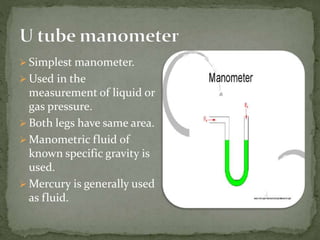
 Simplest manometer.
 Used in the
measurement of liquid or
gas pressure.
 Both legs have same area.
 Manometric fluid of
known specific gravity is
used.
 Mercury is generally used
as fluid.
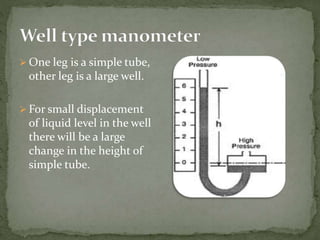
 One leg is a simple tube,
other leg is a large well.
 For small displacement
of liquid level in the well
there will be a large
change in the height of
simple tube.
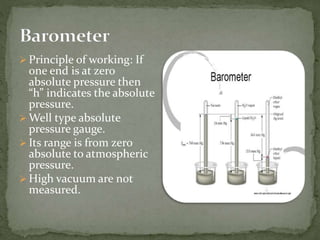
 Principle of working: If
one end is at zero
absolute pressure then
“h” indicates the absolute
pressure.
 Well type absolute
pressure gauge.
 Its range is from zero
absolute to atmospheric
pressure.
 High vacuum are not
measured.
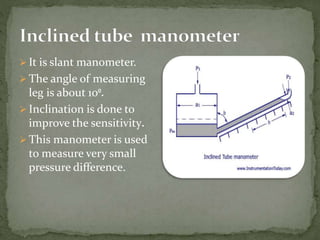
 It is slant manometer.
 The angle of measuring
leg is about 10⁰.
 Inclination is done to
improve the sensitivity.
 This manometer is used
to measure very small
pressure difference.
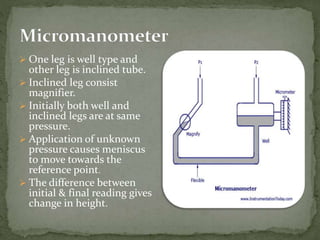
 One leg is well type and
other leg is inclined tube.
 Inclined leg consist
magnifier.
 Initially both well and
inclined legs are at same
pressure.
 Application of unknown
pressure causes meniscus
to move towards the
reference point.
 The difference between
initial & final reading gives
change in height.
Manometer

Manometer

  • 1.
  • 2.
     Introduction  Typesof Manometer  U- tube Manometer  Well type Manometer  Barometer  Inclined tube Manometer  Micromanometer
  • 3.
     A manometeris an instrument that uses a column of liquid to measure pressure.  The manometer utilizes the hydrostatic (standing liquid) balance principle wherein a pressure is measured by the height of the liquid it will support.  There are many types of manometers, some of which are as follows: 1) Simple Manometer 2) U Tube Manometer 3) Well type manometer. 4) Barometer 5) Inclined tube manometer 6) Micromanometer
  • 4.
     Simplest manometer. Used in the measurement of liquid or gas pressure.  Both legs have same area.  Manometric fluid of known specific gravity is used.  Mercury is generally used as fluid.
  • 5.
     One legis a simple tube, other leg is a large well.  For small displacement of liquid level in the well there will be a large change in the height of simple tube.
  • 6.
     Principle ofworking: If one end is at zero absolute pressure then “h” indicates the absolute pressure.  Well type absolute pressure gauge.  Its range is from zero absolute to atmospheric pressure.  High vacuum are not measured.
  • 7.
     It isslant manometer.  The angle of measuring leg is about 10⁰.  Inclination is done to improve the sensitivity.  This manometer is used to measure very small pressure difference.
  • 8.
     One legis well type and other leg is inclined tube.  Inclined leg consist magnifier.  Initially both well and inclined legs are at same pressure.  Application of unknown pressure causes meniscus to move towards the reference point.  The difference between initial & final reading gives change in height.