
PROF. S D YADAV
MGM’S JNEC AURANGABAD
MAHARASHTRA ,INDIA.
PRESSURE MEASURING
INSTRUMENTS
1
Different Types of Pressure
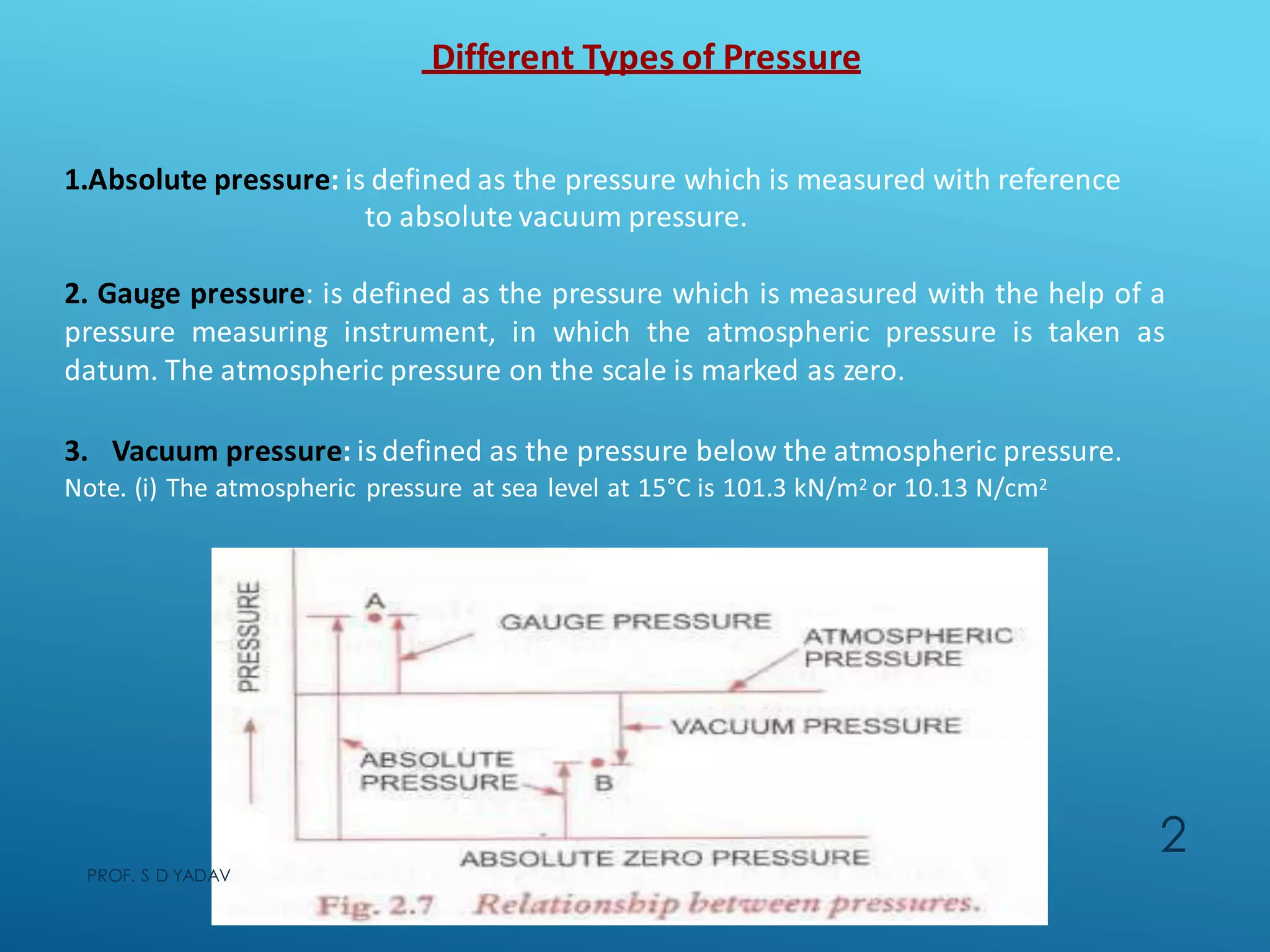
1.Absolute pressure: is defined as the pressure which is measured with reference
to absolute vacuum pressure.
2. Gauge pressure: is defined as the pressure which is measured with the help of a
pressure measuring instrument, in which the atmospheric pressure is taken as
datum. The atmospheric pressure on the scale is marked as zero.
3. Vacuum pressure: isdefined as the pressure below the atmospheric pressure.
Note. (i) The atmospheric pressure at sea level at 15°C is 101.3 kN/m2 or 10.13 N/cm2
PROF. S D YADAV
2
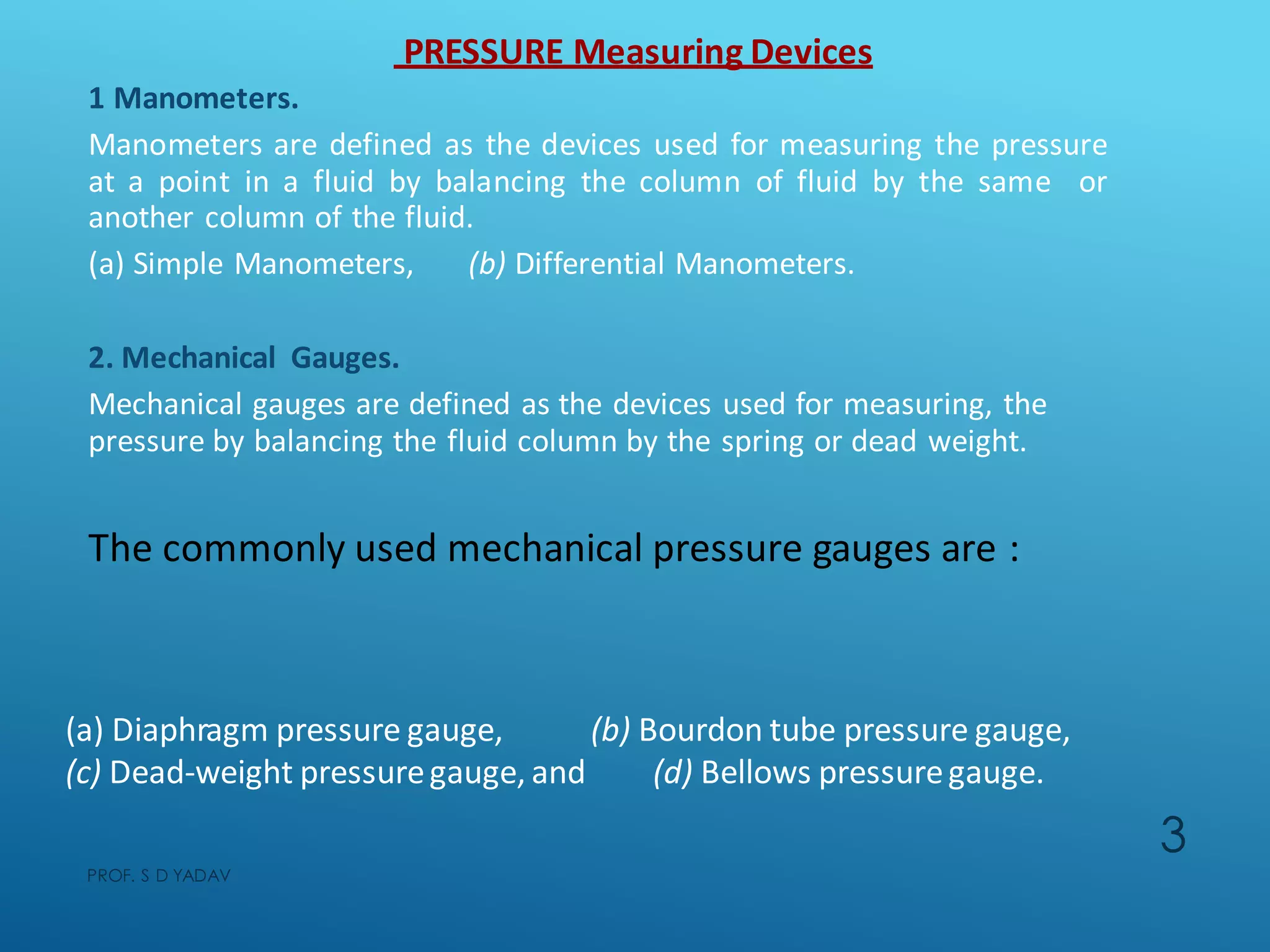
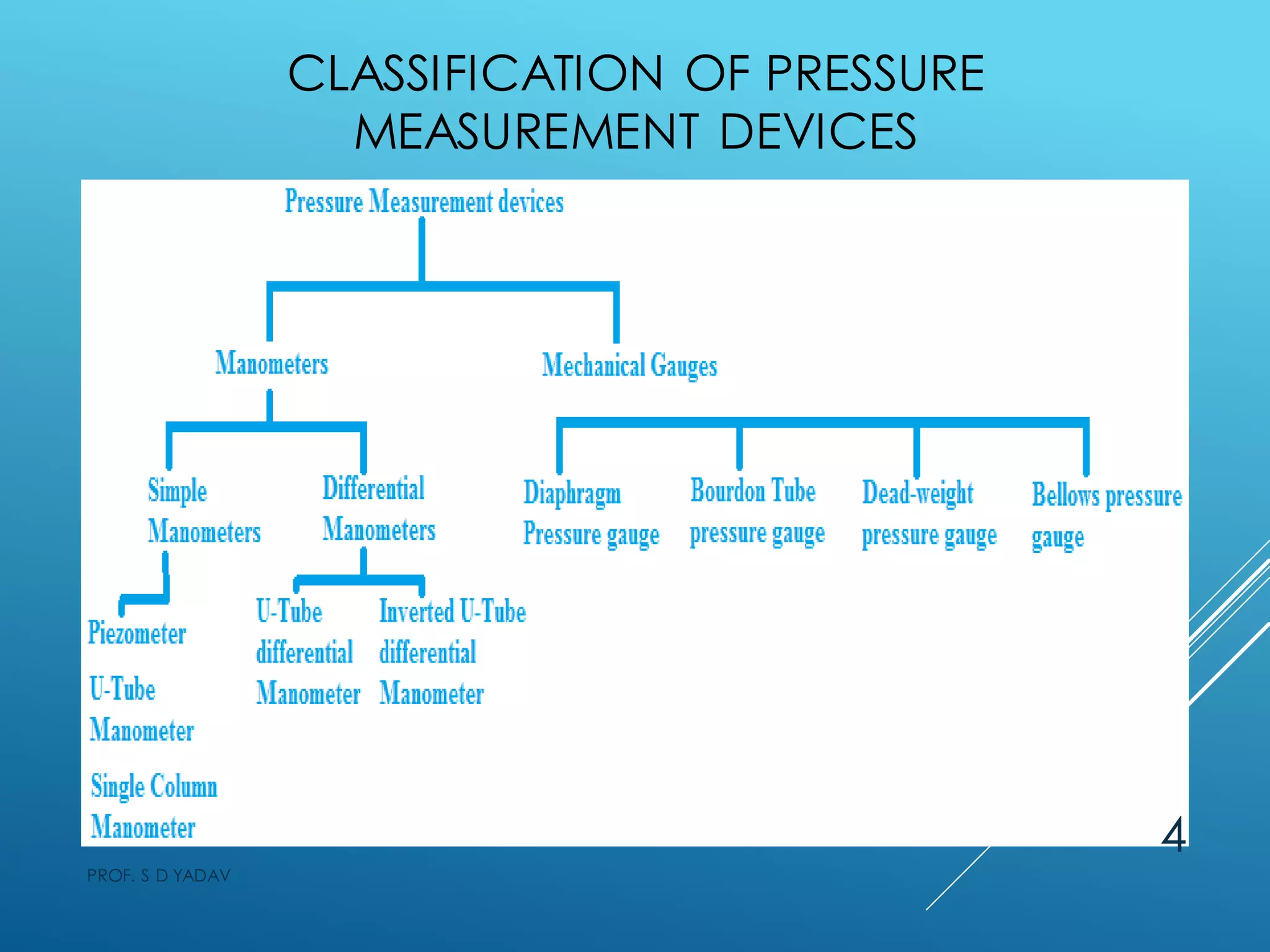
1 Manometers.
Manometers are defined as the devices used for measuring the pressure
at a point in a fluid by balancing the column of fluid by the same or
another column of the fluid.
(a) Simple Manometers, (b) Differential Manometers.
2. Mechanical Gauges.
Mechanical gauges are defined as the devices used for measuring, the
pressure by balancing the fluid column by the spring or dead weight.
The commonly used mechanical pressure gauges are :
PRESSURE Measuring Devices
(a) Diaphragm pressure gauge,
(c) Dead-weight pressuregauge, and
(b) Bourdon tube pressure gauge,
(d) Bellows pressuregauge.
PROF. S D YADAV
3
CLASSIFICATION OF PRESSURE
MEASUREMENT DEVICES
PROF. S D YADAV
4
SIMPLE MANOMETERS
 A simple manometer consists of a glass tube
having one of its ends connected to a point
where pressure is to be measured and other
end remains open to atmosphere.
Common types of simple manometers are :
1.Piezometer.
2.U-tube Manometer.
3.Single Column Manometer.
PROF. S D YADAV
5
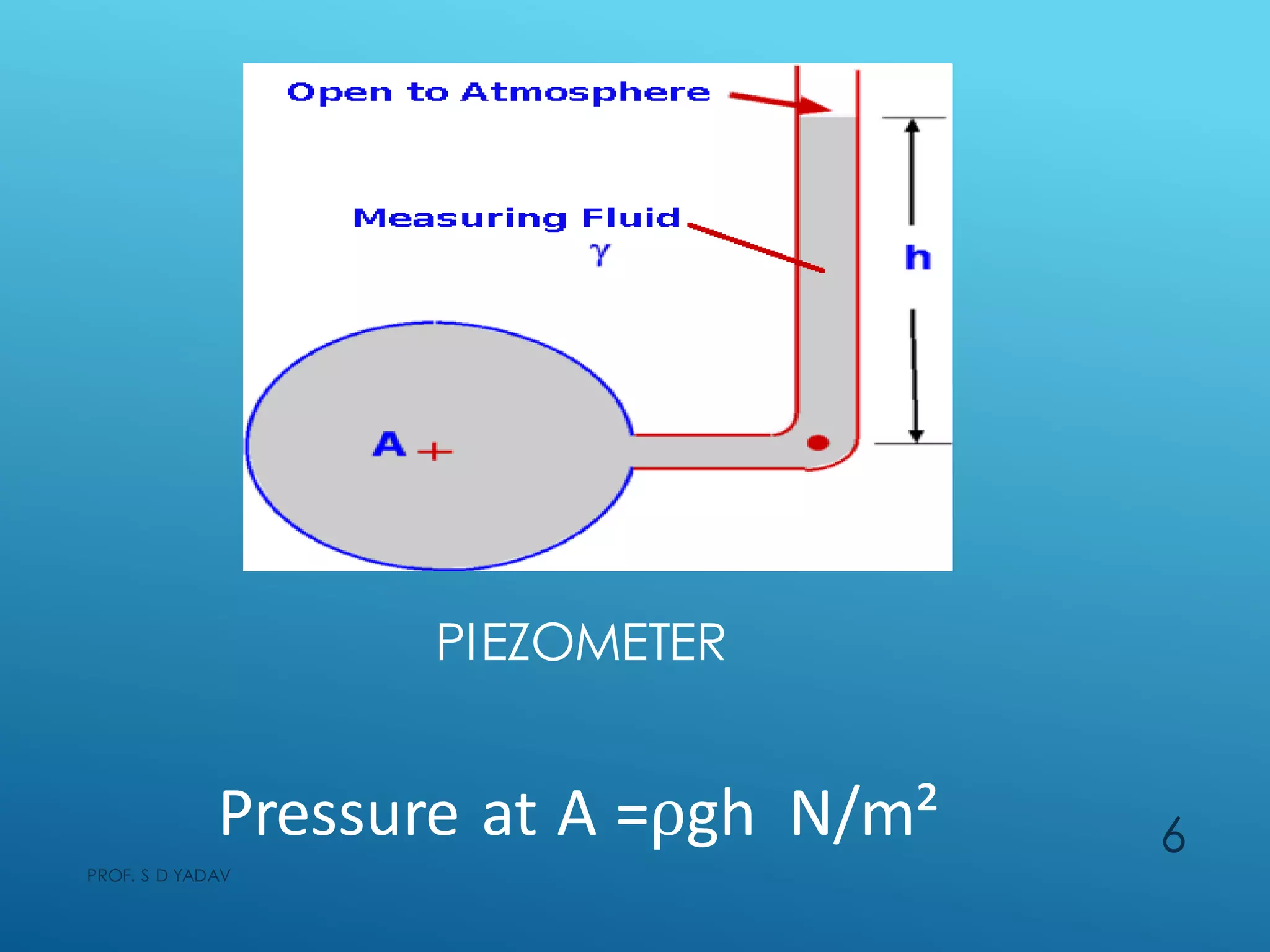
PIEZOMETER
Pressure at A =⍴gh N/m²
PROF. S D YADAV
6
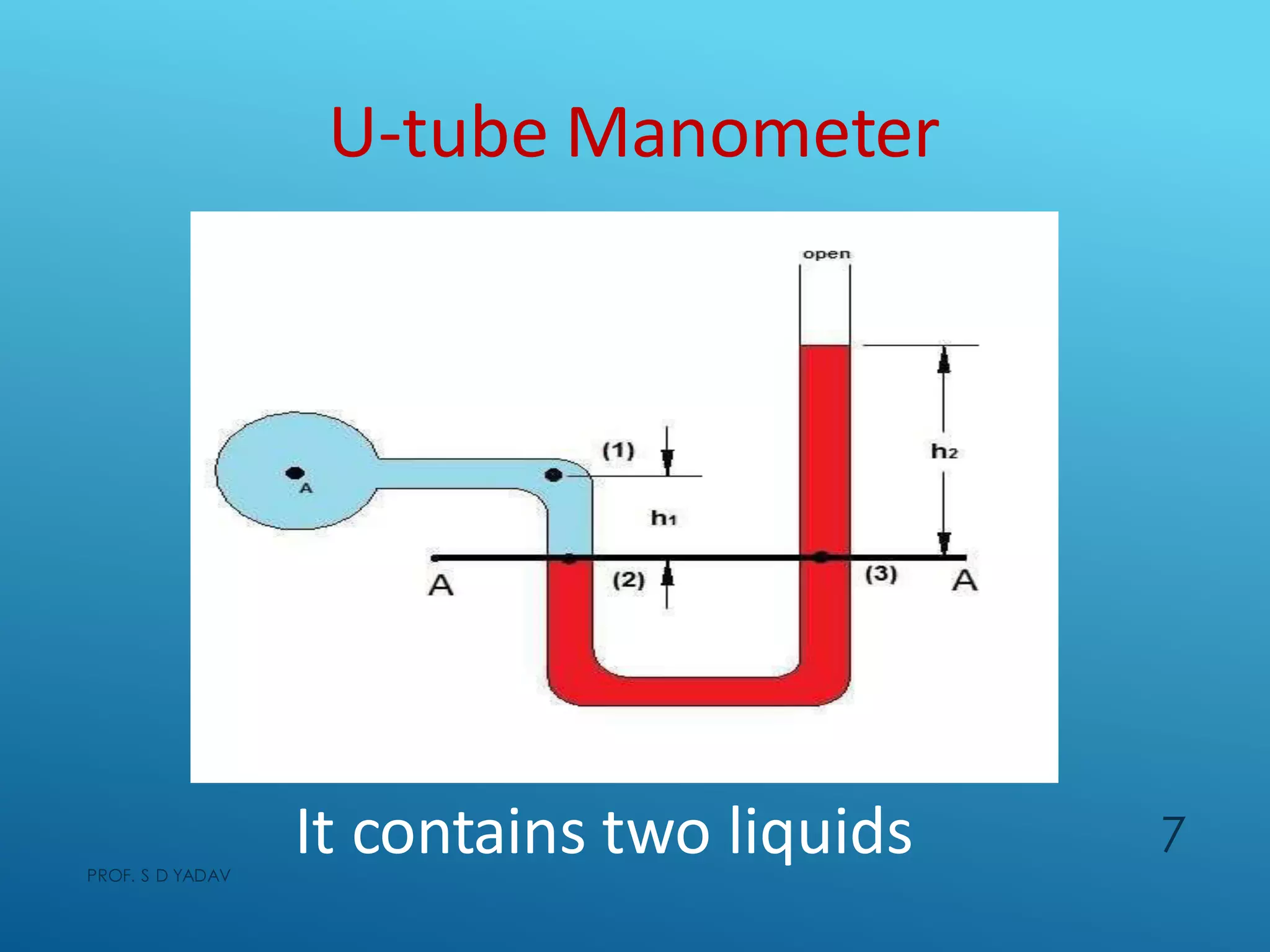
U-tube Manometer
It contains two liquidsPROF. S D YADAV
7
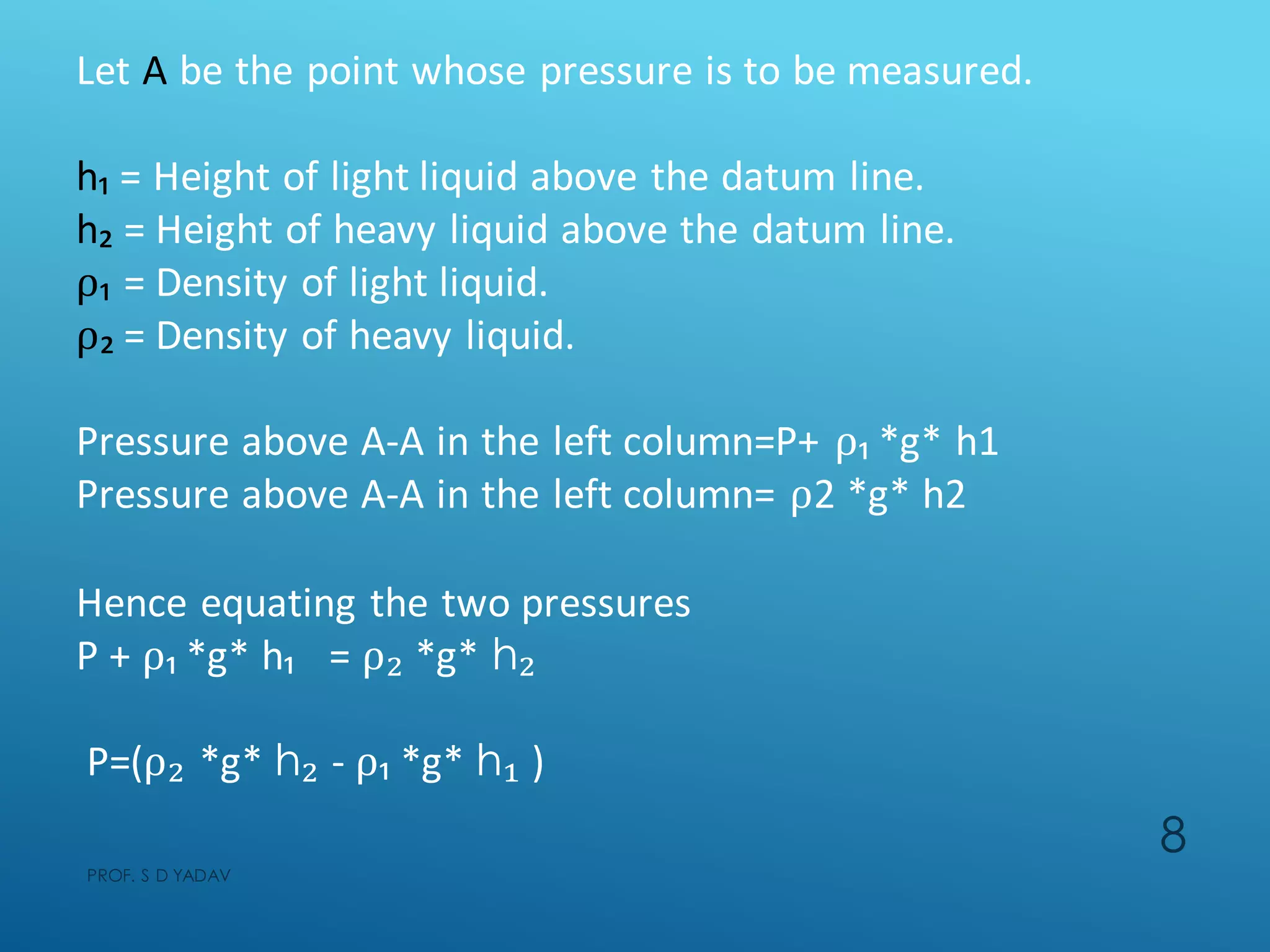
Let A be the point whose pressure is to be measured.
h₁ = Height of light liquid above the datum line.
h₂ = Height of heavy liquid above the datum line.
⍴₁ = Density of light liquid.
⍴₂ = Density of heavy liquid.
Pressure above A-A in the left column=P+ ⍴₁ *g* h1
Pressure above A-A in the left column= ⍴2 *g* h2
Hence equating the two pressures
P + ⍴₁ *g* h₁ = ⍴₂ *g* h₂
P=(⍴₂ *g* h₂ - ⍴₁ *g* h₁ )
PROF. S D YADAV
8
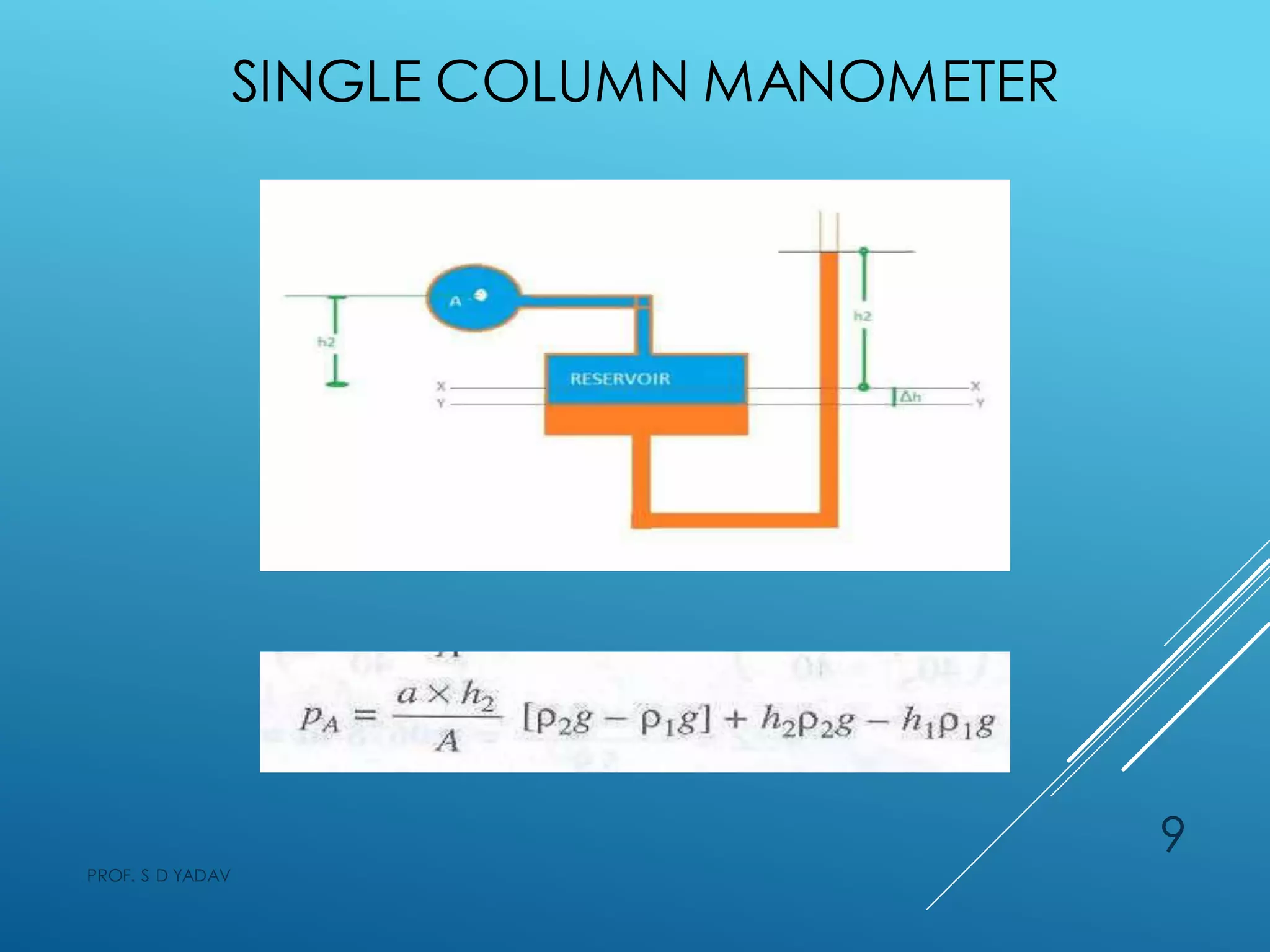
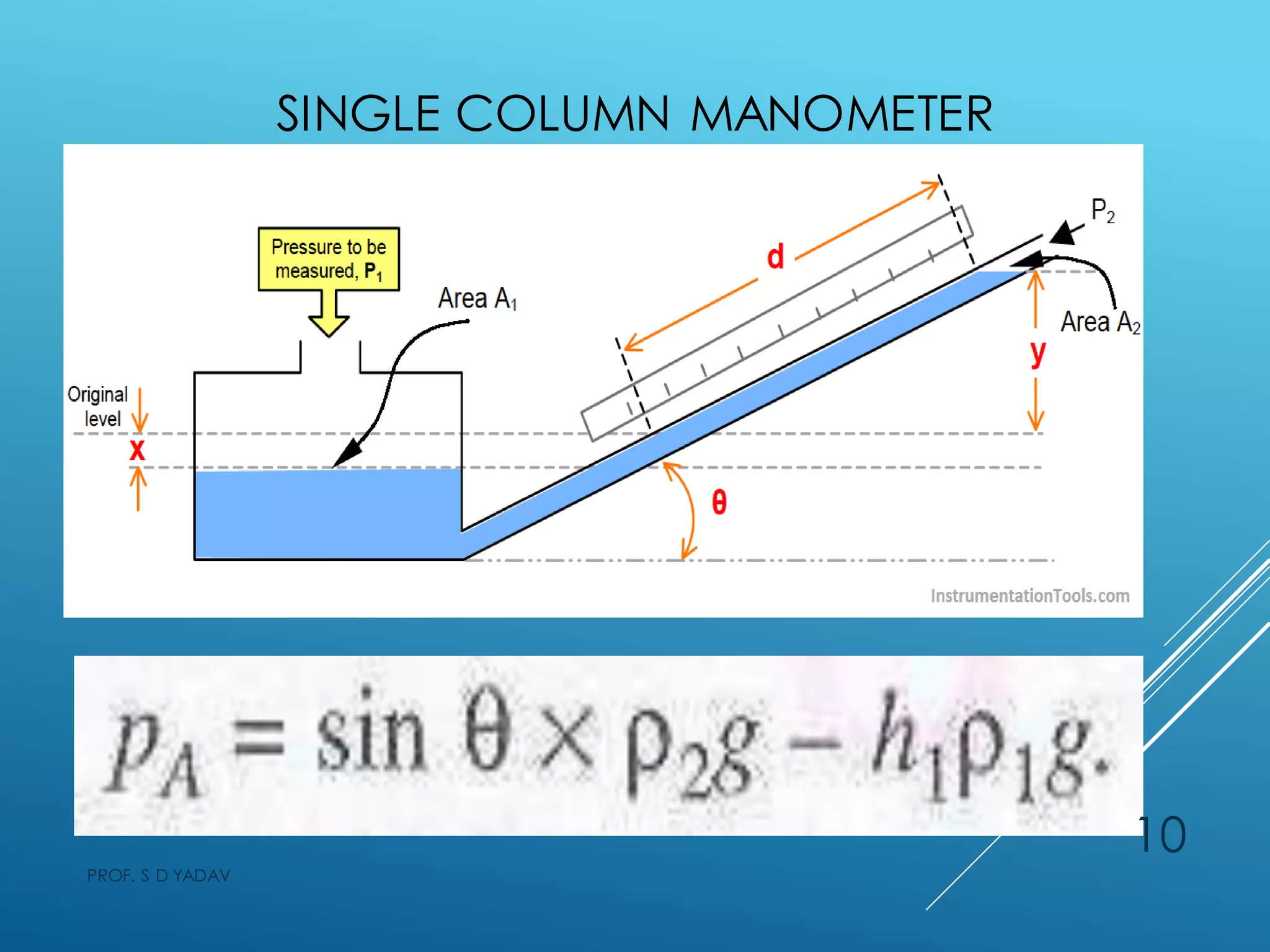
SINGLE COLUMN MANOMETER
PROF. S D YADAV
9
SINGLE COLUMN MANOMETER
PROF. S D YADAV
10
Vertical single column Manometer
•It is a modified form of U-tube manometer.
•It contains reservoir.
•Change in liquid level is very small in the
reservoir.
Inclined single column Manometer
•It is more sensitive
•Distance moved by the heavy liquid in the
right limb will be more.
PROF. S D YADAV
11
PROF. S D YADAV
12
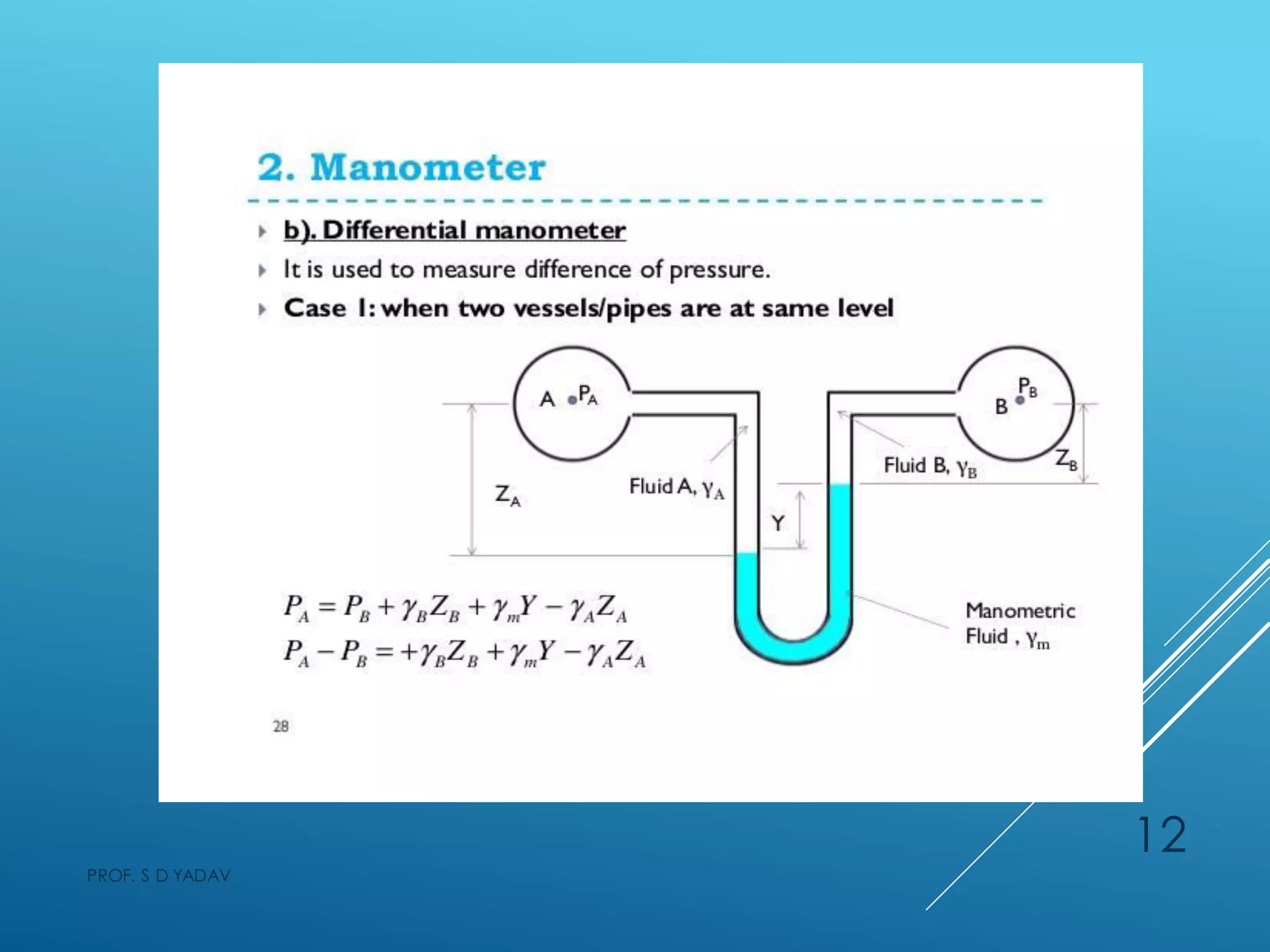
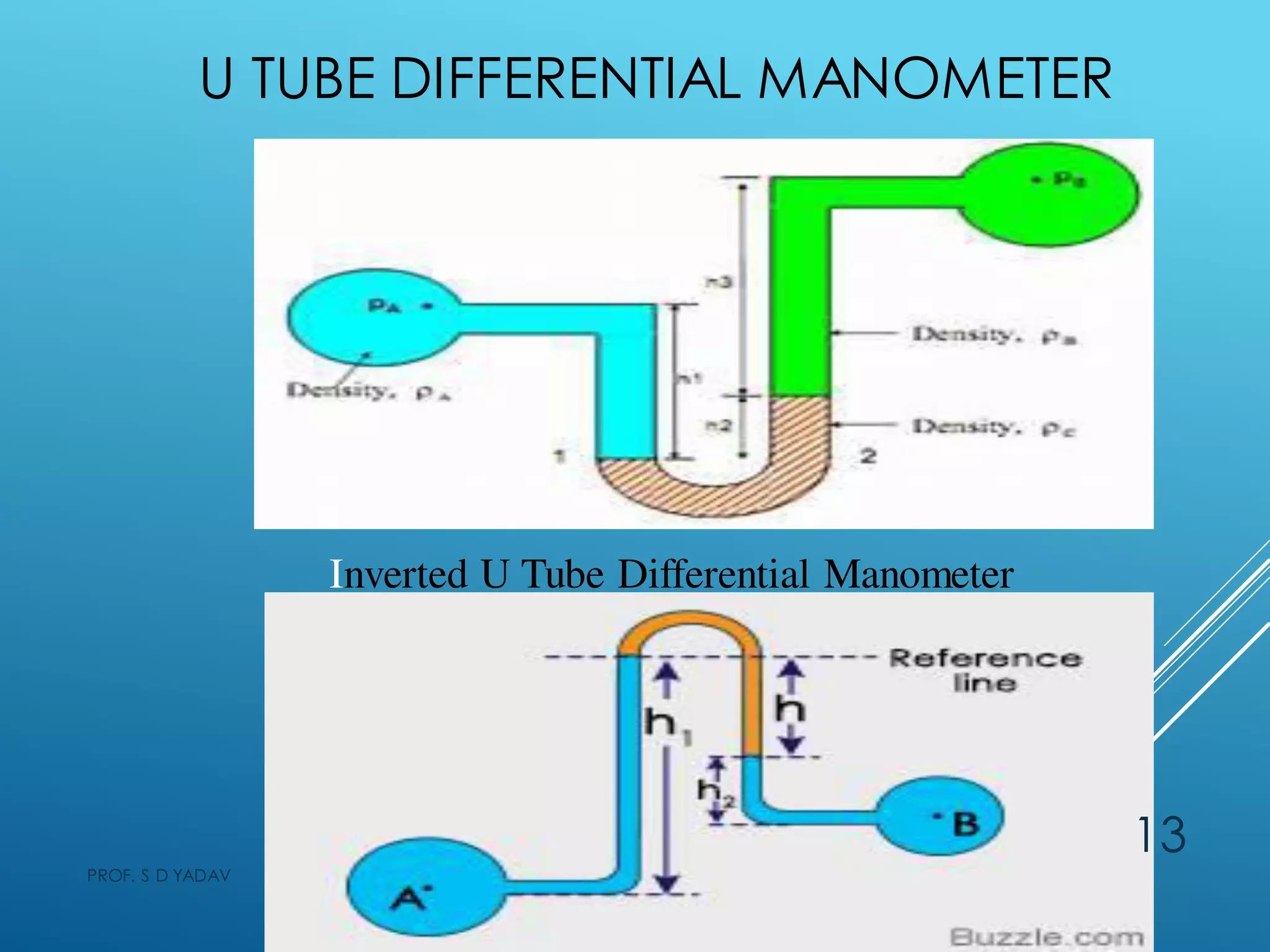
U TUBE DIFFERENTIAL MANOMETER
Inverted U Tube Differential Manometer
PROF. S D YADAV
13
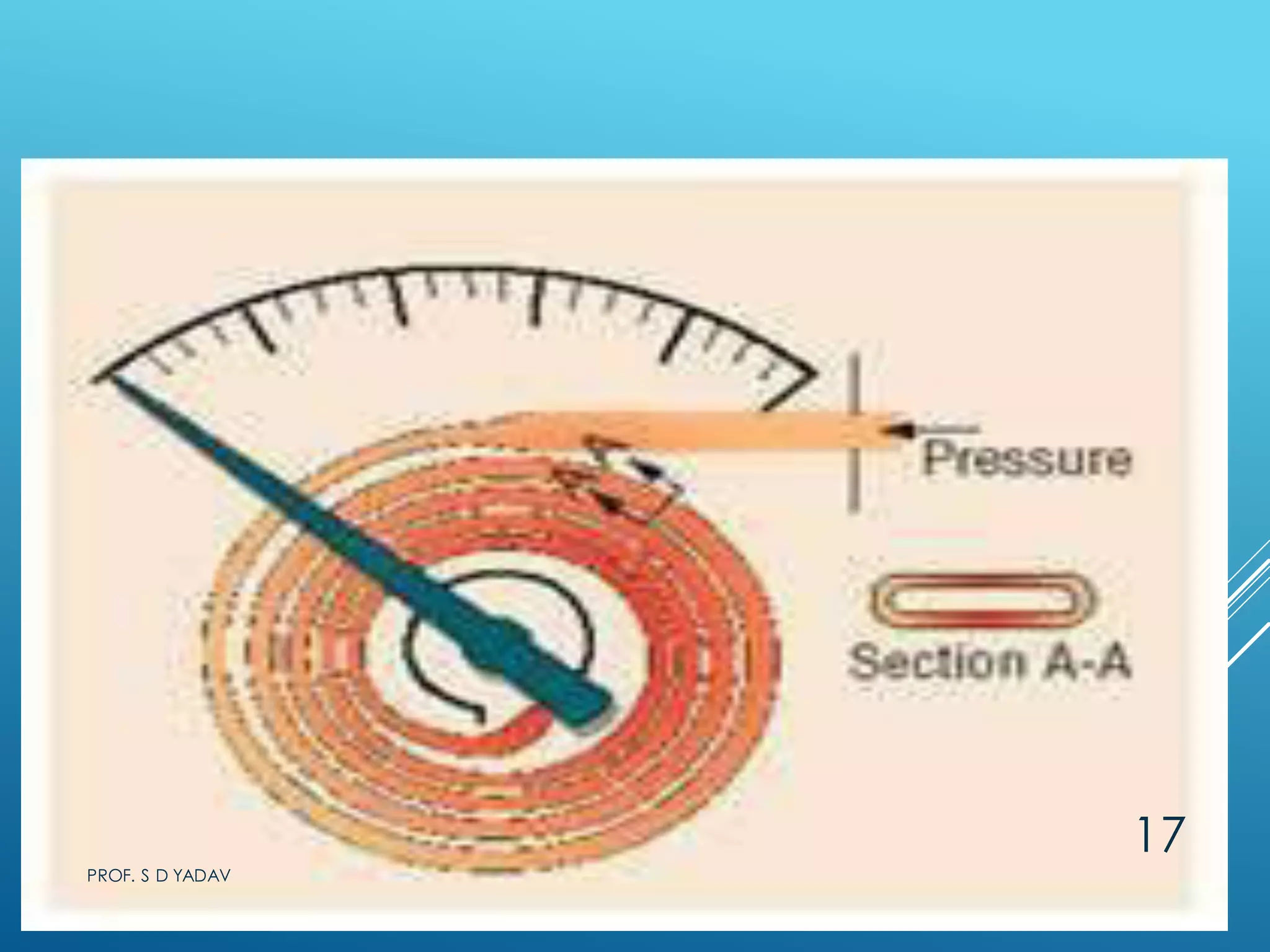
RANGES OF BOURDON TUBE
PRESSURE GAUGES
•C- type bourdon tube elements0-700 mega Pascal & even
higher.
•Spiral type bourdon tube elements0-30 mega Pascal.
•Helical type bourdon tube elements1.5 mega Pascal to 550
mega Pascal.
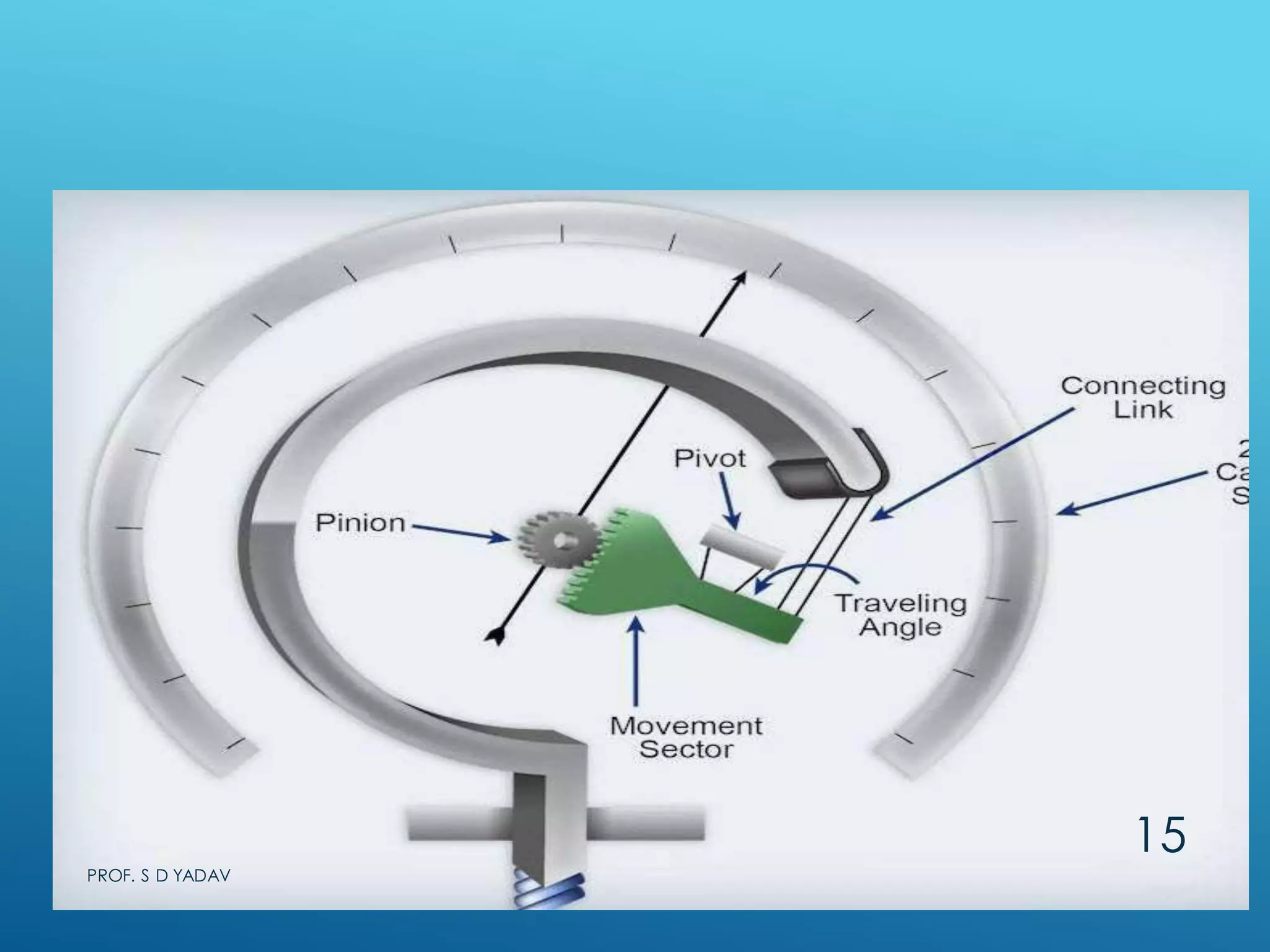
C-TYPE BOURDON TUBE
PROF. S D YADAV
15
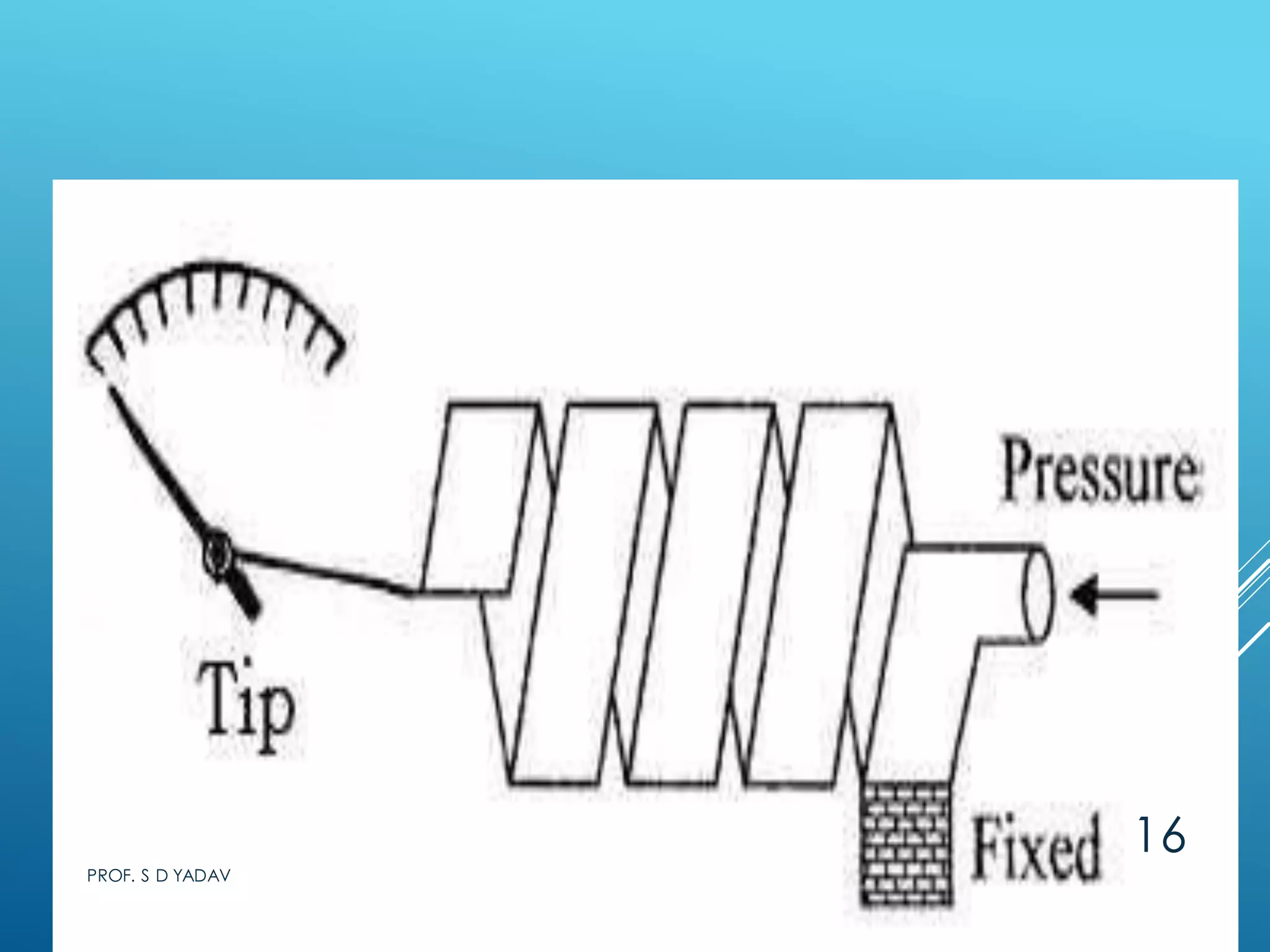
HELICAL TYPE BOURDON
TUBE
PROF. S D YADAV
16
SPIRAL TYPE BOURDON TUBE
PROF. S D YADAV
17
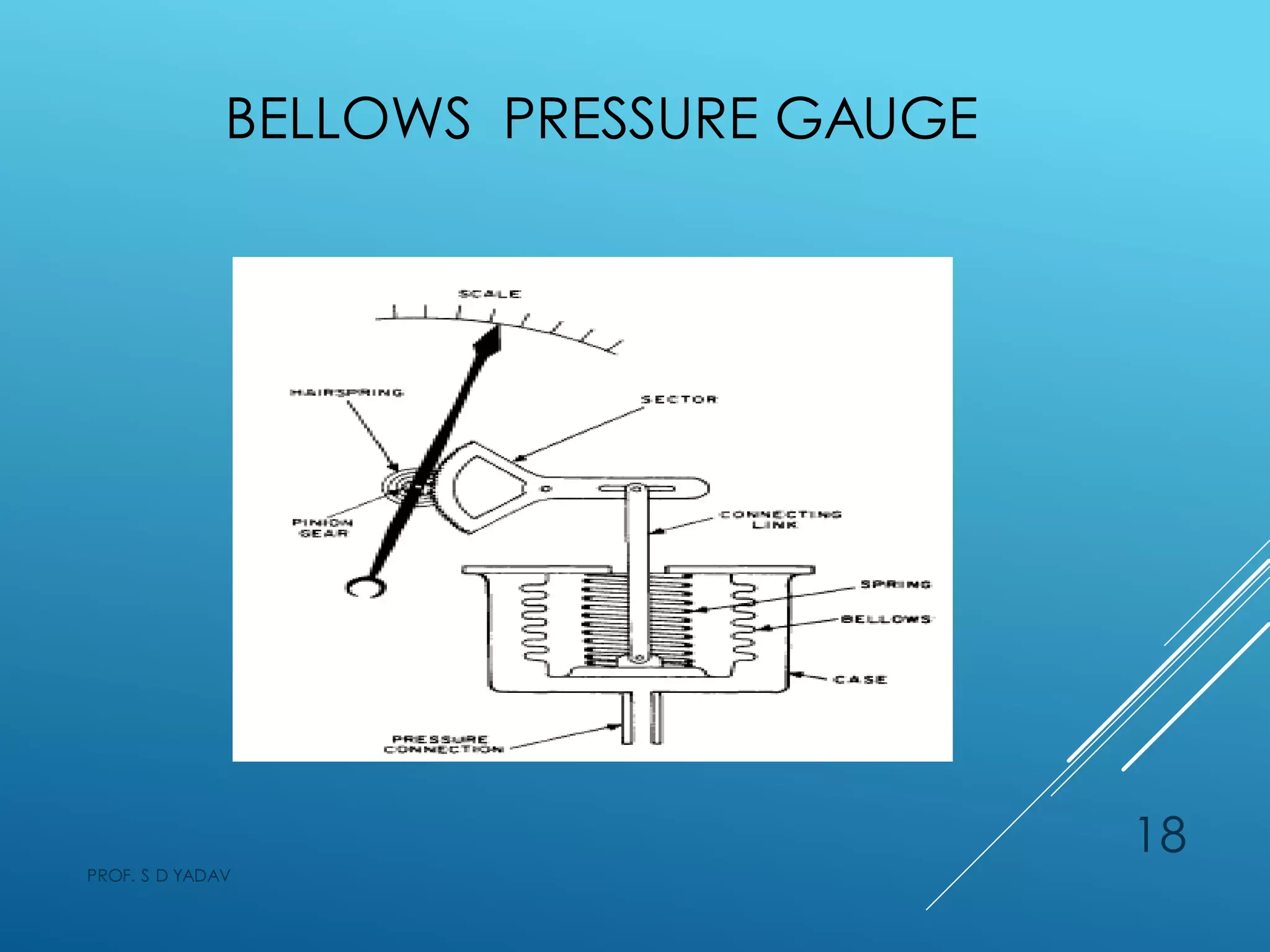
BELLOWS PRESSURE GAUGE
PROF. S D YADAV
18
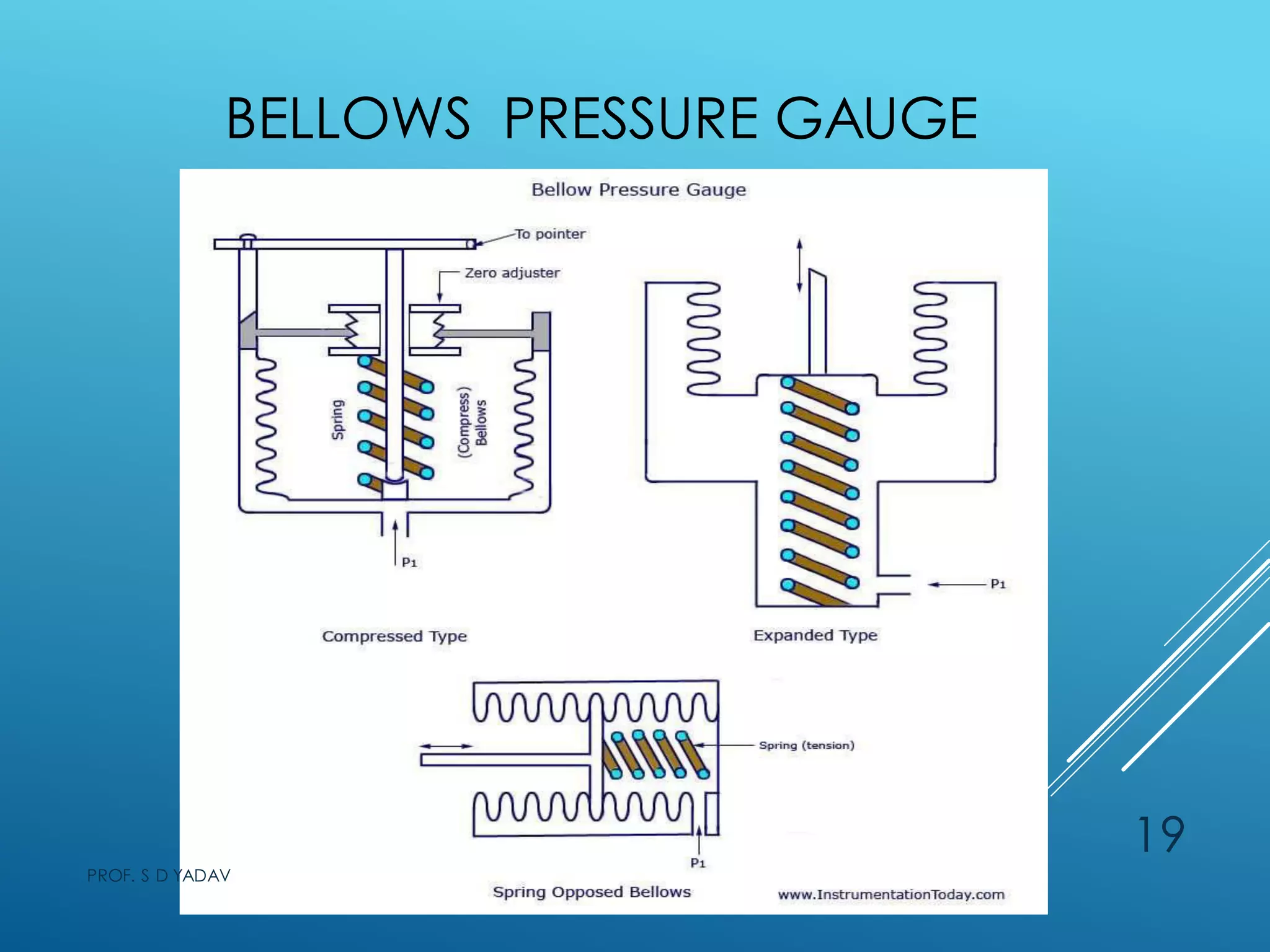
BELLOWS PRESSURE GAUGE
PROF. S D YADAV
19
 bellows are also used for pressure measurement, and can be made of
cascaded capsules. The basic way of manufacturing bellows is by
fastening together many individual diaphragms. The bellows element,
basically, is a one piece expansible, collapsible and axially flexible
member. It has many convolutions or fold. It can be manufactured form a
single piece of thin metal. For industrial purposes, the commonly used
bellow elements are:
 By turning from a solid stock of metal
 By soldering or welding stamped annular rings
 Rolling a tube
 By hydraulically forming a drawn tubing
Working
 The action of bending and tension operates the elastic members. For
proper working, the tension should be least. The design ideas given for a
diaphragm is applied to bowels as well. The manufacturer describes the
bellows with two characters – maximum stroke and maximum allowable
pressure. The force obtained can be increased by increasing the
diameter. The stroke length can be increased by increasing the folds or
convolutions.
20
PROF. S D YADAV
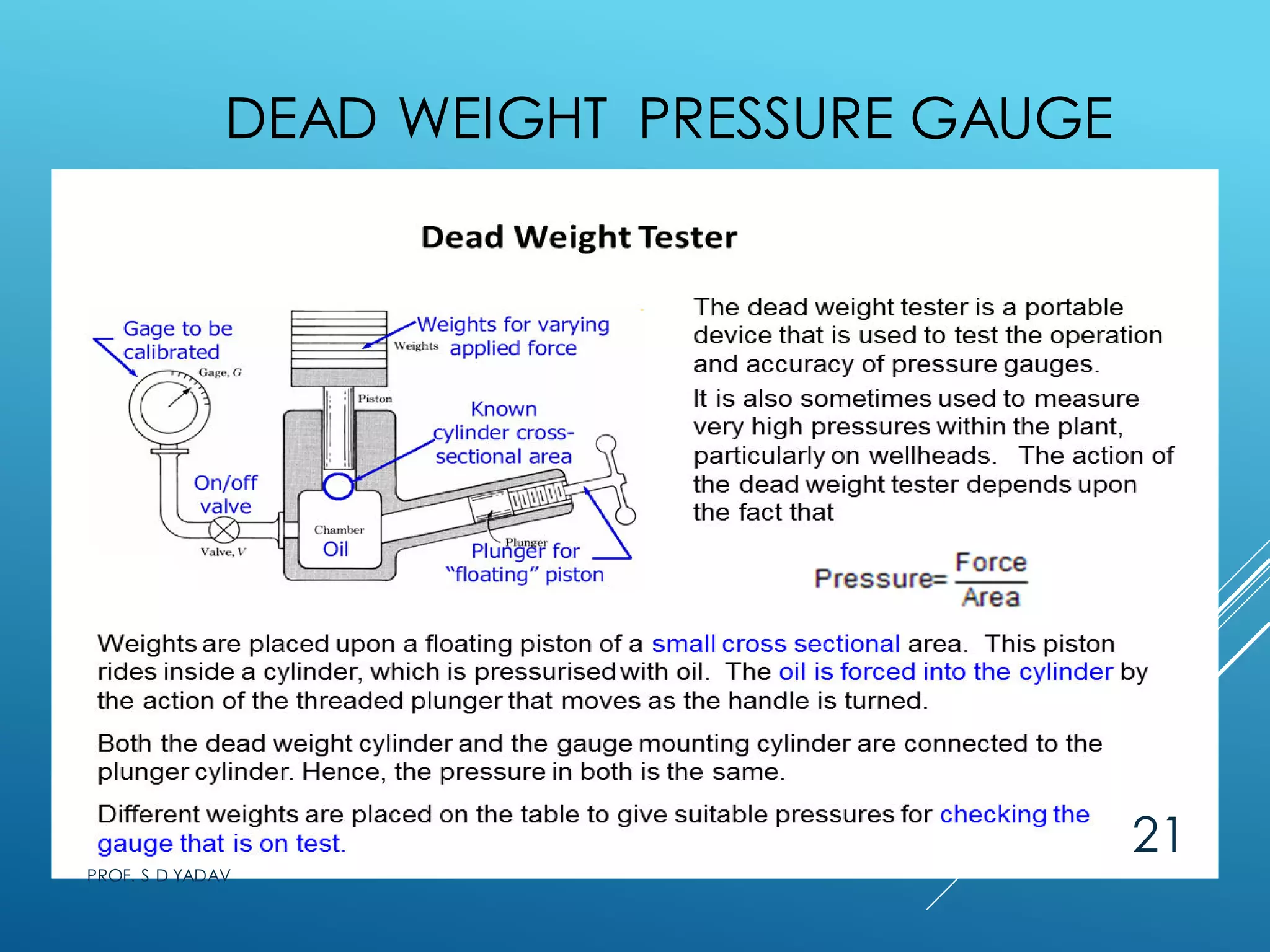
DEAD WEIGHT PRESSURE GAUGE
PROF. S D YADAV
21
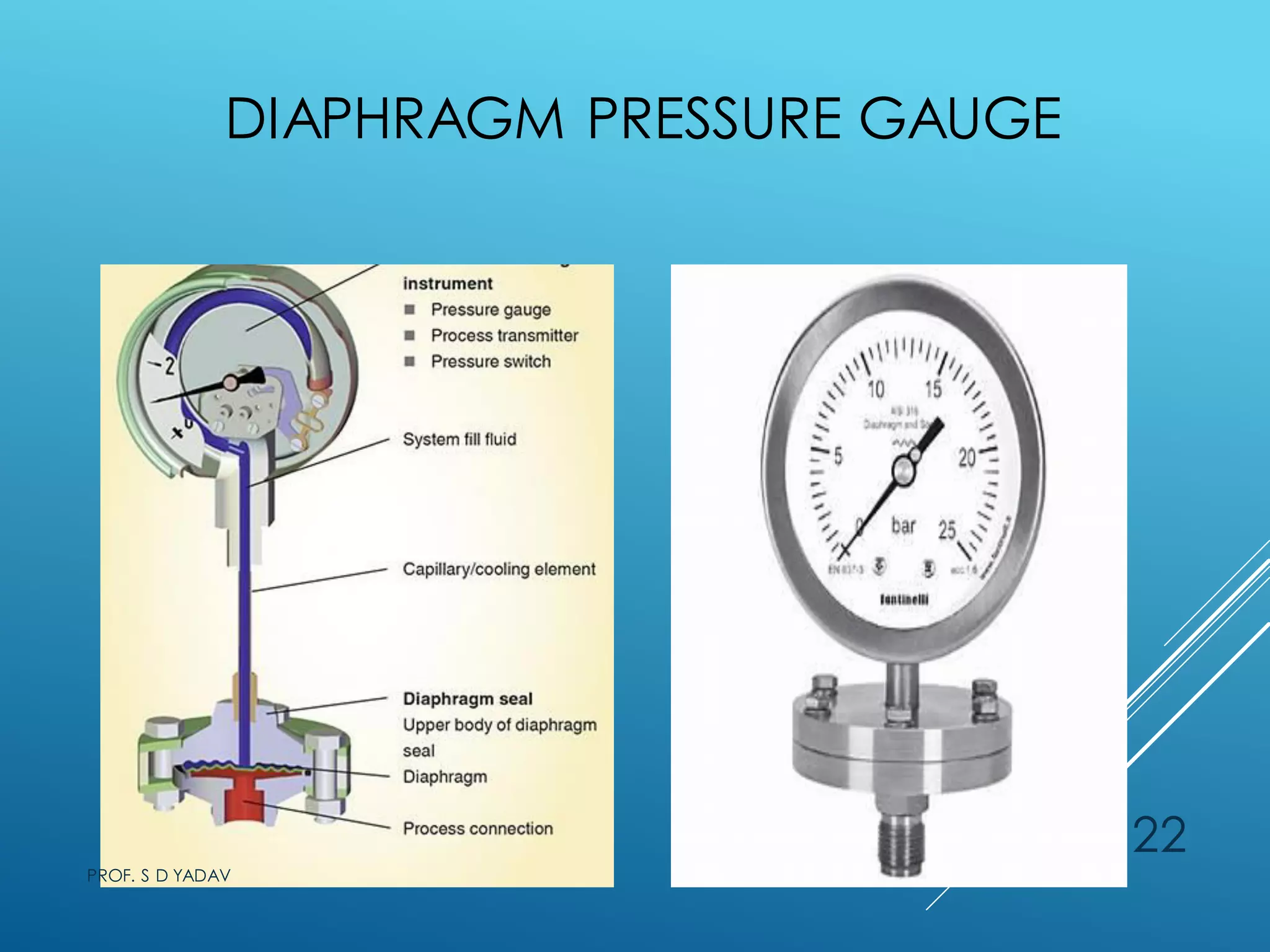
DIAPHRAGM PRESSURE GAUGE
PROF. S D YADAV
22
 A diaphragm pressure transducer is used for
low pressure measurement. They are
commercially available in two types – metallic
and non-metallic.
 Metallic diaphragms are known to have good
spring characteristics and non-metallic types
have no elastic characteristics. Thus, non-
metallic types are used rarely, and are usually
opposed by a calibrated coil spring or any
other elastic type gauge. The non-metallic
types are also called slack diaphragm.
23
PROF. S D YADAV
Thank You
PROF. S D YADAV
24

Pressure measuring instruments

  • 1.
    PROF. S DYADAV MGM’S JNEC AURANGABAD MAHARASHTRA ,INDIA. PRESSURE MEASURING INSTRUMENTS 1
  • 2.
    Different Types ofPressure 1.Absolute pressure: is defined as the pressure which is measured with reference to absolute vacuum pressure. 2. Gauge pressure: is defined as the pressure which is measured with the help of a pressure measuring instrument, in which the atmospheric pressure is taken as datum. The atmospheric pressure on the scale is marked as zero. 3. Vacuum pressure: isdefined as the pressure below the atmospheric pressure. Note. (i) The atmospheric pressure at sea level at 15°C is 101.3 kN/m2 or 10.13 N/cm2 PROF. S D YADAV 2
  • 3.
    1 Manometers. Manometers aredefined as the devices used for measuring the pressure at a point in a fluid by balancing the column of fluid by the same or another column of the fluid. (a) Simple Manometers, (b) Differential Manometers. 2. Mechanical Gauges. Mechanical gauges are defined as the devices used for measuring, the pressure by balancing the fluid column by the spring or dead weight. The commonly used mechanical pressure gauges are : PRESSURE Measuring Devices (a) Diaphragm pressure gauge, (c) Dead-weight pressuregauge, and (b) Bourdon tube pressure gauge, (d) Bellows pressuregauge. PROF. S D YADAV 3
  • 4.
    CLASSIFICATION OF PRESSURE MEASUREMENTDEVICES PROF. S D YADAV 4
  • 5.
    SIMPLE MANOMETERS  Asimple manometer consists of a glass tube having one of its ends connected to a point where pressure is to be measured and other end remains open to atmosphere. Common types of simple manometers are : 1.Piezometer. 2.U-tube Manometer. 3.Single Column Manometer. PROF. S D YADAV 5
  • 6.
    PIEZOMETER Pressure at A=⍴gh N/m² PROF. S D YADAV 6
  • 7.
    U-tube Manometer It containstwo liquidsPROF. S D YADAV 7
  • 8.
    Let A bethe point whose pressure is to be measured. h₁ = Height of light liquid above the datum line. h₂ = Height of heavy liquid above the datum line. ⍴₁ = Density of light liquid. ⍴₂ = Density of heavy liquid. Pressure above A-A in the left column=P+ ⍴₁ *g* h1 Pressure above A-A in the left column= ⍴2 *g* h2 Hence equating the two pressures P + ⍴₁ *g* h₁ = ⍴₂ *g* h₂ P=(⍴₂ *g* h₂ - ⍴₁ *g* h₁ ) PROF. S D YADAV 8
  • 9.
  • 10.
  • 11.
    Vertical single columnManometer •It is a modified form of U-tube manometer. •It contains reservoir. •Change in liquid level is very small in the reservoir. Inclined single column Manometer •It is more sensitive •Distance moved by the heavy liquid in the right limb will be more. PROF. S D YADAV 11
  • 12.
    PROF. S DYADAV 12
  • 13.
    U TUBE DIFFERENTIALMANOMETER Inverted U Tube Differential Manometer PROF. S D YADAV 13
  • 14.
    RANGES OF BOURDONTUBE PRESSURE GAUGES •C- type bourdon tube elements0-700 mega Pascal & even higher. •Spiral type bourdon tube elements0-30 mega Pascal. •Helical type bourdon tube elements1.5 mega Pascal to 550 mega Pascal.
  • 15.
  • 16.
  • 17.
    SPIRAL TYPE BOURDONTUBE PROF. S D YADAV 17
  • 18.
  • 19.
  • 20.
     bellows arealso used for pressure measurement, and can be made of cascaded capsules. The basic way of manufacturing bellows is by fastening together many individual diaphragms. The bellows element, basically, is a one piece expansible, collapsible and axially flexible member. It has many convolutions or fold. It can be manufactured form a single piece of thin metal. For industrial purposes, the commonly used bellow elements are:  By turning from a solid stock of metal  By soldering or welding stamped annular rings  Rolling a tube  By hydraulically forming a drawn tubing Working  The action of bending and tension operates the elastic members. For proper working, the tension should be least. The design ideas given for a diaphragm is applied to bowels as well. The manufacturer describes the bellows with two characters – maximum stroke and maximum allowable pressure. The force obtained can be increased by increasing the diameter. The stroke length can be increased by increasing the folds or convolutions. 20 PROF. S D YADAV
  • 21.
    DEAD WEIGHT PRESSUREGAUGE PROF. S D YADAV 21
  • 22.
  • 23.
     A diaphragmpressure transducer is used for low pressure measurement. They are commercially available in two types – metallic and non-metallic.  Metallic diaphragms are known to have good spring characteristics and non-metallic types have no elastic characteristics. Thus, non- metallic types are used rarely, and are usually opposed by a calibrated coil spring or any other elastic type gauge. The non-metallic types are also called slack diaphragm. 23 PROF. S D YADAV
  • 24.