N SAI SRI VARSHA
GSN AMRUTHA
K SANJANA
MANOMETER
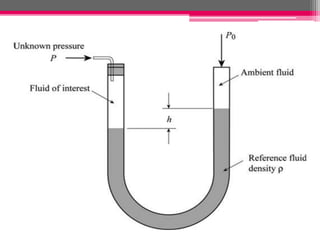
• An instrument for measuring the pressure acting
on a column of fluid, consisting of a u-shaped
tube of liquid in which a difference in the
pressures acting in the two arms of the tube
causes the liquid to reach different heights in the
two arms.
• OTTO VON GUERICKE invented
MANOMETER.
BUILDING A MANOMETER
• A simple manometer can be built by partially
filling a clear plastic tube with a colored liquid to
allow the fluid level to be easily observed. The
tube is then bent into a U-shape and fixed in an
upright position. The levels of the fluid in the
two vertical columns should be equal at this
point, as they are currently exposed to the same
pressure. This level is therefore marked and
identified as the zero point of the manometer.
MEASUREMENT OF PRESSURE
• The manometer is placed against a measured
scale to allow any difference in the height of the
two columns. This height differential can be
used directly to make relative comparisons
between different test pressures. This type of
manometer can also be used to calculate the
absolute pressure when the density of the liquid
in the manometer is known.
HOW IT WORKS ?
• One end of the tube is connected with a gas-tight
seal to a test pressure source. The other end of
the tube is left open to the atmosphere and will
therefore be subjected to a pressure of
approximately 1 atmosphere (atm). If the test
pressure is greater than the reference pressure of
1 atm, the liquid in the test column is forced
down the column. This causes the fluid in the
reference column to rise by an equal amount.
Calculating the Pressure
• The pressure exerted by a column of fluid can be
given by the equation P = hgd. In this equation, P is
the calculated pressure, h is the height of the fluid, g
is the force of gravity and d is the density of the
liquid. Because the manometer is measuring a
pressure differential rather than an absolute
pressure, we use the substitution P = Pa – P0. In
this substitution, Pa is the test pressure and P0 is
the reference pressure.
•
TYPES OF MANOMETER
• U TUBE MANOMETER
• ENLARGED MANOMETER
• WELL TYPE MANOMETER
• INCLINED TYPE MANOMETER
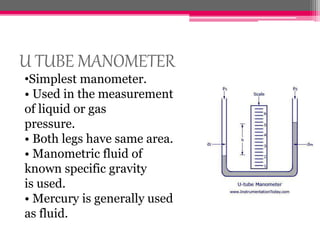
U TUBE MANOMETER
•Simplest manometer.
• Used in the measurement
of liquid or gas
pressure.
• Both legs have same area.
• Manometric fluid of
known specific gravity
is used.
• Mercury is generally used
as fluid.
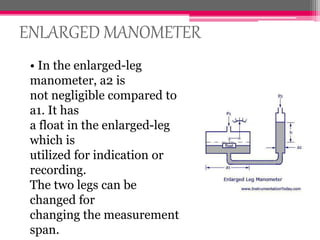
ENLARGED MANOMETER
• In the enlarged-leg
manometer, a2 is
not negligible compared to
a1. It has
a float in the enlarged-leg
which is
utilized for indication or
recording.
The two legs can be
changed for
changing the measurement
span.
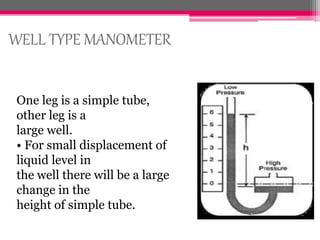
WELL TYPE MANOMETER
One leg is a simple tube,
other leg is a
large well.
• For small displacement of
liquid level in
the well there will be a large
change in the
height of simple tube.
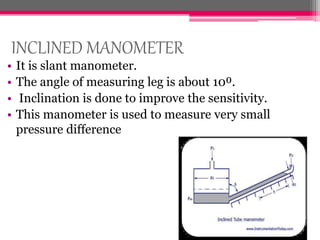
INCLINED MANOMETER
• It is slant manometer.
• The angle of measuring leg is about 10⁰.
• Inclination is done to improve the sensitivity.
• This manometer is used to measure very small
pressure difference
New Microsoft Office PowerPoint Presentation-1.pptx

New Microsoft Office PowerPoint Presentation-1.pptx

  • 1.
    N SAI SRIVARSHA GSN AMRUTHA K SANJANA
  • 2.
    MANOMETER • An instrumentfor measuring the pressure acting on a column of fluid, consisting of a u-shaped tube of liquid in which a difference in the pressures acting in the two arms of the tube causes the liquid to reach different heights in the two arms. • OTTO VON GUERICKE invented MANOMETER.
  • 4.
    BUILDING A MANOMETER •A simple manometer can be built by partially filling a clear plastic tube with a colored liquid to allow the fluid level to be easily observed. The tube is then bent into a U-shape and fixed in an upright position. The levels of the fluid in the two vertical columns should be equal at this point, as they are currently exposed to the same pressure. This level is therefore marked and identified as the zero point of the manometer.
  • 5.
    MEASUREMENT OF PRESSURE •The manometer is placed against a measured scale to allow any difference in the height of the two columns. This height differential can be used directly to make relative comparisons between different test pressures. This type of manometer can also be used to calculate the absolute pressure when the density of the liquid in the manometer is known.
  • 6.
    HOW IT WORKS? • One end of the tube is connected with a gas-tight seal to a test pressure source. The other end of the tube is left open to the atmosphere and will therefore be subjected to a pressure of approximately 1 atmosphere (atm). If the test pressure is greater than the reference pressure of 1 atm, the liquid in the test column is forced down the column. This causes the fluid in the reference column to rise by an equal amount.
  • 7.
    Calculating the Pressure •The pressure exerted by a column of fluid can be given by the equation P = hgd. In this equation, P is the calculated pressure, h is the height of the fluid, g is the force of gravity and d is the density of the liquid. Because the manometer is measuring a pressure differential rather than an absolute pressure, we use the substitution P = Pa – P0. In this substitution, Pa is the test pressure and P0 is the reference pressure. •
  • 8.
    TYPES OF MANOMETER •U TUBE MANOMETER • ENLARGED MANOMETER • WELL TYPE MANOMETER • INCLINED TYPE MANOMETER
  • 9.
    U TUBE MANOMETER •Simplestmanometer. • Used in the measurement of liquid or gas pressure. • Both legs have same area. • Manometric fluid of known specific gravity is used. • Mercury is generally used as fluid.
  • 10.
    ENLARGED MANOMETER • Inthe enlarged-leg manometer, a2 is not negligible compared to a1. It has a float in the enlarged-leg which is utilized for indication or recording. The two legs can be changed for changing the measurement span.
  • 11.
    WELL TYPE MANOMETER Oneleg is a simple tube, other leg is a large well. • For small displacement of liquid level in the well there will be a large change in the height of simple tube.
  • 12.
    INCLINED MANOMETER • Itis slant manometer. • The angle of measuring leg is about 10⁰. • Inclination is done to improve the sensitivity. • This manometer is used to measure very small pressure difference