MANOMETER
PRATHAMESH KUDALKAR
13FET1011
MANOMETERS
 A manometer is an instrument that uses a column of liquid to
measure pressure.
 The manometer utilizes the hydrostatic (standing liquid)
balance principle wherein a pressure is measured by the height of the
liquid it will support.
 There are many types of manometers, some of which are as follows:
 Simple Manometer
 Well Type Manometer
 Inclined Manometer
 Two liquid manometer
SIMPLE MANOMETER
 It consists of a transparent U-tube containing the fluid A of density
p whose pressure is to be measured and an immiscible fluid B of
higher density pm.
 The limbs are connected to the two points between which the
pressure difference (P2- P1) is required.
 If P2 is greater than P1, the interface between the two liquids in limb
2 will be depressed a distance hm (say) below that in limb 1.
 The pressure at the level a — a must be the same in each of the
limbs and, therefore;
𝑷 𝟐 + 𝒛 𝒎 𝝆𝒈 = 𝑷 𝟏 + 𝒛 𝒎 − 𝒉 𝒎 𝝆𝒈 + 𝒉 𝒎 𝝆 𝒎 𝒈
∆𝑷 = 𝑷 𝟐 − 𝑷 𝟏 = 𝒉 𝒎 𝝆 𝒎 − 𝝆 𝒈
 If fluid A is a gas, ∆𝑷 = 𝒉 𝒎 𝝆 𝒎 𝒈
SIMPLE MANOMETER
WELL TYPE MANOMETER
 In order to avoid the inconvenience of having to read two limbs,
the well-type manometer can be used.
 If Aw and Ac are the cross-sectional areas of the well and the
column and hm is the increase in the level of the column and hw
the decrease in the level of the well, then;
∆𝑷 = 𝑷 𝟐 − 𝑷 𝟏 = 𝒉 𝒎 𝝆𝒈(𝟏 +
𝑨𝒄
𝑨𝒘
)
WELL TYPE MANOMETER
INCLINED MANOMETER
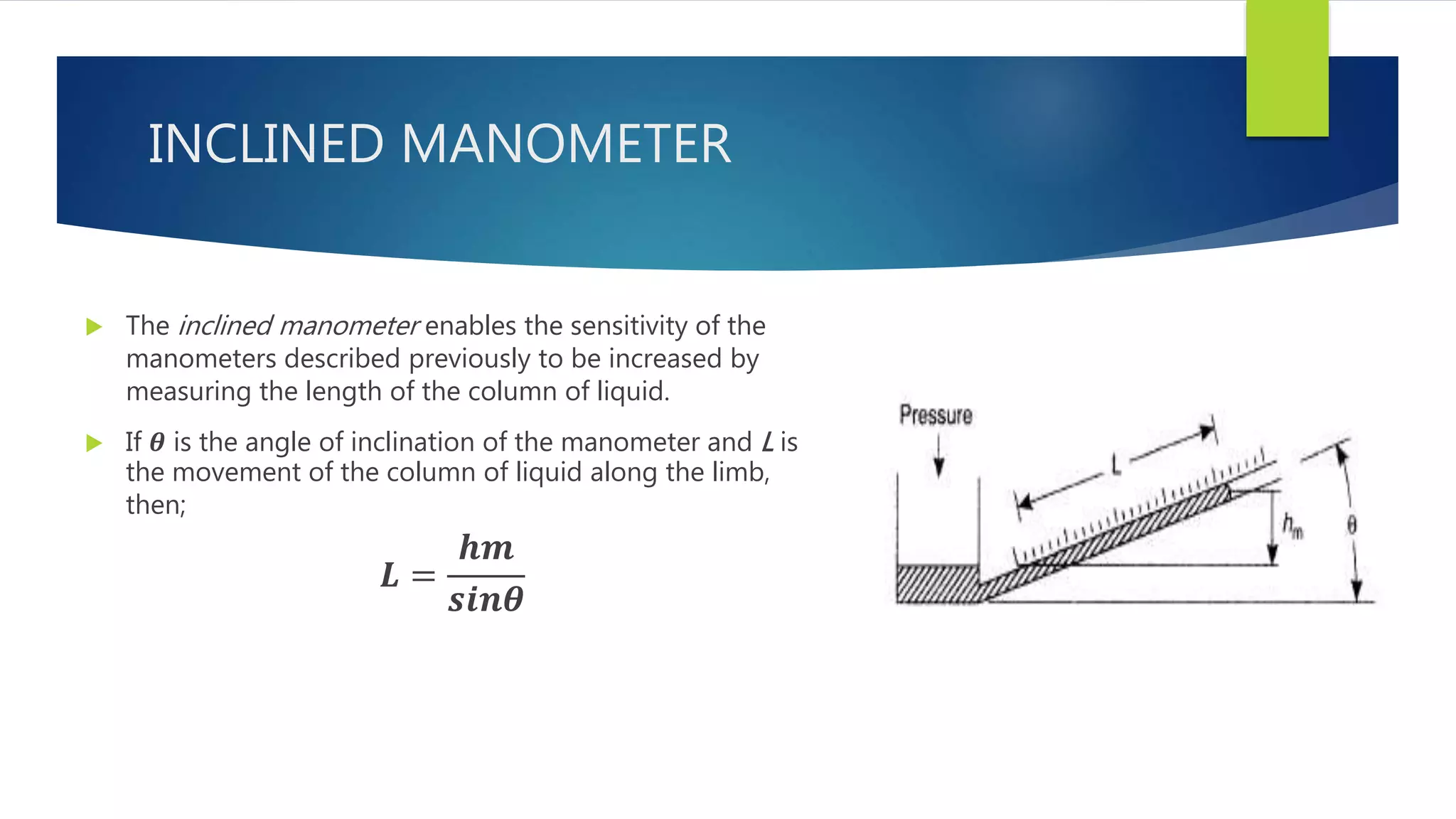
 The inclined manometer enables the sensitivity of the
manometers described previously to be increased by
measuring the length of the column of liquid.
 If 𝜽 is the angle of inclination of the manometer and L is
the movement of the column of liquid along the limb,
then;
𝑳 =
𝒉𝒎
𝒔𝒊𝒏𝜽
TWO LIQUID MANOMETER
 Small differences in pressure in gases are often measured with two liquid
manometer.
 It consists of reservoir at the top of each limb of a sufficiently large
cross-section for the liquid level to remain approximately the same on
each side of manometer.
 ∆𝑷 = 𝑷 𝟐 − 𝑷 𝟏 = 𝒉 𝒎 𝝆 𝒎𝟏 − 𝝆 𝒎𝟐 𝒈
 The sensitivity of the instrument is very high if the densities of the two
liquids are nearly the same.
 Liquids used: 1. Paraffin Oil and Industrial Alcohol
2. Benzyl Alcohol and Calcium Chloride
THANKS!

Manometer

  • 1.
  • 2.
    MANOMETERS  A manometeris an instrument that uses a column of liquid to measure pressure.  The manometer utilizes the hydrostatic (standing liquid) balance principle wherein a pressure is measured by the height of the liquid it will support.  There are many types of manometers, some of which are as follows:  Simple Manometer  Well Type Manometer  Inclined Manometer  Two liquid manometer
  • 3.
    SIMPLE MANOMETER  Itconsists of a transparent U-tube containing the fluid A of density p whose pressure is to be measured and an immiscible fluid B of higher density pm.  The limbs are connected to the two points between which the pressure difference (P2- P1) is required.  If P2 is greater than P1, the interface between the two liquids in limb 2 will be depressed a distance hm (say) below that in limb 1.  The pressure at the level a — a must be the same in each of the limbs and, therefore; 𝑷 𝟐 + 𝒛 𝒎 𝝆𝒈 = 𝑷 𝟏 + 𝒛 𝒎 − 𝒉 𝒎 𝝆𝒈 + 𝒉 𝒎 𝝆 𝒎 𝒈 ∆𝑷 = 𝑷 𝟐 − 𝑷 𝟏 = 𝒉 𝒎 𝝆 𝒎 − 𝝆 𝒈  If fluid A is a gas, ∆𝑷 = 𝒉 𝒎 𝝆 𝒎 𝒈
  • 4.
  • 5.
    WELL TYPE MANOMETER In order to avoid the inconvenience of having to read two limbs, the well-type manometer can be used.  If Aw and Ac are the cross-sectional areas of the well and the column and hm is the increase in the level of the column and hw the decrease in the level of the well, then; ∆𝑷 = 𝑷 𝟐 − 𝑷 𝟏 = 𝒉 𝒎 𝝆𝒈(𝟏 + 𝑨𝒄 𝑨𝒘 )
  • 6.
  • 7.
    INCLINED MANOMETER  Theinclined manometer enables the sensitivity of the manometers described previously to be increased by measuring the length of the column of liquid.  If 𝜽 is the angle of inclination of the manometer and L is the movement of the column of liquid along the limb, then; 𝑳 = 𝒉𝒎 𝒔𝒊𝒏𝜽
  • 8.
    TWO LIQUID MANOMETER Small differences in pressure in gases are often measured with two liquid manometer.  It consists of reservoir at the top of each limb of a sufficiently large cross-section for the liquid level to remain approximately the same on each side of manometer.  ∆𝑷 = 𝑷 𝟐 − 𝑷 𝟏 = 𝒉 𝒎 𝝆 𝒎𝟏 − 𝝆 𝒎𝟐 𝒈  The sensitivity of the instrument is very high if the densities of the two liquids are nearly the same.  Liquids used: 1. Paraffin Oil and Industrial Alcohol 2. Benzyl Alcohol and Calcium Chloride
  • 9.