FLUID
MECHANICS
LECTURENO. 6
PRESSURE
MEASUREMENT
(MANOMETERS)
PREP
AREDBY
:JAF
ARAALI
Jafar.dalo@koyauniversity.org
Oct. 2019
MEASU
REMEN
TOFPRESSU
RE
L
E
C
T
U
R
E6 2
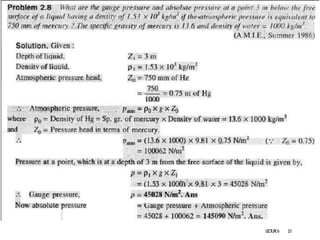
The pressure on a fluid is measured in different systems:
I. Absolute pressure: defined as the pressure which is
measured with reference to absolute vacuum
pressure.
II. Gaugepressure:defined asthepressurewhichis
measured with the help of a pressure measuring
instrument, in which the atmospheric pressure is taken
as datum. The atmospheric pressure on the scale is
marked as zero.
MEASU
REMEN
TOFPRESSU
RE
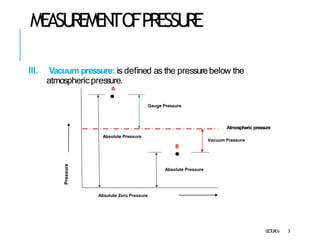
III. Vacuum pressure: is defined as the pressurebelow the
atmosphericpressure.
Absolute Pressure
A
L
E
C
T
U
R
E6 3
B
Gauge Pressure
Vacuum Pressure
Absolute Pressure
Absolute Zero Pressure
Pressure
Atmospheric pressure
MEASU
REMEN
TOFPRESSU
RE
L
E
C
T
U
R
E6 4
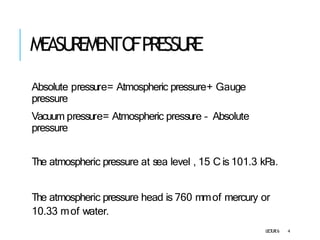
Absolute pressure= Atmospheric pressure+ Gauge
pressure
Vacuum pressure= Atmospheric pressure – Absolute
pressure
The atmospheric pressure at sea level , 15 C is 101.3 kP
a.
The atmospheric pressure head is 760 mmof mercury or
10.33 mof water.
MEASU
RIN
GDEV
IC
ES
L
E
C
T
U
R
E6 5
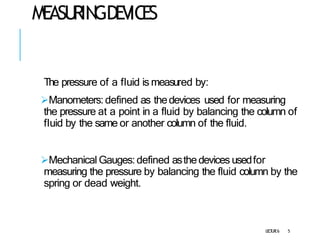
The pressure of a fluid is measured by:
Manometers:defined as thedevices used for measuring
the pressure at a point in a fluid by balancing the column of
fluid by the same or another column of the fluid.
Mechanical Gauges:defined asthedevices usedfor
measuring the pressure by balancing the fluid column by the
spring or dead weight.
MANOMETERS
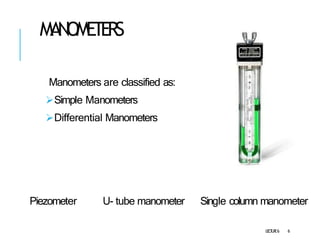
Manometers are classified as:
Simple Manometers
Differential Manometers
Piezometer U- tube manometer Single column manometer
L
E
C
T
U
R
E6 6
SIMPLEMAN
OMET
ER
L
E
C
T
U
R
E6 7
It consistsof a glasstube having oneof itsendsconnected
to a point where pressure is to be measured and other
end remains open to atmosphere.
The followings are types of simple manometer:
1. Piezometer
2. U- tube manometer
3. Single column manometer
PIEZOMETER
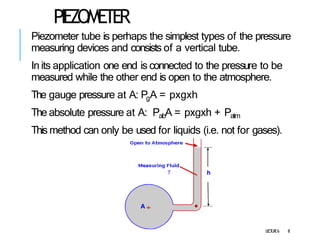
Piezometer tube is perhaps the simplest types of the pressure
measuring devices and consists of a vertical tube.
In its application one end is connected to the pressure to be
measured while the other end is open to the atmosphere.
The gauge pressure at A: PgA = pxgxh
The absolute pressure at A: PabA = pxgxh + Patm
This method can only be used for liquids (i.e. not for gases).
L
E
C
T
U
R
E6 8
U– T
U
BEMAN
OMET
ER
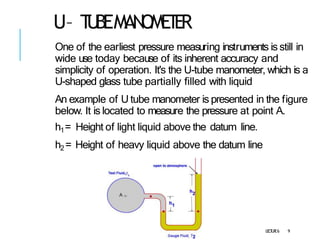
One of the earliest pressure measuring instruments is still in
wide use today because of its inherent accuracy and
simplicity of operation. It's the U-tube manometer, which is a
U-shaped glass tube partially filled with liquid
An example of U tube manometer is presented in the figure
below. It is located to measure the pressure at point A.
h1= Height of light liquid above the datum line.
h2 = Height of heavy liquid above the datum line
L
E
C
T
U
R
E6 9
G
AU
G
EAN
DV
AC
U
U
MPRESSU
RE
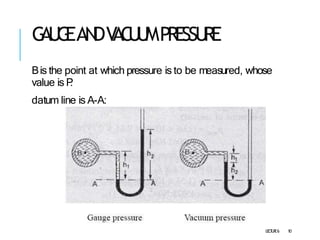
Bis the point at which pressure is to be measured, whose
value is P
.
datum line is A-A:
L
E
C
T
U
R
E6 10
U– T
U
BEMAN
OMET
ER
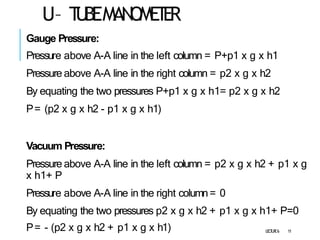
Gauge Pressure:
Pressure above A-A line in the left column = P+p1 x g x h1
Pressure above A-A line in the right column = p2 x g x h2
By equating the two pressures P+p1 x g x h1= p2 x g x h2
P= (p2 x g x h2 - p1 x g x h1)
Vacuum Pressure:
Pressure above A-A line in the left column = p2 x g x h2 + p1 x g
x h1+ P
Pressure above A-A line in the right column= 0
By equating the two pressures p2 x g x h2 + p1 x g x h1+ P=0
P= - (p2 x g x h2 + p1 x g x h1) L
E
C
T
U
R
E6 11
SIN
G
LEC
OL
U
MNMAN
OMET
ER
L
E
C
T
U
R
E6 12
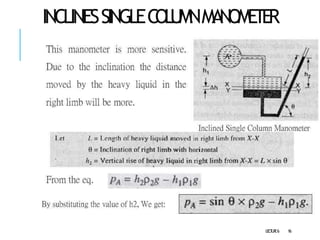
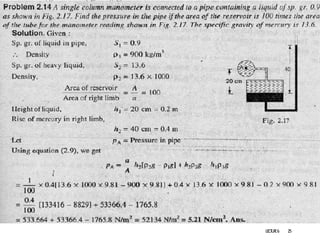
Single column manometer is a modified form of a U-tube
manometer in which one side is a large reservoir and the
other side is a small tube, open to the atmosphere.
There are two types of single column manometer:
1. Vertical single column manometer.
2. Inclined single columnmanometer.
VER
T
IC
ALSIN
G
LEC
OL
U
MNMAN
OMET
ER
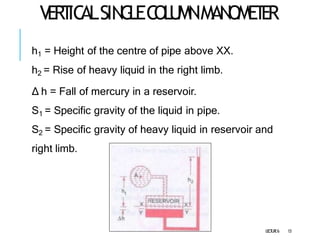
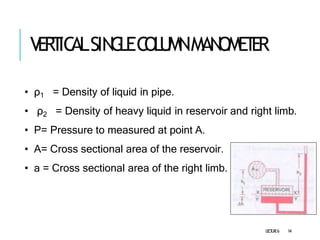
h1 = Height of the centre of pipe above XX.
h2 = Rise of heavy liquid in the right limb.
Δ h = Fall of mercury in a reservoir.
S1 = Specific gravity of the liquid in pipe.
S2 = Specific gravity of heavy liquid in reservoir and
right limb.
L
E
C
T
U
R
E6 13
• ρ1 = Density of liquid in pipe.
• ρ2 = Density of heavy liquid in reservoir and right limb.
• P= Pressure to measured at point A.
• A= Cross sectional area of the reservoir.
• a = Cross sectional area of the right limb.
L
E
C
T
U
R
E6 14
V
ER
T
IC
ALSIN
G
LEC
OL
U
MNMAN
OMET
ER
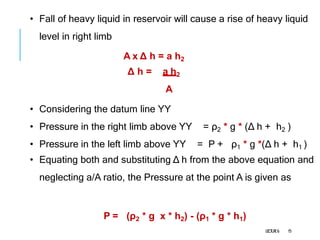
• Fall of heavy liquid in reservoir will cause a rise of heavy liquid
level in right limb
A x Δ h = a h2
Δ h = a h2
A
L
E
C
T
U
R
E6 15
• Considering the datum line YY
• Pressure in the right limb above YY
• Pressure in the left limb above YY
= ρ2 * g * (Δ h + h2 )
= P + ρ1 * g *(Δ h + h1 )
• Equating both and substituting Δ h from the above equation and
neglecting a/A ratio, the Pressure at the point A is given as
P = (ρ2 * g x * h2) - (ρ1 * g * h1)
INCLINESSINGLEC
O
L
U
M
NMANOMETER
L
E
C
T
U
R
E6 16
DIFFEREN
T
IALMAN
OMET
ER
L
E
C
T
U
R
E6 17
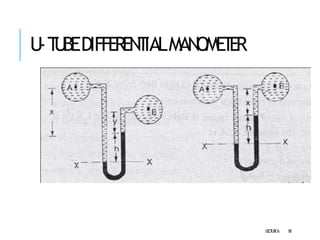
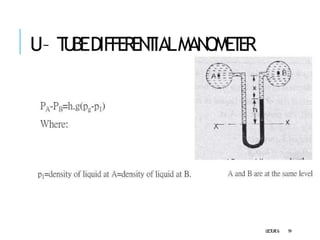
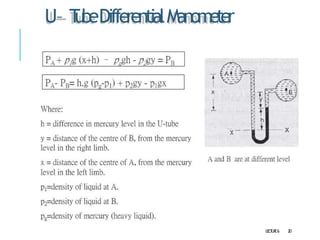
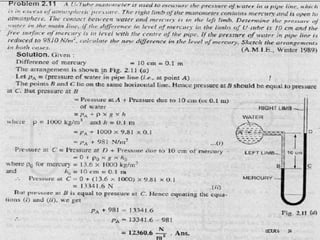
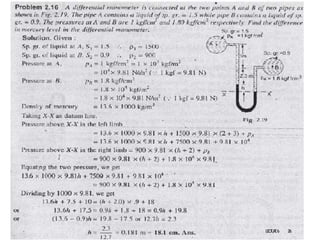
Differential Manometersare devices usedform measuring
the difference of pressure between two points in a pipe or
in two different pipes. A differential manometer consists of
a U- tube, containing a heavy liquid, whosetwo endsare
connectedto thepoints,whichdifference of pressureis to
be measure.
Most commonly types of differential manometers are:
1. U-tube differential manometer.
2. Inverted U-tube differential manometer.
U
-T
U
BEDIFFEREN
T
IALMAN
OMET
ER
L
E
C
T
U
R
E6 18
U– T
U
BEDIFFEREN
T
IALMAN
OMET
ER
L
E
C
T
U
R
E6 19
U– T
ubeDifferentialManometer
L
E
C
T
U
R
E6 20
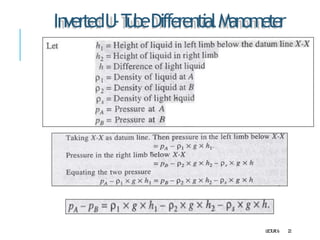
IN
V
ER
T
EDU
-T
U
BEMAN
OMET
ER
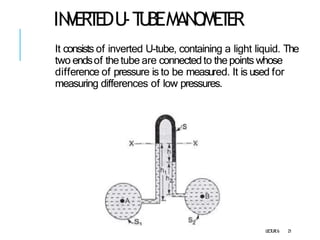
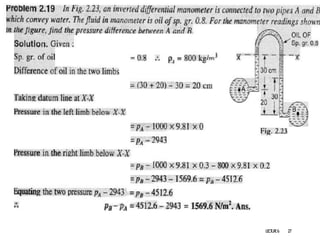
It consists of inverted U-tube, containing a light liquid. The
two endsof thetube are connectedto thepoints whose
difference of pressure is to be measured. It is used for
measuring differences of low pressures.
L
E
C
T
U
R
E6 21
InvertedU
-T
ubeDifferentialManometer
L
E
C
T
U
R
E6 22
L
E
C
T
U
R
E6 23
L
E
C
T
U
R
E6 24
L
E
C
T
U
R
E6 25
L
E
C
T
U
R
E6 26
L
E
C
T
U
R
E6 27

Lecture 6 Manometers.pptx

  • 1.
  • 2.
    MEASU REMEN TOFPRESSU RE L E C T U R E6 2 The pressureon a fluid is measured in different systems: I. Absolute pressure: defined as the pressure which is measured with reference to absolute vacuum pressure. II. Gaugepressure:defined asthepressurewhichis measured with the help of a pressure measuring instrument, in which the atmospheric pressure is taken as datum. The atmospheric pressure on the scale is marked as zero.
  • 3.
    MEASU REMEN TOFPRESSU RE III. Vacuum pressure:is defined as the pressurebelow the atmosphericpressure. Absolute Pressure A L E C T U R E6 3 B Gauge Pressure Vacuum Pressure Absolute Pressure Absolute Zero Pressure Pressure Atmospheric pressure
  • 4.
    MEASU REMEN TOFPRESSU RE L E C T U R E6 4 Absolute pressure=Atmospheric pressure+ Gauge pressure Vacuum pressure= Atmospheric pressure – Absolute pressure The atmospheric pressure at sea level , 15 C is 101.3 kP a. The atmospheric pressure head is 760 mmof mercury or 10.33 mof water.
  • 5.
    MEASU RIN GDEV IC ES L E C T U R E6 5 The pressureof a fluid is measured by: Manometers:defined as thedevices used for measuring the pressure at a point in a fluid by balancing the column of fluid by the same or another column of the fluid. Mechanical Gauges:defined asthedevices usedfor measuring the pressure by balancing the fluid column by the spring or dead weight.
  • 6.
    MANOMETERS Manometers are classifiedas: Simple Manometers Differential Manometers Piezometer U- tube manometer Single column manometer L E C T U R E6 6
  • 7.
    SIMPLEMAN OMET ER L E C T U R E6 7 It consistsofa glasstube having oneof itsendsconnected to a point where pressure is to be measured and other end remains open to atmosphere. The followings are types of simple manometer: 1. Piezometer 2. U- tube manometer 3. Single column manometer
  • 8.
    PIEZOMETER Piezometer tube isperhaps the simplest types of the pressure measuring devices and consists of a vertical tube. In its application one end is connected to the pressure to be measured while the other end is open to the atmosphere. The gauge pressure at A: PgA = pxgxh The absolute pressure at A: PabA = pxgxh + Patm This method can only be used for liquids (i.e. not for gases). L E C T U R E6 8
  • 9.
    U– T U BEMAN OMET ER One ofthe earliest pressure measuring instruments is still in wide use today because of its inherent accuracy and simplicity of operation. It's the U-tube manometer, which is a U-shaped glass tube partially filled with liquid An example of U tube manometer is presented in the figure below. It is located to measure the pressure at point A. h1= Height of light liquid above the datum line. h2 = Height of heavy liquid above the datum line L E C T U R E6 9
  • 10.
    G AU G EAN DV AC U U MPRESSU RE Bis the pointat which pressure is to be measured, whose value is P . datum line is A-A: L E C T U R E6 10
  • 11.
    U– T U BEMAN OMET ER Gauge Pressure: Pressureabove A-A line in the left column = P+p1 x g x h1 Pressure above A-A line in the right column = p2 x g x h2 By equating the two pressures P+p1 x g x h1= p2 x g x h2 P= (p2 x g x h2 - p1 x g x h1) Vacuum Pressure: Pressure above A-A line in the left column = p2 x g x h2 + p1 x g x h1+ P Pressure above A-A line in the right column= 0 By equating the two pressures p2 x g x h2 + p1 x g x h1+ P=0 P= - (p2 x g x h2 + p1 x g x h1) L E C T U R E6 11
  • 12.
    SIN G LEC OL U MNMAN OMET ER L E C T U R E6 12 Single columnmanometer is a modified form of a U-tube manometer in which one side is a large reservoir and the other side is a small tube, open to the atmosphere. There are two types of single column manometer: 1. Vertical single column manometer. 2. Inclined single columnmanometer.
  • 13.
    VER T IC ALSIN G LEC OL U MNMAN OMET ER h1 = Heightof the centre of pipe above XX. h2 = Rise of heavy liquid in the right limb. Δ h = Fall of mercury in a reservoir. S1 = Specific gravity of the liquid in pipe. S2 = Specific gravity of heavy liquid in reservoir and right limb. L E C T U R E6 13
  • 14.
    • ρ1 =Density of liquid in pipe. • ρ2 = Density of heavy liquid in reservoir and right limb. • P= Pressure to measured at point A. • A= Cross sectional area of the reservoir. • a = Cross sectional area of the right limb. L E C T U R E6 14 V ER T IC ALSIN G LEC OL U MNMAN OMET ER
  • 15.
    • Fall ofheavy liquid in reservoir will cause a rise of heavy liquid level in right limb A x Δ h = a h2 Δ h = a h2 A L E C T U R E6 15 • Considering the datum line YY • Pressure in the right limb above YY • Pressure in the left limb above YY = ρ2 * g * (Δ h + h2 ) = P + ρ1 * g *(Δ h + h1 ) • Equating both and substituting Δ h from the above equation and neglecting a/A ratio, the Pressure at the point A is given as P = (ρ2 * g x * h2) - (ρ1 * g * h1)
  • 16.
  • 17.
    DIFFEREN T IALMAN OMET ER L E C T U R E6 17 Differential Manometersaredevices usedform measuring the difference of pressure between two points in a pipe or in two different pipes. A differential manometer consists of a U- tube, containing a heavy liquid, whosetwo endsare connectedto thepoints,whichdifference of pressureis to be measure. Most commonly types of differential manometers are: 1. U-tube differential manometer. 2. Inverted U-tube differential manometer.
  • 18.
  • 19.
  • 20.
  • 21.
    IN V ER T EDU -T U BEMAN OMET ER It consists ofinverted U-tube, containing a light liquid. The two endsof thetube are connectedto thepoints whose difference of pressure is to be measured. It is used for measuring differences of low pressures. L E C T U R E6 21
  • 22.
  • 23.
  • 24.
  • 25.
  • 26.
  • 27.