COMPACT FLUORESCENT LAMP (CFL)
INTRODUCTION:
Man has been aware of fluorescence for hundreds of years, but was unable to put
it to practical use for lighting until Thomas Edison was granted a patent for the
fluorescent lamp in 1907. The fluorescent lamp is an electric lamp consisting of a
glass tube, coated on the inside with a fluorescent substance that gives off light
when acted upon by electricity. Fluorescent lamps and incandescent lamps are the
two major sources of electric light today. However, fluorescent lamps produce 3.5
times as much light per watt, have much longer lives and often cost less than the
corresponding models of incandescent lamps. Consequently, fluorescent lamps are
commonly used in offices, factories, classrooms, restaurants, and libraries, as well
as a number of other public buildings.
Typical fluorescent lamps consist of a long glass tube that seals the inner
components from atmosphere. These inner components include two electrodes that
emit a flow of electrons; mercury vapor, which is the source of ultraviolet
radiation; argon gas, which helps in starting the lamp, and of course fluorescent
power coating on the inner surface of the tube; and compact energy saving
fluorescent lamp contains ballast.
Manufactures of light bulbs are constantly trying to lower the costs of
production. As a leading manufacturer of fluorescent lamps, Taiwan has played an
important role in helping to develop the technology and automated machinery
necessary to keep those products costs down.
Consequently, the manufacturers in Taiwan can help entrepreneurs by
supplying them with the machinery and technology needed to produce more
economical and efficient fluorescent light bulbs.
The production of fluorescent lamps is done in four stages. Most of the work is
done by automatic machinery, so only a minimal number of workers are required.
The four stages of production are:
RAW MATERIAL:
1. Low Sodium Lead free glass tube
2. Exhaust Tube
3. Lead in wire
4. Filament
5. Phosphorus:Three band phosphors;AT, Y, EU
6. Emittor (Oxide): Carbonate suspension
7. Cane glass for beads mount
8. Main Amalgam 2.30±0.10 mm
9. Sub Amalgam net
10. Mercury 99.999%
11. Argon gas 99.999%
12. Base cement (per customer’s standard)
13. Base
MANUFACTURING PROCESS:
(1) Mount Making
Three machines are used to make mounts. This machinery can be used to
make stems for many types of lamps:
a. Flare Making Machine:
A specially designed machine with 12 heads located around the edge of
turntable flanges tubes of glass into flares. The flare is separated from the glass /
tubing by a flame which polishes the surface of the glass as it cuts it.
b. Stem Making Machine:
Exhaust tubes and lead-in wires from presorted hoppers are, along with the
flares, fed into the stem making machine, which automatically forms the stems.
c. Mounting Machine:
The stems are forwarded to the mounting machine, where oxidized, tungsten
wire filaments are attached, thus completing the mount making process.
(2) Glass Tube Preparation
1. Glass tubes of the appropriate length are placed in the washing and coating
machine. This machine uses hot water and hot air to wash and dry the glass tubes
before the inner walls of the tubes are coated with fluorescent powder.
2. After being coated with fluorescent powder the tubes are automatically
unloaded onto a roller conveyor which transports them through an oven and the
through a cooling chamber. As the tubes pass through the oven, the fluorescent
coating is baked on to the tubes.
3. As they pass through the cooling chamber, two end-cleaning machines
automatically brush the fluorescent coating from the ends of the tubes. The
conveyor then transports the tubes to the sealing machine for final assembly.
(3) Base Preparation
a. The required portions of the ingredients needed to make the sealing
compound are mixed together in a cement-mixing machine.
b. The sealing compound is then dispensed into the bases of the lamps by an
automatic filling machine. The bases are then forwarded to the basing machine for
final assembly.
(4) Assembly
The mounts, glass tubes, and the cement filled bases are then assembled into
finished products.
PROCESS FLOW CHART:
MANUFACTURING MACHINES:
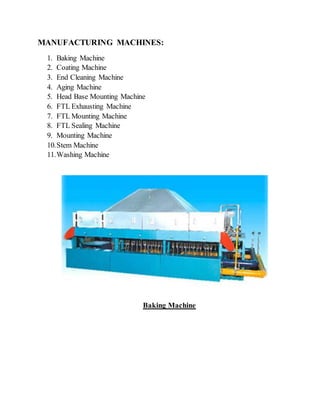
1. Baking Machine
2. Coating Machine
3. End Cleaning Machine
4. Aging Machine
5. Head Base Mounting Machine
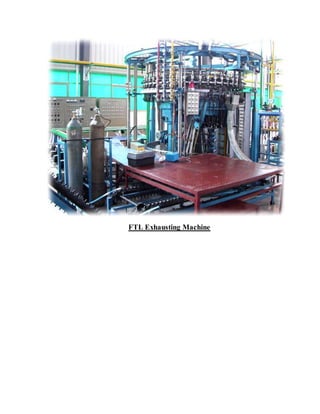
6. FTL Exhausting Machine
7. FTL Mounting Machine
8. FTL Sealing Machine
9. Mounting Machine
10.Stem Machine
11.Washing Machine
Baking Machine
Coating Machine
End Cleaning Machine
Aging Machine
Head Base Mouting Machine
FTL Exhausting Machine
FTL Mounting Machine
FTL Sealing Machine
Mounting Machine
Stem Machine
Washing Machine
MARKET POTENTIAL:
The average rated life of a CFLis between 8 and 15 times that of incandescent.
CFLs typically have a rated life-span of between 6,000 and 15,000 hours, whereas
incandescent lamps are usually manufactured to have a lifespan of 750 hours or
1,000 hours. For a given light output, CFLs use 20 to 33 percent of the power of
equivalent incandescent lamps.
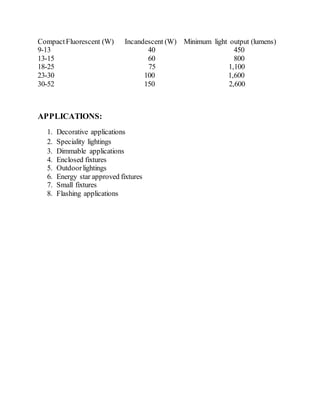
Electrical power equivalents for differing lamps
CompactFluorescent (W) Incandescent (W) Minimum light output (lumens)
9-13 40 450
13-15 60 800
18-25 75 1,100
23-30 100 1,600
30-52 150 2,600
APPLICATIONS:
1. Decorative applications
2. Speciality lightings
3. Dimmable applications
4. Enclosed fixtures
5. Outdoorlightings
6. Energy star approved fixtures
7. Small fixtures
8. Flashing applications

CFL (Compact Fluorescent Lamp) Report

  • 1.
    COMPACT FLUORESCENT LAMP(CFL) INTRODUCTION: Man has been aware of fluorescence for hundreds of years, but was unable to put it to practical use for lighting until Thomas Edison was granted a patent for the fluorescent lamp in 1907. The fluorescent lamp is an electric lamp consisting of a glass tube, coated on the inside with a fluorescent substance that gives off light when acted upon by electricity. Fluorescent lamps and incandescent lamps are the two major sources of electric light today. However, fluorescent lamps produce 3.5 times as much light per watt, have much longer lives and often cost less than the corresponding models of incandescent lamps. Consequently, fluorescent lamps are commonly used in offices, factories, classrooms, restaurants, and libraries, as well as a number of other public buildings. Typical fluorescent lamps consist of a long glass tube that seals the inner components from atmosphere. These inner components include two electrodes that emit a flow of electrons; mercury vapor, which is the source of ultraviolet radiation; argon gas, which helps in starting the lamp, and of course fluorescent power coating on the inner surface of the tube; and compact energy saving fluorescent lamp contains ballast. Manufactures of light bulbs are constantly trying to lower the costs of production. As a leading manufacturer of fluorescent lamps, Taiwan has played an important role in helping to develop the technology and automated machinery necessary to keep those products costs down. Consequently, the manufacturers in Taiwan can help entrepreneurs by supplying them with the machinery and technology needed to produce more economical and efficient fluorescent light bulbs. The production of fluorescent lamps is done in four stages. Most of the work is done by automatic machinery, so only a minimal number of workers are required. The four stages of production are:
  • 2.
    RAW MATERIAL: 1. LowSodium Lead free glass tube 2. Exhaust Tube 3. Lead in wire 4. Filament 5. Phosphorus:Three band phosphors;AT, Y, EU 6. Emittor (Oxide): Carbonate suspension 7. Cane glass for beads mount 8. Main Amalgam 2.30±0.10 mm 9. Sub Amalgam net 10. Mercury 99.999% 11. Argon gas 99.999% 12. Base cement (per customer’s standard) 13. Base MANUFACTURING PROCESS: (1) Mount Making Three machines are used to make mounts. This machinery can be used to make stems for many types of lamps: a. Flare Making Machine: A specially designed machine with 12 heads located around the edge of turntable flanges tubes of glass into flares. The flare is separated from the glass / tubing by a flame which polishes the surface of the glass as it cuts it.
  • 3.
    b. Stem MakingMachine: Exhaust tubes and lead-in wires from presorted hoppers are, along with the flares, fed into the stem making machine, which automatically forms the stems. c. Mounting Machine: The stems are forwarded to the mounting machine, where oxidized, tungsten wire filaments are attached, thus completing the mount making process. (2) Glass Tube Preparation 1. Glass tubes of the appropriate length are placed in the washing and coating machine. This machine uses hot water and hot air to wash and dry the glass tubes before the inner walls of the tubes are coated with fluorescent powder. 2. After being coated with fluorescent powder the tubes are automatically unloaded onto a roller conveyor which transports them through an oven and the through a cooling chamber. As the tubes pass through the oven, the fluorescent coating is baked on to the tubes. 3. As they pass through the cooling chamber, two end-cleaning machines automatically brush the fluorescent coating from the ends of the tubes. The conveyor then transports the tubes to the sealing machine for final assembly. (3) Base Preparation a. The required portions of the ingredients needed to make the sealing compound are mixed together in a cement-mixing machine. b. The sealing compound is then dispensed into the bases of the lamps by an automatic filling machine. The bases are then forwarded to the basing machine for final assembly.
  • 4.
    (4) Assembly The mounts,glass tubes, and the cement filled bases are then assembled into finished products. PROCESS FLOW CHART:
  • 6.
    MANUFACTURING MACHINES: 1. BakingMachine 2. Coating Machine 3. End Cleaning Machine 4. Aging Machine 5. Head Base Mounting Machine 6. FTL Exhausting Machine 7. FTL Mounting Machine 8. FTL Sealing Machine 9. Mounting Machine 10.Stem Machine 11.Washing Machine Baking Machine
  • 7.
  • 8.
    Aging Machine Head BaseMouting Machine
  • 9.
  • 10.
    FTL Mounting Machine FTLSealing Machine
  • 11.
  • 12.
    Washing Machine MARKET POTENTIAL: Theaverage rated life of a CFLis between 8 and 15 times that of incandescent. CFLs typically have a rated life-span of between 6,000 and 15,000 hours, whereas incandescent lamps are usually manufactured to have a lifespan of 750 hours or 1,000 hours. For a given light output, CFLs use 20 to 33 percent of the power of equivalent incandescent lamps. Electrical power equivalents for differing lamps
  • 13.
    CompactFluorescent (W) Incandescent(W) Minimum light output (lumens) 9-13 40 450 13-15 60 800 18-25 75 1,100 23-30 100 1,600 30-52 150 2,600 APPLICATIONS: 1. Decorative applications 2. Speciality lightings 3. Dimmable applications 4. Enclosed fixtures 5. Outdoorlightings 6. Energy star approved fixtures 7. Small fixtures 8. Flashing applications