Manometer are device used to measure the pressure difference values.
Types of Manometer
1.Simple Manometer
2.Differential Manometer
3.Inclined tube manometer
Manometer
A simple manometer is a tube gauge for measuring high as well as
negative pressures.
It is the simplest form, having a U shaped bent tube, one end of
which is attached to the gauge point and the other end is open to
the atmosphere.
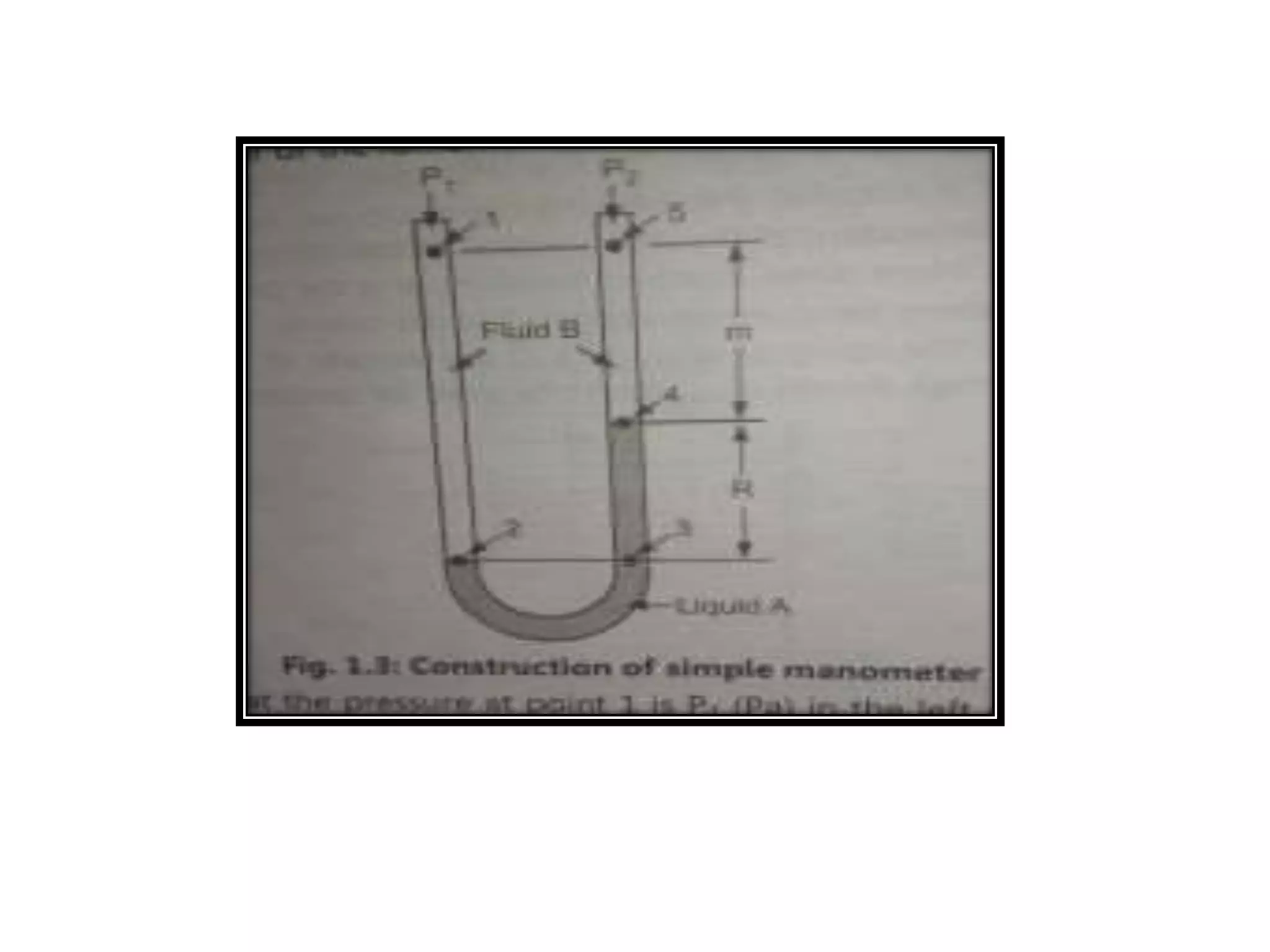
The construction of a simple manometer is shown in Fig.
The U shaped glass tube is filled with a liquid (A) of density,
ρA, kg/m3.
Above liquid A, the tube arms are filled with a lighter liquid B of
density ρB, kg/m.
Both the liquids are immiscible and the junction interface is clearly
visible. Generally, liquid A is mercury which is 13.6 times denser
than water and therefore, suitable for measuring high pressures also.
When two different pressures are applied to the arms of manometer,
the liquid A shows a movement so that the meniscus in both the arms
is at different levels. Consider various This manom
points (1 to 5) in the center of the lumen of U tube at different
distances as shown in Fig. 1.3.
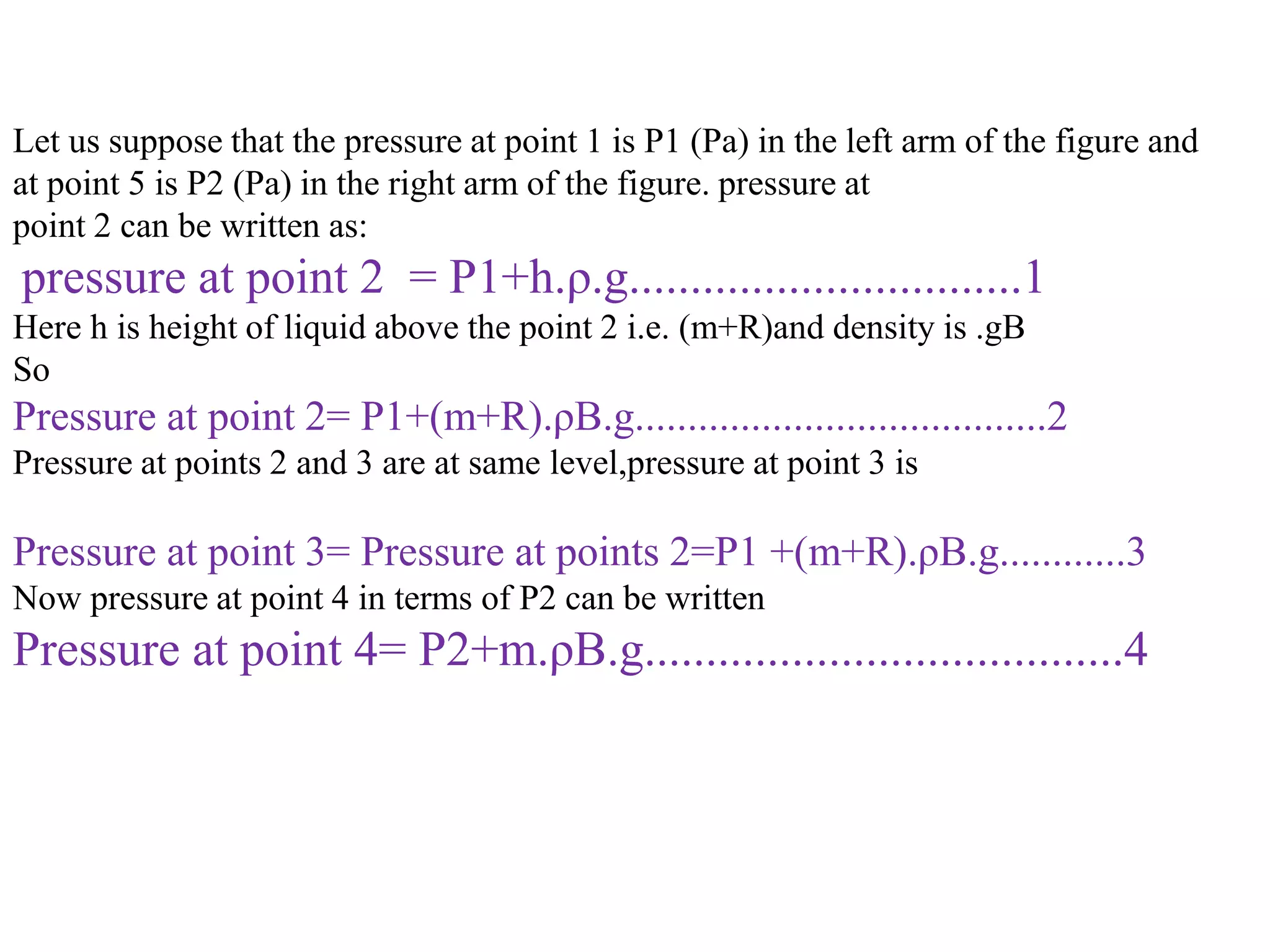
Let us suppose that the pressure at point 1 is P1 (Pa) in the left arm of the figure and
at point 5 is P2 (Pa) in the right arm of the figure. pressure at
point 2 can be written as:
pressure at point 2 = P1+h.ρ.g................................1
Here h is height of liquid above the point 2 i.e. (m+R)and density is .gB
So
Pressure at point 2= P1+(m+R).ρB.g.......................................2
Pressure at points 2 and 3 are at same level,pressure at point 3 is
Pressure at point 3= Pressure at points 2=P1 +(m+R).ρB.g............3
Now pressure at point 4 in terms of P2 can be written
Pressure at point 4= P2+m.ρB.g.......................................4
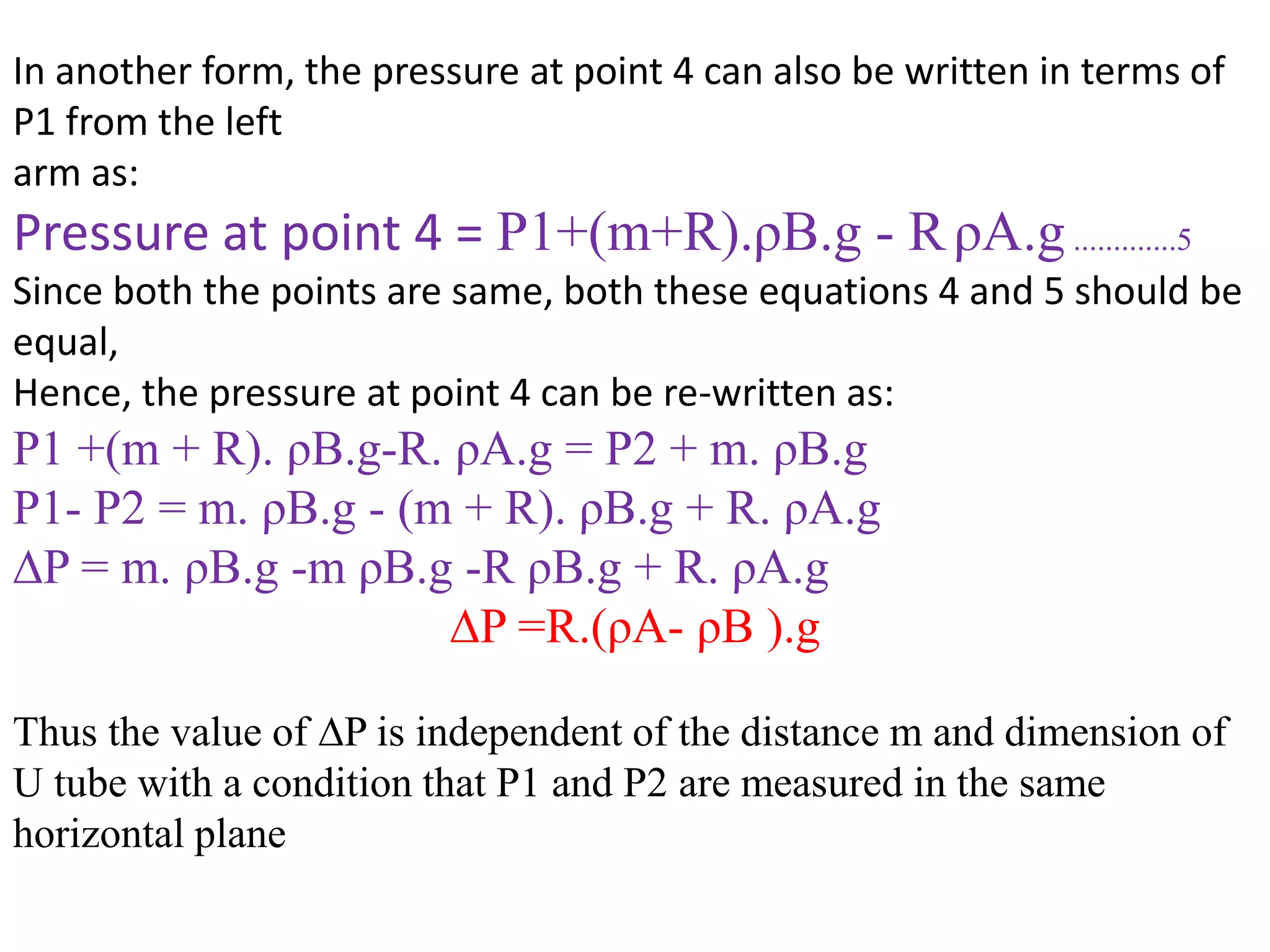
In another form, the pressure at point 4 can also be written in terms of
P1 from the left
arm as:
Pressure at point 4 = P1+(m+R).ρB.g - RρA.g.............5
Since both the points are same, both these equations 4 and 5 should be
equal,
Hence, the pressure at point 4 can be re-written as:
P1 +(m + R). ρB.g-R. ρA.g = P2 + m. ρB.g
P1- P2 = m. ρB.g - (m + R). ρB.g + R. ρA.g
∆P = m. ρB.g -m ρB.g -R ρB.g + R. ρA.g
∆P =R.(ρA- ρB ).g
Thus the value of ∆P is independent of the distance m and dimension of
U tube with a condition that P1 and P2 are measured in the same
horizontal plane
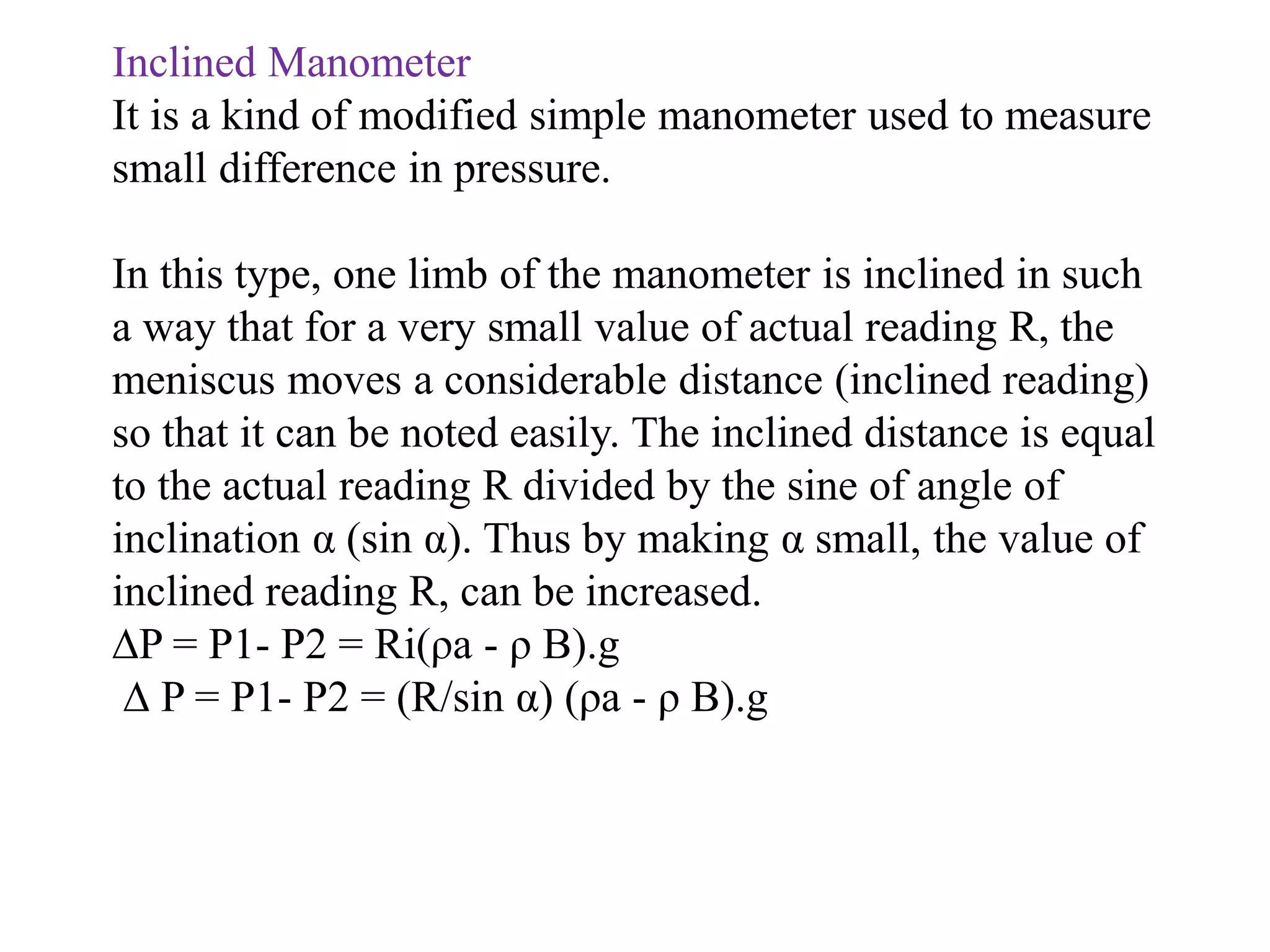
Inclined Manometer
It is a kind of modified simple manometer used to measure
small difference in pressure.
In this type, one limb of the manometer is inclined in such
a way that for a very small value of actual reading R, the
meniscus moves a considerable distance (inclined reading)
so that it can be noted easily. The inclined distance is equal
to the actual reading R divided by the sine of angle of
inclination α (sin α). Thus by making α small, the value of
inclined reading R, can be increased.
∆P = P1- P2 = Ri(ρa - ρ B).g
∆ P = P1- P2 = (R/sin α) (ρa - ρ B).g
Manometer

Manometer

  • 1.
    Manometer are deviceused to measure the pressure difference values. Types of Manometer 1.Simple Manometer 2.Differential Manometer 3.Inclined tube manometer Manometer
  • 3.
    A simple manometeris a tube gauge for measuring high as well as negative pressures. It is the simplest form, having a U shaped bent tube, one end of which is attached to the gauge point and the other end is open to the atmosphere. The construction of a simple manometer is shown in Fig. The U shaped glass tube is filled with a liquid (A) of density, ρA, kg/m3. Above liquid A, the tube arms are filled with a lighter liquid B of density ρB, kg/m.
  • 4.
    Both the liquidsare immiscible and the junction interface is clearly visible. Generally, liquid A is mercury which is 13.6 times denser than water and therefore, suitable for measuring high pressures also. When two different pressures are applied to the arms of manometer, the liquid A shows a movement so that the meniscus in both the arms is at different levels. Consider various This manom points (1 to 5) in the center of the lumen of U tube at different distances as shown in Fig. 1.3.
  • 5.
    Let us supposethat the pressure at point 1 is P1 (Pa) in the left arm of the figure and at point 5 is P2 (Pa) in the right arm of the figure. pressure at point 2 can be written as: pressure at point 2 = P1+h.ρ.g................................1 Here h is height of liquid above the point 2 i.e. (m+R)and density is .gB So Pressure at point 2= P1+(m+R).ρB.g.......................................2 Pressure at points 2 and 3 are at same level,pressure at point 3 is Pressure at point 3= Pressure at points 2=P1 +(m+R).ρB.g............3 Now pressure at point 4 in terms of P2 can be written Pressure at point 4= P2+m.ρB.g.......................................4
  • 6.
    In another form,the pressure at point 4 can also be written in terms of P1 from the left arm as: Pressure at point 4 = P1+(m+R).ρB.g - RρA.g.............5 Since both the points are same, both these equations 4 and 5 should be equal, Hence, the pressure at point 4 can be re-written as: P1 +(m + R). ρB.g-R. ρA.g = P2 + m. ρB.g P1- P2 = m. ρB.g - (m + R). ρB.g + R. ρA.g ∆P = m. ρB.g -m ρB.g -R ρB.g + R. ρA.g ∆P =R.(ρA- ρB ).g Thus the value of ∆P is independent of the distance m and dimension of U tube with a condition that P1 and P2 are measured in the same horizontal plane
  • 7.
    Inclined Manometer It isa kind of modified simple manometer used to measure small difference in pressure. In this type, one limb of the manometer is inclined in such a way that for a very small value of actual reading R, the meniscus moves a considerable distance (inclined reading) so that it can be noted easily. The inclined distance is equal to the actual reading R divided by the sine of angle of inclination α (sin α). Thus by making α small, the value of inclined reading R, can be increased. ∆P = P1- P2 = Ri(ρa - ρ B).g ∆ P = P1- P2 = (R/sin α) (ρa - ρ B).g