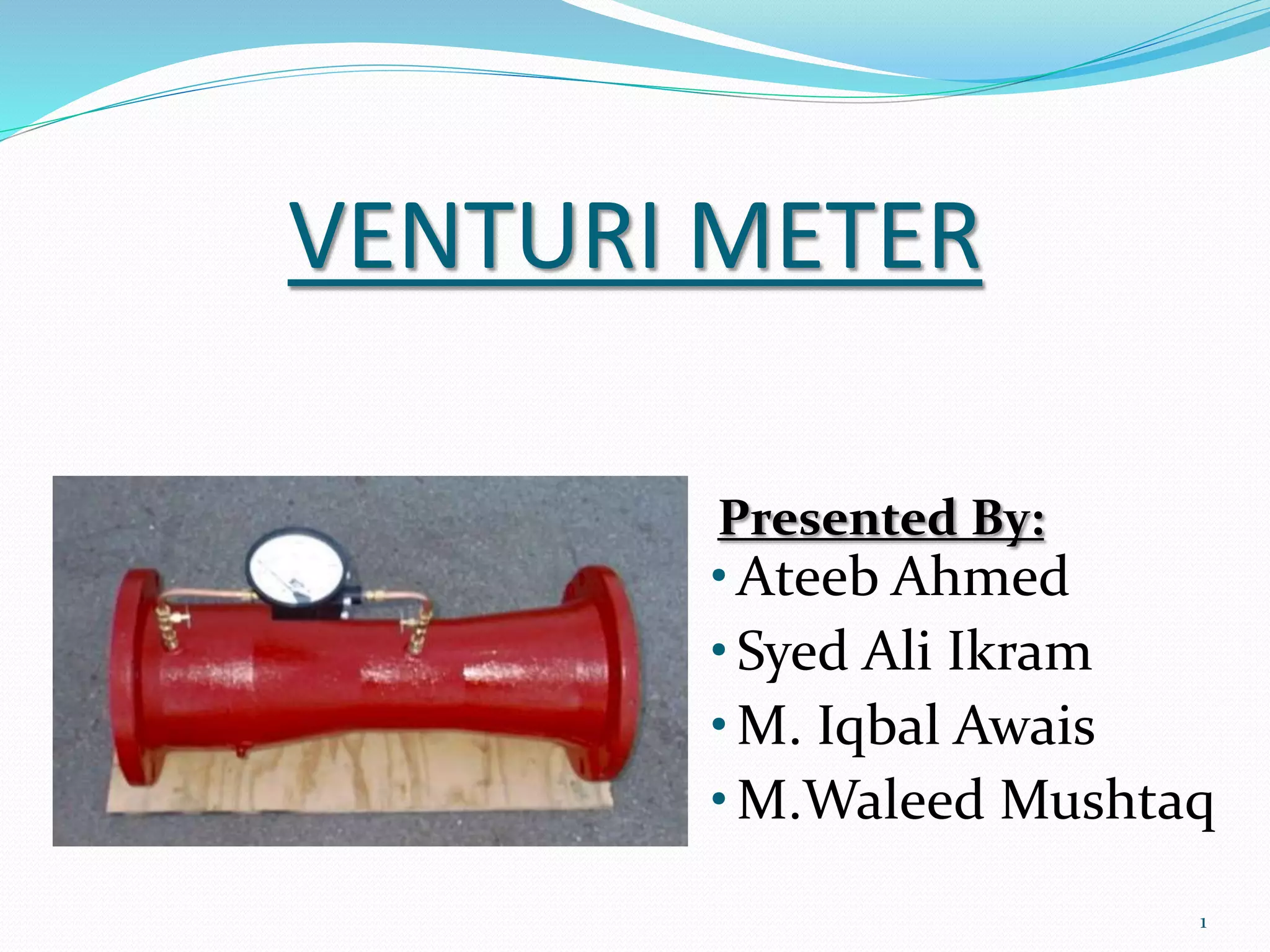
VENTURI METER
Presented By:
•Ateeb Ahmed
•Syed Ali Ikram
•M. Iqbal Awais
•M.Waleed Mushtaq
1
Flow measuring devices:
 The measurement of fluid flow is important in
applications ranging from measurements of blood-
flow rates in human artery to the measurement of
liquid oxygen in a rocket.
 Some sort of restriction is placed in the pipe or duct
carrying the fluid. This flow restriction causes a
pressure drop that varies with the flow rate.
2
Venturi Meter:
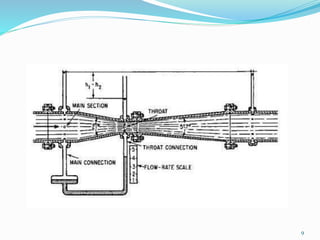
 A venturi meter is a variable head meter, which is used
for measuring the flow rate of a fluid through a pipe.
 In this meter, the fluid is gradually accelerated to a
throat and then gradually retarded in diverging section
where the flow channel expands to the pipe size.
 Venturi meters have only a small head loss, no moving
parts and do not clog easily.
3
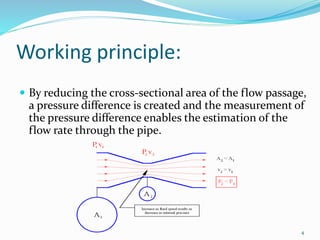
Working principle:
 By reducing the cross-sectional area of the flow passage,
a pressure difference is created and the measurement of
the pressure difference enables the estimation of the
flow rate through the pipe.
4
Oggy and the cockroaches
5
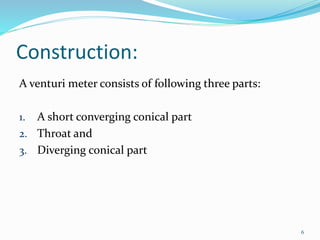
Construction:
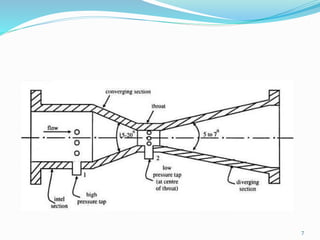
A venturi meter consists of following three parts:
1. A short converging conical part
2. Throat and
3. Diverging conical part
6
7
8
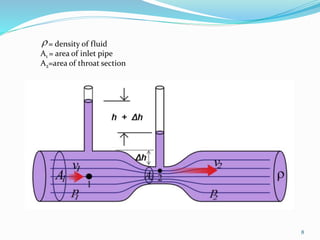
= density of fluid
A1 = area of inlet pipe
A2=area of throat section

9
Coefficient of discharge:
 Ratio of Actual mass or volumetric flow rate to
theoretical mass or volumetric rate .
 It encompasses all the energy losses taking place
during flow through venturi meter.
 Its value depends upon the reynolds number and
ranges from 0.95 to 0.98
10
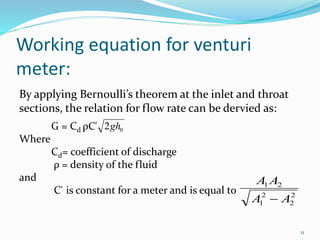
Working equation for venturi
meter:
G = Cd ρC ́
Where
Cd= coefficient of discharge
ρ = density of the fluid
and
C ́ is constant for a meter and is equal to 2
2
2
1
21
AA
AA

By applying Bernoulli’s theorem at the inlet and throat
sections, the relation for flow rate can be dervied as:
02gh
11
Applications:
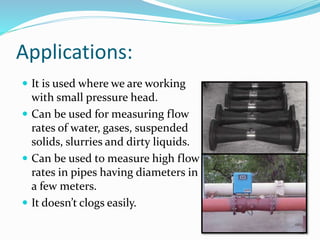
 It is used where we are working
with small pressure head.
 Can be used for measuring flow
rates of water, gases, suspended
solids, slurries and dirty liquids.
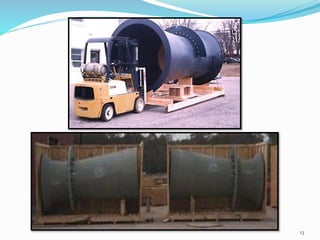
 Can be used to measure high flow
rates in pipes having diameters in
a few meters.
 It doesn’t clogs easily.
12
13
Limitations:
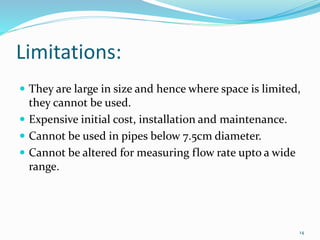
 They are large in size and hence where space is limited,
they cannot be used.
 Expensive initial cost, installation and maintenance.
 Cannot be used in pipes below 7.5cm diameter.
 Cannot be altered for measuring flow rate upto a wide
range.
14
References:
 Unit Operations of Chemical Engineering -7e by
Mccabe
 industrial instrumentation and control by sk singh
 Coulson & Richardson's Chemical Engineering
Fluid flow, heat transfer and mass transfer.
Volume 1
 And our very own
www.google.com
15
Any Queries ?
16

venturi_meter ppt(2)

  • 1.
    VENTURI METER Presented By: •AteebAhmed •Syed Ali Ikram •M. Iqbal Awais •M.Waleed Mushtaq 1
  • 2.
    Flow measuring devices: The measurement of fluid flow is important in applications ranging from measurements of blood- flow rates in human artery to the measurement of liquid oxygen in a rocket.  Some sort of restriction is placed in the pipe or duct carrying the fluid. This flow restriction causes a pressure drop that varies with the flow rate. 2
  • 3.
    Venturi Meter:  Aventuri meter is a variable head meter, which is used for measuring the flow rate of a fluid through a pipe.  In this meter, the fluid is gradually accelerated to a throat and then gradually retarded in diverging section where the flow channel expands to the pipe size.  Venturi meters have only a small head loss, no moving parts and do not clog easily. 3
  • 4.
    Working principle:  Byreducing the cross-sectional area of the flow passage, a pressure difference is created and the measurement of the pressure difference enables the estimation of the flow rate through the pipe. 4
  • 5.
    Oggy and thecockroaches 5
  • 6.
    Construction: A venturi meterconsists of following three parts: 1. A short converging conical part 2. Throat and 3. Diverging conical part 6
  • 7.
  • 8.
    8 = density offluid A1 = area of inlet pipe A2=area of throat section 
  • 9.
  • 10.
    Coefficient of discharge: Ratio of Actual mass or volumetric flow rate to theoretical mass or volumetric rate .  It encompasses all the energy losses taking place during flow through venturi meter.  Its value depends upon the reynolds number and ranges from 0.95 to 0.98 10
  • 11.
    Working equation forventuri meter: G = Cd ρC ́ Where Cd= coefficient of discharge ρ = density of the fluid and C ́ is constant for a meter and is equal to 2 2 2 1 21 AA AA  By applying Bernoulli’s theorem at the inlet and throat sections, the relation for flow rate can be dervied as: 02gh 11
  • 12.
    Applications:  It isused where we are working with small pressure head.  Can be used for measuring flow rates of water, gases, suspended solids, slurries and dirty liquids.  Can be used to measure high flow rates in pipes having diameters in a few meters.  It doesn’t clogs easily. 12
  • 13.
  • 14.
    Limitations:  They arelarge in size and hence where space is limited, they cannot be used.  Expensive initial cost, installation and maintenance.  Cannot be used in pipes below 7.5cm diameter.  Cannot be altered for measuring flow rate upto a wide range. 14
  • 15.
    References:  Unit Operationsof Chemical Engineering -7e by Mccabe  industrial instrumentation and control by sk singh  Coulson & Richardson's Chemical Engineering Fluid flow, heat transfer and mass transfer. Volume 1  And our very own www.google.com 15
  • 16.