

COASTAL ECOSYSTEMS
MANGROVES
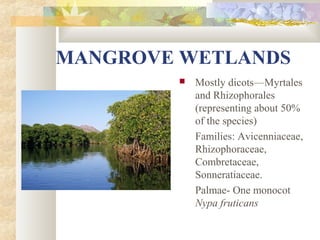
MANGROVE WETLANDS
 Mostly dicots—Myrtales
and Rhizophorales
(representing about 50%
of the species)
Families: Avicenniaceae,
Rhizophoraceae,
Combretaceae,
Sonneratiaceae.
Palmae- One monocot
Nypa fruticans
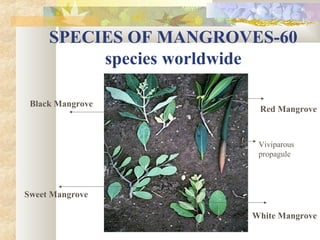
SPECIES OF MANGROVES-60
species worldwide
Black Mangrove
Red Mangrove
Sweet Mangrove
White Mangrove
Viviparous
propagule
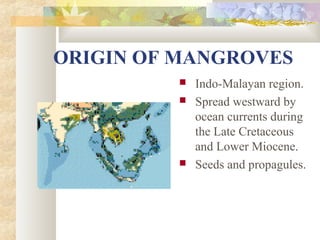
ORIGIN OF MANGROVES
 Indo-Malayan region.
 Spread westward by
ocean currents during
the Late Cretaceous
and Lower Miocene.
 Seeds and propagules.
Characteristics of Mangroves
 Evergreen plants with thick
leathery leaves designed to
minimize transpiration.
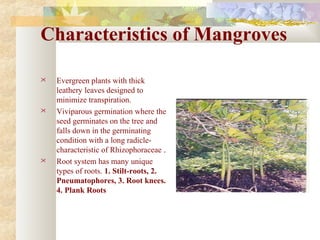
 Viviparous germination where the
seed germinates on the tree and
falls down in the germinating
condition with a long radicle-
characteristic of Rhizophoraceae .
 Root system has many unique
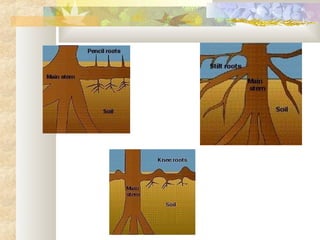
types of roots. 1. Stilt-roots, 2.
Pneumatophores, 3. Root knees.
4. Plank Roots
ROOTS
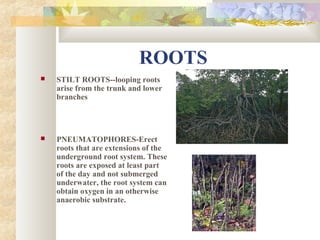
 STILT ROOTS--looping roots
arise from the trunk and lower
branches
 PNEUMATOPHORES-Erect
roots that are extensions of the
underground root system. These
roots are exposed at least part
of the day and not submerged
underwater, the root system can
obtain oxygen in an otherwise
anaerobic substrate.
ROOTS
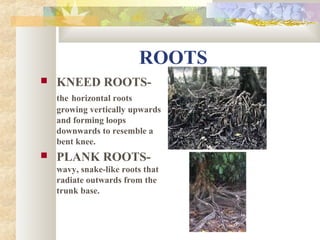
 KNEED ROOTS-
the horizontal roots
growing vertically upwards
and forming loops
downwards to resemble a
bent knee.
 PLANK ROOTS-
wavy, snake-like roots that
radiate outwards from the
trunk base.
Stilt roots are characteristic of Rhizophora but also occur in Brugeria
and Ceriops. They may also occur in Avicennia alba and A.officinalis.
They grow downwards from the trunk and branches, providing gas
exchange in the exposed sections and water uptake in the sections below
the sediment. They also provide support in older trees.
Knee roots are raised loop sections of cable roots, with thickening on
the upper exposed side, forming 'knees'. These are characteristic of
species of Brugueira and Ceriops. Some species of Xylocarpushave
knee roots that grow from the upper surface of horizontal roots,
forming extended blade-like structures. Lumnitzera develops knee
roots without the thickening of secondary growth, which are
structurally intermediate between kneeroots and pneumatophores.
Pneumatophores project through the sediment surface
from underlying cable roots and function primarily in gas
exchange. They are characteristic of Avicennia spp
and Sonneratia spp. Pneumatophores inAvicennia usually
project less than 30cm above the sediment surface. Those
of Sonneratia species are bark-covered and may reach
heights of 3 metres. Some other genera may also develop
pneumatophores. In some
circumstances, Laguncularia may develop
pneumatophores, which are often branched, unlike those
typical of Avicennia and Sonneratia.
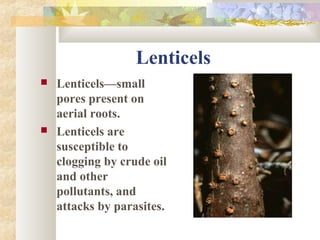
Lenticels
 Lenticels—small
pores present on
aerial roots.
 Lenticels are
susceptible to
clogging by crude oil
and other
pollutants, and
attacks by parasites.
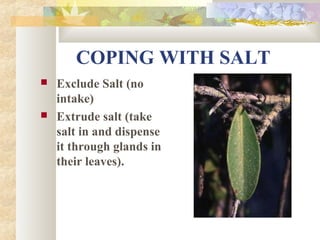
COPING WITH SALT
 Exclude Salt (no
intake)
 Extrude salt (take
salt in and dispense
it through glands in
their leaves).
IMPORTANCE--
ECOLOGICAL
 Habitats, nurseries, and nesting sites.
 Root systems –harbor many organisms that
trap and cycle nutrients and other
chemicals.
 Contribute to higher water quality.
 Protect shorelines from erosion.
IMPORTANCE
--ECONOMIC
 Food--- edible fruits and honey from flowers of
some species. River mangrove—source of best
honey.
 Medicines- Treatment of skin disorders and sores
including leprosy. Headaches, rheumatism,
snakebites, boils, ulcers, diarrhea, and many more
conditions are traditionally treated with mangrove
plants.
 Hard wood -- used for boat building and cabinet
timber.

Mangroves

  • 1.
  • 2.
    MANGROVE WETLANDS  Mostlydicots—Myrtales and Rhizophorales (representing about 50% of the species) Families: Avicenniaceae, Rhizophoraceae, Combretaceae, Sonneratiaceae. Palmae- One monocot Nypa fruticans
  • 3.
    SPECIES OF MANGROVES-60 speciesworldwide Black Mangrove Red Mangrove Sweet Mangrove White Mangrove Viviparous propagule
  • 4.
    ORIGIN OF MANGROVES Indo-Malayan region.  Spread westward by ocean currents during the Late Cretaceous and Lower Miocene.  Seeds and propagules.
  • 5.
    Characteristics of Mangroves Evergreen plants with thick leathery leaves designed to minimize transpiration.  Viviparous germination where the seed germinates on the tree and falls down in the germinating condition with a long radicle- characteristic of Rhizophoraceae .  Root system has many unique types of roots. 1. Stilt-roots, 2. Pneumatophores, 3. Root knees. 4. Plank Roots
  • 6.
    ROOTS  STILT ROOTS--loopingroots arise from the trunk and lower branches  PNEUMATOPHORES-Erect roots that are extensions of the underground root system. These roots are exposed at least part of the day and not submerged underwater, the root system can obtain oxygen in an otherwise anaerobic substrate.
  • 7.
    ROOTS  KNEED ROOTS- thehorizontal roots growing vertically upwards and forming loops downwards to resemble a bent knee.  PLANK ROOTS- wavy, snake-like roots that radiate outwards from the trunk base.
  • 9.
    Stilt roots arecharacteristic of Rhizophora but also occur in Brugeria and Ceriops. They may also occur in Avicennia alba and A.officinalis. They grow downwards from the trunk and branches, providing gas exchange in the exposed sections and water uptake in the sections below the sediment. They also provide support in older trees. Knee roots are raised loop sections of cable roots, with thickening on the upper exposed side, forming 'knees'. These are characteristic of species of Brugueira and Ceriops. Some species of Xylocarpushave knee roots that grow from the upper surface of horizontal roots, forming extended blade-like structures. Lumnitzera develops knee roots without the thickening of secondary growth, which are structurally intermediate between kneeroots and pneumatophores.
  • 10.
    Pneumatophores project throughthe sediment surface from underlying cable roots and function primarily in gas exchange. They are characteristic of Avicennia spp and Sonneratia spp. Pneumatophores inAvicennia usually project less than 30cm above the sediment surface. Those of Sonneratia species are bark-covered and may reach heights of 3 metres. Some other genera may also develop pneumatophores. In some circumstances, Laguncularia may develop pneumatophores, which are often branched, unlike those typical of Avicennia and Sonneratia.
  • 11.
    Lenticels  Lenticels—small pores presenton aerial roots.  Lenticels are susceptible to clogging by crude oil and other pollutants, and attacks by parasites.
  • 12.
    COPING WITH SALT Exclude Salt (no intake)  Extrude salt (take salt in and dispense it through glands in their leaves).
  • 13.
    IMPORTANCE-- ECOLOGICAL  Habitats, nurseries,and nesting sites.  Root systems –harbor many organisms that trap and cycle nutrients and other chemicals.  Contribute to higher water quality.  Protect shorelines from erosion.
  • 14.
    IMPORTANCE --ECONOMIC  Food--- ediblefruits and honey from flowers of some species. River mangrove—source of best honey.  Medicines- Treatment of skin disorders and sores including leprosy. Headaches, rheumatism, snakebites, boils, ulcers, diarrhea, and many more conditions are traditionally treated with mangrove plants.  Hard wood -- used for boat building and cabinet timber.