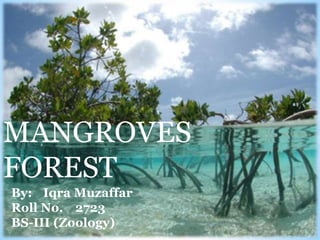
MANGROVES
FOREST
By: Iqra Muzaffar
Roll No. 2723
BS-III (Zoology)
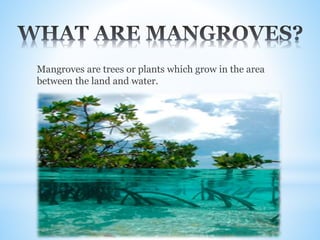
Mangroves are trees or plants which grow in the area
between the land and water.
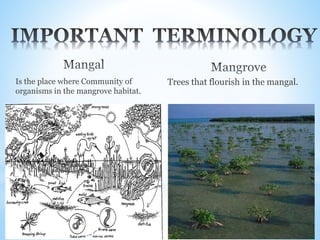
Is the place where Community of
organisms in the mangrove habitat.
Trees that flourish in the mangal.
• Inundation with tides
• Increasing salinity towards ocean
• Sandy clay soil
• Nutrient poor
• Nitrogen & Phosphorus are limiting
• Limiting mangrove growth only
• Organic nutrients deposited via siltation
• Fresh water streams & down-shore currents
• Most all are of terrestrial origin
• In sum: Mangal is a harsh place to live
• Trees and shrubs that grow in saline coastal habitats in
the tropics and subtropics;
• They grow in loose, wet soils, salt water, and are
periodically submerged by tidal flows;
• Their distribution throughout the world is affected by
climate, salinity of the water, fluctuation of the tides, type
of soil;
• Unique ecosystem generally found along sheltered coasts.
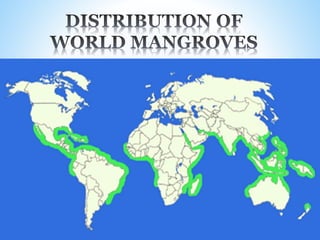
REGION AREA
(km2)
%
Global
South and SE Asia 75,170 41.4
The Americas 49,096 27.1
West Africa 27,995 15.4
Australasia 18,788 10.4
East Africa and Middle East 10,348 5.7
Divided into :
•Abiotic component
•Biotic component
1. Soil (sand+ mud + salt)
- ‘topsoil’ divided to sandy or clayey.
2. pH
- neutral or slightly acidic due to the ‘sulfur reducing
bacteria’ and the presence of acidic silt.
3. Oxygen
- Dissolved oxygen : low – anoxic area
-Can only be home for anaerobic bacteria, which releases
hydrogen sulfide gas (bad smell) when the bacteria bread-
down the organic matter without oxygen.
4. Nutrient
- Because the soil is perpetually waterlogged, there is little
free oxygen. Anaerobic bacteria liberate nitrogen gas,
soluble iron, inorganic phosphates, and methane, which
makes the soil much less nutritious.
5. Wind and waves
-windy and wavy depends on the movement of the sea
water.
6. Light, temperature
- low light and temperature at low ground.
7. Salinity
- high content of salt.
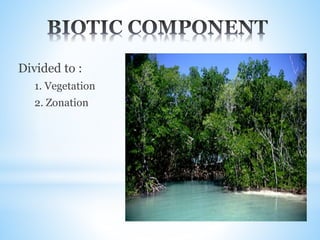
Divided to :
1. Vegetation
2. Zonation
•Mangroves are ‘obligate inhabitants’, which cannot be
found anywhere else
•Adapted to survive in swampy area
WHAT DO THEY NEED TO ADAPT TO?
-High Salinity
-High Sedimentation
-Reproduction
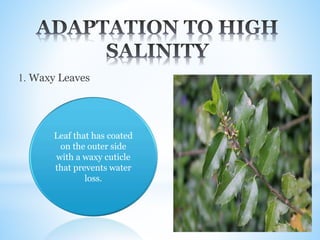
1. Waxy Leaves
Leaf that has coated
on the outer side
with a waxy cuticle
that prevents water
loss.
2. Salt exclusion at leaves
Ability of a mangrove to
exclude salt at the
surface of their leaves.
So, that the salt
content in the plant can
be regulated.
1. Prop roots
An adventitious root
that arises from the
stem, penetrates the
soil, and helps
support the stem.
2. Pneumatophores
Pneumatophores or breathing
roots (Sonneratia) are roots
from the underground root
system, which appear
laterally. These roots are used
for respiration of the plant.
3. Buttress root
Buttress roots (Bruguiera) are
roots from the tree trunk and
expanded to a structure which
looks like a ‘flattened blade’.
These roots provide mechanical
support for plants that grow in
soft and instable substrates.
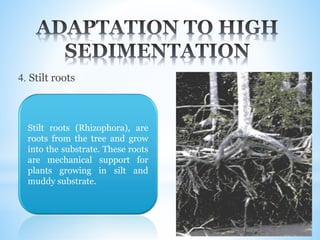
4. Stilt roots
Stilt roots (Rhizophora), are
roots from the tree and grow
into the substrate. These roots
are mechanical support for
plants growing in silt and
muddy substrate.
1. Vivipary normal
• Reproduction and growth while still attached to plant
• Fertilization
- Propagule growth (a ready-to-go seedling)
2. Maturity -> Drop off maternal plant
3. Float horizontally initially
• Dispersal to novel environments ideally
4. Float vertically with appropriate environmental conditions
5. Rooting and growth
6. Pollination through:
• Wind (Rhizophora)
• bat or hawk moth (Sonneratia)
• birds and butterflies (Bruguiera)
• fruit flies (Nypa)
Intraspecific Differences in Environmental Tolerances
1. Salinity variations and adaptations for excreting salt
2. Tidal Inundation and adaptations for gas exchange
3. Low soil stability, Shore morphology, and adaptations for
rooting
4. Sedimentation rates and types
Pictures show from left to right:
Blue crab, Blue heron, Fiddler crab, Mangrove snapper
Pictures show from left to right:
Florida fighting conch, Mangrove buckeye, Periwinkle,
American crocodile
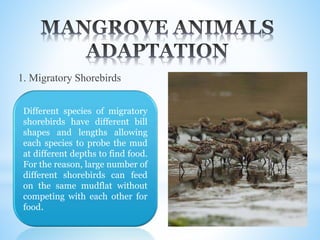
1. Migratory Shorebirds
Different species of migratory
shorebirds have different bill
shapes and lengths allowing
each species to probe the mud
at different depths to find food.
For the reason, large number of
different shorebirds can feed
on the same mudflat without
competing with each other for
food.
2. Mudskipper Fish
The mudskipper is really a fish. It
has modified fins which help it to
move on land. When on land, it
breathes through its damp skin
and by holding water in its mouth.
Huge eyes on top of it to see
better, allowing it to hunt for prey
and also to escape from predators.
These structural adaptation help
the Mudskipper cope with the
mangrove environment, catch
prey and escape predators!
During high tide, the Tree-climbing Crab climbs up a tree
avoid being eaten by predatory fish. Once out of the water, it
must remain still to avoid being spotted by predators like the
kingfishers and water monitor lizards. The above behavioral
adaptations help the Tree- climbing Crab escape predators.
3. Tree-climbing
Crabs
• Mangrove plants form a unique ecosystem THAT consists of living
organisms and non-living factors such as soil and water.
• The leaf detritus provides food for animals such as worms, snails,
mussels, oysters, shrimp.
• The roots of the mangrove provide shelter for many fish and other
animals.
• Act as a buffer against the high winds and eroding waves of storms.
• The mangroves trap sediments and prevent them from building up
further out to sea, which is damaging to other ecosystems like coral reefs
and sea grasses.
• Mangroves can filter out pollutants like nitrates, phosphates and
petroleum based products that are present in run-off.
• Mangroves contribute to our economy; they have a big influence on our
fisheries, because so many commercially fished species breed or develop
there. The mangroves also provide an important source of food for other
marine life.
Destruction : “The action or process of causing so
much damage to something that it no longer exists or
cannot be repaired”
•Urbanization
•Agriculture
•Cutting for timber, fuel and charcoal
•Oil pollution
“Work hard but make time
for yourself, your family
and friends….Nobody
remembers PowerPoint
presentations on your
funeral ”
Mangroves

Mangroves

  • 1.
    MANGROVES FOREST By: Iqra Muzaffar RollNo. 2723 BS-III (Zoology)
  • 2.
    Mangroves are treesor plants which grow in the area between the land and water.
  • 3.
    Is the placewhere Community of organisms in the mangrove habitat. Trees that flourish in the mangal.
  • 4.
    • Inundation withtides • Increasing salinity towards ocean • Sandy clay soil • Nutrient poor • Nitrogen & Phosphorus are limiting • Limiting mangrove growth only • Organic nutrients deposited via siltation • Fresh water streams & down-shore currents • Most all are of terrestrial origin • In sum: Mangal is a harsh place to live
  • 5.
    • Trees andshrubs that grow in saline coastal habitats in the tropics and subtropics; • They grow in loose, wet soils, salt water, and are periodically submerged by tidal flows; • Their distribution throughout the world is affected by climate, salinity of the water, fluctuation of the tides, type of soil; • Unique ecosystem generally found along sheltered coasts.
  • 7.
    REGION AREA (km2) % Global South andSE Asia 75,170 41.4 The Americas 49,096 27.1 West Africa 27,995 15.4 Australasia 18,788 10.4 East Africa and Middle East 10,348 5.7
  • 8.
    Divided into : •Abioticcomponent •Biotic component
  • 9.
    1. Soil (sand+mud + salt) - ‘topsoil’ divided to sandy or clayey. 2. pH - neutral or slightly acidic due to the ‘sulfur reducing bacteria’ and the presence of acidic silt. 3. Oxygen - Dissolved oxygen : low – anoxic area -Can only be home for anaerobic bacteria, which releases hydrogen sulfide gas (bad smell) when the bacteria bread- down the organic matter without oxygen.
  • 10.
    4. Nutrient - Becausethe soil is perpetually waterlogged, there is little free oxygen. Anaerobic bacteria liberate nitrogen gas, soluble iron, inorganic phosphates, and methane, which makes the soil much less nutritious. 5. Wind and waves -windy and wavy depends on the movement of the sea water. 6. Light, temperature - low light and temperature at low ground. 7. Salinity - high content of salt.
  • 11.
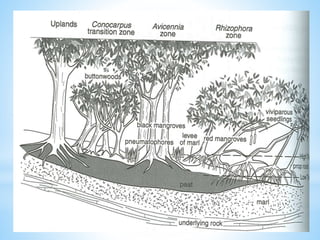
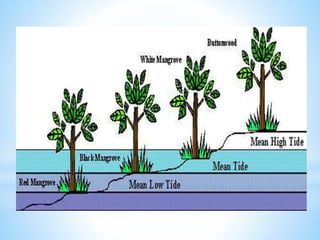
    Divided to : 1.Vegetation 2. Zonation
  • 12.
    •Mangroves are ‘obligateinhabitants’, which cannot be found anywhere else •Adapted to survive in swampy area WHAT DO THEY NEED TO ADAPT TO? -High Salinity -High Sedimentation -Reproduction
  • 13.
    1. Waxy Leaves Leafthat has coated on the outer side with a waxy cuticle that prevents water loss.
  • 14.
    2. Salt exclusionat leaves Ability of a mangrove to exclude salt at the surface of their leaves. So, that the salt content in the plant can be regulated.
  • 15.
    1. Prop roots Anadventitious root that arises from the stem, penetrates the soil, and helps support the stem.
  • 16.
    2. Pneumatophores Pneumatophores orbreathing roots (Sonneratia) are roots from the underground root system, which appear laterally. These roots are used for respiration of the plant.
  • 17.
    3. Buttress root Buttressroots (Bruguiera) are roots from the tree trunk and expanded to a structure which looks like a ‘flattened blade’. These roots provide mechanical support for plants that grow in soft and instable substrates.
  • 18.
    4. Stilt roots Stiltroots (Rhizophora), are roots from the tree and grow into the substrate. These roots are mechanical support for plants growing in silt and muddy substrate.
  • 19.
    1. Vivipary normal •Reproduction and growth while still attached to plant • Fertilization - Propagule growth (a ready-to-go seedling) 2. Maturity -> Drop off maternal plant 3. Float horizontally initially • Dispersal to novel environments ideally 4. Float vertically with appropriate environmental conditions 5. Rooting and growth 6. Pollination through: • Wind (Rhizophora) • bat or hawk moth (Sonneratia) • birds and butterflies (Bruguiera) • fruit flies (Nypa)
  • 21.
    Intraspecific Differences inEnvironmental Tolerances 1. Salinity variations and adaptations for excreting salt 2. Tidal Inundation and adaptations for gas exchange 3. Low soil stability, Shore morphology, and adaptations for rooting 4. Sedimentation rates and types
  • 24.
    Pictures show fromleft to right: Blue crab, Blue heron, Fiddler crab, Mangrove snapper
  • 25.
    Pictures show fromleft to right: Florida fighting conch, Mangrove buckeye, Periwinkle, American crocodile
  • 26.
    1. Migratory Shorebirds Differentspecies of migratory shorebirds have different bill shapes and lengths allowing each species to probe the mud at different depths to find food. For the reason, large number of different shorebirds can feed on the same mudflat without competing with each other for food.
  • 27.
    2. Mudskipper Fish Themudskipper is really a fish. It has modified fins which help it to move on land. When on land, it breathes through its damp skin and by holding water in its mouth. Huge eyes on top of it to see better, allowing it to hunt for prey and also to escape from predators. These structural adaptation help the Mudskipper cope with the mangrove environment, catch prey and escape predators!
  • 28.
    During high tide,the Tree-climbing Crab climbs up a tree avoid being eaten by predatory fish. Once out of the water, it must remain still to avoid being spotted by predators like the kingfishers and water monitor lizards. The above behavioral adaptations help the Tree- climbing Crab escape predators. 3. Tree-climbing Crabs
  • 29.
    • Mangrove plantsform a unique ecosystem THAT consists of living organisms and non-living factors such as soil and water. • The leaf detritus provides food for animals such as worms, snails, mussels, oysters, shrimp. • The roots of the mangrove provide shelter for many fish and other animals. • Act as a buffer against the high winds and eroding waves of storms. • The mangroves trap sediments and prevent them from building up further out to sea, which is damaging to other ecosystems like coral reefs and sea grasses. • Mangroves can filter out pollutants like nitrates, phosphates and petroleum based products that are present in run-off. • Mangroves contribute to our economy; they have a big influence on our fisheries, because so many commercially fished species breed or develop there. The mangroves also provide an important source of food for other marine life.
  • 30.
    Destruction : “Theaction or process of causing so much damage to something that it no longer exists or cannot be repaired” •Urbanization •Agriculture •Cutting for timber, fuel and charcoal •Oil pollution
  • 31.
    “Work hard butmake time for yourself, your family and friends….Nobody remembers PowerPoint presentations on your funeral ”