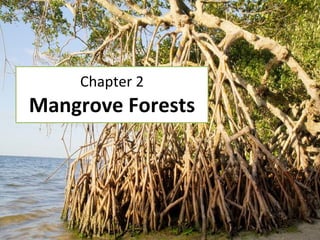
Chapter 2
Mangrove Forests
In this lesson, you will understand:

• Where are Mangrove Forests found?
• What general characteristics do MF have?
• What special adaptations do MF have?
Distribution of Mangrove Forests
• Places that experience tropical climate i.e.
  between 23.5ºN & S of Equator
• especially along sheltered coastal regions and
  where rivers deposit clay and silt
Diversity of Mangrove Forests
• Halophytes (salt-tolerant plants) commonly found
  – e.g. avicennia, sonneratia, rhizophora, bruguiera
  – other plant species e.g. sea hibiscus, nipah palm
Density of Mangrove Forests
• High density due to high temperature & rainfall
• Sparse undergrowth due to dense canopy
Structure of Mangrove Forests
• 3 horizontal zones with trees about 15m tall
• Trees vary in height from 2m – 40m as muddy soil
  in environment cannot provide firm support


 High tide
 Low tide

Coastal zone         Middle zone       Inland zone
Coastal Zone in Mangrove Forests
• Nearest to sea, flooded with saltwater at high
  tides
• Trees have tube-like breathing roots
• e.g. avicennia species (pencil shaped)
• e.g. sonneratia species (peg shaped)
Middle Zone in Mangrove Forests
• Trees have prop or stilt roots growing from trunks
  for anchoring plants firm to muddy soil
• e.g. rhizophora species
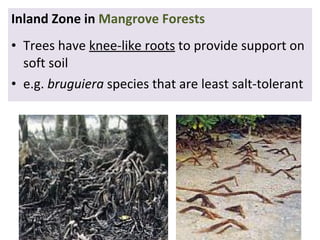
Inland Zone in Mangrove Forests
• Trees have knee-like roots to provide support on
  soft soil
• e.g. bruguiera species that are least salt-tolerant
MF Special Characteristics: Leaves

• Evergreen, thick & leathery, broad
  with drip tips
• Avicennia species are salt secretors
   – excess salt secreted on leaves
     and removed by wind or rain
• Bruguiera, Rhizophora and
  Sonneratia species are
  ultrafiltrators
   – excess salt stored in old leaves
     which then fall off
MF Special Characteristics:
 Flowers and Fruits

• Generally colourful flowers to
  attract insects for pollination
   – e.g. Bruguiera species has
     bright-red lantern flowers
• Buoyant fruits that are
  dispersed by water
• Elongated fruits which
  germinate while on parent tree
   – e.g. Rhizophora species
1   3


2   4
In this lesson, you have understood:

• Where are Mangrove Forests found?
• What general characteristics do MF have?
• What special adaptations do MF have?

Mangroves

  • 1.
  • 2.
    In this lesson,you will understand: • Where are Mangrove Forests found? • What general characteristics do MF have? • What special adaptations do MF have?
  • 3.
    Distribution of MangroveForests • Places that experience tropical climate i.e. between 23.5ºN & S of Equator • especially along sheltered coastal regions and where rivers deposit clay and silt
  • 4.
    Diversity of MangroveForests • Halophytes (salt-tolerant plants) commonly found – e.g. avicennia, sonneratia, rhizophora, bruguiera – other plant species e.g. sea hibiscus, nipah palm
  • 5.
    Density of MangroveForests • High density due to high temperature & rainfall • Sparse undergrowth due to dense canopy
  • 6.
    Structure of MangroveForests • 3 horizontal zones with trees about 15m tall • Trees vary in height from 2m – 40m as muddy soil in environment cannot provide firm support High tide Low tide Coastal zone Middle zone Inland zone
  • 7.
    Coastal Zone inMangrove Forests • Nearest to sea, flooded with saltwater at high tides • Trees have tube-like breathing roots • e.g. avicennia species (pencil shaped) • e.g. sonneratia species (peg shaped)
  • 8.
    Middle Zone inMangrove Forests • Trees have prop or stilt roots growing from trunks for anchoring plants firm to muddy soil • e.g. rhizophora species
  • 9.
    Inland Zone inMangrove Forests • Trees have knee-like roots to provide support on soft soil • e.g. bruguiera species that are least salt-tolerant
  • 10.
    MF Special Characteristics:Leaves • Evergreen, thick & leathery, broad with drip tips • Avicennia species are salt secretors – excess salt secreted on leaves and removed by wind or rain • Bruguiera, Rhizophora and Sonneratia species are ultrafiltrators – excess salt stored in old leaves which then fall off
  • 11.
    MF Special Characteristics: Flowers and Fruits • Generally colourful flowers to attract insects for pollination – e.g. Bruguiera species has bright-red lantern flowers • Buoyant fruits that are dispersed by water • Elongated fruits which germinate while on parent tree – e.g. Rhizophora species
  • 12.
    1 3 2 4
  • 13.
    In this lesson,you have understood: • Where are Mangrove Forests found? • What general characteristics do MF have? • What special adaptations do MF have?