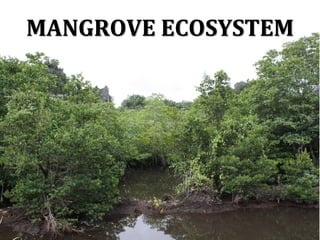
MANGROVE ECOSYSTEM
Mangroves
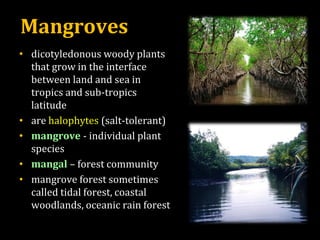
• dicotyledonous woody plants
that grow in the interface
between land and sea in
tropics and sub-tropics
latitude
• are halophytes (salt-tolerant)
• mangrove - individual plant
species
• mangal – forest community
• mangrove forest sometimes
called tidal forest, coastal
woodlands, oceanic rain forest
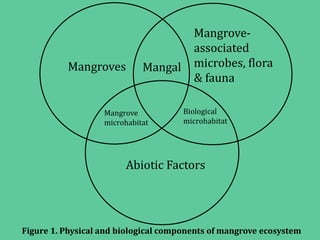
Mangroves
Mangrove-
associated
microbes, flora
& fauna
Mangal
Mangrove
microhabitat
Biological
microhabitat
Abiotic Factors
Figure 1. Physical and biological components of mangrove ecosystem
Species Composition (Tomlinson 1986)
• 54 species of true mangroves ( 34
major & 20 minor) worldwide
• 60 species of mangrove associates
• Philippines harbors around 40
species belonging to 14 families.
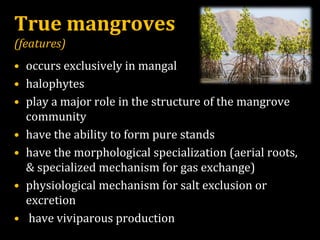
True mangroves
(features)
• occurs exclusively in mangal
• halophytes
• play a major role in the structure of the mangrove
community
• have the ability to form pure stands
• have the morphological specialization (aerial roots,
& specialized mechanism for gas exchange)
• physiological mechanism for salt exclusion or
excretion
• have viviparous production
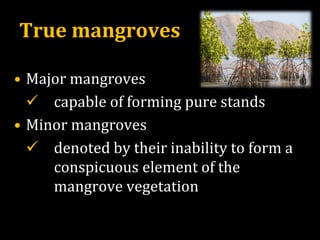
True mangroves
• Major mangroves
✓ capable of forming pure stands
• Minor mangroves
✓ denoted by their inability to form a
conspicuous element of the
mangrove vegetation
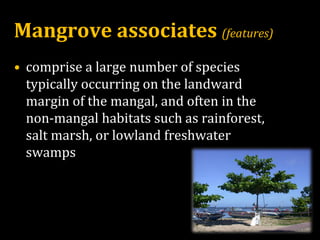
Mangrove associates (features)
• comprise a large number of species
typically occurring on the landward
margin of the mangal, and often in the
non-mangal habitats such as rainforest,
salt marsh, or lowland freshwater
swamps
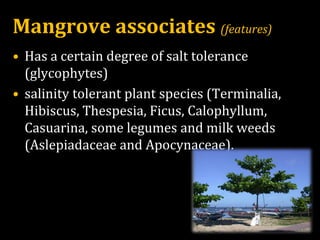
Mangrove associates (features)
• Has a certain degree of salt tolerance
(glycophytes)
• salinity tolerant plant species (Terminalia,
Hibiscus, Thespesia, Ficus, Calophyllum,
Casuarina, some legumes and milk weeds
(Aslepiadaceae and Apocynaceae).
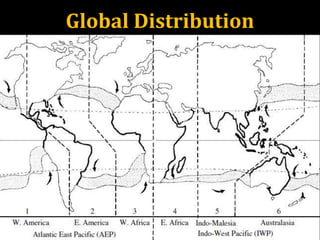
Global Distribution
▪ Occurring in 112 countries and
territories
▪ Distribution is greatly affected with
temperature and moisture
▪ Large-scale currents may also influence
distributions by preventing propagules
from reaching some areas
Mangrove in the Philippines
• holds at least 50% (Primavera et al.
2004) of the world’s approximately 65
mangrove species (Kathiresan and
Bingham 2001)
• considered as one of the top 15 most
mangrove-rich countries in the world
according to Long and Giri (2011)
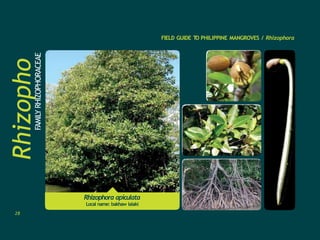
Mangrove in the Philippines
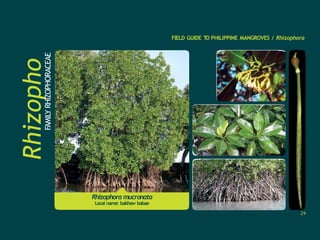
• mature mangrove areas do not exceed
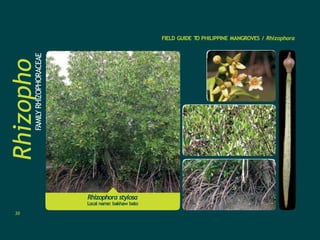
20,000 ha, of which approximately two-
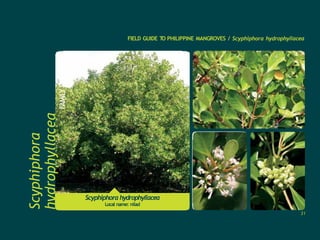
thirds are in Palawan.
• consequently, around 80,000 ha of
mangroves left in the country were
declared as wilderness and forest
reserves in 1981, including all the 40,000
ha of pristine mangroves in Palawan
(Primavera 2002).
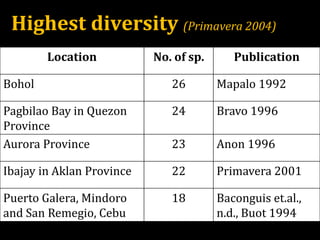
Highest diversity (Primavera 2004)
Location No. of sp. Publication
Bohol 26 Mapalo 1992
Pagbilao Bay in Quezon
Province
24 Bravo 1996
Aurora Province 23 Anon 1996
Ibajay in Aklan Province 22 Primavera 2001
Puerto Galera, Mindoro
and San Remegio, Cebu
18 Baconguis et.al.,
n.d., Buot 1994
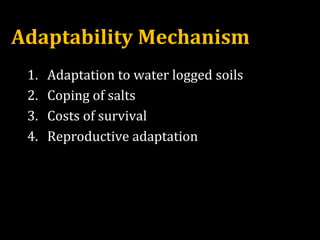
Adaptability Mechanism
1. Adaptation to water logged soils
2. Coping of salts
3. Costs of survival
4. Reproductive adaptation
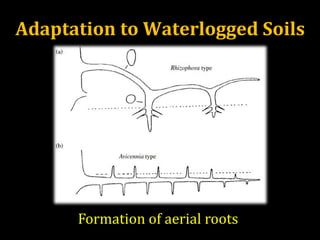
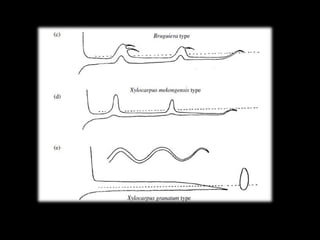
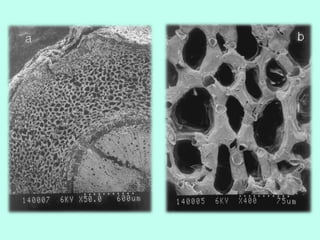
Adaptation to Waterlogged Soils
Formation of aerial roots
Measuring of anaerobic state
✓redox potential (redox being a
telescoping of reduction and oxidation)
✓can be tested by use of a platinum
electrode probe, which senses the redox
state of the surrounding soil
✓redox scale is in millivolts
✓a well-oxygenated soil will have a redox
potential above 300 mV
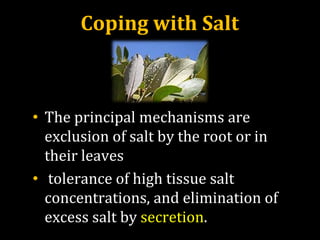
Coping with Salt
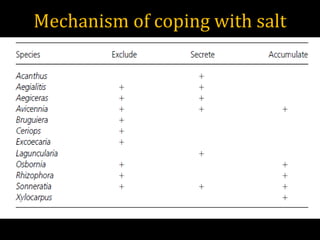
• The principal mechanisms are
exclusion of salt by the root or in
their leaves
• tolerance of high tissue salt
concentrations, and elimination of
excess salt by secretion.
Mechanism of coping with salt
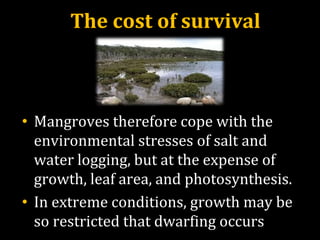
The cost of survival
• Mangroves therefore cope with the
environmental stresses of salt and
water logging, but at the expense of
growth, leaf area, and photosynthesis.
• In extreme conditions, growth may be
so restricted that dwarfing occurs
The cost of survival
• Species found at particularly high
salinities do not occur at high levels of
waterlogging, and vice versa.
• These limits to distribution are narrower
than the extremes that the species could
actually survive: the actual distributions
reflect interspecific competition as well
as physiological tolerance.
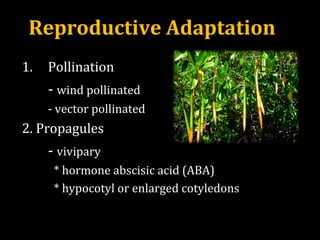
Reproductive Adaptation
1. Pollination
- wind pollinated
- vector pollinated
2. Propagules
- vivipary
* hormone abscisic acid (ABA)
* hypocotyl or enlarged cotyledons
Approaches to Mangrove
Ecosystem Assessment
• Primary productivity of plant communities is
correlated with
– leaf area index
• Leaf area index can be converted to net canopy
photosynthesis
– leaf area index x average rate of
photosynthesis per unit leaf area
• Useful indicator of environmental stress
– leaf shedding and leaf growth are usually
sensitive to environmental factors
Continue,,,,,
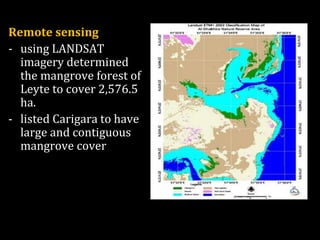
Remote sensing
- using LANDSAT
imagery determined
the mangrove forest of
Leyte to cover 2,576.5
ha.
- listed Carigara to have
large and contiguous
mangrove cover
Continue,,,,,
Ground Truth Surveys:
• Transect quadrat method
– quantitatively describe the community structure
and plant biomass of the mangrove forest
– Permanent plots are established along the
transect through the mangrove forest types or
zones
– permanent plots are suited for long-term
monitoring of changes in community structure
– Diameter at Breast Height (DBH) can be used to
calculate above ground biomass.
http://www.oneocean.org/download/db_files/pcra_training_guide.pdf
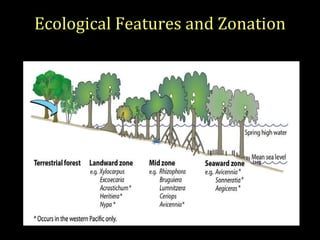
Ecological Features and Zonation
Seaward zone
• daily flooded by tidal inundation including
neap tides
• Species found in here are termed
“frontliners” and are generally true
mangroves
• Soil type ranges from sandy loam, mudflat
or coralline
–sandy coralline: Sonneratia (pagatpat)
• Sandy loam: Rhizophora mucronata (bakauan-
babae), Aegiceras corniculatum (saging-saging)
and A. floridum (tinduk-tindukan)
• sandy loam to clayey mudflats: Comptostemom
philippinensis (gapas-gapas)
Middle zone
• flooded during normal high tide
• soil is generally clayey, silty to silty clay
• species that usually inhabit here include:
Avicennia alba (piapi) A. officinalis (apiapi), A.
corniculatum (saging-saging), A. floridum
(tinduk-tindukan), Bruguiera sexagula
(pototan), Ceriops (tangal), Excoecaria
agallocha (buta-buta), Xylocarpus (tabigi),
• Lumnitzera racemosa (kulasi), Scyphiphora
hydropllacea (Nilad) and Nypa (nipa)
Landward zone
• back portion of the mangrove swamps
• usually remains unaffected by tidal movements
over a long period of time except during
exceptional high tides called “spring tides”
• soil is generally clay to silty clay
• vegetation is highly diverse due to presence of
vines, epiphytes and mangrove associates in
addition to Avicennia (api-api and piapi),
Bruguiera (pototan), Excoecaria (buta-buta),
Scyphiphora (nilad) and Nipa
Riverine
• portions along or bordering the rivers
• at river mouths: Avicennia (bungalon, api-api),
Aegiceras (saging-saging and tinduk-tindukan),
Rhizophora (Bakauan-babae, bakauan-lalake
and bakauan-bangkaw),
• along river banks going inland (soil generally
clayey): Avicennia, Aegiceras, Bruguiera,
Excoecaria, Scyphiphora, and Xylocarpus
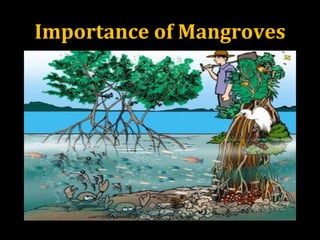
Importance of Mangroves
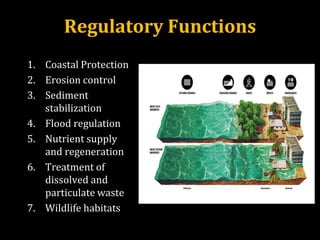
Regulatory Functions
1. Coastal Protection
2. Erosion control
3. Sediment
stabilization
4. Flood regulation
5. Nutrient supply
and regeneration
6. Treatment of
dissolved and
particulate waste
7. Wildlife habitats
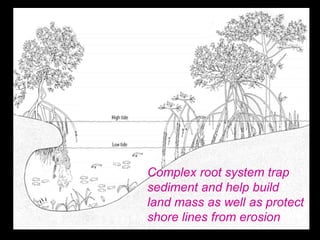
Complex root system trap
sediment and help build
land mass as well as protect
shore lines from erosion
Ecological Importance
– Habitat, nursery and feeding ground of various
animals
– Above tide forest: formed by trunks and leaf
canopy
• inhabited by birds, bats, lizards, tree snakes,
snails, land crabs and mangrove crabs
(keystone species) spiders, insects (most
most diverse and abundant)
• 5% of leaf production here by terrestrial
grazers, the rest enter the aquatic systems
as debris and becoming available for marine
detrivores, either fish or invertebrates
– Intertidal swamp
• offers a variety of different substrates and
different microhabitats to support a more diverse
community of marine species
• organisms attach to mangrove roots , others in or
on mudflats or mudbanks
• barnacles and oysters are common epifauna on
roots with the latter often the dominant
contributor to community biomass
• Nematode, periwinkles,polychaete worms, sea
cucumbers, fiddler crabs, amphipods, shrimps,
mudskippers and other fish species are also
common
• leaf fall is a major source of nutrients and energy in the
intertidal swamp
– subtidal zone
• high organic content
• subtidal mangrove roots support a rich epifauna and
epiflora of algae, sponges, tunicates, anemones, hydroids
and bryozoans
• turtle grass (Thalassia) may be dominant benthic plant
that stabilize mud bottom
• burrowing animals (crabs, shrimps, worms) are common
and their burrows facilitate oxygen penetration into the
mud and ameliorate anoxic conditions
• fish, crabs, lobsters and shrimp form basis for local
fisheries
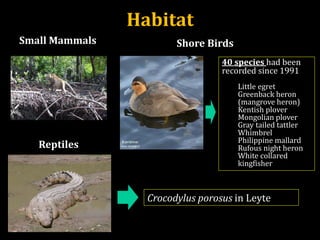
Small Mammals Shore Birds
40 species had been
recorded since 1991
Little egret
Greenback heron
(mangrove heron)
Kentish plover
Mongolian plover
Gray tailed tattler
Whimbrel
Philippine mallard
Rufous night heron
White collared
kingfisher
Reptiles
Crocodylus porosus in Leyte
Habitat
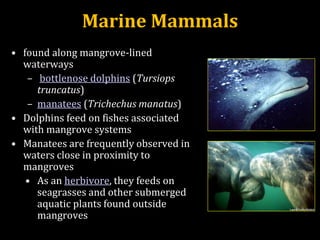
Marine Mammals
• found along mangrove-lined
waterways
– bottlenose dolphins (Tursiops
truncatus)
– manatees (Trichechus manatus)
• Dolphins feed on fishes associated
with mangrove systems
• Manatees are frequently observed in
waters close in proximity to
mangroves
• As an herbivore, they feeds on
seagrasses and other submerged
aquatic plants found outside
mangroves
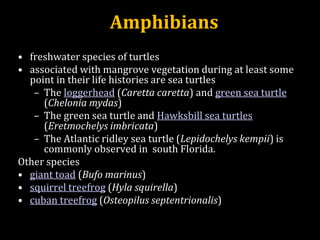
• freshwater species of turtles
• associated with mangrove vegetation during at least some
point in their life histories are sea turtles
– The loggerhead (Caretta caretta) and green sea turtle
(Chelonia mydas)
– The green sea turtle and Hawksbill sea turtles
(Eretmochelys imbricata)
– The Atlantic ridley sea turtle (Lepidochelys kempii) is
commonly observed in south Florida.
Other species
• giant toad (Bufo marinus)
• squirrel treefrog (Hyla squirella)
• cuban treefrog (Osteopilus septentrionalis)
Amphibians
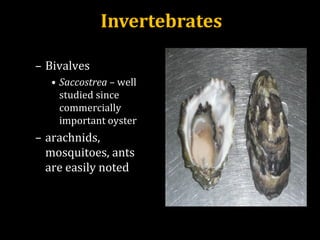
– Bivalves
• Saccostrea – well
studied since
commercially
important oyster
– arachnids,
mosquitoes, ants
are easily noted
http://www.rawfish.com.au/images/-tassie-oyster-pacific-oyster-tasmania-aphrodisiac1.JPG
Invertebrates
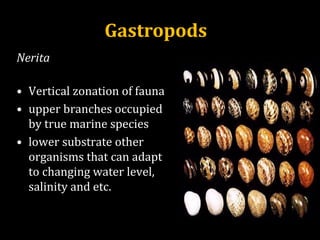
Nerita
• Vertical zonation of fauna
• upper branches occupied
by true marine species
• lower substrate other
organisms that can adapt
to changing water level,
salinity and etc.
http://park.org/Guests/Shells/Shell_Catalogue/Shell_Images/Nerita_polita_variations.jpg
Gastropods
Economic Importance
– a wide variety of marine organisms are
harvested for food and income by
coastal residents
– Mangrove trees provide direct
economic benefit
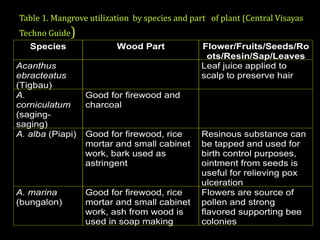
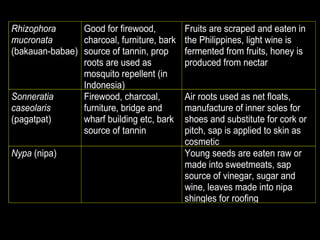
• (table 1)
Species Wood Part Flower/Fruits/Seeds/Ro
ots/Resin/Sap/Leaves
Acanthus
ebracteatus
(Tigbau)
Leaf juice applied to
scalp to preserve hair
A.
corniculatum
(saging-
saging)
Good for firewood and
charcoal
A. alba (Piapi) Good for firewood, rice
mortar and small cabinet
work, bark used as
astringent
Resinous substance can
be tapped and used for
birth control purposes,
ointment from seeds is
useful for relieving pox
ulceration
A. marina
(bungalon)
Good for firewood, rice
mortar and small cabinet
work, ash from wood is
used in soap making
Flowers are source of
pollen and strong
flavored supporting bee
colonies
Table 1. Mangrove utilization by species and part of plant (Central Visayas
Techno Guide)
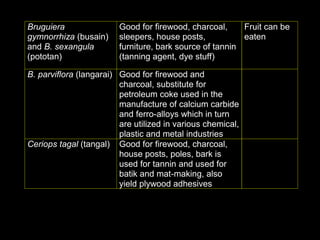
Bruguiera
gymnorrhiza (busain)
and B. sexangula
(pototan)
Good for firewood, charcoal,
sleepers, house posts,
furniture, bark source of tannin
(tanning agent, dye stuff)
Fruit can be
eaten
B. parviflora (langarai) Good for firewood and
charcoal, substitute for
petroleum coke used in the
manufacture of calcium carbide
and ferro-alloys which in turn
are utilized in various chemical,
plastic and metal industries
Ceriops tagal (tangal) Good for firewood, charcoal,
house posts, poles, bark is
used for tannin and used for
batik and mat-making, also
yield plywood adhesives
Rhizophora
mucronata
(bakauan-babae)
Good for firewood,
charcoal, furniture, bark
source of tannin, prop
roots are used as
mosquito repellent (in
Indonesia)
Fruits are scraped and eaten in
the Philippines, light wine is
fermented from fruits, honey is
produced from nectar
Sonneratia
caseolaris
(pagatpat)
Firewood, charcoal,
furniture, bridge and
wharf building etc, bark
source of tannin
Air roots used as net floats,
manufacture of inner soles for
shoes and substitute for cork or
pitch, sap is applied to skin as
cosmetic
Nypa (nipa) Young seeds are eaten raw or
made into sweetmeats, sap
source of vinegar, sugar and
wine, leaves made into nipa
shingles for roofing
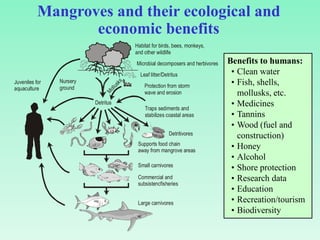
Mangroves and their ecological and
economic benefits
Juveniles for
aquaculture
Nursery
ground
Habitat for birds, bees, monkeys,
and other wildlife
Microbial decomposers and herbivores
Leaf litter/Detritus
Protection from storm
wave and erosion
Traps sediments and
stabilizes coastal areas
Detritus
M
o
l
l
u
s
k
s
Detritivores
Supports food chain
away from mangrove areas
Small carnivores
Commercial and
subsistencfisheries
Large carnivores
Benefits to humans:
• Clean water
• Fish, shells,
mollusks, etc.
• Medicines
• Tannins
• Wood (fuel and
construction)
• Honey
• Alcohol
• Shore protection
• Research data
• Education
• Recreation/tourism
• Biodiversity
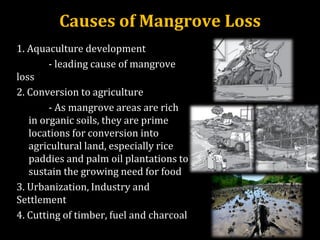
Causes of Mangrove Loss
1. Aquaculture development
- leading cause of mangrove
loss
2. Conversion to agriculture
- As mangrove areas are rich
in organic soils, they are prime
locations for conversion into
agricultural land, especially rice
paddies and palm oil plantations to
sustain the growing need for food
3. Urbanization, Industry and
Settlement
4. Cutting of timber, fuel and charcoal
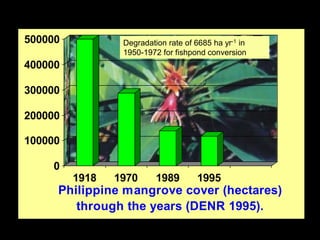
0
100000
200000
300000
400000
500000
1918 1970 1989 1995
Philippine mangrove cover (hectares)
through the years (DENR 1995).
Degradation rate of 6685 ha yr-1 in
1950-1972 for fishpond conversion
Status of the Philippine Mangrove
Forest
• Mangrove forest in the Philippines has
diminished steadily due to overharvesting
• Mangrove had been regarded as “worthless”
that can only be made productive if developed
to aquaculture
• such “worthless” concept” has led to wholesale
destruction of the ecosystem
• Original mangrove forest=500 000 ha (1920)
• left is 100 000 ha (1996)
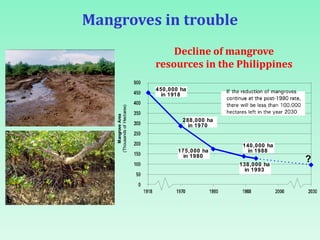
Mangroves in trouble
Mangrove
Area
(Thousands
of
Hectares)
450,000 ha
in 1918
288,000 ha
in 1970
140,000 ha
in 1988
138,000 ha
in 1993
175,000 ha
in 1980
?
Decline of mangrove
resources in the Philippines
Conservation and Rehabilitation Efforts
• Strengthening the information, education and
communication program for the protection and
conservation of mangrove areas
• Proper awareness
• Involvement of the community
• include mangrove in municipal utilization
zoning
• reforestation/mangrove transplantation
Photos from:
Primavera JH,Sadaba RS, Lebata MJHL,Altamirano JP.2004. HandbookofMangrovesin thePhilippines- Panay.SEAFDEC/AQDand UNESCO,unlessspecified otherwise.
Copyright © 2009 JHPrimavera and RDB Dianala
Mangrove species in this field guide are
sorted by genera. Closeup photographs
of distinctive features (leaves, flowers,
fruits, bark, roots) areprovided for visual
comparison to facilitate identification of
species.
J
. H. Primavera, Ph. D.
Awareness of mangrove importance, particularly for coastal
protection, has grown among the general public over the past
several years. In turn, this has led to numerous planting
initiatives by various groups. However, most of these programs did
not yield positive results mainly due to lack of science- guided
protocols, particularly on what species to grow under certain
conditions.
This field guide is an attempt towards broader awareness and
appreciation of the common mangroves found in the
Philippines. It is based on the original material, “Field Guide to
Philippine Mangroves,” developed with support from the Pew
F
ellows Program in Marine Conservation and S
E
A
F
DE
C
PREFACE
Aquaculture Department, and published by
of London-Philippines.
Seeing the vitality of this field guide, Phili
Conservation Foundation, Inc. (PTFCF)
Philippines and Foundation for Communicat
repackaging this field guide for distrib
individuals keen on mangrove rehabilit
the “Community-based Mangrove Rehabilita
and posters, this hopes to increase pro
mangrove rehabilitation efforts, particularly
Typhoon Y
olanda, the most destructive typh
modern history.
4
FIELD GUIDE T
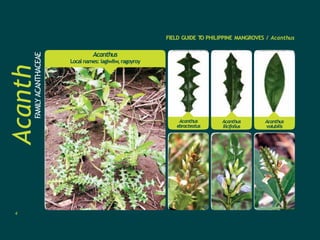
O PHILIPPINE MANGROVES / Acanthus
Acanth
us
FAMILY
ACANTHACEAE
Acanthus
Local names: lagiwliw,ragoyroy
Acanthus
volubilis
Acanthus
ilicifolius
Acanthus
ebracteatus
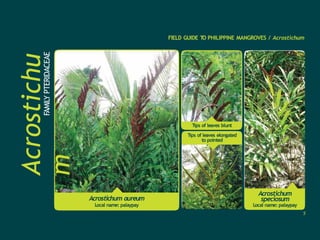
Acrostichum aureum
Local name: palaypay
5
Acrostichu
m
FAMILY
PTERIDACEAE
FIELD GUIDE T
O PHILIPPINE MANGROVES / Acrostichum
Acrostichum
speciosum
Local name: palaypay
Tips of leaves blunt
Tips of leaves elongated
to pointed
FIELD GUIDE T
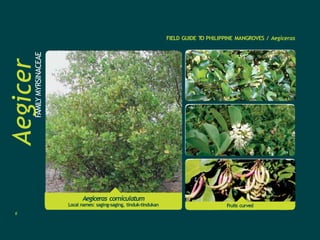
O PHILIPPINE MANGROVES / Aegiceras
Aegicer
as
FAMILY
MYRSINACEAE
Aegiceras corniculatum
Local names: saging-saging, tinduk-tindukan Fruits curved
6
FIELD GUIDE T
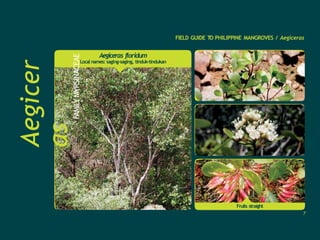
O PHILIPPINE MANGROVES / Aegiceras
Aegicer
asFAMILY
MYRSINACEAE
Fruits straight
Aegiceras floridum
Local names: saging-saging, tinduk-tindukan
7
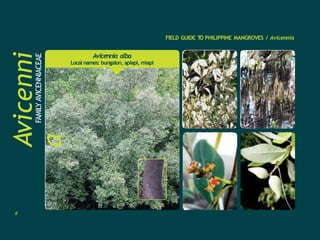
FIELD GUIDE T
O PHILIPPINE MANGROVES / Avicennia
Avicenni
a
FAMILY
AVICENNIACEAE
Avicennia alba
Local names: bungalon, apiapi, miapi
8
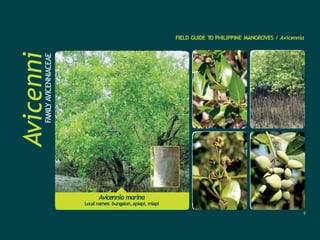
FIELD GUIDE T
O PHILIPPINE MANGROVES / Avicennia
Avicenni
a
FAMILY
AVICENNIACEAE
Avicennia marina
Local names: bungalon, apiapi, miapi
9
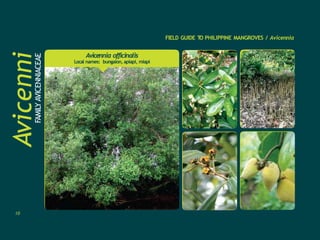
FIELD GUIDE T
O PHILIPPINE MANGROVES / Avicennia
Avicenni
a
FAMILY
AVICENNIACEAE
Avicennia officinalis
Local names: bungalon, apiapi, miapi
10
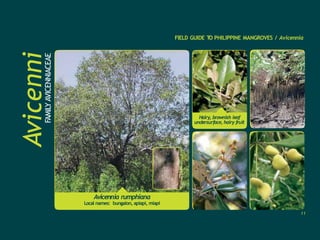
FIELD GUIDE T
O PHILIPPINE MANGROVES / Avicennia
Avicenni
a
FAMILY
AVICENNIACEAE
Avicennia rumphiana
Local names: bungalon, apiapi, miapi
Hairy, brownish leaf
undersurface, hairy fruit
11
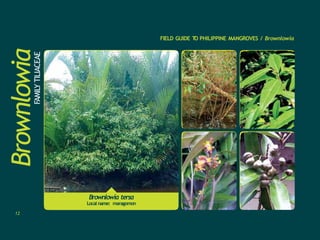
BrownlowiaFAMILY
TILIACEAE FIELD GUIDE T
O PHILIPPINE MANGROVES / Brownlowia
Brownlowia tersa
Local name: maragomon
12
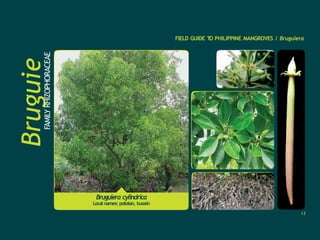
Bruguie
ra
FAMILY
RHIZOPHORACEAE
FIELD GUIDE T
O PHILIPPINE MANGROVES / Bruguiera
Bruguiera cylindrica
Local names: pototan, busain
13
Bruguie
ra
FAMILY
RHIZOPHORACEAE FIELD GUIDE T
O PHILIPPINE MANGROVES / Bruguiera
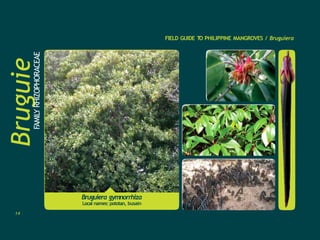
Bruguiera gymnorrhiza
Local names: pototan, busain
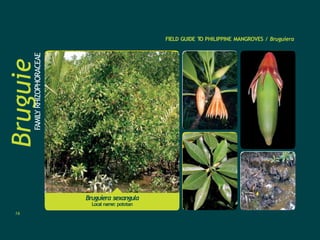
14
Bruguie
ra
FAMILY
RHIZOPHORACEAE
FIELD GUIDE T
O PHILIPPINE MANGROVES / Bruguiera
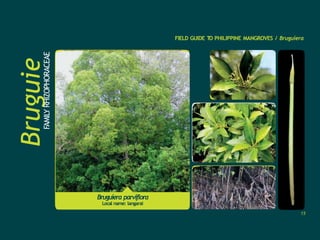
Bruguiera parviflora
Local name: langarai
15
Bruguie
ra
FAMILY
RHIZOPHORACEAE FIELD GUIDE T
O PHILIPPINE MANGROVES / Bruguiera
Bruguiera sexangula
Local name: pototan
16
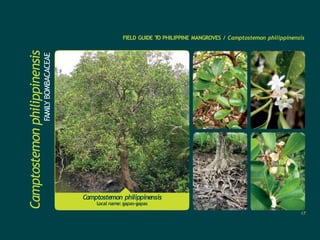
Camptostemon philippinensis
Local name: gapas-gapas
Camptostemon
philippinensis
FAMILY
BOMBACACEAE
FIELD GUIDE T
O PHILIPPINE MANGROVES / Camptostemon philippinensis
17
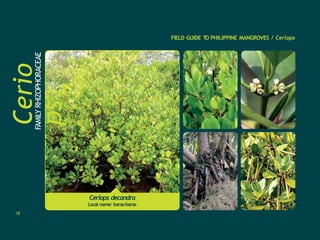
Ceriops decandra
Local name: baras-baras
Cerio
ps
FAMILY
RHIZOPHORACEAE FIELD GUIDE T
O PHILIPPINE MANGROVES / Ceriops
18
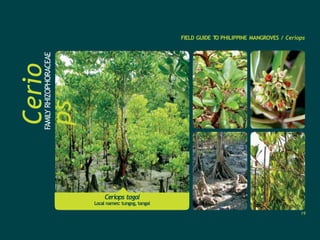
Cerio
ps
FAMILY
RHIZOPHORACEAE
FIELD GUIDE T
O PHILIPPINE MANGROVES / Ceriops
Ceriops tagal
Local names: tungog, tangal
19
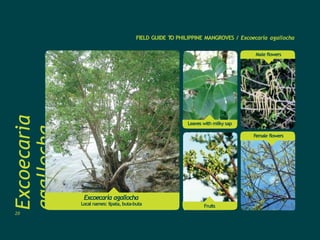
Excoecaria
agallocha
FAMILY
EUPHORBIACEAE
Excoecaria agallocha
Local names: lipata, buta-buta
FIELD GUIDE T
O PHILIPPINE MANGROVES / Excoecaria agallocha
Male flowers
Fruits
Leaves with milky sap
Female flowers
20
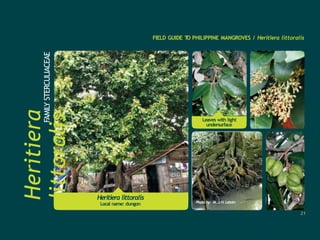
Heritiera littoralis
Local name: dungon
Heritiera
littoralis
FAMILY
STERCULIACEAE
FIELD GUIDE T
O PHILIPPINE MANGROVES / Heritiera littoralis
Leaves with light
undersurface
Photo by: M. J.H. Lebata
21
Kandelia
candel
FAMILY
RHIZOPHORACEAE FIELD GUIDE T
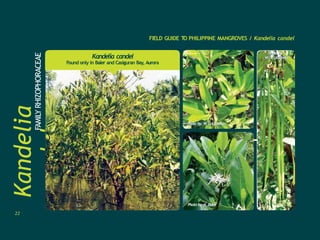
O PHILIPPINE MANGROVES / Kandelia candel
Kandelia candel
Found only in Baler and Casiguran Bay, Aurora
Photo by: N. Duke
Photo by: W
. G. Licuanan
Photo by:
W
. G. Licuanan
22
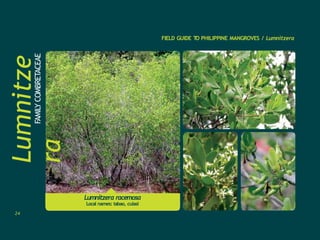
Lumnitze
ra
FAMILY
COMBRETACEAE
FIELD GUIDE T
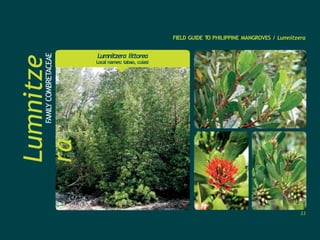
O PHILIPPINE MANGROVES / Lumnitzera
Lumnitzera littorea
Local names: tabao, culasi
23
Lumnitze
ra
FAMILY
COMBRETACEAE FIELD GUIDE T
O PHILIPPINE MANGROVES / Lumnitzera
Lumnitzera racemosa
Local names: tabao, culasi
24
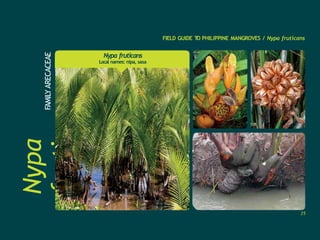
Nypa
fruticans
FAMILY
ARECACEAE
FIELD GUIDE T
O PHILIPPINE MANGROVES / Nypa fruticans
Nypa fruticans
Local names: nipa, sasa
25
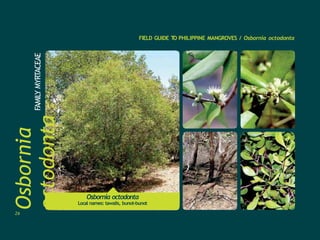
Osbornia
octodonta
FAMILY
MYRTACEAE FIELD GUIDE T
O PHILIPPINE MANGROVES / Osbornia octodonta
Osbornia octodonta
Local names: tawalis, bunot-bunot
26
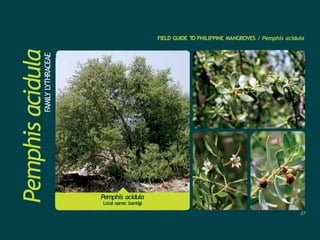
Pemphis
acidulaFAMILY
L
YTHRACEAE
FIELD GUIDE T
O PHILIPPINE MANGROVES / Pemphis acidula
Pemphis acidula
Local name: bantigi
27
Rhizopho
ra
FAMILY
RHIZOPHORACEAE FIELD GUIDE T
O PHILIPPINE MANGROVES / Rhizophora
Rhizophora apiculata
Local name: bakhaw lalaki
28
Rhizopho
ra
FAMILY
RHIZOPHORACEAE
FIELD GUIDE T
O PHILIPPINE MANGROVES / Rhizophora
Rhizophora mucronata
Local name: bakhaw babae
29
Rhizopho
ra
FAMILY
RHIZOPHORACEAE FIELD GUIDE T
O PHILIPPINE MANGROVES / Rhizophora
Rhizophora stylosa
Local name: bakhaw bato
30
Scyphiphora hydrophyllacea
Local name: nilad
Scyphiphora
hydrophyllacea
FAMILY
RUBIACEAE
FIELD GUIDE T
O PHILIPPINE MANGROVES / Scyphiphora hydrophyllacea
31
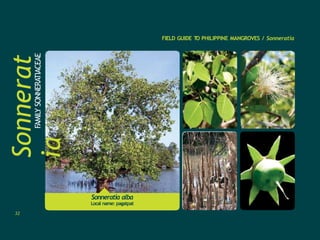
Sonneratia alba
Local name: pagatpat
Sonnerat
ia
FAMILY
SONNERATIACEAE FIELD GUIDE T
O PHILIPPINE MANGROVES / Sonneratia
32
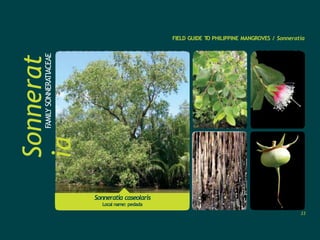
Sonneratia caseolaris
Local name: pedada
Sonnerat
ia
FAMILY
SONNERATIACEAE
FIELD GUIDE T
O PHILIPPINE MANGROVES / Sonneratia
33
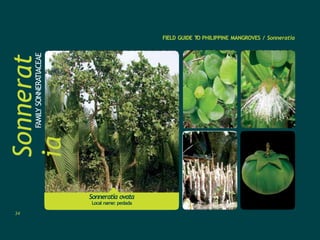
Sonneratia ovata
Local name: pedada
Sonnerat
ia
FAMILY
SONNERATIACEAE FIELD GUIDE T
O PHILIPPINE MANGROVES / Sonneratia
34
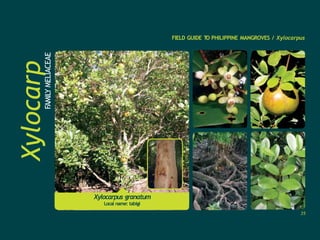
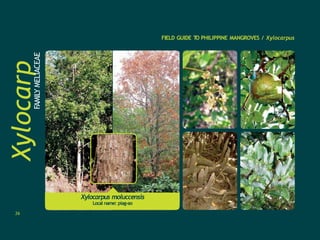
Xylocarp
us
FAMILY
MELIACEAE
FIELD GUIDE T
O PHILIPPINE MANGROVES / Xylocarpus
Xylocarpus granatum
Local name: tabigi
35
Xylocarp
us
FAMILY
MELIACEAE FIELD GUIDE T
O PHILIPPINE MANGROVES / Xylocarpus
Xylocarpus moluccensis
Local name: piag-ao
36
PTFCF’s FOREST AND COMMUNITY REHABILITATION PROGRAM
On November 8, 2013, Super Typhoon Yolanda (International name: Haiyan) hit the Philippines. It was the strongest and
most destructive typhoon the country has experienced in recent history. It destroyed infrastructure, human habitations
and livelihoods. T
odate, government authorities continue to validate the total death toll.
Super Typhoon Yolanda also left various ecosystems, such as mangrove and beach forests damaged.
In response to calls for support towards ecosystems rehabilitation, the Philippine Tropical Forest Conservation
Foundation, Inc. (PTFCF) implemented its Forest and Community Rehabilitation Program. This program aspires to support
efforts in the Yolanda-affected provinces of Capiz, Iloilo, Leyte, Eastern Samar and Northern Palawan by providing grants
and technical assistance to people’s organizations (POs) and non-government organizations (NGOs) for ecosystems
assessment, capacity building, actual forest protection and rehabilitation activities, and advocacy campaigns, among
others.
It was observed from assessments and field visits after Yolanda that many organizations are taking part in mangrove
rehabilitation. The unfortunate truth however, is that some of these projects were against the natural growth and
survival of mangroves. This prompted the PTFCF to partner with Zoological Society of London (ZSL)-Philippines and
Foundation for Communication Initiatives, Inc. (FOCI) to implement a strategic communications project that aspires to
disseminate the right information to the right people through proper knowledge management. Part of the project is this
updated and enhanced Field Guide to Philippine Mangroves by J.H. Primavera, PhD.
This field guide is based on the original material, “Field Guide to Philippine Mangroves,” developed with support from the
Pew Fellows Program in Marine Conservation and SEAFDEC Aquaculture Department, and published by the Zoological
Society of London.
This field guide, together with Community-based Mangrove Rehabilitation Training Manual and posters will be
distributed in Capiz, Iloilo, Eastern Samar, Northern Palawan, and other Yolanda-affected areas.
The Philippine Tropical Forest Conservation Foundation, Inc. (PTFCF)
was established under two bilateral agreements between the
governments of the United States of America and the Republic of the
Philippines under the U.S. Tropical Forest Conservation Act (TFCA).
PTFC
F works towards biologically diverse Philippine forests that
are sustainably managed and equitably accessible to responsible
stakeholders by working with non-governmental organizations
and community groups in forest protection, natural resource
management, capacity building, research, livelihood support, coastal
forest resource management, as well as sustainable use of diverse
animals and plants.
From 2005 to 2014, PTFC
F was able to support 383 projects, which
effectively improved the management of approximately 1.5 million
hectares of forest lands, restored approximately 4,200 hectares of
forests through the re-introduction of appropriate native tree species,
established over 40 community conserved areas in key biodiversity
areas and critical watersheds, instituted over 60 community-level
sustainable enterprises that provide additional income to community
members, and increased awareness of forest conservation issues
particularly the ecosystem services provided by the forests.
2/F Valderrama Building, 107 Esteban Street, Legaspi Village, Makati City 1223
Phone: +63 2 891-0595; email: admin@ptfcf.org; website: www.ptfcf.org
THE ZOOLOGICAL SOCIETY OF LONDON
TheZoological Society of London (ZSL), a charity foundedin 1826, is
a world-renowned centre of excellence for conservation science
and applied conservation. ZSL’s mission is to promote and achieve
the worldwide conservation of animals and their habitats. This is
realized by carrying out field conservation and research in over 50
countries across the globe and through education and awareness
at our two zoos, ZS
LLondon Zoo and ZS
LWhipsnade Zoo, inspiring
people to take conservation action. We strive to achieve our
mission by:
• Conducting world-leading conservation science
• Implementing effective field conservation projects globally
• Providing decision-makers with the best possible
conservation advice, and
• Building conservation capacity and inspiring people to
connect with the natural world.
The Country Manager, Zoological Society of London-Philippines
48 Burgos St. LaP
az, 5000 Iloilo City
Phone: +63 33 330-0929
website: www.zsl.org

MANGROVE-ECOSYSTEM.pdf

  • 1.
  • 2.
    Mangroves • dicotyledonous woodyplants that grow in the interface between land and sea in tropics and sub-tropics latitude • are halophytes (salt-tolerant) • mangrove - individual plant species • mangal – forest community • mangrove forest sometimes called tidal forest, coastal woodlands, oceanic rain forest
  • 3.
  • 4.
    Species Composition (Tomlinson1986) • 54 species of true mangroves ( 34 major & 20 minor) worldwide • 60 species of mangrove associates • Philippines harbors around 40 species belonging to 14 families.
  • 5.
    True mangroves (features) • occursexclusively in mangal • halophytes • play a major role in the structure of the mangrove community • have the ability to form pure stands • have the morphological specialization (aerial roots, & specialized mechanism for gas exchange) • physiological mechanism for salt exclusion or excretion • have viviparous production
  • 6.
    True mangroves • Majormangroves ✓ capable of forming pure stands • Minor mangroves ✓ denoted by their inability to form a conspicuous element of the mangrove vegetation
  • 7.
    Mangrove associates (features) •comprise a large number of species typically occurring on the landward margin of the mangal, and often in the non-mangal habitats such as rainforest, salt marsh, or lowland freshwater swamps
  • 8.
    Mangrove associates (features) •Has a certain degree of salt tolerance (glycophytes) • salinity tolerant plant species (Terminalia, Hibiscus, Thespesia, Ficus, Calophyllum, Casuarina, some legumes and milk weeds (Aslepiadaceae and Apocynaceae).
  • 9.
  • 10.
    ▪ Occurring in112 countries and territories ▪ Distribution is greatly affected with temperature and moisture ▪ Large-scale currents may also influence distributions by preventing propagules from reaching some areas
  • 11.
    Mangrove in thePhilippines • holds at least 50% (Primavera et al. 2004) of the world’s approximately 65 mangrove species (Kathiresan and Bingham 2001) • considered as one of the top 15 most mangrove-rich countries in the world according to Long and Giri (2011)
  • 12.
    Mangrove in thePhilippines • mature mangrove areas do not exceed 20,000 ha, of which approximately two- thirds are in Palawan. • consequently, around 80,000 ha of mangroves left in the country were declared as wilderness and forest reserves in 1981, including all the 40,000 ha of pristine mangroves in Palawan (Primavera 2002).
  • 13.
    Highest diversity (Primavera2004) Location No. of sp. Publication Bohol 26 Mapalo 1992 Pagbilao Bay in Quezon Province 24 Bravo 1996 Aurora Province 23 Anon 1996 Ibajay in Aklan Province 22 Primavera 2001 Puerto Galera, Mindoro and San Remegio, Cebu 18 Baconguis et.al., n.d., Buot 1994
  • 14.
    Adaptability Mechanism 1. Adaptationto water logged soils 2. Coping of salts 3. Costs of survival 4. Reproductive adaptation
  • 15.
    Adaptation to WaterloggedSoils Formation of aerial roots
  • 17.
    Measuring of anaerobicstate ✓redox potential (redox being a telescoping of reduction and oxidation) ✓can be tested by use of a platinum electrode probe, which senses the redox state of the surrounding soil ✓redox scale is in millivolts ✓a well-oxygenated soil will have a redox potential above 300 mV
  • 19.
    Coping with Salt •The principal mechanisms are exclusion of salt by the root or in their leaves • tolerance of high tissue salt concentrations, and elimination of excess salt by secretion.
  • 20.
  • 21.
    The cost ofsurvival • Mangroves therefore cope with the environmental stresses of salt and water logging, but at the expense of growth, leaf area, and photosynthesis. • In extreme conditions, growth may be so restricted that dwarfing occurs
  • 22.
    The cost ofsurvival • Species found at particularly high salinities do not occur at high levels of waterlogging, and vice versa. • These limits to distribution are narrower than the extremes that the species could actually survive: the actual distributions reflect interspecific competition as well as physiological tolerance.
  • 23.
    Reproductive Adaptation 1. Pollination -wind pollinated - vector pollinated 2. Propagules - vivipary * hormone abscisic acid (ABA) * hypocotyl or enlarged cotyledons
  • 24.
    Approaches to Mangrove EcosystemAssessment • Primary productivity of plant communities is correlated with – leaf area index • Leaf area index can be converted to net canopy photosynthesis – leaf area index x average rate of photosynthesis per unit leaf area • Useful indicator of environmental stress – leaf shedding and leaf growth are usually sensitive to environmental factors
  • 25.
    Continue,,,,, Remote sensing - usingLANDSAT imagery determined the mangrove forest of Leyte to cover 2,576.5 ha. - listed Carigara to have large and contiguous mangrove cover
  • 26.
    Continue,,,,, Ground Truth Surveys: •Transect quadrat method – quantitatively describe the community structure and plant biomass of the mangrove forest – Permanent plots are established along the transect through the mangrove forest types or zones – permanent plots are suited for long-term monitoring of changes in community structure – Diameter at Breast Height (DBH) can be used to calculate above ground biomass. http://www.oneocean.org/download/db_files/pcra_training_guide.pdf
  • 27.
  • 28.
    Seaward zone • dailyflooded by tidal inundation including neap tides • Species found in here are termed “frontliners” and are generally true mangroves • Soil type ranges from sandy loam, mudflat or coralline –sandy coralline: Sonneratia (pagatpat)
  • 29.
    • Sandy loam:Rhizophora mucronata (bakauan- babae), Aegiceras corniculatum (saging-saging) and A. floridum (tinduk-tindukan) • sandy loam to clayey mudflats: Comptostemom philippinensis (gapas-gapas)
  • 30.
    Middle zone • floodedduring normal high tide • soil is generally clayey, silty to silty clay • species that usually inhabit here include: Avicennia alba (piapi) A. officinalis (apiapi), A. corniculatum (saging-saging), A. floridum (tinduk-tindukan), Bruguiera sexagula (pototan), Ceriops (tangal), Excoecaria agallocha (buta-buta), Xylocarpus (tabigi), • Lumnitzera racemosa (kulasi), Scyphiphora hydropllacea (Nilad) and Nypa (nipa)
  • 31.
    Landward zone • backportion of the mangrove swamps • usually remains unaffected by tidal movements over a long period of time except during exceptional high tides called “spring tides” • soil is generally clay to silty clay • vegetation is highly diverse due to presence of vines, epiphytes and mangrove associates in addition to Avicennia (api-api and piapi), Bruguiera (pototan), Excoecaria (buta-buta), Scyphiphora (nilad) and Nipa
  • 32.
    Riverine • portions alongor bordering the rivers • at river mouths: Avicennia (bungalon, api-api), Aegiceras (saging-saging and tinduk-tindukan), Rhizophora (Bakauan-babae, bakauan-lalake and bakauan-bangkaw), • along river banks going inland (soil generally clayey): Avicennia, Aegiceras, Bruguiera, Excoecaria, Scyphiphora, and Xylocarpus
  • 33.
  • 34.
    Regulatory Functions 1. CoastalProtection 2. Erosion control 3. Sediment stabilization 4. Flood regulation 5. Nutrient supply and regeneration 6. Treatment of dissolved and particulate waste 7. Wildlife habitats
  • 35.
    Complex root systemtrap sediment and help build land mass as well as protect shore lines from erosion
  • 36.
    Ecological Importance – Habitat,nursery and feeding ground of various animals – Above tide forest: formed by trunks and leaf canopy • inhabited by birds, bats, lizards, tree snakes, snails, land crabs and mangrove crabs (keystone species) spiders, insects (most most diverse and abundant) • 5% of leaf production here by terrestrial grazers, the rest enter the aquatic systems as debris and becoming available for marine detrivores, either fish or invertebrates
  • 37.
    – Intertidal swamp •offers a variety of different substrates and different microhabitats to support a more diverse community of marine species • organisms attach to mangrove roots , others in or on mudflats or mudbanks • barnacles and oysters are common epifauna on roots with the latter often the dominant contributor to community biomass • Nematode, periwinkles,polychaete worms, sea cucumbers, fiddler crabs, amphipods, shrimps, mudskippers and other fish species are also common
  • 38.
    • leaf fallis a major source of nutrients and energy in the intertidal swamp – subtidal zone • high organic content • subtidal mangrove roots support a rich epifauna and epiflora of algae, sponges, tunicates, anemones, hydroids and bryozoans • turtle grass (Thalassia) may be dominant benthic plant that stabilize mud bottom • burrowing animals (crabs, shrimps, worms) are common and their burrows facilitate oxygen penetration into the mud and ameliorate anoxic conditions • fish, crabs, lobsters and shrimp form basis for local fisheries
  • 39.
    Small Mammals ShoreBirds 40 species had been recorded since 1991 Little egret Greenback heron (mangrove heron) Kentish plover Mongolian plover Gray tailed tattler Whimbrel Philippine mallard Rufous night heron White collared kingfisher Reptiles Crocodylus porosus in Leyte Habitat
  • 40.
    Marine Mammals • foundalong mangrove-lined waterways – bottlenose dolphins (Tursiops truncatus) – manatees (Trichechus manatus) • Dolphins feed on fishes associated with mangrove systems • Manatees are frequently observed in waters close in proximity to mangroves • As an herbivore, they feeds on seagrasses and other submerged aquatic plants found outside mangroves
  • 41.
    • freshwater speciesof turtles • associated with mangrove vegetation during at least some point in their life histories are sea turtles – The loggerhead (Caretta caretta) and green sea turtle (Chelonia mydas) – The green sea turtle and Hawksbill sea turtles (Eretmochelys imbricata) – The Atlantic ridley sea turtle (Lepidochelys kempii) is commonly observed in south Florida. Other species • giant toad (Bufo marinus) • squirrel treefrog (Hyla squirella) • cuban treefrog (Osteopilus septentrionalis) Amphibians
  • 42.
    – Bivalves • Saccostrea– well studied since commercially important oyster – arachnids, mosquitoes, ants are easily noted http://www.rawfish.com.au/images/-tassie-oyster-pacific-oyster-tasmania-aphrodisiac1.JPG Invertebrates
  • 43.
    Nerita • Vertical zonationof fauna • upper branches occupied by true marine species • lower substrate other organisms that can adapt to changing water level, salinity and etc. http://park.org/Guests/Shells/Shell_Catalogue/Shell_Images/Nerita_polita_variations.jpg Gastropods
  • 44.
    Economic Importance – awide variety of marine organisms are harvested for food and income by coastal residents – Mangrove trees provide direct economic benefit • (table 1)
  • 45.
    Species Wood PartFlower/Fruits/Seeds/Ro ots/Resin/Sap/Leaves Acanthus ebracteatus (Tigbau) Leaf juice applied to scalp to preserve hair A. corniculatum (saging- saging) Good for firewood and charcoal A. alba (Piapi) Good for firewood, rice mortar and small cabinet work, bark used as astringent Resinous substance can be tapped and used for birth control purposes, ointment from seeds is useful for relieving pox ulceration A. marina (bungalon) Good for firewood, rice mortar and small cabinet work, ash from wood is used in soap making Flowers are source of pollen and strong flavored supporting bee colonies Table 1. Mangrove utilization by species and part of plant (Central Visayas Techno Guide)
  • 46.
    Bruguiera gymnorrhiza (busain) and B.sexangula (pototan) Good for firewood, charcoal, sleepers, house posts, furniture, bark source of tannin (tanning agent, dye stuff) Fruit can be eaten B. parviflora (langarai) Good for firewood and charcoal, substitute for petroleum coke used in the manufacture of calcium carbide and ferro-alloys which in turn are utilized in various chemical, plastic and metal industries Ceriops tagal (tangal) Good for firewood, charcoal, house posts, poles, bark is used for tannin and used for batik and mat-making, also yield plywood adhesives
  • 47.
    Rhizophora mucronata (bakauan-babae) Good for firewood, charcoal,furniture, bark source of tannin, prop roots are used as mosquito repellent (in Indonesia) Fruits are scraped and eaten in the Philippines, light wine is fermented from fruits, honey is produced from nectar Sonneratia caseolaris (pagatpat) Firewood, charcoal, furniture, bridge and wharf building etc, bark source of tannin Air roots used as net floats, manufacture of inner soles for shoes and substitute for cork or pitch, sap is applied to skin as cosmetic Nypa (nipa) Young seeds are eaten raw or made into sweetmeats, sap source of vinegar, sugar and wine, leaves made into nipa shingles for roofing
  • 48.
    Mangroves and theirecological and economic benefits Juveniles for aquaculture Nursery ground Habitat for birds, bees, monkeys, and other wildlife Microbial decomposers and herbivores Leaf litter/Detritus Protection from storm wave and erosion Traps sediments and stabilizes coastal areas Detritus M o l l u s k s Detritivores Supports food chain away from mangrove areas Small carnivores Commercial and subsistencfisheries Large carnivores Benefits to humans: • Clean water • Fish, shells, mollusks, etc. • Medicines • Tannins • Wood (fuel and construction) • Honey • Alcohol • Shore protection • Research data • Education • Recreation/tourism • Biodiversity
  • 49.
    Causes of MangroveLoss 1. Aquaculture development - leading cause of mangrove loss 2. Conversion to agriculture - As mangrove areas are rich in organic soils, they are prime locations for conversion into agricultural land, especially rice paddies and palm oil plantations to sustain the growing need for food 3. Urbanization, Industry and Settlement 4. Cutting of timber, fuel and charcoal
  • 50.
    0 100000 200000 300000 400000 500000 1918 1970 19891995 Philippine mangrove cover (hectares) through the years (DENR 1995). Degradation rate of 6685 ha yr-1 in 1950-1972 for fishpond conversion
  • 51.
    Status of thePhilippine Mangrove Forest • Mangrove forest in the Philippines has diminished steadily due to overharvesting • Mangrove had been regarded as “worthless” that can only be made productive if developed to aquaculture • such “worthless” concept” has led to wholesale destruction of the ecosystem • Original mangrove forest=500 000 ha (1920) • left is 100 000 ha (1996)
  • 52.
    Mangroves in trouble Mangrove Area (Thousands of Hectares) 450,000ha in 1918 288,000 ha in 1970 140,000 ha in 1988 138,000 ha in 1993 175,000 ha in 1980 ? Decline of mangrove resources in the Philippines
  • 53.
    Conservation and RehabilitationEfforts • Strengthening the information, education and communication program for the protection and conservation of mangrove areas • Proper awareness • Involvement of the community • include mangrove in municipal utilization zoning • reforestation/mangrove transplantation
  • 55.
    Photos from: Primavera JH,SadabaRS, Lebata MJHL,Altamirano JP.2004. HandbookofMangrovesin thePhilippines- Panay.SEAFDEC/AQDand UNESCO,unlessspecified otherwise. Copyright © 2009 JHPrimavera and RDB Dianala Mangrove species in this field guide are sorted by genera. Closeup photographs of distinctive features (leaves, flowers, fruits, bark, roots) areprovided for visual comparison to facilitate identification of species. J . H. Primavera, Ph. D.
  • 56.
    Awareness of mangroveimportance, particularly for coastal protection, has grown among the general public over the past several years. In turn, this has led to numerous planting initiatives by various groups. However, most of these programs did not yield positive results mainly due to lack of science- guided protocols, particularly on what species to grow under certain conditions. This field guide is an attempt towards broader awareness and appreciation of the common mangroves found in the Philippines. It is based on the original material, “Field Guide to Philippine Mangroves,” developed with support from the Pew F ellows Program in Marine Conservation and S E A F DE C PREFACE Aquaculture Department, and published by of London-Philippines. Seeing the vitality of this field guide, Phili Conservation Foundation, Inc. (PTFCF) Philippines and Foundation for Communicat repackaging this field guide for distrib individuals keen on mangrove rehabilit the “Community-based Mangrove Rehabilita and posters, this hopes to increase pro mangrove rehabilitation efforts, particularly Typhoon Y olanda, the most destructive typh modern history.
  • 57.
    4 FIELD GUIDE T OPHILIPPINE MANGROVES / Acanthus Acanth us FAMILY ACANTHACEAE Acanthus Local names: lagiwliw,ragoyroy Acanthus volubilis Acanthus ilicifolius Acanthus ebracteatus
  • 58.
    Acrostichum aureum Local name:palaypay 5 Acrostichu m FAMILY PTERIDACEAE FIELD GUIDE T O PHILIPPINE MANGROVES / Acrostichum Acrostichum speciosum Local name: palaypay Tips of leaves blunt Tips of leaves elongated to pointed
  • 59.
    FIELD GUIDE T OPHILIPPINE MANGROVES / Aegiceras Aegicer as FAMILY MYRSINACEAE Aegiceras corniculatum Local names: saging-saging, tinduk-tindukan Fruits curved 6
  • 60.
    FIELD GUIDE T OPHILIPPINE MANGROVES / Aegiceras Aegicer asFAMILY MYRSINACEAE Fruits straight Aegiceras floridum Local names: saging-saging, tinduk-tindukan 7
  • 61.
    FIELD GUIDE T OPHILIPPINE MANGROVES / Avicennia Avicenni a FAMILY AVICENNIACEAE Avicennia alba Local names: bungalon, apiapi, miapi 8
  • 62.
    FIELD GUIDE T OPHILIPPINE MANGROVES / Avicennia Avicenni a FAMILY AVICENNIACEAE Avicennia marina Local names: bungalon, apiapi, miapi 9
  • 63.
    FIELD GUIDE T OPHILIPPINE MANGROVES / Avicennia Avicenni a FAMILY AVICENNIACEAE Avicennia officinalis Local names: bungalon, apiapi, miapi 10
  • 64.
    FIELD GUIDE T OPHILIPPINE MANGROVES / Avicennia Avicenni a FAMILY AVICENNIACEAE Avicennia rumphiana Local names: bungalon, apiapi, miapi Hairy, brownish leaf undersurface, hairy fruit 11
  • 65.
    BrownlowiaFAMILY TILIACEAE FIELD GUIDET O PHILIPPINE MANGROVES / Brownlowia Brownlowia tersa Local name: maragomon 12
  • 66.
    Bruguie ra FAMILY RHIZOPHORACEAE FIELD GUIDE T OPHILIPPINE MANGROVES / Bruguiera Bruguiera cylindrica Local names: pototan, busain 13
  • 67.
    Bruguie ra FAMILY RHIZOPHORACEAE FIELD GUIDET O PHILIPPINE MANGROVES / Bruguiera Bruguiera gymnorrhiza Local names: pototan, busain 14
  • 68.
    Bruguie ra FAMILY RHIZOPHORACEAE FIELD GUIDE T OPHILIPPINE MANGROVES / Bruguiera Bruguiera parviflora Local name: langarai 15
  • 69.
    Bruguie ra FAMILY RHIZOPHORACEAE FIELD GUIDET O PHILIPPINE MANGROVES / Bruguiera Bruguiera sexangula Local name: pototan 16
  • 70.
    Camptostemon philippinensis Local name:gapas-gapas Camptostemon philippinensis FAMILY BOMBACACEAE FIELD GUIDE T O PHILIPPINE MANGROVES / Camptostemon philippinensis 17
  • 71.
    Ceriops decandra Local name:baras-baras Cerio ps FAMILY RHIZOPHORACEAE FIELD GUIDE T O PHILIPPINE MANGROVES / Ceriops 18
  • 72.
    Cerio ps FAMILY RHIZOPHORACEAE FIELD GUIDE T OPHILIPPINE MANGROVES / Ceriops Ceriops tagal Local names: tungog, tangal 19
  • 73.
    Excoecaria agallocha FAMILY EUPHORBIACEAE Excoecaria agallocha Local names:lipata, buta-buta FIELD GUIDE T O PHILIPPINE MANGROVES / Excoecaria agallocha Male flowers Fruits Leaves with milky sap Female flowers 20
  • 74.
    Heritiera littoralis Local name:dungon Heritiera littoralis FAMILY STERCULIACEAE FIELD GUIDE T O PHILIPPINE MANGROVES / Heritiera littoralis Leaves with light undersurface Photo by: M. J.H. Lebata 21
  • 75.
    Kandelia candel FAMILY RHIZOPHORACEAE FIELD GUIDET O PHILIPPINE MANGROVES / Kandelia candel Kandelia candel Found only in Baler and Casiguran Bay, Aurora Photo by: N. Duke Photo by: W . G. Licuanan Photo by: W . G. Licuanan 22
  • 76.
    Lumnitze ra FAMILY COMBRETACEAE FIELD GUIDE T OPHILIPPINE MANGROVES / Lumnitzera Lumnitzera littorea Local names: tabao, culasi 23
  • 77.
    Lumnitze ra FAMILY COMBRETACEAE FIELD GUIDET O PHILIPPINE MANGROVES / Lumnitzera Lumnitzera racemosa Local names: tabao, culasi 24
  • 78.
    Nypa fruticans FAMILY ARECACEAE FIELD GUIDE T OPHILIPPINE MANGROVES / Nypa fruticans Nypa fruticans Local names: nipa, sasa 25
  • 79.
    Osbornia octodonta FAMILY MYRTACEAE FIELD GUIDET O PHILIPPINE MANGROVES / Osbornia octodonta Osbornia octodonta Local names: tawalis, bunot-bunot 26
  • 80.
    Pemphis acidulaFAMILY L YTHRACEAE FIELD GUIDE T OPHILIPPINE MANGROVES / Pemphis acidula Pemphis acidula Local name: bantigi 27
  • 81.
    Rhizopho ra FAMILY RHIZOPHORACEAE FIELD GUIDET O PHILIPPINE MANGROVES / Rhizophora Rhizophora apiculata Local name: bakhaw lalaki 28
  • 82.
    Rhizopho ra FAMILY RHIZOPHORACEAE FIELD GUIDE T OPHILIPPINE MANGROVES / Rhizophora Rhizophora mucronata Local name: bakhaw babae 29
  • 83.
    Rhizopho ra FAMILY RHIZOPHORACEAE FIELD GUIDET O PHILIPPINE MANGROVES / Rhizophora Rhizophora stylosa Local name: bakhaw bato 30
  • 84.
    Scyphiphora hydrophyllacea Local name:nilad Scyphiphora hydrophyllacea FAMILY RUBIACEAE FIELD GUIDE T O PHILIPPINE MANGROVES / Scyphiphora hydrophyllacea 31
  • 85.
    Sonneratia alba Local name:pagatpat Sonnerat ia FAMILY SONNERATIACEAE FIELD GUIDE T O PHILIPPINE MANGROVES / Sonneratia 32
  • 86.
    Sonneratia caseolaris Local name:pedada Sonnerat ia FAMILY SONNERATIACEAE FIELD GUIDE T O PHILIPPINE MANGROVES / Sonneratia 33
  • 87.
    Sonneratia ovata Local name:pedada Sonnerat ia FAMILY SONNERATIACEAE FIELD GUIDE T O PHILIPPINE MANGROVES / Sonneratia 34
  • 88.
    Xylocarp us FAMILY MELIACEAE FIELD GUIDE T OPHILIPPINE MANGROVES / Xylocarpus Xylocarpus granatum Local name: tabigi 35
  • 89.
    Xylocarp us FAMILY MELIACEAE FIELD GUIDET O PHILIPPINE MANGROVES / Xylocarpus Xylocarpus moluccensis Local name: piag-ao 36
  • 90.
    PTFCF’s FOREST ANDCOMMUNITY REHABILITATION PROGRAM On November 8, 2013, Super Typhoon Yolanda (International name: Haiyan) hit the Philippines. It was the strongest and most destructive typhoon the country has experienced in recent history. It destroyed infrastructure, human habitations and livelihoods. T odate, government authorities continue to validate the total death toll. Super Typhoon Yolanda also left various ecosystems, such as mangrove and beach forests damaged. In response to calls for support towards ecosystems rehabilitation, the Philippine Tropical Forest Conservation Foundation, Inc. (PTFCF) implemented its Forest and Community Rehabilitation Program. This program aspires to support efforts in the Yolanda-affected provinces of Capiz, Iloilo, Leyte, Eastern Samar and Northern Palawan by providing grants and technical assistance to people’s organizations (POs) and non-government organizations (NGOs) for ecosystems assessment, capacity building, actual forest protection and rehabilitation activities, and advocacy campaigns, among others. It was observed from assessments and field visits after Yolanda that many organizations are taking part in mangrove rehabilitation. The unfortunate truth however, is that some of these projects were against the natural growth and survival of mangroves. This prompted the PTFCF to partner with Zoological Society of London (ZSL)-Philippines and Foundation for Communication Initiatives, Inc. (FOCI) to implement a strategic communications project that aspires to disseminate the right information to the right people through proper knowledge management. Part of the project is this updated and enhanced Field Guide to Philippine Mangroves by J.H. Primavera, PhD. This field guide is based on the original material, “Field Guide to Philippine Mangroves,” developed with support from the Pew Fellows Program in Marine Conservation and SEAFDEC Aquaculture Department, and published by the Zoological Society of London. This field guide, together with Community-based Mangrove Rehabilitation Training Manual and posters will be distributed in Capiz, Iloilo, Eastern Samar, Northern Palawan, and other Yolanda-affected areas.
  • 91.
    The Philippine TropicalForest Conservation Foundation, Inc. (PTFCF) was established under two bilateral agreements between the governments of the United States of America and the Republic of the Philippines under the U.S. Tropical Forest Conservation Act (TFCA). PTFC F works towards biologically diverse Philippine forests that are sustainably managed and equitably accessible to responsible stakeholders by working with non-governmental organizations and community groups in forest protection, natural resource management, capacity building, research, livelihood support, coastal forest resource management, as well as sustainable use of diverse animals and plants. From 2005 to 2014, PTFC F was able to support 383 projects, which effectively improved the management of approximately 1.5 million hectares of forest lands, restored approximately 4,200 hectares of forests through the re-introduction of appropriate native tree species, established over 40 community conserved areas in key biodiversity areas and critical watersheds, instituted over 60 community-level sustainable enterprises that provide additional income to community members, and increased awareness of forest conservation issues particularly the ecosystem services provided by the forests. 2/F Valderrama Building, 107 Esteban Street, Legaspi Village, Makati City 1223 Phone: +63 2 891-0595; email: admin@ptfcf.org; website: www.ptfcf.org THE ZOOLOGICAL SOCIETY OF LONDON TheZoological Society of London (ZSL), a charity foundedin 1826, is a world-renowned centre of excellence for conservation science and applied conservation. ZSL’s mission is to promote and achieve the worldwide conservation of animals and their habitats. This is realized by carrying out field conservation and research in over 50 countries across the globe and through education and awareness at our two zoos, ZS LLondon Zoo and ZS LWhipsnade Zoo, inspiring people to take conservation action. We strive to achieve our mission by: • Conducting world-leading conservation science • Implementing effective field conservation projects globally • Providing decision-makers with the best possible conservation advice, and • Building conservation capacity and inspiring people to connect with the natural world. The Country Manager, Zoological Society of London-Philippines 48 Burgos St. LaP az, 5000 Iloilo City Phone: +63 33 330-0929 website: www.zsl.org