Mackenzie	
  Taggart*	
  SS	
  421*	
  Wetlands*	
  Spring	
  2014	
  Mangrove Functions and Importance Across Cultures	


Adaptations To Salinity
Mangroves	
  are	
  specially	
  adapted	
  to	
  
withstand	
  many	
  hostile	
  conditions,	
  but	
  their	
  
ability	
  to	
  cope	
  with	
  salinity	
  make	
  them	
  a	
  
remarkable	
  coastal	
  species.	


There	
  are	
  four	
  main	
  adaptations:	


v Preventing	
  influx	
  of	
  saline	
  water	
  into	
  
roots	
  through	
  filtering	
  
v Absorbing	
  large	
  quantities	
  of	
  water	
  to	
  
dilute	
  the	
  salts	
  stored	
  in	
  leaves	
  and	
  
tissues	
  
v Concentrating	
  salt	
  in	
  leaves	
  and	
  bark	
  
which	
  are	
  then	
  shed	
  
v Excreting	
  salt	
  through	
  special	
  pores	
  of	
  
the	
  surface	
  of	
  leaves	


What are Mangroves?
	
  
Mangroves	
  are	
  a	
  specially	
  adapted	
  species	
  that	
  thrive	
  along	
  coastlines	
  
where	
  salt	
  and	
  freshwater	
  converge.	
  Mangrove	
  forests	
  are	
  some	
  of	
  the	
  
most	
  productive	
  terrestrial	
  ecosystems	
  and	
  are	
  considered	
  an	
  
important	
  natural	
  resource.	
  Mangroves	
  grow	
  in	
  Tropical	
  and	
  
Subtropical	
  climates	
  between	
  30˚North	
  and	
  South	
  of	
  the	
  Equator	
  and	
  
are	
  present	
  on	
  almost	
  all	
  continents	
  except	
  Europe	
  and	
  Antarctica.	


Mangroves	
  grow	
  from	
  a	
  long,	
  tubular	
  seed	
  called	
  a	
  Propagule.	
  When	
  
the	
  seed	
  is	
  ready,	
  it	
  falls	
  from	
  the	
  tree	
  and	
  sticks	
  in	
  the	
  mud	
  where	
  it	
  
will	
  begin	
  to	
  grow.	
  If	
  the	
  seed	
  in	
  unsuccessful,	
  it	
  will	
  be	
  carried	
  away	
  
and	
  will	
  stay	
  dormant	
  until	
  it	
  washes	
  ashore.	


Common Species of Mangroves
	
  
There	
  are	
  more	
  than	
  50	
  species	
  of	
  mangroves	
  worldwide,	
  but	
  there	
  are	
  three	
  more	
  variations:	


The	
  White	
  Mangrove	
  
Laguncularia	
  racemosa	


The	
  white	
  mangrove	
  grows	
  at	
  higher	
  
elevations	
  than	
  both	
  black	
  and	
  red	
  
mangroves	
  and	
  is	
  unique	
  for	
  having	
  no	
  
visible	
  root	
  system.	
  The	
  white	
  
mangrove	
  has	
  oval	
  shaped	
  light	
  green	
  
leaves	
  with	
  glands	
  at	
  the	
  base	
  of	
  each	
  
leaf	
  that	
  excrete	
  salt	
  taken	
  in	
  by	
  the	
  
roots.	
  
The	
  Black	
  Mangrove	
  
Avicennia	
  germinans	


Easily	
  identified	
  thanks	
  to	
  the	
  dark	
  
colored	
  bark	
  and	
  roots	
  it	
  is	
  named	
  
after.	
  Another	
  identifiable	
  feature	
  are	
  
the	
  Pneumatophores	
  that	
  supply	
  
oxygen	
  for	
  the	
  mangrove.	
  Black	
  
mangrove	
  leaves	
  are	
  oblong	
  and	
  a	
  
shiny	
  dark	
  green	
  on	
  top,	
  light	
  green	
  on	
  
bottom.	


The	
  Red	
  Mangrove	
  
Rhizophora	
  mangle	


Easily	
  identified	
  by	
  the	
  reddish	
  tint	
  
to	
  its	
  bark	
  and	
  roots,	
  the	
  red	
  
mangrove	
  is	
  nicknamed	
  the	
  “walking	
  
tree”	
  due	
  to	
  its	
  stilt	
  roots.	
  The	
  leaves	
  
are	
  1-­‐2	
  inches	
  in	
  length	
  with	
  a	
  blunt	
  
tip;	
  they	
  are	
  a	
  shiny	
  dark	
  green	
  on	
  
top,	
  and	
  light	
  green	
  on	
  the	
  bottom	


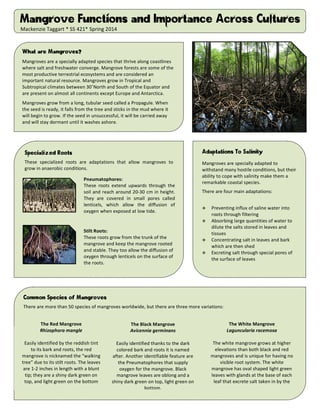
Specialized Roots
	
  
These	
   specialized	
   roots	
   are	
   adaptations	
   that	
   allow	
   mangroves	
   to	
  
grow	
  in	
  anaerobic	
  conditions.	


Stilt	
  Roots:	
  	
  
These	
  roots	
  grow	
  from	
  the	
  trunk	
  of	
  the	
  
mangrove	
  and	
  keep	
  the	
  mangrove	
  rooted	
  
and	
  stable.	
  They	
  too	
  allow	
  the	
  diffusion	
  of	
  
oxygen	
  through	
  lenticels	
  on	
  the	
  surface	
  of	
  
the	
  roots.	
  
Pneumatophores:	
  	
  
These	
   roots	
   extend	
   upwards	
   through	
   the	
  
soil	
  and	
  reach	
  around	
  20-­‐30	
  cm	
  in	
  height.	
  
They	
   are	
   covered	
   in	
   small	
   pores	
   called	
  
lenticels,	
   which	
   allow	
   the	
   diffusion	
   of	
  
oxygen	
  when	
  exposed	
  at	
  low	
  tide.	


  Mackenzie	
  Taggart	
  *	
  SS	
  421*	
  Spring	
  2014	


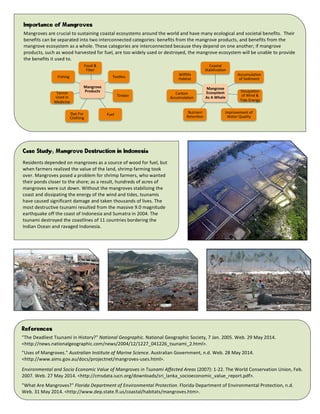
Importance of Mangroves
Mangroves	
  are	
  crucial	
  to	
  sustaining	
  coastal	
  ecosystems	
  around	
  the	
  world	
  and	
  have	
  many	
  ecological	
  and	
  societal	
  benefits.	
  	
  Their	
  
benefits	
  can	
  be	
  separated	
  into	
  two	
  interconnected	
  categories:	
  benefits	
  from	
  the	
  mangrove	
  products,	
  and	
  benefits	
  from	
  the	
  
mangrove	
  ecosystem	
  as	
  a	
  whole.	
  These	
  categories	
  are	
  interconnected	
  because	
  they	
  depend	
  on	
  one	
  another;	
  if	
  mangrove	
  
products,	
  such	
  as	
  wood	
  harvested	
  for	
  fuel,	
  are	
  too	
  widely	
  used	
  or	
  destroyed,	
  the	
  mangrove	
  ecosystem	
  will	
  be	
  unable	
  to	
  provide	
  
the	
  benefits	
  it	
  used	
  to.	


Mangrove	
  
Ecosystem	
  
As	
  A	
  Whole	
  
Coastal	
  
StabilizaUon	
  
AccumulaUon	
  
of	
  Sediment	
  
DissipaUon	
  
of	
  Wind	
  &	
  
Tide	
  Energy	
  
Improvement	
  of	
  
Water	
  Quality	
  	
  
Nutrient	
  
RetenUon	
  
Carbon	
  
AccumulaUon	
  
Wilflife	
  
Habitat	
  
Mangrove	
  
Products	
  
Food	
  &	
  
Fiber	
  
TexUles	
  
Timber	
  	
  
Fuel	
  	
  Dye	
  For	
  
Clothing	
  
Tannin	
  
Used	
  in	
  
Medicine	
  
Fishing	
  
Case Study: Mangrove Destruction in Indonesia
Residents	
  depended	
  on	
  mangroves	
  as	
  a	
  source	
  of	
  wood	
  for	
  fuel,	
  but	
  
when	
  farmers	
  realized	
  the	
  value	
  of	
  the	
  land,	
  shrimp	
  farming	
  took	
  
over.	
  Mangroves	
  posed	
  a	
  problem	
  for	
  shrimp	
  farmers,	
  who	
  wanted	
  
their	
  ponds	
  closer	
  to	
  the	
  shore;	
  as	
  a	
  result,	
  hundreds	
  of	
  acres	
  of	
  
mangroves	
  were	
  cut	
  down.	
  Without	
  the	
  mangroves	
  stabilizing	
  the	
  
coast	
  and	
  dissipating	
  the	
  energy	
  of	
  the	
  wind	
  and	
  tides,	
  tsunamis	
  
have	
  caused	
  significant	
  damage	
  and	
  taken	
  thousands	
  of	
  lives.	
  The	
  
most	
  destructive	
  tsunami	
  resulted	
  from	
  the	
  massive	
  9.0	
  magnitude	
  
earthquake	
  off	
  the	
  coast	
  of	
  Indonesia	
  and	
  Sumatra	
  in	
  2004.	
  The	
  
tsunami	
  destroyed	
  the	
  coastlines	
  of	
  11	
  countries	
  bordering	
  the	
  
Indian	
  Ocean	
  and	
  ravaged	
  Indonesia.	
  	
  
References
"The	
  Deadliest	
  Tsunami	
  in	
  History?"	
  National	
  Geographic.	
  National	
  Geographic	
  Society,	
  7	
  Jan.	
  2005.	
  Web.	
  29	
  May	
  2014.	
  
<http://news.nationalgeographic.com/news/2004/12/1227_041226_tsunami_2.html>.	


"Uses	
  of	
  Mangroves."	
  Australian	
  Institute	
  of	
  Marine	
  Science.	
  Australian	
  Government,	
  n.d.	
  Web.	
  28	
  May	
  2014.	
  
<http://www.aims.gov.au/docs/projectnet/mangroves-­‐uses.html>.	


Environmental	
  and	
  Socio	
  Economic	
  Value	
  of	
  Mangroves	
  in	
  Tsunami	
  Affected	
  Areas	
  (2007):	
  1-­‐22.	
  The	
  World	
  Conservation	
  Union,	
  Feb.	
  
2007.	
  Web.	
  27	
  May	
  2014.	
  <http://cmsdata.iucn.org/downloads/sri_lanka_socioeconomic_value_report.pdf>.	


"What	
  Are	
  Mangroves?"	
  Florida	
  Department	
  of	
  Environmental	
  Protection.	
  Florida	
  Department	
  of	
  Environmental	
  Protection,	
  n.d.	
  
Web.	
  31	
  May	
  2014.	
  <http://www.dep.state.fl.us/coastal/habitats/mangroves.htm>.	


#13Taggart_Mackenzie

  • 1.
         Mackenzie  Taggart*  SS  421*  Wetlands*  Spring  2014  Mangrove Functions and Importance Across Cultures     Adaptations To Salinity Mangroves  are  specially  adapted  to   withstand  many  hostile  conditions,  but  their   ability  to  cope  with  salinity  make  them  a   remarkable  coastal  species.       There  are  four  main  adaptations:       v Preventing  influx  of  saline  water  into   roots  through  filtering   v Absorbing  large  quantities  of  water  to   dilute  the  salts  stored  in  leaves  and   tissues   v Concentrating  salt  in  leaves  and  bark   which  are  then  shed   v Excreting  salt  through  special  pores  of   the  surface  of  leaves     What are Mangroves?   Mangroves  are  a  specially  adapted  species  that  thrive  along  coastlines   where  salt  and  freshwater  converge.  Mangrove  forests  are  some  of  the   most  productive  terrestrial  ecosystems  and  are  considered  an   important  natural  resource.  Mangroves  grow  in  Tropical  and   Subtropical  climates  between  30˚North  and  South  of  the  Equator  and   are  present  on  almost  all  continents  except  Europe  and  Antarctica.       Mangroves  grow  from  a  long,  tubular  seed  called  a  Propagule.  When   the  seed  is  ready,  it  falls  from  the  tree  and  sticks  in  the  mud  where  it   will  begin  to  grow.  If  the  seed  in  unsuccessful,  it  will  be  carried  away   and  will  stay  dormant  until  it  washes  ashore.       Common Species of Mangroves   There  are  more  than  50  species  of  mangroves  worldwide,  but  there  are  three  more  variations:               The  White  Mangrove   Laguncularia  racemosa     The  white  mangrove  grows  at  higher   elevations  than  both  black  and  red   mangroves  and  is  unique  for  having  no   visible  root  system.  The  white   mangrove  has  oval  shaped  light  green   leaves  with  glands  at  the  base  of  each   leaf  that  excrete  salt  taken  in  by  the   roots.   The  Black  Mangrove   Avicennia  germinans     Easily  identified  thanks  to  the  dark   colored  bark  and  roots  it  is  named   after.  Another  identifiable  feature  are   the  Pneumatophores  that  supply   oxygen  for  the  mangrove.  Black   mangrove  leaves  are  oblong  and  a   shiny  dark  green  on  top,  light  green  on   bottom.     The  Red  Mangrove   Rhizophora  mangle     Easily  identified  by  the  reddish  tint   to  its  bark  and  roots,  the  red   mangrove  is  nicknamed  the  “walking   tree”  due  to  its  stilt  roots.  The  leaves   are  1-­‐2  inches  in  length  with  a  blunt   tip;  they  are  a  shiny  dark  green  on   top,  and  light  green  on  the  bottom     Specialized Roots   These   specialized   roots   are   adaptations   that   allow   mangroves   to   grow  in  anaerobic  conditions.                                     Stilt  Roots:     These  roots  grow  from  the  trunk  of  the   mangrove  and  keep  the  mangrove  rooted   and  stable.  They  too  allow  the  diffusion  of   oxygen  through  lenticels  on  the  surface  of   the  roots.   Pneumatophores:     These   roots   extend   upwards   through   the   soil  and  reach  around  20-­‐30  cm  in  height.   They   are   covered   in   small   pores   called   lenticels,   which   allow   the   diffusion   of   oxygen  when  exposed  at  low  tide.          Mackenzie  Taggart  *  SS  421*  Spring  2014  
  • 2.
          Importance of Mangroves Mangroves  are  crucial  to  sustaining  coastal  ecosystems  around  the  world  and  have  many  ecological  and  societal  benefits.    Their   benefits  can  be  separated  into  two  interconnected  categories:  benefits  from  the  mangrove  products,  and  benefits  from  the   mangrove  ecosystem  as  a  whole.  These  categories  are  interconnected  because  they  depend  on  one  another;  if  mangrove   products,  such  as  wood  harvested  for  fuel,  are  too  widely  used  or  destroyed,  the  mangrove  ecosystem  will  be  unable  to  provide   the  benefits  it  used  to.                         Mangrove   Ecosystem   As  A  Whole   Coastal   StabilizaUon   AccumulaUon   of  Sediment   DissipaUon   of  Wind  &   Tide  Energy   Improvement  of   Water  Quality     Nutrient   RetenUon   Carbon   AccumulaUon   Wilflife   Habitat   Mangrove   Products   Food  &   Fiber   TexUles   Timber     Fuel    Dye  For   Clothing   Tannin   Used  in   Medicine   Fishing   Case Study: Mangrove Destruction in Indonesia Residents  depended  on  mangroves  as  a  source  of  wood  for  fuel,  but   when  farmers  realized  the  value  of  the  land,  shrimp  farming  took   over.  Mangroves  posed  a  problem  for  shrimp  farmers,  who  wanted   their  ponds  closer  to  the  shore;  as  a  result,  hundreds  of  acres  of   mangroves  were  cut  down.  Without  the  mangroves  stabilizing  the   coast  and  dissipating  the  energy  of  the  wind  and  tides,  tsunamis   have  caused  significant  damage  and  taken  thousands  of  lives.  The   most  destructive  tsunami  resulted  from  the  massive  9.0  magnitude   earthquake  off  the  coast  of  Indonesia  and  Sumatra  in  2004.  The   tsunami  destroyed  the  coastlines  of  11  countries  bordering  the   Indian  Ocean  and  ravaged  Indonesia.     References "The  Deadliest  Tsunami  in  History?"  National  Geographic.  National  Geographic  Society,  7  Jan.  2005.  Web.  29  May  2014.   <http://news.nationalgeographic.com/news/2004/12/1227_041226_tsunami_2.html>.     "Uses  of  Mangroves."  Australian  Institute  of  Marine  Science.  Australian  Government,  n.d.  Web.  28  May  2014.   <http://www.aims.gov.au/docs/projectnet/mangroves-­‐uses.html>.     Environmental  and  Socio  Economic  Value  of  Mangroves  in  Tsunami  Affected  Areas  (2007):  1-­‐22.  The  World  Conservation  Union,  Feb.   2007.  Web.  27  May  2014.  <http://cmsdata.iucn.org/downloads/sri_lanka_socioeconomic_value_report.pdf>.       "What  Are  Mangroves?"  Florida  Department  of  Environmental  Protection.  Florida  Department  of  Environmental  Protection,  n.d.   Web.  31  May  2014.  <http://www.dep.state.fl.us/coastal/habitats/mangroves.htm>.