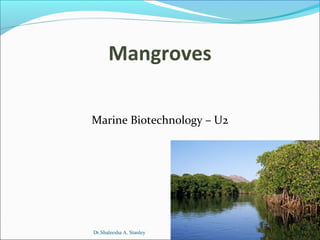
Mangroves
Marine Biotechnology – U2

Dr.Shaleesha A. Stanley

1
Dr.Shaleesha A. Stanley

2
About mangroves
 Mangrove forests perform multiple ecological functions such as
1. production of woody trees;
2. provision of habitat,
3. food, and
4. Spawning grounds for fin-fish and shellfish;
5. provision of habitat for birds and other valuable fauna;
6. protection of coastlines and accretion of sediment to form new land.

Mangrove areas have high biological productivity, associated with heavy leaf
production, leaf fall and rapid decomposition to form detritus
The mangrove ecosystem is dynamic, changing in both location and
composition, and has great resilience with the ability to restore itself after
heavy damage, as long as seed sources and water flow are maintained.
There are also many economic benefits from mangrove resources; like as a
source of firewood, self replenishing areas of fishery resources, for collecting
honey and for tourism.
Dr.Shaleesha A. Stanley

3
Distribution
Found on coastlines between 25° N and 25°S
latitude, dependent on temperature
i.
ii.

Rhizophora - survive 2-4° C for 24 hrs
Avicennia – survives 2-4° C for several days

Dr.Shaleesha A. Stanley

4
Dr.Shaleesha A. Stanley

5
SPECIES OF MANGROVES-60 species
worldwide
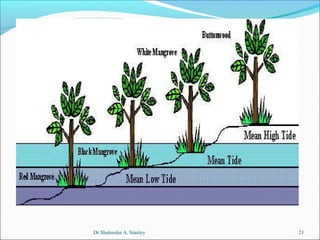
Black Mangrove

Red Mangrove

White Mangrove
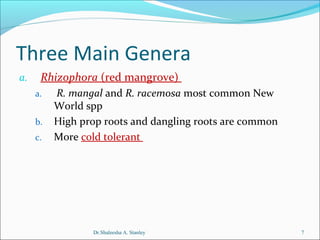
Three Main Genera
a.

Rhizophora (red mangrove)
a.
b.
c.

R. mangal and R. racemosa most common New
World spp
High prop roots and dangling roots are common
More cold tolerant

Dr.Shaleesha A. Stanley

7
Dr.Shaleesha A. Stanley

8
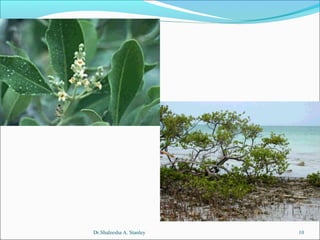
Avicennia (black mangrove)
i. A. germanaus most common in New World
 ii. Can tolerate very high salinity (60 ppt) and
very anoxic conditions
 iii. Known for having pneumatophores

Dr.Shaleesha A. Stanley

9
Dr.Shaleesha A. Stanley

10
Lagunicularia (white mangrove)
i.
ii.

L. racemosa most common in New World
Affinity for lower salinity areas

Dr.Shaleesha A. Stanley

11
Dr.Shaleesha A. Stanley

12
Characteristics of Mangroves
 Evergreen plants with thick leathery

leaves designed to minimize
transpiration.
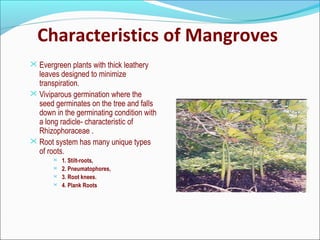
 Viviparous germination where the
seed germinates on the tree and falls
down in the germinating condition with
a long radicle- characteristic of
Rhizophoraceae .
 Root system has many unique types
of roots.





1. Stilt-roots,
2. Pneumatophores,
3. Root knees.
4. Plank Roots
ROOTS
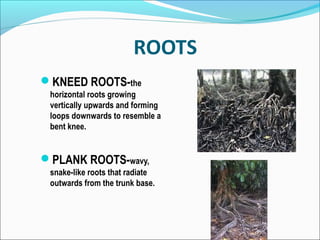
KNEED ROOTS-the
horizontal roots growing
vertically upwards and forming
loops downwards to resemble a
bent knee.

PLANK ROOTS-wavy,
snake-like roots that radiate
outwards from the trunk base.
Lenticels
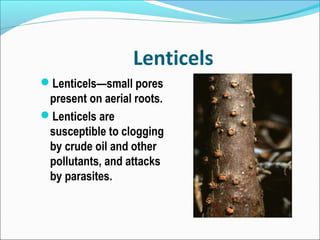
Lenticels—small pores

present on aerial roots.
Lenticels are
susceptible to clogging
by crude oil and other
pollutants, and attacks
by parasites.
Do Mangroves need salt?
Facultative halophytes
Grow in fresh water +

salt water.
COPING WITH SALT
Exclude Salt (no intake)
Extrude salt (take salt

in and dispense it
through glands in their
leaves).
IMPORTANCE--ECOLOGICAL
Habitats, nurseries, and nesting sites.
Root systems –harbor many organisms that trap and

cycle nutrients and other chemicals.
Contribute to higher water quality.
Protect shorelines from erosion.
IMPORTANCE --ECONOMIC
Food--- edible fruits and honey from flowers of

some species. River mangrove—source of best
honey.
Medicines- Treatment of skin disorders and sores
including leprosy. Headaches, rheumatism,
snakebites, boils, ulcers, diarrhea, and many more
conditions are traditionally treated with
mangrove plants.
Hard wood -- used for boat building and cabinet
timber.
Dr.Shaleesha A. Stanley

20
Dr.Shaleesha A. Stanley

21

Mangroves

  • 1.
    Mangroves Marine Biotechnology –U2 Dr.Shaleesha A. Stanley 1
  • 2.
  • 3.
    About mangroves  Mangroveforests perform multiple ecological functions such as 1. production of woody trees; 2. provision of habitat, 3. food, and 4. Spawning grounds for fin-fish and shellfish; 5. provision of habitat for birds and other valuable fauna; 6. protection of coastlines and accretion of sediment to form new land. Mangrove areas have high biological productivity, associated with heavy leaf production, leaf fall and rapid decomposition to form detritus The mangrove ecosystem is dynamic, changing in both location and composition, and has great resilience with the ability to restore itself after heavy damage, as long as seed sources and water flow are maintained. There are also many economic benefits from mangrove resources; like as a source of firewood, self replenishing areas of fishery resources, for collecting honey and for tourism. Dr.Shaleesha A. Stanley 3
  • 4.
    Distribution Found on coastlinesbetween 25° N and 25°S latitude, dependent on temperature i. ii. Rhizophora - survive 2-4° C for 24 hrs Avicennia – survives 2-4° C for several days Dr.Shaleesha A. Stanley 4
  • 5.
  • 6.
    SPECIES OF MANGROVES-60species worldwide Black Mangrove Red Mangrove White Mangrove
  • 7.
    Three Main Genera a. Rhizophora(red mangrove) a. b. c. R. mangal and R. racemosa most common New World spp High prop roots and dangling roots are common More cold tolerant Dr.Shaleesha A. Stanley 7
  • 8.
  • 9.
    Avicennia (black mangrove) i.A. germanaus most common in New World  ii. Can tolerate very high salinity (60 ppt) and very anoxic conditions  iii. Known for having pneumatophores Dr.Shaleesha A. Stanley 9
  • 10.
  • 11.
    Lagunicularia (white mangrove) i. ii. L.racemosa most common in New World Affinity for lower salinity areas Dr.Shaleesha A. Stanley 11
  • 12.
  • 13.
    Characteristics of Mangroves Evergreen plants with thick leathery leaves designed to minimize transpiration.  Viviparous germination where the seed germinates on the tree and falls down in the germinating condition with a long radicle- characteristic of Rhizophoraceae .  Root system has many unique types of roots.     1. Stilt-roots, 2. Pneumatophores, 3. Root knees. 4. Plank Roots
  • 14.
    ROOTS KNEED ROOTS-the horizontal rootsgrowing vertically upwards and forming loops downwards to resemble a bent knee. PLANK ROOTS-wavy, snake-like roots that radiate outwards from the trunk base.
  • 15.
    Lenticels Lenticels—small pores present onaerial roots. Lenticels are susceptible to clogging by crude oil and other pollutants, and attacks by parasites.
  • 16.
    Do Mangroves needsalt? Facultative halophytes Grow in fresh water + salt water.
  • 17.
    COPING WITH SALT ExcludeSalt (no intake) Extrude salt (take salt in and dispense it through glands in their leaves).
  • 18.
    IMPORTANCE--ECOLOGICAL Habitats, nurseries, andnesting sites. Root systems –harbor many organisms that trap and cycle nutrients and other chemicals. Contribute to higher water quality. Protect shorelines from erosion.
  • 19.
    IMPORTANCE --ECONOMIC Food--- ediblefruits and honey from flowers of some species. River mangrove—source of best honey. Medicines- Treatment of skin disorders and sores including leprosy. Headaches, rheumatism, snakebites, boils, ulcers, diarrhea, and many more conditions are traditionally treated with mangrove plants. Hard wood -- used for boat building and cabinet timber.
  • 20.
  • 21.