CHAPTER 13:
Managing Conflict and
Negotiating
Presented by:
Mirasol S. Madrid
Mikee Solano
II-9 BS Psychology
Lo.1 conflict:
a modern perspective
Solano, Mikee C.
II-9 BS Psychology
These major trends conspire to make
organizational conflict inevitable:
Constant change
Greater employee diversity
More teams (virtual and self-managed)
Less face to face communication (more
electronic interaction)
A global economy with increased cross-
cultural dealings.
The Language of Conflict: Metaphors
and Meaning
 Conflict as war: “We shot down that idea.”
 Conflict as opportunity: “What will it take
to resolve this disagreement?”
 Conflict as journey: “Let’s search for
common ground and all learn something
useful.”
Is commonly referred to in
management circles as
constructive or cooperative
conflict.
Dysfunctional Conflict
It is a conflict that hinder organizational
performance.
Other term for dysfunctional conflict is
destructive forms.
They are undesirable and the manager
should seek their eradication.
Situations tending to produce either
functional or dysfunctional conflict are
 Incompatible personalities or value systems
 Overlapping or unclear job boundaries
 Interdepartment/intergroup competition
 Competition for limited resources
 Inadequate communication
 Interdependent tasks
 Organizational complexity
 Unreasonable or unclear policies, standards,
or rules.
 Unreasonable deadlines or extreme time
pressure.
 Collective decision making
 Decision making by consensus
 Unmet expectations
 Unresolved or suppressed conflicts.
Desired Conflict Outcomes
Agreement
Stronger relationship
Learning
Is an interpersonal opposition
driven by personal dislike or
disagreement.
Day of Contemplation
A one-time-only day off with pay
to allow a problem employee to
recommit to the organization’s
values and mission.
Tips for employees having a
personality conflict
 Communicate directly with the other person
to resolve the perceived conflict.
 Avoid dragging co-workers into the conflict
 If dysfunctional conflict persists, seek help
from direct supervisors or human resource
specialists.
Tips for third-party observers of a
personality conflict
 Do not take sides in someone else’s
personality conflict.
 Suggest the parties work things out
themselves in a constructive and positive
way.
 If dysfunctional conflict persists, refer the
problem to parties direct supervisors.
 Investigate and document conflict
 If appropriate, take corrective action
 If necessary, attempt informal dispute
resolution.
 Refer difficult conflicts to human resource
specialists or hired counselors for formal
resolution attempts and other interventions.
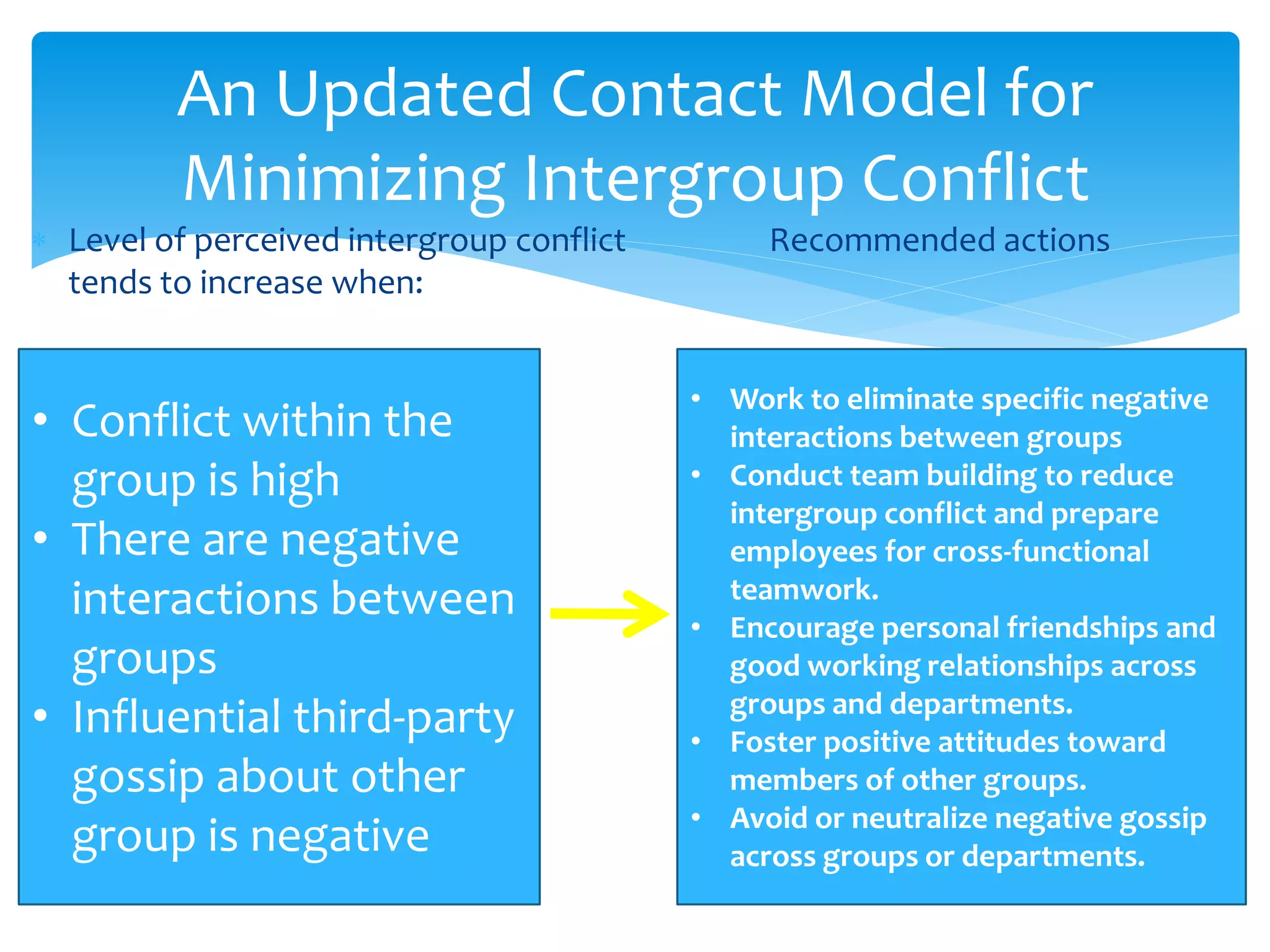
An Updated Contact Model for
Minimizing Intergroup Conflict
 Level of perceived intergroup conflict
tends to increase when:
Recommended actions
• Conflict within the
group is high
• There are negative
interactions between
groups
• Influential third-party
gossip about other
group is negative
• Work to eliminate specific negative
interactions between groups
• Conduct team building to reduce
intergroup conflict and prepare
employees for cross-functional
teamwork.
• Encourage personal friendships and
good working relationships across
groups and departments.
• Foster positive attitudes toward
members of other groups.
• Avoid or neutralize negative gossip
across groups or departments.
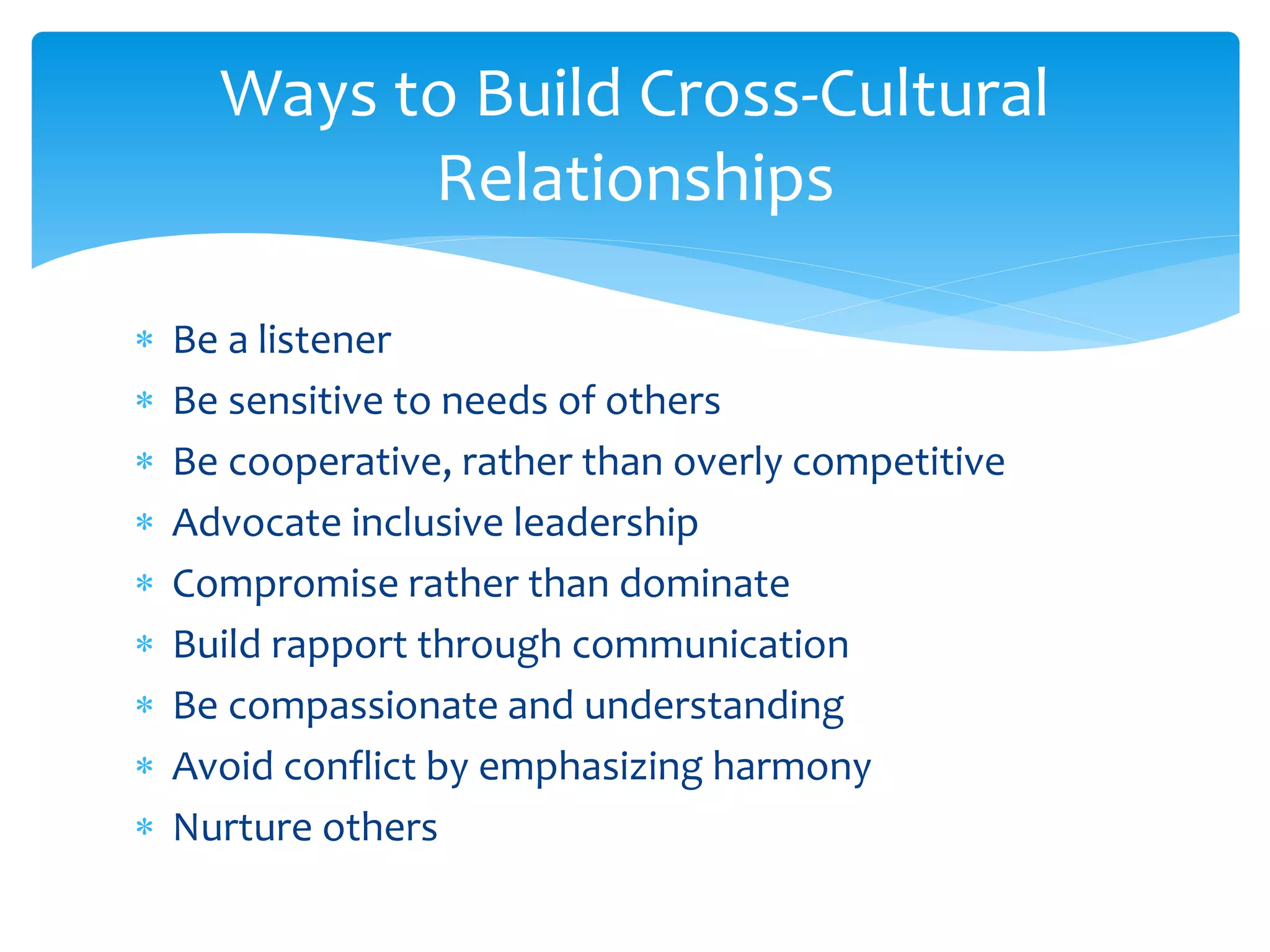
Ways to Build Cross-Cultural
Relationships
 Be a listener
 Be sensitive to needs of others
 Be cooperative, rather than overly competitive
 Advocate inclusive leadership
 Compromise rather than dominate
 Build rapport through communication
 Be compassionate and understanding
 Avoid conflict by emphasizing harmony
 Nurture others
STIMULATING A FUNCTIONAL
CONFLICT
L.0 7
PRESENTED BY:
Mirasol S. Madrid
Carefully monitored functional unit can help get the
creative juices flowing once again.
 Programmed conflict – “conflict that raises different
opinions regardless of the personal feelings of the
managers.
 Devil’s Advocacy – Occurs by assigning someone
the role of the critic, that is the devil’s advocate.
Example: the devil’s advocate before a cardinal’s
sainthood
L.O 7.
Stimulating Functional Conflict
 Dialectic Method – Fostering a structured debate
of opposing points of views prior to making a
decision. However, in this method, the “winning
team” may overshadow the issue at hand. It also
requires more skill training than the Devil’s
Advocacy.
In a more recent laboratory study, groups using devil’s
advocacy produced more potential solution.
L.O 7.
Stimulating Functional Conflict
People tend to handle negative conflict in patterned
ways referred to as styles:
1. Integrating (Problem Solving) – Interested parties
confront the issue and cooperatively identify the
problem, generate and weigh alternative solutions and
select a solution. The weakness of this style is that it is
very time consuming.
Alternative Styles for Handling
Dysfunctional Conflict
2. Obliging (Smoothing) – “An obliging person neglects
his or her own concern to satisfy the other party.” This
emphasizes commonalities. The weakness of this style is
that it is a temporary fix and it fails to confront the
underlying problem.
3. Dominating (Forcing) – The other party’s needs are
largely ignored. It relies on formal authority to force
compliance. In addition, this often breeds resentment.
Alternative Styles for Handling
Dysfunctional Conflict
4. Avoiding – This tactic involve either passive
withdrawal from the problem or active suppression of
the issue. However, it may buy time in unfolding or
ambiguous situations.
5. Compromising – This is a give-and-take approach
involving moderate concern for both self and others.
The primary strength of this tactic is that it has no
disgruntled losers.
Alternative Styles for Handling
Dysfunctional Conflict
THIRD-PARTY
INTERVENTIONS
L.0 8
 Conflict triangles – “occurs when two people are
having a problem and, instead of addressing the
problem directly with each other, one of them gets a
third person involved.”
 Alternative Dispute Resolution – Avoiding costly
lawsuits by resolving conflicts informally or through
mediation or arbitration.
L.O 8.
Third-Party Interventions
ADR Techniques:
 Facilitation – A third party, informally urges disputing
parties to deal directly with each other in a positive
and constructive manner.
 Conciliation – A neutral third party informally acts as
a communication conduit between disputing parties.
This is appropriate when conflicting parties refuse to
meet face to face
L.O 8.
Third-Party Interventions
ADR Techniques:
 Peer Review – A panel of trustworthy co-workers, hears
both sides of a dispute in an informal and confidential
meeting. Any decision by the review panel may not may
not be binding.
 Ombudsman – Someone who works for the organization,
and is widely respected and trusted by his or her co-
workers, hears grievances on a confidential basis, and
attempts to arrange a solution.
L.O 8.
Third-Party Interventions
ADR Techniques:
 Mediation – “The mediator – trained, third-party
neutral – actively guides the disputing parties in
exploring innovative solutions to the conflict. The
decision is up to the disputants to reach a mutually
acceptable decisions.
L.O 8.
Third-Party Interventions
ADR Techniques:
 Arbitration – Disputing parties agree ahead of time
to accept the decision of a neutral arbitrator in a
formal court-like setting, often with complete
witnesses and evidence. The decisions are based on
legal merits.
L.O 8.
Third-Party Interventions
NEGOTIATION
L.0 9
 Negotiation – a give-and-take decision-making
process involving interdependent parties with
different preferences. This has two types:
 Distributive Negotiation – usually involves a single
issue – a fixed-pie – in which one person gains at
the expense of the other.
 Integrative Negotiation – better for both parties.
Involves a win-win strategy.
L.O 9.
Negotiation
 Ethical Pitfalls in Negotiation - focuses on the
quality of information exchanged. Awareness of
these dirty tricks can keep a good faith bargainers
from being unfairly exploited. These are some of the
unethical negotiating tactics:
L.O 9.
Negotiation
 Lies
 Puffery
 Deception
 Weakening the opponent
 Strengthening one’s own position
 Nondisclosure
 Information exploitation
 Change of mind
 Distraction
 Maximization
L.O 9.
Negotiation
Core emotional elements of negotiation need to be
addressed:
 Appreciation – acknowledge that each other’s thoughts,
feelings, and actions have merit.
 Affiliation – treat each other as colleagues rather than as
adversaries to be kept at a distance
 Autonomy – respect each other’s freedom to make
important decision
 Status – recognize each other’s standing instead of
viewing the other person as inferior
 Role – define your roles and activities in a fulfilling way
L.O 9.
Conflict Management and Negotiation: A
Contingency Approach

Managing Conflict and Negotiating

  • 1.
    CHAPTER 13: Managing Conflictand Negotiating Presented by: Mirasol S. Madrid Mikee Solano II-9 BS Psychology
  • 2.
    Lo.1 conflict: a modernperspective Solano, Mikee C. II-9 BS Psychology
  • 4.
    These major trendsconspire to make organizational conflict inevitable: Constant change Greater employee diversity More teams (virtual and self-managed) Less face to face communication (more electronic interaction) A global economy with increased cross- cultural dealings.
  • 5.
    The Language ofConflict: Metaphors and Meaning  Conflict as war: “We shot down that idea.”  Conflict as opportunity: “What will it take to resolve this disagreement?”  Conflict as journey: “Let’s search for common ground and all learn something useful.”
  • 7.
    Is commonly referredto in management circles as constructive or cooperative conflict.
  • 8.
    Dysfunctional Conflict It isa conflict that hinder organizational performance. Other term for dysfunctional conflict is destructive forms. They are undesirable and the manager should seek their eradication.
  • 10.
    Situations tending toproduce either functional or dysfunctional conflict are  Incompatible personalities or value systems  Overlapping or unclear job boundaries  Interdepartment/intergroup competition  Competition for limited resources  Inadequate communication  Interdependent tasks  Organizational complexity
  • 11.
     Unreasonable orunclear policies, standards, or rules.  Unreasonable deadlines or extreme time pressure.  Collective decision making  Decision making by consensus  Unmet expectations  Unresolved or suppressed conflicts.
  • 12.
  • 14.
    Is an interpersonalopposition driven by personal dislike or disagreement.
  • 15.
    Day of Contemplation Aone-time-only day off with pay to allow a problem employee to recommit to the organization’s values and mission.
  • 16.
    Tips for employeeshaving a personality conflict  Communicate directly with the other person to resolve the perceived conflict.  Avoid dragging co-workers into the conflict  If dysfunctional conflict persists, seek help from direct supervisors or human resource specialists.
  • 17.
    Tips for third-partyobservers of a personality conflict  Do not take sides in someone else’s personality conflict.  Suggest the parties work things out themselves in a constructive and positive way.  If dysfunctional conflict persists, refer the problem to parties direct supervisors.
  • 19.
     Investigate anddocument conflict  If appropriate, take corrective action  If necessary, attempt informal dispute resolution.  Refer difficult conflicts to human resource specialists or hired counselors for formal resolution attempts and other interventions.
  • 21.
    An Updated ContactModel for Minimizing Intergroup Conflict  Level of perceived intergroup conflict tends to increase when: Recommended actions • Conflict within the group is high • There are negative interactions between groups • Influential third-party gossip about other group is negative • Work to eliminate specific negative interactions between groups • Conduct team building to reduce intergroup conflict and prepare employees for cross-functional teamwork. • Encourage personal friendships and good working relationships across groups and departments. • Foster positive attitudes toward members of other groups. • Avoid or neutralize negative gossip across groups or departments.
  • 23.
    Ways to BuildCross-Cultural Relationships  Be a listener  Be sensitive to needs of others  Be cooperative, rather than overly competitive  Advocate inclusive leadership  Compromise rather than dominate  Build rapport through communication  Be compassionate and understanding  Avoid conflict by emphasizing harmony  Nurture others
  • 24.
    STIMULATING A FUNCTIONAL CONFLICT L.07 PRESENTED BY: Mirasol S. Madrid
  • 25.
    Carefully monitored functionalunit can help get the creative juices flowing once again.  Programmed conflict – “conflict that raises different opinions regardless of the personal feelings of the managers.  Devil’s Advocacy – Occurs by assigning someone the role of the critic, that is the devil’s advocate. Example: the devil’s advocate before a cardinal’s sainthood L.O 7. Stimulating Functional Conflict
  • 26.
     Dialectic Method– Fostering a structured debate of opposing points of views prior to making a decision. However, in this method, the “winning team” may overshadow the issue at hand. It also requires more skill training than the Devil’s Advocacy. In a more recent laboratory study, groups using devil’s advocacy produced more potential solution. L.O 7. Stimulating Functional Conflict
  • 27.
    People tend tohandle negative conflict in patterned ways referred to as styles: 1. Integrating (Problem Solving) – Interested parties confront the issue and cooperatively identify the problem, generate and weigh alternative solutions and select a solution. The weakness of this style is that it is very time consuming. Alternative Styles for Handling Dysfunctional Conflict
  • 28.
    2. Obliging (Smoothing)– “An obliging person neglects his or her own concern to satisfy the other party.” This emphasizes commonalities. The weakness of this style is that it is a temporary fix and it fails to confront the underlying problem. 3. Dominating (Forcing) – The other party’s needs are largely ignored. It relies on formal authority to force compliance. In addition, this often breeds resentment. Alternative Styles for Handling Dysfunctional Conflict
  • 29.
    4. Avoiding –This tactic involve either passive withdrawal from the problem or active suppression of the issue. However, it may buy time in unfolding or ambiguous situations. 5. Compromising – This is a give-and-take approach involving moderate concern for both self and others. The primary strength of this tactic is that it has no disgruntled losers. Alternative Styles for Handling Dysfunctional Conflict
  • 30.
  • 31.
     Conflict triangles– “occurs when two people are having a problem and, instead of addressing the problem directly with each other, one of them gets a third person involved.”  Alternative Dispute Resolution – Avoiding costly lawsuits by resolving conflicts informally or through mediation or arbitration. L.O 8. Third-Party Interventions
  • 32.
    ADR Techniques:  Facilitation– A third party, informally urges disputing parties to deal directly with each other in a positive and constructive manner.  Conciliation – A neutral third party informally acts as a communication conduit between disputing parties. This is appropriate when conflicting parties refuse to meet face to face L.O 8. Third-Party Interventions
  • 33.
    ADR Techniques:  PeerReview – A panel of trustworthy co-workers, hears both sides of a dispute in an informal and confidential meeting. Any decision by the review panel may not may not be binding.  Ombudsman – Someone who works for the organization, and is widely respected and trusted by his or her co- workers, hears grievances on a confidential basis, and attempts to arrange a solution. L.O 8. Third-Party Interventions
  • 34.
    ADR Techniques:  Mediation– “The mediator – trained, third-party neutral – actively guides the disputing parties in exploring innovative solutions to the conflict. The decision is up to the disputants to reach a mutually acceptable decisions. L.O 8. Third-Party Interventions
  • 35.
    ADR Techniques:  Arbitration– Disputing parties agree ahead of time to accept the decision of a neutral arbitrator in a formal court-like setting, often with complete witnesses and evidence. The decisions are based on legal merits. L.O 8. Third-Party Interventions
  • 36.
  • 37.
     Negotiation –a give-and-take decision-making process involving interdependent parties with different preferences. This has two types:  Distributive Negotiation – usually involves a single issue – a fixed-pie – in which one person gains at the expense of the other.  Integrative Negotiation – better for both parties. Involves a win-win strategy. L.O 9. Negotiation
  • 38.
     Ethical Pitfallsin Negotiation - focuses on the quality of information exchanged. Awareness of these dirty tricks can keep a good faith bargainers from being unfairly exploited. These are some of the unethical negotiating tactics: L.O 9. Negotiation
  • 39.
     Lies  Puffery Deception  Weakening the opponent  Strengthening one’s own position  Nondisclosure  Information exploitation  Change of mind  Distraction  Maximization L.O 9. Negotiation
  • 40.
    Core emotional elementsof negotiation need to be addressed:  Appreciation – acknowledge that each other’s thoughts, feelings, and actions have merit.  Affiliation – treat each other as colleagues rather than as adversaries to be kept at a distance  Autonomy – respect each other’s freedom to make important decision  Status – recognize each other’s standing instead of viewing the other person as inferior  Role – define your roles and activities in a fulfilling way L.O 9. Conflict Management and Negotiation: A Contingency Approach