People management
Dario Di Nucci
How to select staff?
How to motivate people?
How to manage groups?
The People Capability Maturity Model
People management
Why People Management?
"People are an organisation’s most important assets."
"The tasks of a manager are essentially people-oriented.
Unless there is some understanding of people, management
will be unsuccessful."
"Poor people management is an important contributor to
project failure."
Important factor to not forget
Consistency
Respect
Inclusion
Honesty
How to select staff?
Curriculum Vitae
Interview and talking
Recommendations and comments
"Managers in a company may not wish to lose people to a
new project. Part-time involvement may be inevitable."
"Skills such as UI design and hardware interfacing are in
short supply."
"Recent graduates may not have specific skills but may be a
way of introducing new skills."
"Technical proficiency may be less important than social
skills."
How to select staff?
How to motivate people?
Motivation is a complex issue but it appears that their are
different types of motivation.
How to motivate people?
How to satisfy needs?
Social Provide communal facilities
Allow informal communication
Esteem Recognition of achievements
Appropriate rewards
Self-realization Training - people want to learn more
Responsibility
Personality types
How to motivate people?
Task-oriented
Self-oriented
Interaction-oriented
"Individual motivations are made up of elements
of each class."
"The balance can change depending on personal
circumstances and external events."
"However, people are not just motivated by personal factors
but also by being part of a group and culture."
"People go to work because they are motivated by the
people that they work with."
How to motivate people?
How to manage groups?
"Software engineering is a group activity."
"Group interaction is a key determinant of group
performance."
"Managers must do the best they can with available
people."
How to manage groups?
Group composition
Group cohesiveness
Group communications
Group organisation
How to manage groups?
Group composition
Manage group composed of members who share the same motivation can
be problematic:
Task-oriented everyone wants to do their own thing
Self-oriented everyone wants to be the boss
Interaction-oriented too much chatting, not enough work
An effective group has a balance of all types.
How to manage groups?
Group composition
"A leader knows where he wants to go, he starts, and
finally he arrives." John Erskine
How to manage groups?
Cohesiveness
"The group is more important than any individual in it."
How to manage groups?
Cohesiveness
Cohesiveness can be encoraged through:
● Developing a group identity and territory
● Social events
● Explicit team-building activities
How to manage groups?
Cohesiveness
Group member tend to be loyal to cohesive groups.
"Groupthink" is preservation of group irrespective of
technical or organizational consideration
Management should avoid groupthink by
forcing external involvement with each group.
How to manage groups?
Communication
Essential for effective group working.
Regard the status of work, design decisions and changes to
previous decisions.
Strengthens group cohesion as it
promotes understanding.
How to manage groups?
Communication
Size
Structure
Physical Work
Environment
Composition
How to manage groups?
Organisation
Small software engineering groups are usally organised
informally without a rigid structure.
For large projects, there may be a hierarchical structure
where different groups are responsible for different sub-
projects.
How to manage groups?
Organisation
Extreme programming groups
Chief programmer groups
Informal groups
How to manage groups?
Environment
"Every engineer requires an area for uninterrupted work"
"People prefer natural light"
"Individuals adopt different working practices and like to
organize their environment in different ways."
"Teams working together also require spaces
where formal and informal meetings can be
held."
The People Capability Maturity Model
"Framework for managing the development of people
involved in software development."
What?
The People Capability Maturity Model
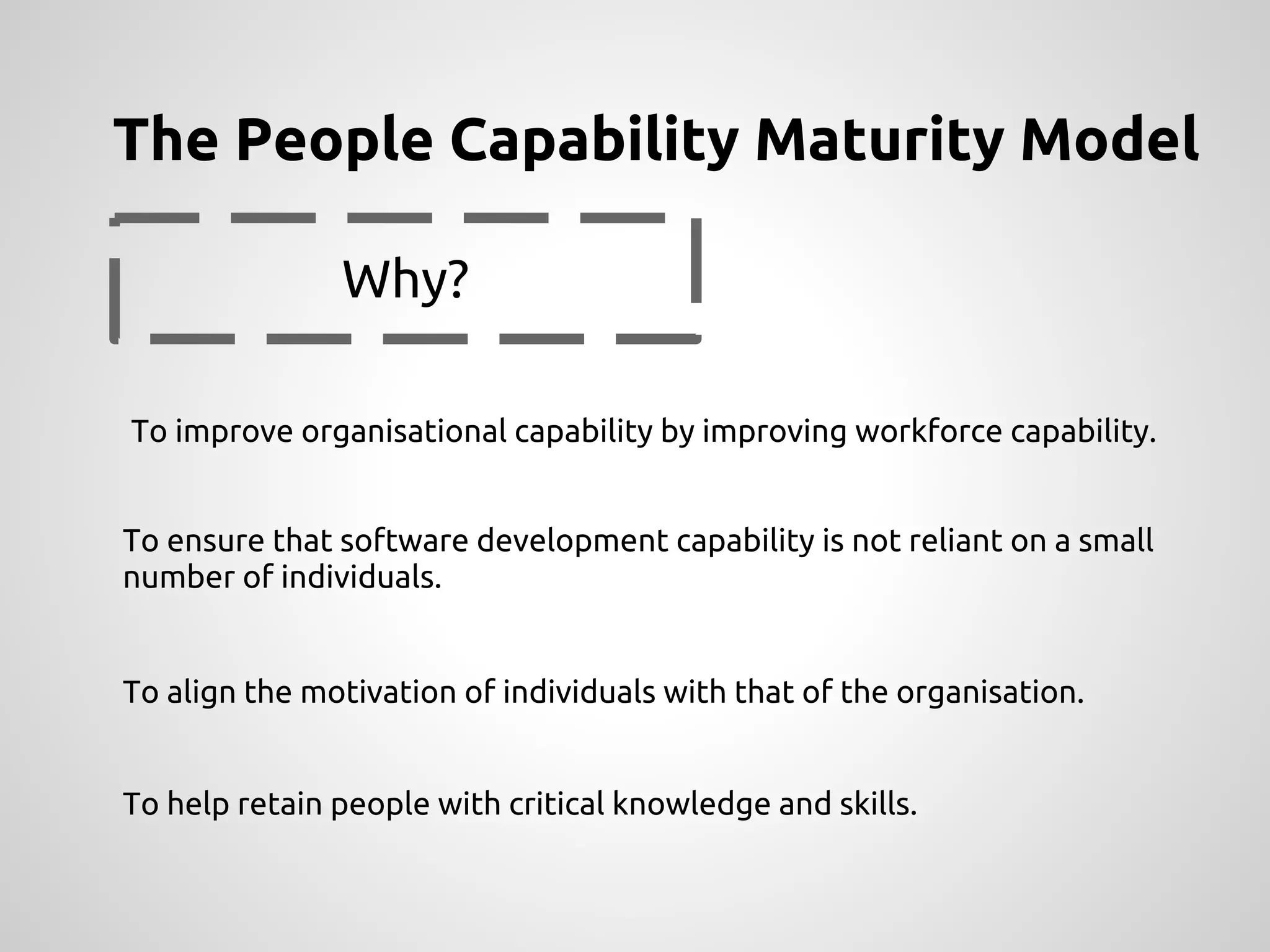
Why?
To improve organisational capability by improving workforce capability.
To ensure that software development capability is not reliant on a small
number of individuals.
To align the motivation of individuals with that of the organisation.
To help retain people with critical knowledge and skills.
The People Capability Maturity Model
How?
Initial
Repeatable
Defined
Managed
Optimizing

People management

  • 1.
  • 2.
    How to selectstaff? How to motivate people? How to manage groups? The People Capability Maturity Model People management
  • 3.
    Why People Management? "Peopleare an organisation’s most important assets." "The tasks of a manager are essentially people-oriented. Unless there is some understanding of people, management will be unsuccessful." "Poor people management is an important contributor to project failure."
  • 4.
    Important factor tonot forget Consistency Respect Inclusion Honesty
  • 5.
  • 6.
    How to selectstaff? Curriculum Vitae Interview and talking Recommendations and comments
  • 7.
    "Managers in acompany may not wish to lose people to a new project. Part-time involvement may be inevitable." "Skills such as UI design and hardware interfacing are in short supply." "Recent graduates may not have specific skills but may be a way of introducing new skills." "Technical proficiency may be less important than social skills." How to select staff?
  • 8.
  • 9.
    How to motivatepeople? Motivation is a complex issue but it appears that their are different types of motivation.
  • 10.
    How to motivatepeople? How to satisfy needs? Social Provide communal facilities Allow informal communication Esteem Recognition of achievements Appropriate rewards Self-realization Training - people want to learn more Responsibility
  • 11.
    Personality types How tomotivate people? Task-oriented Self-oriented Interaction-oriented
  • 12.
    "Individual motivations aremade up of elements of each class." "The balance can change depending on personal circumstances and external events." "However, people are not just motivated by personal factors but also by being part of a group and culture." "People go to work because they are motivated by the people that they work with." How to motivate people?
  • 13.
  • 14.
    How to managegroups? "Software engineering is a group activity." "Group interaction is a key determinant of group performance." "Managers must do the best they can with available people."
  • 15.
    How to managegroups? Group composition Group cohesiveness Group communications Group organisation
  • 16.
    How to managegroups? Group composition Manage group composed of members who share the same motivation can be problematic: Task-oriented everyone wants to do their own thing Self-oriented everyone wants to be the boss Interaction-oriented too much chatting, not enough work An effective group has a balance of all types.
  • 17.
    How to managegroups? Group composition "A leader knows where he wants to go, he starts, and finally he arrives." John Erskine
  • 18.
    How to managegroups? Cohesiveness "The group is more important than any individual in it."
  • 19.
    How to managegroups? Cohesiveness Cohesiveness can be encoraged through: ● Developing a group identity and territory ● Social events ● Explicit team-building activities
  • 20.
    How to managegroups? Cohesiveness Group member tend to be loyal to cohesive groups. "Groupthink" is preservation of group irrespective of technical or organizational consideration Management should avoid groupthink by forcing external involvement with each group.
  • 21.
    How to managegroups? Communication Essential for effective group working. Regard the status of work, design decisions and changes to previous decisions. Strengthens group cohesion as it promotes understanding.
  • 22.
    How to managegroups? Communication Size Structure Physical Work Environment Composition
  • 23.
    How to managegroups? Organisation Small software engineering groups are usally organised informally without a rigid structure. For large projects, there may be a hierarchical structure where different groups are responsible for different sub- projects.
  • 24.
    How to managegroups? Organisation Extreme programming groups Chief programmer groups Informal groups
  • 25.
    How to managegroups? Environment "Every engineer requires an area for uninterrupted work" "People prefer natural light" "Individuals adopt different working practices and like to organize their environment in different ways." "Teams working together also require spaces where formal and informal meetings can be held."
  • 26.
    The People CapabilityMaturity Model
  • 27.
    The People CapabilityMaturity Model "Framework for managing the development of people involved in software development." What?
  • 28.
    The People CapabilityMaturity Model Why? To improve organisational capability by improving workforce capability. To ensure that software development capability is not reliant on a small number of individuals. To align the motivation of individuals with that of the organisation. To help retain people with critical knowledge and skills.
  • 29.
    The People CapabilityMaturity Model How? Initial Repeatable Defined Managed Optimizing