Functional and Dysfunctional
         Conflicts

          S. Ebi Pearlin
         MA.HRM(1st year)
Topics to be covered

1.   What id Conflict.?
2.   Difference between the traditional, human relations, and
     interactionist views of conflict.
3.   The conflict iceberg
4.   Functional vs. Dysfunctional Conflict
5.   Contrast task, relationship, and process conflict.
6.   Outline of the conflict process.
7.   5 stages in the Conflict process
8.   Conflict management techniques
Conflict
Conflict Defined
   – Is a process that begins when one party perceives that
     another party has negatively affected, or is about to
     negatively affect, something that the first party cares
     about.
       o Is that point in an ongoing activity when an interaction “crosses
         over” to become an interparty conflict.
   – Encompasses a wide range of conflicts that people
     experience in organizations
           o Incompatibility of goals
           o Differences over interpretations of facts
           o Disagreements based on behavioral expectations
Transitions in Conflict Thought
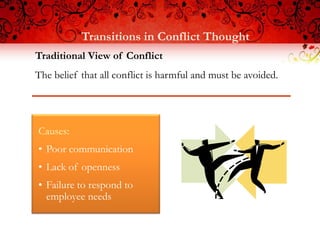
Traditional View of Conflict
The belief that all conflict is harmful and must be avoided.


Causes:
• Poor communication
• Lack of openness
• Failure to respond to
  employee needs
Transitions in Conflict Thought (cont’d)
Human Relations View of Conflict
The belief that conflict is a natural and inevitable outcome
in any group.

Interactionist View of Conflict
The belief that conflict is not only a
positive force in a group but that it is
absolutely necessary for a group to
perform effectively.
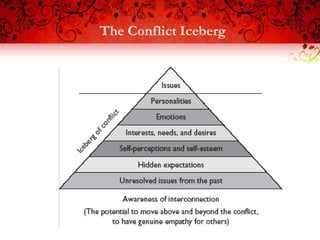
The Conflict Iceberg
Functional versus Dysfunctional Conflict
Functional Conflict
Conflict that supports the goals of
the group and improves its
performance.


                                      Dysfunctional Conflict
                                 Conflict that hinders group
                                                performance.
Functional vs. Dysfunctional Conflict


Functional or Dysfunctional is determined by
whether the organization’s interests are served


• Functional Conflict serves    • Dysfunctional Conflict
  organization’s interests        threatens organization’s
                                  interests
• Is commonly referred to as
  constructive or cooperative   • Wastes the organization’s
  conflict                        resources and is
                                  counterproductive
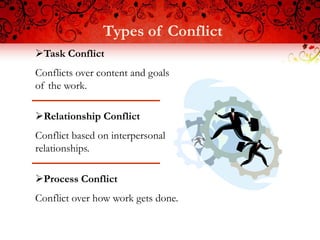
Types of Conflict
Task Conflict
Conflicts over content and goals
of the work.

Relationship Conflict
Conflict based on interpersonal
relationships.

Process Conflict
Conflict over how work gets done.
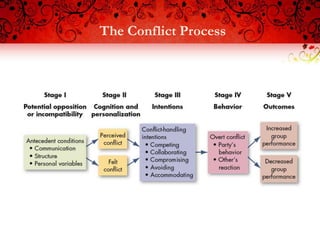
The Conflict Process
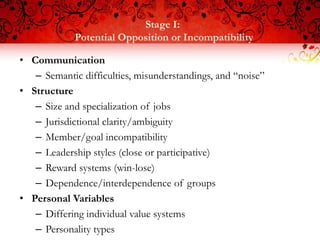
Stage I:
             Potential Opposition or Incompatibility

• Communication
   – Semantic difficulties, misunderstandings, and “noise”
• Structure
   – Size and specialization of jobs
   – Jurisdictional clarity/ambiguity
   – Member/goal incompatibility
   – Leadership styles (close or participative)
   – Reward systems (win-lose)
   – Dependence/interdependence of groups
• Personal Variables
   – Differing individual value systems
   – Personality types
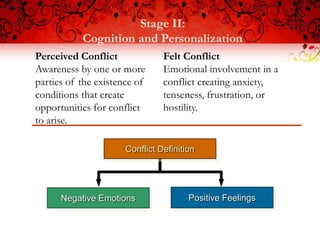
Stage II:
           Cognition and Personalization
Perceived Conflict              Felt Conflict
Awareness by one or more        Emotional involvement in a
parties of the existence of     conflict creating anxiety,
conditions that create          tenseness, frustration, or
opportunities for conflict      hostility.
to arise.

                      Conflict Definition


      Negative Emotions                Positive Feelings
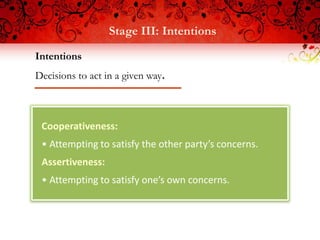
Stage III: Intentions
Intentions
Decisions to act in a given way.


 Cooperativeness:
 • Attempting to satisfy the other party’s concerns.
 Assertiveness:
 • Attempting to satisfy one’s own concerns.
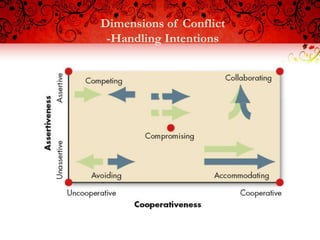
Dimensions of Conflict
 -Handling Intentions
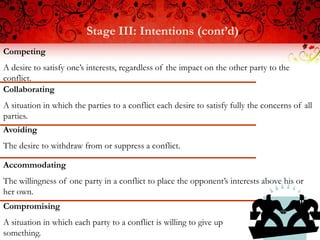
Stage III: Intentions (cont’d)
Competing
A desire to satisfy one’s interests, regardless of the impact on the other party to the
conflict.
Collaborating
A situation in which the parties to a conflict each desire to satisfy fully the concerns of all
parties.
Avoiding
The desire to withdraw from or suppress a conflict.

Accommodating
The willingness of one party in a conflict to place the opponent’s interests above his or
her own.
Compromising
A situation in which each party to a conflict is willing to give up
something.
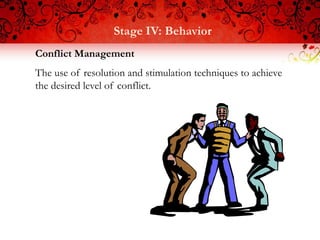
Stage IV: Behavior
Conflict Management
The use of resolution and stimulation techniques to achieve
the desired level of conflict.
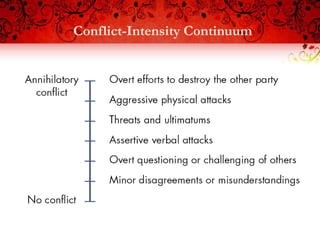
Conflict-Intensity Continuum
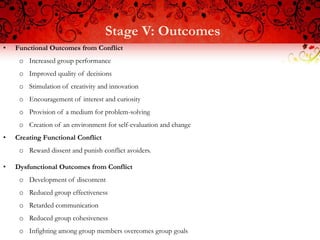
Stage V: Outcomes
•   Functional Outcomes from Conflict
     o Increased group performance
     o Improved quality of decisions
     o Stimulation of creativity and innovation
     o Encouragement of interest and curiosity
     o Provision of a medium for problem-solving
     o Creation of an environment for self-evaluation and change
•   Creating Functional Conflict
     o Reward dissent and punish conflict avoiders.

•   Dysfunctional Outcomes from Conflict
     o Development of discontent
     o Reduced group effectiveness
     o Retarded communication
     o Reduced group cohesiveness
     o Infighting among group members overcomes group goals
Types of Conflict

• Personality Conflict
   – Given the many possible combinations of personality traits, it is
     clear why personality conflicts are inevitable
   – A personality conflict is an interpersonal opposition based on
     personal dislike, disagreement, and/or different styles


• Intergroup Conflict
   – Conflict among work groups, teams and departments is a common
     threat to organizational competitiveness
   – Intergroup cohesiveness – a “we feeling” binding group members
     together – can be a good or bad thing (smooth running team or
     result in groupthink which limits critical thinking)
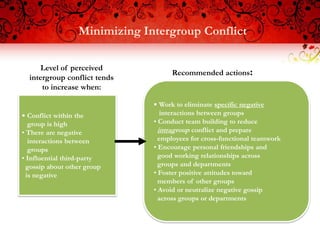
Minimizing Intergroup Conflict

     Level of perceived
                                    Recommended actions:
  intergroup conflict tends
      to increase when:

                               • Work to eliminate specific negative
• Conflict within the             interactions between groups
   group is high               • Conduct team building to reduce
• There are negative             intragroup conflict and prepare
   interactions between          employees for cross-functional teamwork
   groups                      • Encourage personal friendships and
• Influential third-party        good working relationships across
  gossip about other group       groups and departments
  is negative                  • Foster positive attitudes toward
                                 members of other groups
                               • Avoid or neutralize negative gossip
                                 across groups or departments
Managing Conflict

• Stimulating Functional Conflict
   – Devil’s Advocacy
   – The Dialectic Method


• 5 Alternative Styles for Handling Dysfunctional Conflict
   – Integrating (Problem Solving), Obliging (Smoothing),
     Dominating (Forcing), Avoiding and Compromising


• Third-Party Interventions
   – Conflict Triangles
   – Alternative Dispute Resolution
Stimulating Functional Conflict:
                      Devil’s Advocacy

1)   A proposed course of action is
     generated
2)   A devil’s advocate is assigned to
     critique the proposal
3)   The critique is presented to key
     decision makers
4)   Any additional information relevant
     to the issues is gathered
5)   The decision to adopt, modify, or
     discontinue the proposed course of
     action is taken
6)   The decision is monitored
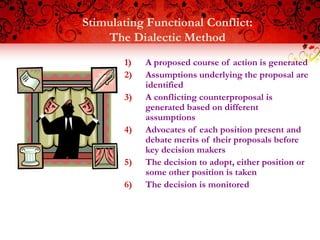
Stimulating Functional Conflict:
    The Dialectic Method
       1)   A proposed course of action is generated
       2)   Assumptions underlying the proposal are
            identified
       3)   A conflicting counterproposal is
            generated based on different
            assumptions
       4)   Advocates of each position present and
            debate merits of their proposals before
            key decision makers
       5)   The decision to adopt, either position or
            some other position is taken
       6)   The decision is monitored
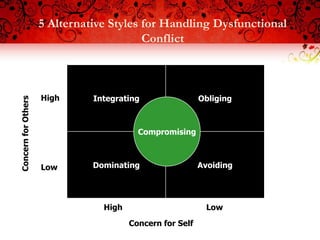
5 Alternative Styles for Handling Dysfunctional
                                          Conflict


                     High      Integrating                 Obliging
Concern for Others


                                          Compromising


                     Low       Dominating                  Avoiding


                                 High                       Low
                                        Concern for Self
5 Alternative Styles for Handling Dysfunctional
                              Conflict
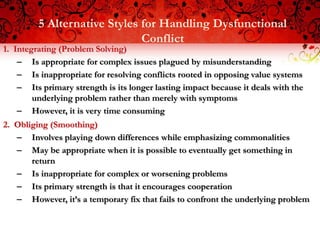
1. Integrating (Problem Solving)
    – Is appropriate for complex issues plagued by misunderstanding
    – Is inappropriate for resolving conflicts rooted in opposing value systems
    – Its primary strength is its longer lasting impact because it deals with the
        underlying problem rather than merely with symptoms
    – However, it is very time consuming
2. Obliging (Smoothing)
   – Involves playing down differences while emphasizing commonalities
   – May be appropriate when it is possible to eventually get something in
       return
   – Is inappropriate for complex or worsening problems
   – Its primary strength is that it encourages cooperation
   – However, it’s a temporary fix that fails to confront the underlying problem
5 Alternative Styles for Handling Dysfunctional
                             Conflict

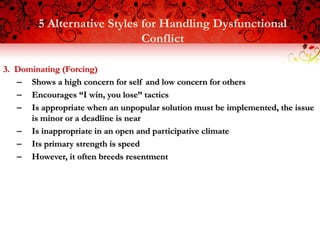
3. Dominating (Forcing)
   – Shows a high concern for self and low concern for others
   – Encourages “I win, you lose” tactics
   – Is appropriate when an unpopular solution must be implemented, the issue
      is minor or a deadline is near
   – Is inappropriate in an open and participative climate
   – Its primary strength is speed
   – However, it often breeds resentment
5 Alternative Styles for Handling Dysfunctional
                              Conflict
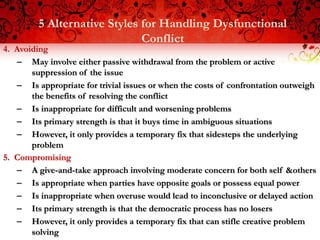
4. Avoiding
   – May involve either passive withdrawal from the problem or active
       suppression of the issue
   – Is appropriate for trivial issues or when the costs of confrontation outweigh
       the benefits of resolving the conflict
   – Is inappropriate for difficult and worsening problems
   – Its primary strength is that it buys time in ambiguous situations
   – However, it only provides a temporary fix that sidesteps the underlying
       problem
5. Compromising
   – A give-and-take approach involving moderate concern for both self &others
   – Is appropriate when parties have opposite goals or possess equal power
   – Is inappropriate when overuse would lead to inconclusive or delayed action
   – Its primary strength is that the democratic process has no losers
   – However, it only provides a temporary fix that can stifle creative problem
       solving
Third-Party Interventions

• Conflict Triangles
   – When two people are having a problem and instead of
     addressing the problem, one of them gets a third party
     involved


• Alternative Dispute Resolution (ADR)
   – Avoiding costly lawsuits by resolving conflicts informally or
     through mediation or arbitration
Alternative Dispute Resolutions

Facilitation
   – A third party, usually a manager, informally urges disputing parties
     to deal direction with each other in a positive manner


Conciliation
   – A neutral third party informally acts as a communication conduit
     between disputing parties


Peer review
   – A panel of trustworthy co-workers hears both sides of a dispute in an
     informal and confidential meeting
Alternative Dispute Resolutions

Ombudsman
  – Someone who works for the organization, and is widely
    respected, hears grievances on a confidential basis and
    attempts to arrange a solution

Mediation
  – A trained, third-party neutral actively guides the
    disputing parties in exploring a solution; the mediator
    does not render a decision

Arbitration
   – A trained, third-party neutral, makes a decision regarding
      the dispute

Functional and dysfunctional conflicts

  • 1.
    Functional and Dysfunctional Conflicts S. Ebi Pearlin MA.HRM(1st year)
  • 2.
    Topics to becovered 1. What id Conflict.? 2. Difference between the traditional, human relations, and interactionist views of conflict. 3. The conflict iceberg 4. Functional vs. Dysfunctional Conflict 5. Contrast task, relationship, and process conflict. 6. Outline of the conflict process. 7. 5 stages in the Conflict process 8. Conflict management techniques
  • 3.
    Conflict Conflict Defined – Is a process that begins when one party perceives that another party has negatively affected, or is about to negatively affect, something that the first party cares about. o Is that point in an ongoing activity when an interaction “crosses over” to become an interparty conflict. – Encompasses a wide range of conflicts that people experience in organizations o Incompatibility of goals o Differences over interpretations of facts o Disagreements based on behavioral expectations
  • 4.
    Transitions in ConflictThought Traditional View of Conflict The belief that all conflict is harmful and must be avoided. Causes: • Poor communication • Lack of openness • Failure to respond to employee needs
  • 5.
    Transitions in ConflictThought (cont’d) Human Relations View of Conflict The belief that conflict is a natural and inevitable outcome in any group. Interactionist View of Conflict The belief that conflict is not only a positive force in a group but that it is absolutely necessary for a group to perform effectively.
  • 6.
  • 7.
    Functional versus DysfunctionalConflict Functional Conflict Conflict that supports the goals of the group and improves its performance. Dysfunctional Conflict Conflict that hinders group performance.
  • 8.
    Functional vs. DysfunctionalConflict Functional or Dysfunctional is determined by whether the organization’s interests are served • Functional Conflict serves • Dysfunctional Conflict organization’s interests threatens organization’s interests • Is commonly referred to as constructive or cooperative • Wastes the organization’s conflict resources and is counterproductive
  • 9.
    Types of Conflict TaskConflict Conflicts over content and goals of the work. Relationship Conflict Conflict based on interpersonal relationships. Process Conflict Conflict over how work gets done.
  • 10.
  • 11.
    Stage I: Potential Opposition or Incompatibility • Communication – Semantic difficulties, misunderstandings, and “noise” • Structure – Size and specialization of jobs – Jurisdictional clarity/ambiguity – Member/goal incompatibility – Leadership styles (close or participative) – Reward systems (win-lose) – Dependence/interdependence of groups • Personal Variables – Differing individual value systems – Personality types
  • 12.
    Stage II: Cognition and Personalization Perceived Conflict Felt Conflict Awareness by one or more Emotional involvement in a parties of the existence of conflict creating anxiety, conditions that create tenseness, frustration, or opportunities for conflict hostility. to arise. Conflict Definition Negative Emotions Positive Feelings
  • 13.
    Stage III: Intentions Intentions Decisionsto act in a given way. Cooperativeness: • Attempting to satisfy the other party’s concerns. Assertiveness: • Attempting to satisfy one’s own concerns.
  • 14.
    Dimensions of Conflict -Handling Intentions
  • 15.
    Stage III: Intentions(cont’d) Competing A desire to satisfy one’s interests, regardless of the impact on the other party to the conflict. Collaborating A situation in which the parties to a conflict each desire to satisfy fully the concerns of all parties. Avoiding The desire to withdraw from or suppress a conflict. Accommodating The willingness of one party in a conflict to place the opponent’s interests above his or her own. Compromising A situation in which each party to a conflict is willing to give up something.
  • 16.
    Stage IV: Behavior ConflictManagement The use of resolution and stimulation techniques to achieve the desired level of conflict.
  • 17.
  • 18.
    Stage V: Outcomes • Functional Outcomes from Conflict o Increased group performance o Improved quality of decisions o Stimulation of creativity and innovation o Encouragement of interest and curiosity o Provision of a medium for problem-solving o Creation of an environment for self-evaluation and change • Creating Functional Conflict o Reward dissent and punish conflict avoiders. • Dysfunctional Outcomes from Conflict o Development of discontent o Reduced group effectiveness o Retarded communication o Reduced group cohesiveness o Infighting among group members overcomes group goals
  • 19.
    Types of Conflict •Personality Conflict – Given the many possible combinations of personality traits, it is clear why personality conflicts are inevitable – A personality conflict is an interpersonal opposition based on personal dislike, disagreement, and/or different styles • Intergroup Conflict – Conflict among work groups, teams and departments is a common threat to organizational competitiveness – Intergroup cohesiveness – a “we feeling” binding group members together – can be a good or bad thing (smooth running team or result in groupthink which limits critical thinking)
  • 20.
    Minimizing Intergroup Conflict Level of perceived Recommended actions: intergroup conflict tends to increase when: • Work to eliminate specific negative • Conflict within the interactions between groups group is high • Conduct team building to reduce • There are negative intragroup conflict and prepare interactions between employees for cross-functional teamwork groups • Encourage personal friendships and • Influential third-party good working relationships across gossip about other group groups and departments is negative • Foster positive attitudes toward members of other groups • Avoid or neutralize negative gossip across groups or departments
  • 21.
    Managing Conflict • StimulatingFunctional Conflict – Devil’s Advocacy – The Dialectic Method • 5 Alternative Styles for Handling Dysfunctional Conflict – Integrating (Problem Solving), Obliging (Smoothing), Dominating (Forcing), Avoiding and Compromising • Third-Party Interventions – Conflict Triangles – Alternative Dispute Resolution
  • 22.
    Stimulating Functional Conflict: Devil’s Advocacy 1) A proposed course of action is generated 2) A devil’s advocate is assigned to critique the proposal 3) The critique is presented to key decision makers 4) Any additional information relevant to the issues is gathered 5) The decision to adopt, modify, or discontinue the proposed course of action is taken 6) The decision is monitored
  • 23.
    Stimulating Functional Conflict: The Dialectic Method 1) A proposed course of action is generated 2) Assumptions underlying the proposal are identified 3) A conflicting counterproposal is generated based on different assumptions 4) Advocates of each position present and debate merits of their proposals before key decision makers 5) The decision to adopt, either position or some other position is taken 6) The decision is monitored
  • 24.
    5 Alternative Stylesfor Handling Dysfunctional Conflict High Integrating Obliging Concern for Others Compromising Low Dominating Avoiding High Low Concern for Self
  • 25.
    5 Alternative Stylesfor Handling Dysfunctional Conflict 1. Integrating (Problem Solving) – Is appropriate for complex issues plagued by misunderstanding – Is inappropriate for resolving conflicts rooted in opposing value systems – Its primary strength is its longer lasting impact because it deals with the underlying problem rather than merely with symptoms – However, it is very time consuming 2. Obliging (Smoothing) – Involves playing down differences while emphasizing commonalities – May be appropriate when it is possible to eventually get something in return – Is inappropriate for complex or worsening problems – Its primary strength is that it encourages cooperation – However, it’s a temporary fix that fails to confront the underlying problem
  • 26.
    5 Alternative Stylesfor Handling Dysfunctional Conflict 3. Dominating (Forcing) – Shows a high concern for self and low concern for others – Encourages “I win, you lose” tactics – Is appropriate when an unpopular solution must be implemented, the issue is minor or a deadline is near – Is inappropriate in an open and participative climate – Its primary strength is speed – However, it often breeds resentment
  • 27.
    5 Alternative Stylesfor Handling Dysfunctional Conflict 4. Avoiding – May involve either passive withdrawal from the problem or active suppression of the issue – Is appropriate for trivial issues or when the costs of confrontation outweigh the benefits of resolving the conflict – Is inappropriate for difficult and worsening problems – Its primary strength is that it buys time in ambiguous situations – However, it only provides a temporary fix that sidesteps the underlying problem 5. Compromising – A give-and-take approach involving moderate concern for both self &others – Is appropriate when parties have opposite goals or possess equal power – Is inappropriate when overuse would lead to inconclusive or delayed action – Its primary strength is that the democratic process has no losers – However, it only provides a temporary fix that can stifle creative problem solving
  • 28.
    Third-Party Interventions • ConflictTriangles – When two people are having a problem and instead of addressing the problem, one of them gets a third party involved • Alternative Dispute Resolution (ADR) – Avoiding costly lawsuits by resolving conflicts informally or through mediation or arbitration
  • 29.
    Alternative Dispute Resolutions Facilitation – A third party, usually a manager, informally urges disputing parties to deal direction with each other in a positive manner Conciliation – A neutral third party informally acts as a communication conduit between disputing parties Peer review – A panel of trustworthy co-workers hears both sides of a dispute in an informal and confidential meeting
  • 30.
    Alternative Dispute Resolutions Ombudsman – Someone who works for the organization, and is widely respected, hears grievances on a confidential basis and attempts to arrange a solution Mediation – A trained, third-party neutral actively guides the disputing parties in exploring a solution; the mediator does not render a decision Arbitration – A trained, third-party neutral, makes a decision regarding the dispute