TEAM
BUILDING
AMMAN GENER B. PIMENTEL
“If everyone is
moving forward
together, then
success takes
care of itself.”
–Henry Ford
is the process of turning a group of
individual into a cohesive team.
TEAM BUILDING
IMPORTANCE OF TEAM BUILDING
Facilitates better communication
Breaks the barrier
Motivates employees
Promotes creativity
Develops problem-solving skills
STAGES OF TEAM BUILDING
FORMING STORMING NORMING PERFORMING ADJOURNING
The team meets for
the first time
Agreement and
consensus form
within the team
which responds well
to the leader's
facilitation
Different ideas
compete for
consideration
Some teams will
reach the performing
stage
The team shares the
improved processes
with others
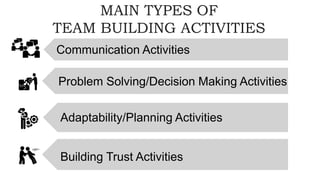
Communication Activities
Problem Solving/Decision Making Activities
Adaptability/Planning Activities
Building Trust Activities
MAIN TYPES OF
TEAM BUILDING ACTIVITIES
COMMUNICATION ACTIVITIES
Two Truths and a Lie
Life Highlights Game
Coin Logo
The One Question Ice Breaker Activity
Classification Game
PROBLEM SOLVING/
DECISION MAKING ACTIVITIES
Picture Pieces Game
Sneak a Peek Game
Zoom
The Great Egg Drop
Create you Own Team Building Activities
Lost at Sea
The Great Egg Drop
ADAPTABILITY/
PLANNING ACTIVITIES
The Paper Tower
Road Map Game
BUILDING TRUST ACTIVITIES
Mine Field
Eye Contact
Willow in the Wind
IMPORTANCE OF
TEAM BUILDING ACTIVITIES
Improves
Morale and
Productivity
Provides
High-impact
Learning
Increases Team
Skills and
Communications
Respectful
Positive Attitude
Relationship Building
Responsibility
ESSENTIAL ABILITIES
IN THE TEAM BUILDING
Understanding Feelings
Honesty
Influencing
Improve workplace
projects that
involve teamwork
WHY IS IT IMPORTANT
TO TEAM BUILD?
This understanding helps them work even better together
on future progress vital to a company.
Better understand each
other's strengths,
weaknesses, and
interests
Most effective team leaders build their relationships of
trust and loyalty, rather than fear or the power of their
positions.
FIRST RULE OF TEAM BUILDING
“TO LEAD A
TEAM EFFECTIVELY”
TEAM
WORK
is all about being able
to operate smoothly and
efficiently within a
group.
TEAM WORK
WE RISE BY
LIFTING
OTHERS.
-Robert Ingersoll
Team leaders and members become proficient
at dividing up tasks so they are done by the
most qualified people.
BENEFIT OF
STRONG TEAMWORK
HOW CAN TEAMWORK
BE SUCCESFUL?
Execute
Set team goals
Foster a creative environment
Build cohesion
Visualize ideas
Break down barriers
TOP FIVE TEAMWORK SKILLS
Communication
Conflict
Management
Listening Reliable Respectful
When individual contributors harmonize
their efforts and work toward a common
goal.
WHAT MAKES A
GOOD TEAM WORK?
Develop
collaborative
group
activities
WAYS ON HOW TO DEVELOP
TEAMWORK SKILLS
Create online
discussion groups
to build active
listening skills
Integrate
simulations that
focus on conflict
resolution
 Implement Recognition Programs
 Encourage quality teamwork
 Encourage Social Activities
 Outline Clear Roles
 Identify Existing Problems
 Mediate Disputes
WAYS ON HOW TO IMPROVE
TEAMWORK IN THE WORKPLACE
 Communicate
 Respect individuality
 Encourage creativity
 Include a mix of genders
 Hold trust-building exercises
 Define roles
 Don't settle
TIPS ON HOW TEAMS WORK
WELL TOGETHER
TEAM
A TEAM that works well
together understands the
strengths and weaknesses of
each team member.
“Enables companies to achieve their
goals are quickly and efficiently.”
WHY IS IT IMPORTANT
TO WORK AS A TEAM?
 Establish a mission
 Look for diversity
 Practice teamwork
 Utilize individual strengths
 Communicate effectively
 Give feedback
 Ask for feedback
 Celebrate success
WAYS ON HOW TO
BUILD A COHESIVE TEAM
Discuss Trust
Issues
WAYS ON HOW TO
BUILD TRUST WITH YOUR TEAM
Lead by
Example
Communicate
Openly
 Open door policy
 Encourage two-way feedback
 Clarity of roles and responsibilities
 Build the team spirit
 Use time wisely
 Training
 Use appropriate forms of communication
 Online tools instead of meetings
WAYS ON HOW TO IMPROVE
COMMUNICATION IN A TEAM
 Establish leadership
 Establish relationships with each of your team
 Build relationships between your team
 Foster teamwork
 Set ground rules for the team
STEPS IN BUILDING
A PRODUCTIVE TEAM
 Make time to lead
 Get to know your team
 Communicate
 Lead by example
 Reward the good and learn from the bad Delegate
 Be decisive
TIPS ON HOW TO ESTABLISH AND
MAINTAIN A PRODUCTIVE/
COLLABORATIVE TEAM
Focus on roles
Value each role
Communicate
Set goals
Celebrate successes and failures
Know each other
HOW TO BUILD A STRONG TEAM
GROUP
FIVE STAGES OF
GROUP DEVELOPMENT
 Allow extra time
 Adapt the task to the group
 Try active listening
 Get someone to be in charge
 Find a suitable space
 Use appropriate technology
 Be aware of subjective error
 Use your emotional intelligence
WAYS ON HOW TO
WORK WELL IN A GROUP
 An Example of Integrity
 Influential
 Willing to Delegate
 Powerful Facilitator
 Skilled Negotiator
EFFECTIVE QUALITIES
OF A TEAM LEADER
 A Clear Communicator
 Organized
 Confident in the Team
 Respectful to Others
 Fair and Kind
TEAM
LEADER
 Assign clear tasks to each member
 Regularly review and monitor progress of work
 Ensure that the team meets deadlines
 Discuss and agree on the timetable for major activities with the
team
 Motivate team members
 Resolve conflicts
 Give guidance when needed
 Helps members to overcome barriers
 Regularly assess team performance using a checklist
RESPONSIBILITIES OF A
TEAM LEADER
TEAM
MEMBERS
The strength of the
team is each individual
member. The strength
of each member is the
team. -Phil Jackson
Pay your people what they are worth
Provide them with a pleasant place to work
Offer opportunities for self-development
Foster collaboration within the team
Encourage happiness
Don't punish failure
Set clear goals
WAYS ON HOW MOTIVATE YOUR TEAM
MEMBERS
 Be an active participant
 Set challenging goals
 Maintain a big picture perspective
 Model and monitor the team values
 Don't ignore mistakes
 Recognize others' contributions and the team's
success
WAYS ON HOW TO
SUPPORT TEAM MEMBERS
Honest and Straightforward
Shares the Load
Reliable
Fair
Complements Others' Skills
Good Communication Skills
Positive Attitude
WAYS ON HOW CAN YOU BE AN
EFFECTIVE TEAM MEMBER
 Shaper Role
 Implementer Role
 Completer/Finisher Role
 Coordinator Role
 Team worker Role
 Resource Investigator Role
 Monitor-Evaluator Role
 Specialist Role
ROLES OF MEMBERS IN THE TEAM
Team Building
Team Building

Team Building

  • 1.
  • 2.
    “If everyone is movingforward together, then success takes care of itself.” –Henry Ford
  • 3.
    is the processof turning a group of individual into a cohesive team. TEAM BUILDING
  • 4.
    IMPORTANCE OF TEAMBUILDING Facilitates better communication Breaks the barrier Motivates employees Promotes creativity Develops problem-solving skills
  • 5.
    STAGES OF TEAMBUILDING FORMING STORMING NORMING PERFORMING ADJOURNING The team meets for the first time Agreement and consensus form within the team which responds well to the leader's facilitation Different ideas compete for consideration Some teams will reach the performing stage The team shares the improved processes with others
  • 6.
    Communication Activities Problem Solving/DecisionMaking Activities Adaptability/Planning Activities Building Trust Activities MAIN TYPES OF TEAM BUILDING ACTIVITIES
  • 7.
    COMMUNICATION ACTIVITIES Two Truthsand a Lie Life Highlights Game Coin Logo The One Question Ice Breaker Activity Classification Game
  • 8.
    PROBLEM SOLVING/ DECISION MAKINGACTIVITIES Picture Pieces Game Sneak a Peek Game Zoom The Great Egg Drop Create you Own Team Building Activities Lost at Sea The Great Egg Drop
  • 9.
  • 10.
    BUILDING TRUST ACTIVITIES MineField Eye Contact Willow in the Wind
  • 11.
    IMPORTANCE OF TEAM BUILDINGACTIVITIES Improves Morale and Productivity Provides High-impact Learning Increases Team Skills and Communications
  • 12.
    Respectful Positive Attitude Relationship Building Responsibility ESSENTIALABILITIES IN THE TEAM BUILDING Understanding Feelings Honesty Influencing
  • 13.
    Improve workplace projects that involveteamwork WHY IS IT IMPORTANT TO TEAM BUILD? This understanding helps them work even better together on future progress vital to a company. Better understand each other's strengths, weaknesses, and interests
  • 14.
    Most effective teamleaders build their relationships of trust and loyalty, rather than fear or the power of their positions. FIRST RULE OF TEAM BUILDING “TO LEAD A TEAM EFFECTIVELY”
  • 15.
  • 16.
    is all aboutbeing able to operate smoothly and efficiently within a group. TEAM WORK
  • 17.
  • 18.
    Team leaders andmembers become proficient at dividing up tasks so they are done by the most qualified people. BENEFIT OF STRONG TEAMWORK
  • 19.
    HOW CAN TEAMWORK BESUCCESFUL? Execute Set team goals Foster a creative environment Build cohesion Visualize ideas Break down barriers
  • 20.
    TOP FIVE TEAMWORKSKILLS Communication Conflict Management Listening Reliable Respectful
  • 21.
    When individual contributorsharmonize their efforts and work toward a common goal. WHAT MAKES A GOOD TEAM WORK?
  • 22.
    Develop collaborative group activities WAYS ON HOWTO DEVELOP TEAMWORK SKILLS Create online discussion groups to build active listening skills Integrate simulations that focus on conflict resolution
  • 23.
     Implement RecognitionPrograms  Encourage quality teamwork  Encourage Social Activities  Outline Clear Roles  Identify Existing Problems  Mediate Disputes WAYS ON HOW TO IMPROVE TEAMWORK IN THE WORKPLACE
  • 24.
     Communicate  Respectindividuality  Encourage creativity  Include a mix of genders  Hold trust-building exercises  Define roles  Don't settle TIPS ON HOW TEAMS WORK WELL TOGETHER
  • 25.
  • 26.
    A TEAM thatworks well together understands the strengths and weaknesses of each team member.
  • 28.
    “Enables companies toachieve their goals are quickly and efficiently.” WHY IS IT IMPORTANT TO WORK AS A TEAM?
  • 29.
     Establish amission  Look for diversity  Practice teamwork  Utilize individual strengths  Communicate effectively  Give feedback  Ask for feedback  Celebrate success WAYS ON HOW TO BUILD A COHESIVE TEAM
  • 30.
    Discuss Trust Issues WAYS ONHOW TO BUILD TRUST WITH YOUR TEAM Lead by Example Communicate Openly
  • 31.
     Open doorpolicy  Encourage two-way feedback  Clarity of roles and responsibilities  Build the team spirit  Use time wisely  Training  Use appropriate forms of communication  Online tools instead of meetings WAYS ON HOW TO IMPROVE COMMUNICATION IN A TEAM
  • 32.
     Establish leadership Establish relationships with each of your team  Build relationships between your team  Foster teamwork  Set ground rules for the team STEPS IN BUILDING A PRODUCTIVE TEAM
  • 33.
     Make timeto lead  Get to know your team  Communicate  Lead by example  Reward the good and learn from the bad Delegate  Be decisive TIPS ON HOW TO ESTABLISH AND MAINTAIN A PRODUCTIVE/ COLLABORATIVE TEAM
  • 34.
    Focus on roles Valueeach role Communicate Set goals Celebrate successes and failures Know each other HOW TO BUILD A STRONG TEAM
  • 35.
  • 37.
  • 38.
     Allow extratime  Adapt the task to the group  Try active listening  Get someone to be in charge  Find a suitable space  Use appropriate technology  Be aware of subjective error  Use your emotional intelligence WAYS ON HOW TO WORK WELL IN A GROUP
  • 39.
     An Exampleof Integrity  Influential  Willing to Delegate  Powerful Facilitator  Skilled Negotiator EFFECTIVE QUALITIES OF A TEAM LEADER  A Clear Communicator  Organized  Confident in the Team  Respectful to Others  Fair and Kind
  • 40.
  • 41.
     Assign cleartasks to each member  Regularly review and monitor progress of work  Ensure that the team meets deadlines  Discuss and agree on the timetable for major activities with the team  Motivate team members  Resolve conflicts  Give guidance when needed  Helps members to overcome barriers  Regularly assess team performance using a checklist RESPONSIBILITIES OF A TEAM LEADER
  • 43.
  • 44.
    The strength ofthe team is each individual member. The strength of each member is the team. -Phil Jackson
  • 46.
    Pay your peoplewhat they are worth Provide them with a pleasant place to work Offer opportunities for self-development Foster collaboration within the team Encourage happiness Don't punish failure Set clear goals WAYS ON HOW MOTIVATE YOUR TEAM MEMBERS
  • 47.
     Be anactive participant  Set challenging goals  Maintain a big picture perspective  Model and monitor the team values  Don't ignore mistakes  Recognize others' contributions and the team's success WAYS ON HOW TO SUPPORT TEAM MEMBERS
  • 48.
    Honest and Straightforward Sharesthe Load Reliable Fair Complements Others' Skills Good Communication Skills Positive Attitude WAYS ON HOW CAN YOU BE AN EFFECTIVE TEAM MEMBER
  • 49.
     Shaper Role Implementer Role  Completer/Finisher Role  Coordinator Role  Team worker Role  Resource Investigator Role  Monitor-Evaluator Role  Specialist Role ROLES OF MEMBERS IN THE TEAM