DECISION MAKING
PROCESS
SUBMITTED BY : SHAHANWAZ SHEIKH
DECISION MAKING
PROCESS
SUBMITTED BY :
SHAHANWAZ SHEIKH
INTRODUCTION:
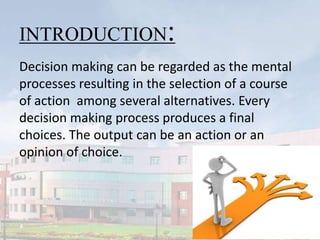
Decision making can be regarded as the mental
processes resulting in the selection of a course
of action among several alternatives. Every
decision making process produces a final
choices. The output can be an action or an
opinion of choice.
Decision making steps:
There are eight steps of decision making:
 Identification of problem
 Identification of decision criteria
 Allocating weight to criteria
 Develop alternatives
 Analysis of alternatives
 Selection of alternatives
 Implementation of the best alternatives
 Evaluation of decision effectiveness
Problem
The decision-making process begins when a manager
identifies the real problem. The accurate definition of
the problem affects all the steps that follow, if the
problem is inaccurately defined, every step in the
decision-making process will be based on an incorrect
starting point. One way that a manager can help
determines the true problem separately from its
symptoms.
Step 1: Identification of problem
A problem is defined as a discrepancy between an
existing and a desired state of affairs. Some cautions
about problem identification include the following:
1. Make sure it’s a problem and not just a symptom of a
problem.
2. Problem identification is subjective.
3. Discrepancies can be found by comparing current results
with some standard.
4. Managers are not likely to characterize a discrepancy as a
problem if they perceive that they don’t have the authority,
information, or other resources needed to act on it.
So the problem we are not identifying is to get a job in a school
with maximum salary and benefits.
Step 2: Identification of Decision Criteria
Decision criteria are factors that are important to
resolving the problem:
So the factors which are relevant in solving our
problems are:
1. Salary
2. Opportunity to progress
3. Job Environment
4. Incentives
5. Facilities
6. Job securities
7. Location
8. Timings
Step 3: Allocation of Weight to criteria
Step 3 is allocate weights to the criteria. The
criteria identified in Step 2 of the decision
making process are not all equally important, So
the decision maker must weight the items in
order to give them correct priority in the
decision.
Step 4: Development of Alternatives
Identifying viable alternatives:
Alternatives are listed that can resolve the problem:
Name of schools
1) Unique
2) American Lycetuff
3) LDA
4) Allied
5) Cathedral
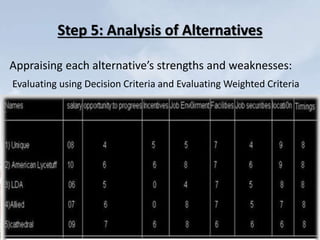
Step 5: Analysis of Alternatives
Appraising each alternative’s strengths and weaknesses:
Evaluating using Decision Criteria and Evaluating Weighted Criteria
THANK YOU

Decision Making Process ppt

  • 1.
  • 2.
  • 3.
    INTRODUCTION: Decision making canbe regarded as the mental processes resulting in the selection of a course of action among several alternatives. Every decision making process produces a final choices. The output can be an action or an opinion of choice.
  • 4.
    Decision making steps: Thereare eight steps of decision making:  Identification of problem  Identification of decision criteria  Allocating weight to criteria  Develop alternatives  Analysis of alternatives  Selection of alternatives  Implementation of the best alternatives  Evaluation of decision effectiveness
  • 5.
    Problem The decision-making processbegins when a manager identifies the real problem. The accurate definition of the problem affects all the steps that follow, if the problem is inaccurately defined, every step in the decision-making process will be based on an incorrect starting point. One way that a manager can help determines the true problem separately from its symptoms.
  • 6.
    Step 1: Identificationof problem A problem is defined as a discrepancy between an existing and a desired state of affairs. Some cautions about problem identification include the following: 1. Make sure it’s a problem and not just a symptom of a problem. 2. Problem identification is subjective. 3. Discrepancies can be found by comparing current results with some standard. 4. Managers are not likely to characterize a discrepancy as a problem if they perceive that they don’t have the authority, information, or other resources needed to act on it. So the problem we are not identifying is to get a job in a school with maximum salary and benefits.
  • 7.
    Step 2: Identificationof Decision Criteria Decision criteria are factors that are important to resolving the problem: So the factors which are relevant in solving our problems are: 1. Salary 2. Opportunity to progress 3. Job Environment 4. Incentives 5. Facilities 6. Job securities 7. Location 8. Timings
  • 8.
    Step 3: Allocationof Weight to criteria Step 3 is allocate weights to the criteria. The criteria identified in Step 2 of the decision making process are not all equally important, So the decision maker must weight the items in order to give them correct priority in the decision.
  • 9.
    Step 4: Developmentof Alternatives Identifying viable alternatives: Alternatives are listed that can resolve the problem: Name of schools 1) Unique 2) American Lycetuff 3) LDA 4) Allied 5) Cathedral
  • 10.
    Step 5: Analysisof Alternatives Appraising each alternative’s strengths and weaknesses: Evaluating using Decision Criteria and Evaluating Weighted Criteria
  • 11.