Mammography Positioning
Technique for Cranio-Caudal
(CC) View
Ms Selin Prasad
Radiographer/Sonographer
ALARA Principle
 As Low As Reasonably Achievable (ALARA)
 Mammography uses low dose protocols in accordance
with ALARA, however, all precaution should be taken
not to take unnecessary images/repeats
 Repeats should be kept to a very minimum and ONLY
done if absolutely necessary
 Repeat of an image should ONLY be done if it serves a
diagnostic purpose, will aid in final diagnosis
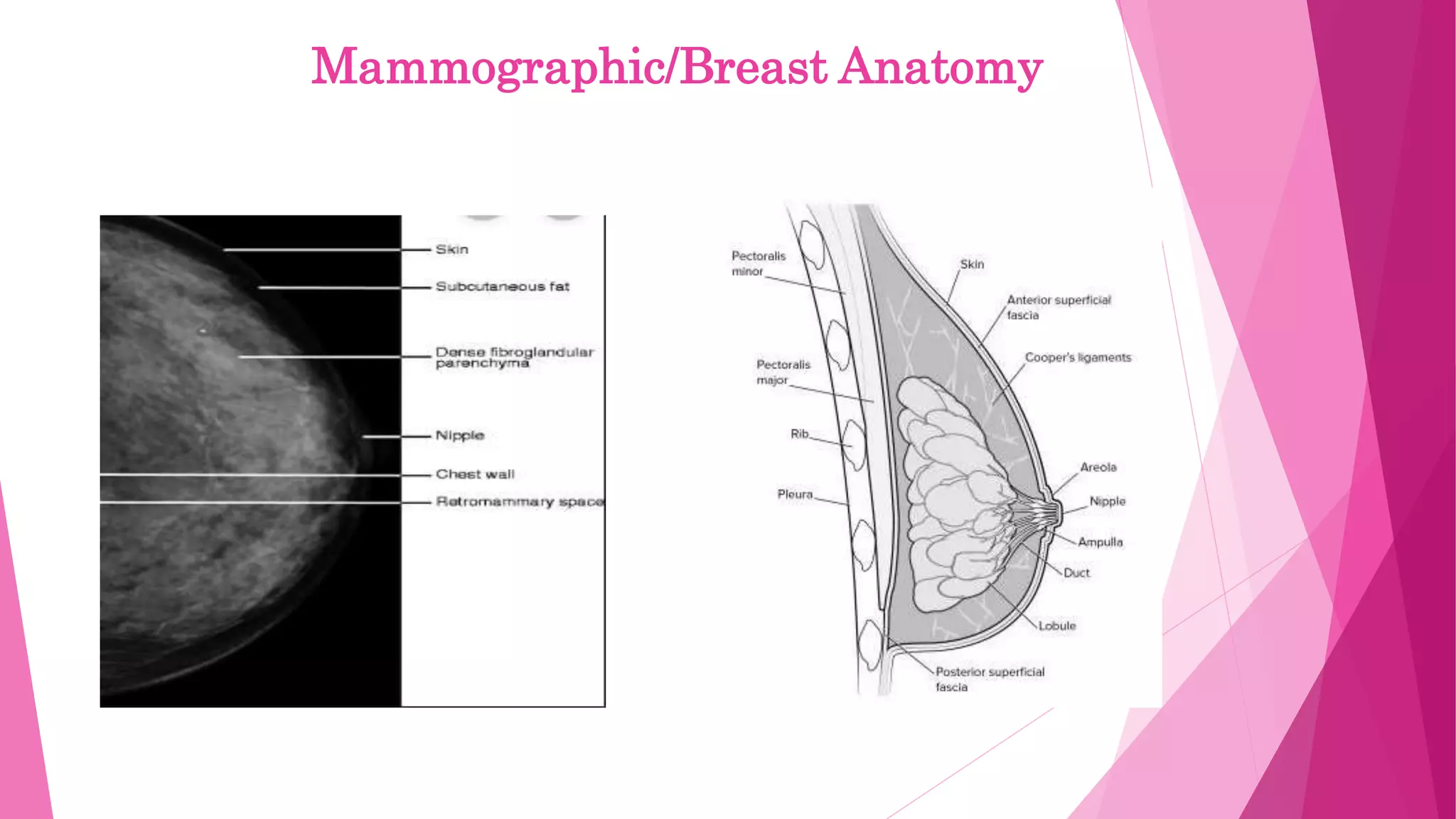
Mammographic/Breast Anatomy
Standard Views/Projections in Mammography
Medio-lateral Oblique (MLO)
Cranio-caudal (CC)
Latero-medial (LM)
CC Projection
The craniocaudal projection will best visualize the sub-areolar, central,
medial, and posteromedial aspects of the breast.
Basic Concepts/ Application of Positioning
 To bring the breast to it’s natural anatomical position ( nipple perpendicular to chest wall)
to maximise visualisation of entire breast anatomy and potential pathology and avoid
superimposition of breast structures.
 The lateral and inferior portions of the breast are more mobile than the superior and medial
portions. Therefore standard views have been developed to maximize this mobility and pull
as much breast tissue toward the more fixed borders and onto the imaging device as is
possible.
 All mammographic views are defined by the direction of the x-ray beam from the tube
toward the detector. The mediolateral oblique view (MLO) is the single best view to image
the majority of the breast tissue.
 The upper inner portion of the breast is the least successfully included portion, and so the
standard mammographic view, the craniocaudal (CC), should include as much medial tissue
as is possible without excluding lateral tissue.
 To visualize the posterior and upper-outer quadrants of the breast. This is intrinsic to the
anatomy of the breast, which lies anterior to and follows the line of the obliquely coursing
pectoral muscle. Positioning the breast parallel to this oblique line, which is the natural
course of the tissue, it is possible to demonstrate most of the glandular tissue
Anatomical Landmarks for Positioning and Image
Analysis
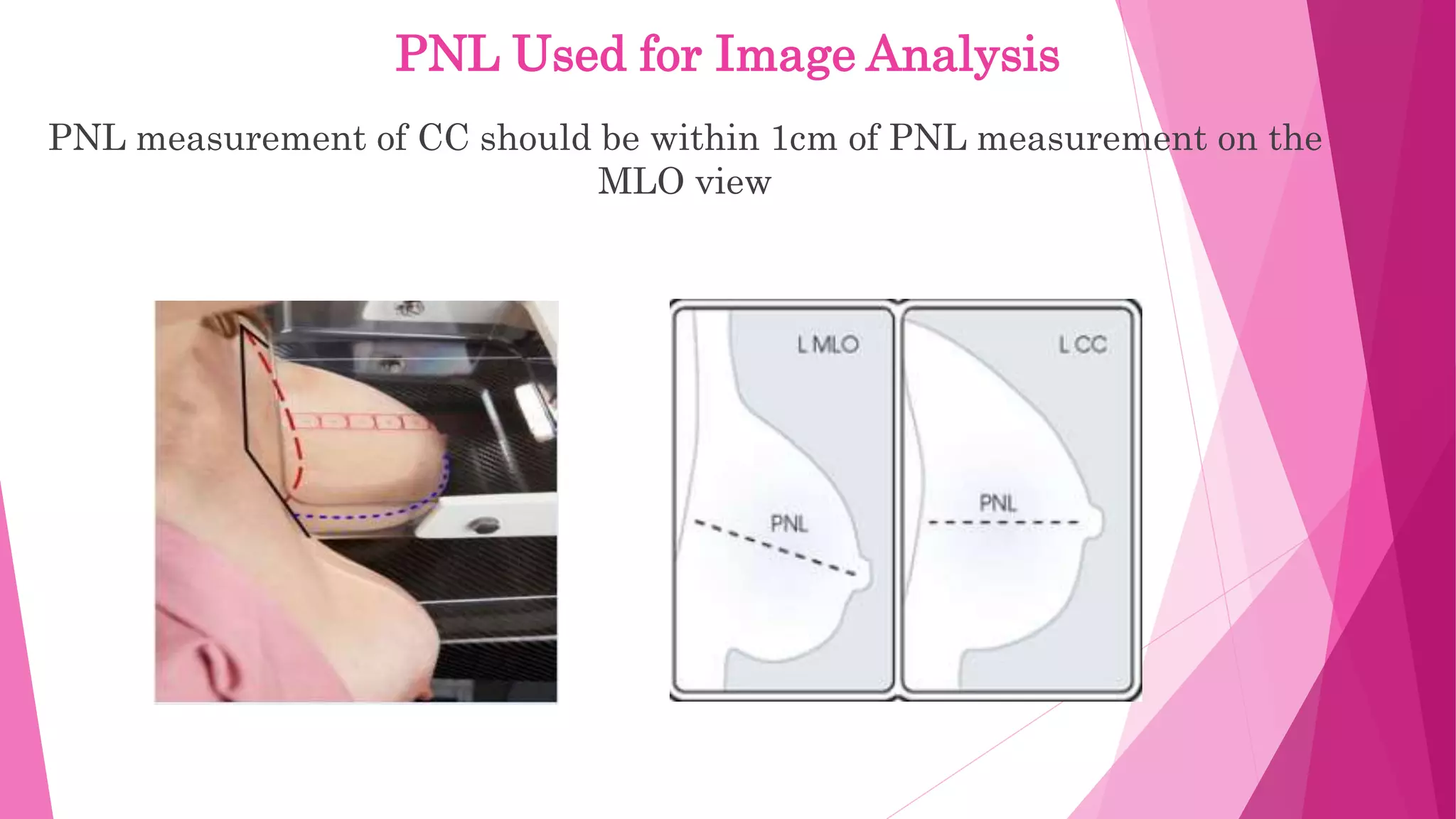
PNL Used for Image Analysis
PNL measurement of CC should be within 1cm of PNL measurement on the
MLO view
PNL Used for Image Analysis
 Adequate posterior nipple line (PNL) measurement differences between the
craniocaudal (CC) and mediolateral oblique (MLO) views. The difference in
this distance between the two views is less or equal to 1 cm
PNL Used for Image Analysis
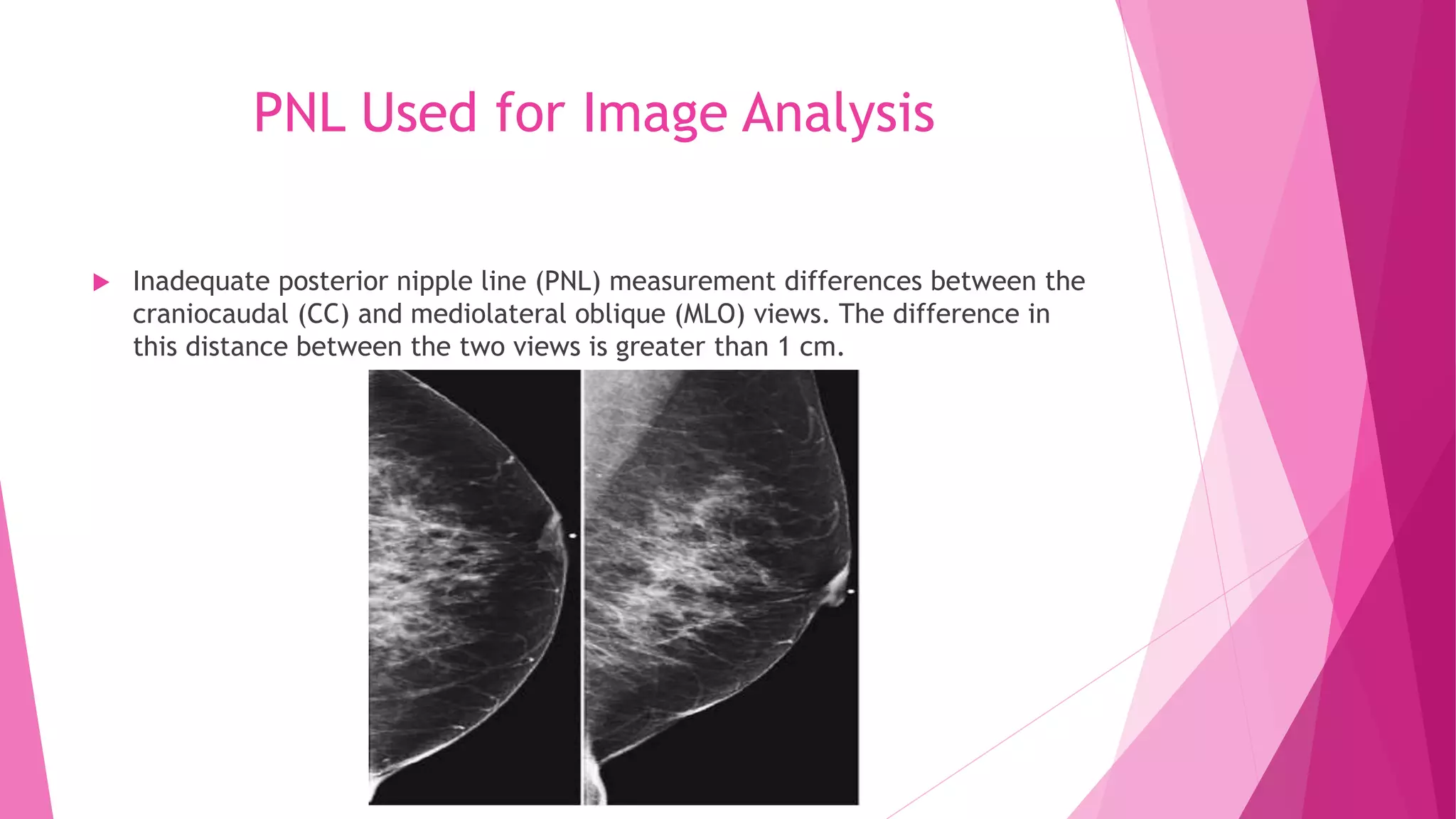
 Inadequate posterior nipple line (PNL) measurement differences between the
craniocaudal (CC) and mediolateral oblique (MLO) views. The difference in
this distance between the two views is greater than 1 cm.
CC Projection Aims:
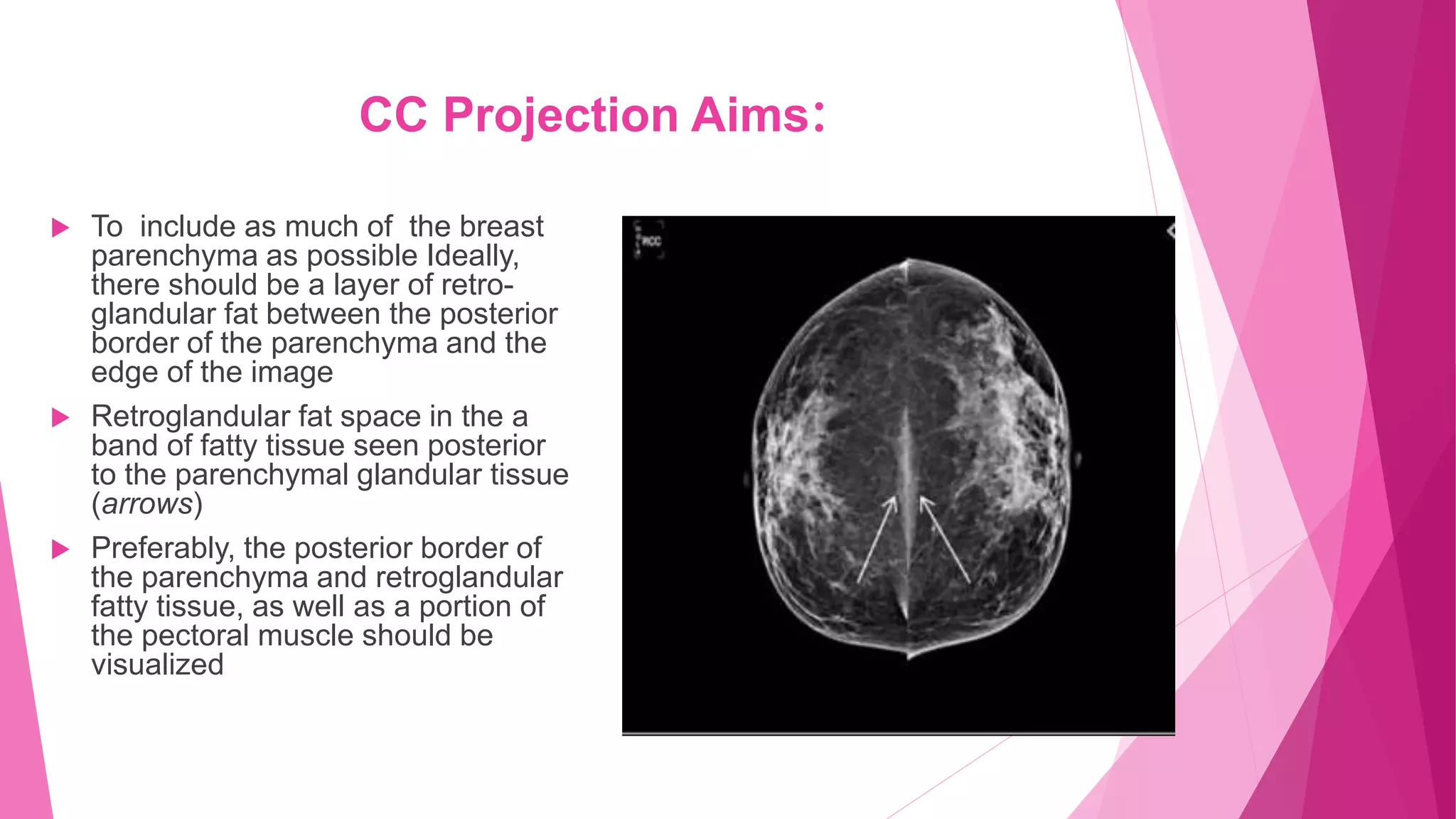
 To include as much of the breast
parenchyma as possible Ideally,
there should be a layer of retro-
glandular fat between the posterior
border of the parenchyma and the
edge of the image
 Retroglandular fat space in the a
band of fatty tissue seen posterior
to the parenchymal glandular tissue
(arrows)
 Preferably, the posterior border of
the parenchyma and retroglandular
fatty tissue, as well as a portion of
the pectoral muscle should be
visualized
CC Aims:
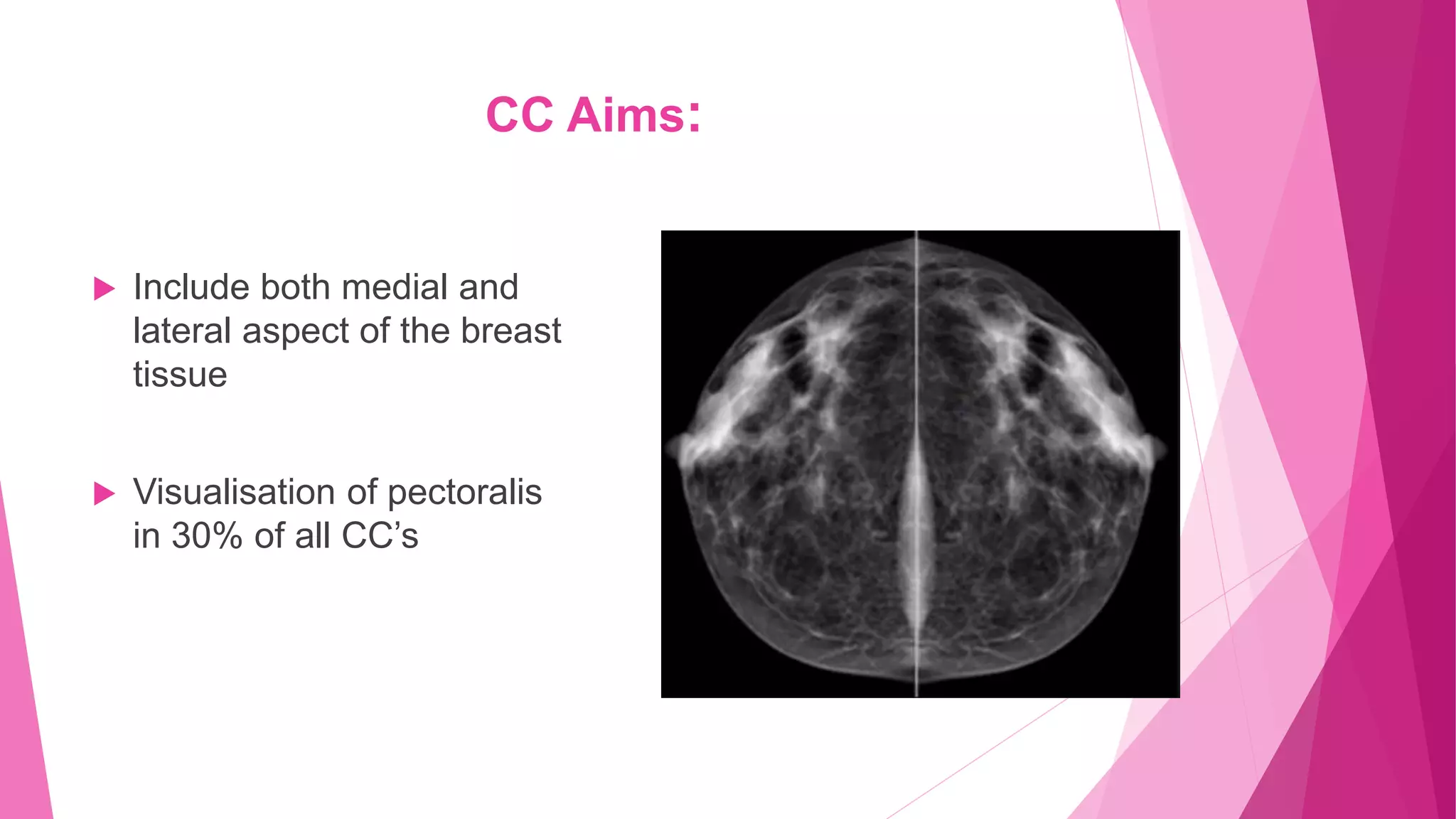
 Include both medial and
lateral aspect of the breast
tissue
 Visualisation of pectoralis
in 30% of all CC’s
CC Aims:
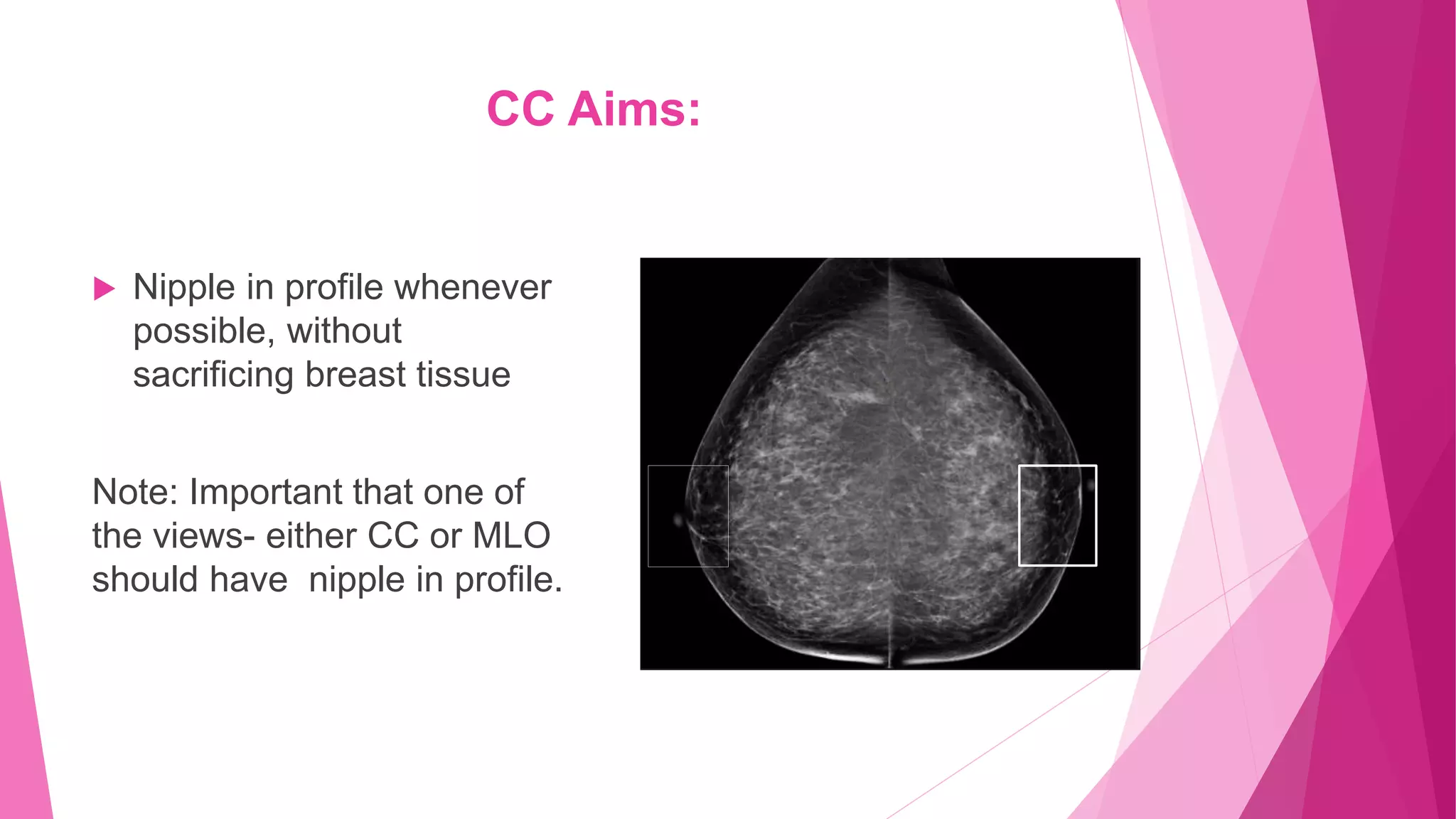
 Nipple in profile whenever
possible, without
sacrificing breast tissue
Note: Important that one of
the views- either CC or MLO
should have nipple in profile.
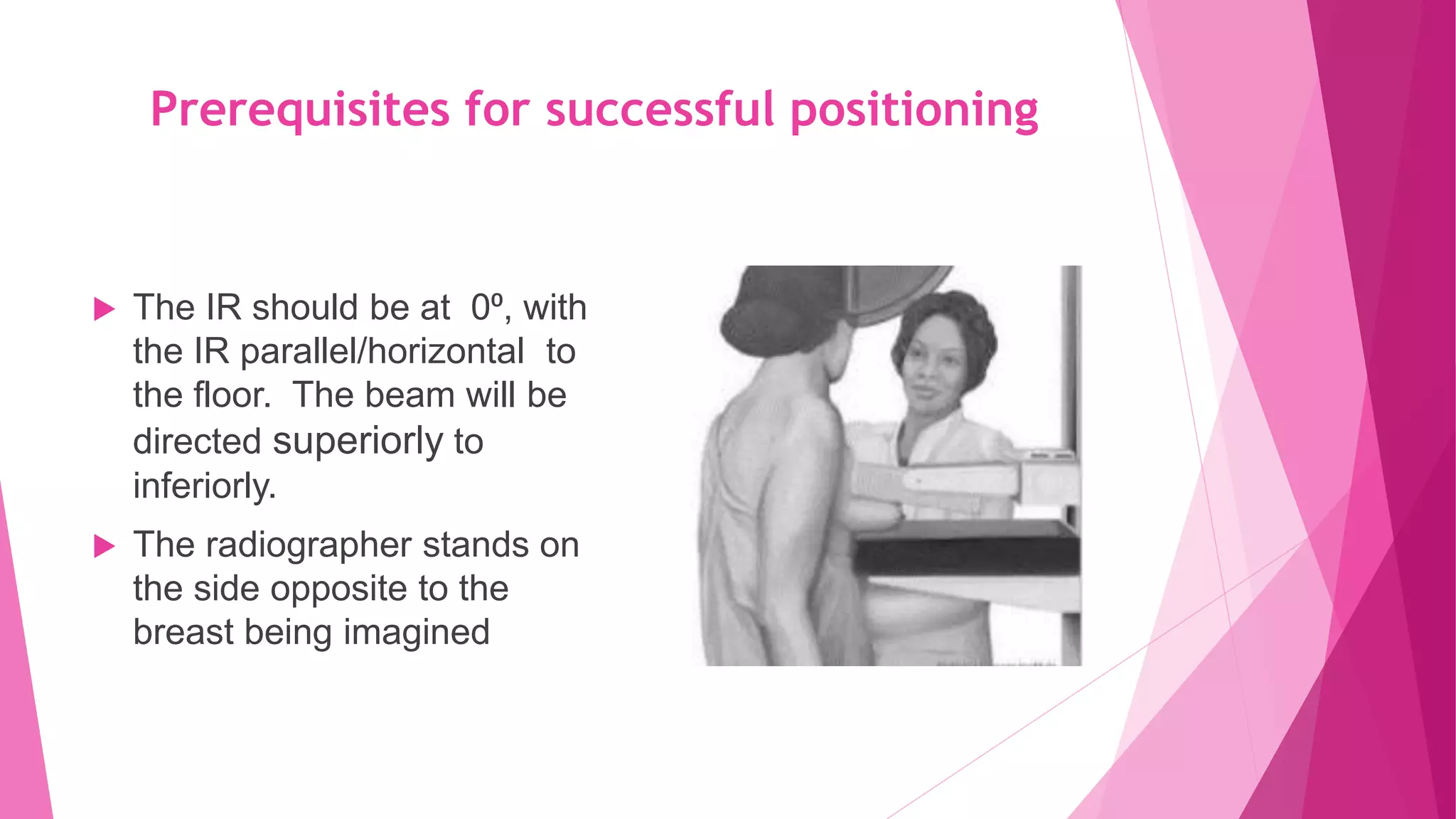
Prerequisites for successful positioning
 The IR should be at 0⁰, with
the IR parallel/horizontal to
the floor. The beam will be
directed superiorly to
inferiorly.
 The radiographer stands on
the side opposite to the
breast being imagined
Positioning CC Projection
 Ensure that the patient’s stance is stable. Have the
patient step back slightly away from the image
receptor, bending forward at the waist just enough to
allow the breast to naturally fall forward- (A)
 This positioning brings the chest wall closer to the
positioning surface and allows more medial and
posterior tissue to be captured on the image.
 The image receptor will be placed inferior to the
breast-(B)
 Instruct the patient to relax or to droop her
shoulders. Place the patient’s hand on the abdomen
below the waist on the side to be examined. This
facilitates relaxation of the shoulder, and brings
medial tissue closer to the image receptor and allows
inclusion of more soft tissue from the upper outer
quadrant and reduces the incidence of skin folds- (C)
A
B
B
C
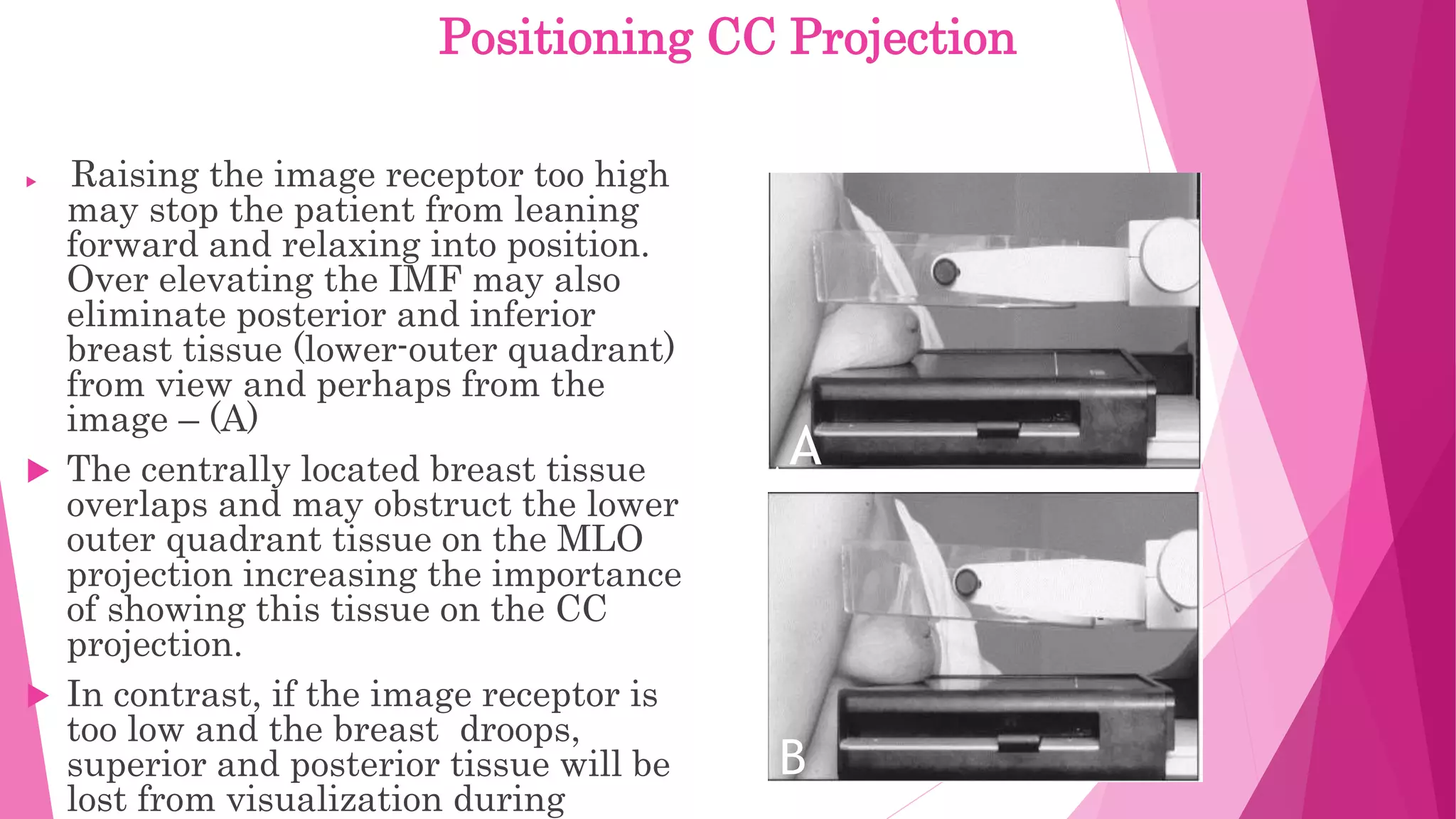
Positioning CC Projection
 Raising the image receptor too high
may stop the patient from leaning
forward and relaxing into position.
Over elevating the IMF may also
eliminate posterior and inferior
breast tissue (lower-outer quadrant)
from view and perhaps from the
image – (A)
 The centrally located breast tissue
overlaps and may obstruct the lower
outer quadrant tissue on the MLO
projection increasing the importance
of showing this tissue on the CC
projection.
 In contrast, if the image receptor is
too low and the breast droops,
superior and posterior tissue will be
lost from visualization during
A
B
A
Positioning CC Projection
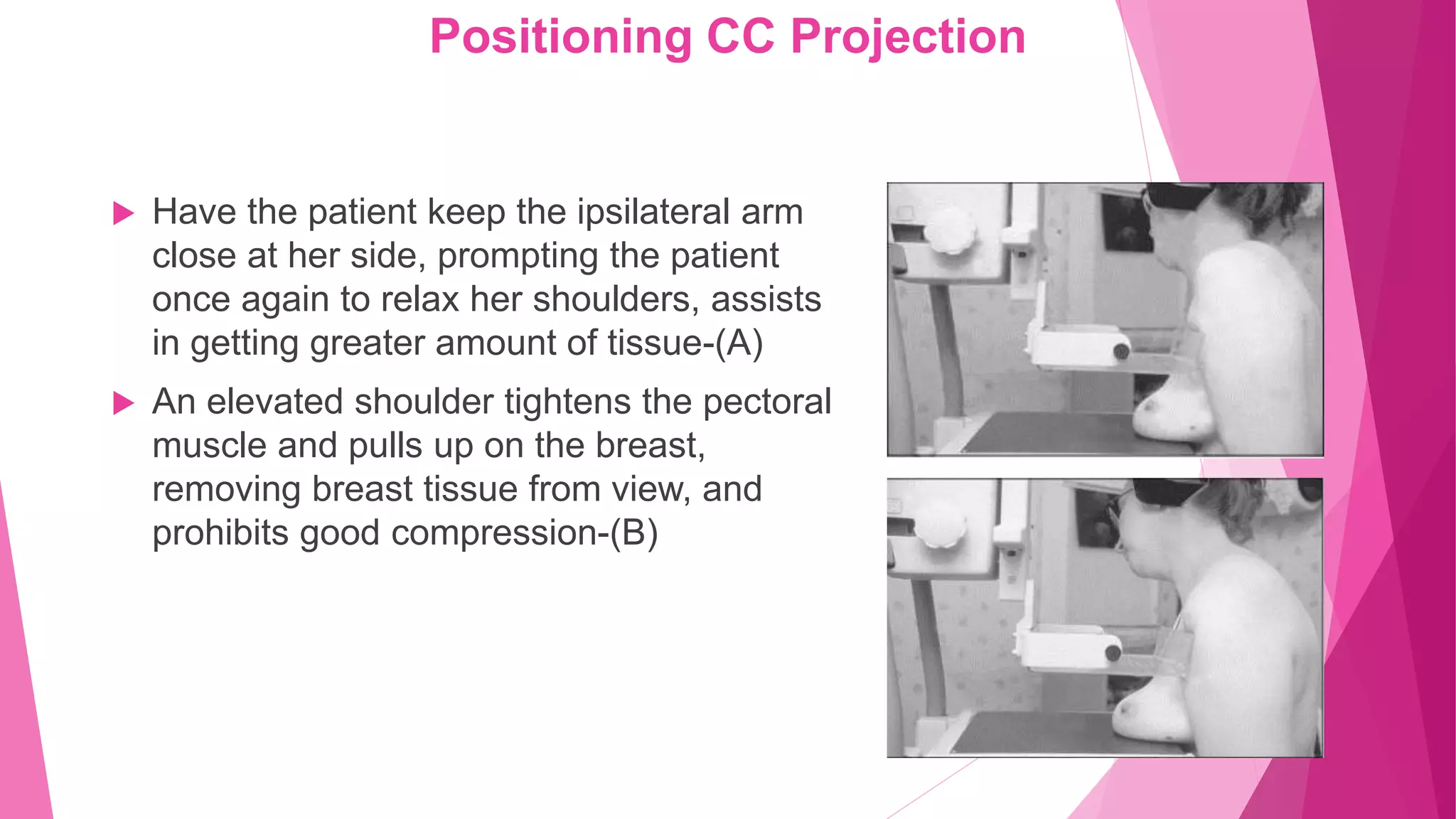
 Have the patient keep the ipsilateral arm
close at her side, prompting the patient
once again to relax her shoulders, assists
in getting greater amount of tissue-(A)
 An elevated shoulder tightens the pectoral
muscle and pulls up on the breast,
removing breast tissue from view, and
prohibits good compression-(B)
Positioning CC Projection
 Rotate the patient’s body
slightly medially for best
visualization of the medial
and posterior tissue, even
if this means losing some
lateral tissue, which is best
imaged with the oblique
view. This is the most
important aspect of the CC
projection.
 It is extremely important to
prevent eliminating any
Positioning CC Projection
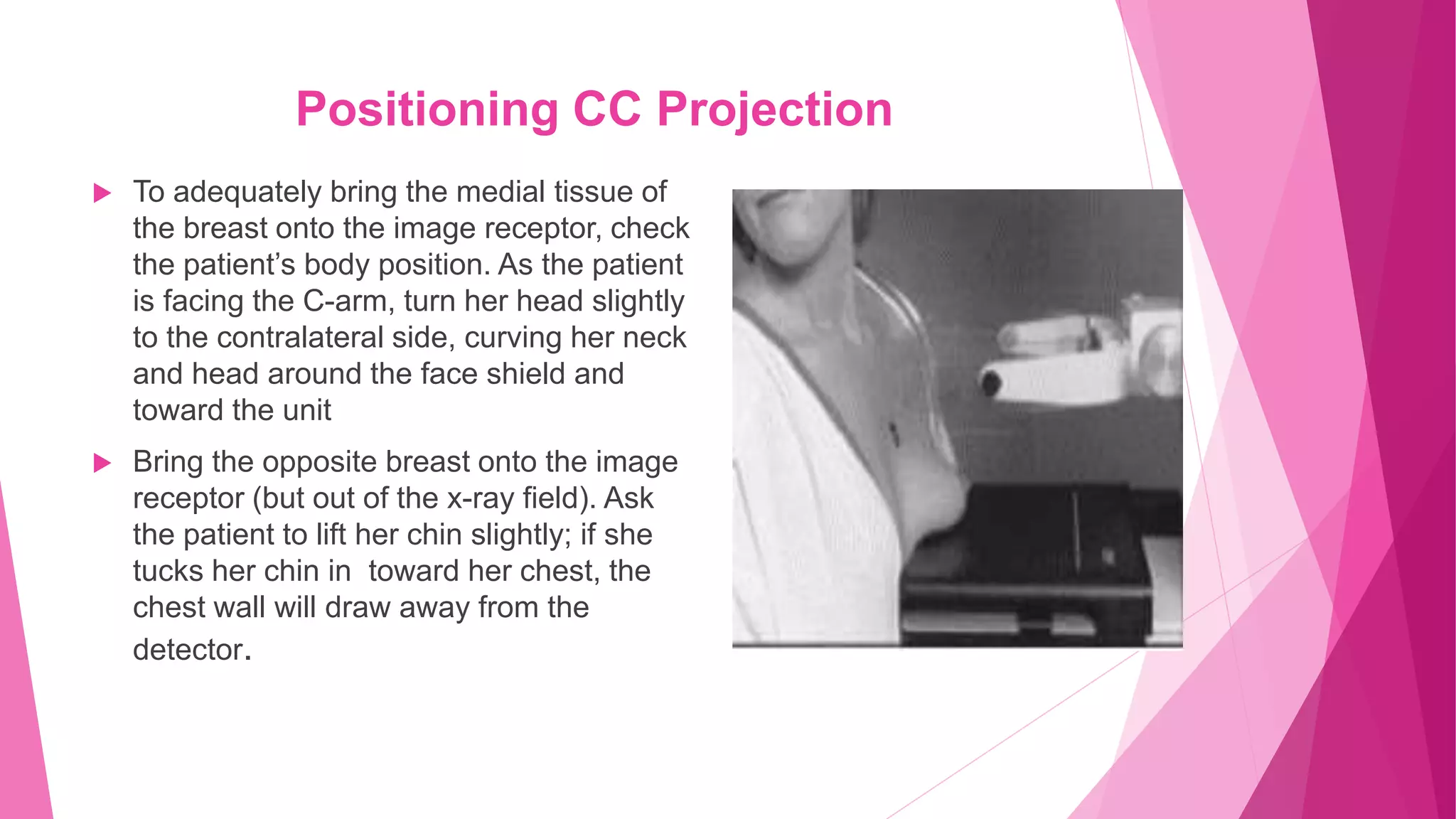
 To adequately bring the medial tissue of
the breast onto the image receptor, check
the patient’s body position. As the patient
is facing the C-arm, turn her head slightly
to the contralateral side, curving her neck
and head around the face shield and
toward the unit
 Bring the opposite breast onto the image
receptor (but out of the x-ray field). Ask
the patient to lift her chin slightly; if she
tucks her chin in toward her chest, the
chest wall will draw away from the
detector.
Positioning CC Projection
 After securing the medial aspect of
the breast, try to capture more lateral
tissue. Draw the lateral aspect of the
breast forward and onto the image
receptor; be careful not to rotate the
breast .
 This manoeuvre will help to
compensate for lost lateral tissue.
Hold the breast in place, smoothing
skin wrinkles toward the nipple, and
apply compression. As the
compression gradually fixes the
breast in place, slide the stabilizing
hand out toward the nipple. Place one
hand gently on the woman’s back to
prohibit the natural movement away
from the compression
Positioning CC Projection
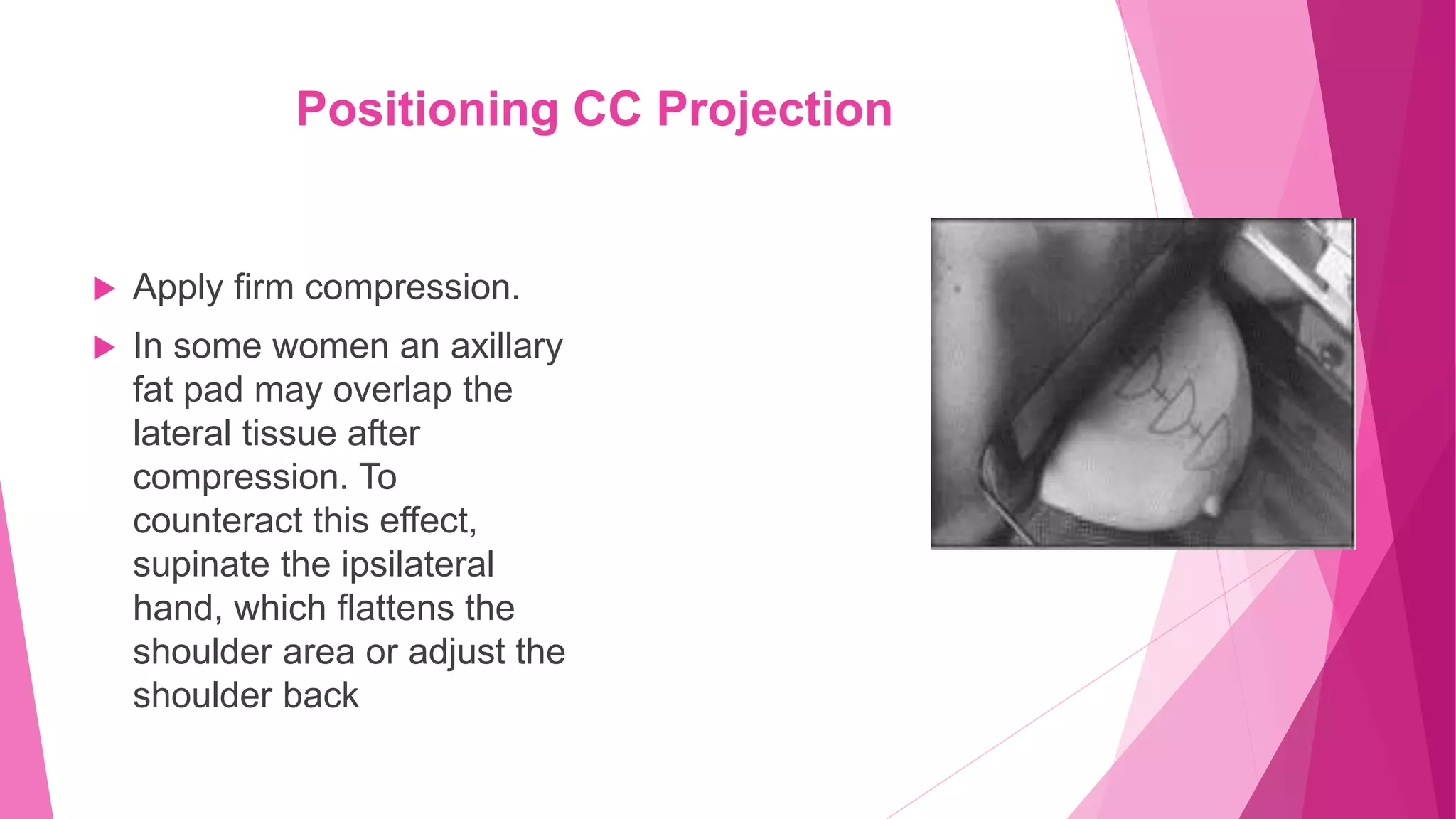
 Apply firm compression.
 In some women an axillary
fat pad may overlap the
lateral tissue after
compression. To
counteract this effect,
supinate the ipsilateral
hand, which flattens the
shoulder area or adjust the
shoulder back
Helpful Hints CC Projection
 The patient may be standing too straight and erect. Have the patient
slouch drooping her shoulders. This relaxes the muscles and lets the
breast fall forward onto the IR.
 Ask the patient to relax using different words such as “slouch,” “droop,” to
obtain the necessary results.
 Many patients push their hips forward. Advise them to step back and lean
forward from the waist.
 The contralateral breast of a larger breasted woman may inhibit
visualization of medial tissue. To overcome this, drape the medial aspect
of the contralateral breast over the edge of the image receptor, which will
allow more of the medial tissue of the imaged breast to also be pulled
forward and onto the image.
Summary of CC Projection Positioning
A B C
D E
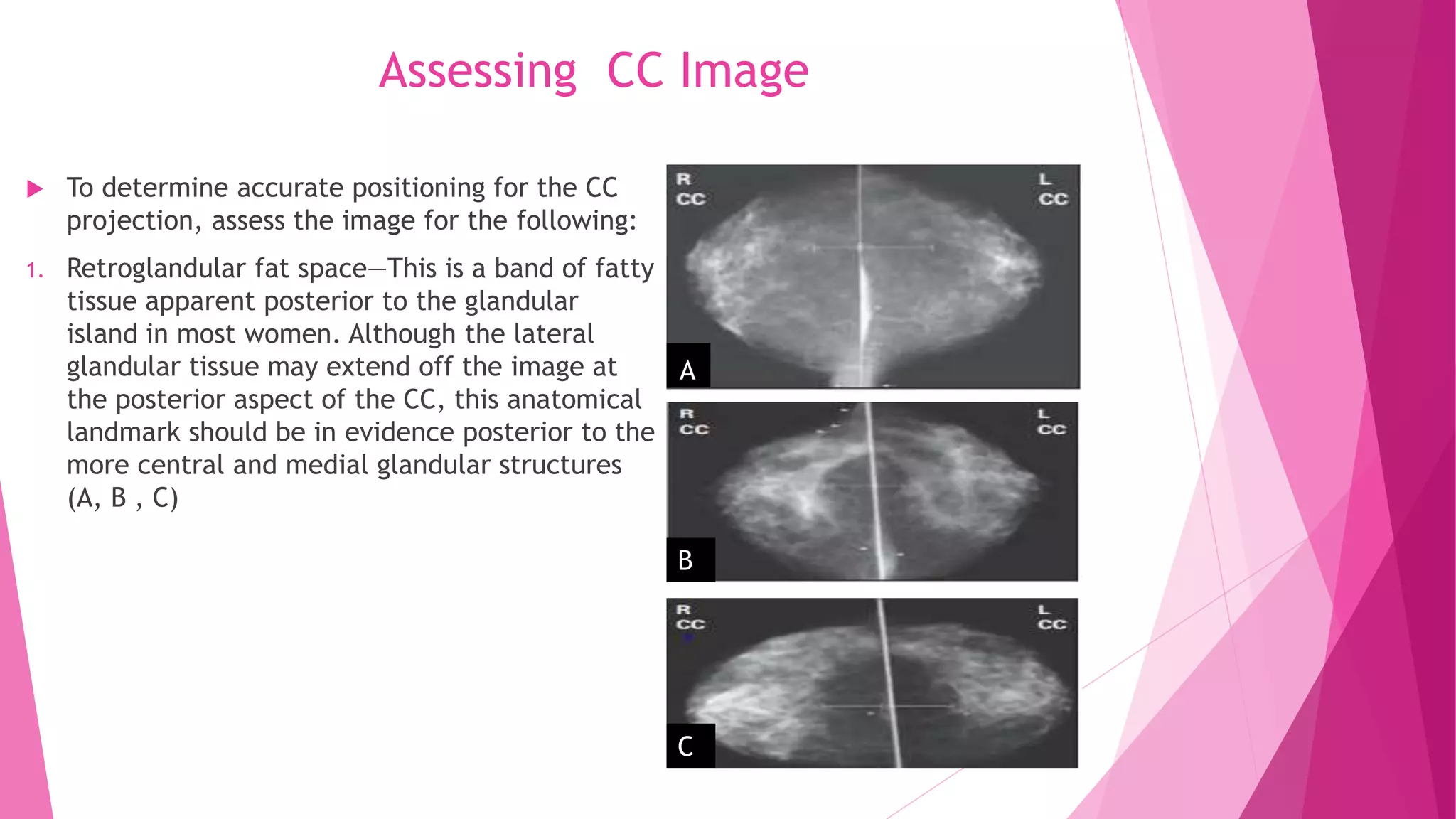
Assessing CC Image
 To determine accurate positioning for the CC
projection, assess the image for the following:
1. Retroglandular fat space—This is a band of fatty
tissue apparent posterior to the glandular
island in most women. Although the lateral
glandular tissue may extend off the image at
the posterior aspect of the CC, this anatomical
landmark should be in evidence posterior to the
more central and medial glandular structures
(A, B , C)
A
B
C
 Pectoral muscle presenting at the medial
aspect of the
 breast. This structure, evident on 20% to 30%
of CC
 images, is a radiopaque density of varying
size. Often
 it has a triangular shape and mirrors itself
when apparent bilaterally. When appearance
is unilateral, the pectoral muscle can imitate
a carcinoma (Figure 7-25). An
 superolateral to inferomedial oblique (SIO)
(see later
 discussion) of 5 to 20 will show more of the
density
 to rule out cancer (Figure 7-26).
 3. Skin thickening toward the cleavage of th
Assessing CC Image
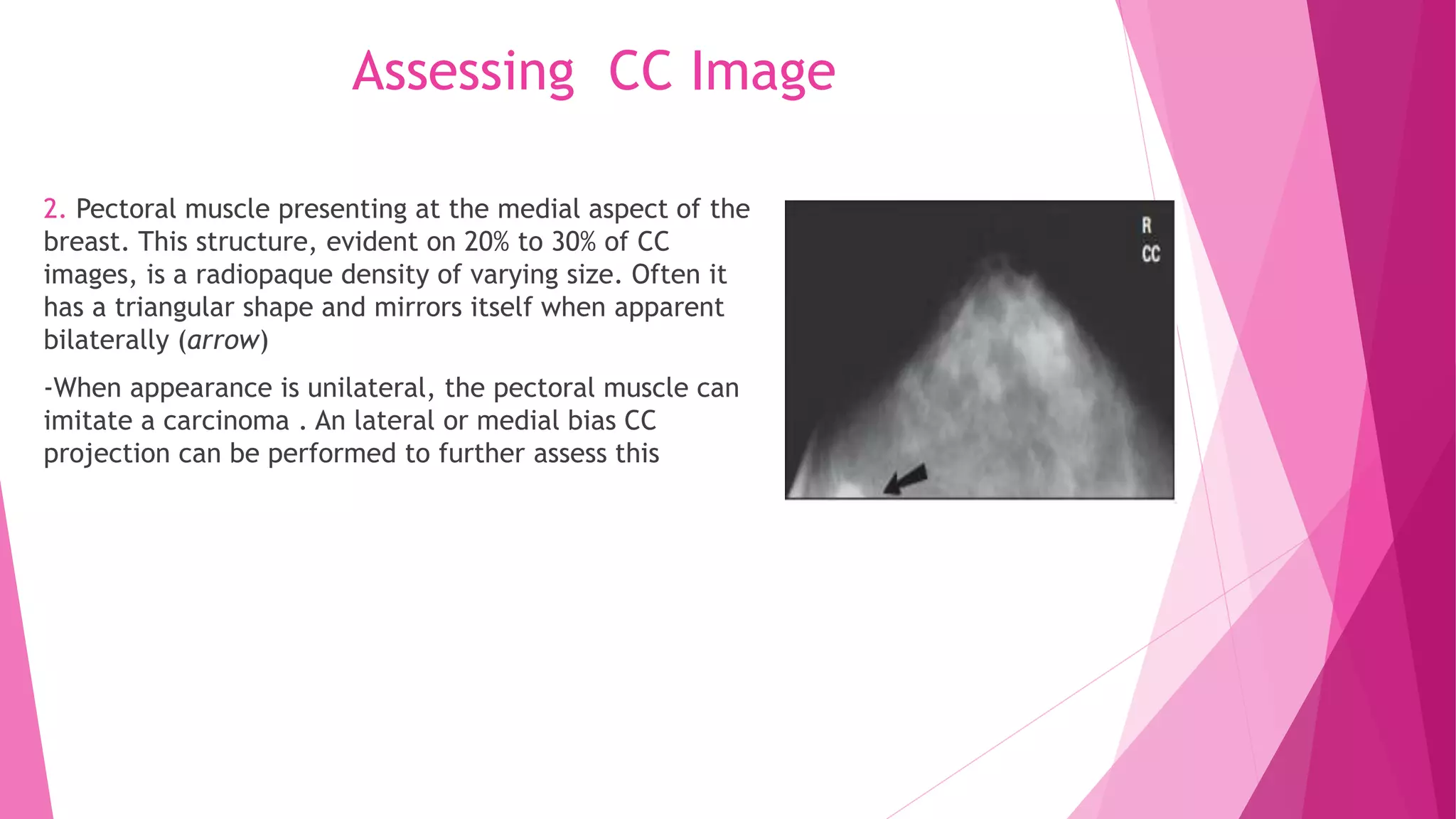
2. Pectoral muscle presenting at the medial aspect of the
breast. This structure, evident on 20% to 30% of CC
images, is a radiopaque density of varying size. Often it
has a triangular shape and mirrors itself when apparent
bilaterally (arrow)
-When appearance is unilateral, the pectoral muscle can
imitate a carcinoma . An lateral or medial bias CC
projection can be performed to further assess this
Assessing CC Image
 One or all of these indicators may be absent in one or both CC mammograms
because of anatomical differences from one woman to another and from the
left breast to the right breast.
 If most of the images do not show these landmarks, consider refining the
positioning method. Discretion should be used in adding subsequent images:
Remember, the goal is to image the whole breast, not the anatomical
landmarks
Additional CC Projections
 Exaggerated Lateral Craniocaudal (XCCL)
Projection / Lateral Bias/ Extended CC
 Exaggerated CC Medial Projection (XCCM)
 Cleavage Projection (CV)
 The exaggerated views are used to
determine the location in two projections
of a lesion seen only on the MLO
posteriorly.
 Rolled CC View ( Medial or Lateral)
 Tangential View
XCCL Projections
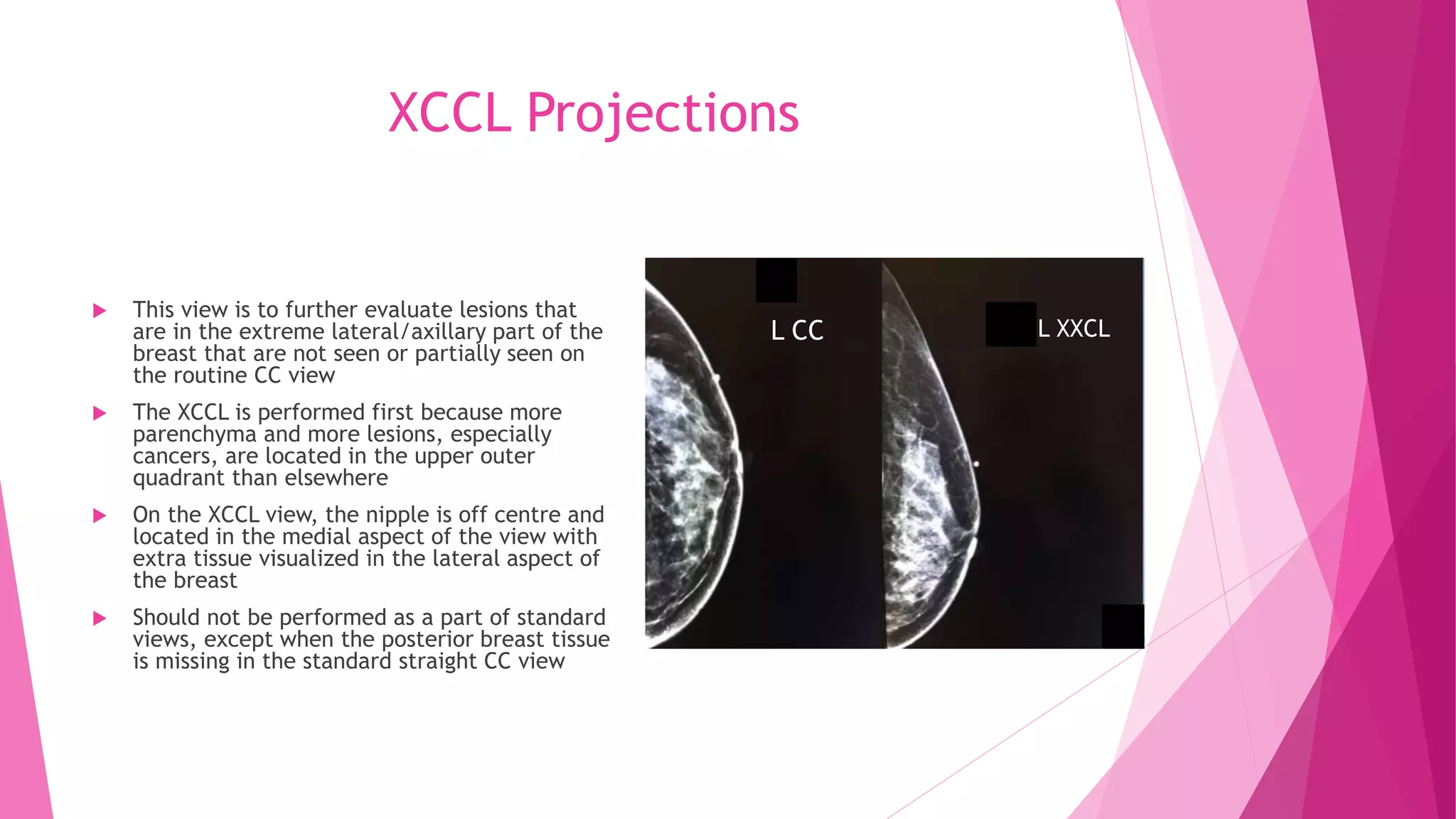
 This view is to further evaluate lesions that
are in the extreme lateral/axillary part of the
breast that are not seen or partially seen on
the routine CC view
 The XCCL is performed first because more
parenchyma and more lesions, especially
cancers, are located in the upper outer
quadrant than elsewhere
 On the XCCL view, the nipple is off centre and
located in the medial aspect of the view with
extra tissue visualized in the lateral aspect of
the breast
 Should not be performed as a part of standard
views, except when the posterior breast tissue
is missing in the standard straight CC view
L CC L XXCL
Positioning for XCCL Projection
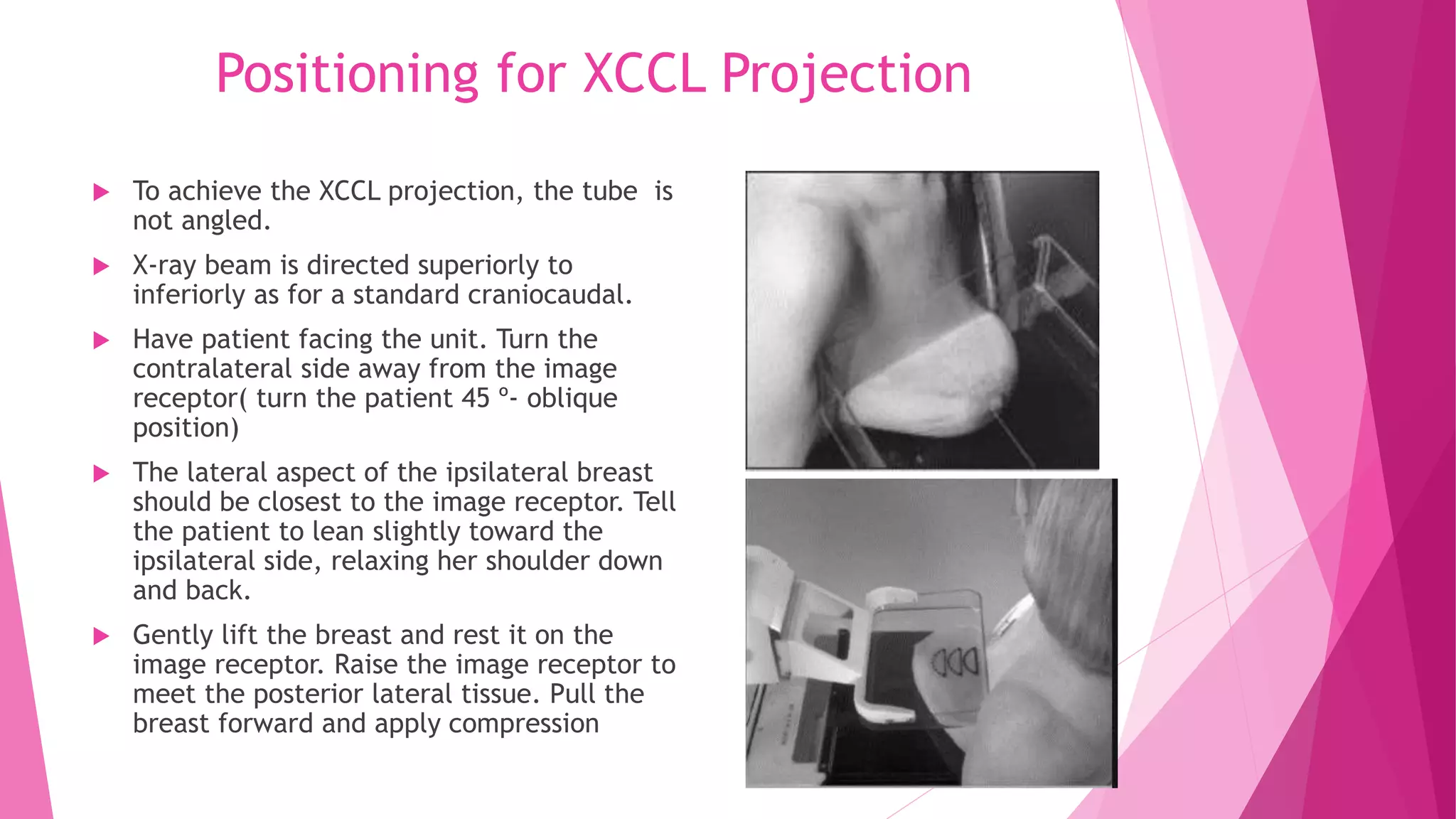
 To achieve the XCCL projection, the tube is
not angled.
 X-ray beam is directed superiorly to
inferiorly as for a standard craniocaudal.
 Have patient facing the unit. Turn the
contralateral side away from the image
receptor( turn the patient 45 º- oblique
position)
 The lateral aspect of the ipsilateral breast
should be closest to the image receptor. Tell
the patient to lean slightly toward the
ipsilateral side, relaxing her shoulder down
and back.
 Gently lift the breast and rest it on the
image receptor. Raise the image receptor to
meet the posterior lateral tissue. Pull the
breast forward and apply compression
XCCM Projection
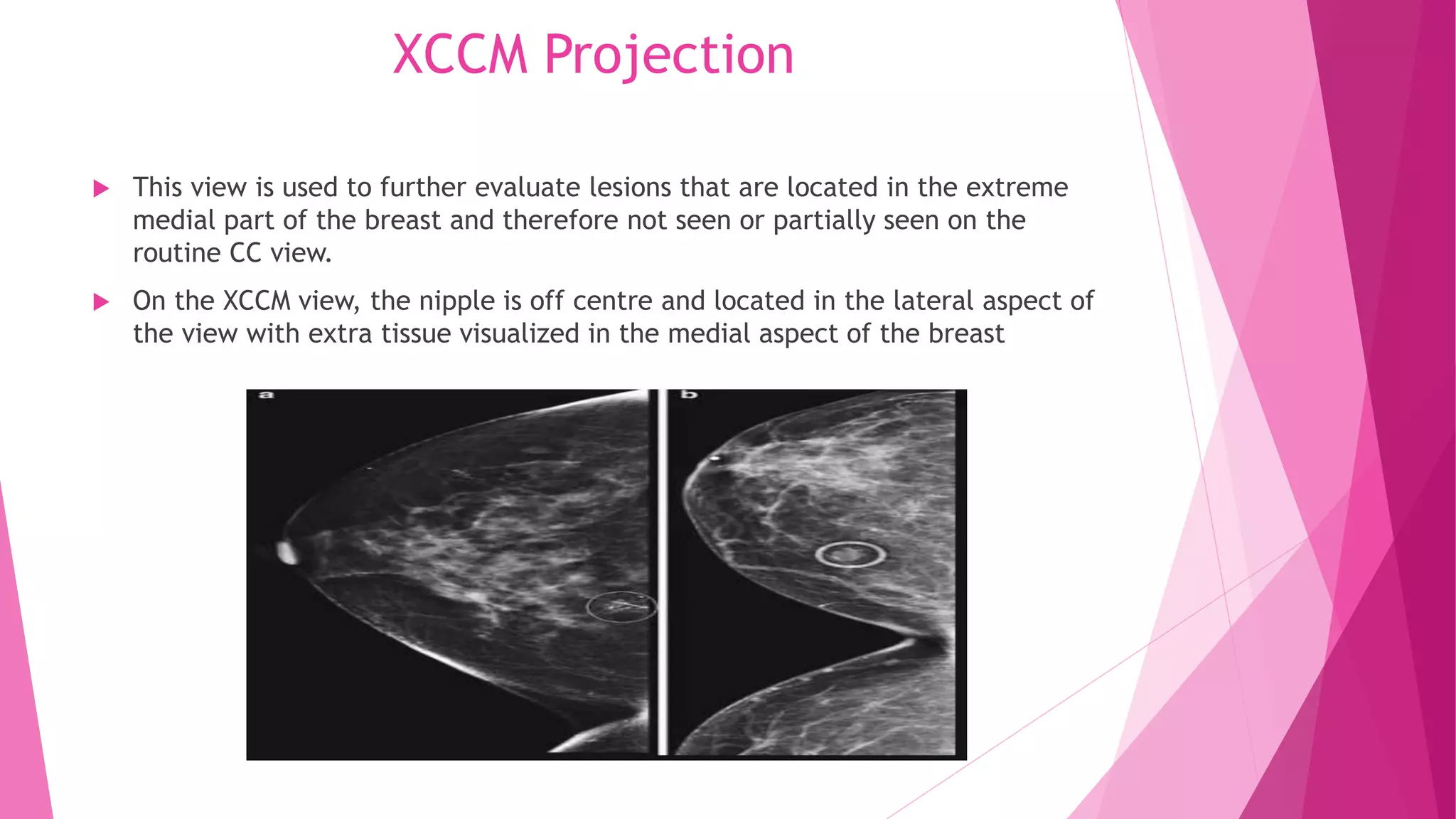
 This view is used to further evaluate lesions that are located in the extreme
medial part of the breast and therefore not seen or partially seen on the
routine CC view.
 On the XCCM view, the nipple is off centre and located in the lateral aspect of
the view with extra tissue visualized in the medial aspect of the breast
Positioning for XCCM Projection
 The patient is rotated anteriorly, extending her chest forward, with the far
medio-posterior aspect of the breast being imaged.
 If the lesion is located high in the upper inner quadrant, it may be necessary
to elevate the cassette holder and compress the uppermost aspect of the
breast.
CV Projection Application and
Positioning
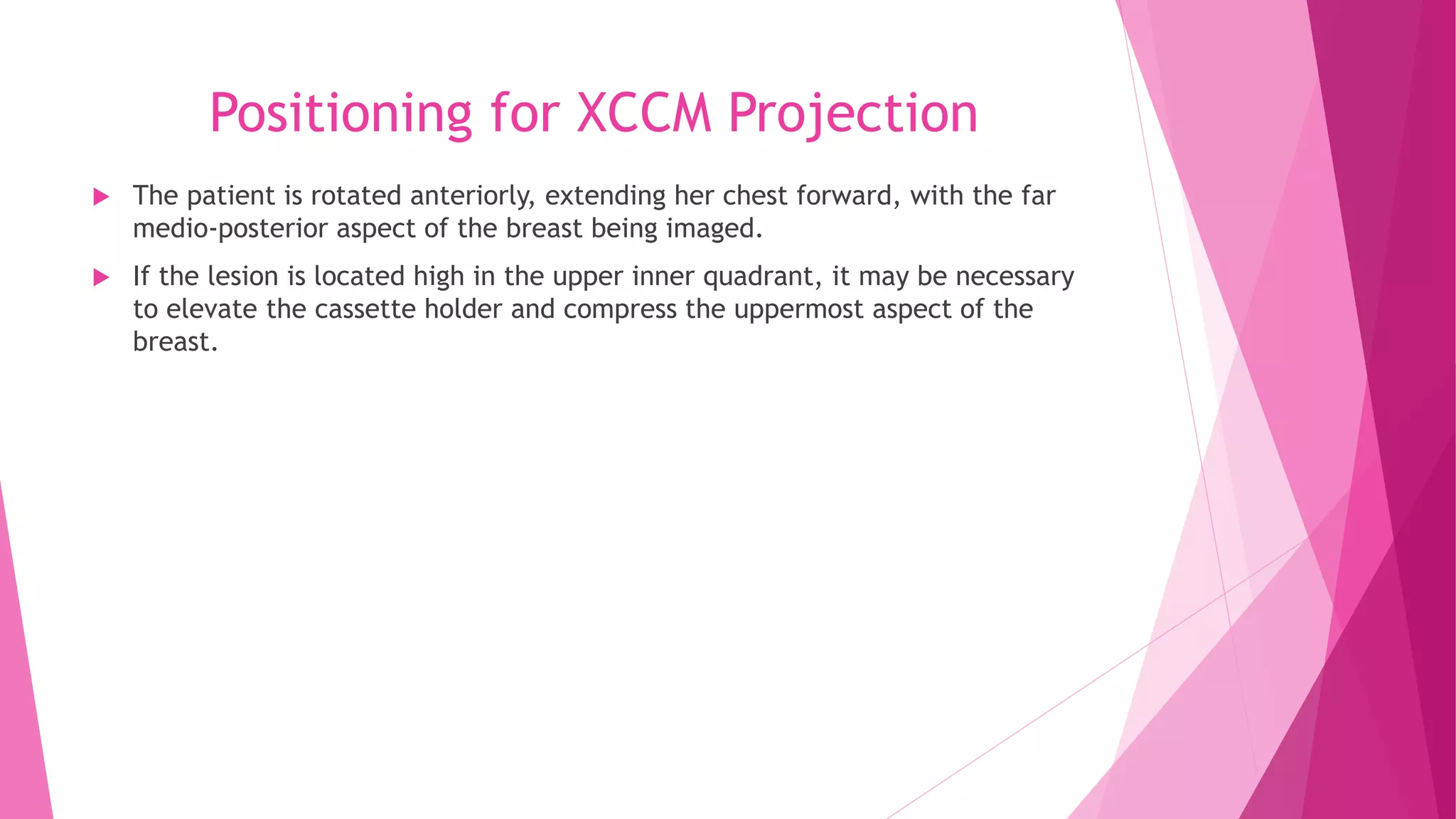
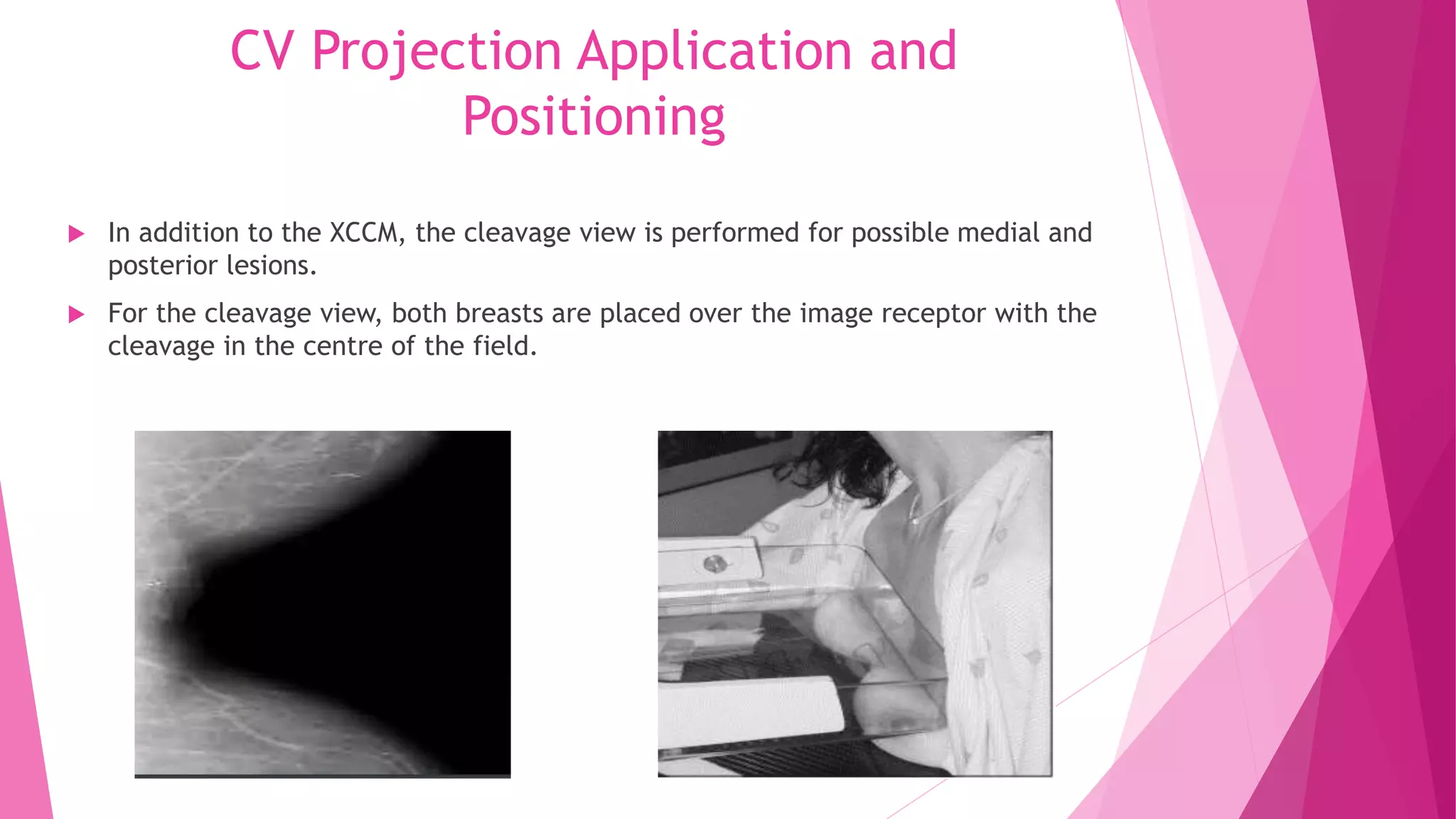
 In addition to the XCCM, the cleavage view is performed for possible medial and
posterior lesions.
 For the cleavage view, both breasts are placed over the image receptor with the
cleavage in the centre of the field.
Rolled CC Views
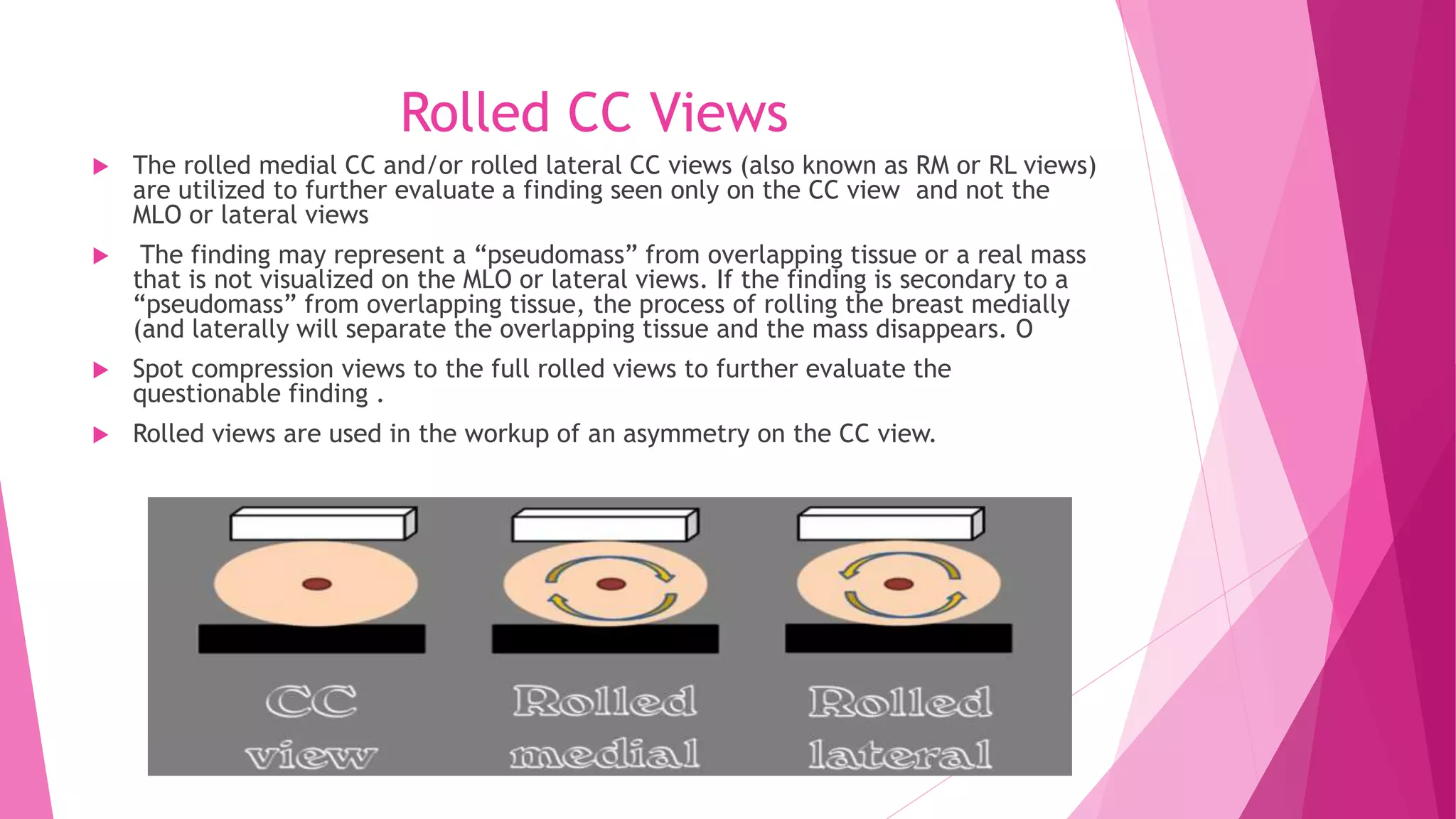
 The rolled medial CC and/or rolled lateral CC views (also known as RM or RL views)
are utilized to further evaluate a finding seen only on the CC view and not the
MLO or lateral views
 The finding may represent a “pseudomass” from overlapping tissue or a real mass
that is not visualized on the MLO or lateral views. If the finding is secondary to a
“pseudomass” from overlapping tissue, the process of rolling the breast medially
(and laterally will separate the overlapping tissue and the mass disappears. O
 Spot compression views to the full rolled views to further evaluate the
questionable finding .
 Rolled views are used in the workup of an asymmetry on the CC view.
Rolled CC View
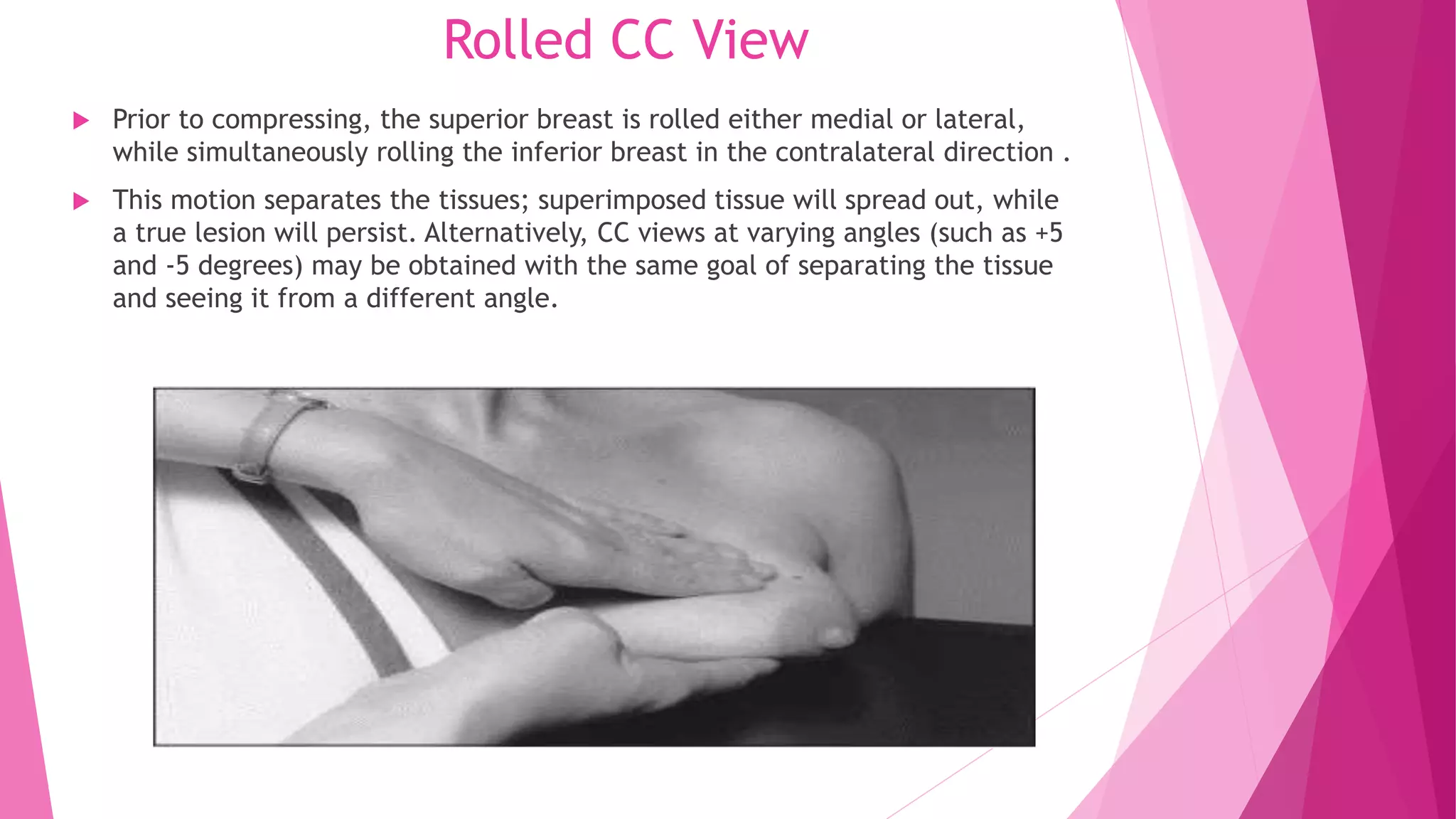
 Prior to compressing, the superior breast is rolled either medial or lateral,
while simultaneously rolling the inferior breast in the contralateral direction .
 This motion separates the tissues; superimposed tissue will spread out, while
a true lesion will persist. Alternatively, CC views at varying angles (such as +5
and -5 degrees) may be obtained with the same goal of separating the tissue
and seeing it from a different angle.
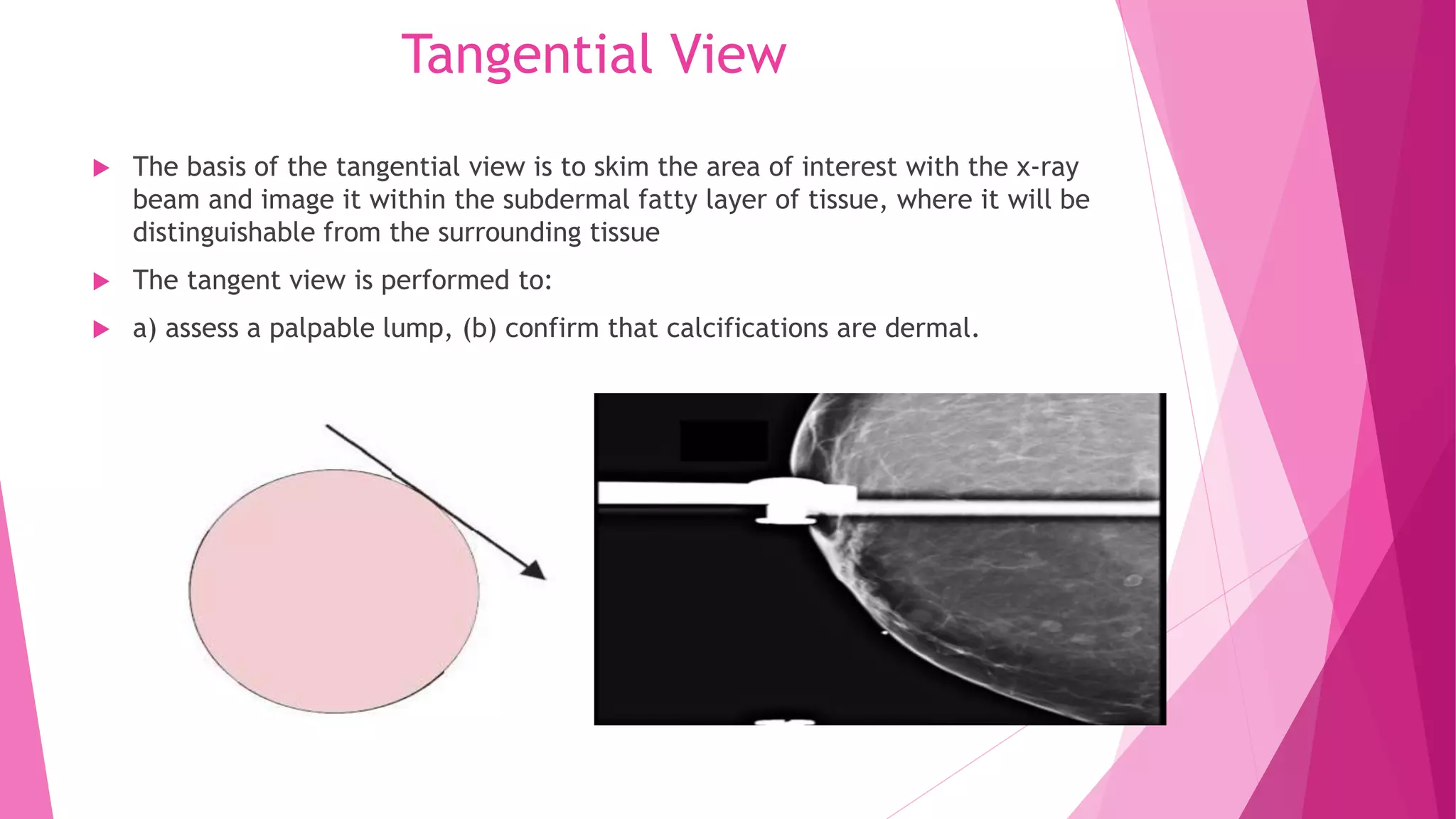
Tangential View
 The basis of the tangential view is to skim the area of interest with the x-ray
beam and image it within the subdermal fatty layer of tissue, where it will be
distinguishable from the surrounding tissue
 The tangent view is performed to:
 a) assess a palpable lump, (b) confirm that calcifications are dermal.
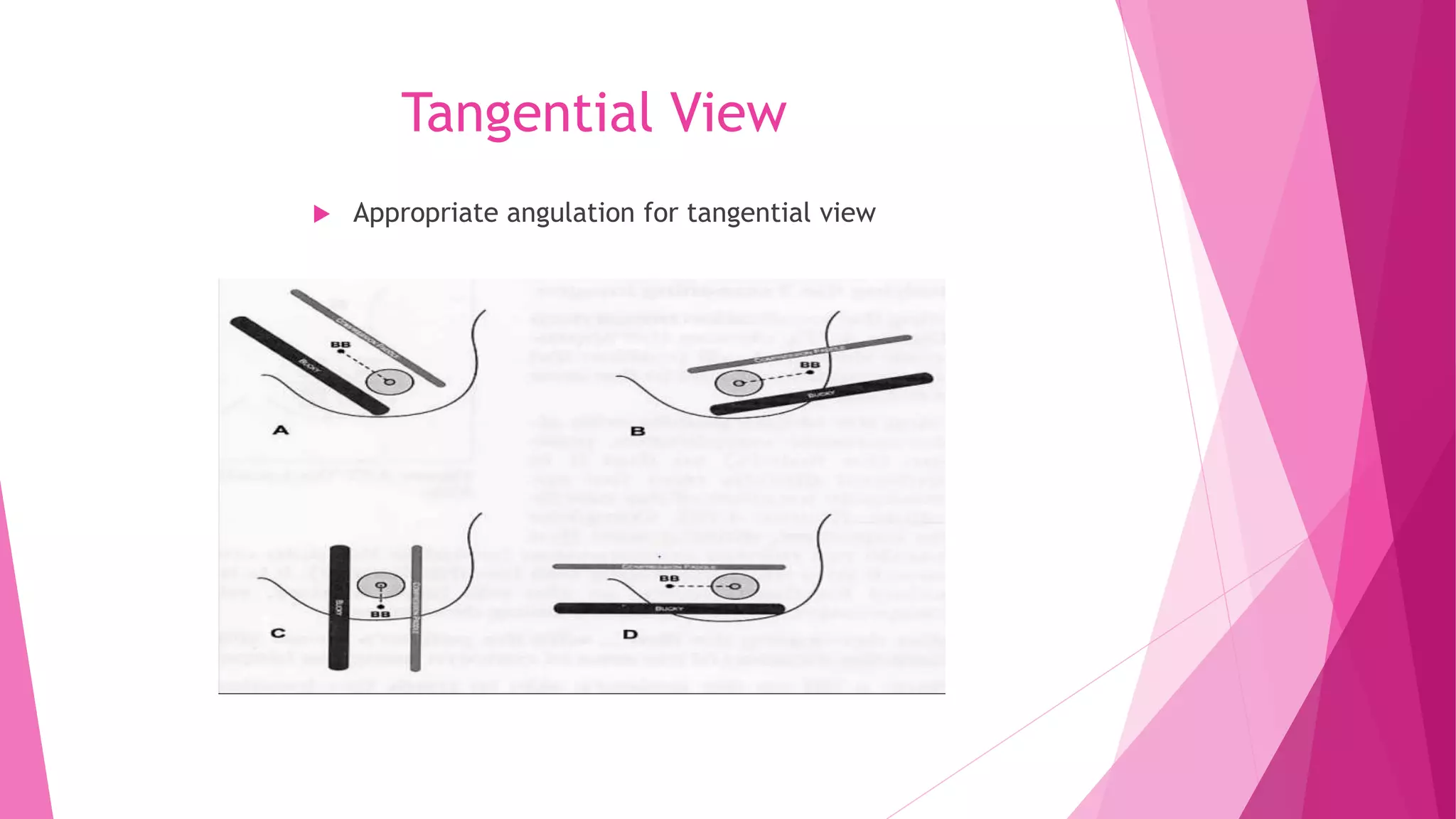
Tangential View Positioning
Place a BB marker on the palpable lump/mass or the area identified by localising
skin calcification
The angle of obliquity will depend on the location of the abnormality. To
determine the angle and direction of obliquity of either the tube, patient or
breast, draw an imaginary line from the nipple to the abnormality. Turn the C-
arm so that the image receptor parallels this line
Tangential View
 Appropriate angulation for tangential view
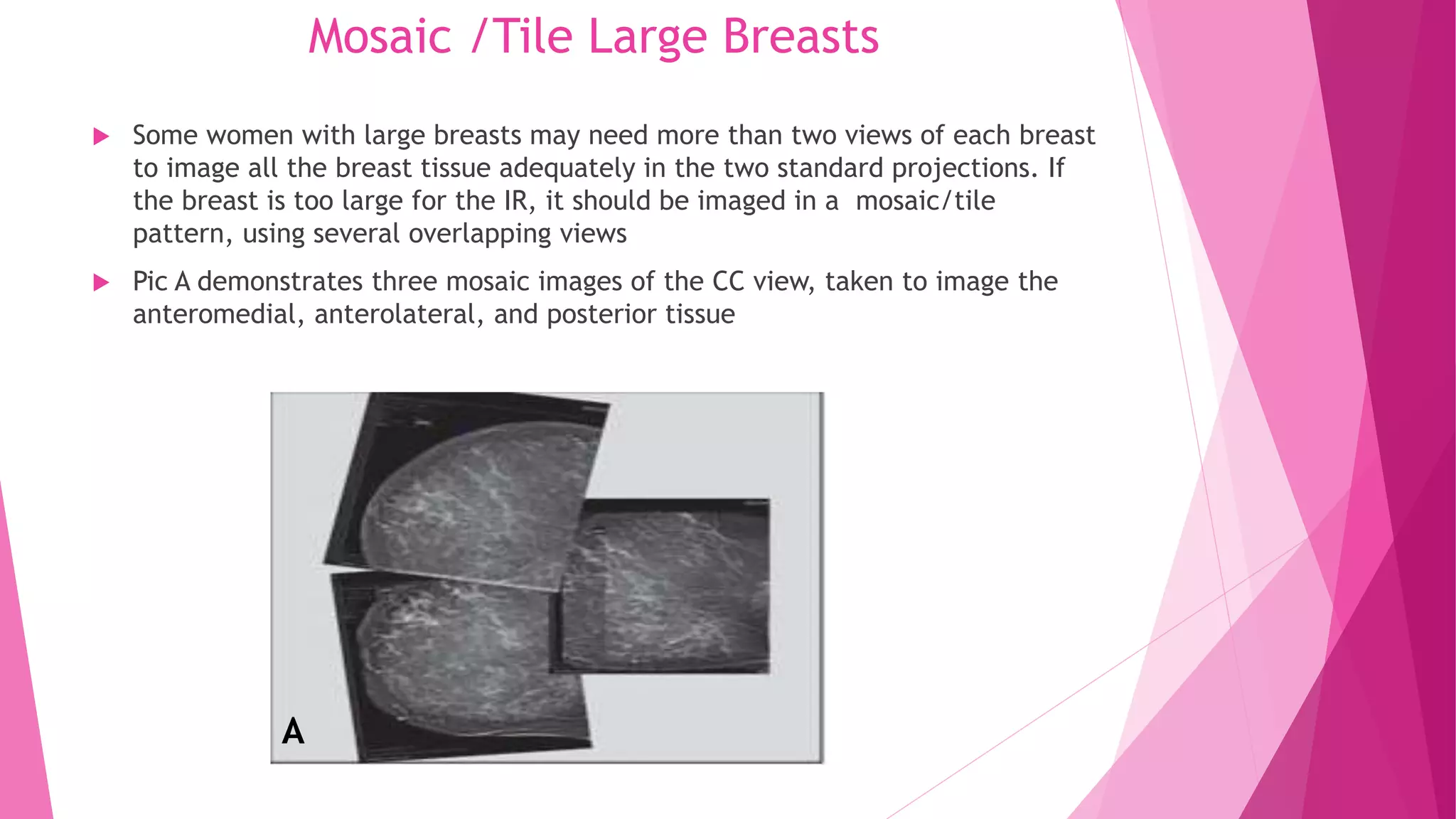
Mosaic /Tile Large Breasts
 Some women with large breasts may need more than two views of each breast
to image all the breast tissue adequately in the two standard projections. If
the breast is too large for the IR, it should be imaged in a mosaic/tile
pattern, using several overlapping views
 Pic A demonstrates three mosaic images of the CC view, taken to image the
anteromedial, anterolateral, and posterior tissue
A B
A

Mammography positioning technique for Cranio Caudal (CC)

  • 1.
    Mammography Positioning Technique forCranio-Caudal (CC) View Ms Selin Prasad Radiographer/Sonographer
  • 2.
    ALARA Principle  AsLow As Reasonably Achievable (ALARA)  Mammography uses low dose protocols in accordance with ALARA, however, all precaution should be taken not to take unnecessary images/repeats  Repeats should be kept to a very minimum and ONLY done if absolutely necessary  Repeat of an image should ONLY be done if it serves a diagnostic purpose, will aid in final diagnosis
  • 3.
  • 4.
    Standard Views/Projections inMammography Medio-lateral Oblique (MLO) Cranio-caudal (CC) Latero-medial (LM)
  • 5.
    CC Projection The craniocaudalprojection will best visualize the sub-areolar, central, medial, and posteromedial aspects of the breast.
  • 6.
    Basic Concepts/ Applicationof Positioning  To bring the breast to it’s natural anatomical position ( nipple perpendicular to chest wall) to maximise visualisation of entire breast anatomy and potential pathology and avoid superimposition of breast structures.  The lateral and inferior portions of the breast are more mobile than the superior and medial portions. Therefore standard views have been developed to maximize this mobility and pull as much breast tissue toward the more fixed borders and onto the imaging device as is possible.  All mammographic views are defined by the direction of the x-ray beam from the tube toward the detector. The mediolateral oblique view (MLO) is the single best view to image the majority of the breast tissue.  The upper inner portion of the breast is the least successfully included portion, and so the standard mammographic view, the craniocaudal (CC), should include as much medial tissue as is possible without excluding lateral tissue.  To visualize the posterior and upper-outer quadrants of the breast. This is intrinsic to the anatomy of the breast, which lies anterior to and follows the line of the obliquely coursing pectoral muscle. Positioning the breast parallel to this oblique line, which is the natural course of the tissue, it is possible to demonstrate most of the glandular tissue
  • 7.
    Anatomical Landmarks forPositioning and Image Analysis
  • 8.
    PNL Used forImage Analysis PNL measurement of CC should be within 1cm of PNL measurement on the MLO view
  • 9.
    PNL Used forImage Analysis  Adequate posterior nipple line (PNL) measurement differences between the craniocaudal (CC) and mediolateral oblique (MLO) views. The difference in this distance between the two views is less or equal to 1 cm
  • 10.
    PNL Used forImage Analysis  Inadequate posterior nipple line (PNL) measurement differences between the craniocaudal (CC) and mediolateral oblique (MLO) views. The difference in this distance between the two views is greater than 1 cm.
  • 11.
    CC Projection Aims: To include as much of the breast parenchyma as possible Ideally, there should be a layer of retro- glandular fat between the posterior border of the parenchyma and the edge of the image  Retroglandular fat space in the a band of fatty tissue seen posterior to the parenchymal glandular tissue (arrows)  Preferably, the posterior border of the parenchyma and retroglandular fatty tissue, as well as a portion of the pectoral muscle should be visualized
  • 12.
    CC Aims:  Includeboth medial and lateral aspect of the breast tissue  Visualisation of pectoralis in 30% of all CC’s
  • 13.
    CC Aims:  Nipplein profile whenever possible, without sacrificing breast tissue Note: Important that one of the views- either CC or MLO should have nipple in profile.
  • 14.
    Prerequisites for successfulpositioning  The IR should be at 0⁰, with the IR parallel/horizontal to the floor. The beam will be directed superiorly to inferiorly.  The radiographer stands on the side opposite to the breast being imagined
  • 15.
    Positioning CC Projection Ensure that the patient’s stance is stable. Have the patient step back slightly away from the image receptor, bending forward at the waist just enough to allow the breast to naturally fall forward- (A)  This positioning brings the chest wall closer to the positioning surface and allows more medial and posterior tissue to be captured on the image.  The image receptor will be placed inferior to the breast-(B)  Instruct the patient to relax or to droop her shoulders. Place the patient’s hand on the abdomen below the waist on the side to be examined. This facilitates relaxation of the shoulder, and brings medial tissue closer to the image receptor and allows inclusion of more soft tissue from the upper outer quadrant and reduces the incidence of skin folds- (C) A B B C
  • 16.
    Positioning CC Projection Raising the image receptor too high may stop the patient from leaning forward and relaxing into position. Over elevating the IMF may also eliminate posterior and inferior breast tissue (lower-outer quadrant) from view and perhaps from the image – (A)  The centrally located breast tissue overlaps and may obstruct the lower outer quadrant tissue on the MLO projection increasing the importance of showing this tissue on the CC projection.  In contrast, if the image receptor is too low and the breast droops, superior and posterior tissue will be lost from visualization during A B A
  • 17.
    Positioning CC Projection Have the patient keep the ipsilateral arm close at her side, prompting the patient once again to relax her shoulders, assists in getting greater amount of tissue-(A)  An elevated shoulder tightens the pectoral muscle and pulls up on the breast, removing breast tissue from view, and prohibits good compression-(B)
  • 18.
    Positioning CC Projection Rotate the patient’s body slightly medially for best visualization of the medial and posterior tissue, even if this means losing some lateral tissue, which is best imaged with the oblique view. This is the most important aspect of the CC projection.  It is extremely important to prevent eliminating any
  • 19.
    Positioning CC Projection To adequately bring the medial tissue of the breast onto the image receptor, check the patient’s body position. As the patient is facing the C-arm, turn her head slightly to the contralateral side, curving her neck and head around the face shield and toward the unit  Bring the opposite breast onto the image receptor (but out of the x-ray field). Ask the patient to lift her chin slightly; if she tucks her chin in toward her chest, the chest wall will draw away from the detector.
  • 20.
    Positioning CC Projection After securing the medial aspect of the breast, try to capture more lateral tissue. Draw the lateral aspect of the breast forward and onto the image receptor; be careful not to rotate the breast .  This manoeuvre will help to compensate for lost lateral tissue. Hold the breast in place, smoothing skin wrinkles toward the nipple, and apply compression. As the compression gradually fixes the breast in place, slide the stabilizing hand out toward the nipple. Place one hand gently on the woman’s back to prohibit the natural movement away from the compression
  • 21.
    Positioning CC Projection Apply firm compression.  In some women an axillary fat pad may overlap the lateral tissue after compression. To counteract this effect, supinate the ipsilateral hand, which flattens the shoulder area or adjust the shoulder back
  • 22.
    Helpful Hints CCProjection  The patient may be standing too straight and erect. Have the patient slouch drooping her shoulders. This relaxes the muscles and lets the breast fall forward onto the IR.  Ask the patient to relax using different words such as “slouch,” “droop,” to obtain the necessary results.  Many patients push their hips forward. Advise them to step back and lean forward from the waist.  The contralateral breast of a larger breasted woman may inhibit visualization of medial tissue. To overcome this, drape the medial aspect of the contralateral breast over the edge of the image receptor, which will allow more of the medial tissue of the imaged breast to also be pulled forward and onto the image.
  • 23.
    Summary of CCProjection Positioning A B C D E
  • 24.
    Assessing CC Image To determine accurate positioning for the CC projection, assess the image for the following: 1. Retroglandular fat space—This is a band of fatty tissue apparent posterior to the glandular island in most women. Although the lateral glandular tissue may extend off the image at the posterior aspect of the CC, this anatomical landmark should be in evidence posterior to the more central and medial glandular structures (A, B , C) A B C
  • 25.
     Pectoral musclepresenting at the medial aspect of the  breast. This structure, evident on 20% to 30% of CC  images, is a radiopaque density of varying size. Often  it has a triangular shape and mirrors itself when apparent bilaterally. When appearance is unilateral, the pectoral muscle can imitate a carcinoma (Figure 7-25). An  superolateral to inferomedial oblique (SIO) (see later  discussion) of 5 to 20 will show more of the density  to rule out cancer (Figure 7-26).  3. Skin thickening toward the cleavage of th
  • 26.
    Assessing CC Image 2.Pectoral muscle presenting at the medial aspect of the breast. This structure, evident on 20% to 30% of CC images, is a radiopaque density of varying size. Often it has a triangular shape and mirrors itself when apparent bilaterally (arrow) -When appearance is unilateral, the pectoral muscle can imitate a carcinoma . An lateral or medial bias CC projection can be performed to further assess this
  • 27.
    Assessing CC Image One or all of these indicators may be absent in one or both CC mammograms because of anatomical differences from one woman to another and from the left breast to the right breast.  If most of the images do not show these landmarks, consider refining the positioning method. Discretion should be used in adding subsequent images: Remember, the goal is to image the whole breast, not the anatomical landmarks
  • 28.
    Additional CC Projections Exaggerated Lateral Craniocaudal (XCCL) Projection / Lateral Bias/ Extended CC  Exaggerated CC Medial Projection (XCCM)  Cleavage Projection (CV)  The exaggerated views are used to determine the location in two projections of a lesion seen only on the MLO posteriorly.  Rolled CC View ( Medial or Lateral)  Tangential View
  • 29.
    XCCL Projections  Thisview is to further evaluate lesions that are in the extreme lateral/axillary part of the breast that are not seen or partially seen on the routine CC view  The XCCL is performed first because more parenchyma and more lesions, especially cancers, are located in the upper outer quadrant than elsewhere  On the XCCL view, the nipple is off centre and located in the medial aspect of the view with extra tissue visualized in the lateral aspect of the breast  Should not be performed as a part of standard views, except when the posterior breast tissue is missing in the standard straight CC view L CC L XXCL
  • 30.
    Positioning for XCCLProjection  To achieve the XCCL projection, the tube is not angled.  X-ray beam is directed superiorly to inferiorly as for a standard craniocaudal.  Have patient facing the unit. Turn the contralateral side away from the image receptor( turn the patient 45 º- oblique position)  The lateral aspect of the ipsilateral breast should be closest to the image receptor. Tell the patient to lean slightly toward the ipsilateral side, relaxing her shoulder down and back.  Gently lift the breast and rest it on the image receptor. Raise the image receptor to meet the posterior lateral tissue. Pull the breast forward and apply compression
  • 31.
    XCCM Projection  Thisview is used to further evaluate lesions that are located in the extreme medial part of the breast and therefore not seen or partially seen on the routine CC view.  On the XCCM view, the nipple is off centre and located in the lateral aspect of the view with extra tissue visualized in the medial aspect of the breast
  • 32.
    Positioning for XCCMProjection  The patient is rotated anteriorly, extending her chest forward, with the far medio-posterior aspect of the breast being imaged.  If the lesion is located high in the upper inner quadrant, it may be necessary to elevate the cassette holder and compress the uppermost aspect of the breast.
  • 33.
    CV Projection Applicationand Positioning  In addition to the XCCM, the cleavage view is performed for possible medial and posterior lesions.  For the cleavage view, both breasts are placed over the image receptor with the cleavage in the centre of the field.
  • 34.
    Rolled CC Views The rolled medial CC and/or rolled lateral CC views (also known as RM or RL views) are utilized to further evaluate a finding seen only on the CC view and not the MLO or lateral views  The finding may represent a “pseudomass” from overlapping tissue or a real mass that is not visualized on the MLO or lateral views. If the finding is secondary to a “pseudomass” from overlapping tissue, the process of rolling the breast medially (and laterally will separate the overlapping tissue and the mass disappears. O  Spot compression views to the full rolled views to further evaluate the questionable finding .  Rolled views are used in the workup of an asymmetry on the CC view.
  • 35.
    Rolled CC View Prior to compressing, the superior breast is rolled either medial or lateral, while simultaneously rolling the inferior breast in the contralateral direction .  This motion separates the tissues; superimposed tissue will spread out, while a true lesion will persist. Alternatively, CC views at varying angles (such as +5 and -5 degrees) may be obtained with the same goal of separating the tissue and seeing it from a different angle.
  • 36.
    Tangential View  Thebasis of the tangential view is to skim the area of interest with the x-ray beam and image it within the subdermal fatty layer of tissue, where it will be distinguishable from the surrounding tissue  The tangent view is performed to:  a) assess a palpable lump, (b) confirm that calcifications are dermal.
  • 37.
    Tangential View Positioning Placea BB marker on the palpable lump/mass or the area identified by localising skin calcification The angle of obliquity will depend on the location of the abnormality. To determine the angle and direction of obliquity of either the tube, patient or breast, draw an imaginary line from the nipple to the abnormality. Turn the C- arm so that the image receptor parallels this line
  • 38.
    Tangential View  Appropriateangulation for tangential view
  • 39.
    Mosaic /Tile LargeBreasts  Some women with large breasts may need more than two views of each breast to image all the breast tissue adequately in the two standard projections. If the breast is too large for the IR, it should be imaged in a mosaic/tile pattern, using several overlapping views  Pic A demonstrates three mosaic images of the CC view, taken to image the anteromedial, anterolateral, and posterior tissue A B A