 The quality of the mammograms should be
assessed, and if not optimal, repeat
examinations may be ordered.
 Mammograms of the right and left breasts
are first placed back to back (mirror images)
for comparable projections.
 Lighting should be homogeneous, and
adequate viewing conditions should be
maintained. The mammograms are inspected
carefully. The search is done systematically
through similar areas in both breasts.
 First, breast symmetry, size, general
density, and glandular distribution are
observed. Next, a search for
masses, densities, calcifications, architectural
distortions, and associated findings is
performed.
 Benign calcifications tend to have specific
shapes: eggshell calcifications in cyst
walls, tramlike in arterial walls, popcorn type
in fibroadenomas, large and rodlike with
possible branching in ectatic ducts, and small
calcifications with a lucent center in the skin.
 Associated findings are then taken into account.
These include skin or nipple retraction, skin
thickening (which may be focal or diffuse)
especially with superficially positioned
lesions, tethering of the pectoralis major may be
seen with deeply positioned tumors, trabecular
thickening, skin lesions, axillary adenopathy, and
architectural distortion.
 If previous examination results are
available, their comparison is useful in assessing
disease progress.
 The lesion seen is located by using the views
to either of the inner or outer or the lower or
upper quadrants. It may also be central or
retroareolar. The lesion can be described in a
clock-shape position. The breast is viewed as
the face of a clock with the patient facing the
observer. The depth of the lesion is assigned
to the anterior, middle, or posterior third of
the breast.
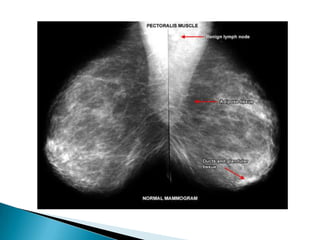
 Masses in adipose breasts are east to detect
because of the high contrast between the
mass and surrounding breast tissue. In dense
glandular breasts, masses can be difficult to
perceive because they may be partially
obscured by glandular tissue.
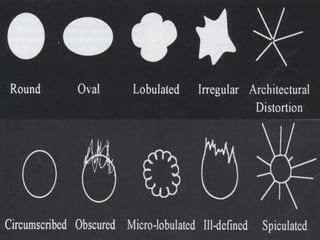
 A 'Mass' is a space occupying lesion seen in two
different projections. If a potential mass is seen in
only a single projection it should be called a 'Density'
until its three-dimensionality is confirmed.
 Circumscribed (well-defined or sharply-defined)
margins: The margins are sharply demarcated with an
abrupt transition between the lesion and the
surrounding tissue. Without additional modifiers
there is nothing to suggest infiltration.
 Indistinct (ill defined) margins: The poor definition of
the margins raises concern that there may be
infiltration by the lesion and this is not likely due to
superimposed normal breast tissue.
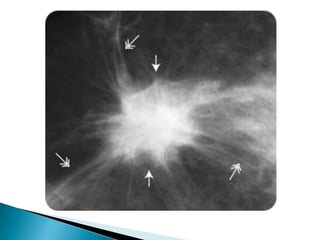
 Spiculated Margins: The lesion is characterized by
lines radiating from the margins of a mass.
The normal architecture is distorted with no
definite mass visible. This includes
spiculations radiating from a point, and focal
retraction or distortion of the edge of the
parenchyma. Architectural distortion can also
be an associated finding.
 This is a density that cannot be accurately
described using the other shapes.
 It is visible as asymmetry of tissue density with
similar shape on two views, but completely
lacking borders and the conspicuity of a true
mass.
It could represent an island of normal breast, but
its lack of specific benign characteristics may
warrant further evaluation.
 Additional imaging may reveal a true mass or
significant architectural distortion.
 Due to confusion of the term mass with the term
'density' which describes attenuation
characteristics of masses, the term 'density' has
been replaced with 'asymmetry'.
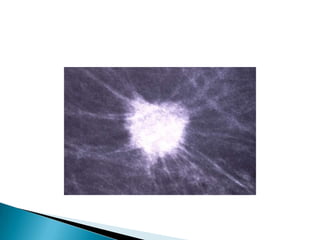
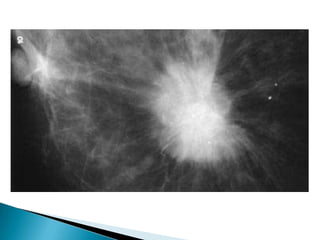
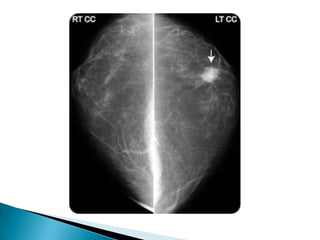
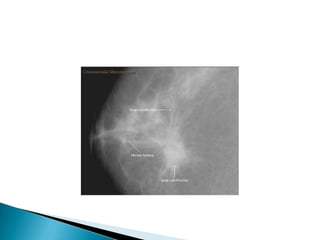
 A spiculate breast mass is the commonest
mammographic appearance of invasive breast
carcinoma
 It consists of a central soft tissue tumor mass
from the surface of which spicules extend
into the surrounding breast tissue. The larger
the tumor mass, the larger the spicules tend
to be.
 Invasive carcinoma: 95% of spiculate masses
seen on mammography
 Non invasive carcinoma
 Complex sclerosing lesion/ radial scar
 Surgical scar
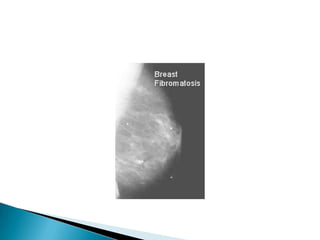
 Fibromatosis
 Granular cell tumor
 Characterized histologically by a fibroelastic
centre surrounded by ducts and lobules
arranged in a radiating fashion.
 Areas of similar or atypical ductal hyperplasia
are often found in the peripheral of CSLs.
 Microcalicifications may be associated
particularly in areas of epithelial hyperplasia.
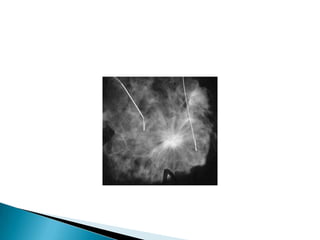
 Usually diagnosed with ease from the
appropriate clinical history and physical
examination revealing the position of scar
corresponding to the spiculated lesion.
 In cases of confusion may be confirmed by
repeating the mammogram with skin markers
placed on the scar.
 Surgical scars often show a difference in size
and shape on orthogonal views cause of their
discoid shape.
 They are histologically similar to abdominal
desmoid tumors.
 They are locally invasive but do not
metastasize.
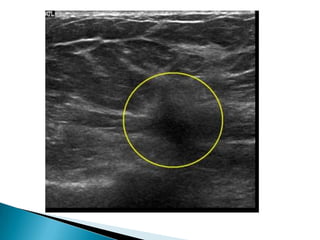
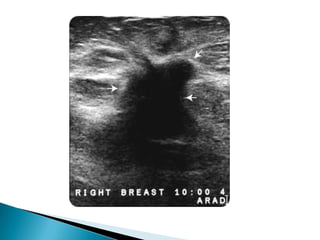
 Most Ca greater than 1 cm can be reliably
demonstrated by ultrasound.
 Typical features are echo poor mass, with
poorly defined margins and posterior
acoustic shadowing.
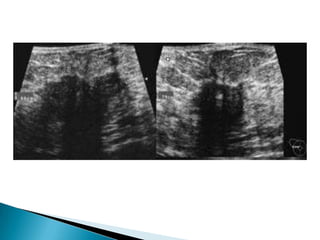
 There may be distortion of the surrounding
parenchyma and a rim of increased
reflectivity may be seen- tumor collar
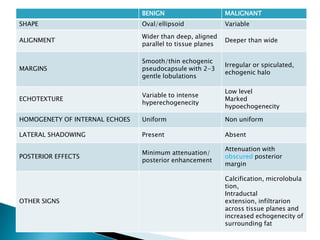
BENIGN MALIGNANT
SHAPE Oval/ellipsoid Variable
ALIGNMENT
Wider than deep, aligned
parallel to tissue planes
Deeper than wide
MARGINS
Smooth/thin echogenic
pseudocapsule with 2-3
gentle lobulations
Irregular or spiculated,
echogenic halo
ECHOTEXTURE
Variable to intense
hyperechogenecity
Low level
Marked
hypoechogenecity
HOMOGENETY OF INTERNAL ECHOES Uniform Non uniform
LATERAL SHADOWING Present Absent
POSTERIOR EFFECTS
Minimum attenuation/
posterior enhancement
Attenuation with
obscured posterior
margin
OTHER SIGNS
Calcification, microlobula
tion,
Intraductal
extension, infiltrarion
across tissue planes and
increased echogenecity of
surrounding fat
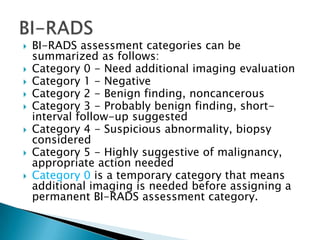
 BI-RADS assessment categories can be
summarized as follows:
 Category 0 - Need additional imaging evaluation
 Category 1 - Negative
 Category 2 - Benign finding, noncancerous
 Category 3 - Probably benign finding, short-
interval follow-up suggested
 Category 4 - Suspicious abnormality, biopsy
considered
 Category 5 - Highly suggestive of malignancy,
appropriate action needed
 Category 0 is a temporary category that means
additional imaging is needed before assigning a
permanent BI-RADS assessment category.
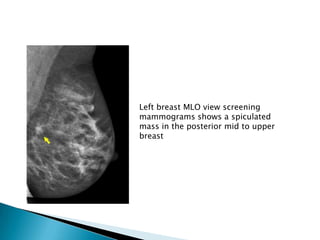
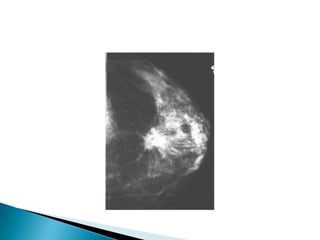
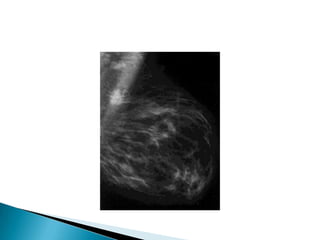
Left breast MLO view screening
mammograms shows a spiculated
mass in the posterior mid to upper
breast
Spiculate breast mass

Spiculate breast mass

  • 2.
     The qualityof the mammograms should be assessed, and if not optimal, repeat examinations may be ordered.  Mammograms of the right and left breasts are first placed back to back (mirror images) for comparable projections.  Lighting should be homogeneous, and adequate viewing conditions should be maintained. The mammograms are inspected carefully. The search is done systematically through similar areas in both breasts.
  • 3.
     First, breastsymmetry, size, general density, and glandular distribution are observed. Next, a search for masses, densities, calcifications, architectural distortions, and associated findings is performed.  Benign calcifications tend to have specific shapes: eggshell calcifications in cyst walls, tramlike in arterial walls, popcorn type in fibroadenomas, large and rodlike with possible branching in ectatic ducts, and small calcifications with a lucent center in the skin.
  • 4.
     Associated findingsare then taken into account. These include skin or nipple retraction, skin thickening (which may be focal or diffuse) especially with superficially positioned lesions, tethering of the pectoralis major may be seen with deeply positioned tumors, trabecular thickening, skin lesions, axillary adenopathy, and architectural distortion.  If previous examination results are available, their comparison is useful in assessing disease progress.
  • 5.
     The lesionseen is located by using the views to either of the inner or outer or the lower or upper quadrants. It may also be central or retroareolar. The lesion can be described in a clock-shape position. The breast is viewed as the face of a clock with the patient facing the observer. The depth of the lesion is assigned to the anterior, middle, or posterior third of the breast.
  • 6.
     Masses inadipose breasts are east to detect because of the high contrast between the mass and surrounding breast tissue. In dense glandular breasts, masses can be difficult to perceive because they may be partially obscured by glandular tissue.
  • 8.
     A 'Mass'is a space occupying lesion seen in two different projections. If a potential mass is seen in only a single projection it should be called a 'Density' until its three-dimensionality is confirmed.  Circumscribed (well-defined or sharply-defined) margins: The margins are sharply demarcated with an abrupt transition between the lesion and the surrounding tissue. Without additional modifiers there is nothing to suggest infiltration.  Indistinct (ill defined) margins: The poor definition of the margins raises concern that there may be infiltration by the lesion and this is not likely due to superimposed normal breast tissue.  Spiculated Margins: The lesion is characterized by lines radiating from the margins of a mass.
  • 10.
    The normal architectureis distorted with no definite mass visible. This includes spiculations radiating from a point, and focal retraction or distortion of the edge of the parenchyma. Architectural distortion can also be an associated finding.
  • 11.
     This isa density that cannot be accurately described using the other shapes.  It is visible as asymmetry of tissue density with similar shape on two views, but completely lacking borders and the conspicuity of a true mass. It could represent an island of normal breast, but its lack of specific benign characteristics may warrant further evaluation.  Additional imaging may reveal a true mass or significant architectural distortion.  Due to confusion of the term mass with the term 'density' which describes attenuation characteristics of masses, the term 'density' has been replaced with 'asymmetry'.
  • 12.
     A spiculatebreast mass is the commonest mammographic appearance of invasive breast carcinoma  It consists of a central soft tissue tumor mass from the surface of which spicules extend into the surrounding breast tissue. The larger the tumor mass, the larger the spicules tend to be.
  • 13.
     Invasive carcinoma:95% of spiculate masses seen on mammography  Non invasive carcinoma  Complex sclerosing lesion/ radial scar  Surgical scar  Fibromatosis  Granular cell tumor
  • 14.
     Characterized histologicallyby a fibroelastic centre surrounded by ducts and lobules arranged in a radiating fashion.  Areas of similar or atypical ductal hyperplasia are often found in the peripheral of CSLs.  Microcalicifications may be associated particularly in areas of epithelial hyperplasia.
  • 15.
     Usually diagnosedwith ease from the appropriate clinical history and physical examination revealing the position of scar corresponding to the spiculated lesion.  In cases of confusion may be confirmed by repeating the mammogram with skin markers placed on the scar.  Surgical scars often show a difference in size and shape on orthogonal views cause of their discoid shape.
  • 16.
     They arehistologically similar to abdominal desmoid tumors.  They are locally invasive but do not metastasize.
  • 17.
     Most Cagreater than 1 cm can be reliably demonstrated by ultrasound.  Typical features are echo poor mass, with poorly defined margins and posterior acoustic shadowing.  There may be distortion of the surrounding parenchyma and a rim of increased reflectivity may be seen- tumor collar
  • 18.
    BENIGN MALIGNANT SHAPE Oval/ellipsoidVariable ALIGNMENT Wider than deep, aligned parallel to tissue planes Deeper than wide MARGINS Smooth/thin echogenic pseudocapsule with 2-3 gentle lobulations Irregular or spiculated, echogenic halo ECHOTEXTURE Variable to intense hyperechogenecity Low level Marked hypoechogenecity HOMOGENETY OF INTERNAL ECHOES Uniform Non uniform LATERAL SHADOWING Present Absent POSTERIOR EFFECTS Minimum attenuation/ posterior enhancement Attenuation with obscured posterior margin OTHER SIGNS Calcification, microlobula tion, Intraductal extension, infiltrarion across tissue planes and increased echogenecity of surrounding fat
  • 19.
     BI-RADS assessmentcategories can be summarized as follows:  Category 0 - Need additional imaging evaluation  Category 1 - Negative  Category 2 - Benign finding, noncancerous  Category 3 - Probably benign finding, short- interval follow-up suggested  Category 4 - Suspicious abnormality, biopsy considered  Category 5 - Highly suggestive of malignancy, appropriate action needed  Category 0 is a temporary category that means additional imaging is needed before assigning a permanent BI-RADS assessment category.
  • 21.
    Left breast MLOview screening mammograms shows a spiculated mass in the posterior mid to upper breast