Prehospital Trauma  Life Support  PHTLS   Refresher Program
Course Purpose Reaffirm knowledge of prehospital trauma care Introduce recent changes in trauma care as it affects the prehospital patient Demonstrate proficiency at performing skills necessary in the care of critically injured patients
Prehospital Trauma Life Support   Managing the Multisystem  Trauma Patient Part I
Objectives Discuss the laws of energy and motion Discuss trauma associated with blunt impact and penetrating injury Overview of the effects of energy distribution in MVCs Review the kinematics of blast and violent injuries Use kinematics to predict injury patterns
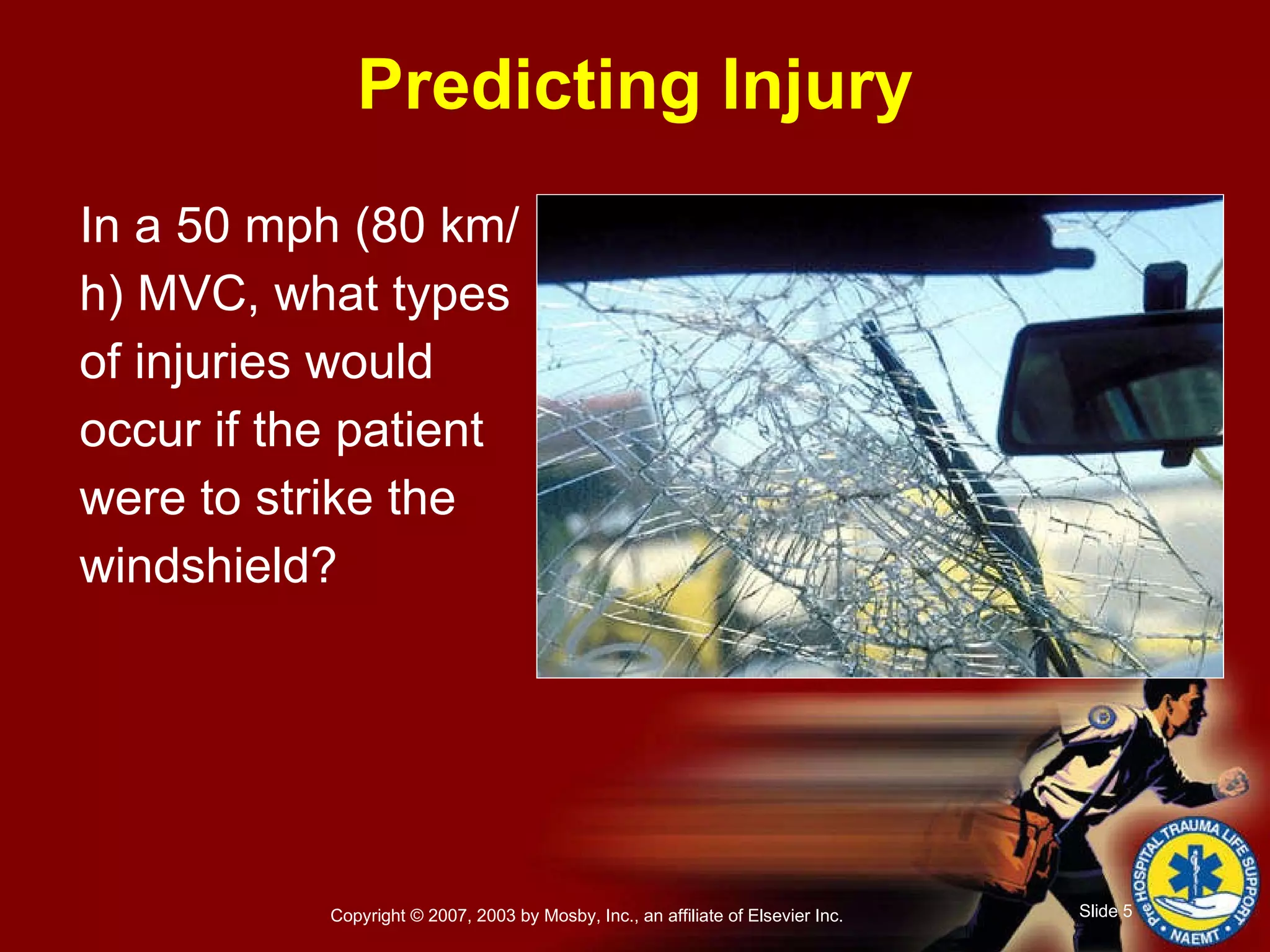
Predicting Injury In a 50 mph (80 km/h) MVC, what types of injuries would occur if the patient were to strike the windshield?
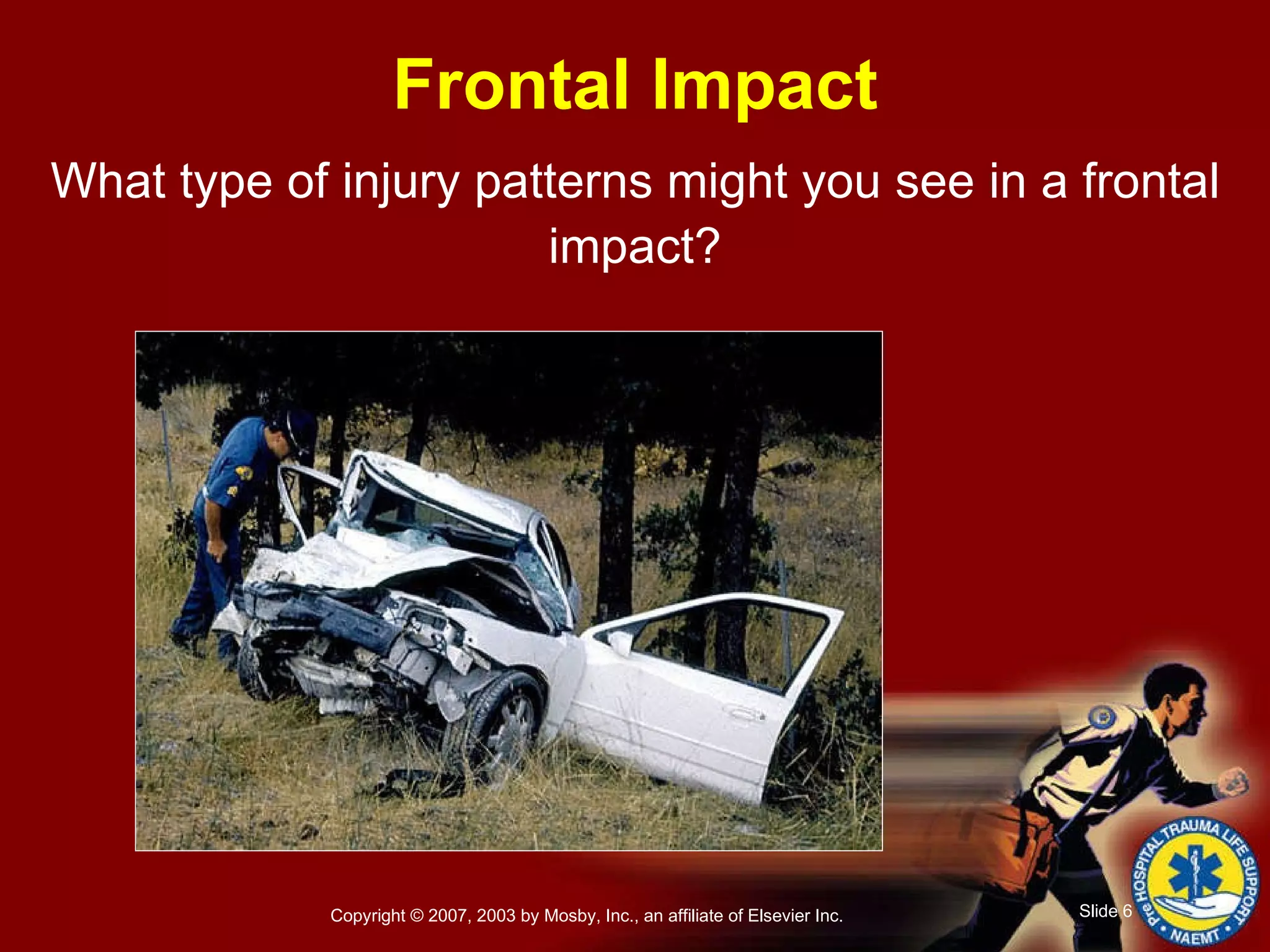
What type of injury patterns might you see in a frontal impact? Frontal Impact
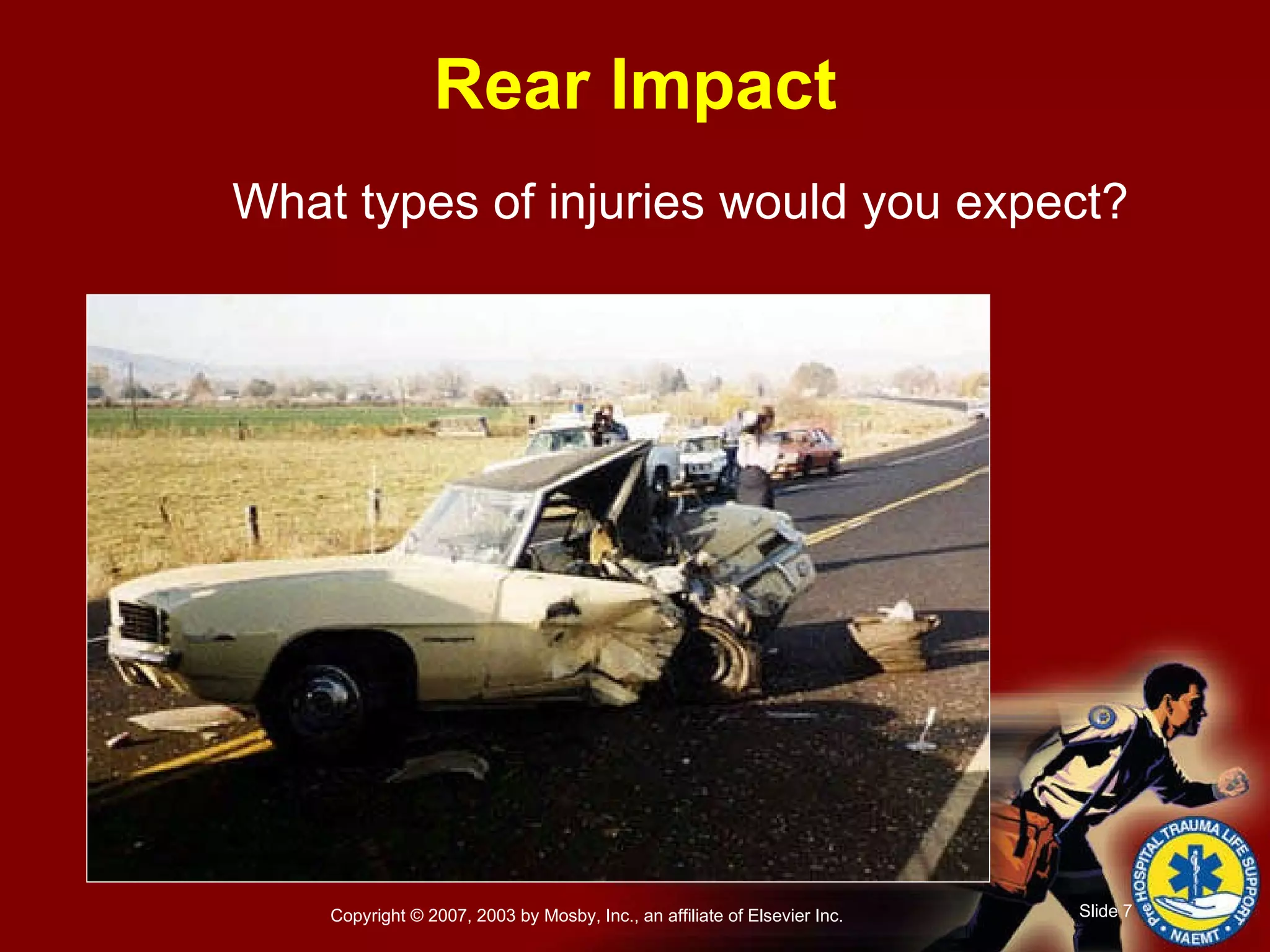
What types of injuries would you expect? Rear Impact
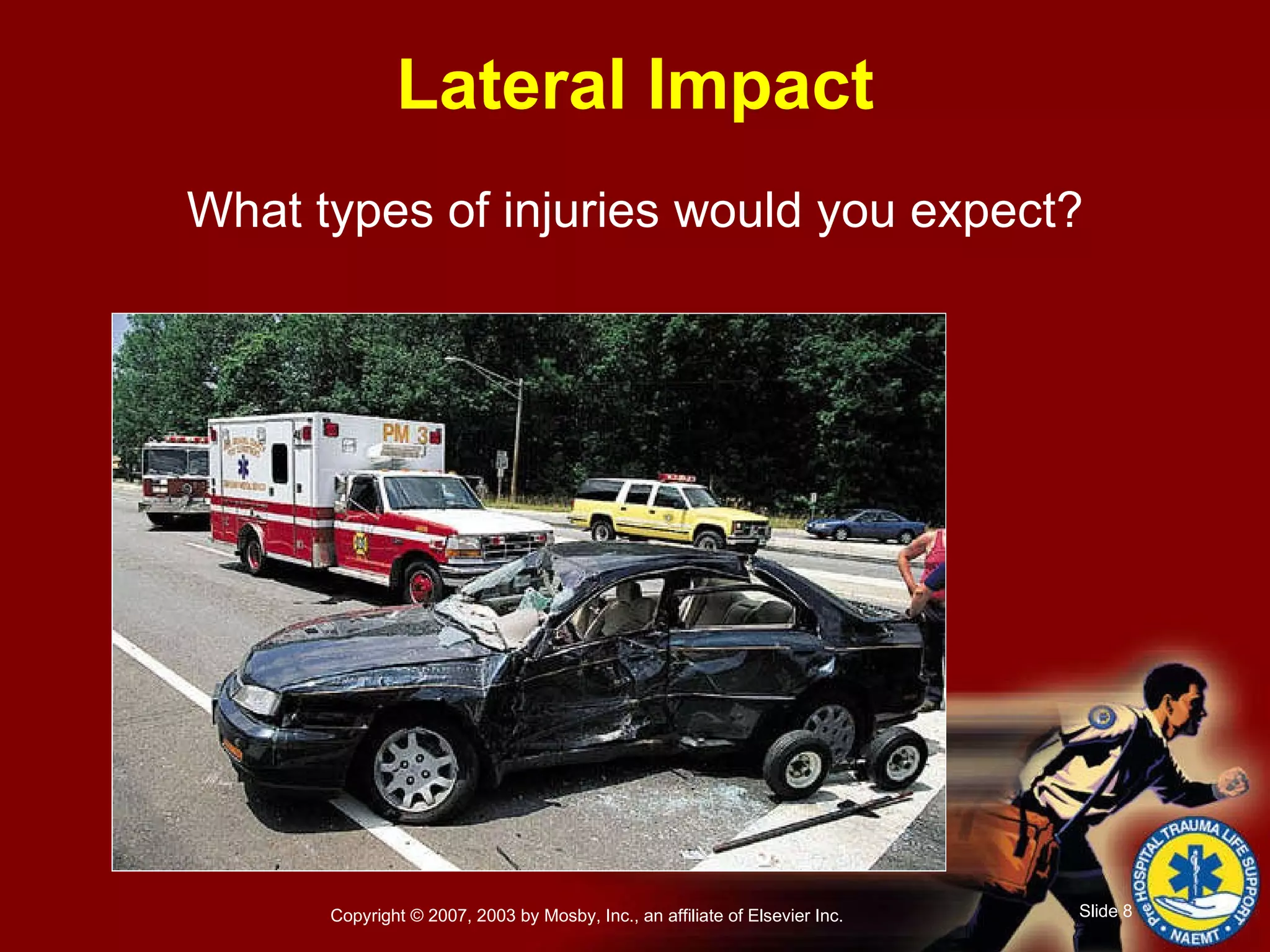
What types of injuries would you expect? Lateral Impact
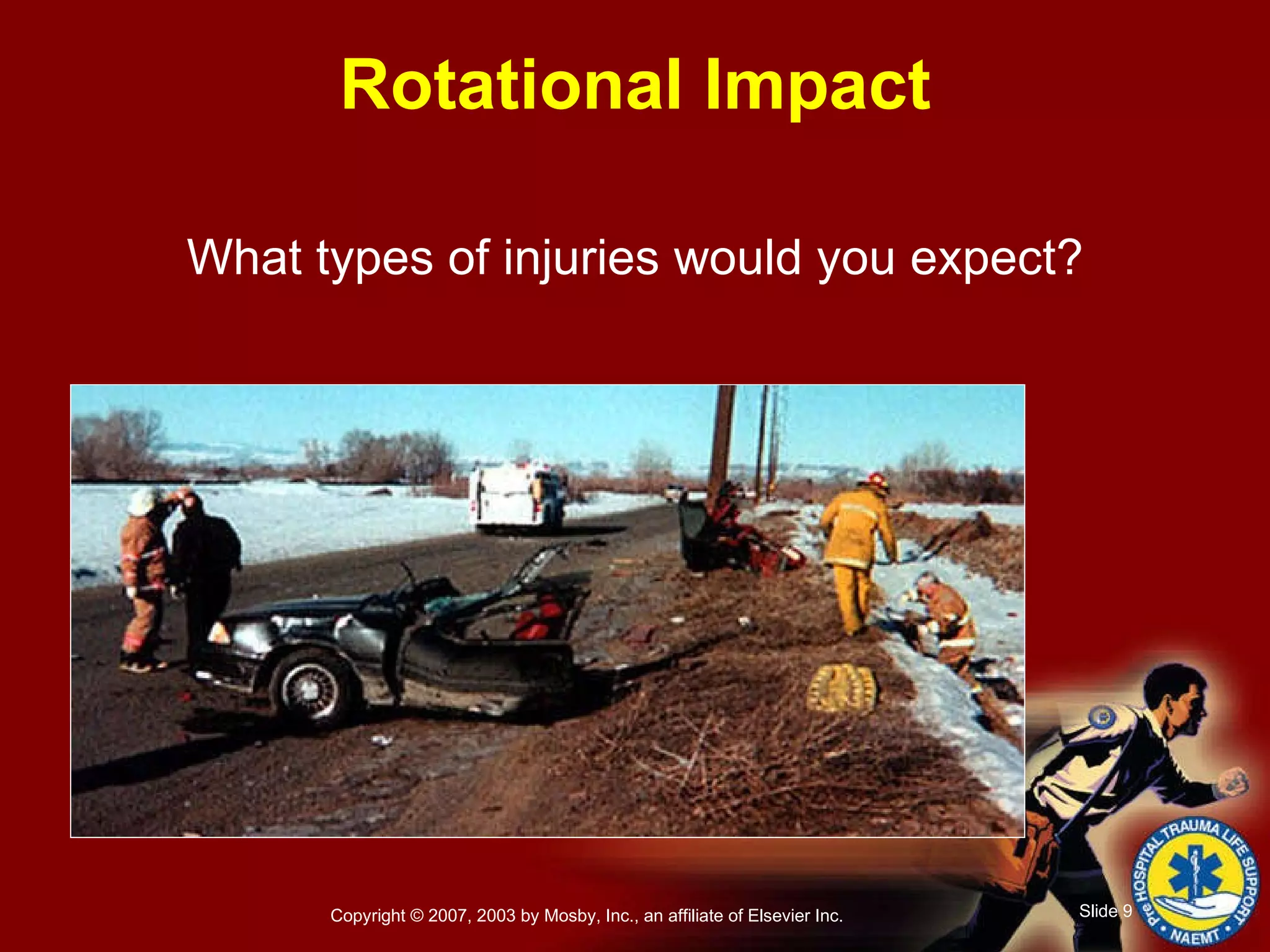
What types of injuries would you expect? Rotational Impact
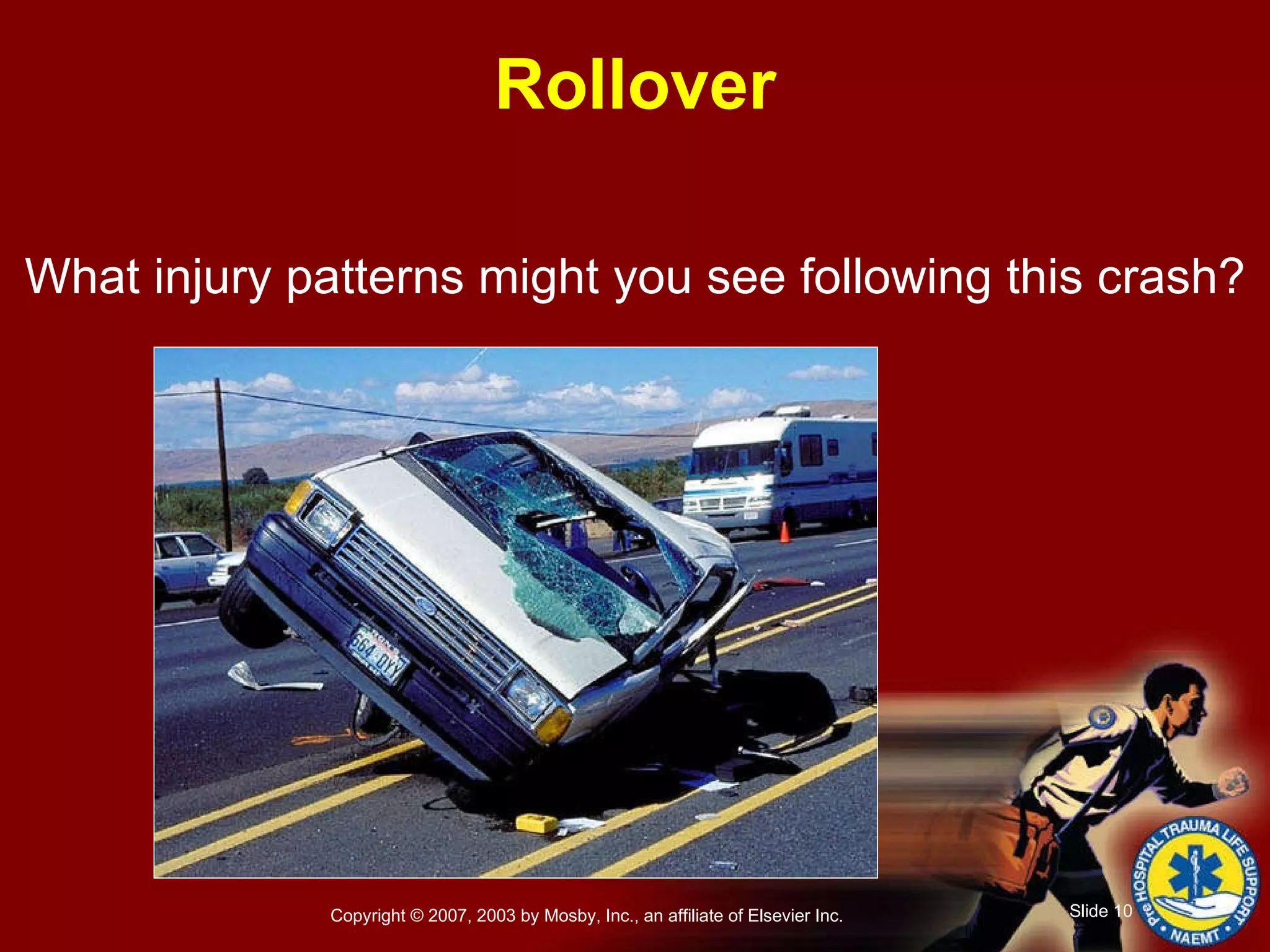
What injury patterns might you see following this crash? Rollover
Warfare/terrorism Industrial/residential What types of explosions may occur in your area? Blast Injuries
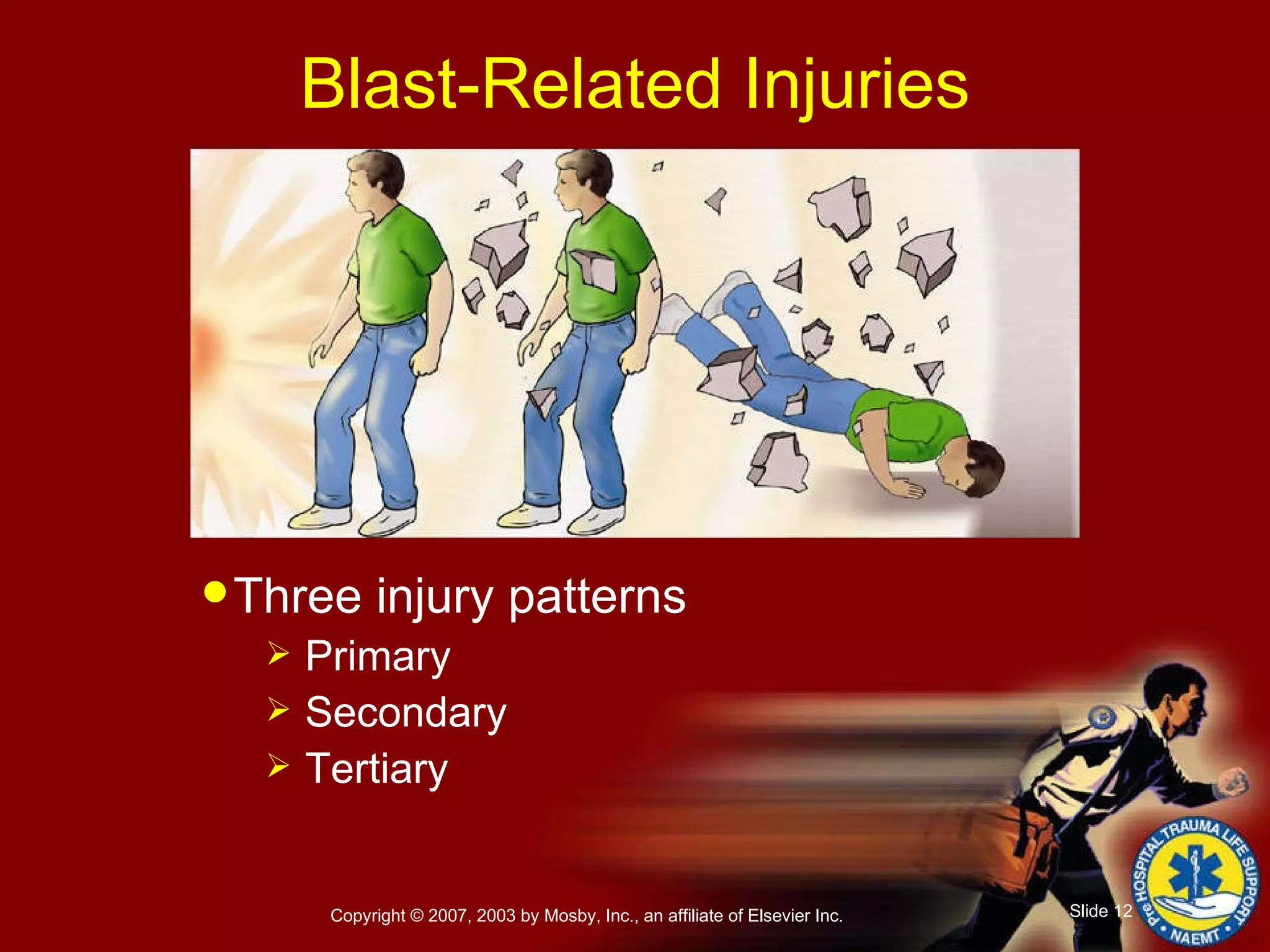
Three injury patterns Primary Secondary Tertiary Blast-Related Injuries
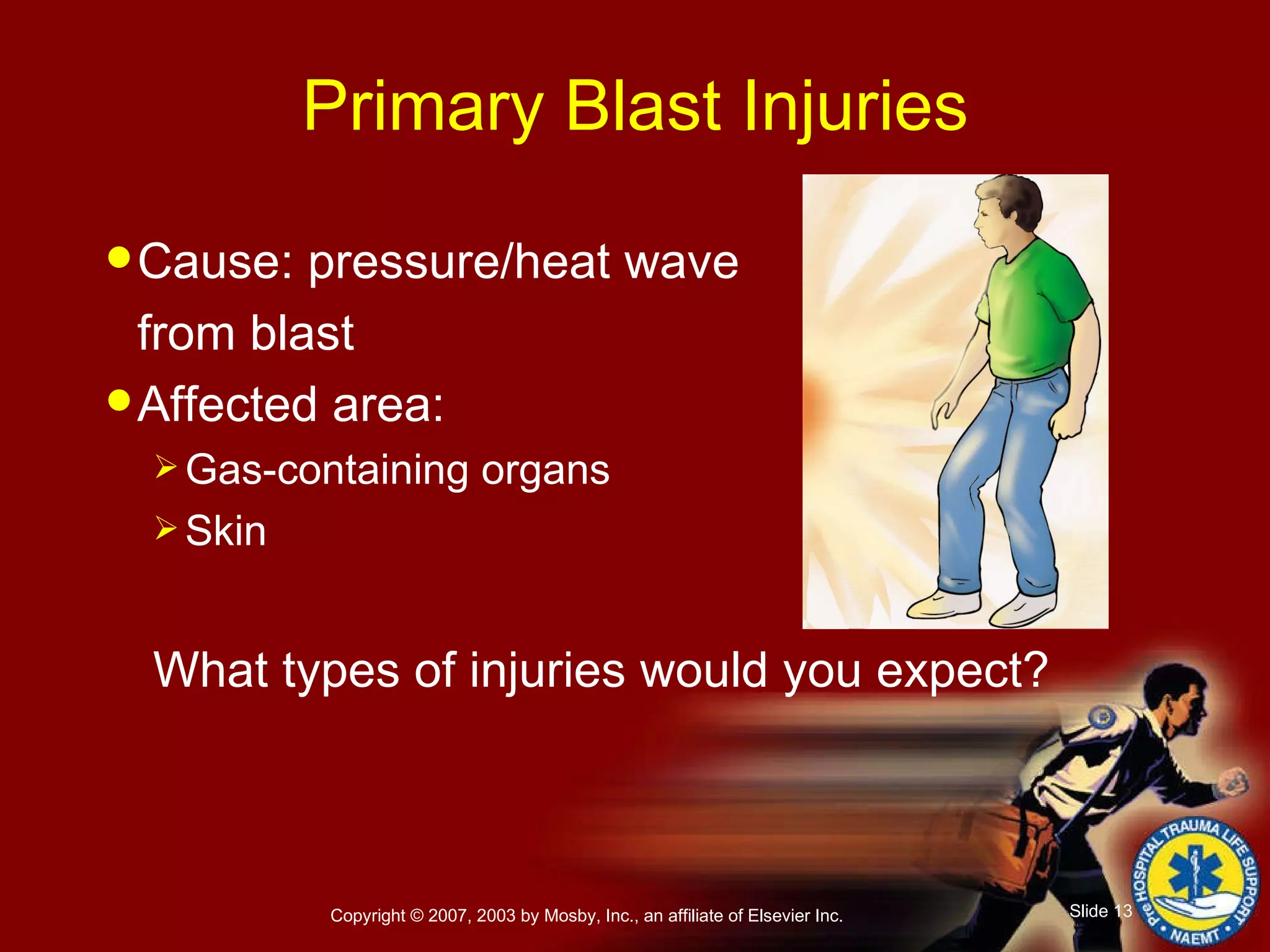
Cause: pressure/heat wave  from blast Affected area: Gas-containing organs Skin What types of injuries would you expect? Primary Blast Injuries
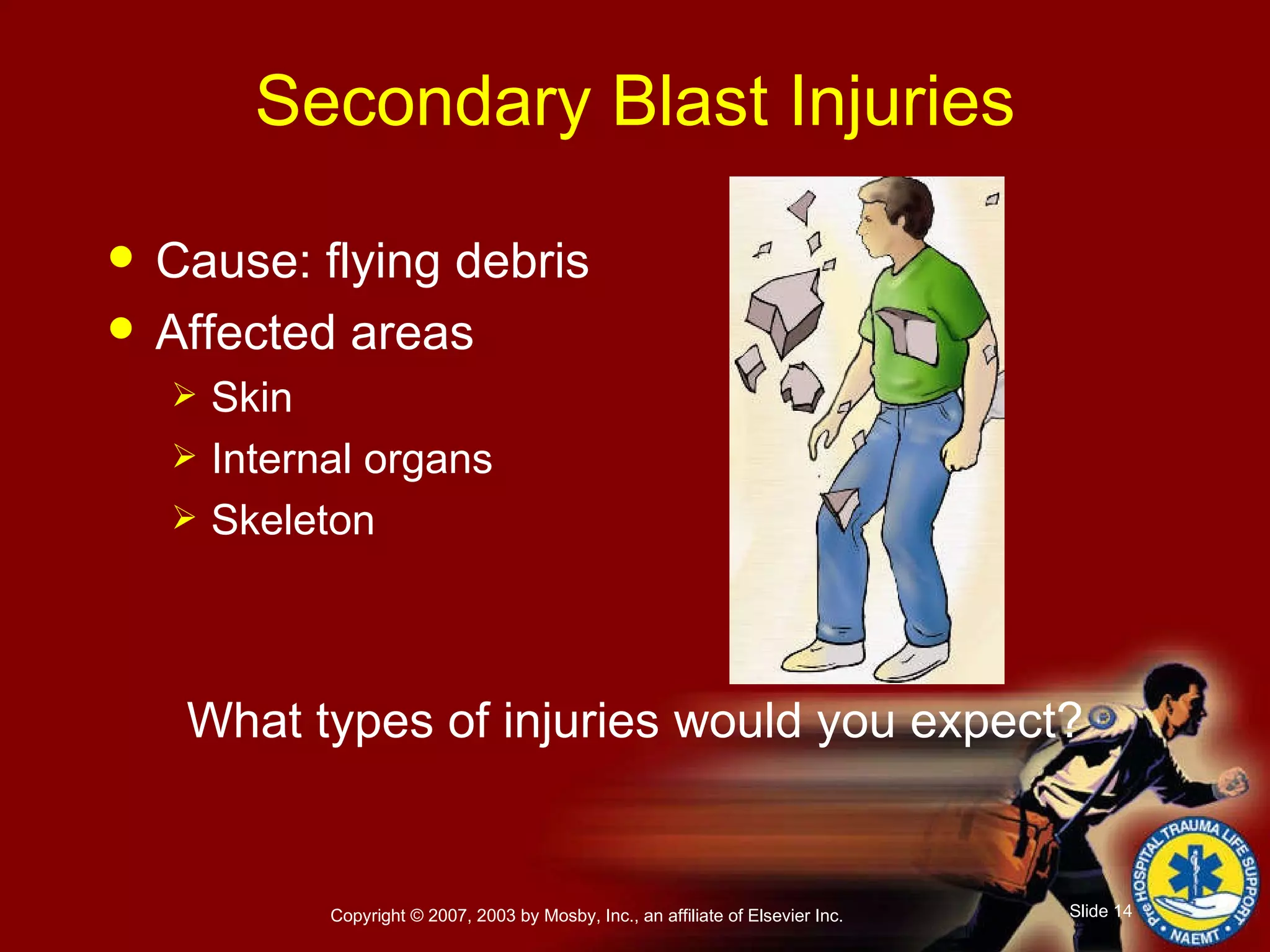
Cause: flying debris Affected areas Skin Internal organs Skeleton What types of injuries would you expect? Secondary Blast Injuries
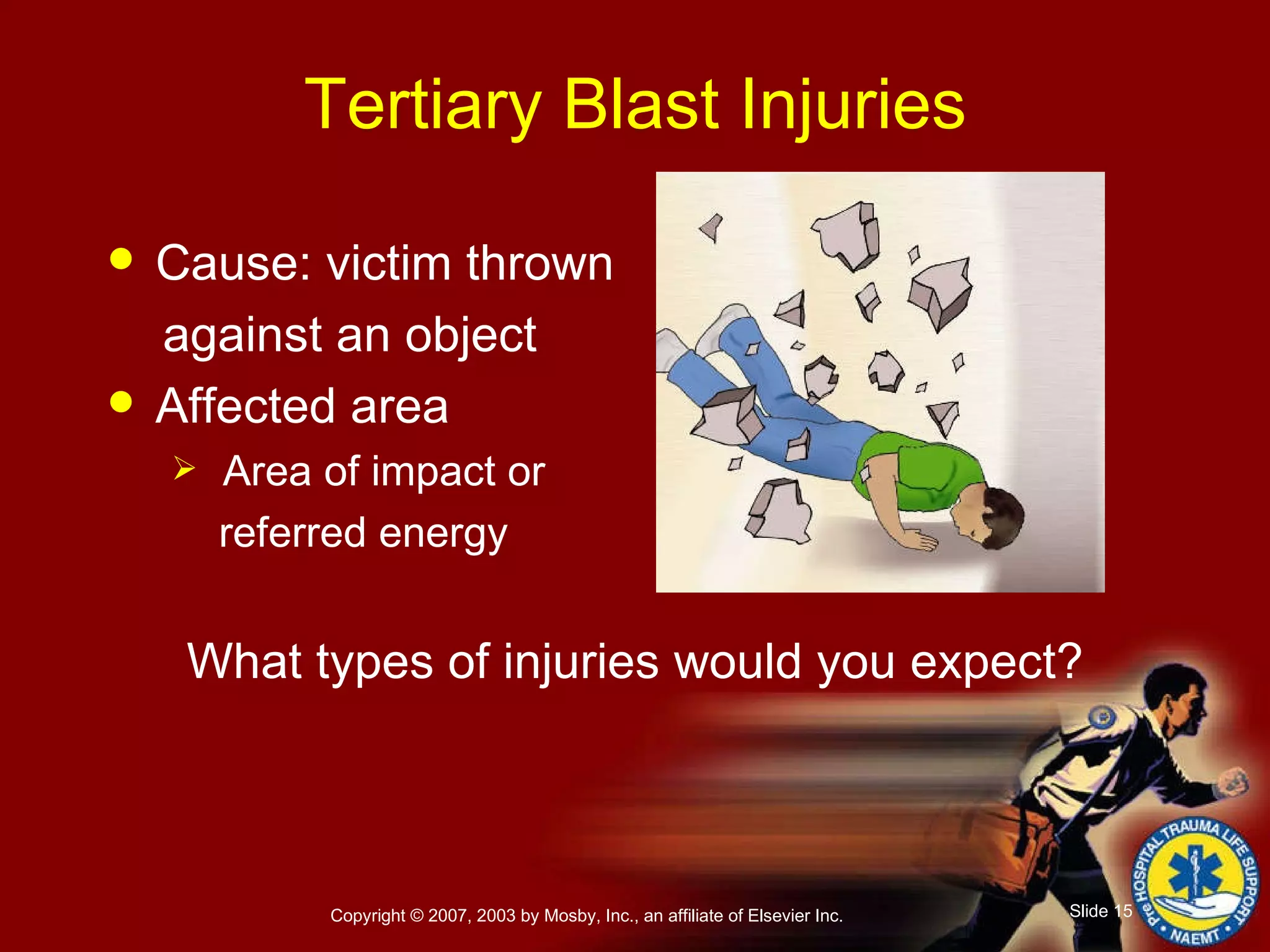
Cause: victim thrown  against an object Affected area Area of impact or referred energy What types of injuries would you expect? Tertiary Blast Injuries
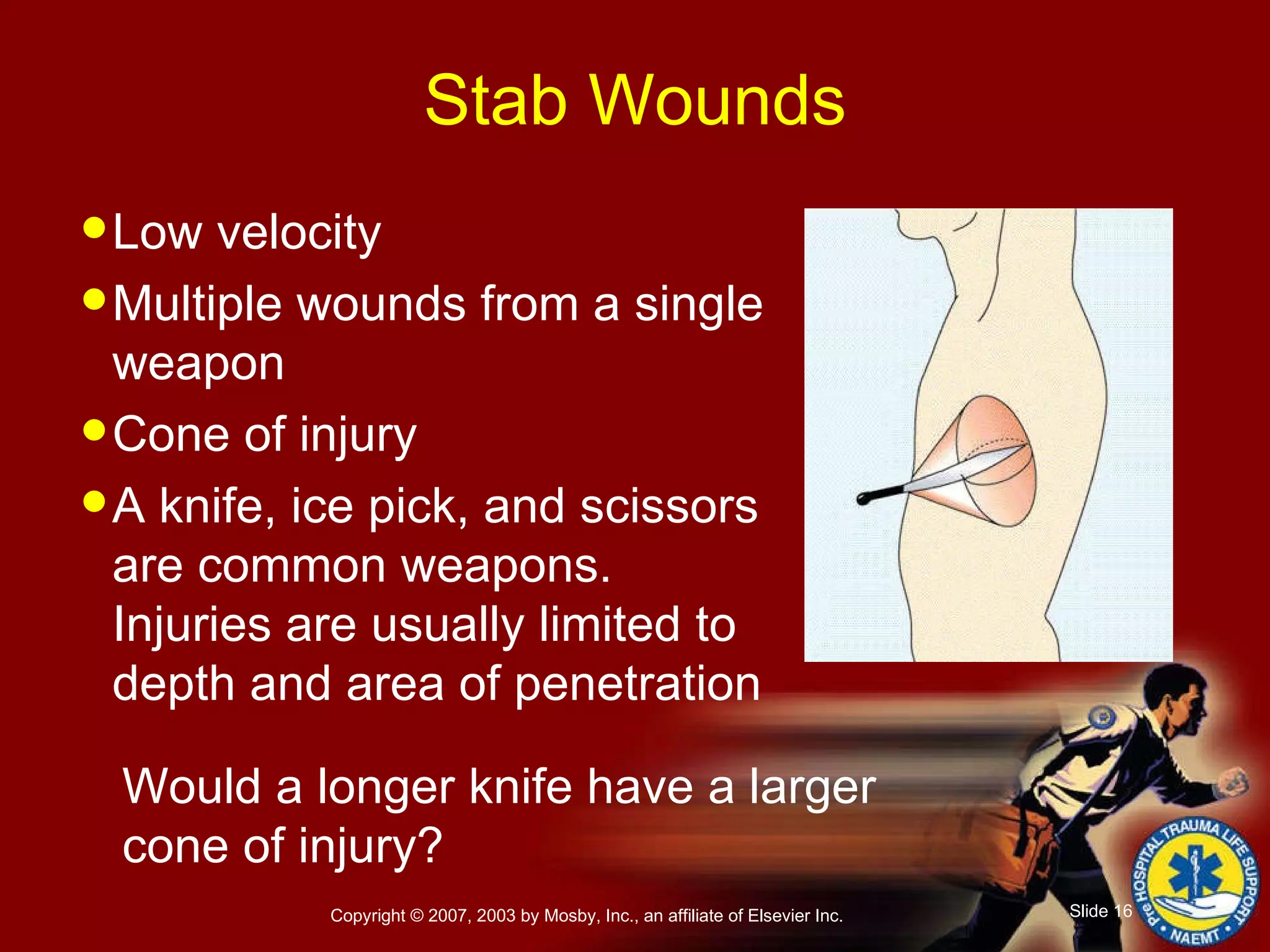
Low velocity Multiple wounds from a single weapon Cone of injury A knife, ice pick, and scissors are common weapons. Injuries are usually limited to depth and area of penetration Stab Wounds Would a longer knife have a larger cone of injury?
Stab Wounds: Key Issues Type of weapon Number of wounds Depth of penetration Anatomic structures along potential path
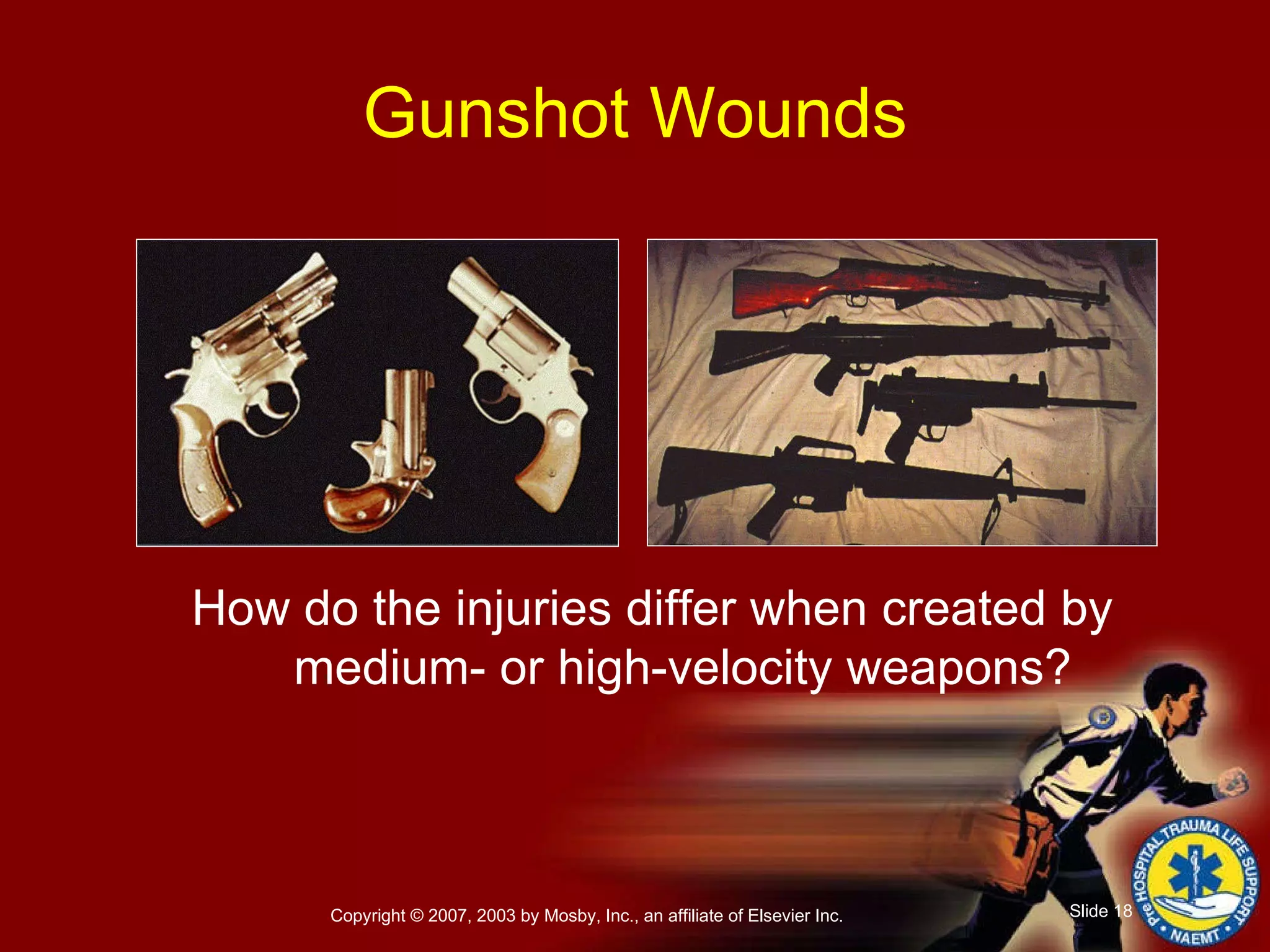
Gunshot Wounds How do the injuries differ when created by  medium- or high-velocity weapons?
Projectiles: Key Issues Profile Fragmentation Tumble/pathway Velocity
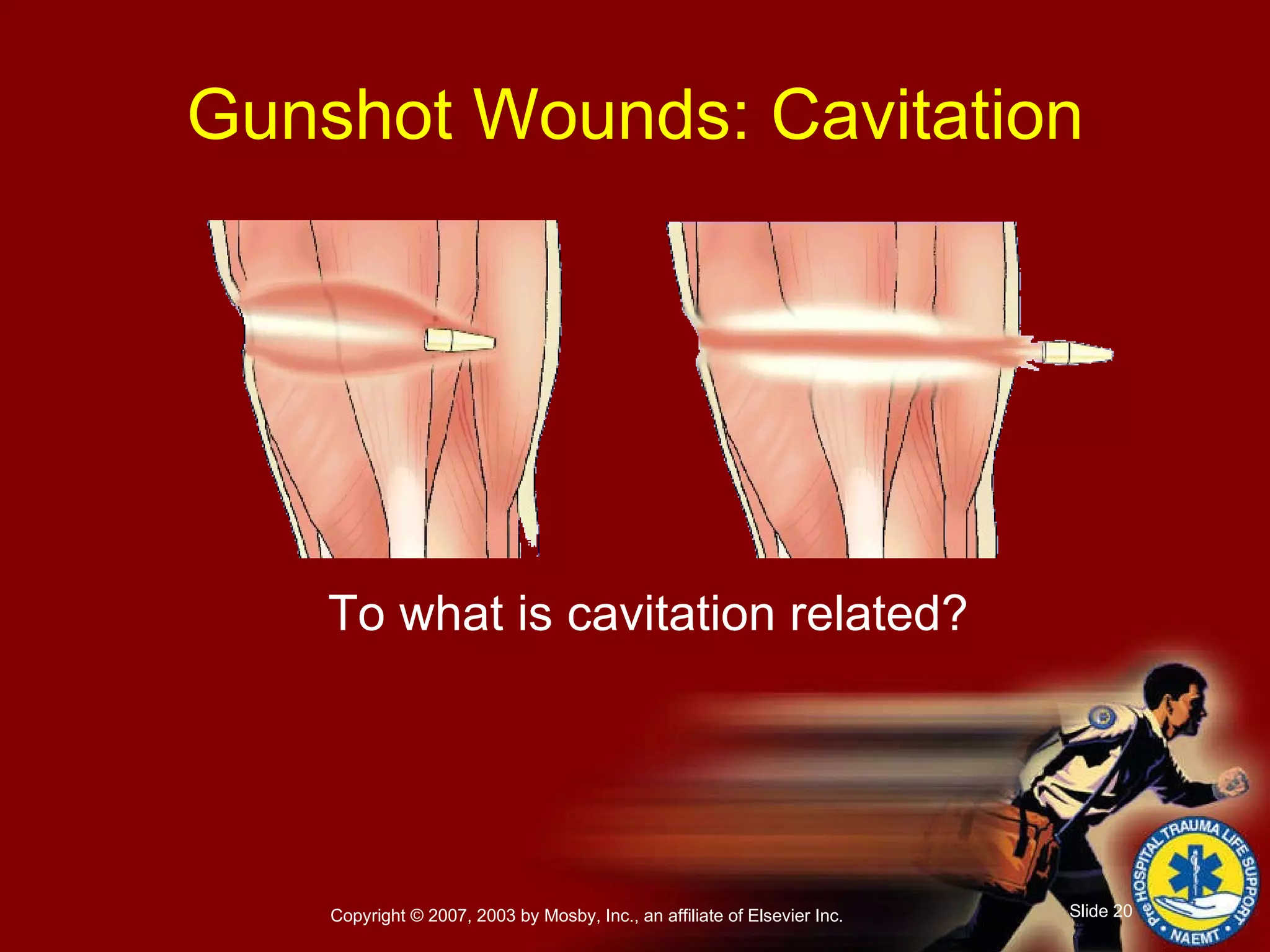
To what is cavitation related? Gunshot Wounds: Cavitation
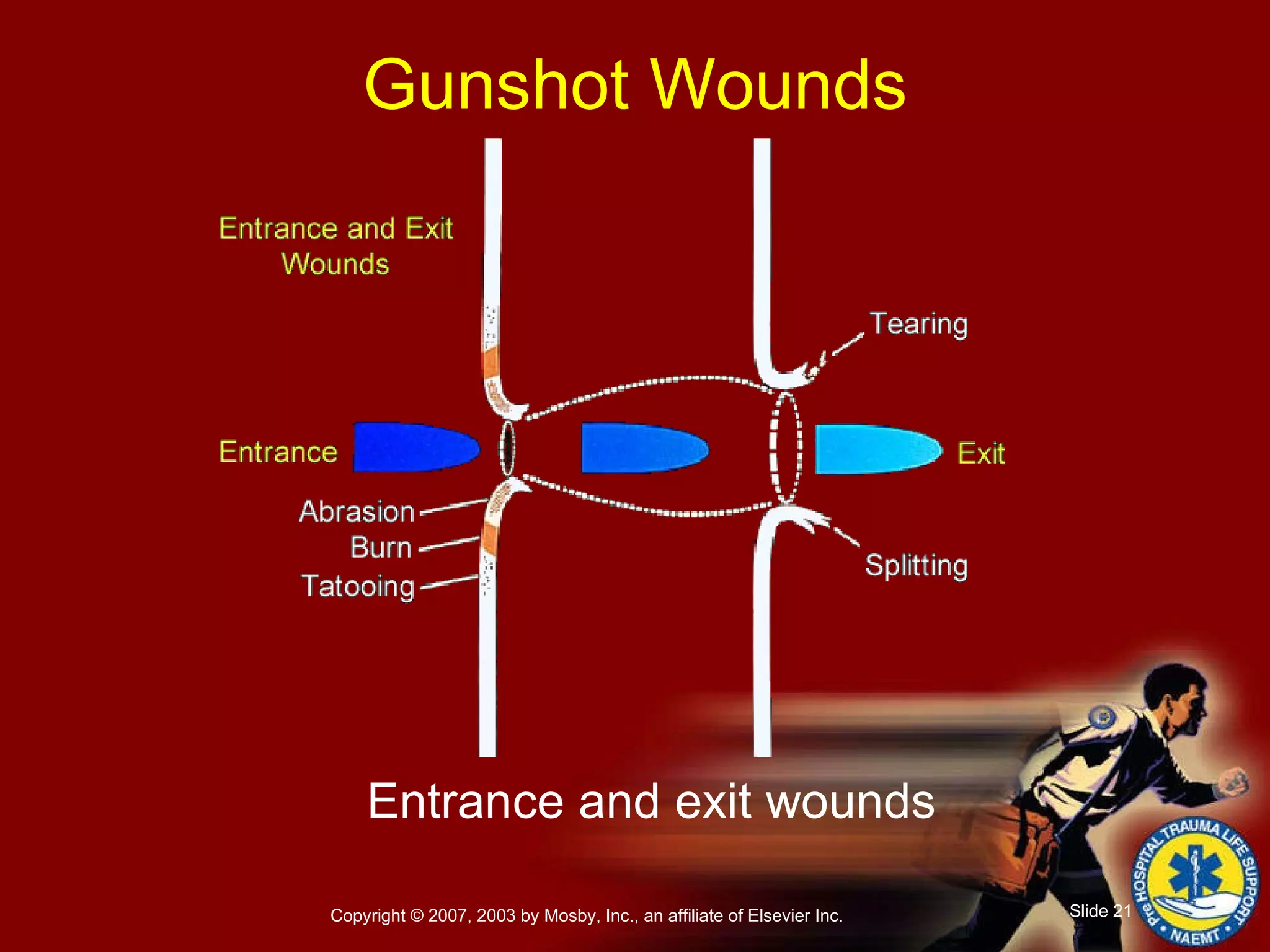
Entrance and exit wounds Gunshot Wounds
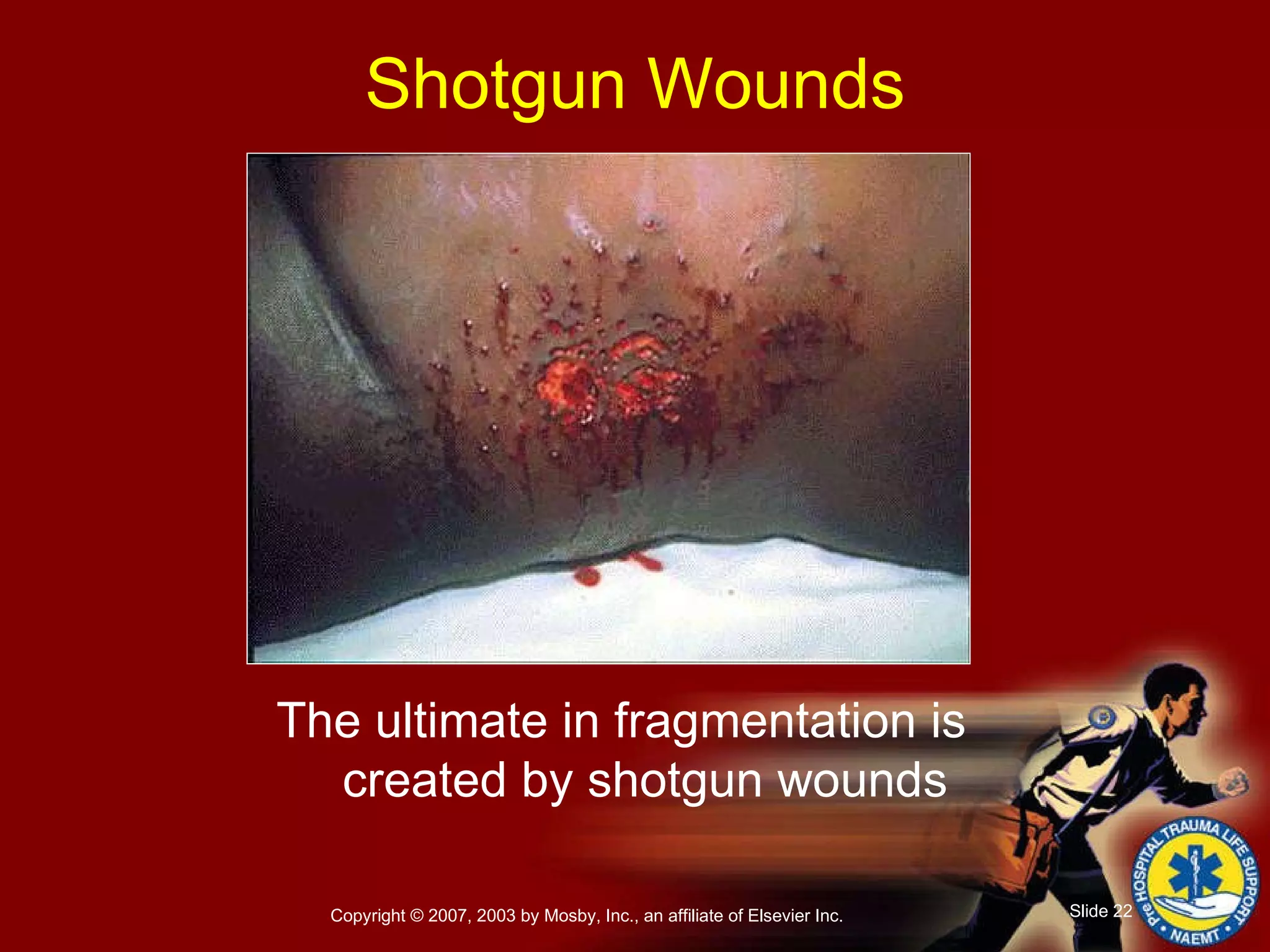
The ultimate in fragmentation is created by shotgun wounds Shotgun Wounds
Scene safety is the top priority! Weapon type Anatomic structures along potential path Crime scene preservation Patient care takes precedence Considerations for Penetrating Trauma
Objectives Discuss the importance of scene assessment Identify components of the primary survey Differentiate between critical and noncritical patients Defend the need for early transport of critical patients Describe when to perform a secondary survey
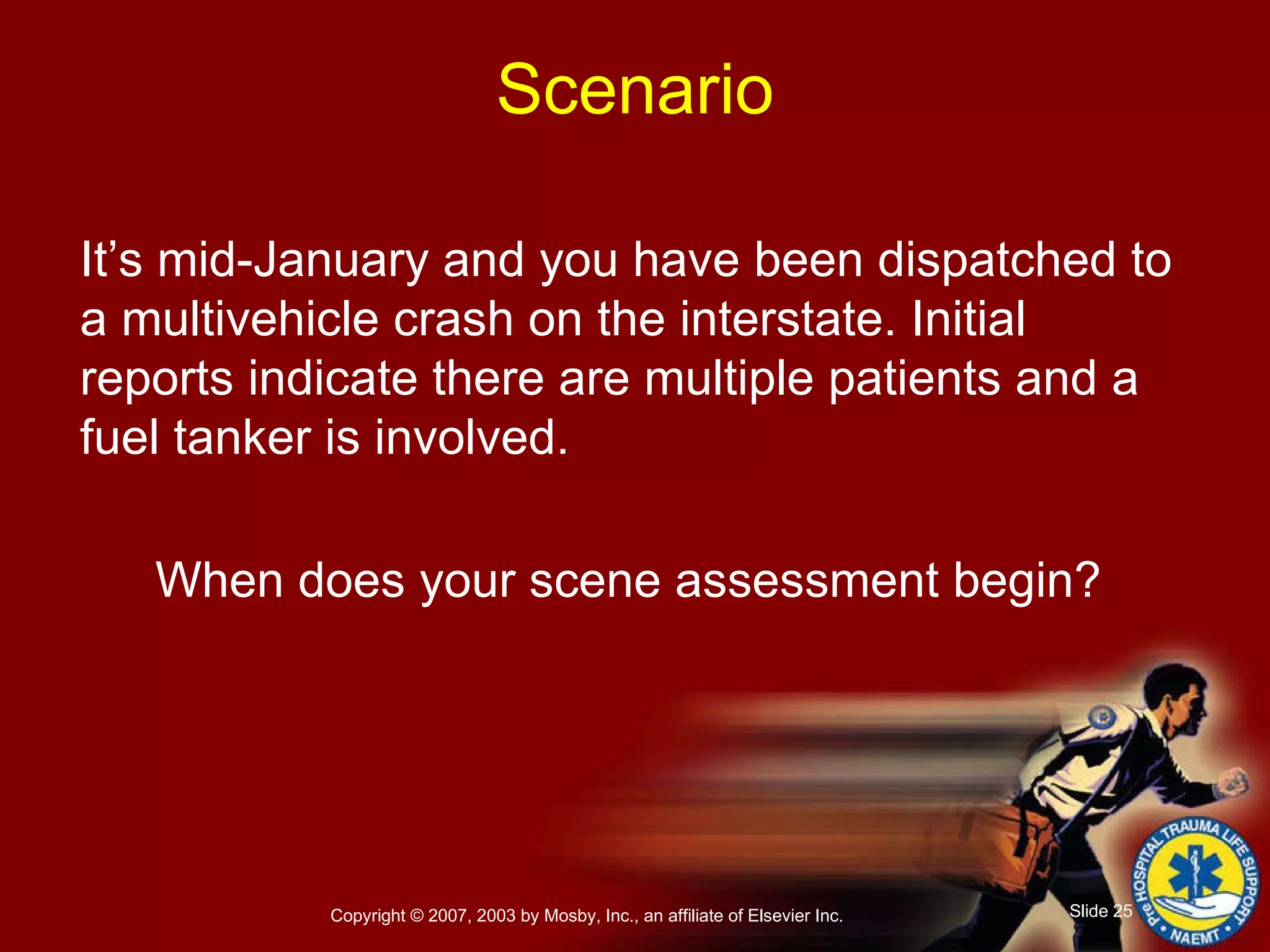
It’s mid-January and you have been dispatched to a multivehicle crash on the interstate. Initial reports indicate there are multiple patients and a fuel tanker is involved. When does your scene assessment begin? Scenario
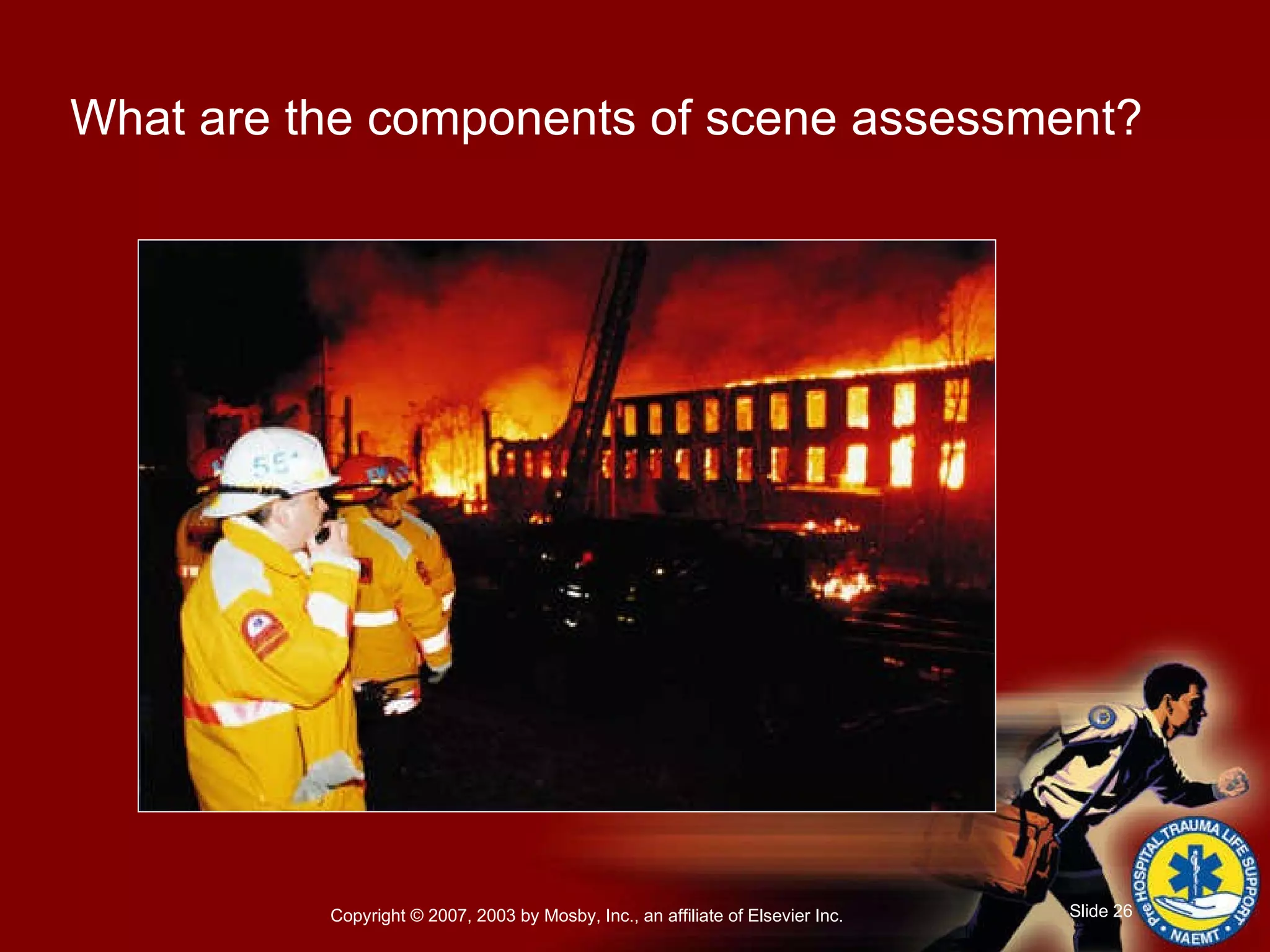
What are the components of scene assessment?
Scene Safety Ensure safety of rescuers and patients Threatening situations may include: Fire Electrical lines     Hazardous materials   Blood and body fluids Can you think of any other hazards? Traffic Weapons Environmental conditions
Scene Situation What really happened? What are the kinematics? How many patients involved? Ages? Additional resources needed? How will patients be transported?
Your patient is the 32-year-old female unrestrained driver who is found slumped over in the vehicle. She has no obvious external hemorrhage, is breathing rapidly, and is mumbling inappropriate words. What do these findings suggest? How should you assess this patient? Scenario
Patient Assessment Primary survey “ Treat as you go” Resuscitation Secondary survey Definitive care in the field
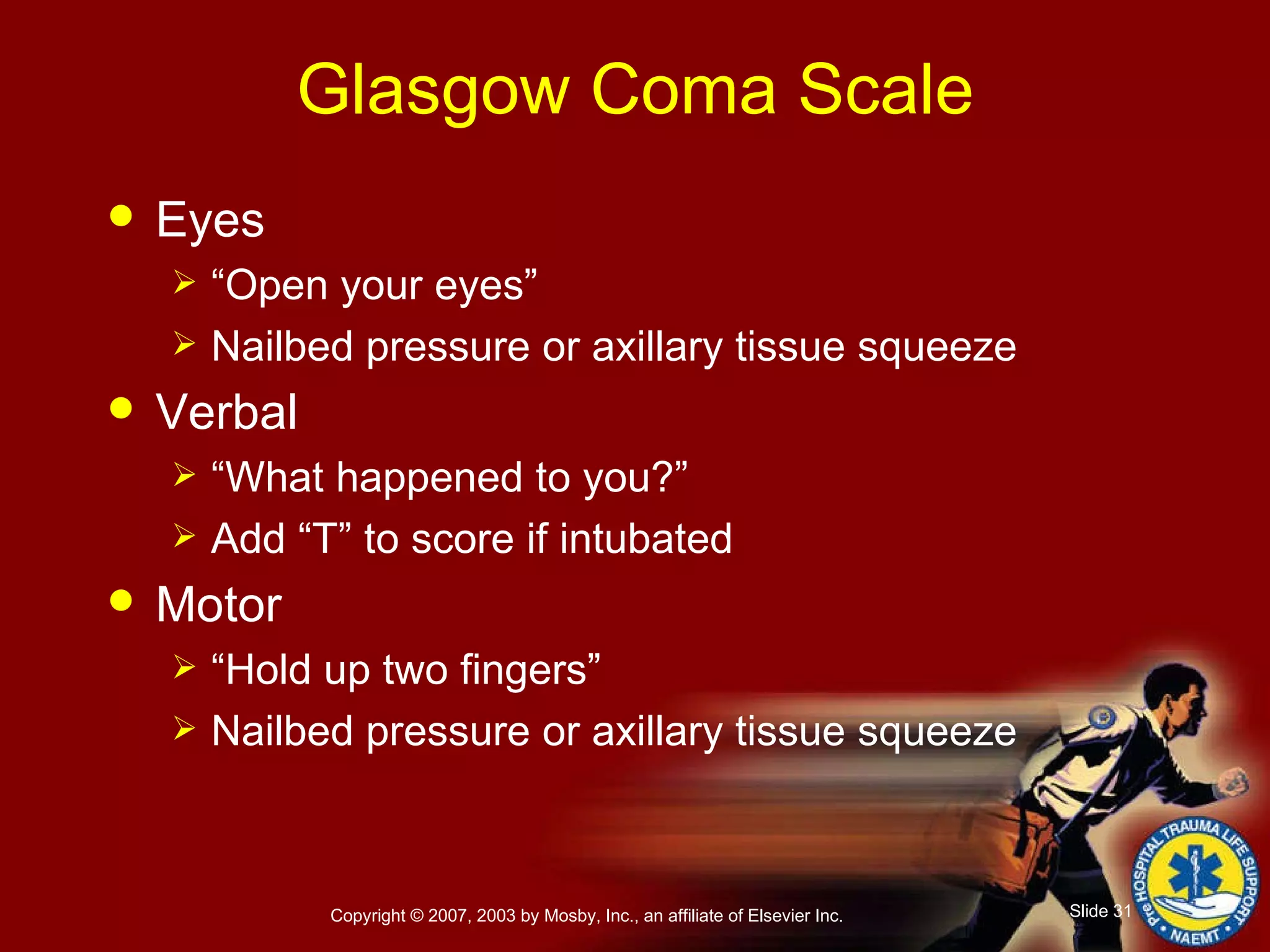
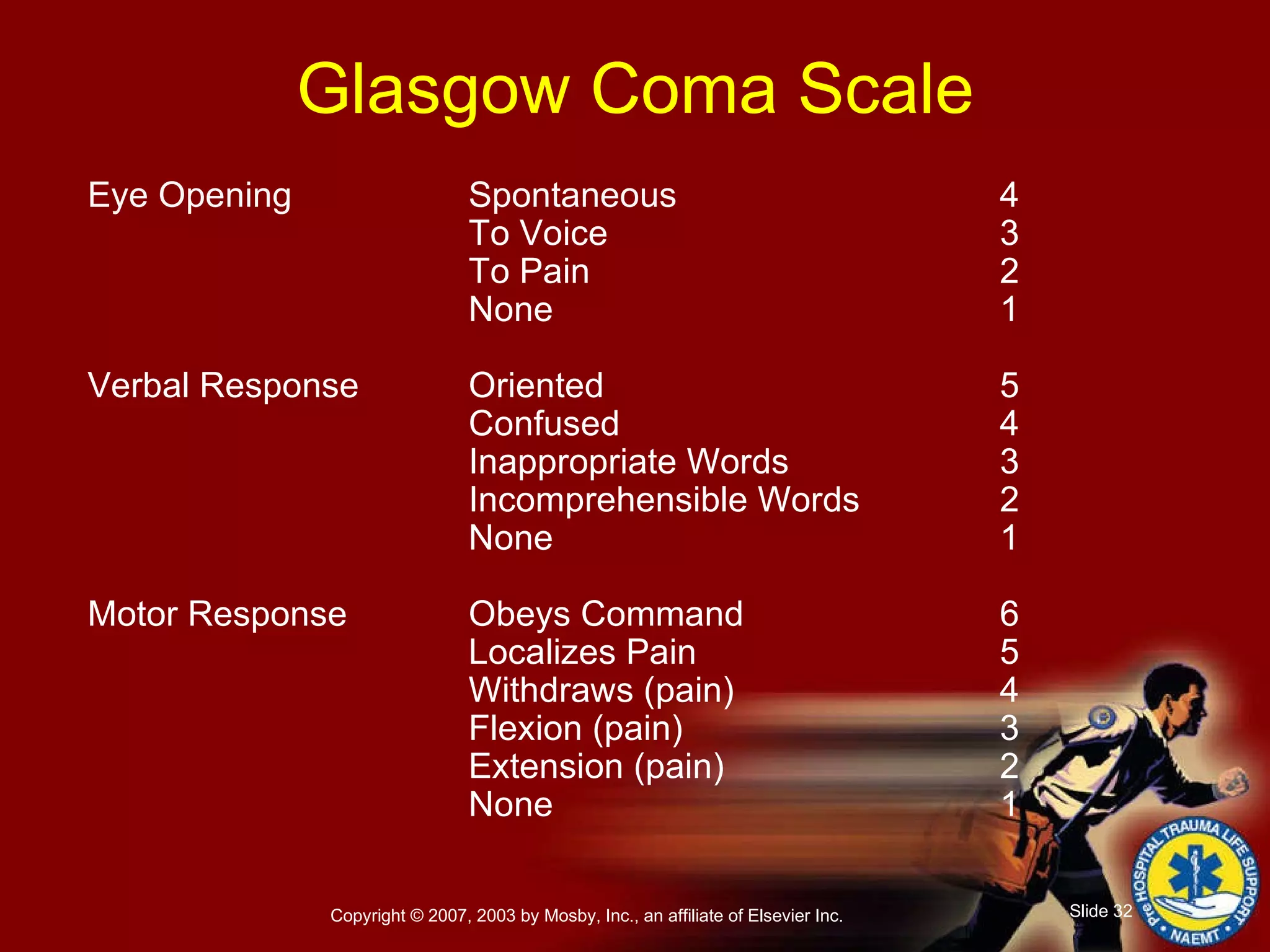
Glasgow Coma Scale Eyes   “ Open your eyes” Nailbed pressure or axillary tissue squeeze Verbal   “ What happened to you?” Add “T” to score if intubated Motor   “ Hold up two fingers” Nailbed pressure or axillary tissue squeeze
Glasgow Coma Scale Eye Opening Spontaneous 4 To Voice 3 To Pain 2 None 1 Verbal Response Oriented 5 Confused 4 Inappropriate Words 3 Incomprehensible Words 2 None 1 Motor Response Obeys Command 6 Localizes Pain 5 Withdraws (pain) 4 Flexion (pain) 3 Extension (pain) 2 None 1
Expose/Environment Expose patient as environment allows to assess for other life-threatening conditions; then preserve/maintain body heat Life-threatening conditions missed because of failure to adequately expose the patient Failing to preserve body heat and to consider environmental conditions
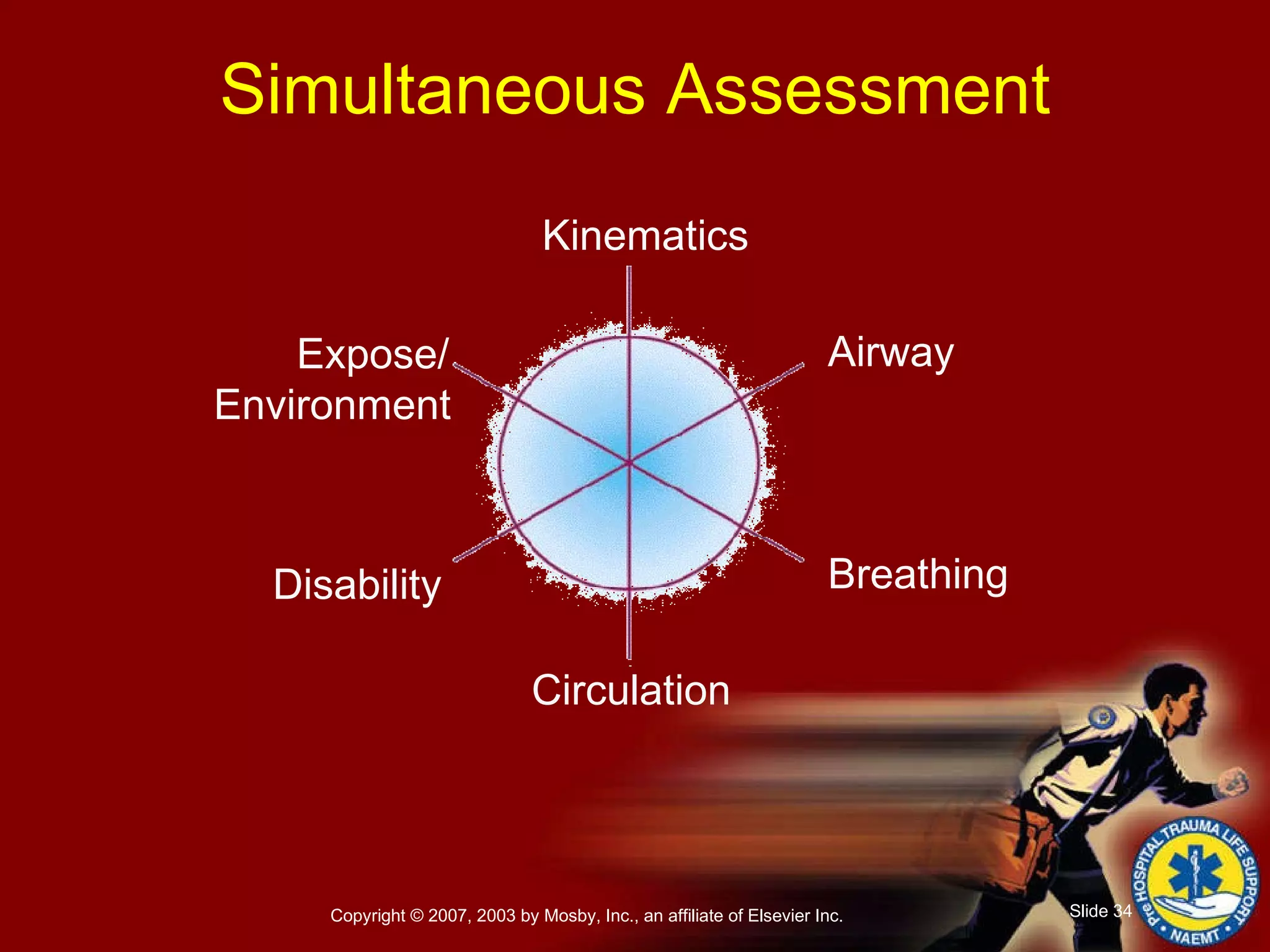
Simultaneous Assessment Breathing Airway Kinematics Circulation Disability Expose/ Environment
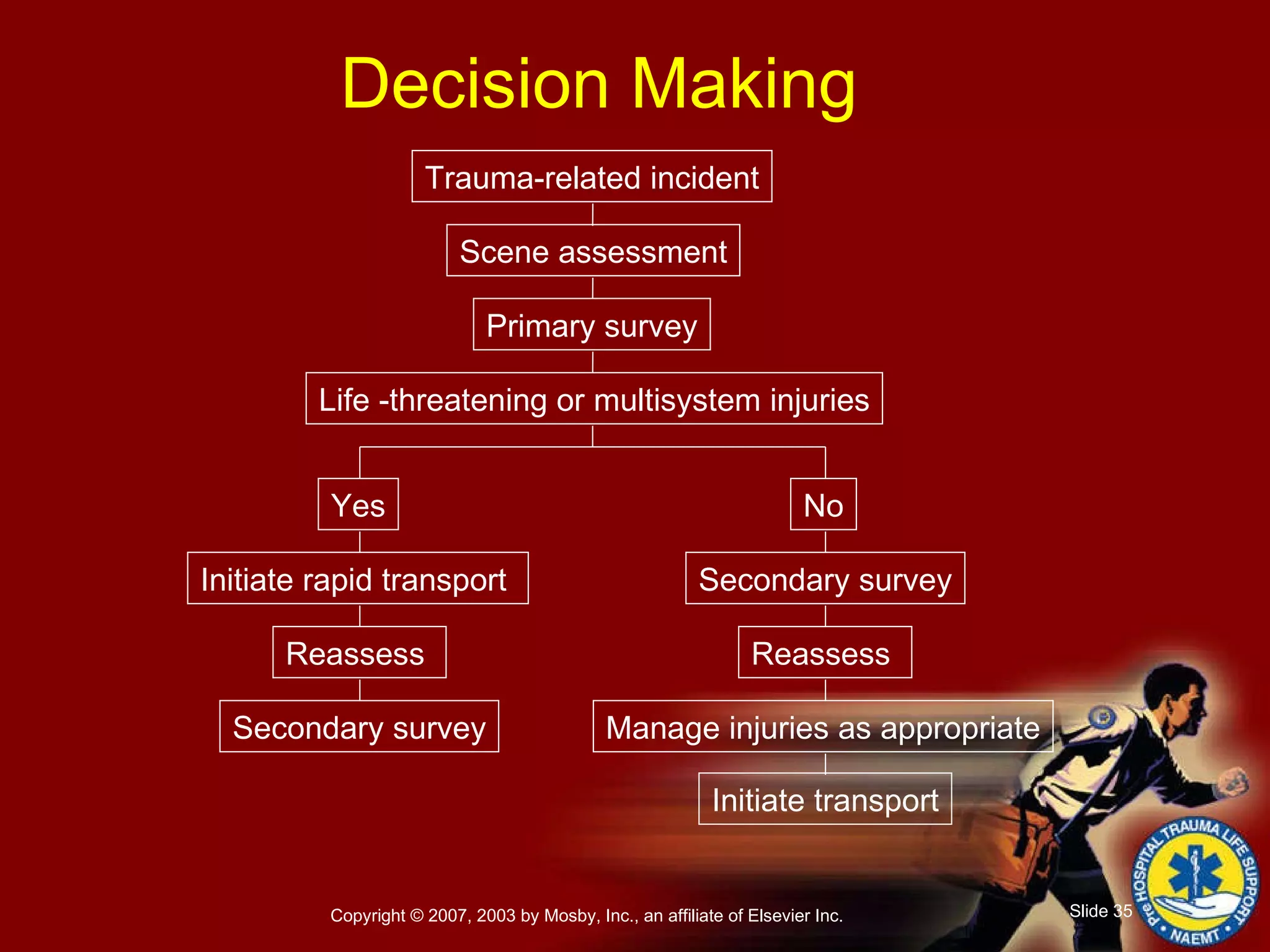
Decision Making Trauma-related incident Scene assessment Primary survey Life -threatening or multisystem injuries No Yes Initiate rapid transport  Reassess  Secondary survey Secondary survey Reassess  Manage injuries as appropriate Initiate transport
A 16-year-old loses control of his bicycle on gravel. Your patient is found on the side of the road holding his right wrist. Multiple abrasions are noted on his face and upper extremities. The scene is safe. Scenario
Primary Survey A: Patent B: Normal; BS clear C: Minor bleeding from chin laceration; radial pulse normal; skin warm, pink, and dry D: GCS score 15 E: Deformity noted to right wrist How do you proceed?
Secondary Survey Vital signs AMPLE history Head-to-toe exam Performing a secondary survey on a critical patient prior to initiating resuscitation Failing to complete a secondary survey on a noncritical patient
Head-to-Toe Exam Systematic and Complete Observation What do we  look  for? Auscultation What do we  listen  for? Palpation What do we  feel  for?
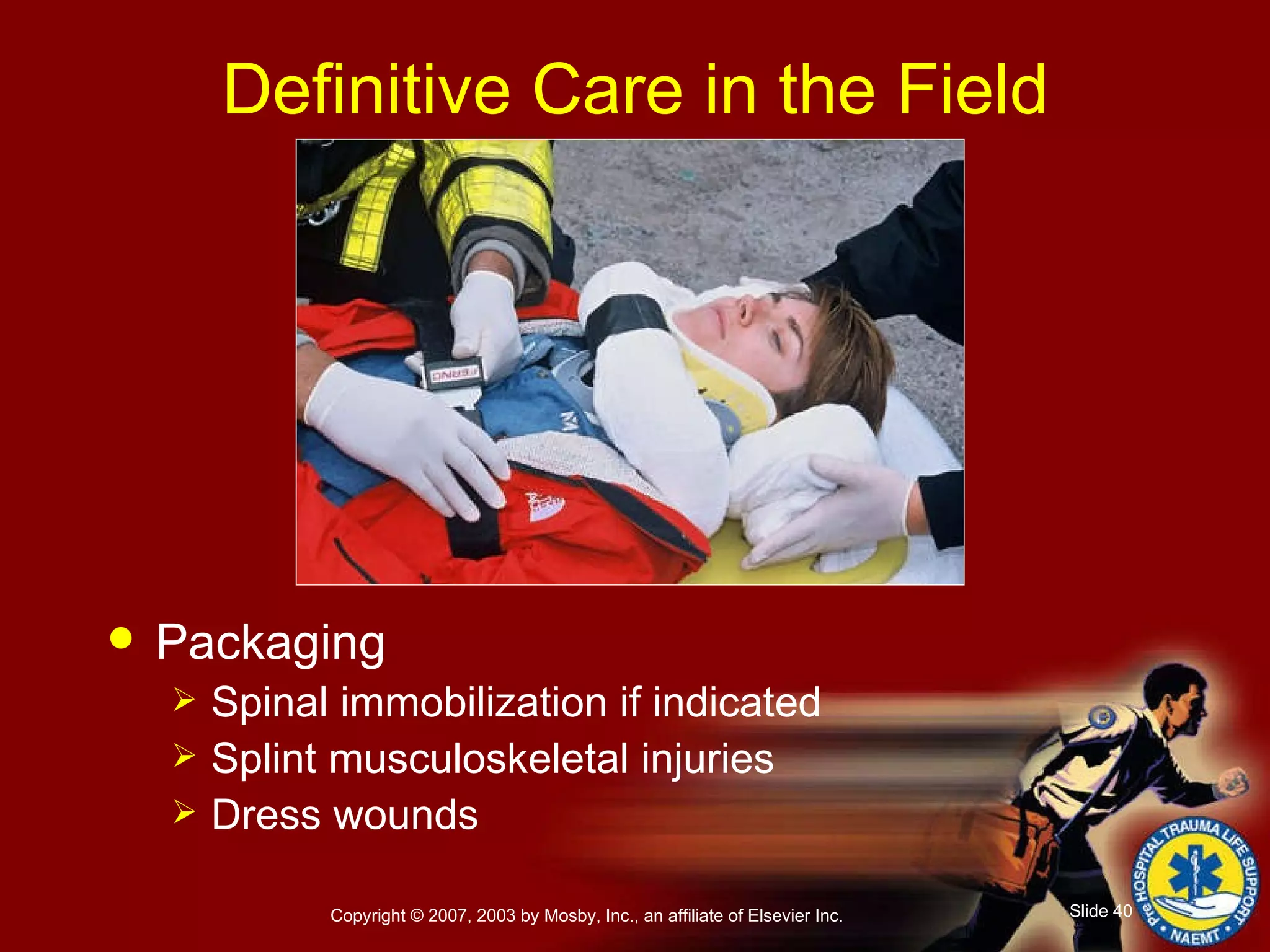
Definitive Care in the Field Packaging Spinal immobilization if indicated Splint musculoskeletal injuries Dress wounds
Transportation Closest  appropriate  facility In general, bypass closest facility to reach trauma center Receiving facilities should be determined by local protocol Mode Ground Aeromedical
Trauma Center Candidates Triage to trauma centers determined by: Physiologic criteria Anatomic criteria Mechanism of injury Preexisting conditions Follow local protocol
Pain Management Consider analgesia for: Isolated extremity injury  Spinal fracture Narcotics Titrate in small increments IV Beware of ventilatory depression and vasodilation (hypotension)
You are dispatched to a motorcycle and vehicle collision. Bystanders report that the motorcycle was traveling at about 40 mph (65 km/h) when a car pulled in front of the motorcycle. You find the patient lying on the pavement 30 ft (9 m) away from the crash. His helmet is heavily damaged and has been removed by a bystander. Scenario
Findings Gurgling ventilations Blood is seen in the upper airway Ventilations are rapid and labored Patient is cyanotic Is this airway compromised?
You arrive on the scene of a single vehicle MVC. Your patient is a 25-year-old female who is trapped upright in the driver’s seat. Her VR is 36 and she is cyanotic. Gurgling sounds do not improve with suctioning or manual maneuvers. The fire department estimates that it will be 10 minutes before she is extricated. How would you manage her airway at this point?  Scenario
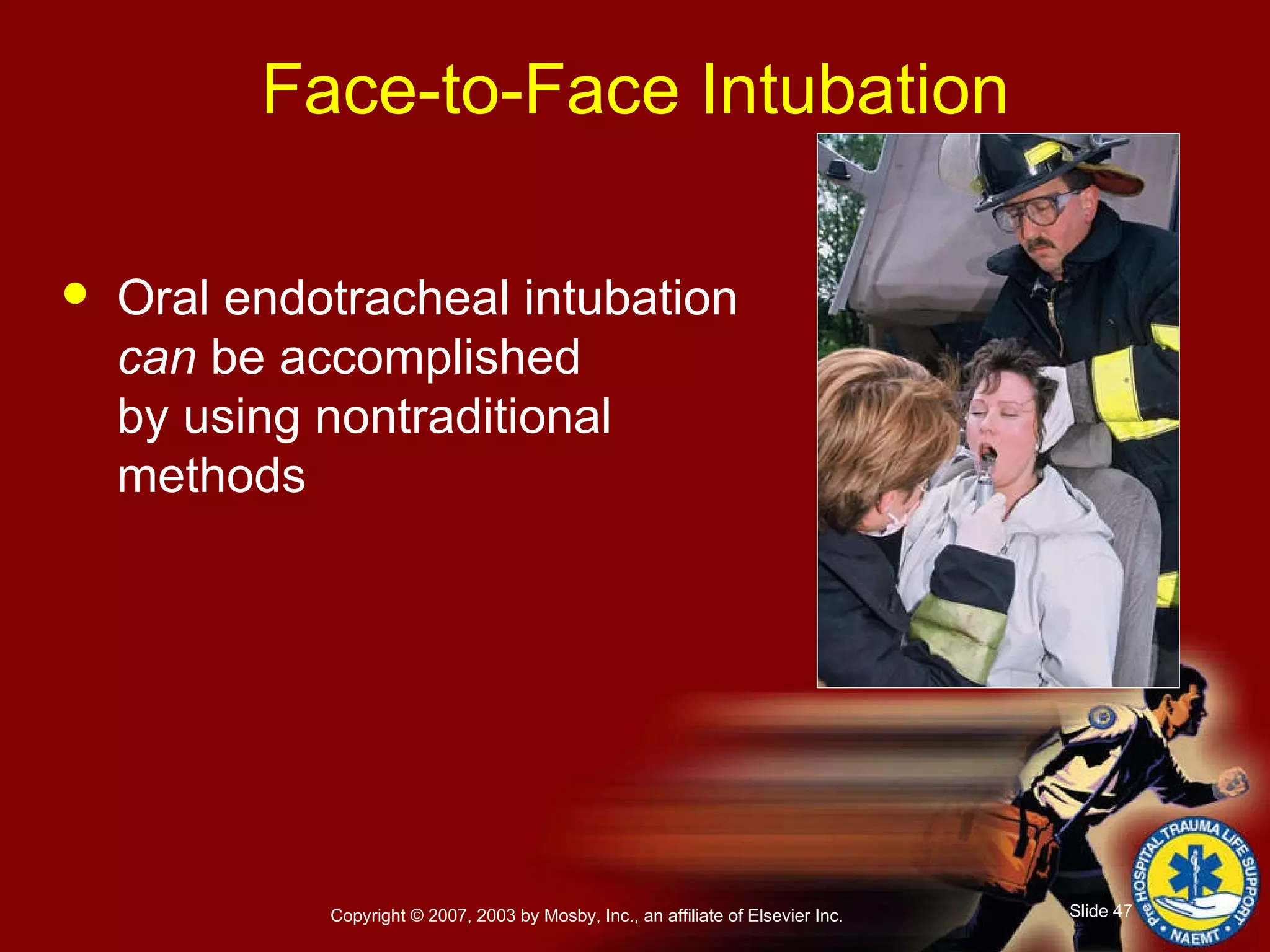
Face-to-Face Intubation Oral endotracheal intubation  can  be accomplished  by using nontraditional methods
Your patient is a 35-year-old construction worker who fell 25 ft (7.6 m) and landed on his head. His GCS score is 3. He is apneic and is being ventilated with a BVM. Three attempts at orotracheal intubation are unsuccessful. What are the airway management options at this point? Scenario
Alternative Airway Procedures  Laryngeal mask airway (LMA) Digital intubation Retrograde intubation Percutaneous transtracheal ventilation (PTV) Surgical cricothyrotomy
At a college baseball game a 22-year-old third baseman is struck in the head by a line drive. Upon your arrival his GCS score is 7 (E-1, V-1, M-5). His teeth are clenched and he is vomiting. How would you manage his airway? Scenario
Objectives Describe the pathophysiology of shock Identify the types of shock Differentiate between signs of compensated and decompensated shock Discuss the role of hemorrhage control, hypothermia, PASG, and volume resuscitation in shock management
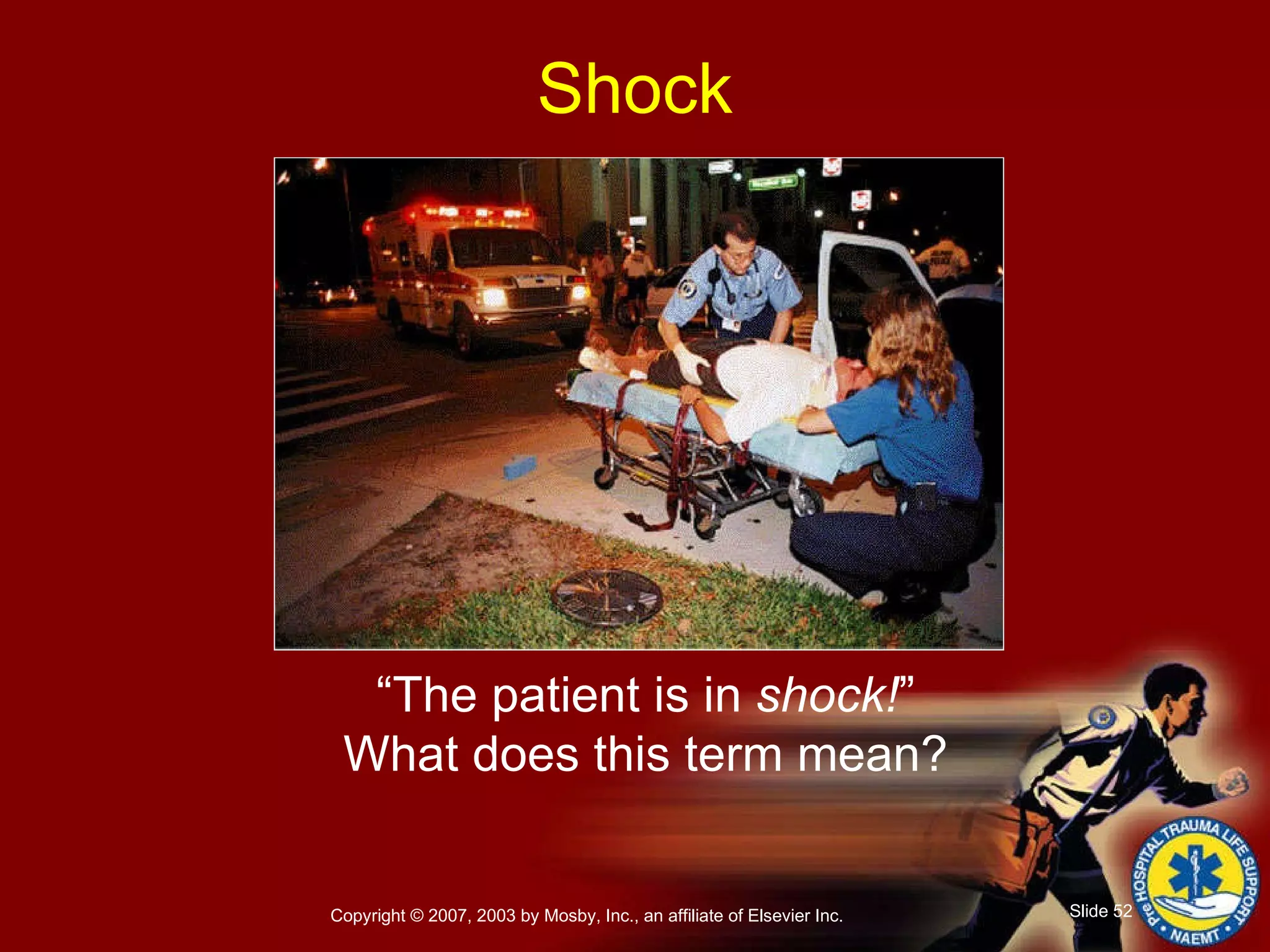
Shock “ The patient is in  shock! ” What does this term mean?
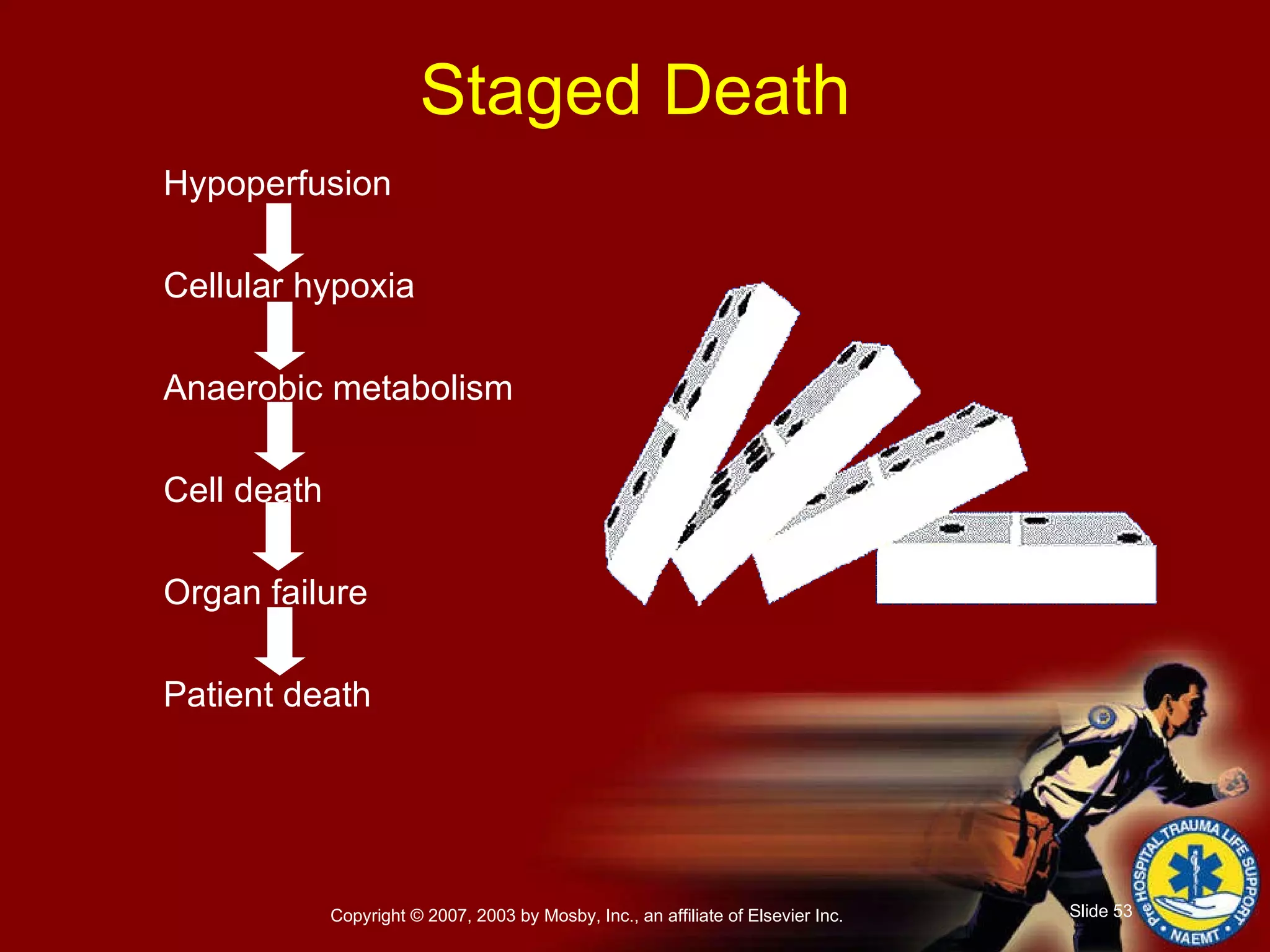
Staged Death Hypoperfusion Cellular hypoxia Anaerobic metabolism Cell death Organ failure Patient death
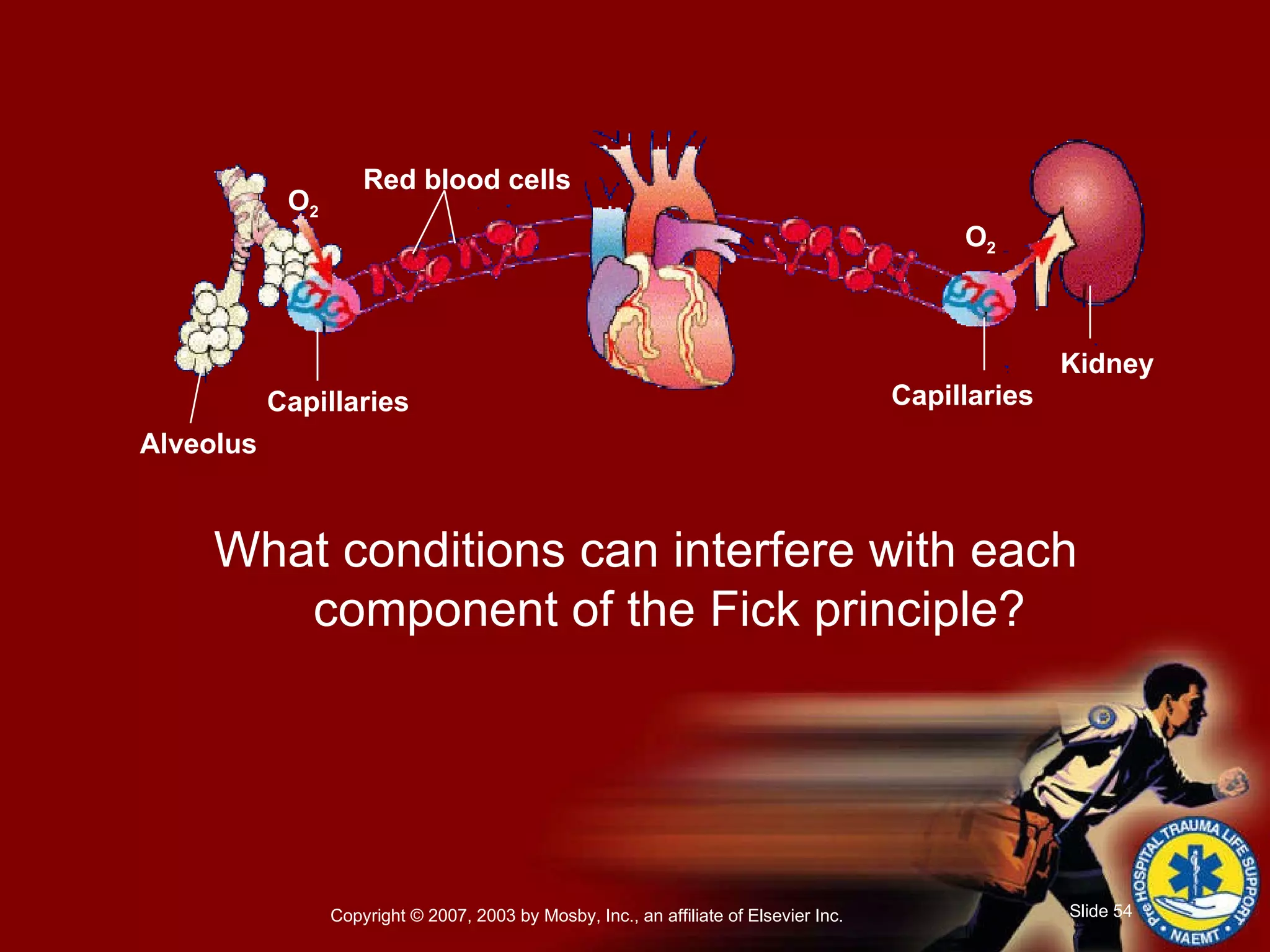
  What conditions can interfere with each component of the Fick principle? Alveolus Capillaries Red blood cells Capillaries Kidney O 2 O 2
Your patient is a 30-year-old woman who lost control of her vehicle, which then struck a light pole. The patient was unrestrained. There is significant damage to the vehicle. You find the patient slumped over in the driver’s seat. You see that the steering wheel is bent. The scene is safe. Scenario
Primary Survey A: Patent B: Fast; BS clear C: No external hemorrhage; weak and rapid radial pulse; cool and diaphoretic skin D: GCS score 14 (E-4, V-4, M-6); anxious E: Bruising across abdomen and right thigh deformity Vitals: VR, 24; pulse, 118; BP, 112/82 Is this patient in shock? Why?
What is the most likely cause of the patient’s shock? Why is the patient’s BP normal? Primary Survey
Estimated Blood Loss Approximate internal Bone   blood loss (mL) Rib   125 Radius or ulna   250–500 Humerus   500–750 Tibia or fibula   500–1000 Femur   1000–2000 Pelvis   1000–massive
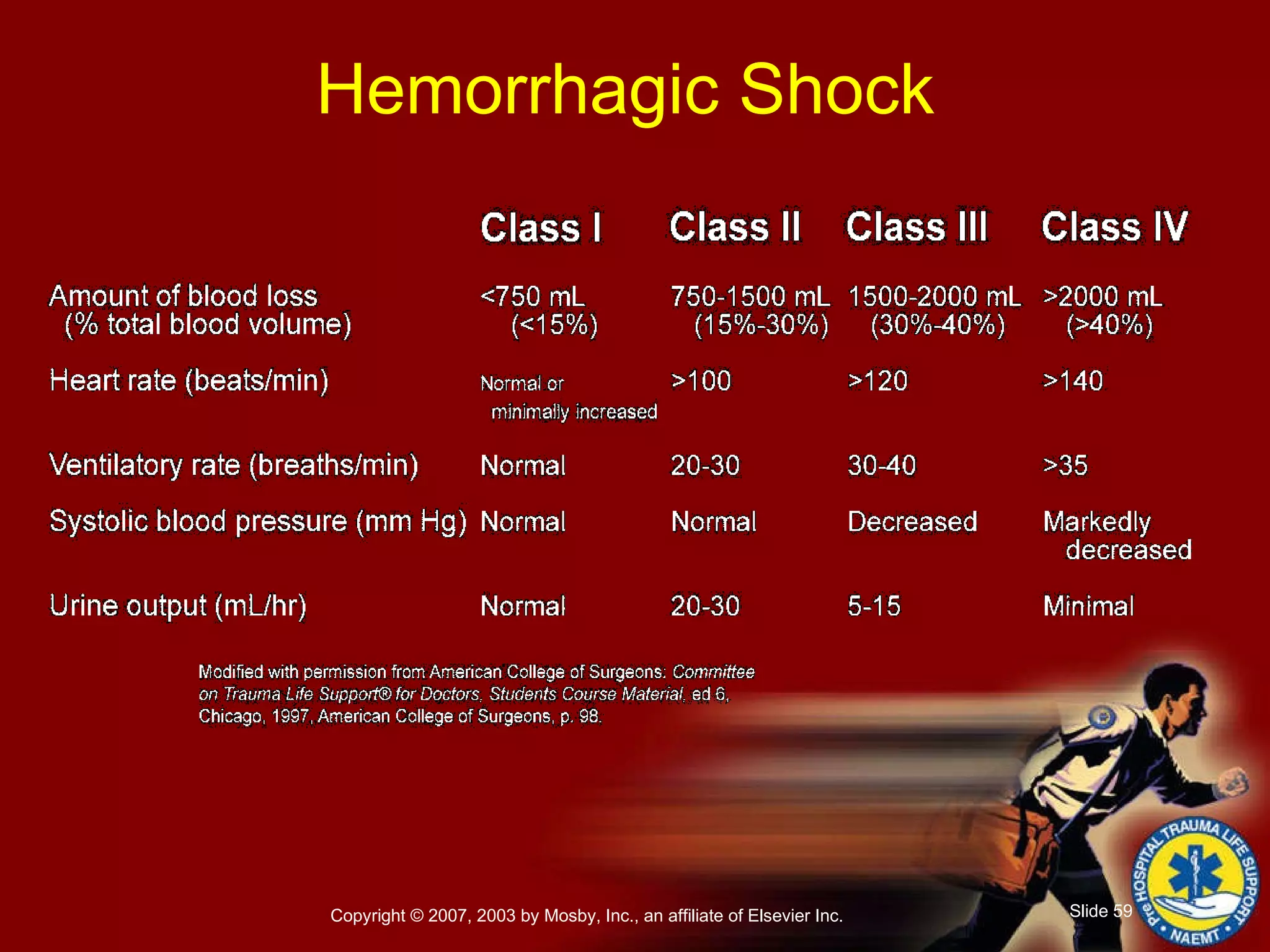
Hemorrhagic Shock
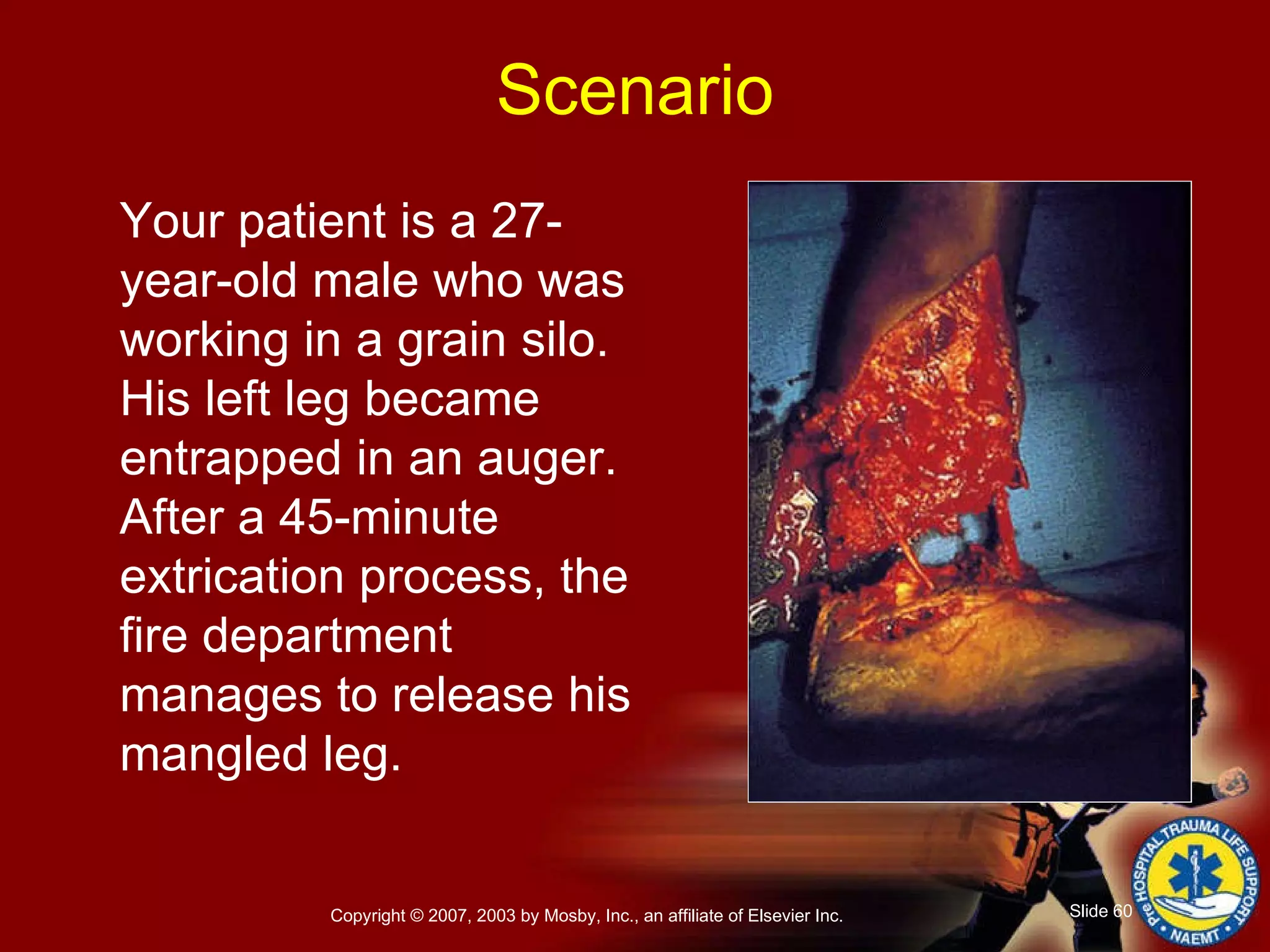
Your patient is a 27-year-old male who was working in a grain silo. His left leg became entrapped in an auger. After a 45-minute extrication process, the fire department manages to release his mangled leg.  Scenario
Primary Survey A: Patent B: Marked tachypnea C: Moderate hemorrhage from extensive soft tissue injury to lower left leg; no radial pulse; very fast, weak carotid pulse; pale, cool, diaphoretic skin D: GCS score 12 (E-3, V-3, M-6) Vitals: VR, 38; pulse, 140; BP, 74/50 What stage of shock is the patient in?
A 27-year-old male dock worker was pinned between a fork lift and a loading dock. Upon your arrival, the patient is lying supine on the ground complaining of severe lower abdominal pain. The ambient temperature is 35° F (1° C).  You are 25 minutes from the trauma center. Scenario
Primary Survey A: Patent B: VR fast C: No external hemorrhage; rapid and weak radial  pulse; pale, cool, moist skin D: GCS score 15 E: Significant pain on palpation of lower abdomen and pelvis What are the principles of shock management?
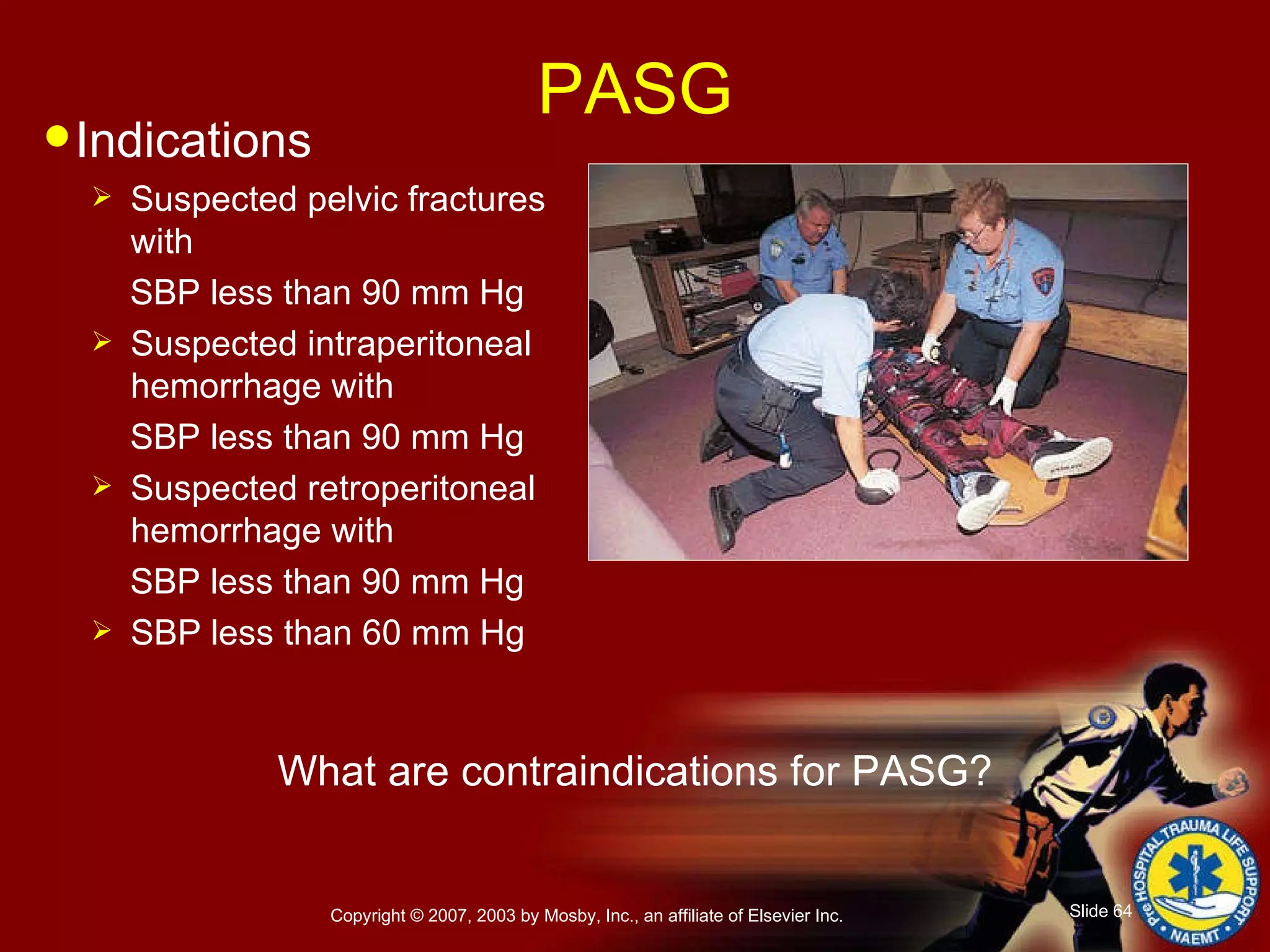
PASG Indications Suspected pelvic fractures with  SBP less than 90 mm Hg Suspected intraperitoneal hemorrhage with  SBP less than 90 mm Hg Suspected retroperitoneal hemorrhage with  SBP less than 90 mm Hg SBP less than 60 mm Hg What are contraindications for PASG?
Volume Resuscitation Preferably two large-bore peripheral IVs  Lactated Ringer’s  Warmed fluid if possible (102° F/39 ° C) Initial bolus Adults: 1 to 2 L Pediatric: 20 mL/kg Delaying transport of critical patients to initiate IVs on scene
Prehospital Trauma Life Support   Managing the Multisystem  Trauma Patient Part II
Objectives Review the anatomy of the chest Discuss the mechanics of breathing Detail the assessment process Cover the management of:  Rib fracture Flail chest injury Pulmonary contusion Pneumothorax (open and tension) Hemothorax Blunt cardiac injury
Responding to a call at a police station, you encounter a 19-year-old male complaining of chest pain and dyspnea. You learn that your patient was kicked in the chest during a fight. What injuries could occur with this mechanism? Scenario
Primary Survey A: Patent B: Left chest pain during inspiration; BS equal, VR fast C: No external bleeding, normal pulse rate D: GCS score 15 What injuries can you rule out? How should this patient be managed?
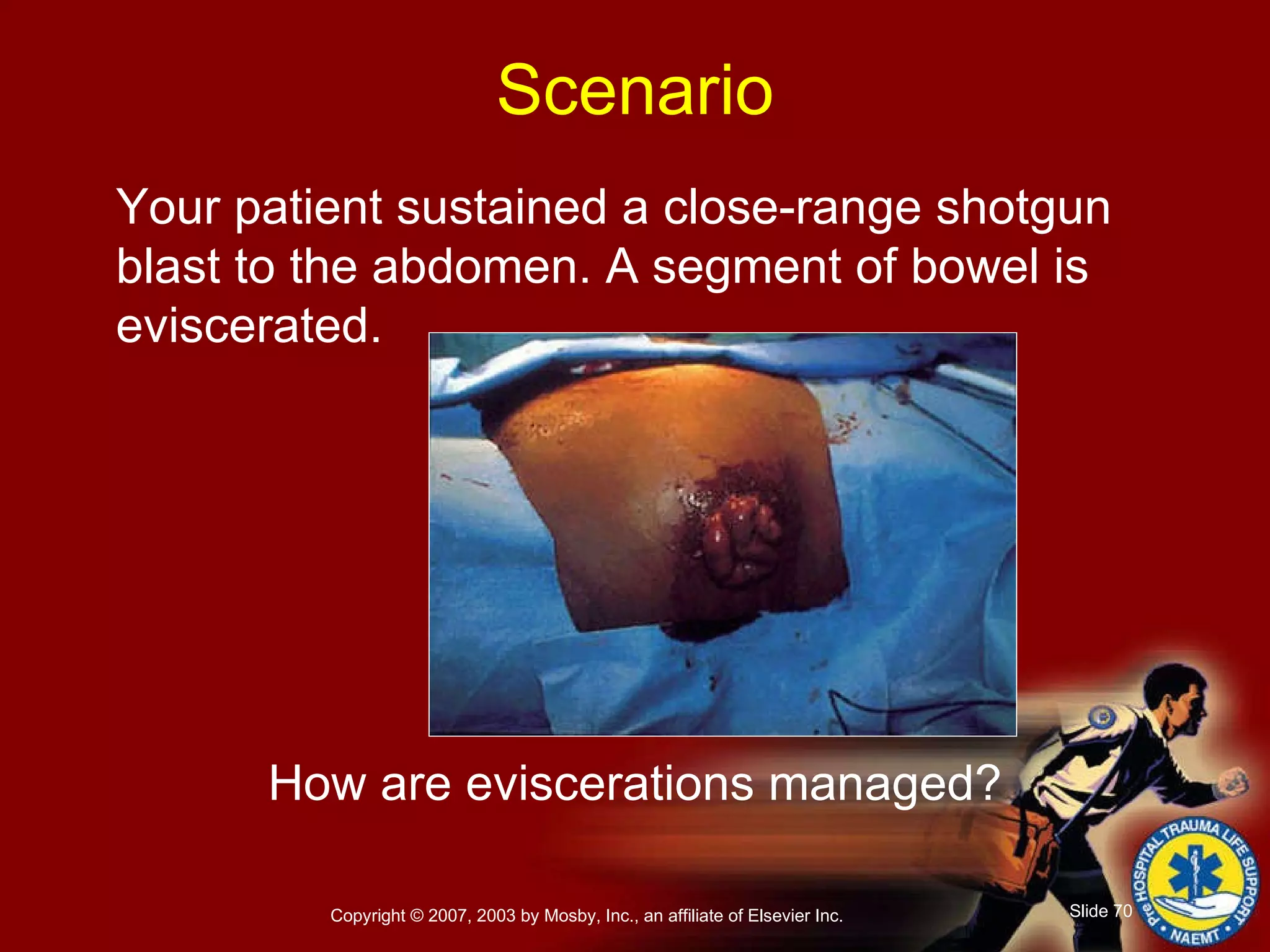
Your patient sustained a close-range shotgun blast to the abdomen. A segment of bowel is eviscerated. How are eviscerations managed? Scenario
A 24-year-old female fell down a flight of stairs. She is 36 weeks pregnant. She is complaining of severe back pain.  What physiologic changes occur during pregnancy? What are the common causes of injury  in the pregnant patient? Scenario
Primary Survey A: Patent B: Normal C: Pulse rapid; skin warm and dry D: Anxious E: No obvious injury noted Vitals: pulse, 114; VR, 20; BP, 92/56 Are these findings due to trauma or pregnancy?
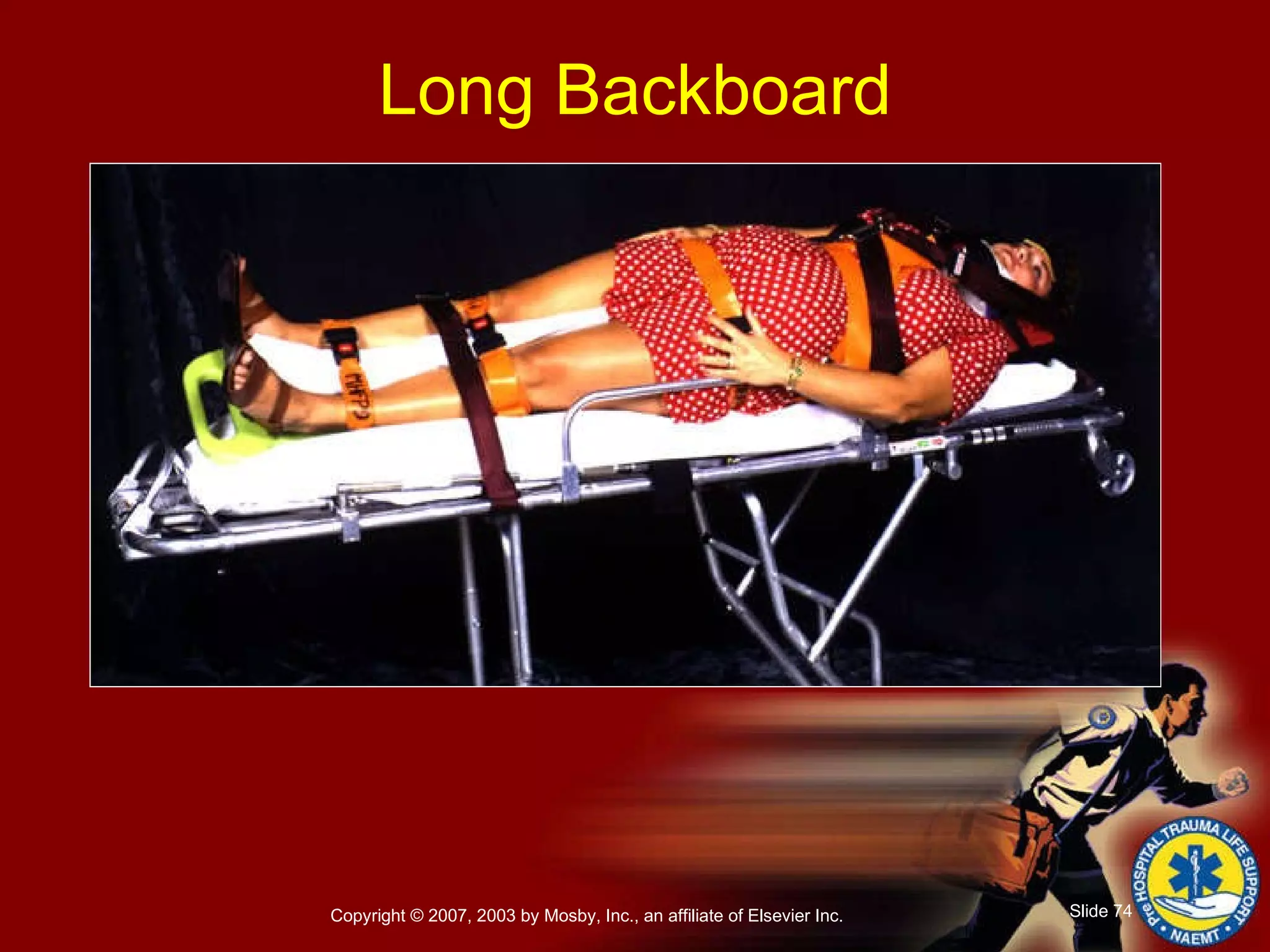
After immobilization to a long backboard, reassessment shows her radial pulse to be 140 and weak. Her BP is 80/60. What could explain these findings? How would you manage this patient? Scenario
Long Backboard
Objectives Define primary and secondary brain injury Discuss how assessment findings suggest traumatic brain injury Discuss management for suspected traumatic brain injury
Traumatic Brain Injury (TBI) Commonly occurs in young adults Major contributing cause of trauma deaths Many survivors have permanent disability
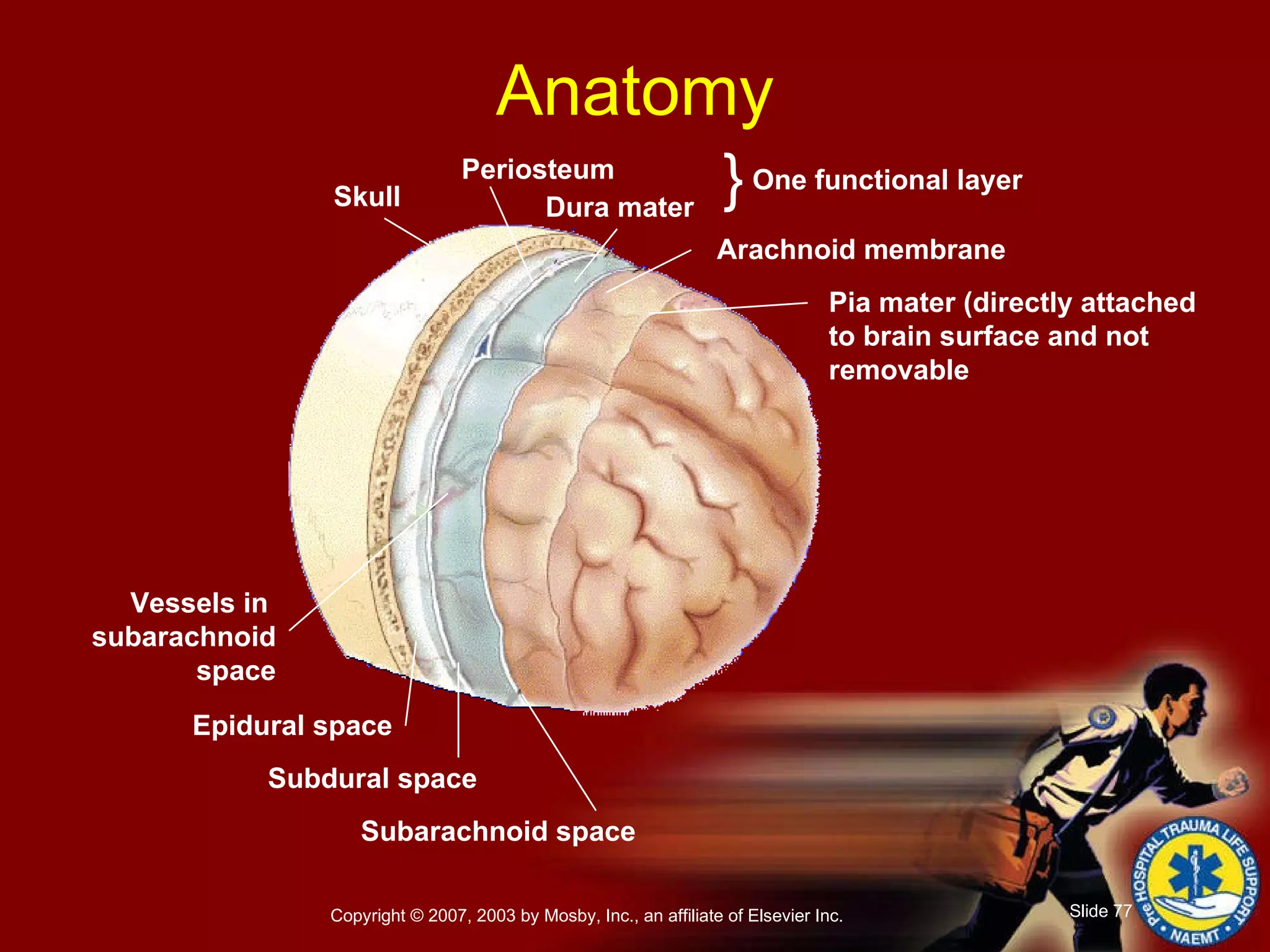
Anatomy Skull Periosteum Dura mater } One functional layer Arachnoid membrane Pia mater (directly attached to brain surface and not  removable Vessels in  subarachnoid space Epidural space Subdural space Subarachnoid space
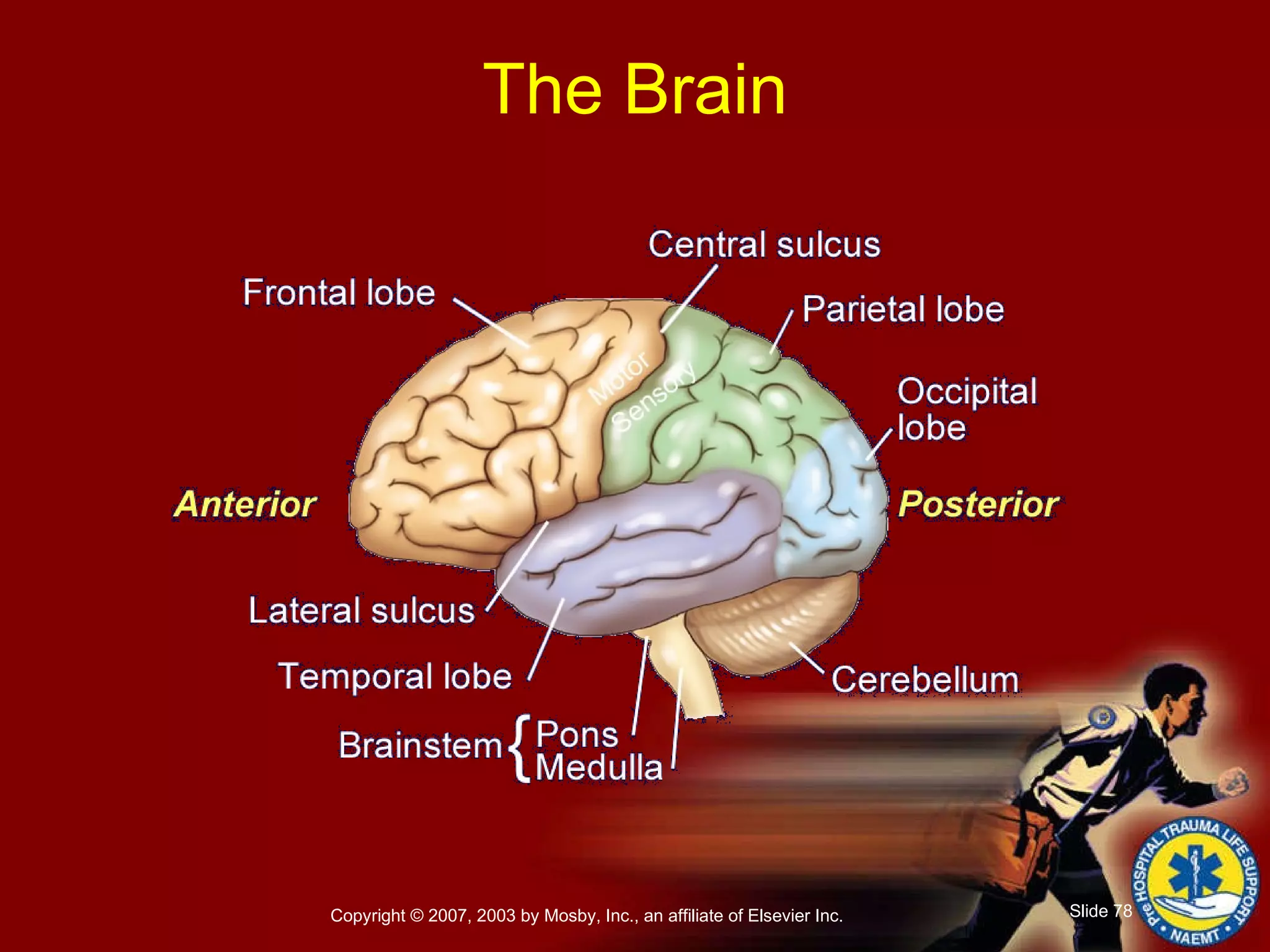
The Brain
Pathophysiology Primary brain injury Secondary brain injury Systemic causes Intracranial causes Can you name some examples of systemic  and intracranial causes?
Your patient is a 12-year-old Little League baseball player who was struck in the head by a line drive. How could TBI affect: Airway? Breathing? Circulation? Disability? Scenario
Primary Survey Bystanders report a 5-minute loss of consciousness. The child is now awake and complaining of a headache and has vomited once. A:  Intact B:  Normal C:  Normal D:  GCS score 14 (E-4, V-4, M-6), PERL What is a concussion?
You are called to a local bar where a 22-year-old male has been in a fight. Bystanders state that your patient was beaten with a pool cue. The scene is safe. Scenario
Primary Survey A: Snoring noises B: VR slow and shallow; BS equal C: No external hemorrhage, radial pulse fast D: GCS score 6 (E-1, V-1, M-4); pupils R>L, sluggish E: Multiple hematomas on scalp and face Vitals: VR, 8; pulse, 110; BP, 150/90 What injuries do these findings suggest?
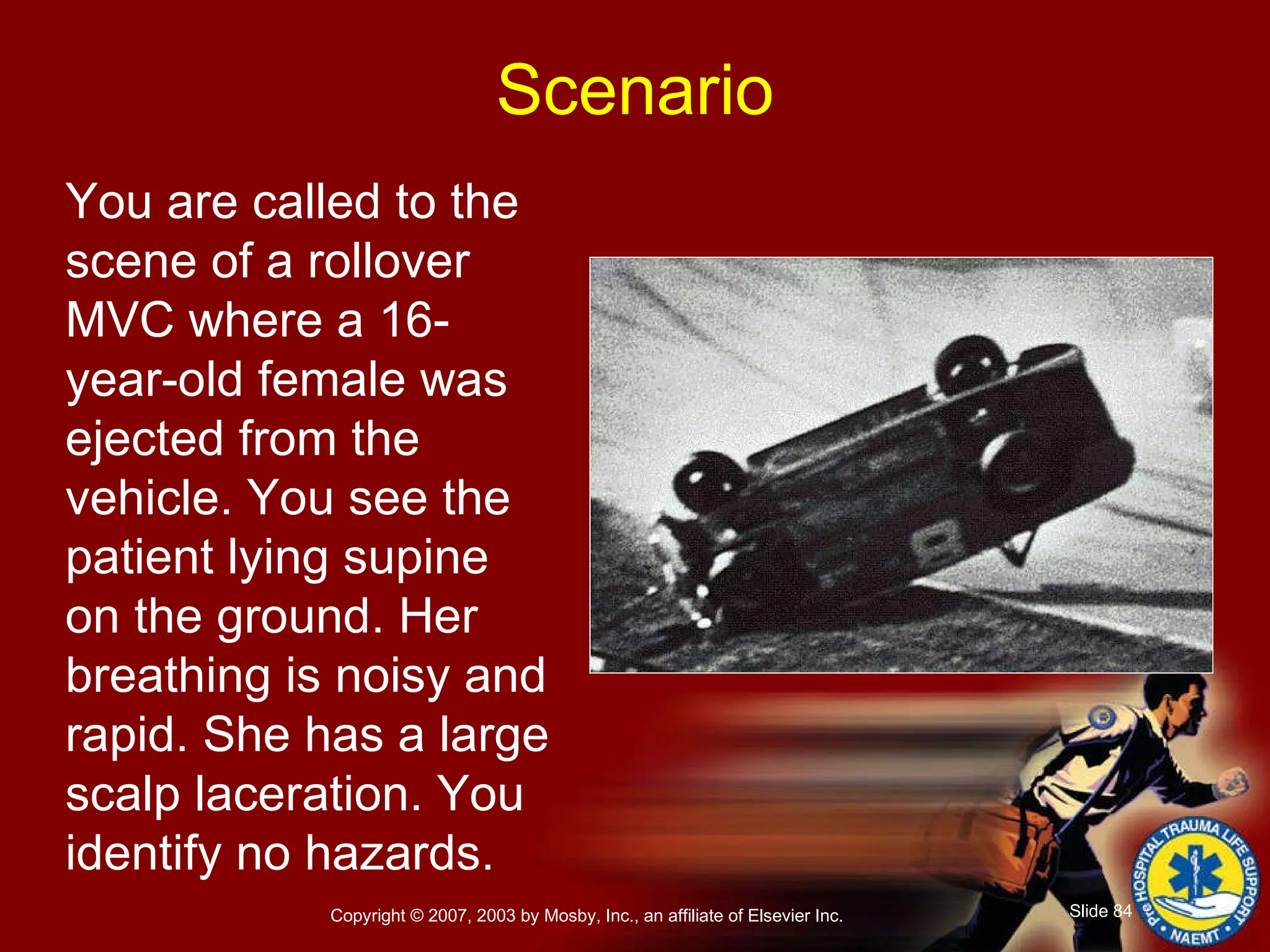
You are called to the scene of a rollover MVC where a 16-year-old female was ejected from the vehicle. You see the patient lying supine on the ground. Her breathing is noisy and rapid. She has a large scalp laceration. You identify no hazards. Scenario
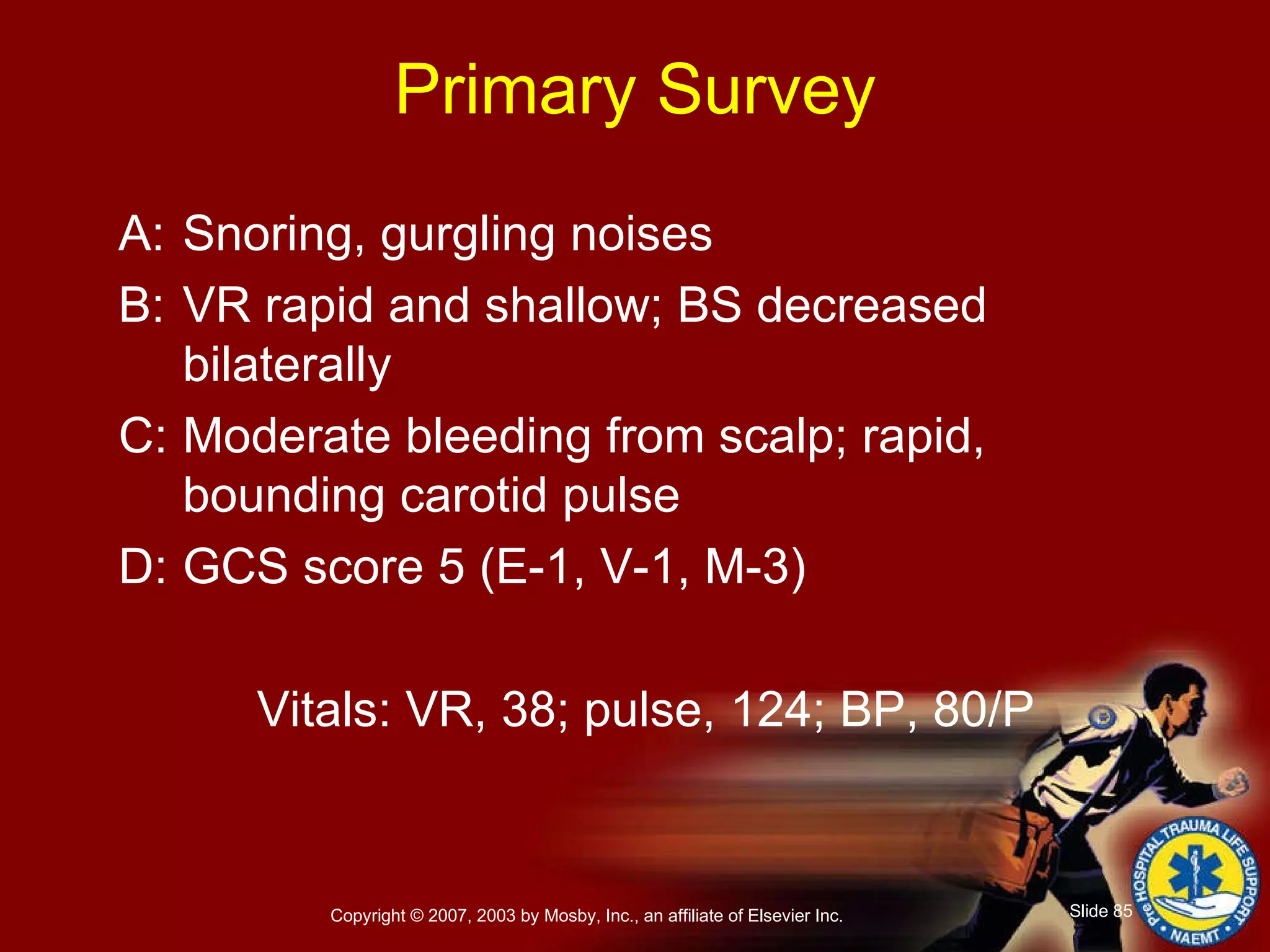
Primary Survey A: Snoring, gurgling noises B: VR rapid and shallow; BS decreased bilaterally C: Moderate bleeding from scalp; rapid, bounding carotid pulse D: GCS score 5 (E-1, V-1, M-3) Vitals: VR, 38; pulse, 124; BP, 80/P
What life-threatening conditions do you identify? What could be causing her shock? Primary Survey
Management Goals for the TBI patient include preventing and reversing causes of secondary brain injury
Objectives Identify life-threatening conditions associated with spinal trauma Recognize the indications for spinal immobilization Discuss the principles of spinal immobilization Describe use of rapid extrication
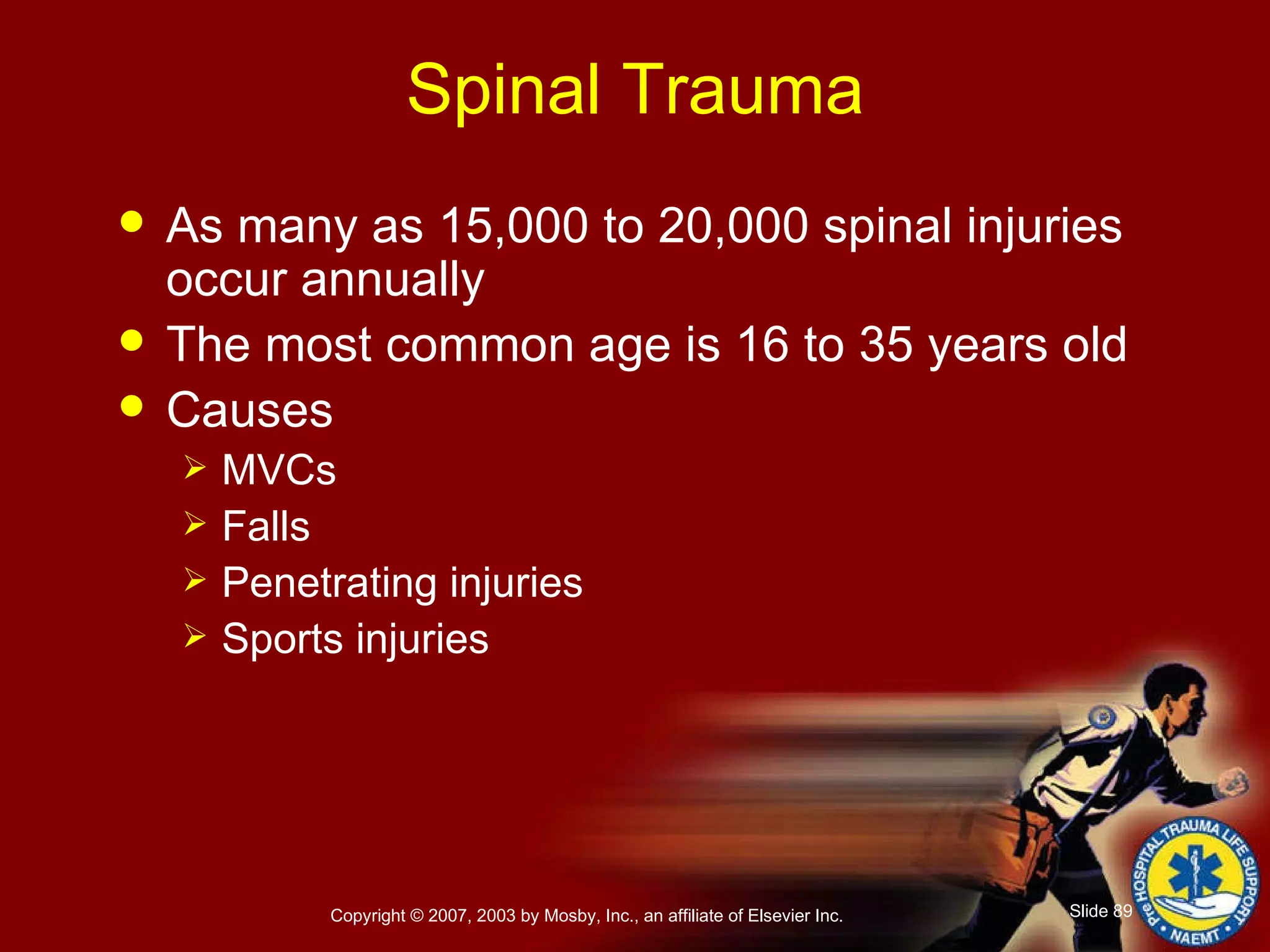
Spinal Trauma As many as 15,000 to 20,000 spinal injuries occur annually The most common age is 16 to 35 years old Causes MVCs Falls Penetrating injuries Sports injuries
You are called to a public pool for a 16-year-old male who sustained an injury while diving. Upon your arrival he has been removed from the pool. Scenario
Primary Survey A: Patent B: Rapid and shallow C: Slow heart rate; weak radial pulse; warm  extremities D: GCS score 15, loss of motor and sensory  function in extremities E: No other obvious injuries What is the life-threatening problem?
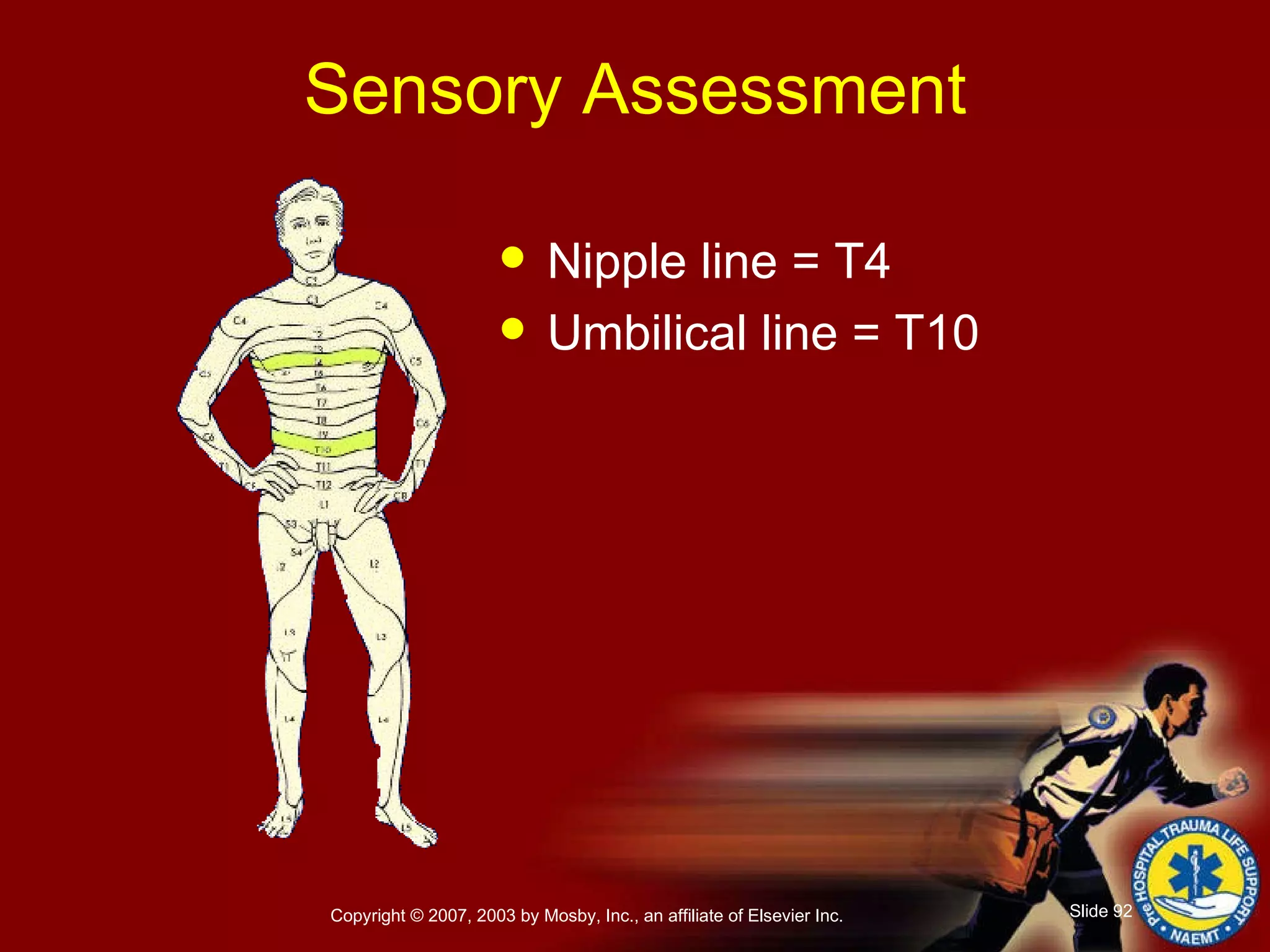
Sensory Assessment Nipple line = T4 Umbilical line = T10
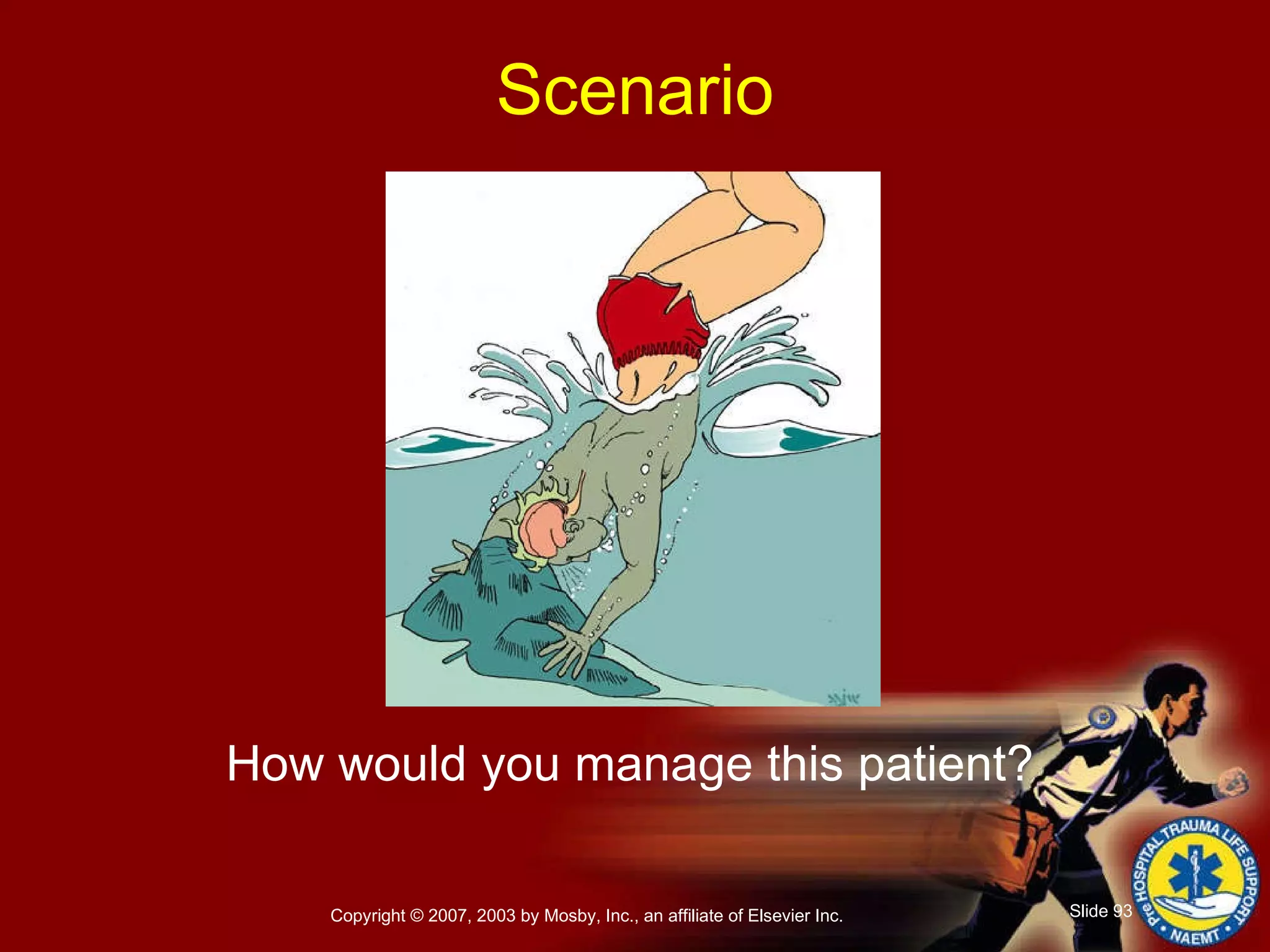
How would you manage this patient? Scenario
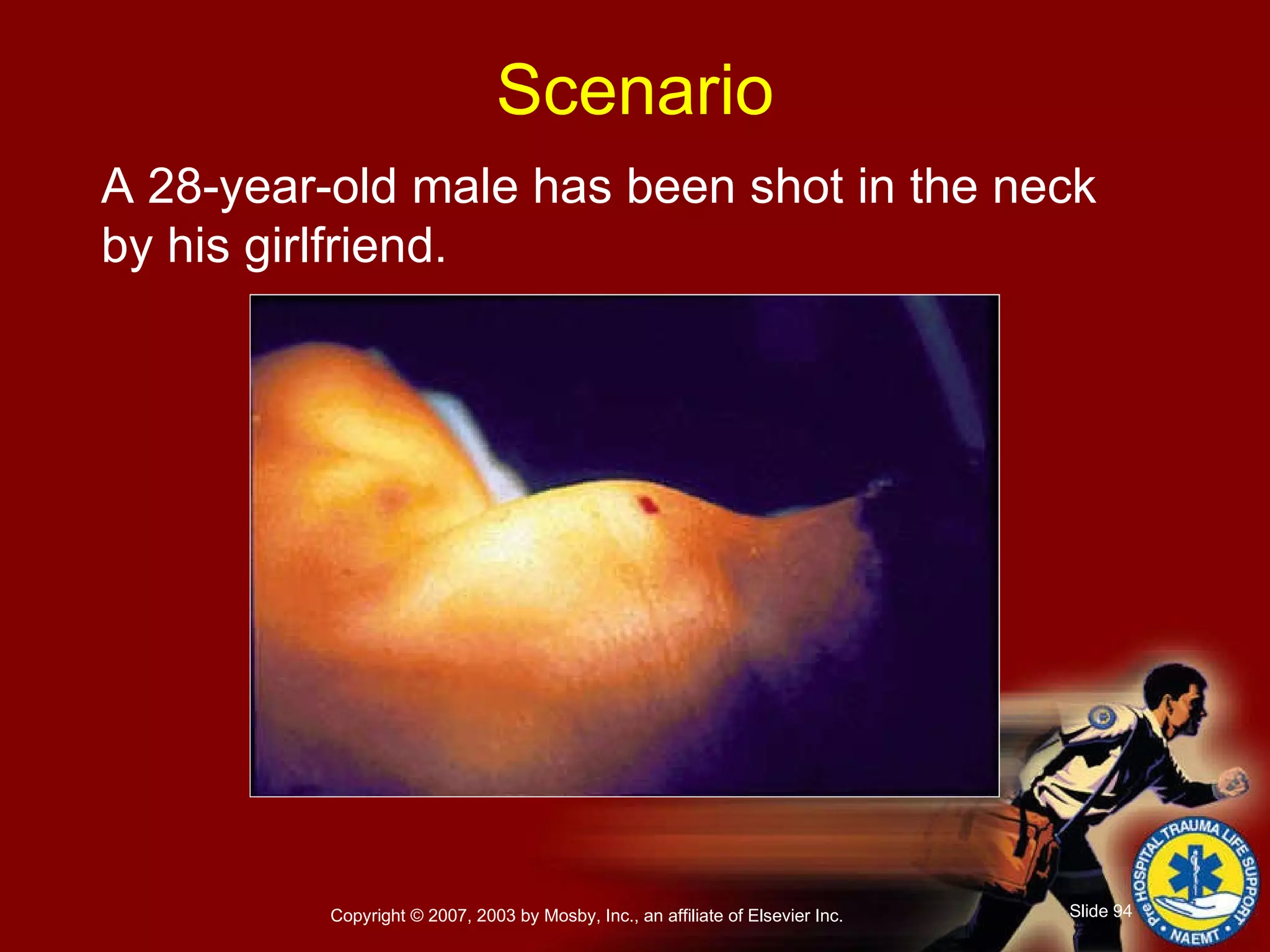
A 28-year-old male has been shot in the neck by his girlfriend.  Scenario
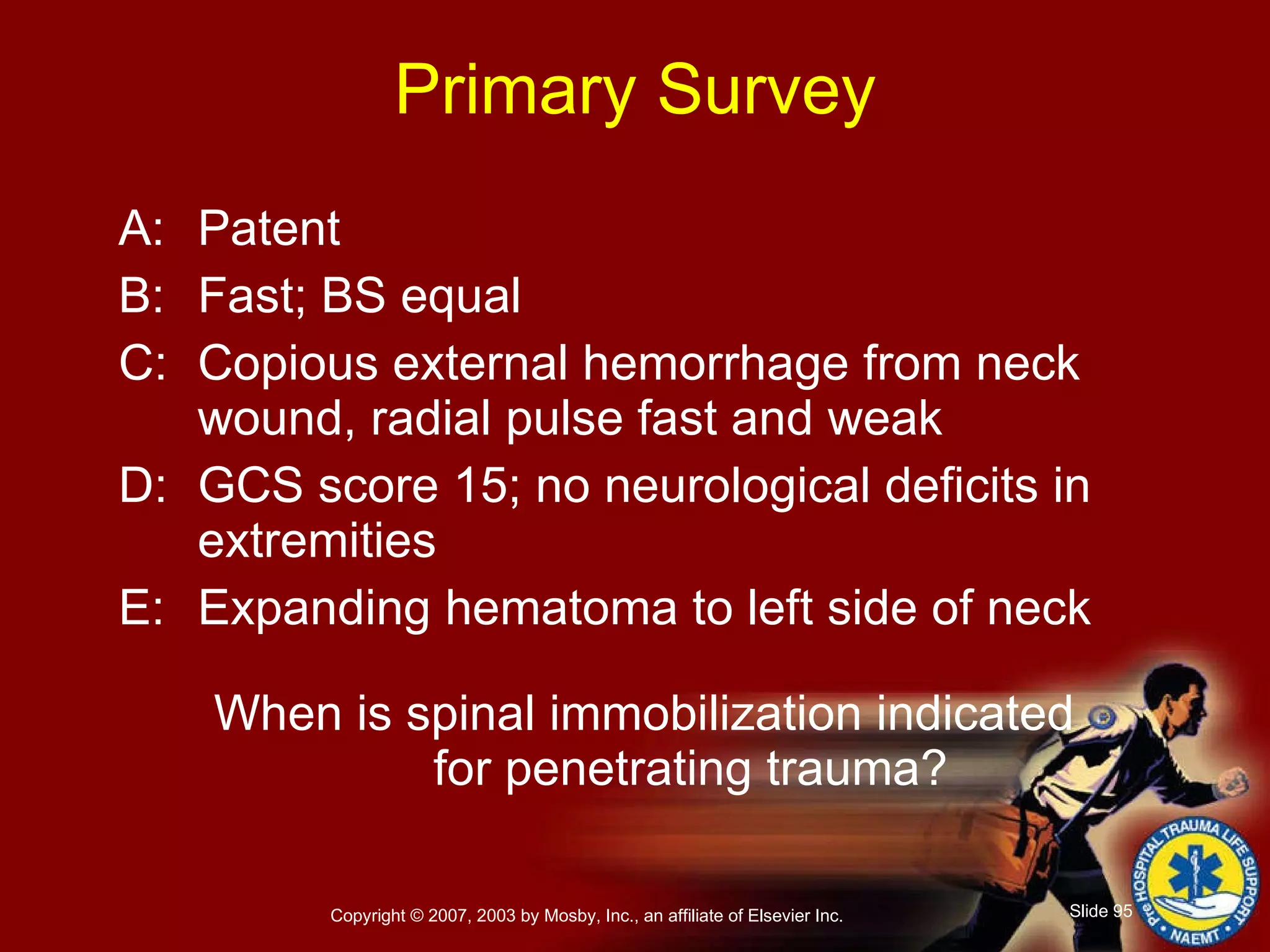
Primary Survey A: Patent B: Fast; BS equal C: Copious external hemorrhage from neck wound, radial pulse fast and weak D: GCS score 15; no neurological deficits in extremities E: Expanding hematoma to left side of neck When is spinal immobilization indicated  for penetrating trauma?
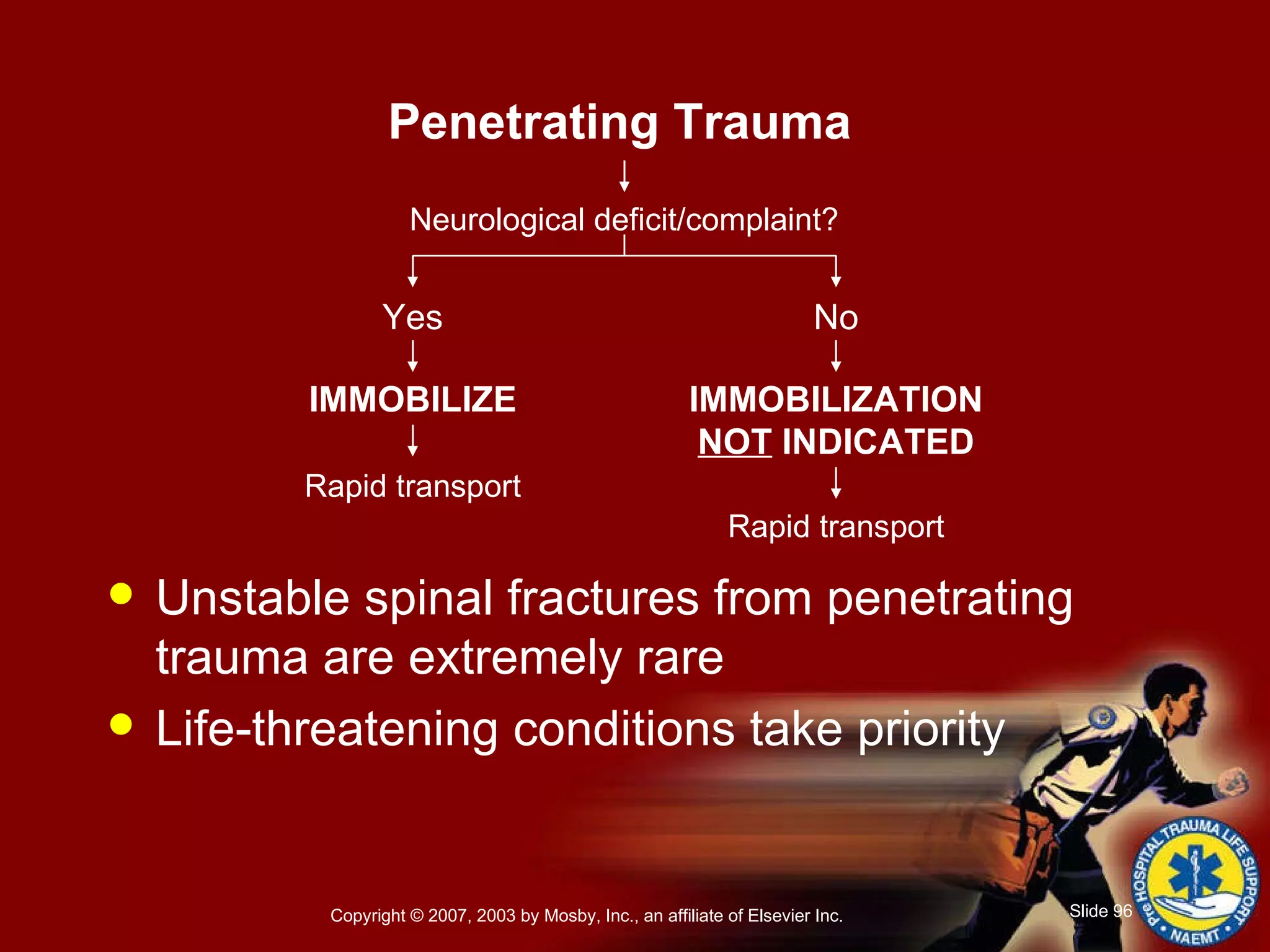
Unstable spinal fractures from penetrating trauma are extremely rare Life-threatening conditions take priority Penetrating Trauma Neurological deficit/complaint? No Yes IMMOBILIZE IMMOBILIZATION  NOT  INDICATED Rapid transport Rapid transport
You are called to a nightclub where a 35-year-old female has fallen down a flight of stairs. Your patient denies neck and back pain but complains of severe left ankle pain. You smell alcohol on her breath. Scenario
Primary Survey A: Patent B: Normal; BS clear C: Minor bleeding from small scalp laceration; normal radial pulse D: Slurred speech; GCS score 15 E: Grossly deformed left ankle When is spinal immobilization indicated  for blunt trauma?
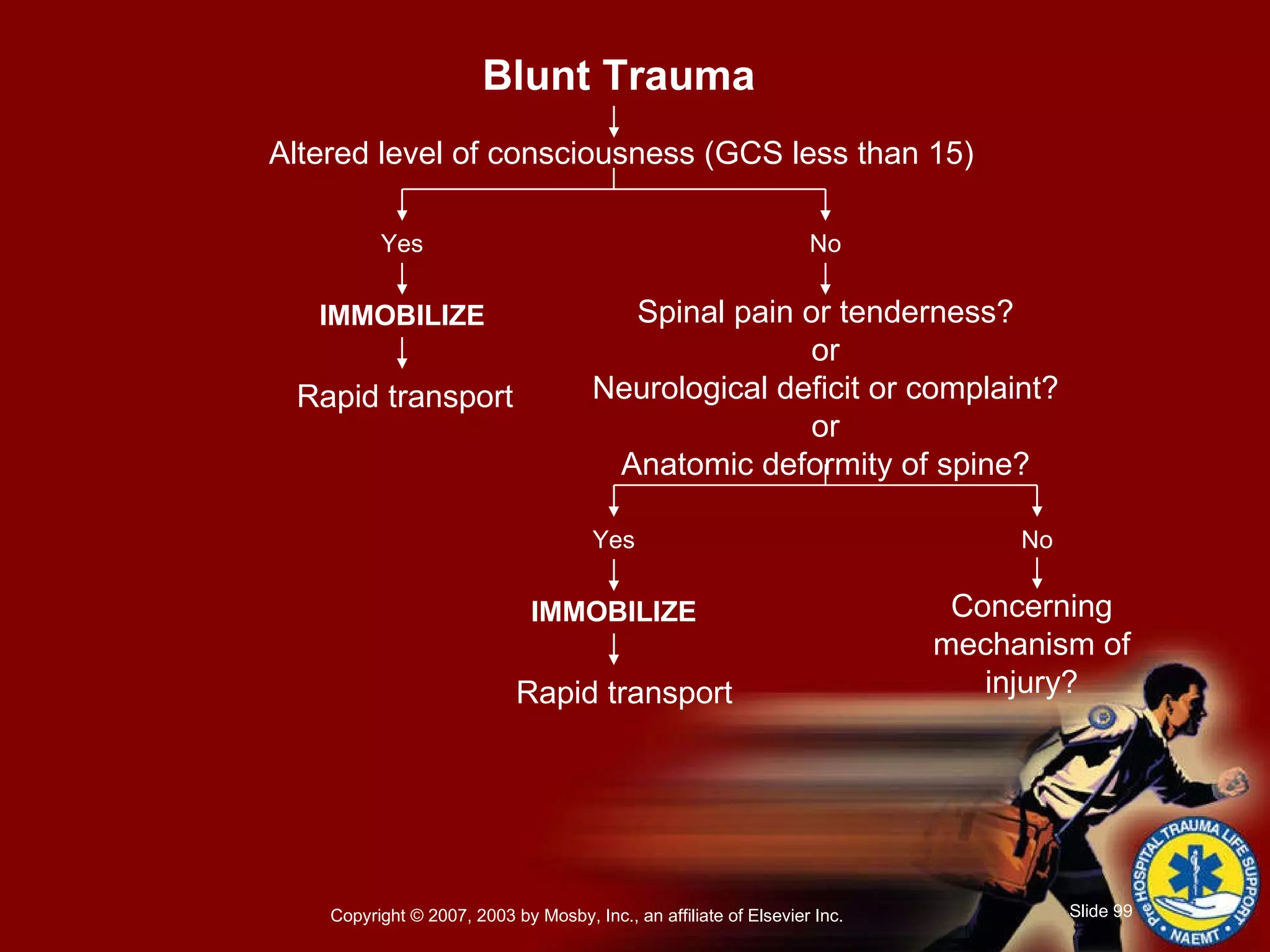
Blunt Trauma Altered level of consciousness (GCS less than 15) No Yes IMMOBILIZE Rapid transport Spinal pain or tenderness? or Neurological deficit or complaint? or Anatomic deformity of spine? No Yes IMMOBILIZE Rapid transport Concerning mechanism of injury?
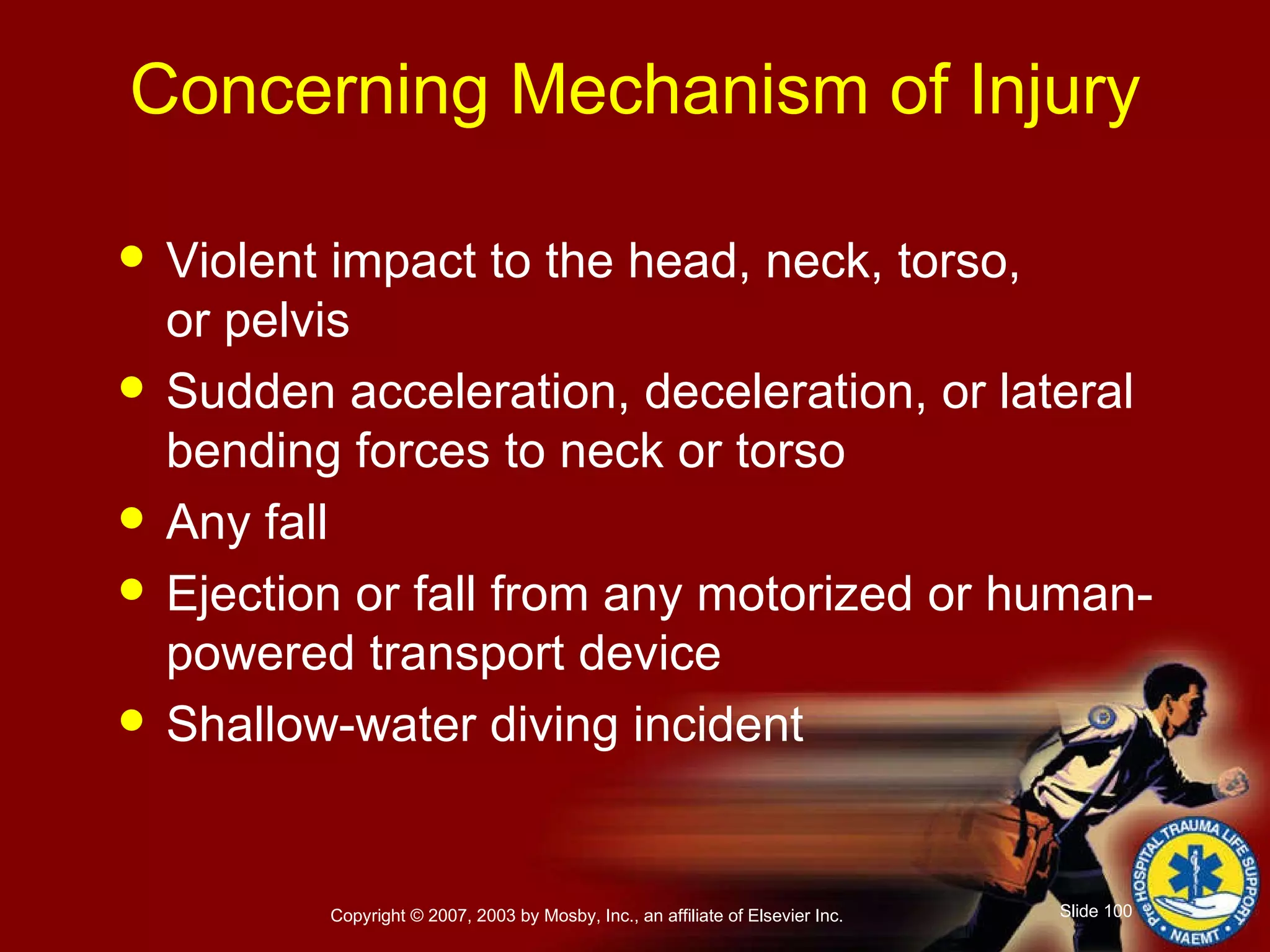
Concerning Mechanism of Injury Violent impact to the head, neck, torso,  or pelvis Sudden acceleration, deceleration, or lateral bending forces to neck or torso Any fall Ejection or fall from any motorized or human-powered transport device Shallow-water diving incident
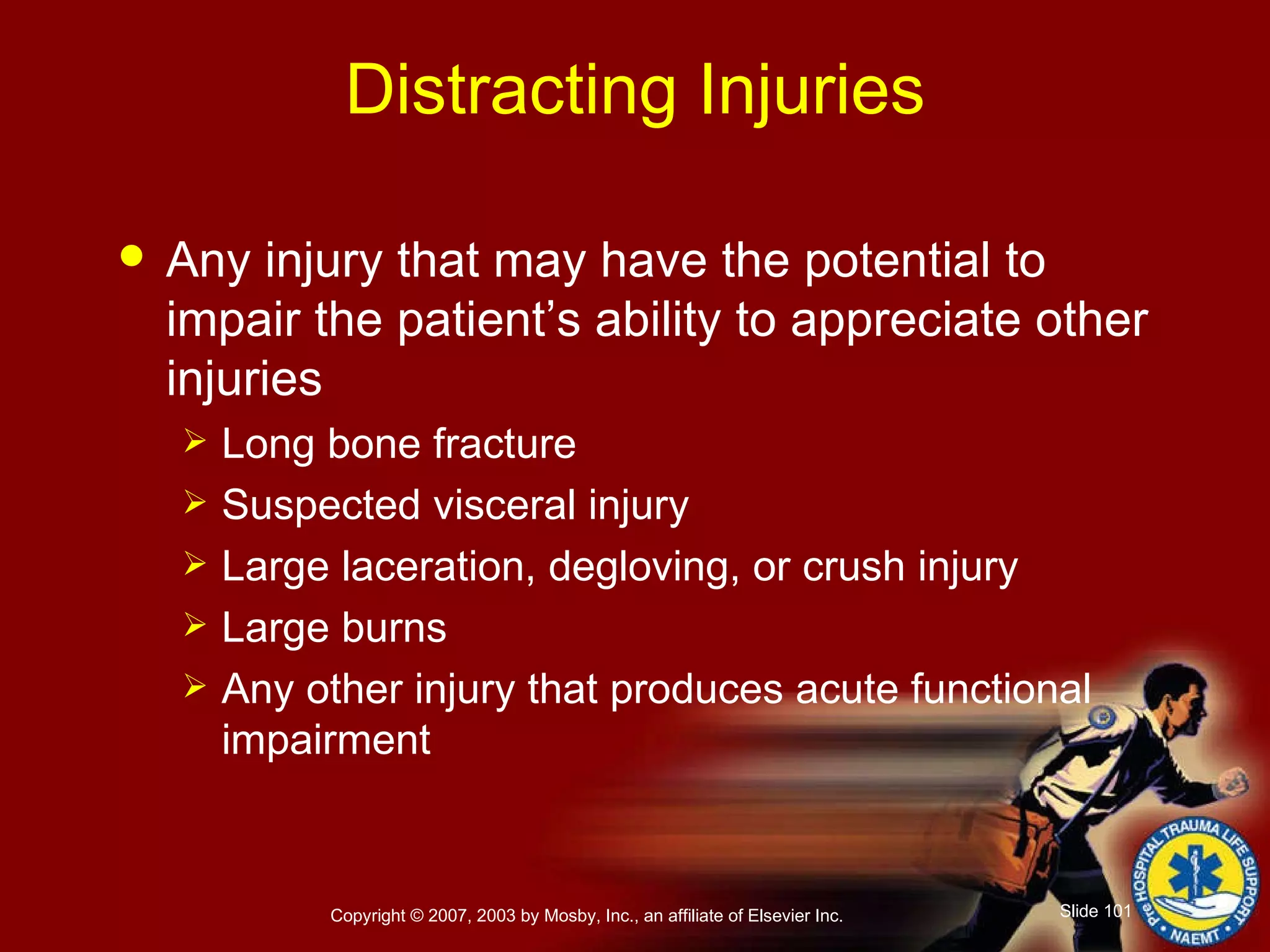
Distracting Injuries Any injury that may have the potential to impair the patient’s ability to appreciate other injuries Long bone fracture Suspected visceral injury Large laceration, degloving, or crush injury Large burns Any other injury that produces acute functional impairment
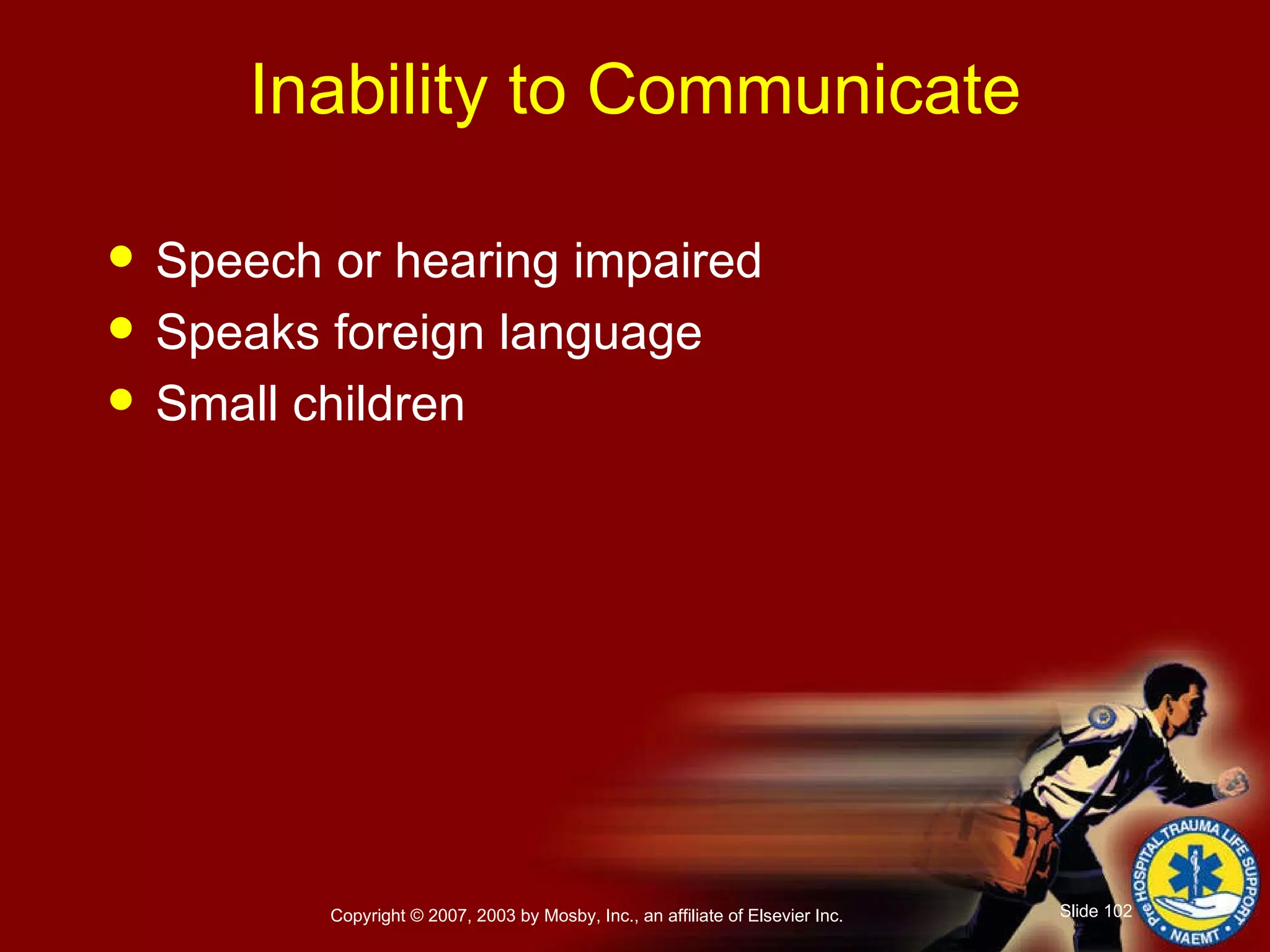
Inability to Communicate Speech or hearing impaired Speaks foreign language Small children
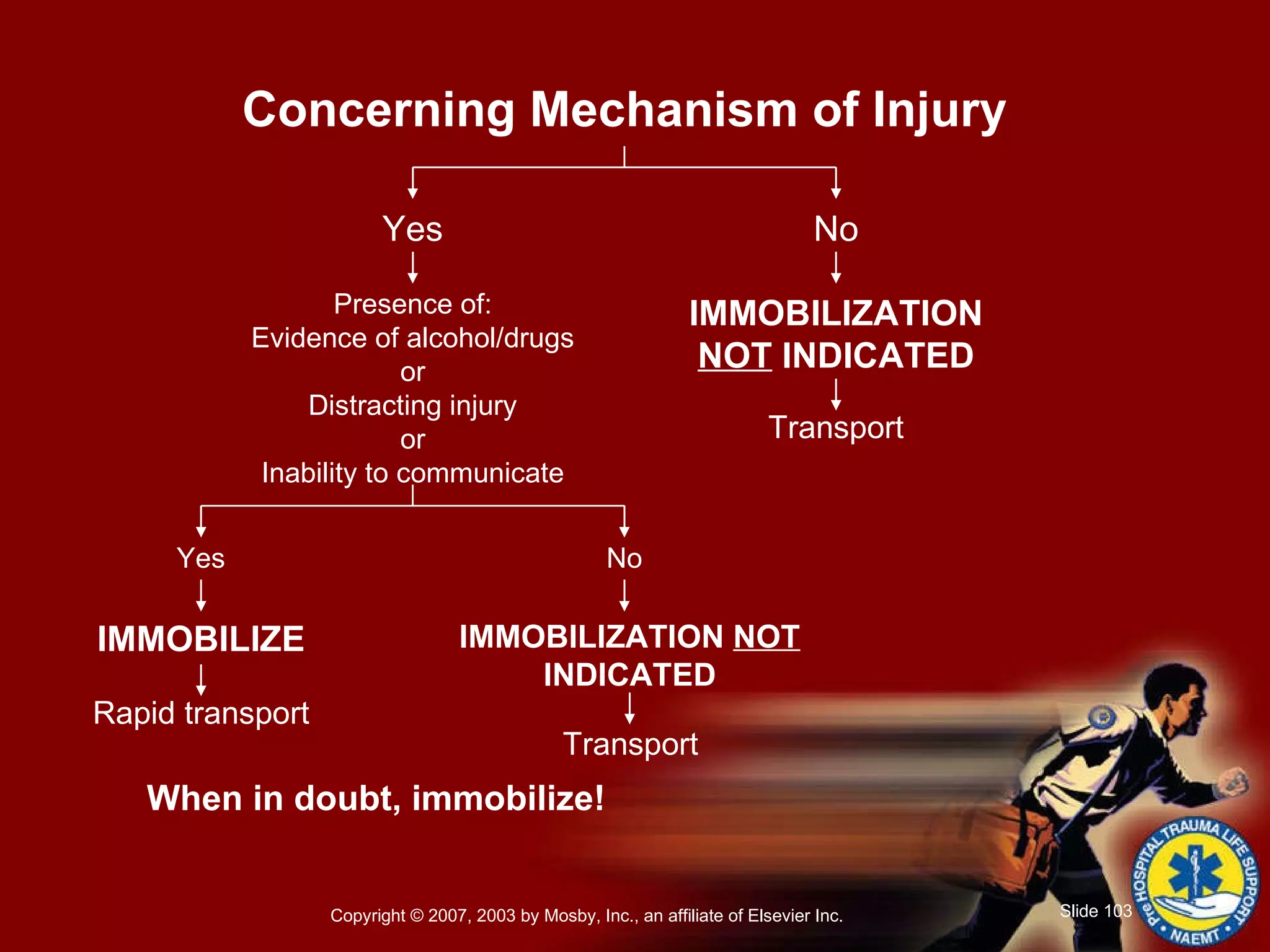
Presence of: Evidence of alcohol/drugs or Distracting injury or Inability to communicate When in doubt, immobilize! Concerning Mechanism of Injury No Yes IMMOBILIZE IMMOBILIZATION  NOT  INDICATED Rapid transport Transport No Yes IMMOBILIZATION  NOT  INDICATED Transport
You are called to the scene of a multivehicle crash on a highway. After your patient’s vehicle was rear-ended, it was propelled into the vehicle in front of it. The vehicle has moderate damage. The driver was unrestrained and the windshield is spider-webbed. On the basis of kinematics, why should  spinal injury be suspected?  Scenario
Primary Survey A: Patent B: Normal; BS clear C: Normal radial pulse D: GCS score 15 E: Abrasion on forehead What are the indications for rapid extrication?
The patient is complaining of neck pain.  What role does a cervical collar play  in spinal immobilization? How is spinal immobilization performed? Primary Survey
Prehospital Trauma Life Support   Managing the Multisystem  Trauma Patient Part III
Objectives Discuss the pathophysiology of musculoskeletal trauma Discuss the management of musculoskeletal trauma in isolated trauma and multisystem trauma
You are called to the scene where an intoxicated male has stumbled and put his hand through a window. On your arrival you see a large amount of blood and broken glass by the front door. The police direct you to a 40-year-old male sitting in a chair, bleeding heavily from the upper arm. On examination you see a laceration to the antecubital fossa with copious, bright-red bleeding. Scenario
What, if any, life-threatening injuries  are present? What are some examples of life-threatening musculoskeletal injuries? What ways exist to control the bleeding? Does this injury require rapid packaging  and transport? Scenario
A 28-year-old female fell while skiing. Ski patrol has brought her to the lodge. She complains of severe right thigh pain. Scenario
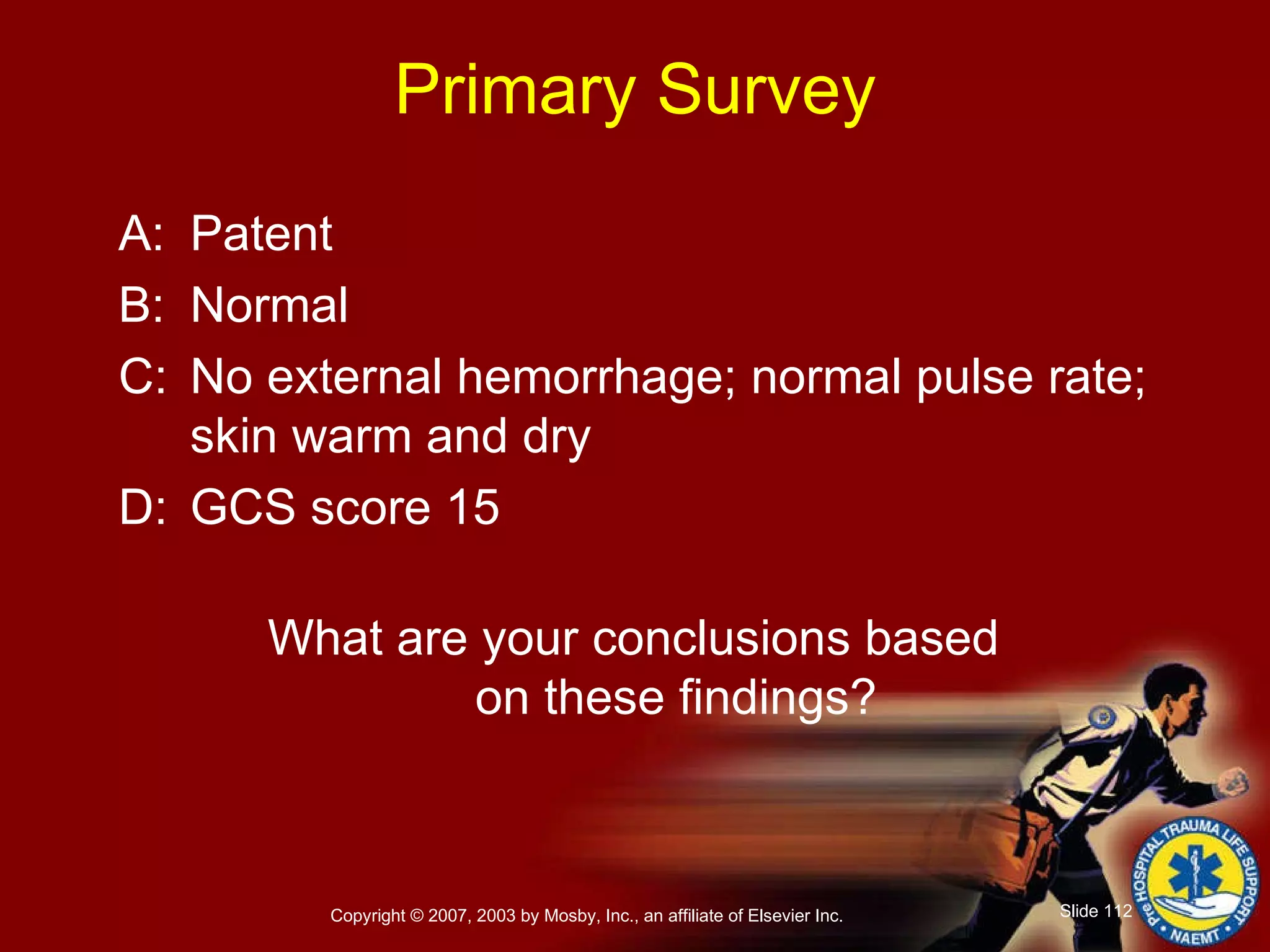
Primary Survey A: Patent B: Normal  C: No external hemorrhage; normal pulse rate; skin warm and dry D: GCS score 15 What are your conclusions based  on these findings?
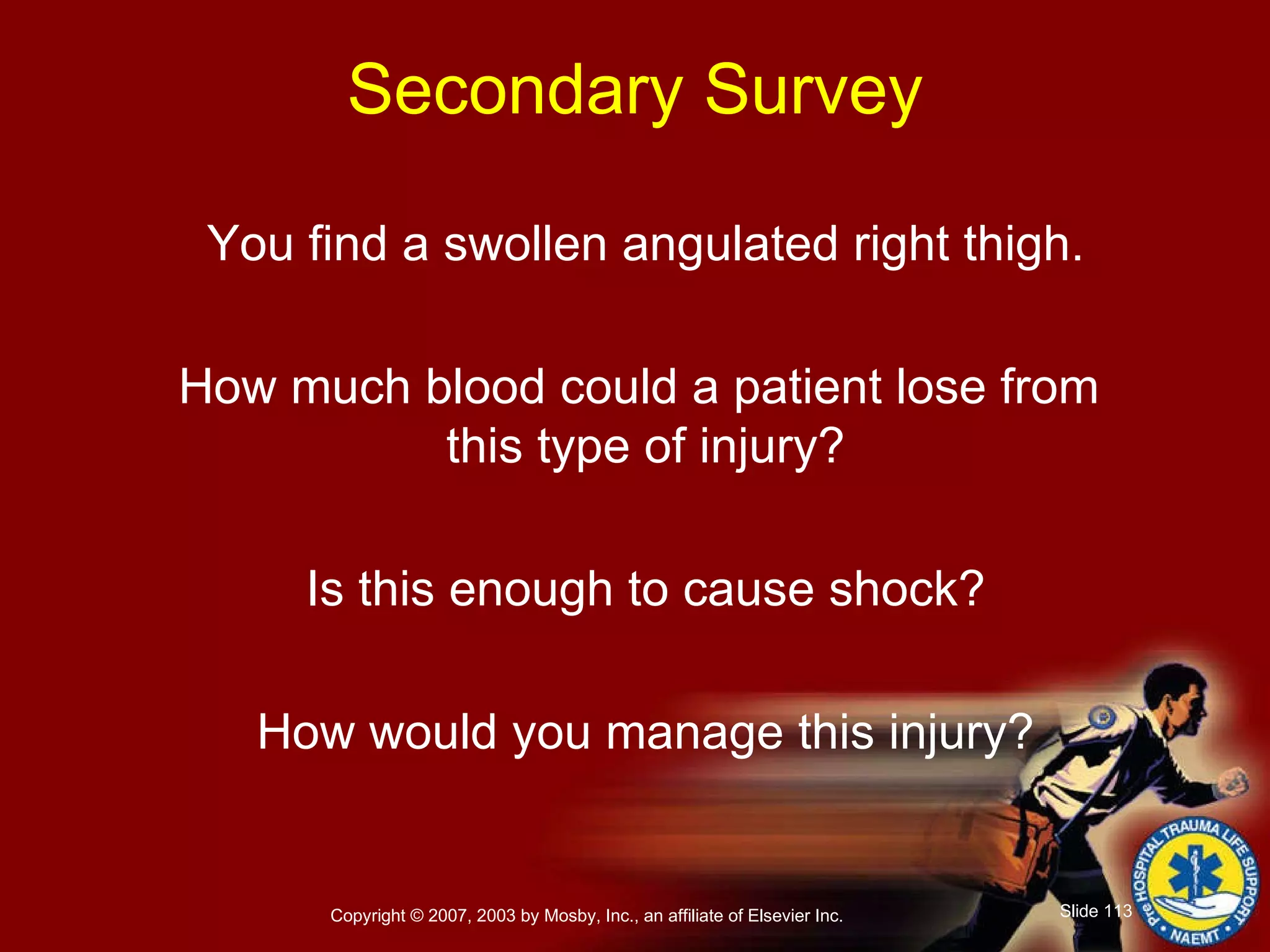
Secondary Survey You find a swollen angulated right thigh. How much blood could a patient lose from  this type of injury? Is this enough to cause shock? How would you manage this injury?
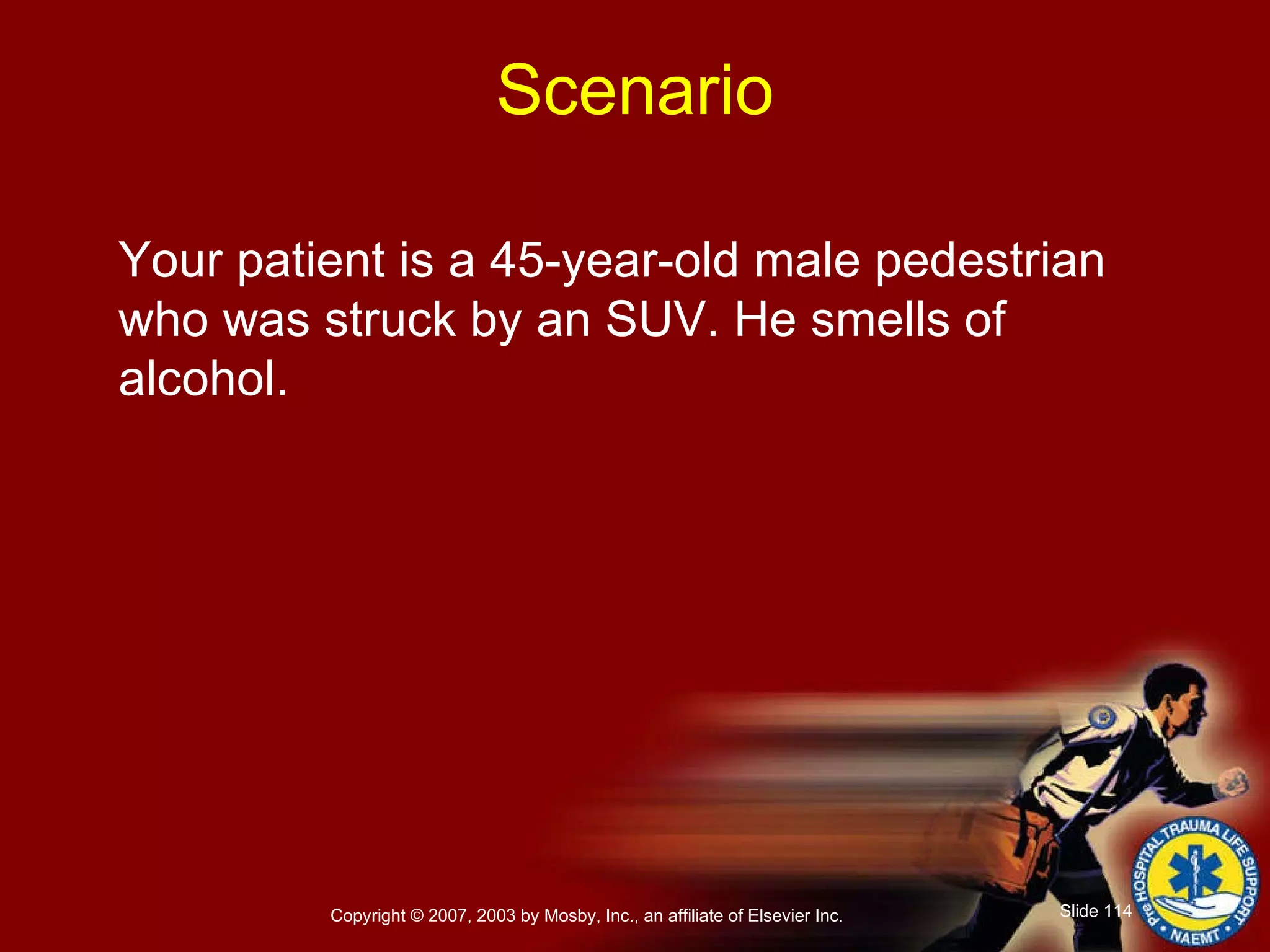
Your patient is a 45-year-old male pedestrian who was struck by an SUV. He smells of alcohol. Scenario
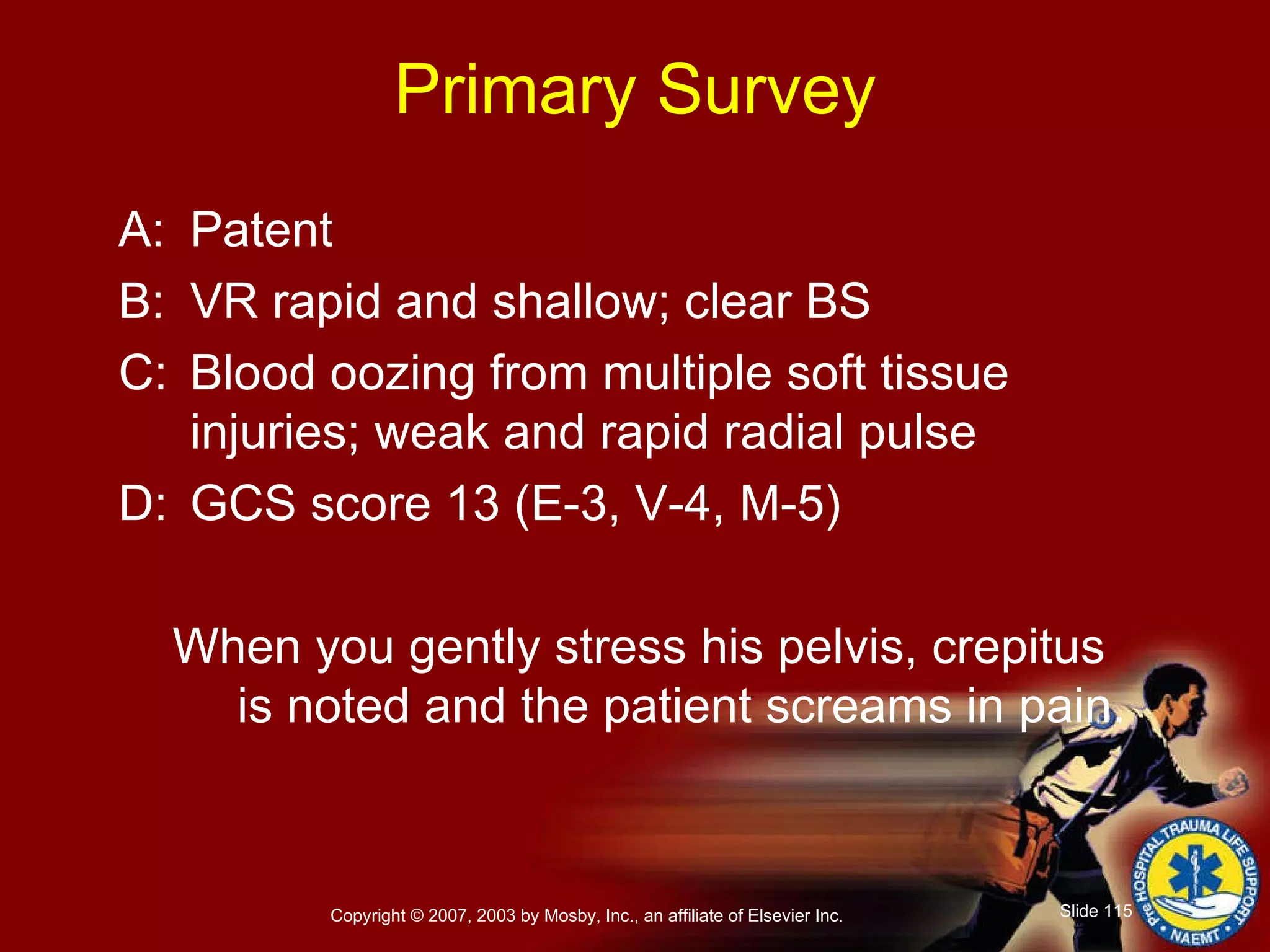
Primary Survey A: Patent B: VR rapid and shallow; clear BS C: Blood oozing from multiple soft tissue injuries; weak and rapid radial pulse D: GCS score 13 (E-3, V-4, M-5) When you gently stress his pelvis, crepitus  is noted and the patient screams in pain.
What are your conclusions based on the primary survey? What are your management priorities  for this patient? Primary Survey
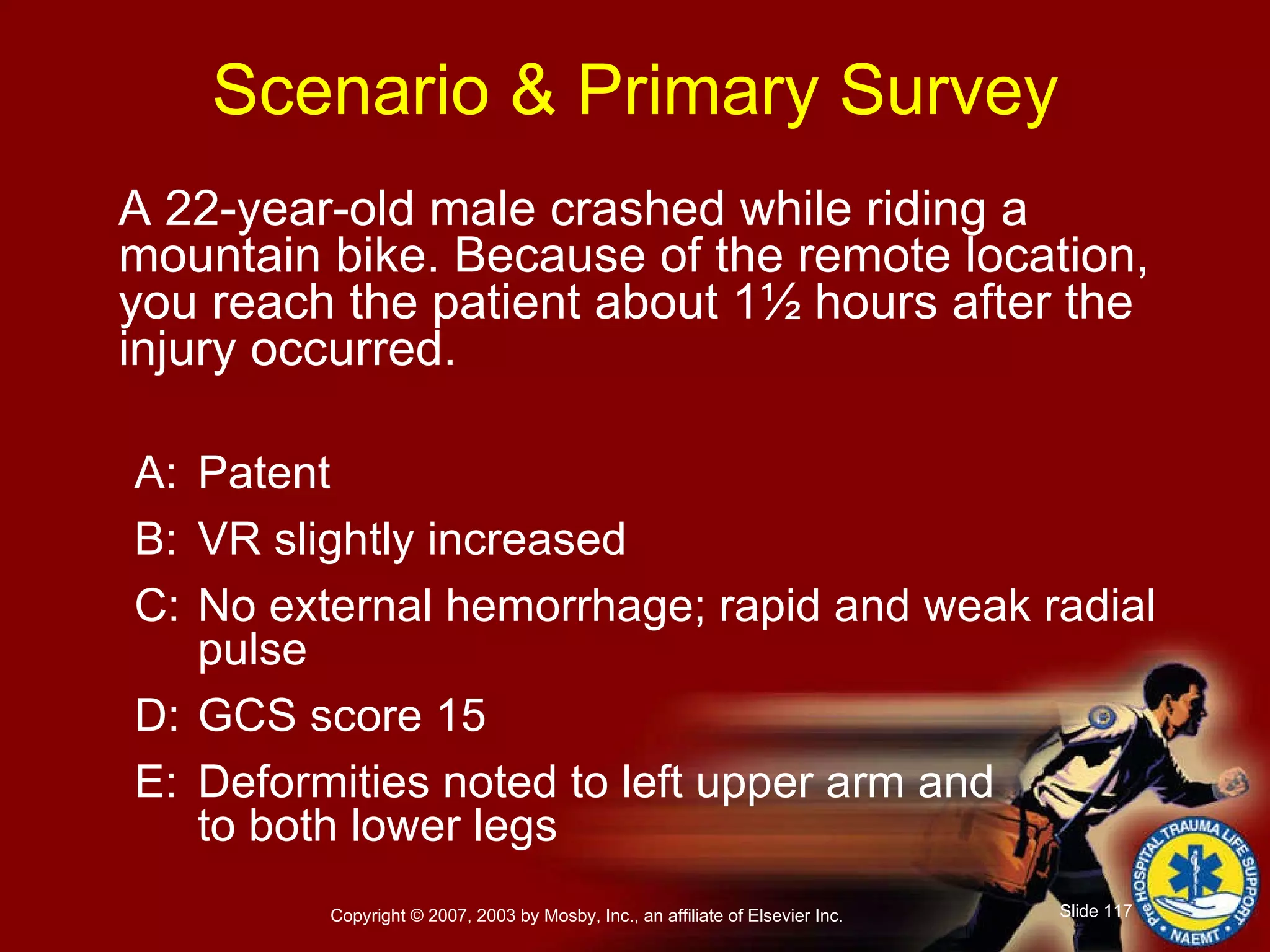
A 22-year-old male crashed while riding a mountain bike. Because of the remote location, you reach the patient about 1½ hours after the injury occurred. A: Patent B: VR slightly increased C: No external hemorrhage; rapid and weak radial pulse D: GCS score 15 E: Deformities noted to left upper arm and to both lower legs Scenario & Primary Survey
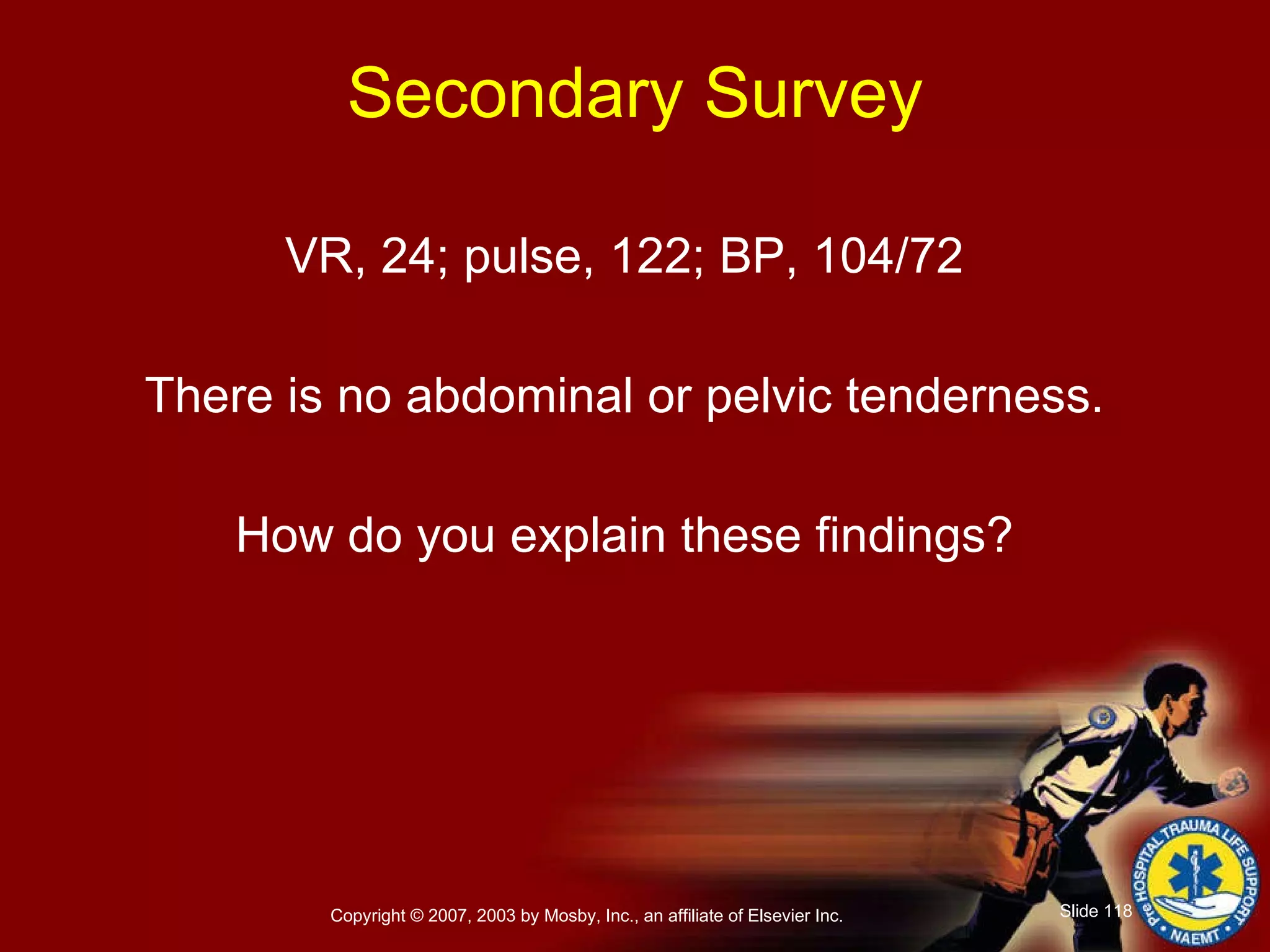
Secondary Survey VR, 24; pulse, 122; BP, 104/72 There is no abdominal or pelvic tenderness. How do you explain these findings?
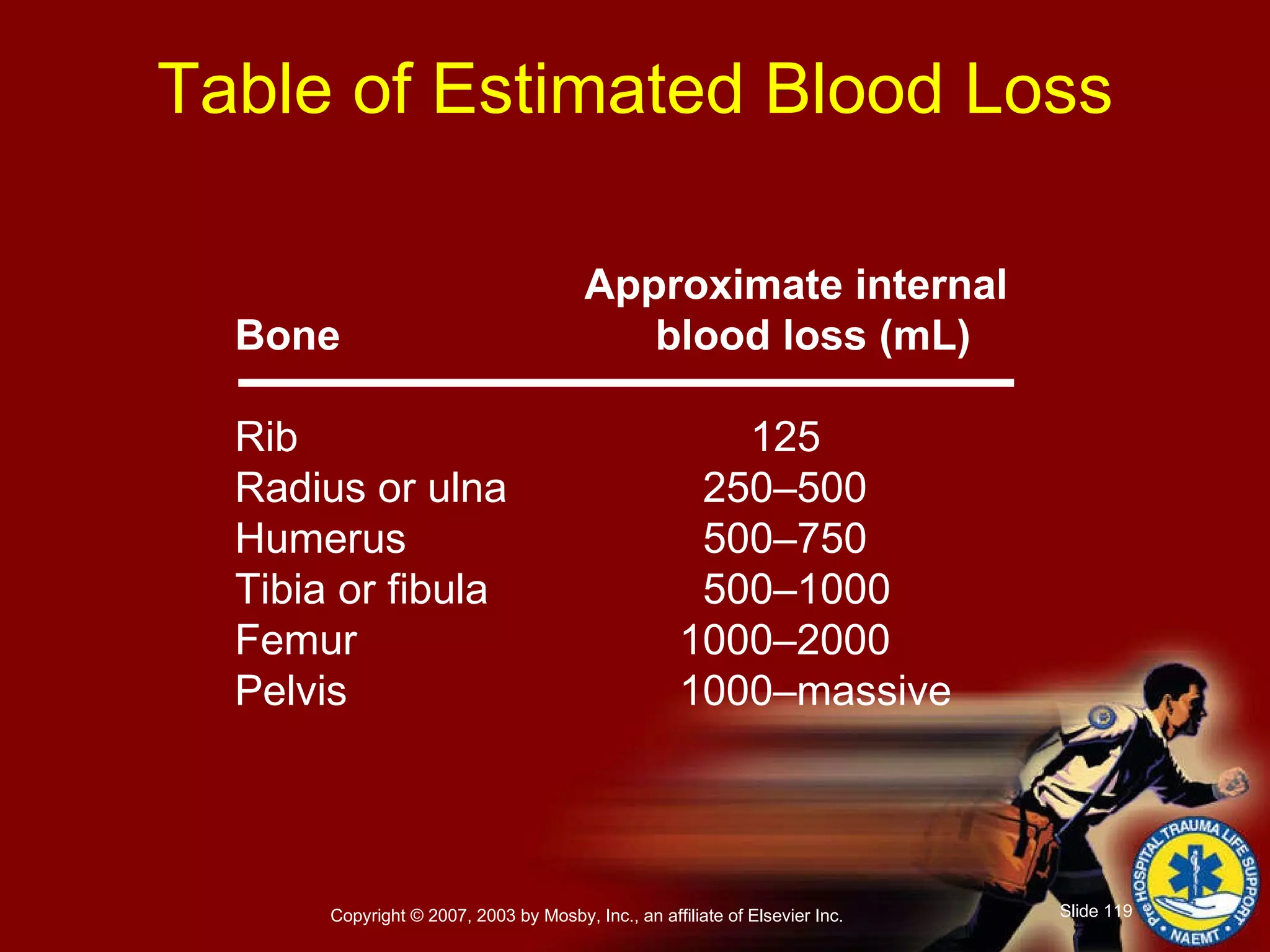
Table of Estimated Blood Loss Approximate internal Bone   blood loss (mL) Rib   125 Radius or ulna   250–500 Humerus   500–750 Tibia or fibula   500–1000 Femur   1000–2000 Pelvis   1000–massive
A 70-year-old woman slipped on some ice and fallen down a staircase. On your arrival she is complaining of pain in her left wrist and left ankle. On examination, deformities are found in both extremities. Scenario
Primary Survey A: Patent B: VR slightly fast C: Moderate hemorrhage from oozing and open ankle; irregular pulse D: GCS score 15 VR, 22; pulse, 105; BP, 110/70 Complains of pain at fracture sites
Are life-threatening injuries present? How are you going to manage this patient? Primary Survey
Objectives Identify, manage, and differentiate critical and noncritical burns Identify how chemical and electrical burns differ from thermal burns Discuss assessment and care of CO inhalation Address the priorities for assessing and managing heat-related injuries Discuss the priorities for assessing and managing cold-related injuries
You are called to care for a patient who has been burned while fueling his lawn mower. As you approach, you see a 65-year-old male with burns to his right arm and anterior chest. The fire is now extinguished. Scenario
Primary Survey A: Patent B: Normal; clear BS C: No external bleeding; normal pulse rate DL GCS score 15 E: Bright-red skin with blisters on chest and entire right arm What are the key issues in assessing thermal burns?
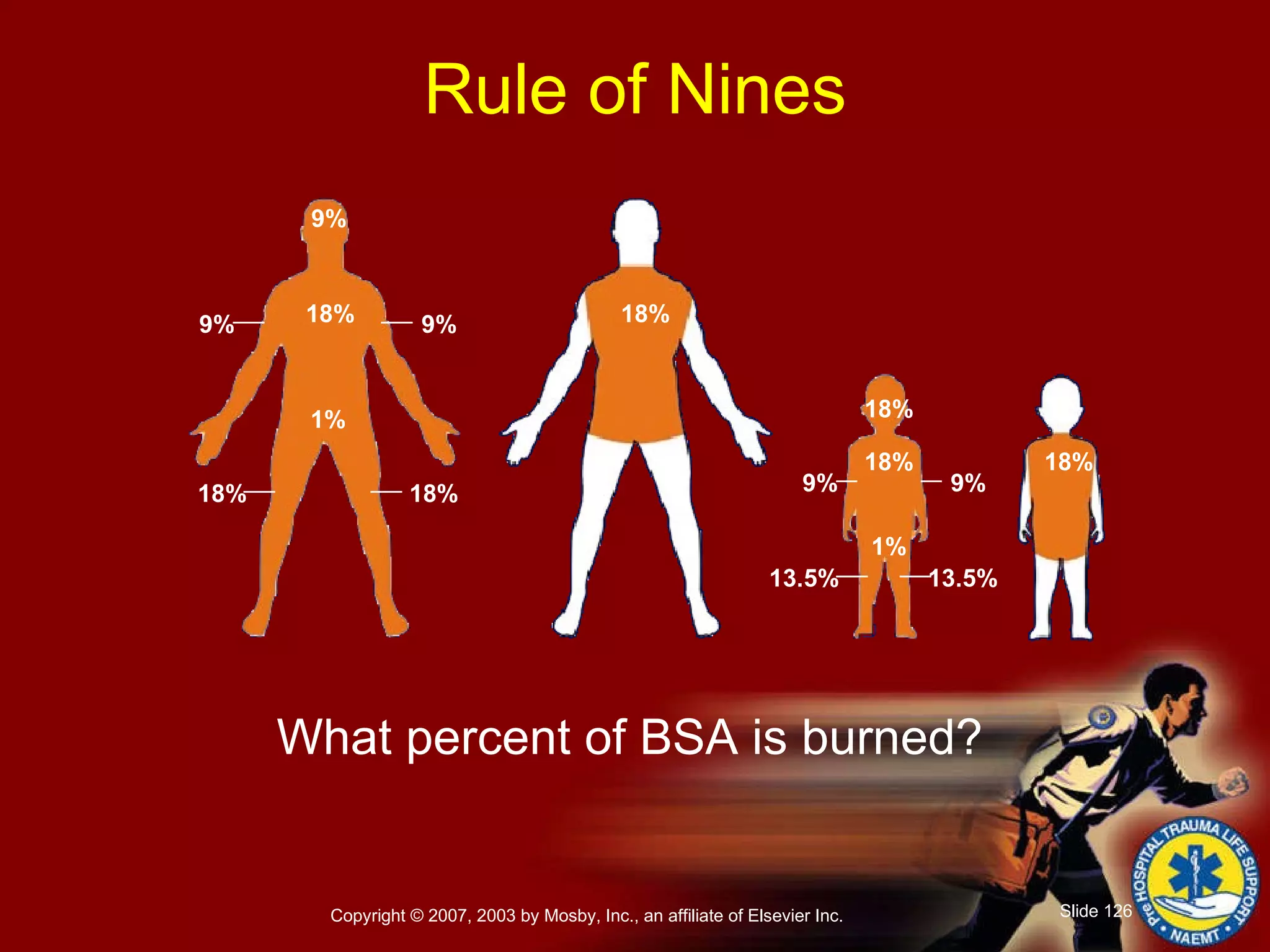
Rule of Nines What percent of BSA is burned? 9% 18% 9% 9% 18% 18% 18% 1% 18% 18% 9% 9% 18% 1% 13.5% 13.5%
What are other factors in assessing patients with thermal burns? How are you going to treat this patient? When is pain management indicated? Primary Survey
Resuscitation Parkland formula  4 mL  ×  BSA  ×  weight (kg) Calculate the Parkland formula for this patient (wt=70 kg) How is this administered?
Wound Management Superficial (first degree) Generally no field treatment needed Partial thickness/full thickness (second degree/third degree) Dry, clean dressings preferred Do not apply ointments or salves Do not attempt to break blisters Do not remove clothing that is melted to skin
Pain Management Administer analgesics if indicated Intermittent IV doses of narcotics Nitrous oxide Moist dressings ONLY  if less than 10% BSA burned If more than 10%, wet dressings can cause hypothermia
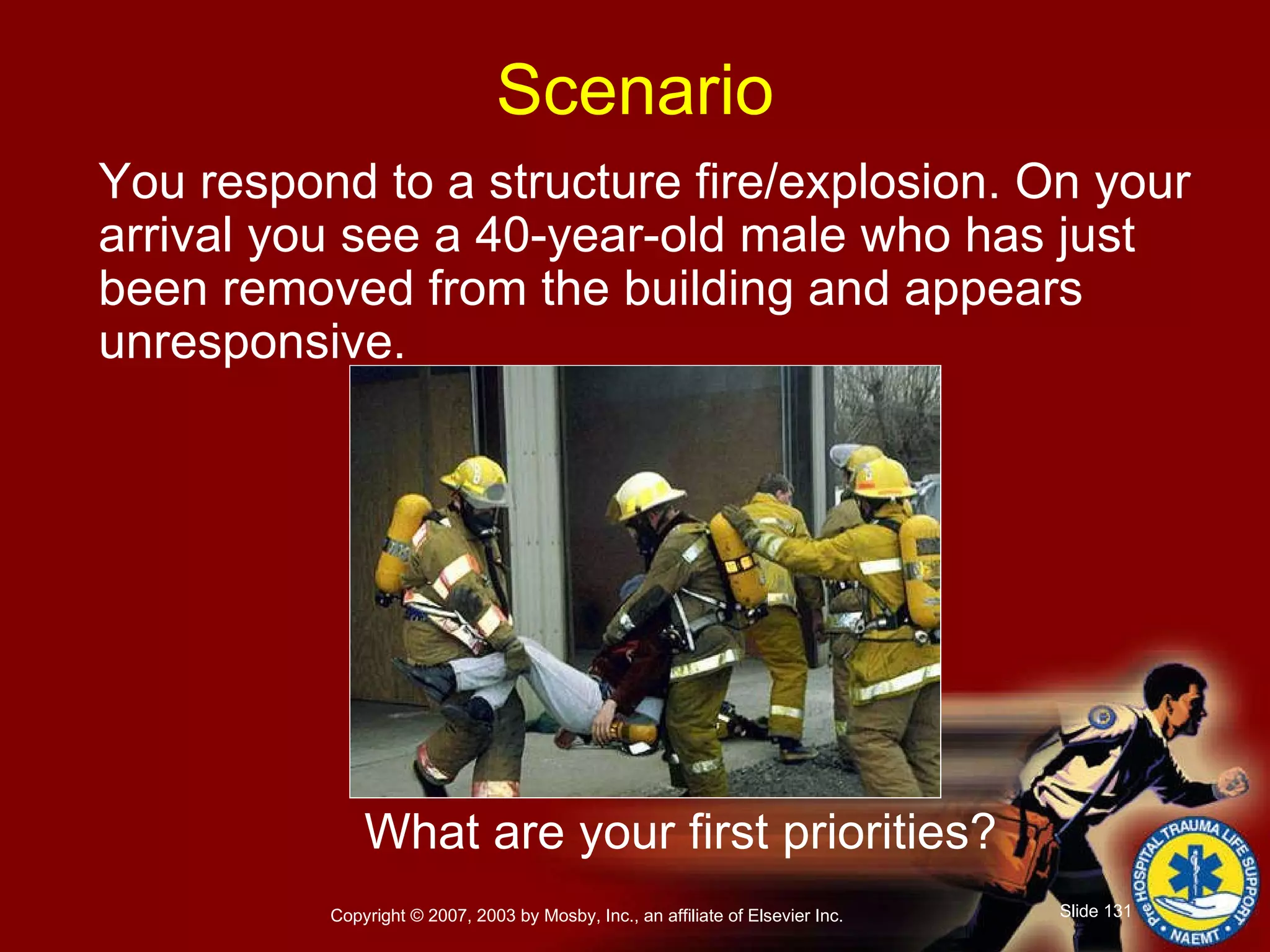
You respond to a structure fire/explosion. On your arrival you see a 40-year-old male who has just been removed from the building and appears unresponsive.  What are your first priorities? Scenario
Primary Survey A: Stridor noted; oral mucosa appears red B: Rapid; BS equal; rhonchi in all fields C: No external bleeding; weak and rapid pulse D: GCS score 3 (E-1, V-1, M-1) E: Partial-thickness burns of upper chest (9% BSA) What are your immediate concerns? Why is he showing signs and  symptoms of shock?
Possible Injuries Airway and pulmonary burns secondary to inhalation of superheated gases Associated injuries CO poisoning Burns How are you going to treat this patient?
Special Burn Situations Chemical burns What is different about these burns? How would you treat chemical burns?
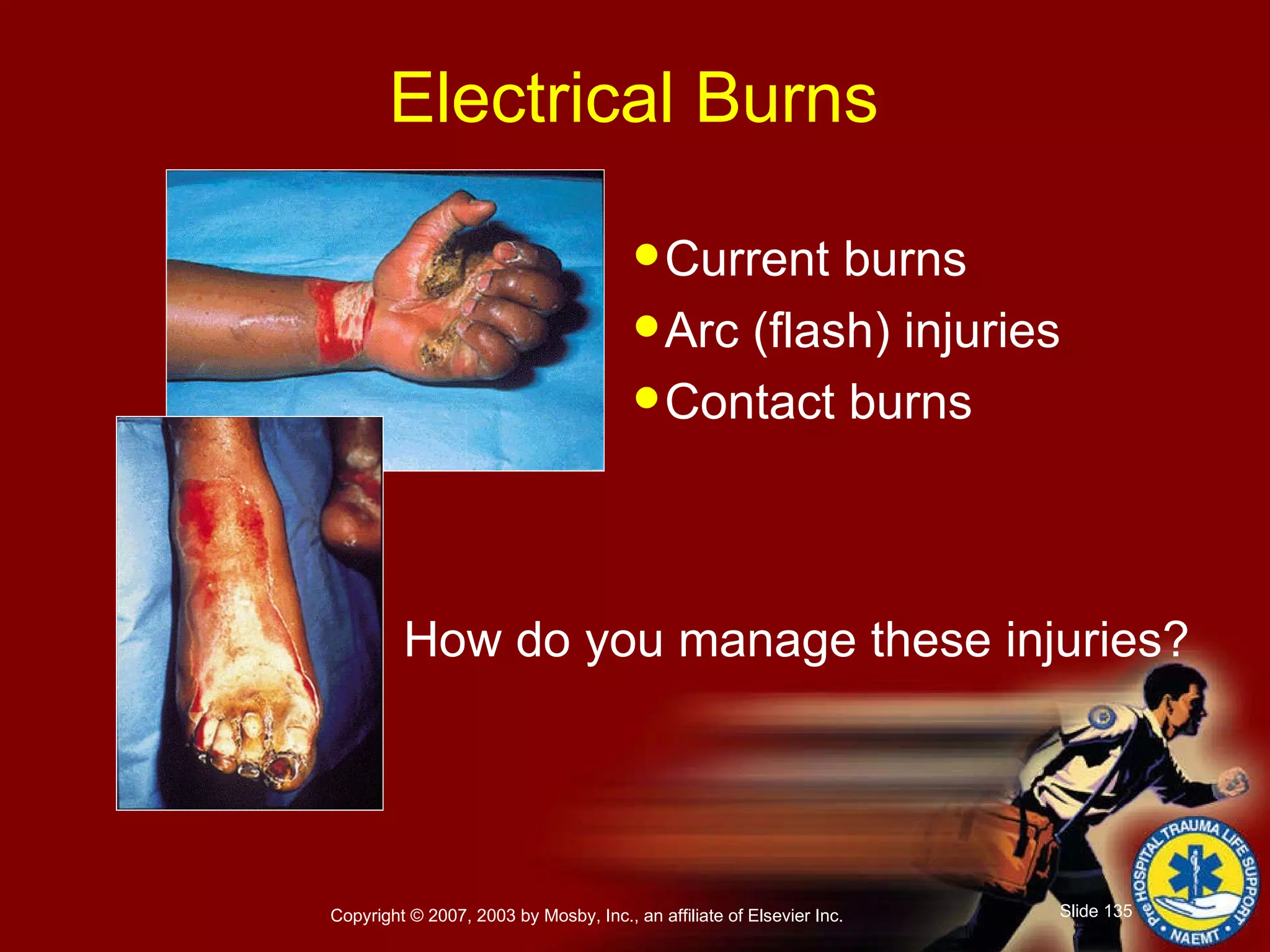
Electrical Burns Current burns Arc (flash) injuries Contact burns How do you manage these injuries?
Patients Requiring  Burn Centers Inhalation injuries Partial-thickness burns more than 10% Full-thickness burns Burns to face, hands, feet, genitalia, perineum, or major joints Electrical burns Chemical burns Burn injury in compromised patient Other special situations
Burns: Summary DO NOT  become a victim yourself Airway management and oxygenation are critical Early shock after burns points to other injuries Avoid hypothermia Transport patient to an appropriate facility Pain management Fluid therapy as indicated
Environmental Injuries
You are doing race coverage for a 10-km (6-mile) race. The temperature is 90° F (32° C) with 90% humidity. On finishing the race, a 55-year-old male collapsed. On your arrival you find the patient confused. What places this patient at high risk  for a heat emergency? How would you treat him? Scenario
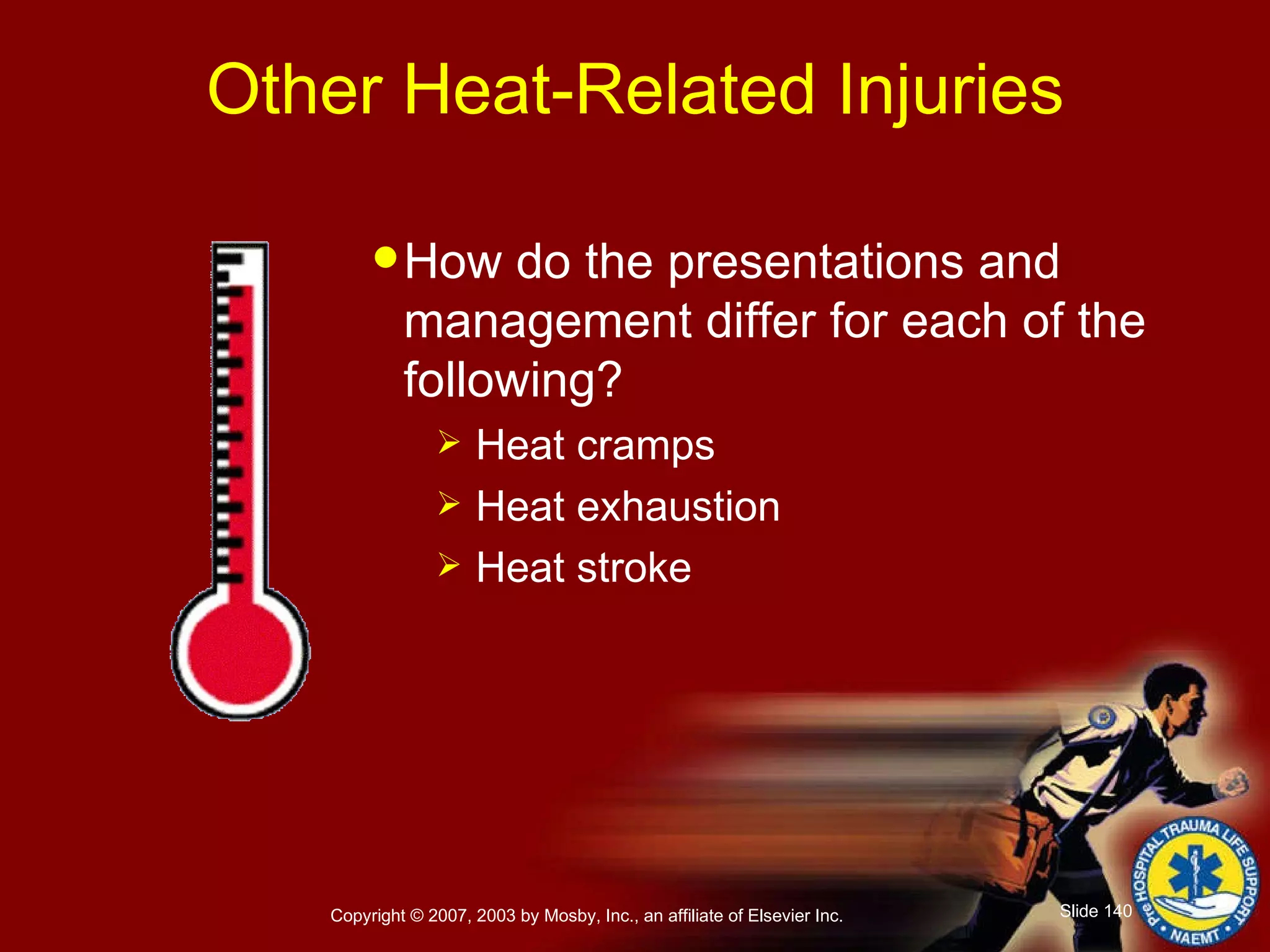
Other Heat-Related Injuries How do the presentations and management differ for each of the following? Heat cramps Heat exhaustion Heat stroke
Hypothermia Hypothermia begins when body temperature reaches 95° F (35° C) Shivering begins Heart rate, ventilations, and BP begin to decrease CNS impairment Below 90° F (32° C), shivering ceases Below 82° F (28° C), ventricular fibrillation possible
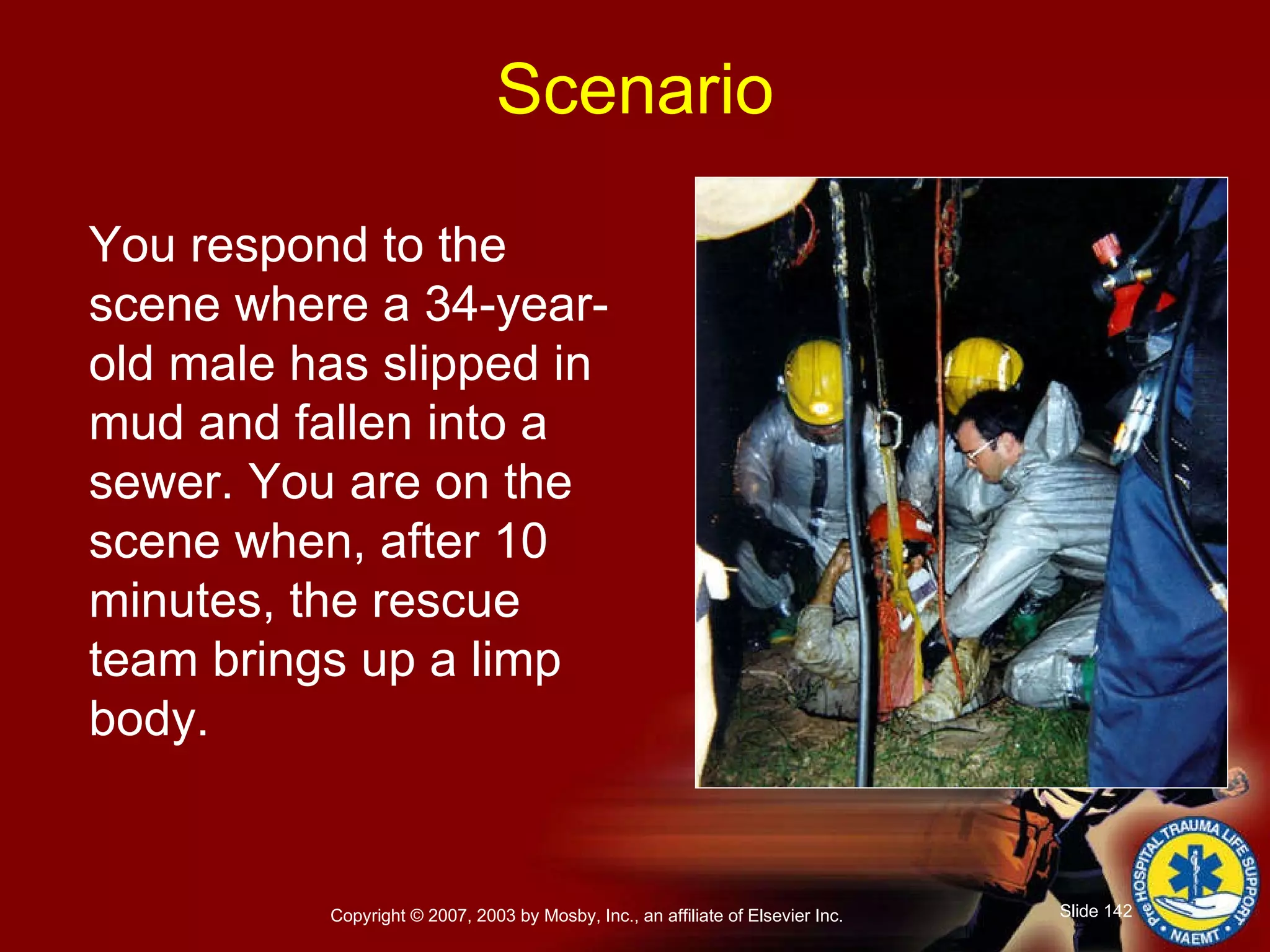
You respond to the scene where a 34-year-old male has slipped in mud and fallen into a sewer. You are on the scene when, after 10 minutes, the rescue team brings up a limp body. Scenario
Primary Survey A: Water in oropharynx B: Apneic C: No active hemorrhage; very slow and weak carotid pulse D: Unresponsive; GCS score 3 (E-1, V-1, M-1) E: Clothing is wet How are you going to manage this patient?
Objectives Identify injury patterns common to geriatric and pediatric trauma patients Identify anatomic and physiologic differences in pediatric and geriatric patients Discuss the importance of obtaining history for pediatric and geriatric trauma patients Discuss the management of pediatric and geriatric trauma patients
Pediatric Trauma Injury is the most frequent cause of death Approximately 20% to 40% of deaths may be preventable What are the common mechanisms of injury in children?
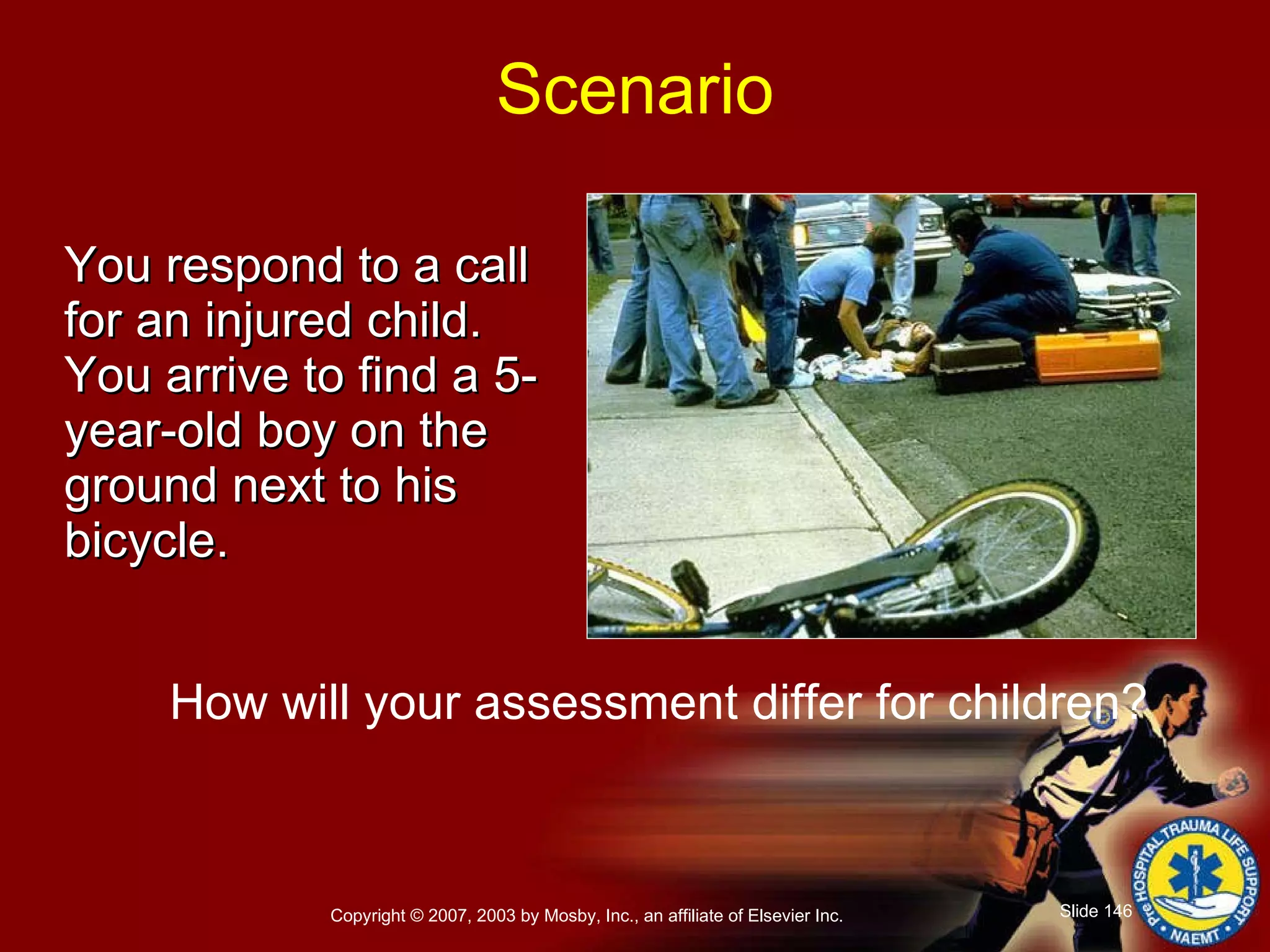
You respond to a call  for an injured child. You arrive to find a 5-year-old boy on the ground next to his bicycle.  How will your assessment differ for children? Scenario
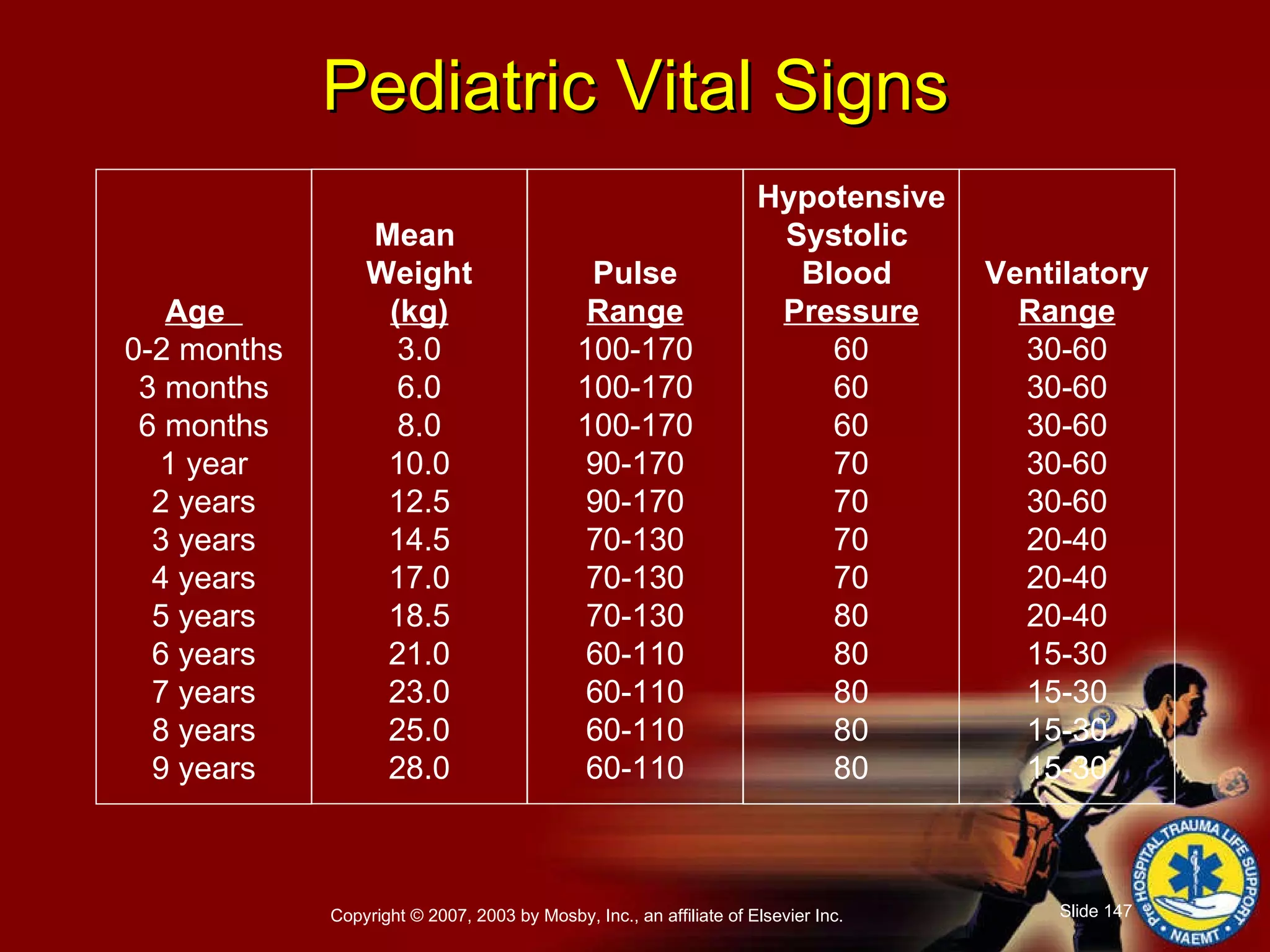
Pediatric Vital Signs Age  0-2 months 3 months 6 months 1 year 2 years 3 years 4 years 5 years 6 years 7 years 8 years 9 years Mean  Weight (kg) 3.0 6.0 8.0 10.0 12.5 14.5 17.0 18.5 21.0 23.0 25.0 28.0 Pulse Range 100-170 100-170 100-170 90-170 90-170 70-130 70-130 70-130 60-110 60-110 60-110 60-110 Hypotensive Systolic  Blood  Pressure 60 60 60 70 70 70 70 80 80 80 80 80 Ventilatory Range 30-60 30-60 30-60 30-60 30-60 20-40 20-40 20-40 15-30 15-30 15-30 15-30
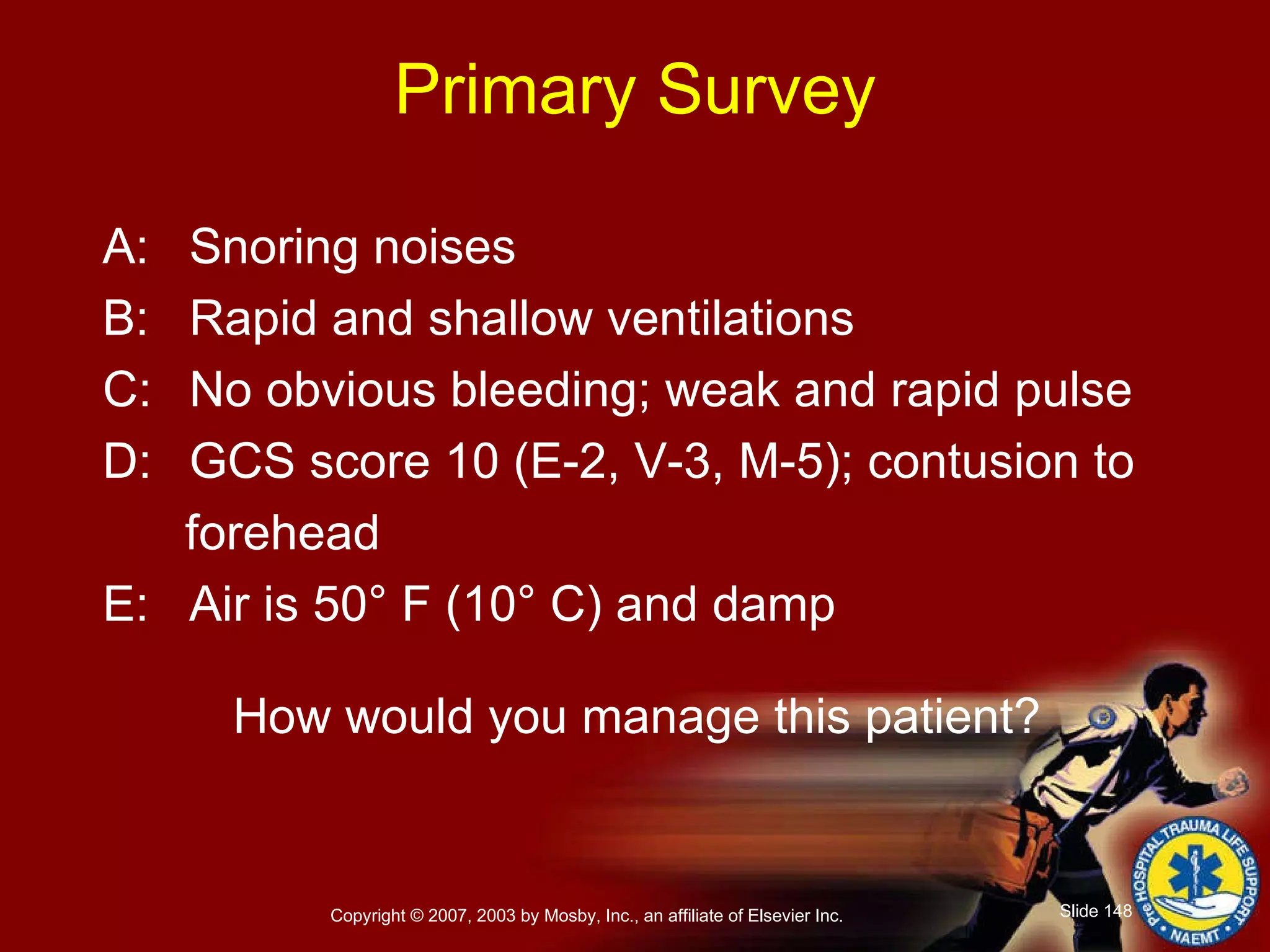
Primary Survey A: Snoring noises B: Rapid and shallow ventilations C: No obvious bleeding; weak and rapid pulse D: GCS score 10 (E-2, V-3, M-5); contusion to  forehead E: Air is 50° F (10° C) and damp How would you manage this patient?
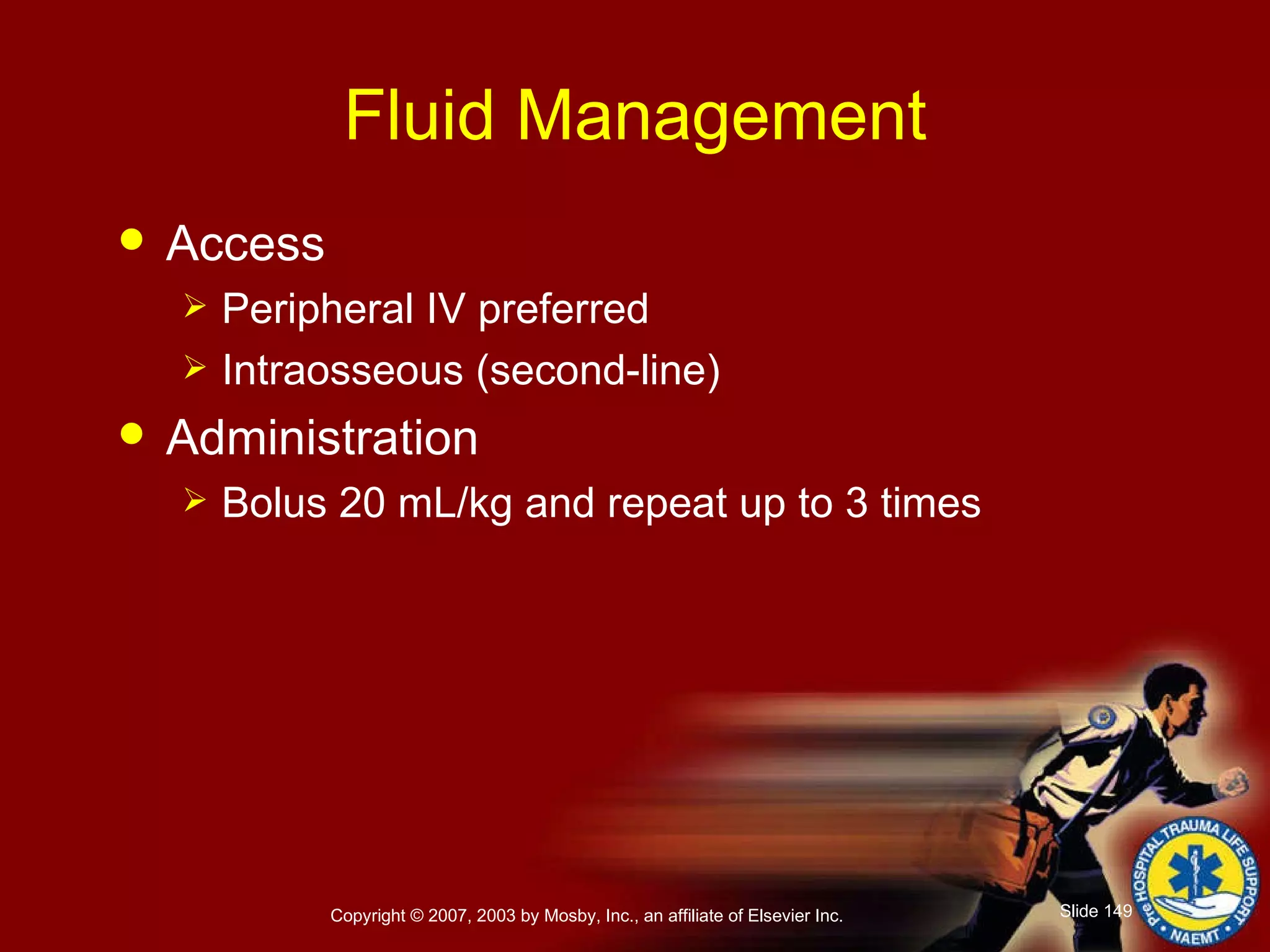
Fluid Management Access Peripheral IV preferred Intraosseous (second-line) Administration Bolus 20 mL/kg and repeat up to 3 times
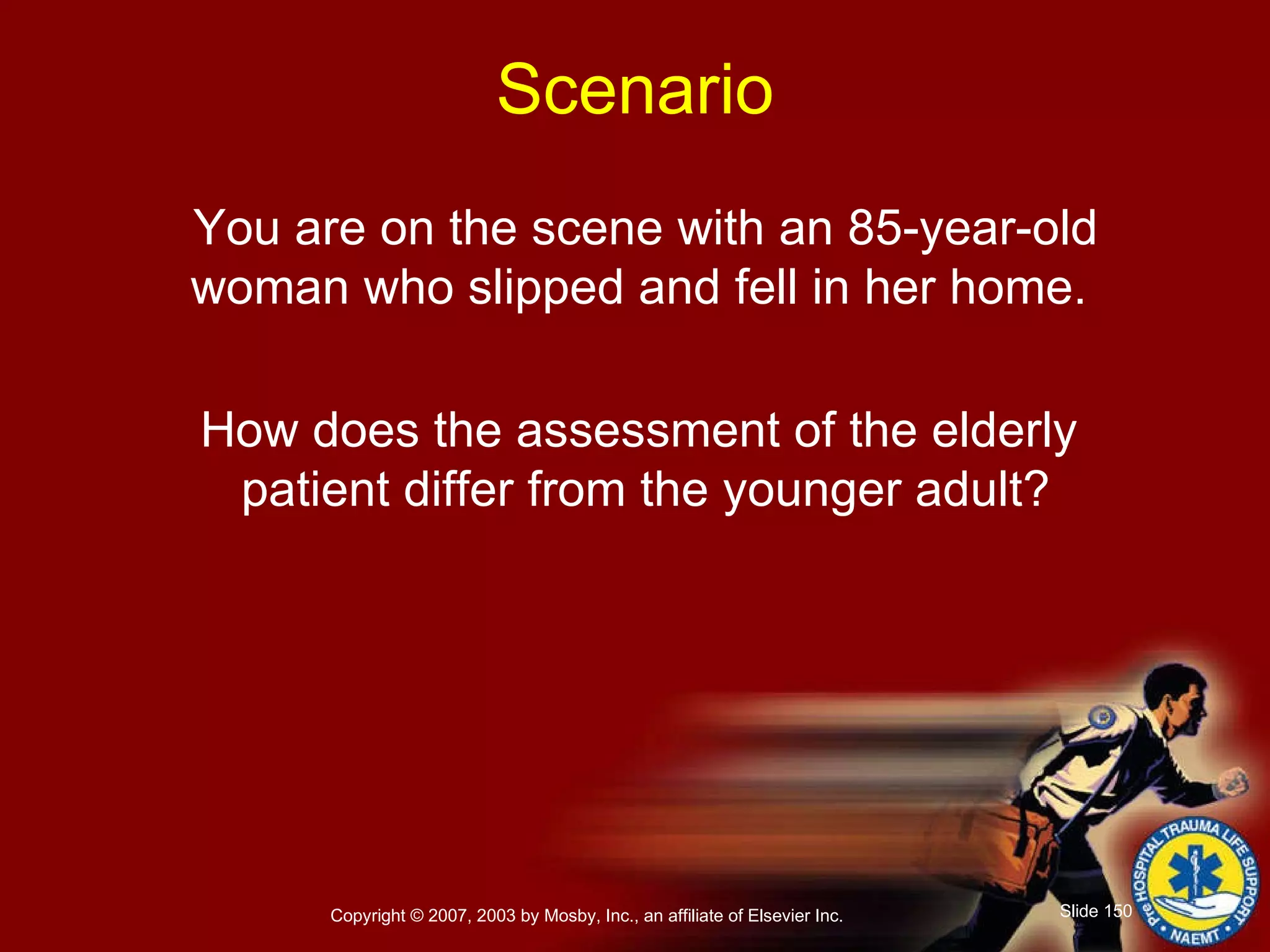
You are on the scene with an 85-year-old woman who slipped and fell in her home.  How does the assessment of the elderly  patient differ from the younger adult? Scenario
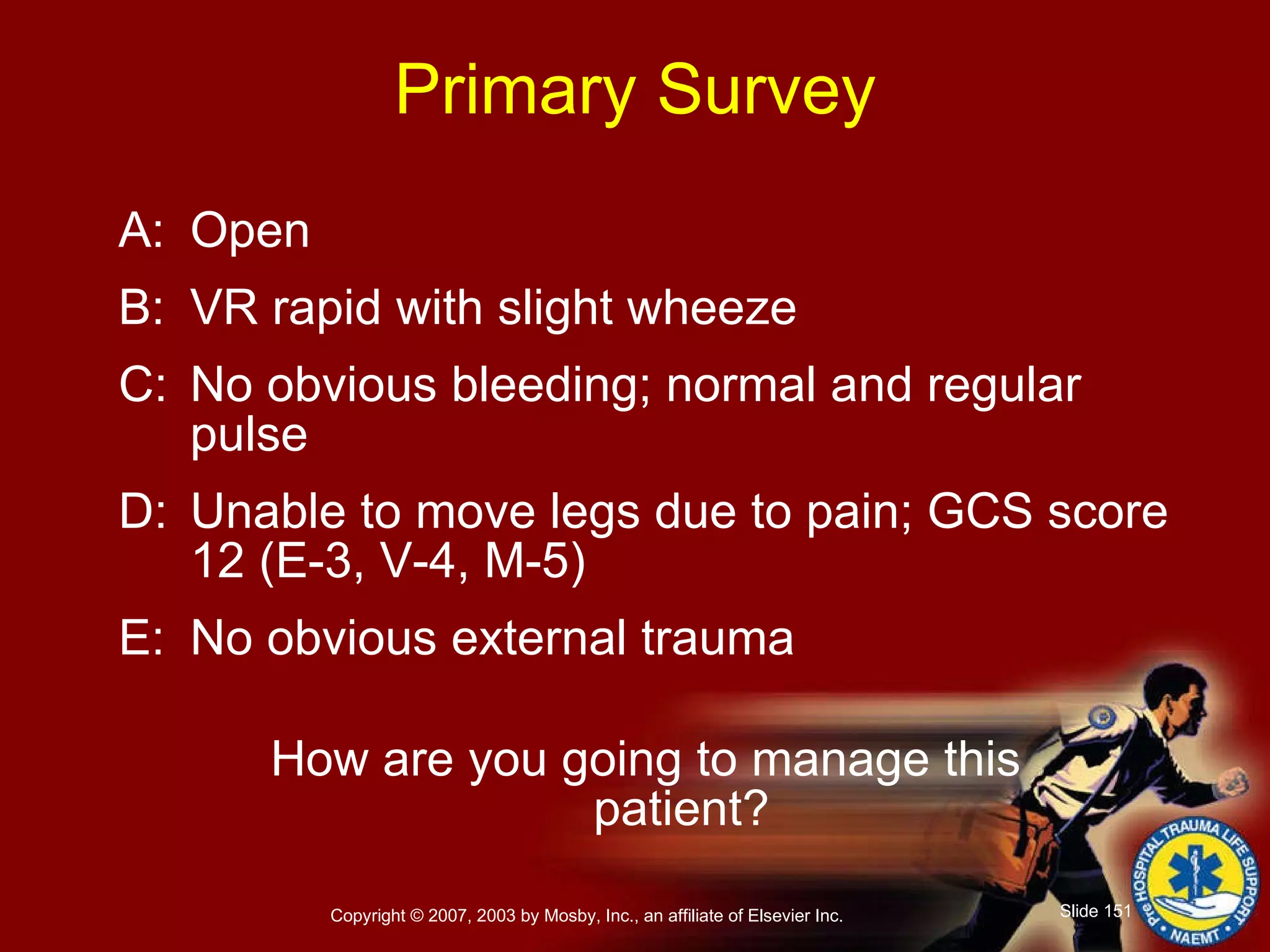
Primary Survey A: Open B: VR rapid with slight wheeze C: No obvious bleeding; normal and regular pulse D: Unable to move legs due to pain; GCS score 12 (E-3, V-4, M-5) E: No obvious external trauma How are you going to manage this patient?
Special Considerations  in the Elderly Preexisting disease may increase with age Age and general physical condition greatly influence response to injury Medical history Prescription medications   Trauma may be the result of a medical emergency
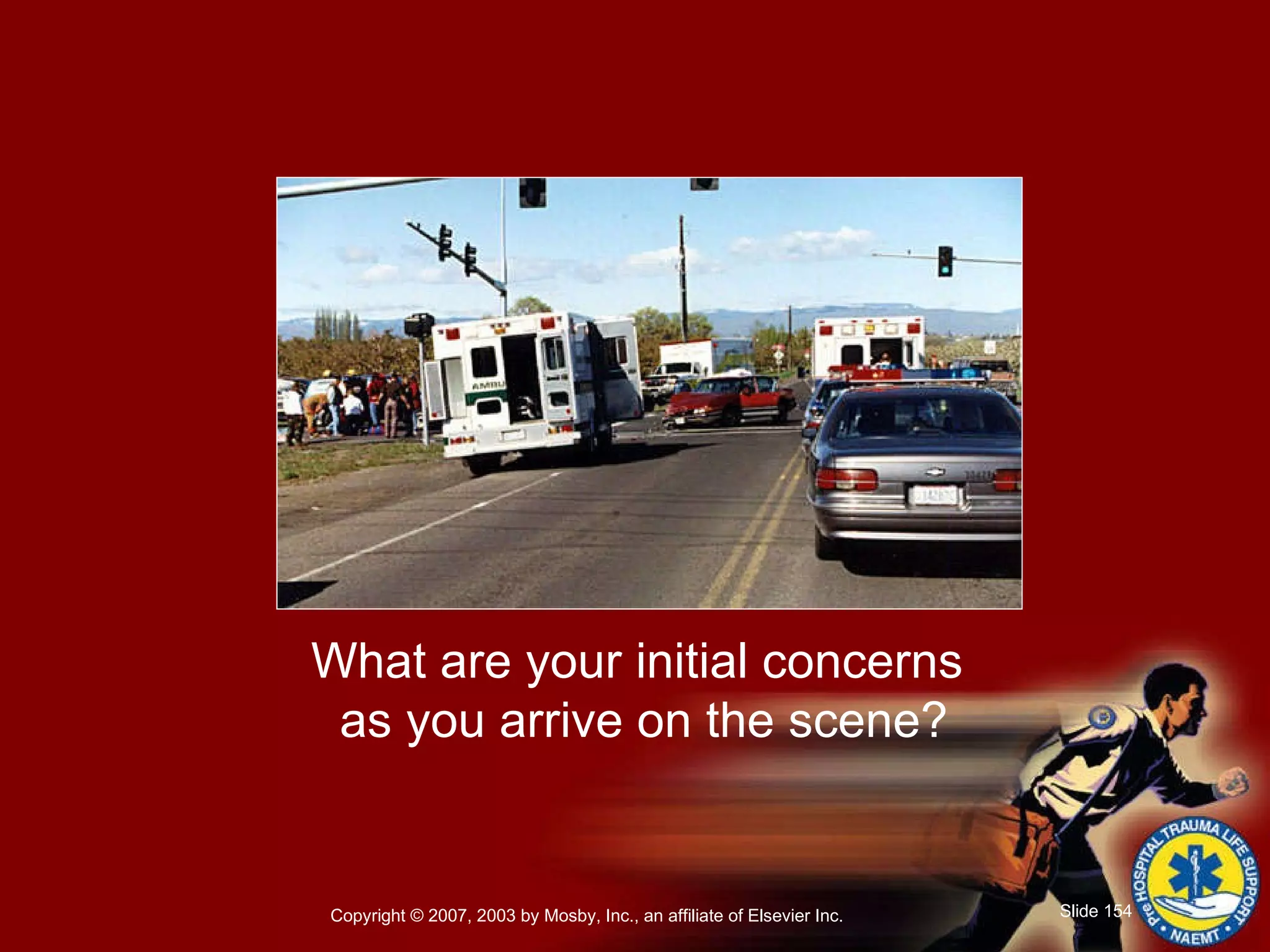
You are dispatched to the scene of a pedestrian struck by a vehicle. Law enforcement and the fire department are en route. It is an overcast spring day with a temperature of 50° F (10° C).  Scenario
What are your initial concerns  as you arrive on the scene?
Ensure the safety of the prehospital  care providers and the patient. What are the safety concerns  with this scene? Overview
Assess the scene situation to determine  the need for additional resources. What additional resources may be needed? Overview
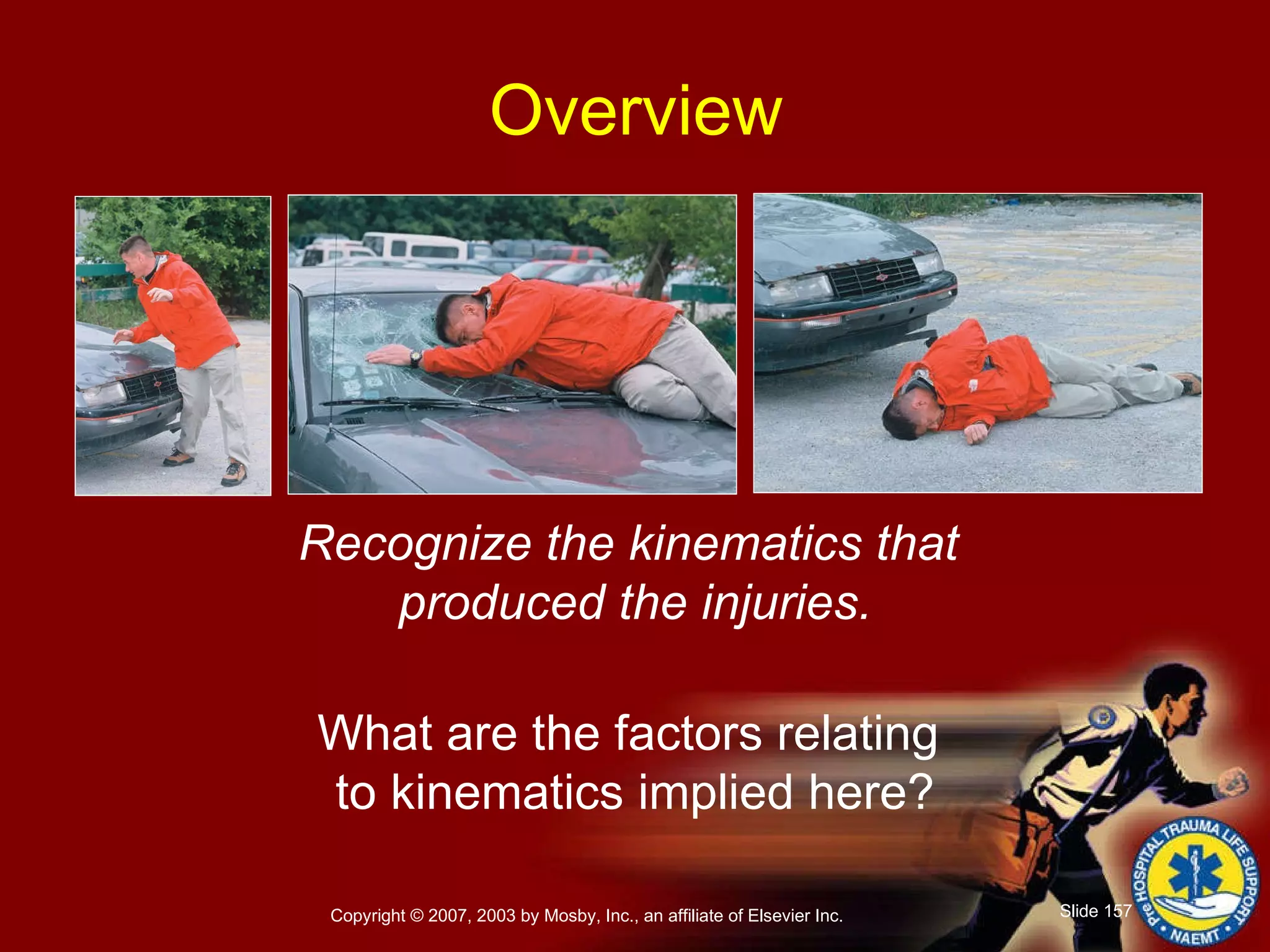
Recognize the kinematics that  produced the injuries. What are the factors relating  to kinematics implied here? Overview
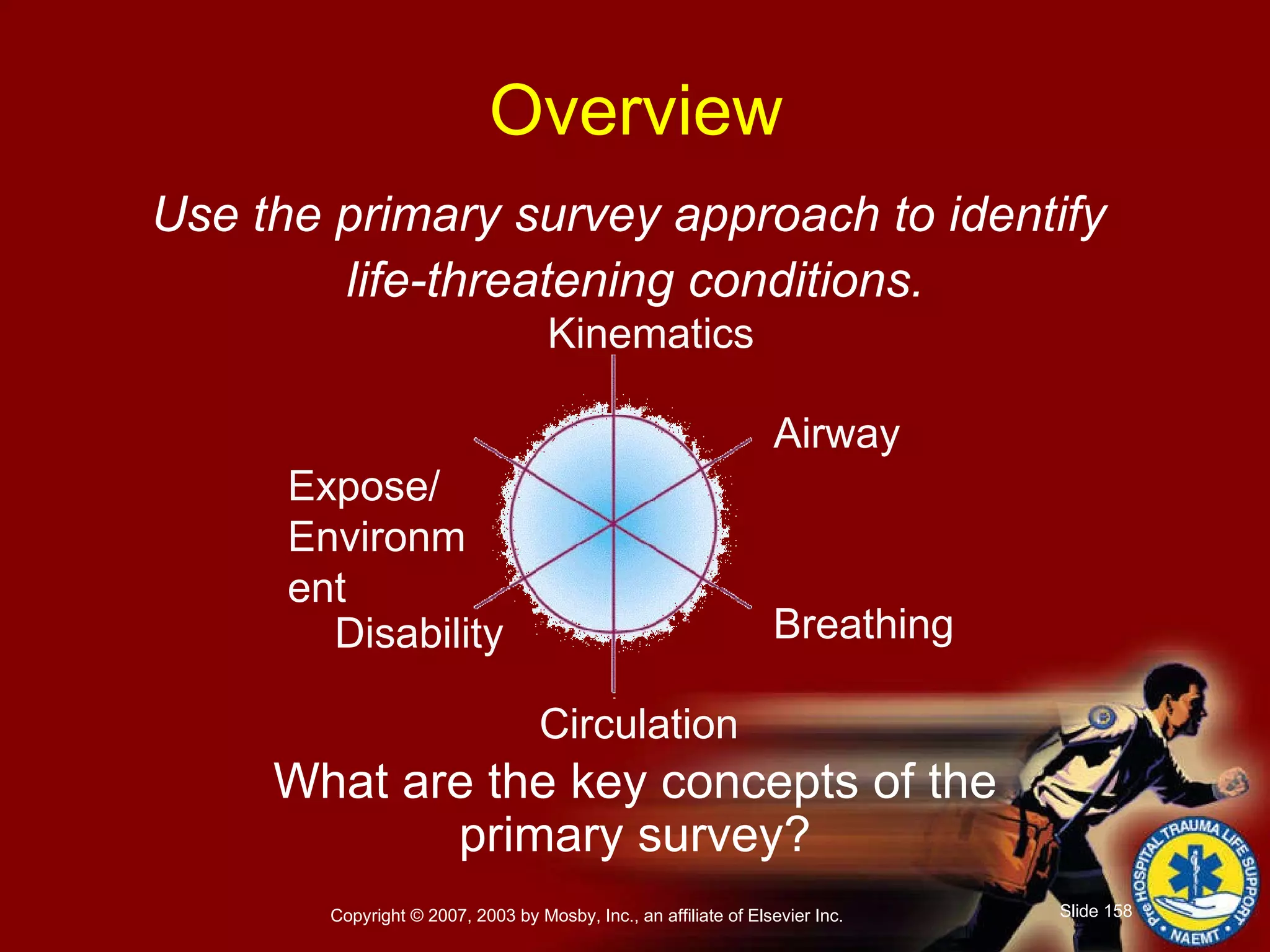
Use the primary survey approach to identify  life-threatening conditions. What are the key concepts of the primary survey? Overview Breathing Airway Kinematics Circulation Disability Expose/ Environment
Provide appropriate management while maintaining cervical spine stabilization. The patient has noisy ventilations and blood is draining from the oropharynx. What should be considered when  managing this airway? Overview
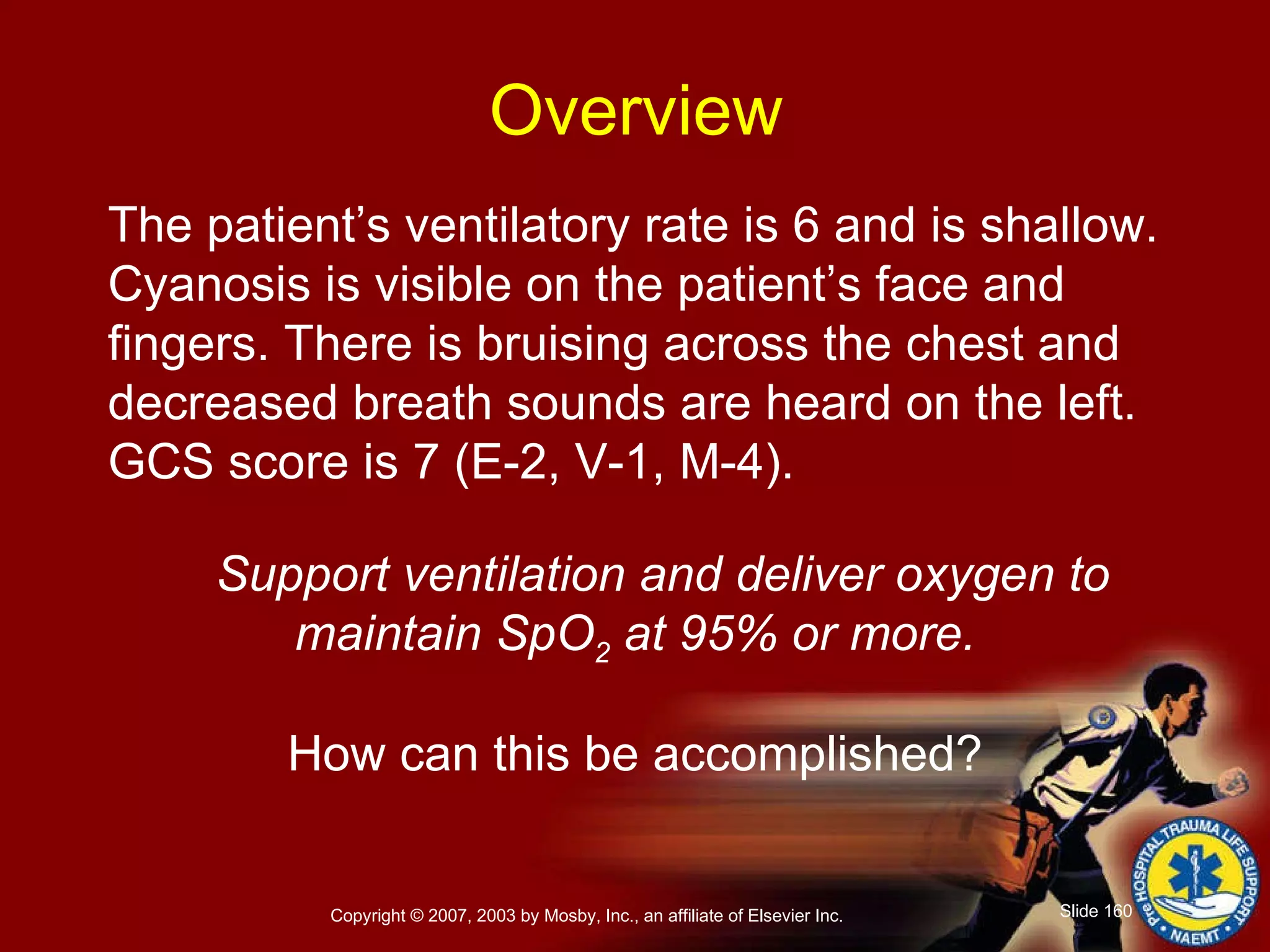
The patient’s ventilatory rate is 6 and is shallow. Cyanosis is visible on the patient’s face and fingers. There is bruising across the chest and decreased breath sounds are heard on the left. GCS score is 7 (E-2, V-1, M-4). Support ventilation and deliver oxygen to maintain SpO 2  at 95% or more. How can this be accomplished? Overview
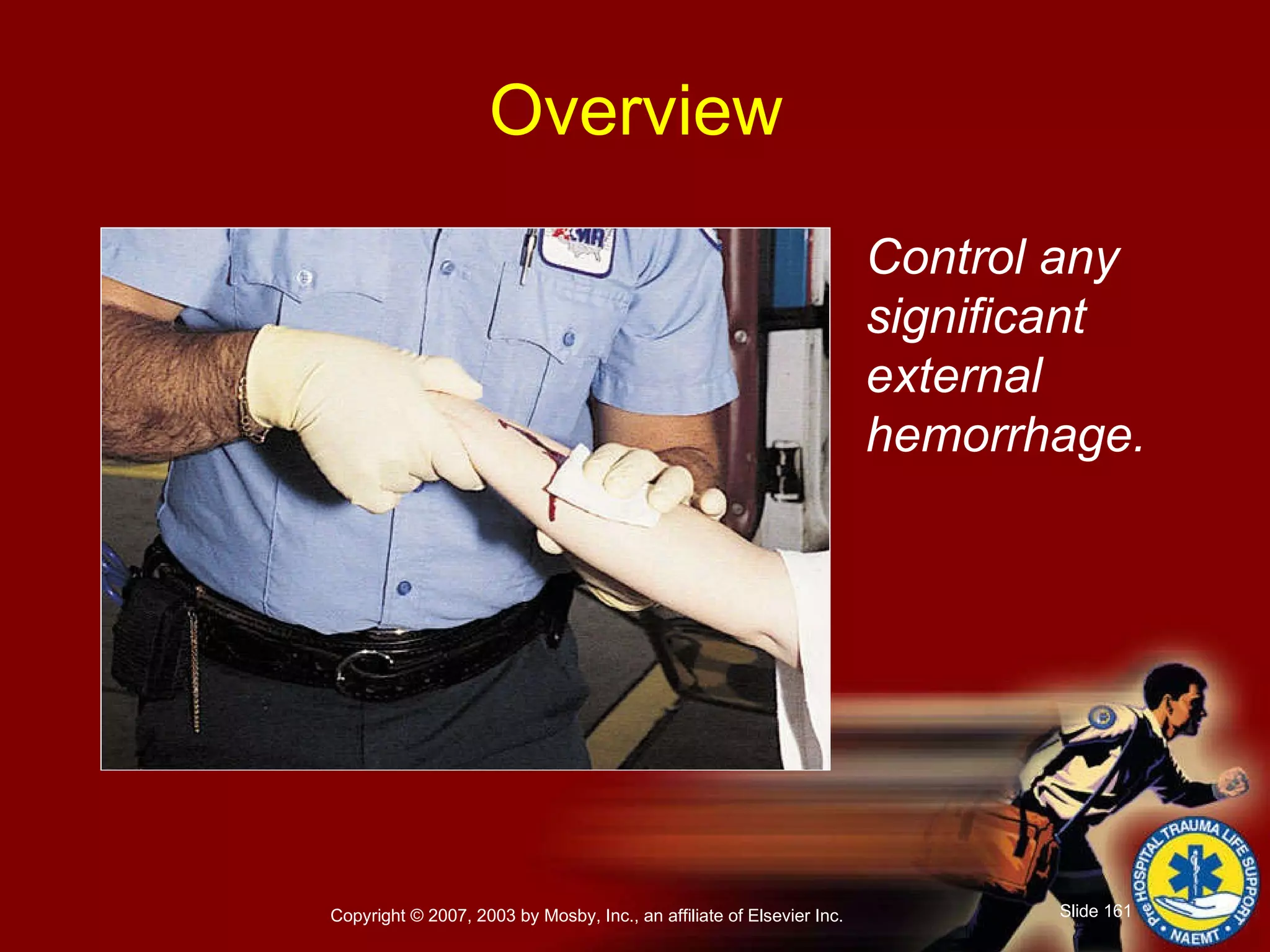
Control any significant external hemorrhage. Overview
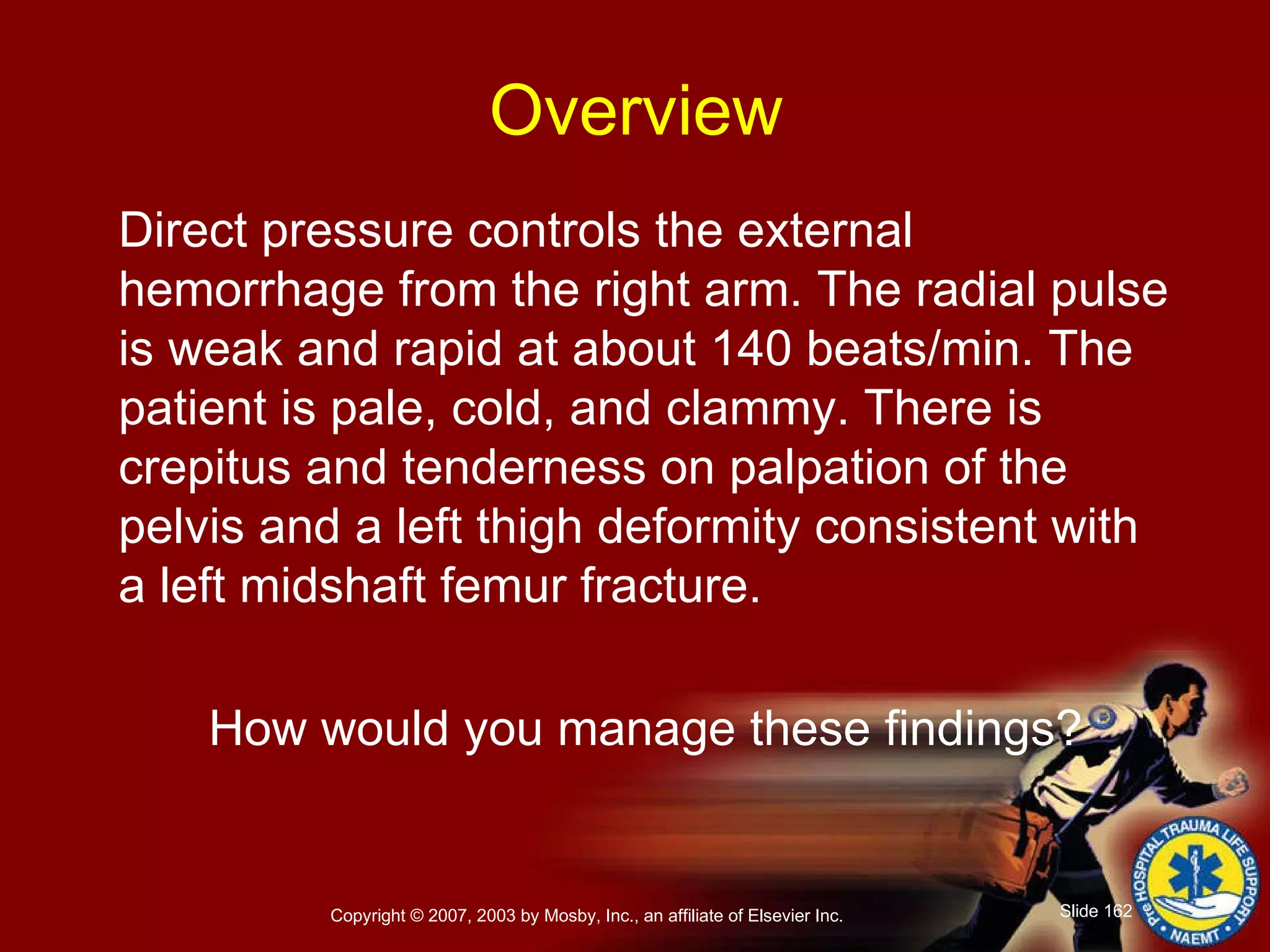
Direct pressure controls the external hemorrhage from the right arm. The radial pulse is weak and rapid at about 140 beats/min. The patient is pale, cold, and clammy. There is crepitus and tenderness on palpation of the pelvis and a left thigh deformity consistent with a left midshaft femur fracture. How would you manage these findings? Overview
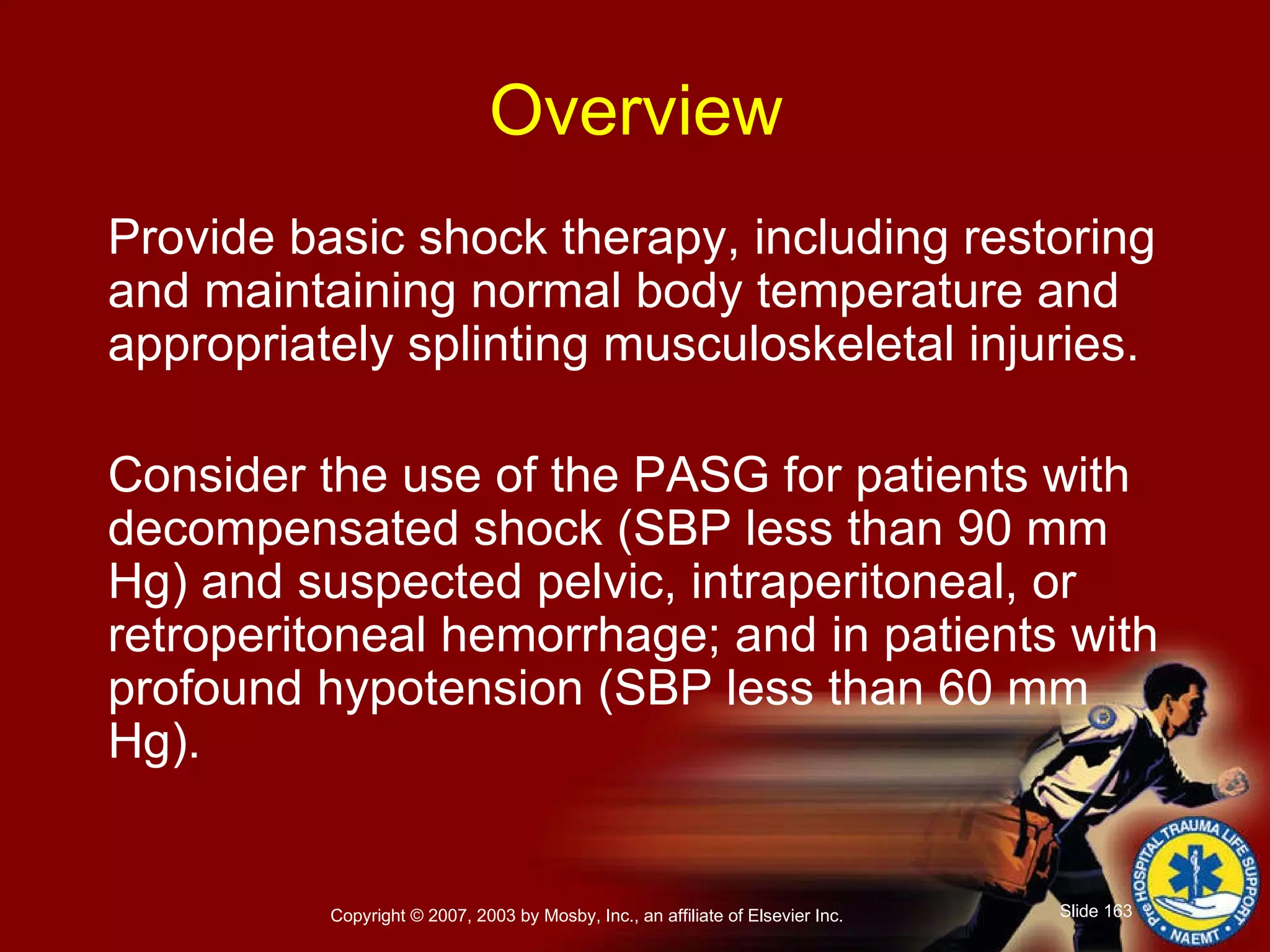
Provide basic shock therapy, including restoring and maintaining normal body temperature and appropriately splinting musculoskeletal injuries. Consider the use of the PASG for patients with decompensated shock (SBP less than 90 mm Hg) and suspected pelvic, intraperitoneal, or retroperitoneal hemorrhage; and in patients with profound hypotension (SBP less than 60 mm Hg). Overview
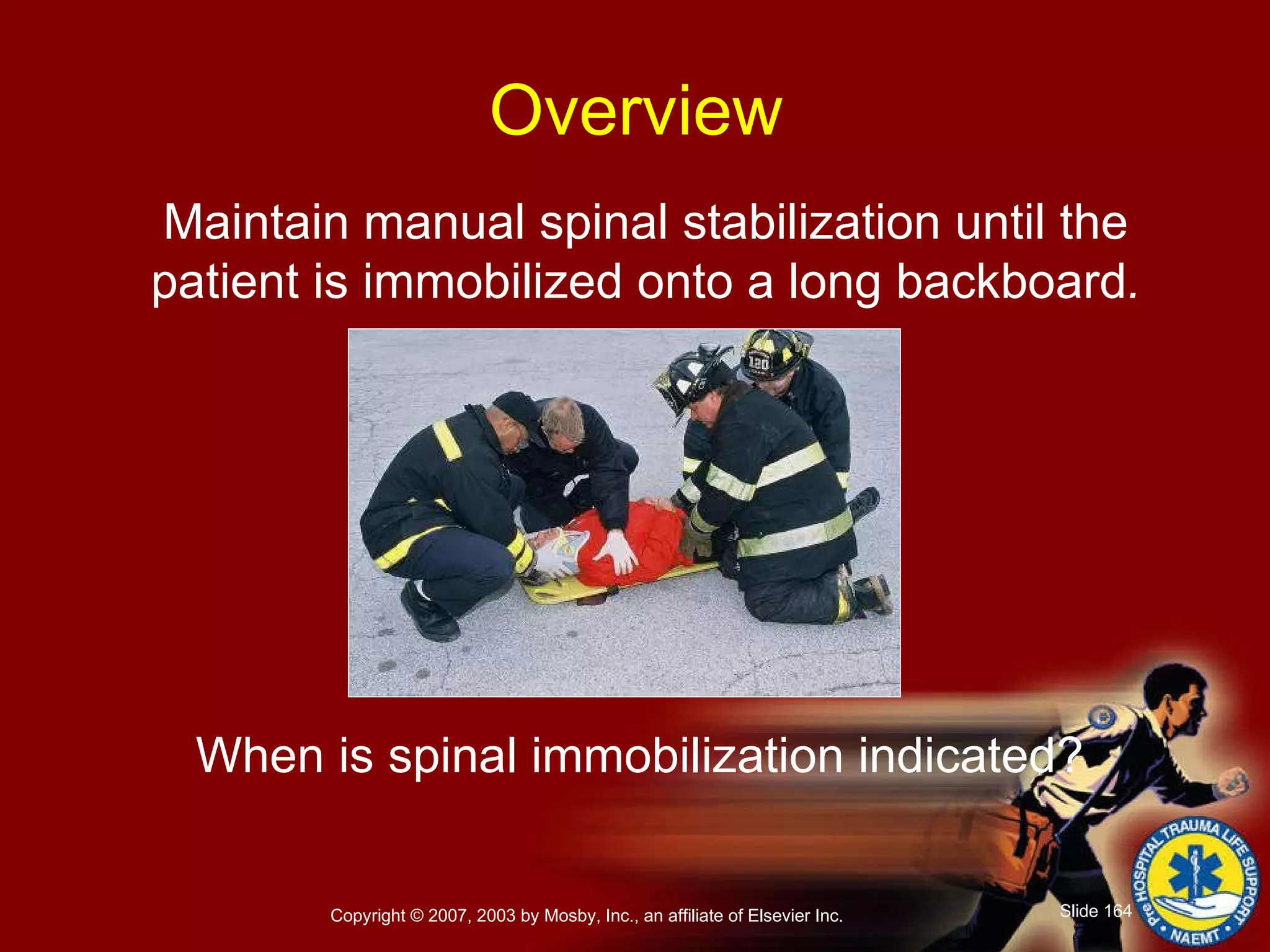
Maintain manual spinal stabilization until the patient is immobilized onto a long backboard . When is spinal immobilization indicated?   Overview
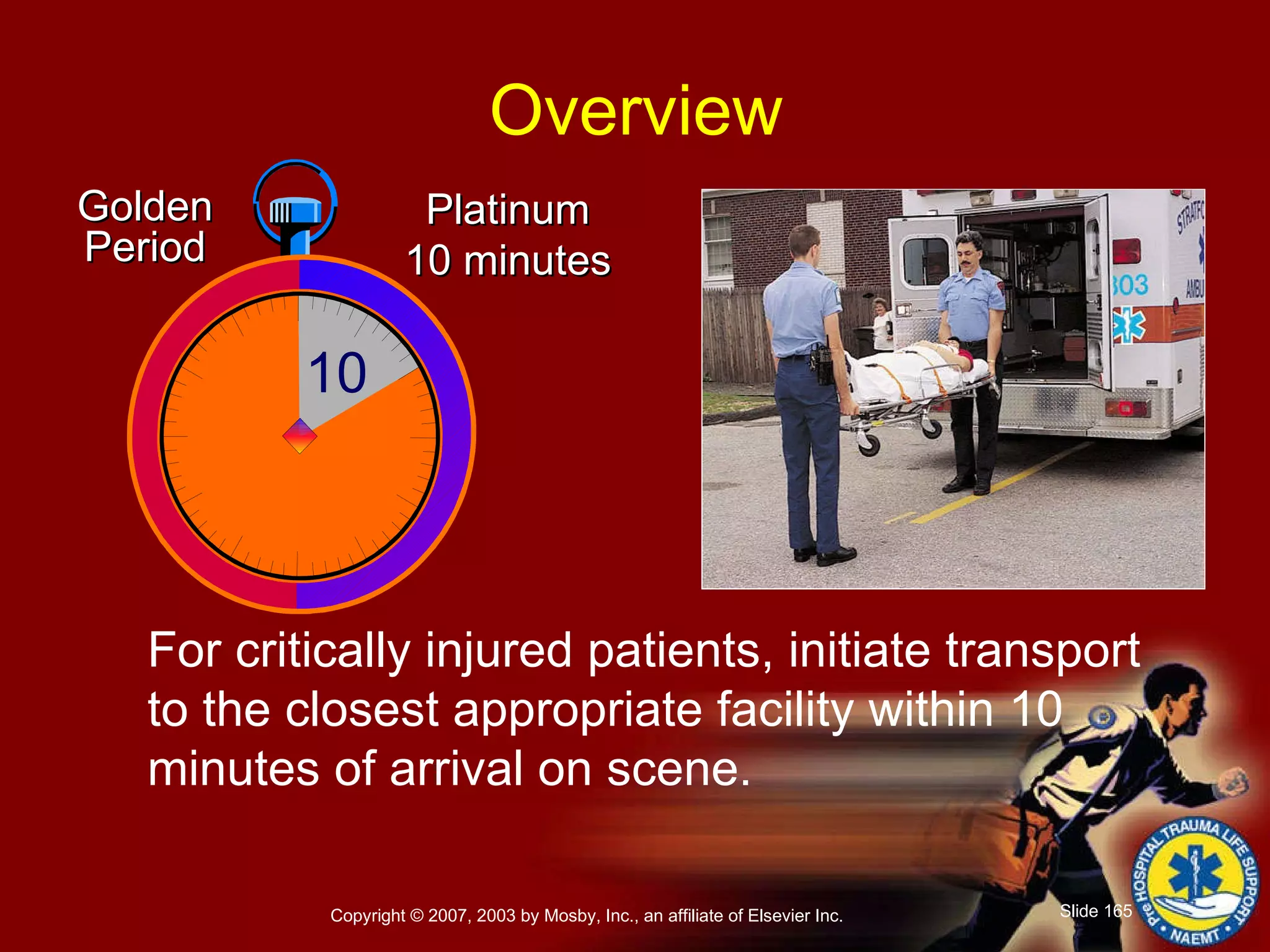
For critically injured patients, initiate transport  to the closest appropriate facility within 10 minutes of arrival on scene. Platinum 10 minutes Golden Period Overview 10
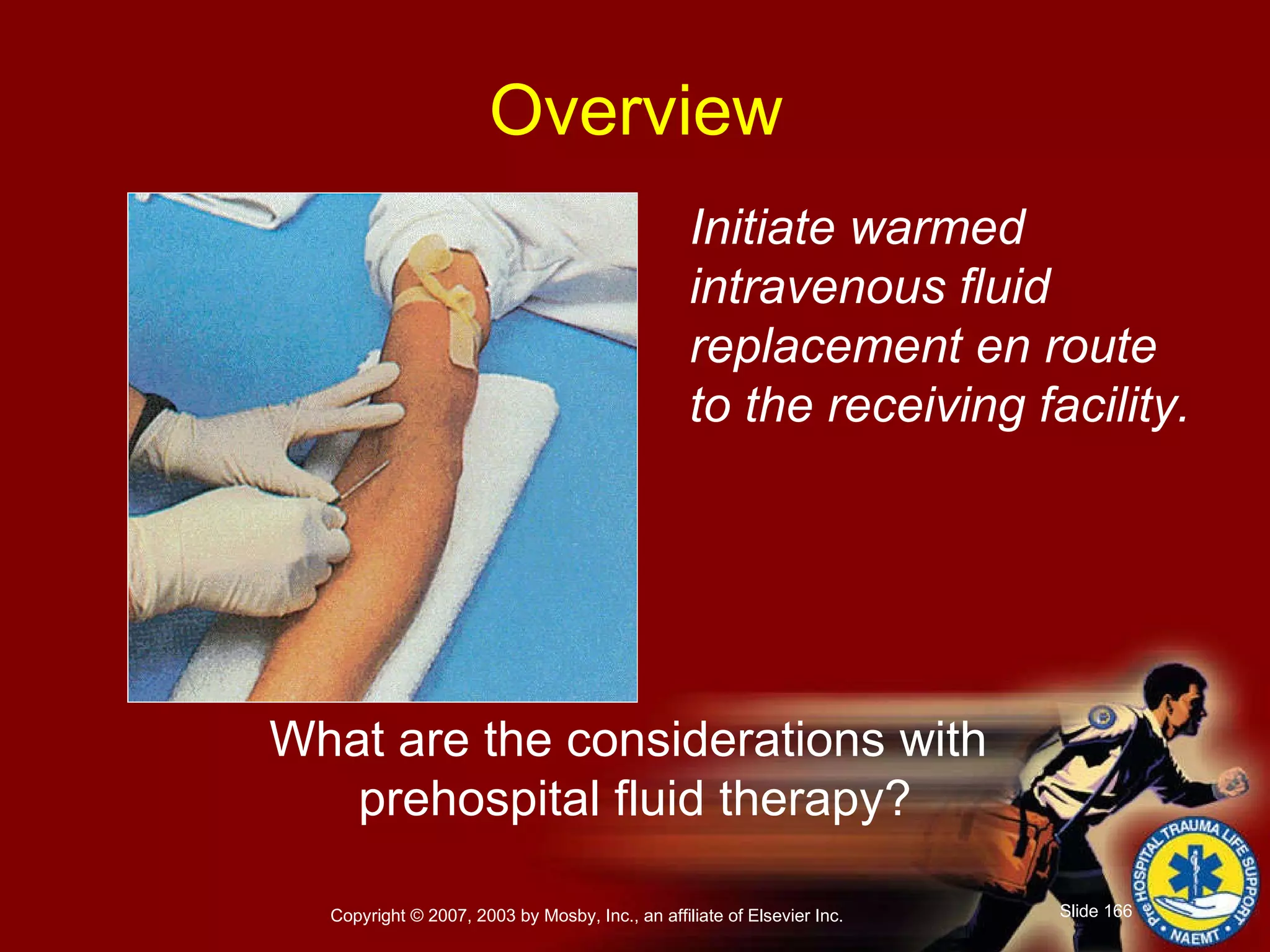
Initiate warmed intravenous fluid replacement en route  to the receiving facility. What are the considerations with  prehospital fluid therapy? Overview
Ascertain the patient’s medical history and perform a secondary survey when life-threatening problems have been satisfactorily managed or have been  ruled out. Overview
Above all,  do no further harm.
Fundamental Principles Rapid assessment Key field interventions Rapid transport to the closest appropriate facility
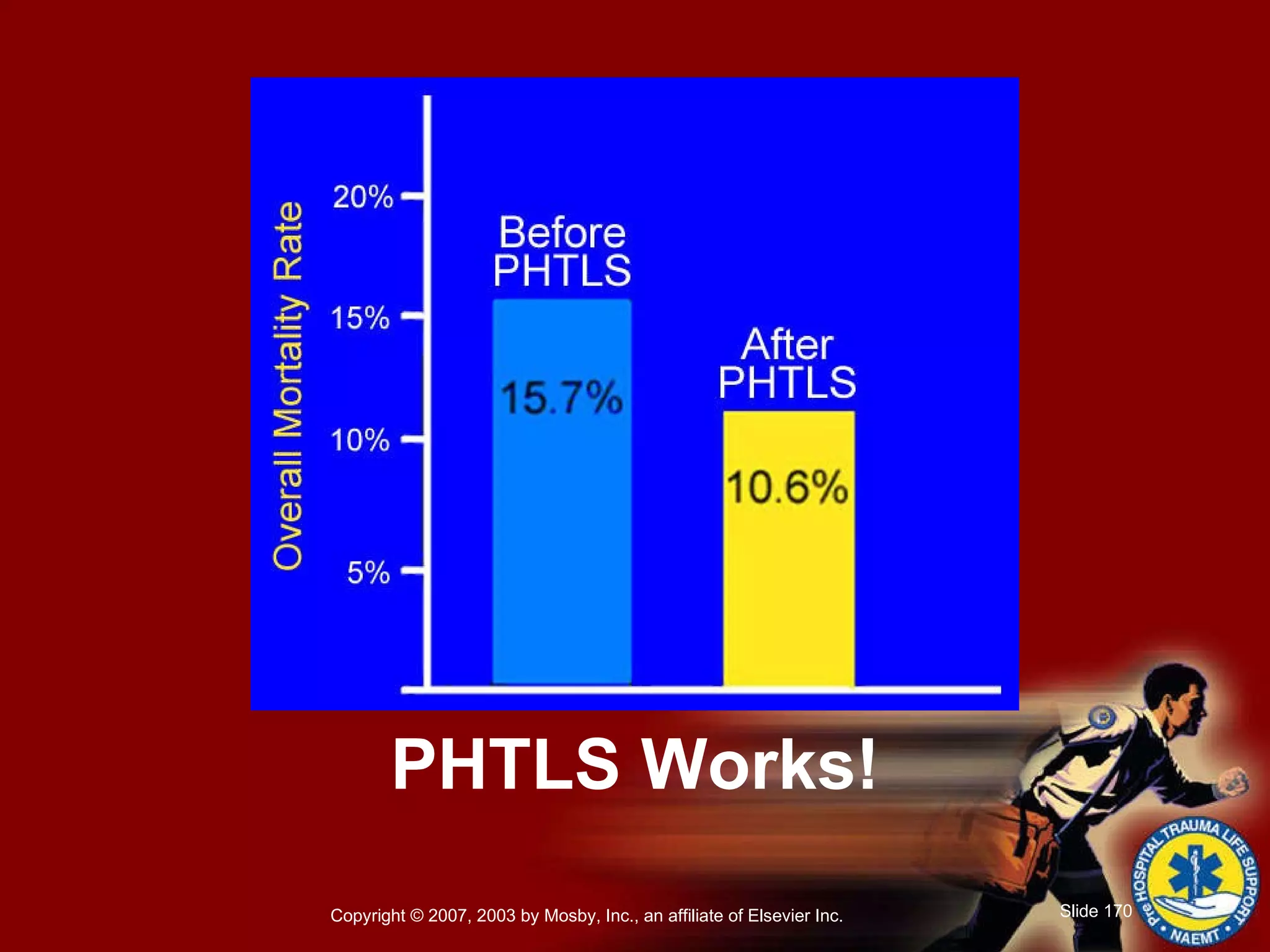
PHTLS Works!
QUESTIONS?

Refresher Program

  • 1.
    Prehospital Trauma Life Support PHTLS Refresher Program
  • 2.
    Course Purpose Reaffirmknowledge of prehospital trauma care Introduce recent changes in trauma care as it affects the prehospital patient Demonstrate proficiency at performing skills necessary in the care of critically injured patients
  • 3.
    Prehospital Trauma LifeSupport Managing the Multisystem Trauma Patient Part I
  • 4.
    Objectives Discuss thelaws of energy and motion Discuss trauma associated with blunt impact and penetrating injury Overview of the effects of energy distribution in MVCs Review the kinematics of blast and violent injuries Use kinematics to predict injury patterns
  • 5.
    Predicting Injury Ina 50 mph (80 km/h) MVC, what types of injuries would occur if the patient were to strike the windshield?
  • 6.
    What type ofinjury patterns might you see in a frontal impact? Frontal Impact
  • 7.
    What types ofinjuries would you expect? Rear Impact
  • 8.
    What types ofinjuries would you expect? Lateral Impact
  • 9.
    What types ofinjuries would you expect? Rotational Impact
  • 10.
    What injury patternsmight you see following this crash? Rollover
  • 11.
    Warfare/terrorism Industrial/residential Whattypes of explosions may occur in your area? Blast Injuries
  • 12.
    Three injury patternsPrimary Secondary Tertiary Blast-Related Injuries
  • 13.
    Cause: pressure/heat wave from blast Affected area: Gas-containing organs Skin What types of injuries would you expect? Primary Blast Injuries
  • 14.
    Cause: flying debrisAffected areas Skin Internal organs Skeleton What types of injuries would you expect? Secondary Blast Injuries
  • 15.
    Cause: victim thrown against an object Affected area Area of impact or referred energy What types of injuries would you expect? Tertiary Blast Injuries
  • 16.
    Low velocity Multiplewounds from a single weapon Cone of injury A knife, ice pick, and scissors are common weapons. Injuries are usually limited to depth and area of penetration Stab Wounds Would a longer knife have a larger cone of injury?
  • 17.
    Stab Wounds: KeyIssues Type of weapon Number of wounds Depth of penetration Anatomic structures along potential path
  • 18.
    Gunshot Wounds Howdo the injuries differ when created by medium- or high-velocity weapons?
  • 19.
    Projectiles: Key IssuesProfile Fragmentation Tumble/pathway Velocity
  • 20.
    To what iscavitation related? Gunshot Wounds: Cavitation
  • 21.
    Entrance and exitwounds Gunshot Wounds
  • 22.
    The ultimate infragmentation is created by shotgun wounds Shotgun Wounds
  • 23.
    Scene safety isthe top priority! Weapon type Anatomic structures along potential path Crime scene preservation Patient care takes precedence Considerations for Penetrating Trauma
  • 24.
    Objectives Discuss theimportance of scene assessment Identify components of the primary survey Differentiate between critical and noncritical patients Defend the need for early transport of critical patients Describe when to perform a secondary survey
  • 25.
    It’s mid-January andyou have been dispatched to a multivehicle crash on the interstate. Initial reports indicate there are multiple patients and a fuel tanker is involved. When does your scene assessment begin? Scenario
  • 26.
    What are thecomponents of scene assessment?
  • 27.
    Scene Safety Ensuresafety of rescuers and patients Threatening situations may include: Fire Electrical lines Hazardous materials Blood and body fluids Can you think of any other hazards? Traffic Weapons Environmental conditions
  • 28.
    Scene Situation Whatreally happened? What are the kinematics? How many patients involved? Ages? Additional resources needed? How will patients be transported?
  • 29.
    Your patient isthe 32-year-old female unrestrained driver who is found slumped over in the vehicle. She has no obvious external hemorrhage, is breathing rapidly, and is mumbling inappropriate words. What do these findings suggest? How should you assess this patient? Scenario
  • 30.
    Patient Assessment Primarysurvey “ Treat as you go” Resuscitation Secondary survey Definitive care in the field
  • 31.
    Glasgow Coma ScaleEyes “ Open your eyes” Nailbed pressure or axillary tissue squeeze Verbal “ What happened to you?” Add “T” to score if intubated Motor “ Hold up two fingers” Nailbed pressure or axillary tissue squeeze
  • 32.
    Glasgow Coma ScaleEye Opening Spontaneous 4 To Voice 3 To Pain 2 None 1 Verbal Response Oriented 5 Confused 4 Inappropriate Words 3 Incomprehensible Words 2 None 1 Motor Response Obeys Command 6 Localizes Pain 5 Withdraws (pain) 4 Flexion (pain) 3 Extension (pain) 2 None 1
  • 33.
    Expose/Environment Expose patientas environment allows to assess for other life-threatening conditions; then preserve/maintain body heat Life-threatening conditions missed because of failure to adequately expose the patient Failing to preserve body heat and to consider environmental conditions
  • 34.
    Simultaneous Assessment BreathingAirway Kinematics Circulation Disability Expose/ Environment
  • 35.
    Decision Making Trauma-relatedincident Scene assessment Primary survey Life -threatening or multisystem injuries No Yes Initiate rapid transport Reassess Secondary survey Secondary survey Reassess Manage injuries as appropriate Initiate transport
  • 36.
    A 16-year-old losescontrol of his bicycle on gravel. Your patient is found on the side of the road holding his right wrist. Multiple abrasions are noted on his face and upper extremities. The scene is safe. Scenario
  • 37.
    Primary Survey A:Patent B: Normal; BS clear C: Minor bleeding from chin laceration; radial pulse normal; skin warm, pink, and dry D: GCS score 15 E: Deformity noted to right wrist How do you proceed?
  • 38.
    Secondary Survey Vitalsigns AMPLE history Head-to-toe exam Performing a secondary survey on a critical patient prior to initiating resuscitation Failing to complete a secondary survey on a noncritical patient
  • 39.
    Head-to-Toe Exam Systematicand Complete Observation What do we look for? Auscultation What do we listen for? Palpation What do we feel for?
  • 40.
    Definitive Care inthe Field Packaging Spinal immobilization if indicated Splint musculoskeletal injuries Dress wounds
  • 41.
    Transportation Closest appropriate facility In general, bypass closest facility to reach trauma center Receiving facilities should be determined by local protocol Mode Ground Aeromedical
  • 42.
    Trauma Center CandidatesTriage to trauma centers determined by: Physiologic criteria Anatomic criteria Mechanism of injury Preexisting conditions Follow local protocol
  • 43.
    Pain Management Consideranalgesia for: Isolated extremity injury Spinal fracture Narcotics Titrate in small increments IV Beware of ventilatory depression and vasodilation (hypotension)
  • 44.
    You are dispatchedto a motorcycle and vehicle collision. Bystanders report that the motorcycle was traveling at about 40 mph (65 km/h) when a car pulled in front of the motorcycle. You find the patient lying on the pavement 30 ft (9 m) away from the crash. His helmet is heavily damaged and has been removed by a bystander. Scenario
  • 45.
    Findings Gurgling ventilationsBlood is seen in the upper airway Ventilations are rapid and labored Patient is cyanotic Is this airway compromised?
  • 46.
    You arrive onthe scene of a single vehicle MVC. Your patient is a 25-year-old female who is trapped upright in the driver’s seat. Her VR is 36 and she is cyanotic. Gurgling sounds do not improve with suctioning or manual maneuvers. The fire department estimates that it will be 10 minutes before she is extricated. How would you manage her airway at this point? Scenario
  • 47.
    Face-to-Face Intubation Oralendotracheal intubation can be accomplished by using nontraditional methods
  • 48.
    Your patient isa 35-year-old construction worker who fell 25 ft (7.6 m) and landed on his head. His GCS score is 3. He is apneic and is being ventilated with a BVM. Three attempts at orotracheal intubation are unsuccessful. What are the airway management options at this point? Scenario
  • 49.
    Alternative Airway Procedures Laryngeal mask airway (LMA) Digital intubation Retrograde intubation Percutaneous transtracheal ventilation (PTV) Surgical cricothyrotomy
  • 50.
    At a collegebaseball game a 22-year-old third baseman is struck in the head by a line drive. Upon your arrival his GCS score is 7 (E-1, V-1, M-5). His teeth are clenched and he is vomiting. How would you manage his airway? Scenario
  • 51.
    Objectives Describe thepathophysiology of shock Identify the types of shock Differentiate between signs of compensated and decompensated shock Discuss the role of hemorrhage control, hypothermia, PASG, and volume resuscitation in shock management
  • 52.
    Shock “ Thepatient is in shock! ” What does this term mean?
  • 53.
    Staged Death HypoperfusionCellular hypoxia Anaerobic metabolism Cell death Organ failure Patient death
  • 54.
    Whatconditions can interfere with each component of the Fick principle? Alveolus Capillaries Red blood cells Capillaries Kidney O 2 O 2
  • 55.
    Your patient isa 30-year-old woman who lost control of her vehicle, which then struck a light pole. The patient was unrestrained. There is significant damage to the vehicle. You find the patient slumped over in the driver’s seat. You see that the steering wheel is bent. The scene is safe. Scenario
  • 56.
    Primary Survey A:Patent B: Fast; BS clear C: No external hemorrhage; weak and rapid radial pulse; cool and diaphoretic skin D: GCS score 14 (E-4, V-4, M-6); anxious E: Bruising across abdomen and right thigh deformity Vitals: VR, 24; pulse, 118; BP, 112/82 Is this patient in shock? Why?
  • 57.
    What is themost likely cause of the patient’s shock? Why is the patient’s BP normal? Primary Survey
  • 58.
    Estimated Blood LossApproximate internal Bone blood loss (mL) Rib 125 Radius or ulna 250–500 Humerus 500–750 Tibia or fibula 500–1000 Femur 1000–2000 Pelvis 1000–massive
  • 59.
  • 60.
    Your patient isa 27-year-old male who was working in a grain silo. His left leg became entrapped in an auger. After a 45-minute extrication process, the fire department manages to release his mangled leg. Scenario
  • 61.
    Primary Survey A:Patent B: Marked tachypnea C: Moderate hemorrhage from extensive soft tissue injury to lower left leg; no radial pulse; very fast, weak carotid pulse; pale, cool, diaphoretic skin D: GCS score 12 (E-3, V-3, M-6) Vitals: VR, 38; pulse, 140; BP, 74/50 What stage of shock is the patient in?
  • 62.
    A 27-year-old maledock worker was pinned between a fork lift and a loading dock. Upon your arrival, the patient is lying supine on the ground complaining of severe lower abdominal pain. The ambient temperature is 35° F (1° C). You are 25 minutes from the trauma center. Scenario
  • 63.
    Primary Survey A:Patent B: VR fast C: No external hemorrhage; rapid and weak radial pulse; pale, cool, moist skin D: GCS score 15 E: Significant pain on palpation of lower abdomen and pelvis What are the principles of shock management?
  • 64.
    PASG Indications Suspectedpelvic fractures with SBP less than 90 mm Hg Suspected intraperitoneal hemorrhage with SBP less than 90 mm Hg Suspected retroperitoneal hemorrhage with SBP less than 90 mm Hg SBP less than 60 mm Hg What are contraindications for PASG?
  • 65.
    Volume Resuscitation Preferablytwo large-bore peripheral IVs Lactated Ringer’s Warmed fluid if possible (102° F/39 ° C) Initial bolus Adults: 1 to 2 L Pediatric: 20 mL/kg Delaying transport of critical patients to initiate IVs on scene
  • 66.
    Prehospital Trauma LifeSupport Managing the Multisystem Trauma Patient Part II
  • 67.
    Objectives Review theanatomy of the chest Discuss the mechanics of breathing Detail the assessment process Cover the management of: Rib fracture Flail chest injury Pulmonary contusion Pneumothorax (open and tension) Hemothorax Blunt cardiac injury
  • 68.
    Responding to acall at a police station, you encounter a 19-year-old male complaining of chest pain and dyspnea. You learn that your patient was kicked in the chest during a fight. What injuries could occur with this mechanism? Scenario
  • 69.
    Primary Survey A:Patent B: Left chest pain during inspiration; BS equal, VR fast C: No external bleeding, normal pulse rate D: GCS score 15 What injuries can you rule out? How should this patient be managed?
  • 70.
    Your patient sustaineda close-range shotgun blast to the abdomen. A segment of bowel is eviscerated. How are eviscerations managed? Scenario
  • 71.
    A 24-year-old femalefell down a flight of stairs. She is 36 weeks pregnant. She is complaining of severe back pain. What physiologic changes occur during pregnancy? What are the common causes of injury in the pregnant patient? Scenario
  • 72.
    Primary Survey A:Patent B: Normal C: Pulse rapid; skin warm and dry D: Anxious E: No obvious injury noted Vitals: pulse, 114; VR, 20; BP, 92/56 Are these findings due to trauma or pregnancy?
  • 73.
    After immobilization toa long backboard, reassessment shows her radial pulse to be 140 and weak. Her BP is 80/60. What could explain these findings? How would you manage this patient? Scenario
  • 74.
  • 75.
    Objectives Define primaryand secondary brain injury Discuss how assessment findings suggest traumatic brain injury Discuss management for suspected traumatic brain injury
  • 76.
    Traumatic Brain Injury(TBI) Commonly occurs in young adults Major contributing cause of trauma deaths Many survivors have permanent disability
  • 77.
    Anatomy Skull PeriosteumDura mater } One functional layer Arachnoid membrane Pia mater (directly attached to brain surface and not removable Vessels in subarachnoid space Epidural space Subdural space Subarachnoid space
  • 78.
  • 79.
    Pathophysiology Primary braininjury Secondary brain injury Systemic causes Intracranial causes Can you name some examples of systemic and intracranial causes?
  • 80.
    Your patient isa 12-year-old Little League baseball player who was struck in the head by a line drive. How could TBI affect: Airway? Breathing? Circulation? Disability? Scenario
  • 81.
    Primary Survey Bystandersreport a 5-minute loss of consciousness. The child is now awake and complaining of a headache and has vomited once. A: Intact B: Normal C: Normal D: GCS score 14 (E-4, V-4, M-6), PERL What is a concussion?
  • 82.
    You are calledto a local bar where a 22-year-old male has been in a fight. Bystanders state that your patient was beaten with a pool cue. The scene is safe. Scenario
  • 83.
    Primary Survey A:Snoring noises B: VR slow and shallow; BS equal C: No external hemorrhage, radial pulse fast D: GCS score 6 (E-1, V-1, M-4); pupils R>L, sluggish E: Multiple hematomas on scalp and face Vitals: VR, 8; pulse, 110; BP, 150/90 What injuries do these findings suggest?
  • 84.
    You are calledto the scene of a rollover MVC where a 16-year-old female was ejected from the vehicle. You see the patient lying supine on the ground. Her breathing is noisy and rapid. She has a large scalp laceration. You identify no hazards. Scenario
  • 85.
    Primary Survey A:Snoring, gurgling noises B: VR rapid and shallow; BS decreased bilaterally C: Moderate bleeding from scalp; rapid, bounding carotid pulse D: GCS score 5 (E-1, V-1, M-3) Vitals: VR, 38; pulse, 124; BP, 80/P
  • 86.
    What life-threatening conditionsdo you identify? What could be causing her shock? Primary Survey
  • 87.
    Management Goals forthe TBI patient include preventing and reversing causes of secondary brain injury
  • 88.
    Objectives Identify life-threateningconditions associated with spinal trauma Recognize the indications for spinal immobilization Discuss the principles of spinal immobilization Describe use of rapid extrication
  • 89.
    Spinal Trauma Asmany as 15,000 to 20,000 spinal injuries occur annually The most common age is 16 to 35 years old Causes MVCs Falls Penetrating injuries Sports injuries
  • 90.
    You are calledto a public pool for a 16-year-old male who sustained an injury while diving. Upon your arrival he has been removed from the pool. Scenario
  • 91.
    Primary Survey A:Patent B: Rapid and shallow C: Slow heart rate; weak radial pulse; warm extremities D: GCS score 15, loss of motor and sensory function in extremities E: No other obvious injuries What is the life-threatening problem?
  • 92.
    Sensory Assessment Nippleline = T4 Umbilical line = T10
  • 93.
    How would youmanage this patient? Scenario
  • 94.
    A 28-year-old malehas been shot in the neck by his girlfriend. Scenario
  • 95.
    Primary Survey A:Patent B: Fast; BS equal C: Copious external hemorrhage from neck wound, radial pulse fast and weak D: GCS score 15; no neurological deficits in extremities E: Expanding hematoma to left side of neck When is spinal immobilization indicated for penetrating trauma?
  • 96.
    Unstable spinal fracturesfrom penetrating trauma are extremely rare Life-threatening conditions take priority Penetrating Trauma Neurological deficit/complaint? No Yes IMMOBILIZE IMMOBILIZATION NOT INDICATED Rapid transport Rapid transport
  • 97.
    You are calledto a nightclub where a 35-year-old female has fallen down a flight of stairs. Your patient denies neck and back pain but complains of severe left ankle pain. You smell alcohol on her breath. Scenario
  • 98.
    Primary Survey A:Patent B: Normal; BS clear C: Minor bleeding from small scalp laceration; normal radial pulse D: Slurred speech; GCS score 15 E: Grossly deformed left ankle When is spinal immobilization indicated for blunt trauma?
  • 99.
    Blunt Trauma Alteredlevel of consciousness (GCS less than 15) No Yes IMMOBILIZE Rapid transport Spinal pain or tenderness? or Neurological deficit or complaint? or Anatomic deformity of spine? No Yes IMMOBILIZE Rapid transport Concerning mechanism of injury?
  • 100.
    Concerning Mechanism ofInjury Violent impact to the head, neck, torso, or pelvis Sudden acceleration, deceleration, or lateral bending forces to neck or torso Any fall Ejection or fall from any motorized or human-powered transport device Shallow-water diving incident
  • 101.
    Distracting Injuries Anyinjury that may have the potential to impair the patient’s ability to appreciate other injuries Long bone fracture Suspected visceral injury Large laceration, degloving, or crush injury Large burns Any other injury that produces acute functional impairment
  • 102.
    Inability to CommunicateSpeech or hearing impaired Speaks foreign language Small children
  • 103.
    Presence of: Evidenceof alcohol/drugs or Distracting injury or Inability to communicate When in doubt, immobilize! Concerning Mechanism of Injury No Yes IMMOBILIZE IMMOBILIZATION NOT INDICATED Rapid transport Transport No Yes IMMOBILIZATION NOT INDICATED Transport
  • 104.
    You are calledto the scene of a multivehicle crash on a highway. After your patient’s vehicle was rear-ended, it was propelled into the vehicle in front of it. The vehicle has moderate damage. The driver was unrestrained and the windshield is spider-webbed. On the basis of kinematics, why should spinal injury be suspected? Scenario
  • 105.
    Primary Survey A:Patent B: Normal; BS clear C: Normal radial pulse D: GCS score 15 E: Abrasion on forehead What are the indications for rapid extrication?
  • 106.
    The patient iscomplaining of neck pain. What role does a cervical collar play in spinal immobilization? How is spinal immobilization performed? Primary Survey
  • 107.
    Prehospital Trauma LifeSupport Managing the Multisystem Trauma Patient Part III
  • 108.
    Objectives Discuss thepathophysiology of musculoskeletal trauma Discuss the management of musculoskeletal trauma in isolated trauma and multisystem trauma
  • 109.
    You are calledto the scene where an intoxicated male has stumbled and put his hand through a window. On your arrival you see a large amount of blood and broken glass by the front door. The police direct you to a 40-year-old male sitting in a chair, bleeding heavily from the upper arm. On examination you see a laceration to the antecubital fossa with copious, bright-red bleeding. Scenario
  • 110.
    What, if any,life-threatening injuries are present? What are some examples of life-threatening musculoskeletal injuries? What ways exist to control the bleeding? Does this injury require rapid packaging and transport? Scenario
  • 111.
    A 28-year-old femalefell while skiing. Ski patrol has brought her to the lodge. She complains of severe right thigh pain. Scenario
  • 112.
    Primary Survey A:Patent B: Normal C: No external hemorrhage; normal pulse rate; skin warm and dry D: GCS score 15 What are your conclusions based on these findings?
  • 113.
    Secondary Survey Youfind a swollen angulated right thigh. How much blood could a patient lose from this type of injury? Is this enough to cause shock? How would you manage this injury?
  • 114.
    Your patient isa 45-year-old male pedestrian who was struck by an SUV. He smells of alcohol. Scenario
  • 115.
    Primary Survey A:Patent B: VR rapid and shallow; clear BS C: Blood oozing from multiple soft tissue injuries; weak and rapid radial pulse D: GCS score 13 (E-3, V-4, M-5) When you gently stress his pelvis, crepitus is noted and the patient screams in pain.
  • 116.
    What are yourconclusions based on the primary survey? What are your management priorities for this patient? Primary Survey
  • 117.
    A 22-year-old malecrashed while riding a mountain bike. Because of the remote location, you reach the patient about 1½ hours after the injury occurred. A: Patent B: VR slightly increased C: No external hemorrhage; rapid and weak radial pulse D: GCS score 15 E: Deformities noted to left upper arm and to both lower legs Scenario & Primary Survey
  • 118.
    Secondary Survey VR,24; pulse, 122; BP, 104/72 There is no abdominal or pelvic tenderness. How do you explain these findings?
  • 119.
    Table of EstimatedBlood Loss Approximate internal Bone blood loss (mL) Rib 125 Radius or ulna 250–500 Humerus 500–750 Tibia or fibula 500–1000 Femur 1000–2000 Pelvis 1000–massive
  • 120.
    A 70-year-old womanslipped on some ice and fallen down a staircase. On your arrival she is complaining of pain in her left wrist and left ankle. On examination, deformities are found in both extremities. Scenario
  • 121.
    Primary Survey A:Patent B: VR slightly fast C: Moderate hemorrhage from oozing and open ankle; irregular pulse D: GCS score 15 VR, 22; pulse, 105; BP, 110/70 Complains of pain at fracture sites
  • 122.
    Are life-threatening injuriespresent? How are you going to manage this patient? Primary Survey
  • 123.
    Objectives Identify, manage,and differentiate critical and noncritical burns Identify how chemical and electrical burns differ from thermal burns Discuss assessment and care of CO inhalation Address the priorities for assessing and managing heat-related injuries Discuss the priorities for assessing and managing cold-related injuries
  • 124.
    You are calledto care for a patient who has been burned while fueling his lawn mower. As you approach, you see a 65-year-old male with burns to his right arm and anterior chest. The fire is now extinguished. Scenario
  • 125.
    Primary Survey A:Patent B: Normal; clear BS C: No external bleeding; normal pulse rate DL GCS score 15 E: Bright-red skin with blisters on chest and entire right arm What are the key issues in assessing thermal burns?
  • 126.
    Rule of NinesWhat percent of BSA is burned? 9% 18% 9% 9% 18% 18% 18% 1% 18% 18% 9% 9% 18% 1% 13.5% 13.5%
  • 127.
    What are otherfactors in assessing patients with thermal burns? How are you going to treat this patient? When is pain management indicated? Primary Survey
  • 128.
    Resuscitation Parkland formula 4 mL × BSA × weight (kg) Calculate the Parkland formula for this patient (wt=70 kg) How is this administered?
  • 129.
    Wound Management Superficial(first degree) Generally no field treatment needed Partial thickness/full thickness (second degree/third degree) Dry, clean dressings preferred Do not apply ointments or salves Do not attempt to break blisters Do not remove clothing that is melted to skin
  • 130.
    Pain Management Administeranalgesics if indicated Intermittent IV doses of narcotics Nitrous oxide Moist dressings ONLY if less than 10% BSA burned If more than 10%, wet dressings can cause hypothermia
  • 131.
    You respond toa structure fire/explosion. On your arrival you see a 40-year-old male who has just been removed from the building and appears unresponsive. What are your first priorities? Scenario
  • 132.
    Primary Survey A:Stridor noted; oral mucosa appears red B: Rapid; BS equal; rhonchi in all fields C: No external bleeding; weak and rapid pulse D: GCS score 3 (E-1, V-1, M-1) E: Partial-thickness burns of upper chest (9% BSA) What are your immediate concerns? Why is he showing signs and symptoms of shock?
  • 133.
    Possible Injuries Airwayand pulmonary burns secondary to inhalation of superheated gases Associated injuries CO poisoning Burns How are you going to treat this patient?
  • 134.
    Special Burn SituationsChemical burns What is different about these burns? How would you treat chemical burns?
  • 135.
    Electrical Burns Currentburns Arc (flash) injuries Contact burns How do you manage these injuries?
  • 136.
    Patients Requiring Burn Centers Inhalation injuries Partial-thickness burns more than 10% Full-thickness burns Burns to face, hands, feet, genitalia, perineum, or major joints Electrical burns Chemical burns Burn injury in compromised patient Other special situations
  • 137.
    Burns: Summary DONOT become a victim yourself Airway management and oxygenation are critical Early shock after burns points to other injuries Avoid hypothermia Transport patient to an appropriate facility Pain management Fluid therapy as indicated
  • 138.
  • 139.
    You are doingrace coverage for a 10-km (6-mile) race. The temperature is 90° F (32° C) with 90% humidity. On finishing the race, a 55-year-old male collapsed. On your arrival you find the patient confused. What places this patient at high risk for a heat emergency? How would you treat him? Scenario
  • 140.
    Other Heat-Related InjuriesHow do the presentations and management differ for each of the following? Heat cramps Heat exhaustion Heat stroke
  • 141.
    Hypothermia Hypothermia beginswhen body temperature reaches 95° F (35° C) Shivering begins Heart rate, ventilations, and BP begin to decrease CNS impairment Below 90° F (32° C), shivering ceases Below 82° F (28° C), ventricular fibrillation possible
  • 142.
    You respond tothe scene where a 34-year-old male has slipped in mud and fallen into a sewer. You are on the scene when, after 10 minutes, the rescue team brings up a limp body. Scenario
  • 143.
    Primary Survey A:Water in oropharynx B: Apneic C: No active hemorrhage; very slow and weak carotid pulse D: Unresponsive; GCS score 3 (E-1, V-1, M-1) E: Clothing is wet How are you going to manage this patient?
  • 144.
    Objectives Identify injurypatterns common to geriatric and pediatric trauma patients Identify anatomic and physiologic differences in pediatric and geriatric patients Discuss the importance of obtaining history for pediatric and geriatric trauma patients Discuss the management of pediatric and geriatric trauma patients
  • 145.
    Pediatric Trauma Injuryis the most frequent cause of death Approximately 20% to 40% of deaths may be preventable What are the common mechanisms of injury in children?
  • 146.
    You respond toa call for an injured child. You arrive to find a 5-year-old boy on the ground next to his bicycle. How will your assessment differ for children? Scenario
  • 147.
    Pediatric Vital SignsAge 0-2 months 3 months 6 months 1 year 2 years 3 years 4 years 5 years 6 years 7 years 8 years 9 years Mean Weight (kg) 3.0 6.0 8.0 10.0 12.5 14.5 17.0 18.5 21.0 23.0 25.0 28.0 Pulse Range 100-170 100-170 100-170 90-170 90-170 70-130 70-130 70-130 60-110 60-110 60-110 60-110 Hypotensive Systolic Blood Pressure 60 60 60 70 70 70 70 80 80 80 80 80 Ventilatory Range 30-60 30-60 30-60 30-60 30-60 20-40 20-40 20-40 15-30 15-30 15-30 15-30
  • 148.
    Primary Survey A:Snoring noises B: Rapid and shallow ventilations C: No obvious bleeding; weak and rapid pulse D: GCS score 10 (E-2, V-3, M-5); contusion to forehead E: Air is 50° F (10° C) and damp How would you manage this patient?
  • 149.
    Fluid Management AccessPeripheral IV preferred Intraosseous (second-line) Administration Bolus 20 mL/kg and repeat up to 3 times
  • 150.
    You are onthe scene with an 85-year-old woman who slipped and fell in her home. How does the assessment of the elderly patient differ from the younger adult? Scenario
  • 151.
    Primary Survey A:Open B: VR rapid with slight wheeze C: No obvious bleeding; normal and regular pulse D: Unable to move legs due to pain; GCS score 12 (E-3, V-4, M-5) E: No obvious external trauma How are you going to manage this patient?
  • 152.
    Special Considerations in the Elderly Preexisting disease may increase with age Age and general physical condition greatly influence response to injury Medical history Prescription medications Trauma may be the result of a medical emergency
  • 153.
    You are dispatchedto the scene of a pedestrian struck by a vehicle. Law enforcement and the fire department are en route. It is an overcast spring day with a temperature of 50° F (10° C). Scenario
  • 154.
    What are yourinitial concerns as you arrive on the scene?
  • 155.
    Ensure the safetyof the prehospital care providers and the patient. What are the safety concerns with this scene? Overview
  • 156.
    Assess the scenesituation to determine the need for additional resources. What additional resources may be needed? Overview
  • 157.
    Recognize the kinematicsthat produced the injuries. What are the factors relating to kinematics implied here? Overview
  • 158.
    Use the primarysurvey approach to identify life-threatening conditions. What are the key concepts of the primary survey? Overview Breathing Airway Kinematics Circulation Disability Expose/ Environment
  • 159.
    Provide appropriate managementwhile maintaining cervical spine stabilization. The patient has noisy ventilations and blood is draining from the oropharynx. What should be considered when managing this airway? Overview
  • 160.
    The patient’s ventilatoryrate is 6 and is shallow. Cyanosis is visible on the patient’s face and fingers. There is bruising across the chest and decreased breath sounds are heard on the left. GCS score is 7 (E-2, V-1, M-4). Support ventilation and deliver oxygen to maintain SpO 2 at 95% or more. How can this be accomplished? Overview
  • 161.
    Control any significantexternal hemorrhage. Overview
  • 162.
    Direct pressure controlsthe external hemorrhage from the right arm. The radial pulse is weak and rapid at about 140 beats/min. The patient is pale, cold, and clammy. There is crepitus and tenderness on palpation of the pelvis and a left thigh deformity consistent with a left midshaft femur fracture. How would you manage these findings? Overview
  • 163.
    Provide basic shocktherapy, including restoring and maintaining normal body temperature and appropriately splinting musculoskeletal injuries. Consider the use of the PASG for patients with decompensated shock (SBP less than 90 mm Hg) and suspected pelvic, intraperitoneal, or retroperitoneal hemorrhage; and in patients with profound hypotension (SBP less than 60 mm Hg). Overview
  • 164.
    Maintain manual spinalstabilization until the patient is immobilized onto a long backboard . When is spinal immobilization indicated? Overview
  • 165.
    For critically injuredpatients, initiate transport to the closest appropriate facility within 10 minutes of arrival on scene. Platinum 10 minutes Golden Period Overview 10
  • 166.
    Initiate warmed intravenousfluid replacement en route to the receiving facility. What are the considerations with prehospital fluid therapy? Overview
  • 167.
    Ascertain the patient’smedical history and perform a secondary survey when life-threatening problems have been satisfactorily managed or have been ruled out. Overview
  • 168.
    Above all, do no further harm.
  • 169.
    Fundamental Principles Rapidassessment Key field interventions Rapid transport to the closest appropriate facility
  • 170.
  • 171.