The Dilemma in Approach to Polytrauma Management
Dr. SHUBHANSHU (Orthopedic Surgeon)
Overview
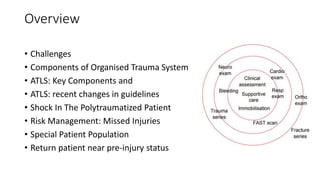
• Challenges
• Components of Organised Trauma System
• ATLS: Key Components and
• ATLS: recent changes in guidelines
• Shock In The Polytraumatized Patient
• Risk Management: Missed Injuries
• Special Patient Population
• Return patient near pre-injury status
Introduction:
• Challenges
• Common injuries
• Common causes of mortality
• Initial management
• Definitive Management
• Approach to improve the outcome vs ETC
• Trauma courses and Mock drills
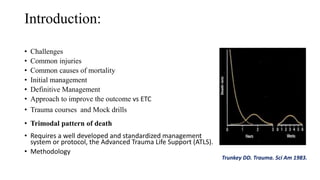
• Trimodal pattern of death
• Requires a well developed and standardized management
system or protocol, the Advanced Trauma Life Support (ATLS).
• Methodology
Trunkey DD. Trauma. Sci Am 1983.
Definition
• Polytrauma : Two or more significant injury to two or more organ
system
• Abbreviated Injury score(AIS)>2
• Injury Severity Score (ISS) > 15
• Definition also includes: concurrent injury to two or more body parts
or systems that results in cognitive, physical, psychological or other
psychosocial impairment.
Dobscha et al, Washington (DC): Department of Veterans Affairs (US); 2008 Sep.
• Sequential systemic reactions that may lead to:
dysfunction or failure of uninjured organs and vital systems
Challenges
• Real Challenge: RTA affects young productive population most
• Special Patient Populations
Polytrauma in pregnancy: Imaging, Positioning, priority
Elderly/ Paediatric
• Fear of fat embolism syndrome /ARDS/MODS/Sepsis/DVT/ Acute
PE
Challenges in Emergency
• Sensitive patients: team work and counselling
• Overcrowding : Train more and more co-workers
• Urgency of care: Mock drill at regular intervals
• Physical and psychological distress,
• Long wait before being seen by a doctor or being transferred
Components Of Organized Trauma Care Systems.
Leadership
Prehospital and in-hospital triage
 Designated and accredited trauma care facilities
Human resources (planning, administrative and clinical teamwork)
Good communication (at all levels of the trauma system)
 Data collection
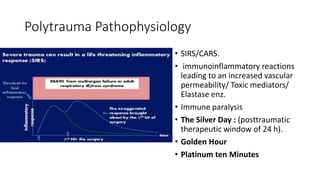
Polytrauma Pathophysiology
• SIRS/CARS.
• immunoinflammatory reactions
leading to an increased vascular
permeability/ Toxic mediators/
Elastase enz.
• Immune paralysis
• The Silver Day : (posttraumatic
therapeutic window of 24 h).
• Golden Hour
• Platinum ten Minutes
Decision making:
• Lactate/ Base deficit/ ABG
• Urine output
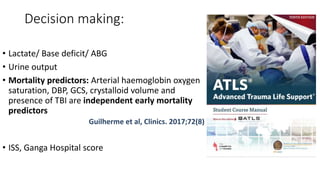
• Mortality predictors: Arterial haemoglobin oxygen
saturation, DBP, GCS, crystalloid volume and
presence of TBI are independent early mortality
predictors
Guilherme et al, Clinics. 2017;72(8)
• ISS, Ganga Hospital score
Key components of ATLS
• Team leader
• Solid framework
• Common language
• Hospital pre-alert/ Handover
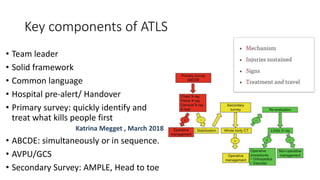
• Primary survey: quickly identify and
treat what kills people first
Katrina Megget , March 2018
• ABCDE: simultaneously or in sequence.
• AVPU/GCS
• Secondary Survey: AMPLE, Head to toe
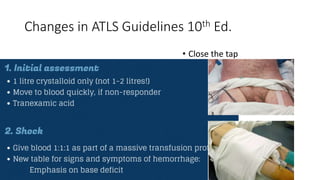
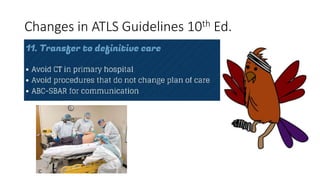
Changes in ATLS Guidelines 10th Ed.
• Close the tap
SHOCK
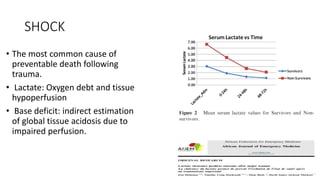
• The most common cause of
preventable death following
trauma.
• Lactate: Oxygen debt and tissue
hypoperfusion
• Base deficit: indirect estimation
of global tissue acidosis due to
impaired perfusion.
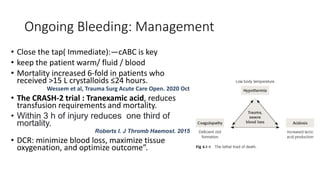
Ongoing Bleeding: Management
• Close the tap( Immediate):—cABC is key
• keep the patient warm/ fluid / blood
• Mortality increased 6-fold in patients who
received >15 L crystalloids ≤24 hours.
Wessem et al, Trauma Surg Acute Care Open. 2020 Oct
• The CRASH-2 trial : Tranexamic acid, reduces
transfusion requirements and mortality.
• Within 3 h of injury reduces one third of
mortality.
Roberts I. J Thromb Haemost. 2015
• DCR: minimize blood loss, maximize tissue
oxygenation, and optimize outcome”.
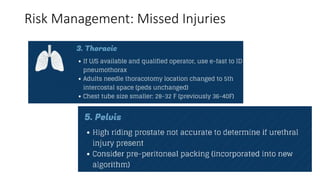
Risk Management: Missed Injuries
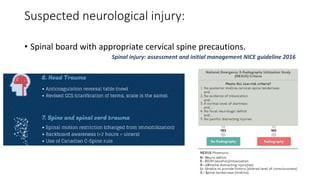
Suspected neurological injury:
• Spinal board with appropriate cervical spine precautions.
Spinal injury: assessment and initial management NICE guideline 2016
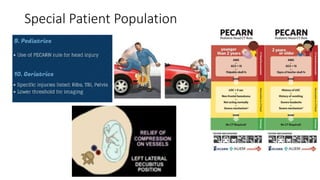
Special Patient Population
Changes in ATLS Guidelines 10th Ed.
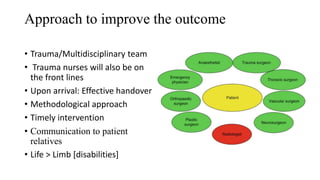
Approach to improve the outcome
• Trauma/Multidisciplinary team
• Trauma nurses will also be on
the front lines
• Upon arrival: Effective handover
• Methodological approach
• Timely intervention
• Communication to patient
relatives
• Life > Limb [disabilities]
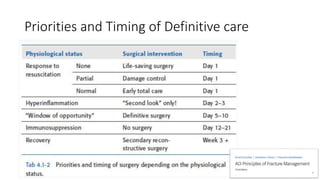
Priorities and Timing of Definitive care
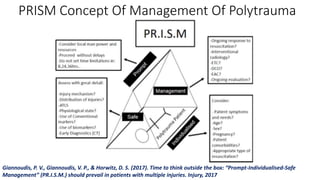
PRISM Concept Of Management Of Polytrauma
Giannoudis, P. V., Giannoudis, V. P., & Horwitz, D. S. (2017). Time to think outside the box: “Prompt-Individualised-Safe
Management” (PR.I.S.M.) should prevail in patients with multiple injuries. Injury, 2017
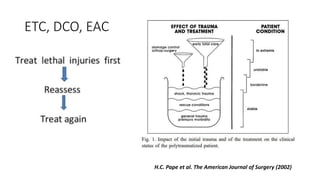
ETC, DCO, EAC
H.C. Pape et al. The American Journal of Surgery (2002)
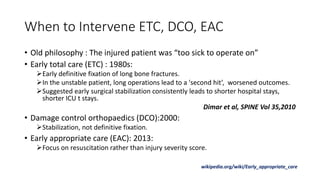
When to Intervene ETC, DCO, EAC
• Old philosophy : The injured patient was “too sick to operate on”
• Early total care (ETC) : 1980s:
Early definitive fixation of long bone fractures.
In the unstable patient, long operations lead to a 'second hit’, worsened outcomes.
Suggested early surgical stabilization consistently leads to shorter hospital stays,
shorter ICU t stays.
Dimar et al, SPINE Vol 35,2010
• Damage control orthopaedics (DCO):2000:
Stabilization, not definitive fixation.
• Early appropriate care (EAC): 2013:
Focus on resuscitation rather than injury severity score.
wikipedia.org/wiki/Early_appropriate_care
So Where we Stand
• Fracture fixation: Not during
resuscitation but delayed until
• Full resuscitation
• Return to normal physiological
parameters.
• Exception: Considers the fixation of
unstable pelvic and spinal fractures as a
part of resuscitation
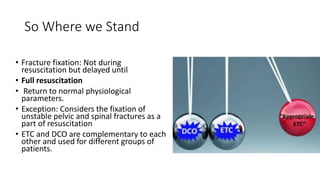
• ETC and DCO are complementary to each
other and used for different groups of
patients.
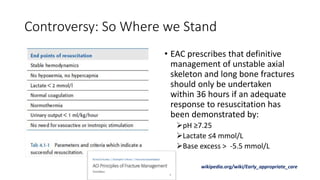
Controversy: So Where we Stand
• EAC prescribes that definitive
management of unstable axial
skeleton and long bone fractures
should only be undertaken
within 36 hours if an adequate
response to resuscitation has
been demonstrated by:
pH ≥7.25
Lactate ≤4 mmol/L
Base excess > -5.5 mmol/L
wikipedia.org/wiki/Early_appropriate_care
Dilemmas
• Ethical : Triage : Who shall live when not everyone can live
• Legal : Documentation and proper communication is lacking
• First aid: nearby clinics, vs multidisciplinary team.
Take Home
• Unstructured management: associated with avoidable death and
disability.
• Act quickly and systematically: Time is essence
• Ethical and legal issues : Adhere to Guidelines
• Assuming every patient is Covid positive: Take precautions