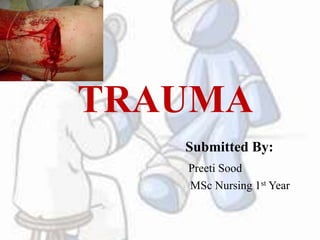
TRAUMA
Submitted By:
Preeti Sood
MSc Nursing 1st Year
Trauma
Terminology:
• Injury = The result of harmful event that arises
from the release of specific forms of energy.
• “Trauma” = Injury of one or more systems,
that results in excessive bleeding and may
affect the normal body functioning.
EPIDEMIOLOGY
• 3242 persons die each day around the world.
• 50 million people are disabled or injured each year.
• India : 1%of motor vehicles in the world but bears
the burden of 6% of global vehicular accidents.
• Unfortunately, a majority of trauma survivors are
either confined to bed or wheel chair for the rest of
their lives.
• The tragedy of India :
78% of the victims – men, 20 to 44 years, causing
significant impact on productivity.
• A vehicular accident reported every 3 min and a
death every 6 min on Indian roads
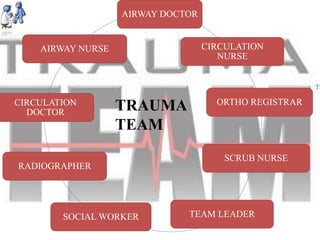
AIRWAY DOCTOR
CIRCULATION
NURSE
ORTHO REGISTRAR
SCRUB NURSE
TEAM LEADERSOCIAL WORKER
RADIOGRAPHER
CIRCULATION
DOCTOR
AIRWAY NURSE
TRAUMA
TEAM
Trauma deaths
FIRST PEAK
• Within minutes of injury
• Due to major neurological or vascular injury
• Medical treatment can rarely improve outcome
SECOND PEAK
• Occurs during the 'golden hour'
• Due to intracranial haematoma, major thoracic or abdominal injury
• Primary focus of intervention for the Advanced Trauma Life
Support (ATLS) methodology
THIRD PEAK
• Occurs after days or weeks
• Due to sepsis and multiple organ failure
Trauma
• Preparation and triage
• Primary Survey
• Adjuncts to primary survey
• Secondary Survey
• Adjuncts to secondary survey
• Definitive treatment
• Records, Consent, Forensic evidence
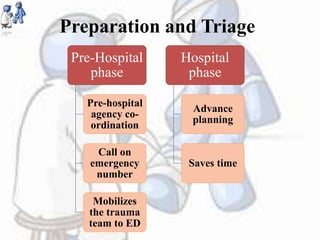
Preparation and Triage
Pre-Hospital
phase
Pre-hospital
agency co-
ordination
Call on
emergency
number
Mobilizes
the trauma
team to ED
Hospital
phase
Advance
planning
Saves time
Triage
The process of categorizing victims or mass
casualties based on their need for treatment and
the resources available.
ITS MAIN GOALS ARE:
• Prevent avoidable deaths.
• Ensure proper initial treatment with a minimal
time frame.
• Avoid misusing asserts on hopeless cases.
MULTIPLE CASUALTIES
No. of patients and the severity of their injuries
do not exceed the ability of the facility to
provide care.
MASS CASUALTIES
The no. of patients and the severity of their
injuries exceed the ability of the facility to
provide care.
Assessment of the injured patient
Primary survey and resuscitation
 A = Airway and cervical spine
 B = Breathing
 C = Circulation and hemorrhage control
 D = Disability or Dysfunction of the central
nervous system
 E = Exposure
Airway and cervical spine
• Always assume that patient has cervical spine
injury
• If patient can talk then he is able to maintain
own airway
• If airway compromised initially attempt a chin
lift and clear airway of foreign bodies.
• Intubate or cricothyroidotomy
• Give 100% Oxygen
Breathing
• Check position of trachea, respiratory rate and
air entry
• If clinical evidence of tension pneumothorax
will need immediate relief
• Place venous cannula through second
intercostal space in the mid-clavicular line
• If open chest wound seal with occlusive
dressing
Circulation and hemorrhage control
• Assess pulse, capillary return and state of neck
veins
• Identify exsanguinating hemorrhage and apply
direct pressure.
• Place two large calibre intravenous cannulas
Give intravenous fluids
• Attach patient to ECG monitor
Disability or Dysfunction of the
central nervous system
Rapid assessment of neurologic status to identify
life-threatening injury
• Pupil size and response
• Mental status (Glasscow coma scale)
• Motor and sensory exam
Exposure
Head to toe examination of the patient for injury
• Pitfalls
- Maintenance of spine precautions
- Prevention of heat loss
- Under cervical collar
- Back and flanks
• Undress the patient completely but prevent
hypothermia.
• Logrolling and looking for back of the pt. is very
important
Adjuncts to the Primary Survey
• Exams during or after primary survey to aid in
identifying life-threatening injuries
- ECG
- Pulse oximetry
- Chest x-ray
- Pelvis x-ray
- ABGS
- Catheters
- Focused abdominal sonogram for trauma (FAST)
- Diagnostic peritoneal lavage (DPL)
o Resuscitation may be required in some cases.
Secondary survey
Secondary survey does not begin until the primary survey is
completed, resuscitative efforts are established and patient is
demonstrating normalization of vital functions.
It includes:
• Head to toe evaluation
• AMPLE history
- Allergy
- Medications currently taking
- Past illness
- Last meal
- Event/environment related to injury.
• Physical examination
• Reassessment of all vital organs
Adjuncts to the secondary survey
• CT SCAN
• CONTRAST STUDIES
• EXTREMITY XRAY
• ENDOSCOPY
• ULTRASONOGRAPHY
Definitive Treatment
Treatment plans, especially for multiple injuries,
based on clinical status and specific injuries.
• AFTER identifying the patients injury.
• Managing life threatening problems
• Obtaining special studies.
• If the patients injuries exceed the capabilities
of the institution.
Take home message
• ABCDE approach.
• Treat greatest threat to life.
• Definitive diagnosis is not immediately
important.
• Time is the essence.
• Do no further harm the patient.
Trauma

Trauma

  • 1.
  • 2.
    Trauma Terminology: • Injury =The result of harmful event that arises from the release of specific forms of energy. • “Trauma” = Injury of one or more systems, that results in excessive bleeding and may affect the normal body functioning.
  • 3.
    EPIDEMIOLOGY • 3242 personsdie each day around the world. • 50 million people are disabled or injured each year. • India : 1%of motor vehicles in the world but bears the burden of 6% of global vehicular accidents. • Unfortunately, a majority of trauma survivors are either confined to bed or wheel chair for the rest of their lives. • The tragedy of India : 78% of the victims – men, 20 to 44 years, causing significant impact on productivity. • A vehicular accident reported every 3 min and a death every 6 min on Indian roads
  • 4.
    AIRWAY DOCTOR CIRCULATION NURSE ORTHO REGISTRAR SCRUBNURSE TEAM LEADERSOCIAL WORKER RADIOGRAPHER CIRCULATION DOCTOR AIRWAY NURSE TRAUMA TEAM
  • 5.
    Trauma deaths FIRST PEAK •Within minutes of injury • Due to major neurological or vascular injury • Medical treatment can rarely improve outcome SECOND PEAK • Occurs during the 'golden hour' • Due to intracranial haematoma, major thoracic or abdominal injury • Primary focus of intervention for the Advanced Trauma Life Support (ATLS) methodology THIRD PEAK • Occurs after days or weeks • Due to sepsis and multiple organ failure
  • 6.
    Trauma • Preparation andtriage • Primary Survey • Adjuncts to primary survey • Secondary Survey • Adjuncts to secondary survey • Definitive treatment • Records, Consent, Forensic evidence
  • 7.
    Preparation and Triage Pre-Hospital phase Pre-hospital agencyco- ordination Call on emergency number Mobilizes the trauma team to ED Hospital phase Advance planning Saves time
  • 8.
  • 9.
    The process ofcategorizing victims or mass casualties based on their need for treatment and the resources available. ITS MAIN GOALS ARE: • Prevent avoidable deaths. • Ensure proper initial treatment with a minimal time frame. • Avoid misusing asserts on hopeless cases.
  • 10.
    MULTIPLE CASUALTIES No. ofpatients and the severity of their injuries do not exceed the ability of the facility to provide care. MASS CASUALTIES The no. of patients and the severity of their injuries exceed the ability of the facility to provide care.
  • 11.
    Assessment of theinjured patient Primary survey and resuscitation  A = Airway and cervical spine  B = Breathing  C = Circulation and hemorrhage control  D = Disability or Dysfunction of the central nervous system  E = Exposure
  • 12.
    Airway and cervicalspine • Always assume that patient has cervical spine injury • If patient can talk then he is able to maintain own airway • If airway compromised initially attempt a chin lift and clear airway of foreign bodies. • Intubate or cricothyroidotomy • Give 100% Oxygen
  • 14.
    Breathing • Check positionof trachea, respiratory rate and air entry • If clinical evidence of tension pneumothorax will need immediate relief • Place venous cannula through second intercostal space in the mid-clavicular line • If open chest wound seal with occlusive dressing
  • 15.
    Circulation and hemorrhagecontrol • Assess pulse, capillary return and state of neck veins • Identify exsanguinating hemorrhage and apply direct pressure. • Place two large calibre intravenous cannulas Give intravenous fluids • Attach patient to ECG monitor
  • 16.
    Disability or Dysfunctionof the central nervous system Rapid assessment of neurologic status to identify life-threatening injury • Pupil size and response • Mental status (Glasscow coma scale) • Motor and sensory exam
  • 17.
    Exposure Head to toeexamination of the patient for injury • Pitfalls - Maintenance of spine precautions - Prevention of heat loss - Under cervical collar - Back and flanks • Undress the patient completely but prevent hypothermia. • Logrolling and looking for back of the pt. is very important
  • 18.
    Adjuncts to thePrimary Survey • Exams during or after primary survey to aid in identifying life-threatening injuries - ECG - Pulse oximetry - Chest x-ray - Pelvis x-ray - ABGS - Catheters - Focused abdominal sonogram for trauma (FAST) - Diagnostic peritoneal lavage (DPL) o Resuscitation may be required in some cases.
  • 19.
    Secondary survey Secondary surveydoes not begin until the primary survey is completed, resuscitative efforts are established and patient is demonstrating normalization of vital functions. It includes: • Head to toe evaluation • AMPLE history - Allergy - Medications currently taking - Past illness - Last meal - Event/environment related to injury. • Physical examination • Reassessment of all vital organs
  • 20.
    Adjuncts to thesecondary survey • CT SCAN • CONTRAST STUDIES • EXTREMITY XRAY • ENDOSCOPY • ULTRASONOGRAPHY
  • 21.
    Definitive Treatment Treatment plans,especially for multiple injuries, based on clinical status and specific injuries. • AFTER identifying the patients injury. • Managing life threatening problems • Obtaining special studies. • If the patients injuries exceed the capabilities of the institution.
  • 22.
    Take home message •ABCDE approach. • Treat greatest threat to life. • Definitive diagnosis is not immediately important. • Time is the essence. • Do no further harm the patient.